

Enzyme Linked Immunosorbent Assay (ELISA) Market Size and Share Analysis - 2026 to 2033
The global Enzyme Linked Immunosorbent Assay (ELISA) Market was valued at USD 2,456.60 Mn in 2026 and is forecast to reach a value of USD 3,476.00 Mn by 2033 at a CAGR of 5.1% between 2026 and 2033.
Key Takeaways
- Based on Method, the sandwich ELISA segment is expected to dominate the market with 42.3% share in 2026.
- Based on Application, the diagnostics segment is expected to hold 53.7% share in 2026.
- Based on Technology, the colorimetric segment is projected to account for 57.8% share in 2026.
- Based on Region, North America is set to lead the market with 43% share in 2026. While, Asia Pacific is expected to be the fastest growing region.
Market Overview
Enzyme Linked Immunosorbent Assay (ELISA) is immunoassay used to identify proteins, peptides, antibodies, and hormones. ELISA assay has application in biotechnology medicine, as a diagnostic tool, which detects color change to identify a target substance and measures its concentration in the test sample. The common diagnostic applications of ELISA are Human Immunodeficiency Virus (HIV) infection, pregnancy tests, and measurement of cytokines, soluble proteins, and others. Various antigen-antibody combinations are used in the immunoassay that include an enzyme-labeled antigen or antibody and enzyme activity is measured.
Current Events and Its Impacts on the Enzyme Linked Immunosorbent Assay (ELISA) Market
Current Event | Description and its Impact |
Regulatory Framework Evolution and Harmonization |
|
Technological Advancement and Platform Competition |
|
How does ELISA measure up in sensitivity, specificity, dynamic range, and beyond?
Here’s an expanded data‑driven table for Enzyme‑Linked Immunosorbent Assay (ELISA), adding more categories beyond sensitivity, specificity, and dynamic range
Category | Typical Values / Insights |
Sensitivity | Detects proteins at 0.01–0.1 ng/mL (sandwich ELISA most sensitive). |
Specificity | >95% with monoclonal antibodies; lower with polyclonal. |
Dynamic Range | 3–4 orders of magnitude (pg/mL to µg/mL). |
Assay Time | Traditional: 4–6 hours; automated high‑throughput: 60–90 minutes. |
Sample Volume | 50–100 µL per well; multiplex ELISA reduces volume by up to 80%. |
Reproducibility | Intra‑assay CV: <10%; inter‑assay CV: <15%. |
Cost per Test | $2–$5 for basic kits; multiplex or specialty assays can exceed $20/test. |
Throughput | Standard 96‑well plate: 96 samples/run; high‑density plates: 384–1536 samples/run. |
Global Usage | >70% of immunoassays in clinical labs; dominant in infectious disease diagnostics. |
Multiplex Capacity | Up to 50 analytes simultaneously with bead‑based ELISA platforms. |
Limitations | Cross‑reactivity, need for high‑quality antibodies, less effective for very low‑abundance proteins compared to mass spectrometry. |
- Current Industry Events of 2026
- Market Size Estimation
- Regional Breakdown
- Competitive Landscape
- Customer Intelligence
- Segmental Analysis
- Pricing Analysis
- Key Market Drivers, Challenges & Future Trends
- Customized Insights Section
Segmental Insights
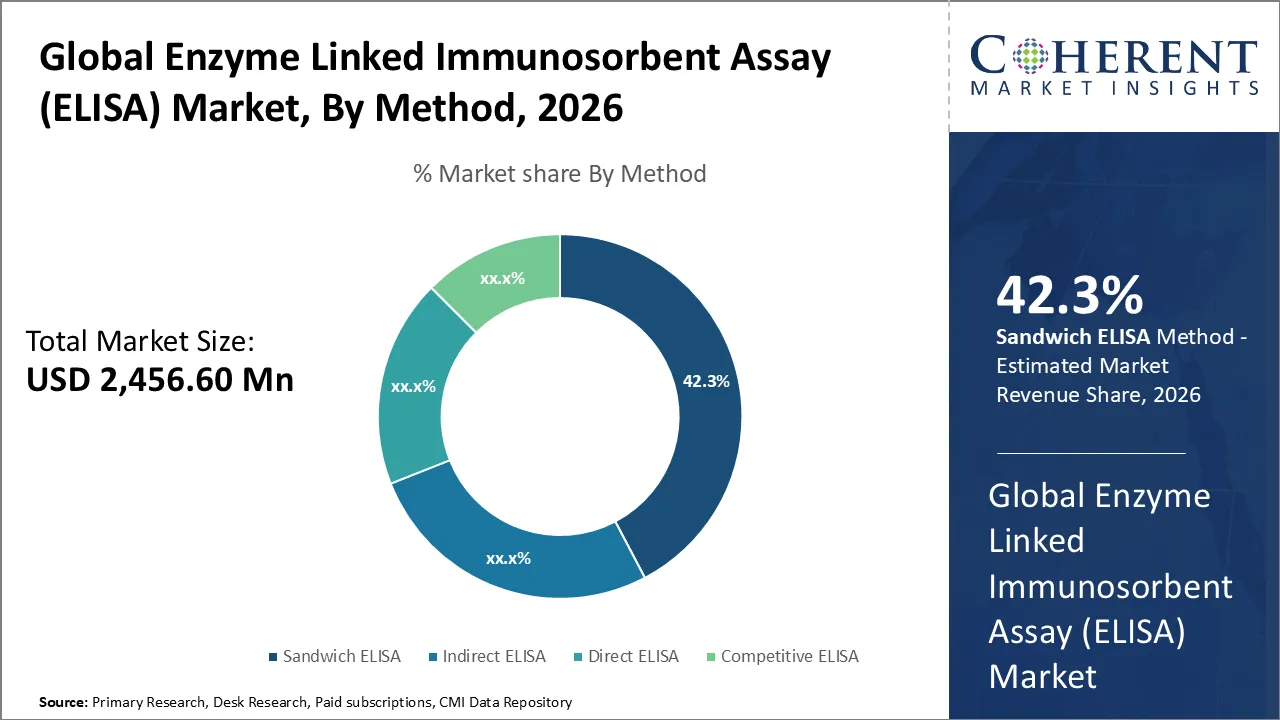
Enzyme Linked Immunosorbent Assay (ELISA) Market Insights, By Method: Sandwich ELISA is driven by its unmatched sensitivity and specificity for complex sample analysis
In terms of method, the sandwich ELISA segment is expected to dominate the market with 42.3% share in 2026, due to its superior sensitivity and specificity, making it ideal for detecting low-abundance proteins and complex biological samples. Its ability to reduce background noise and give accurate results has led to its widespread use in diagnostics, pharmaceutical research, and clinical labs, making it the most popular ELISA method.
For instance, in October 2025, ArcticZymes Technologies has launched the SAN HQ 2.0 ELISA Kit, a highly sensitive sandwich ELISA created to detect and quantify SAN HQ 2.0 enzyme during complex biomanufacturing processes, like viral vector production. With precision and accuracy, the kit supports customers in eliminating residual nucleic acids effectively.
Enzyme Linked Immunosorbent Assay (ELISA) Market Insights, By Application: Diagnostics dominance is driven by global demand for infectious disease, cancer, and autoimmune testing
In terms of application, the diagnostics segment is expected to hold 53.7% share in 2026, due to healthcare systems are using them increasingly to find infectious diseases, analyze cancer biomarkers, and monitor on autoimmune disorders. As the need for reliable, low-cost diagnostic tools grows around the world, ELISA has become a key technology in clinical testing and public health programs.
For instance, in January 2026, Creative Diagnostics has established ELISA kits with high sensitivity that can find antibiotic residues in the production of biologics. These kits improve safety and quality control by allowing for precise monitoring of contaminants during production. The new idea makes it easier for pharmaceutical companies to follow the rules and make sure that biologics are made in a reliable way with better diagnostic accuracy.
Enzyme Linked Immunosorbent Assay (ELISA) Market Insights, By Technology: Colorimetric dominates due to affordability, simplicity, and widespread laboratory adoption
In terms of technology, the colorimetric segment is projected to account for 57.8% share in 2026, because it is simple, affordable, and easy to understand. Laboratories worldwide prefer it for routine testing, as results can be visually assessed or measured with basic spectrophotometers. Colorimetric assays are still the most popular type of test since they are accessible and practical, even though chemiluminescent and fluorescent methods have improved.
For instance, in December 2025, The Mercodia announcement of the HNL Homodimer ELISA introduces a monoclonal-based sequential sandwich assay with colorimetric detection. This tool is made to measure the neutrophil-specific homodimeric form of Human Neutrophil Lipocalin. It helps with sepsis research and monitoring antibiotic response, and it works well and is easy to use in labs that do clinical and biomedical studies.
Regional Insights
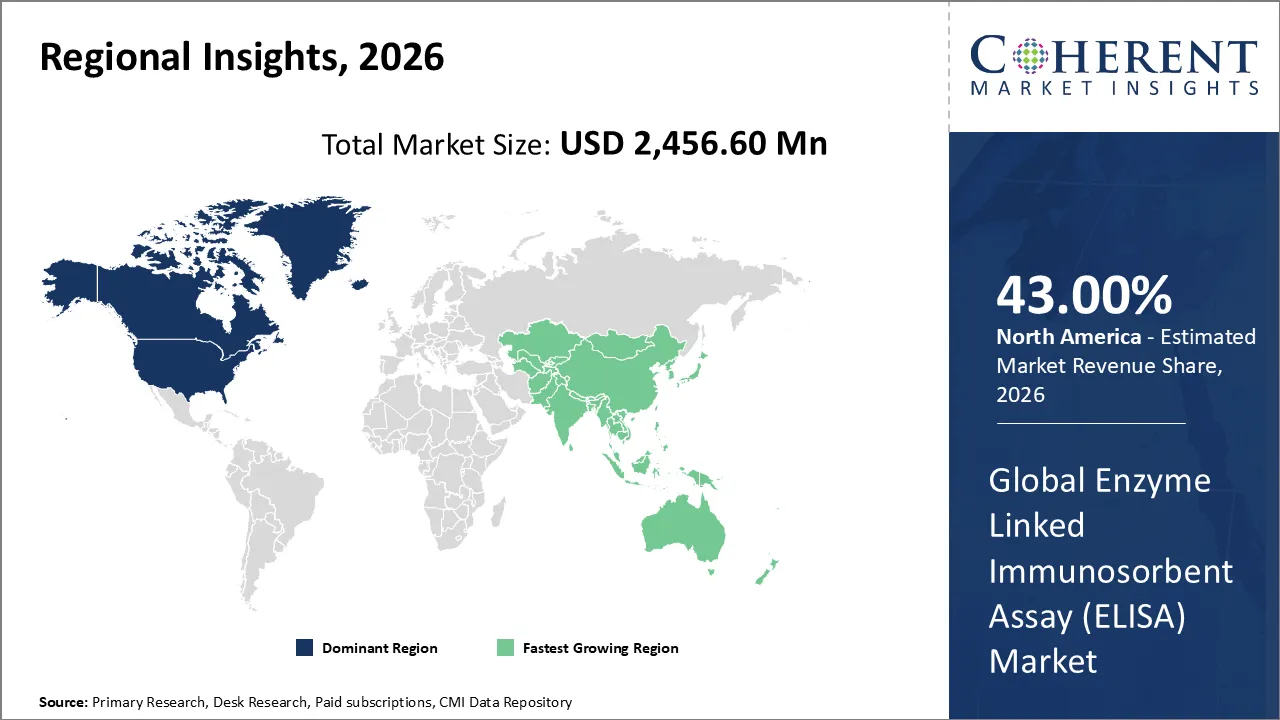
North America Enzyme Linked Immunosorbent Assay (ELISA) Market Analysis & Trends
North America continues to hold 43% of the market share due to its advanced healthcare infrastructure, strong presence of leading diagnostic companies, and high adoption of ELISA in clinical diagnostics and pharmaceutical R&D. The U.S. is especially significant because it investing heavily in biotechnology and drug development.
Asia Pacific Enzyme Linked Immunosorbent Assay (ELISA) Market Analysis & Trends
Asia-Pacific is expected to grow the fastest, due to rising healthcare costs, expanding diagnostic labs, and increasing awareness about the importance of early disease detection. China, India, and Japan are all spending heavily on modernizing their healthcare systems. This should speed up the use of ELISA.
For instance, in June 2025, The FAO started special training workshops in Tajikistan to improve the use of serological methods, such as ELISA, to diagnose brucellosis. The goal of these sessions is to improve disease detection, build the capacity of veterinarians and public health professionals, and support efforts in Central Asia to control zoonotic infections through better laboratory skills and modern diagnostic methods.
Enzyme Linked Immunosorbent Assay (ELISA) Market Outlook Country-Wise
Finland Enzyme Linked Immunosorbent Assay (ELISA) Market Trends
The Enzyme Linked Immunosorbent Assay (ELISA) Market in Finland is expected to be have strong demand in 2026 due to rising investments into biotechnology, healthcare infrastructure is getting better, and more attention is being paid to finding diseases early. Finland is becoming a key Nordic hub as more research and development is done in pharmaceuticals and diagnostics.
For instance, in June 2025, Nokia and Elisa have worked together to update networks in Finland and Estonia for the 5G Advanced era. The four-year deal will improve capacity, coverage, and speed, which will help Elisa's customers stay connected. This partnership makes both companies more important in getting next-generation mobile technology out into the world.
China Enzyme Linked Immunosorbent Assay (ELISA) Market Trends
In 2026, the ELISA market in China is extremely competitive because biotechnology is growing quickly, healthcare infrastructure is getting bigger, and personalized medicine is becoming more popular. Strong investments in diagnostics, vaccine development, and biomarker discovery drive adoption. The market size is expected to grow steadily, which is a sign of more clinical and research uses.
For instance, in October 2025, Chinese researchers created a nanoreactor that can both detect biomarkers and kill bacteria. It was excellent at finding dopamine and alpha-fetoprotein, and the results were compared to the clinical standard ELISA. This new idea shows that it could lead to better ways to diagnose and treat diseases, which would improve precision medicine and disease monitoring.
Market Report Scope
Enzyme Linked Immunosorbent Assay (ELISA) Market Report Coverage
| Report Coverage | Details | ||
|---|---|---|---|
| Base Year: | 2025 | Market Size in 2026: | USD 2,456.60 Mn |
| Historical Data for: | 2020 To 2024 | Forecast Period: | 2026 To 2033 |
| Forecast Period 2026 to 2033 CAGR: | 5.1% | 2033 Value Projection: | USD 3,476.00 Mn |
| Geographies covered: |
| ||
| Segments covered: |
| ||
| Companies covered: | Bio-Rad Laboratories, Inc., Enzo Life Sciences, Inc., Thermo Fisher Scientific, Inc., Biomerieux S.A., Alpco, BioLegand, Inc., R&D Systems, Creative Diagnostics, Zeus Scientific, Inc., and Shenzhen YHLO Biotech Co., Ltd. | ||
| Growth Drivers: |
| ||
| Restraints & Challenges: |
| ||
Enzyme Linked Immunosorbent Assay (ELISA) Market Driver
Rising prevalence of infectious and chronic diseases
As the number of infectious diseases like HIV and hepatitis and chronic diseases like cancer and autoimmune disorders rises, has significantly increased reliance on ELISA for accurate diagnosis. The Enzyme Linked Immunosorbent Assay (ELISA) Market share keeps growing as healthcare systems around the world put more emphasis on early detection and monitoring. ELISA is an essential tool in clinical diagnostics because it can provide sensitive, reliable, and cost-effective results. This has led to its widespread use in hospitals, labs, and research institutions.
Expansion of drug development and quality control
Increasingly, drug discovery, therapeutic monitoring, and product safety validation depend on ELISA for pharmaceutical and biotech companies. The assay is extremely helpful for finding proteins, antibodies, and hormones, which makes it an important part of research and development (R&D) pipelines and quality assurance (QA) processes. As companies seek out for strong tools to accelerate innovation and follow the rules, the Enzyme Linked Immunosorbent Assay (ELISA) Market is growing. ELISA is still a key part of modern drug development, and its uses are growing in biologics and personalized medicine.
Enzyme Linked Immunosorbent Assay (ELISA) Market Opportunity
Personalized Medicine and Biomarker Discovery
As personalized medicine becomes more important, ELISA is finding new ways to identify biomarkers and make diagnoses that are specific to each patient. As healthcare moves toward more precise treatments, ELISA's ability to monitor efficiency of treatments are working and customize them for each patient becomes essential. This trend is likely to accelerate new ideas and make them more widely used in both research and clinical settings. The Enzyme Linked Immunosorbent Assay (ELISA) Market forecast predicts strong growth, driven by it is becoming more important in precision healthcare and drug development based on biomarkers.
Analyst opinion (Expert Opinion)
The enzyme-linked immunosorbent assay (ELISA) market value continues to expand, anchored by its widespread utility, like diagnostics, biomedical research, and drug development. Following its high sensitivity and specificity, ELISA is the best way to measure antibodies, antigens, proteins, and hormones in both clinical and research settings. Industry segmentation shows that ELISA kits and reagents are in high demand due to they are used repeatedly in routine testing and analytical workflows. ELISA readers and washers, on the other hand, bring strong investment for instruments as laboratories grow and become more automated. Sandwich ELISA is still the most popular format because it is very reliable and can be used to find many different types of biomarkers. Competitive, indirect, and direct ELISA formats continue to have important uses, especially in drug monitoring and specialized testing.
Application analysis shows that ELISA is very important for screening for infectious diseases, studying biomarkers for cancer, evaluating autoimmune disorders, and doing endocrinology assays. Toxicology and protein quantitation continue to be important for academic and industrial research. Hospitals, diagnostic labs, drug and biotech companies, and contract research organizations are the main end users of ELISA. This shows that it is important for both patient diagnostics and drug development.
The data-driven path of the ELISA market shows that it will always be important as a basic part of immunodiagnostic testing and quantitative biological analysis. New assay formats and the digitization of labs are also changing the way the market works.
Speak to the analyst
Want personalized insights?
Take the findings above to one of our principal consultants, or have the report rebuilt around the segments, geographies and competitors you actually track.
Global Enzyme Linked Immunosorbent Assay (ELISA) Market: Key Development
- In October 2025, AMSBIO released QuicKey Pro™ one-step ELISA kits, which make tests easier by only needing one wash and one sample. Compared to regular ELISA, these kits reduce on experiment time by 1 to 2 hours while keeping sensitivity and specificity. They work with both competitive and sandwich formats, and they can find analytes in complicated biological samples with high accuracy.
- In May 2025, The IDS i20™ platform is a fully automated ELISA testing system that EUROIMMUN, a part of Revvity's diagnostics arm, has released. It has a CE mark and is listed by the FDA. It can process up to 140 tests per hour in six different areas. It improves the efficiency, scalability, and accuracy of clinical diagnostics by allowing for continuous loading, reagent cooling, and advanced software.
Market Segmentation
- By Method
- Direct ELISA
- Indirect ELISA
- Sandwich ELISA
- Competitive ELISA
- By Application
- Vaccine Development
- Immunology
- Diagnostics
- Toxicology
- Drug Monitoring & Pharmaceutical Industry
- Transplantation
- By Technology
- Chemiluminescent
- Colorimetric
- Fluorescent
- By Region
- North America
- U.S.
- Canada
- Latin America
- Brazil
- Argentina
- Mexico
- Rest of Latin America
- Europe
- Germany
- U.K.
- Spain
- France
- Italy
- Russia
- Rest of Europe
- Asia Pacific
- China
- India
- Japan
- Australia
- South Korea
- ASEAN
- Rest of Asia Pacific
- Middle East & Africa
- GCC Countries
- Israel
- Rest of Middle East & Africa
- North America
- Key Players
- Bio-Rad Laboratories, Inc.
- Enzo Life Sciences, Inc.
- Thermo Fisher Scientific, Inc.
- Biomerieux S.A.
- Alpco, BioLegand, Inc.
- R&D Systems
- Creative Diagnostics
- Zeus Scientific, Inc.
- Shenzhen YHL.
Sources
Primary Research Interviews
- ELISA Kit Manufacturers
- Diagnostic Reagent & Antibody Suppliers
- Clinical Laboratory Directors & Pathologists
- Hospital Procurement Managers
- Biotechnology & Pharmaceutical R&D Executives
- Contract Research Organizations (CROs)
- Academic Research Scientists (Immunology & Molecular Biology)
- Others
Databases
- Bloomberg Terminal
- Thomson Reuters Eikon
- S&P Global Market Intelligence
- IQVIA Database
- GlobalData Healthcare
- Frost & Sullivan
- Factiva
- Others
Magazines
- Clinical Lab Products Magazine
- Diagnostics World News
- BioPharm International
- Genetic Engineering & Biotechnology News (GEN)
- Laboratory Equipment Magazine
- Contract Pharma
- Others
Journals
- Journal of Immunological Methods
- Clinical Chemistry
- Journal of Clinical Microbiology
- Analytical Biochemistry
- Nature Biotechnology
- The Lancet Diagnostics
- Others
Newspapers
- The Wall Street Journal
- Financial Times
- Reuters
- Bloomberg News
- Business Standard
- The Economic Times
- Others
Associations
- American Association for Clinical Chemistry (AACC)
- Clinical & Forensic Toxicology Association (SOFT)
- Biotechnology Innovation Organization (BIO)
- European Federation of Clinical Chemistry and Laboratory Medicine (EFLM)
- Indian Association of Medical Microbiologists (IAMM)
- Others
Public Domain Sources
- World Health Organization (WHO)
- U.S. Food & Drug Administration (FDA)
- Centers for Disease Control and Prevention (CDC)
- National Institutes of Health (NIH)
- European Medicines Agency (EMA)
- OECD Health Statistics
- Others
Proprietary Elements
- CMI Data Analytics Tool
- Proprietary CMI Existing Repository of Information for the Last 8 Years
Get access to 250+ pages report
Every segment, forecast, competitor profile and data table behind the analysis above — available for instant download.
- ESOMAR Member
- ISO 9001:2015 Certified
- D-U-N-S Registered
- GDPR & CCPA Compliant
Missing comfort of reading report in your local language? Find your preferred language:
Transform your Strategy with Exclusive Trending Reports
Frequently Asked Questions
The global Enzyme Linked Immunosorbent Assay (ELISA) Market size was valued at USD 2,456.60 Mn in 2026 and is expected to reach USD 3,476.00 Mn in 2033.
Rising prevalence of infectious and chronic diseases and expansion of drug development and quality control are major factors driving the market growth.
Sandwich ELISA is the leading method segment in the market.
The major factors hampering growth of the market include high cost of advanced ELISA kits and instruments.
Major players operating in the market include Bio-Rad Laboratories, Inc., Enzo Life Sciences, Inc., Thermo Fisher Scientific, Inc., Biomerieux S.A., Alpco, BioLegand, Inc., R&D Systems, Creative Diagnostics, Zeus Scientific, Inc., and Shenzhen YHLO Biotech Co., Ltd.