

Pyrogen Testing Market Size and Share Analysis: (2026 - 2033)
The Pyrogen Testing Market is estimated to be valued at USD 1.47 Bn in 2026 and expected to reach USD 2.89 Bn by 2033, witnessing a CAGR of 10.1% over the forecast period (2026-2033), driven by rising demand for safe biologics, vaccines, and stringent regulatory requirements in pharmaceutical manufacturing.
Key Takeaways
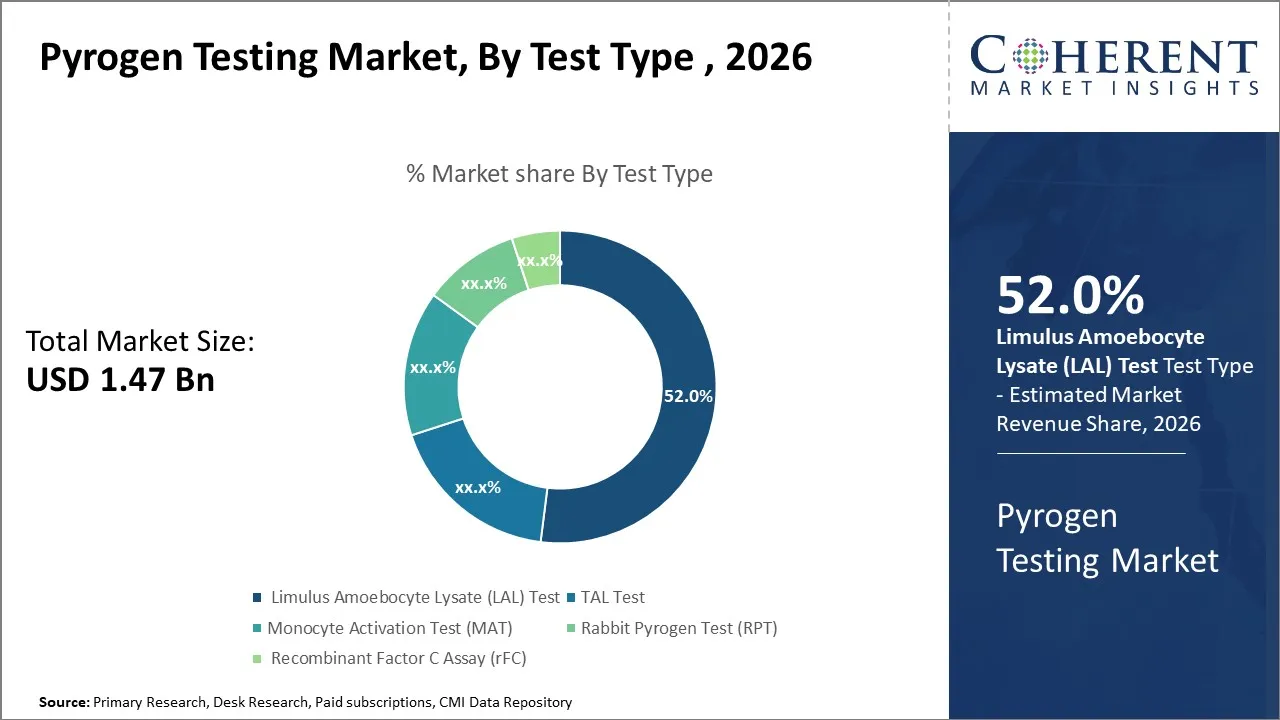
- Based on Test Type, the Limulus Amebocyte Lysate (LAL) segment is the dominant segment with 52% share of the market in 2026.
- Based on Product Type, the consumables segment is expected to lead the market with 60% share in 2026.
- Based on End User, the minor pharmaceutical and biotechnology companies segment is expected to lead the market with 48% share in 2026.
- Based on Region, North America region is expected to hold 38% share of the market in 2026.
Market Overview
Pyrogen testing is key to protecting patient’s safety (Drs/Docs) from toxic temp. Furthermore, testing is required for developing/approving regulated products due to the potential to cause illness or other issues. Tests employed include LAL, rFC, IPT, however, LAL is the preferred method as it has been established as the standard method across the industry due to its established reliability and acceptance with regulators (FDA/EMA). However, as there is increasing interest in eco-friendly test methods utilizing synthetic biology and bioreactors, the use of LAL is decreasing.
Application for pyrogen testing typically include injectables, vaccines, implants and CGT. Due to the growing interest in biologics/ biosimilars, pyrogen testing will also be required to comply with current standards established by agencies worldwide. Therefore, the use and demand for pyrogen testing continues to increase. However, the increase in usage/demand has increased over the last few years due to the increase in investment in the area of R&D, the significant increase in the production of biologics, and continued emphasis on patient safety and quality assurance.
Current Events and their Impacts on the Pyrogen Testing Market
Current Event | Description and its Impact |
Expansion of biologics manufacturing |
|
Shift to Non-Animal Testing Options |
|
New FDA and EMA Regulations |
|
Segmental Insights
- Current Industry Events of 2026
- Market Size Estimation
- Regional Breakdown
- Competitive Landscape
- Customer Intelligence
- Segmental Analysis
- Pricing Analysis
- Key Market Drivers, Challenges & Future Trends
- Customized Insights Section
Pyrogen Testing Market Insights, By Test Type - Limulus Amebocyte Lysate (LAL) segment is the dominant segment
The Limulus Amebocyte Lysate (LAL) test remains the most common form of pyrogen testing due to its extreme sensitivity regarding the detection of endotoxins and for having strong regulatory approval globally. It is extensively used within the pharmaceutical industry for injectable drugs as well as for biological products. The reliability and cost-effectiveness of the LAL method make it continue to dominate this market despite the ethical concerns over animal testing.
On January 22, 2025, Lonza group AG introduced an upgraded version of its LAL assay platform with enhanced sensitivity and reduced interference from complex biologics.
Pyrogen Testing Market Insights, By Product Type - The Consumables segment is the dominant segment.
Consumables are the largest portion of product type because they are repeat purchase used regularly in laboratories and for manufacturing. This category consists of reagents, assay kits and cartridges, all of which are required for each test cycle conducted. With the increasing volume of products being manufactured in the pharmaceutical industry, there is also an increasing demand for consumables making them an ongoing source of revenue.
Pyrogen Testing Market Insights, By End user - The pharmaceutical and biotechnology companies’ segment is the dominant segment
Pharmaceutical and biotechnology companies are the major portion of the end-user segment for pyrogen testing products because they utilize this type of testing extensively throughout the development process, in clinical trials and during manufacturing. The increase in the production of biologics, vaccines and biosimilars has further contributed to the increasing need for robust pyrogen testing methodologies.
Regional Insights
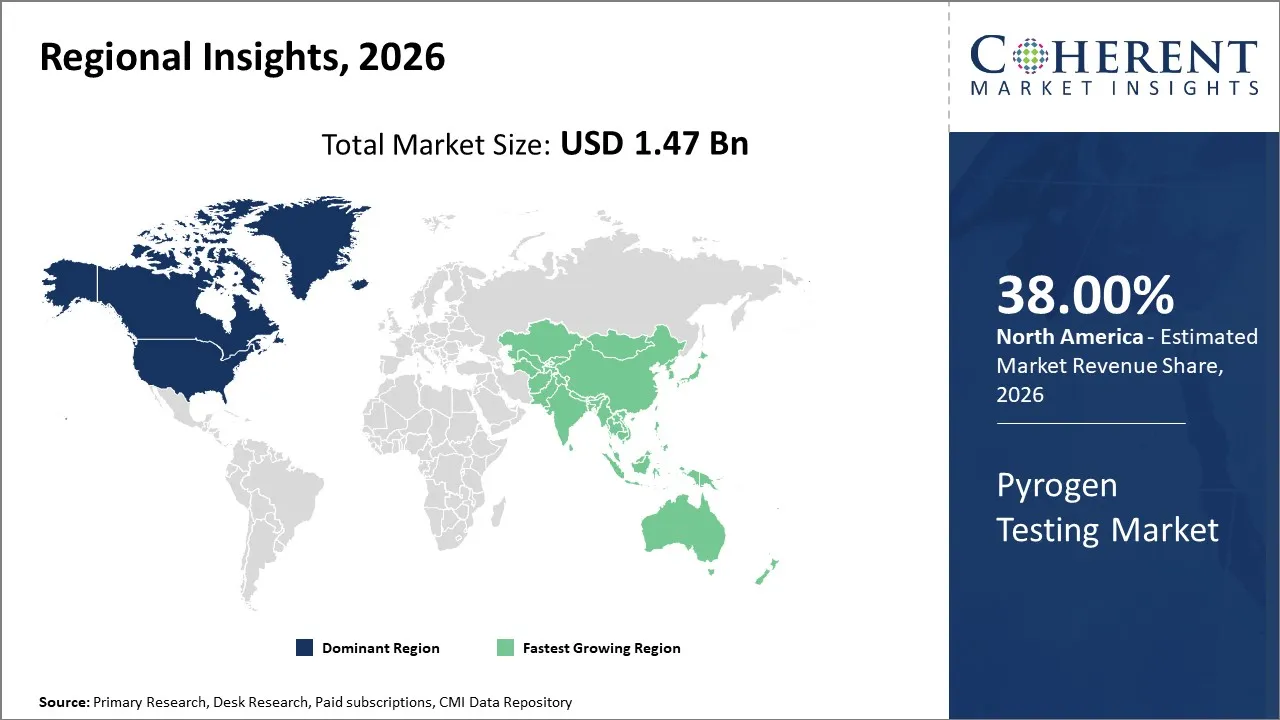
North America Remains at the Epicenter of Market with approximately 38% of the market Share
North America leads the market with 38% in 2026 and this is due to its very highly regulated environment for pharmaceuticals, advanced capabilities for biologics manufacturing, and large numbers of leading players in this space.
- United States: The US has largest share in North American market. This is driven by the presence of many of the largest and most powerful pharmaceutical and biotechnology companies, as well as by large amounts of research & development investment.
- Canada: The Canadian market is growing steadily with increased levels of clinical research activity, coupled with new biologics manufacturing facilities. There has also been government support and funding in the life sciences are to help grow the pyrogen testing market in Canada.
Asia Pacific remains the Fastest-Growing Region of Market
Asia Pacific will be the area with the highest growth in the pyrogen testing industry. Factors contributing to this growth include a boom in pharmaceutical manufacturing, an increase in drug manufacturing by third parties, and greater adoption of international quality standards.
- China: China is emerging as a major part of this growth because of the size of its pharmaceutical manufacturing base, government support for biotechnology innovation, and greater compliance with international regulatory frameworks, all of which will increase the need for state-of-the-art pyrogen testing capabilities.
- India: the growth in India is driven in part by the country’s emergence as a global leader in generic drug manufacturing and contract manufacturing. The large influx of USFDA registered facilities and the increase in production of biological drugs will create an ever-increasing need for dependable pyrogen testing solutions.
Market Report Scope
Pyrogen Testing Market Report Coverage
| Report Coverage | Details | ||
|---|---|---|---|
| Base Year: | 2025 | Market Size in 2026: | USD 1.47 Bn |
| Historical Data for: | 2020 To 2024 | Forecast Period: | 2026 To 2033 |
| Forecast Period 2026 to 2033 CAGR: | 10.1% | 2033 Value Projection: | USD 2.89 Bn |
| Geographies covered: |
| ||
| Segments covered: |
| ||
| Companies covered: | Thermo Fisher Scientific, Merck KGaA, Lonza Group, Associates of Cape Cod Inc., Charles River Laboratories Inc., GenScript, WuXi PharmaTech (Cayman), Inc., bioMérieux, Wako Chemicals USA, Inc., Sanquin, Ellab A/S, and Pyrostar | ||
| Growth Drivers: |
| ||
Pyrogen Testing Market Driver
Biologic and Vaccine Development on the rise
The rising development and commercialization of biologics and vaccines requires more rigorous safety testing to ensure products are not contaminated with pyrogens. The growing worldwide emphasis on immunizing individuals and providing advanced therapies will continue to increase the need for reliable pyrogen testing solutions.
Strict Regulatory Requirements
Regulatory authorities require strict testing for endotoxins in injectable drugs and medical devices. Pharmaceutical manufacturers are therefore required to comply with these requirements by adopting newer testing methodologies, creating a steady demand for the product in the market.
Pyrogen Testing Market Opportunity
Adoption of recombinant and Animal-free testing methods
Adopting an ethical and sustainable approach to laboratory testing will create immense growth opportunities in this industry through recombinant factor C testing. R-FCC is a logical substitute for the traditional Limulus Amebocyte Lysate (LAL) assays, meeting all relevant US & European regulatory and environmental requirements.
Analyst Opinion (Expert Opinion)
- Due to an increasing amount of growth occurring in the global biologics sector, the pyrogen testing market will see continued growth driven by an evolving organization shift to recombinant vs in vito methods, we can expect the competitive landscape to change. Companies that focus on automation, sustainability and integration of AI into their business practices will likely have an advantage in the near term.
Speak to the analyst
Want personalized insights?
Take the findings above to one of our principal consultants, or have the report rebuilt around the segments, geographies and competitors you actually track.
Pyrogen Testing Market News
- On January 22, 2025, Lonza Group AG launched an upgraded LAL assay system to enhance endotoxin detection sensitivity in biologics manufacturing.
Market Segmentation
- Global Pyrogen Testing Market, By Test Type
- Limulus Amoebocyte Lysate (LAL) Test
- TAL Test
- Monocyte Activation Test (MAT)
- Rabbit Pyrogen Test (RPT)
- Recombinant Factor C Assay (rFC)
- Global Pyrogen Testing Market, By Product Type
- Instruments
- Kits
- Reagents
- Global Pyrogen Testing Market, By End User
- Pharmaceutical and Biotech Companies
- Food and Beverages Companies
- Others
- Global Pyrogen Testing Market, By Region
- North America
- U.S.
- Canada
- Latin America
- Brazil
- Mexico
- Argentina
- Rest of Latin America
- Europe
- Germany
- U.K.
- France
- Italy
- Spain
- Russia
- Rest of Europe
- Asia Pacific
- China
- India
- Japan
- Australia
- South Korea
- ASEAN
- Rest of Asia Pacific
- Middle East
- GCC
- Israel
- Rest of Middle East
- Africa
- South Africa
- Central Africa
- North Africa
- North America
- Key Players
- Thermo Fisher Scientific,
- Merck KGaA,
- Lonza Group,
- Associates of Cape Cod Inc,
- Charles River Laboratories Inc,
- GenScript,
- WuXi PharmaTech (Cayman), Inc,
- bioMerieux,
- Wako Chemicals USA, Inc,
- Sanquin, Ellab A/S,
- Pyrostar
Sources
Primary Research Interviews
- Quality control managers and laboratory heads from pharmaceutical and biotechnology companies
- Regulatory affairs specialists involved in endotoxin and pyrogen testing compliance
- R&D scientists working in microbiology and analytical testing
- Contract research organization (CRO) professionals specializing in sterility and pyrogen testing
- Medical device manufacturers’ quality assurance personnel
Databases
- U.S. Food and Drug Administration (FDA) database
- European Medicines Agency (EMA) database
- World Health Organization (WHO) database
- National Center for Biotechnology Information (NCBI)
- PubMed
- ClinicalTrials.gov
Magazines
- Pharmaceutical Technology
- BioPharm International
- Drug Discovery & Development
- European Pharmaceutical Review
Journals
- Journal of Pharmaceutical Sciences
- American Journal of Clinical Pathology
- Journal of Endotoxin Research
- PDA Journal of Pharmaceutical Science and Technology
Newspapers
- The Economic Times
- The Wall Street Journal
- Financial Times
- The Hindu
Associations
- Parenteral Drug Association
- International Society for Pharmaceutical Engineering
- American Society for Microbiology
- Regulatory Affairs Professionals Society
Public Domain sources
- Government health department publications and guidelines
- Regulatory guidelines such as pharmacopeias (USP, EP, JP)
- Company annual reports and investor presentations
- Academic publications and university research papers
- Open-access scientific repositories
Proprietary Elements
- CMI Data Analytics Tool
- Proprietary CMI Existing Repository of Information for the Last 8 Years
Get access to 250+ pages report
Every segment, forecast, competitor profile and data table behind the analysis above — available for instant download.
- ESOMAR Member
- ISO 9001:2015 Certified
- D-U-N-S Registered
- GDPR & CCPA Compliant
Missing comfort of reading report in your local language? Find your preferred language:
Transform your Strategy with Exclusive Trending Reports
Frequently Asked Questions
The Pyrogen Testing Market is estimated to be valued at USD 1.47 Bn in 2026 and expected to reach USD 2.89 Bn by 2033, witnessing a CAGR of 10.1% over the forecast period (2026-2033)
Pyrogen testing determines the presence of contaminants in medical devices or drugs that can cause fever. Pyrogen testing plays an important role in both ensuring patient safety and meeting the regulatory requirements for manufacturing drugs.
The Limulus Amebocyte Lysate (LAL) test is the main pyrogen test on the market, because it has the highest sensitivity of any method of testing for pyrogens and is also the most widely accepted by regulatory agencies.
There are three major factors that are contributing to the growth of the pyrogen testing market, the increase in the number of biologics being manufactured, strict regulatory requirements, and patient safety have all driven demand for advanced testing solutions.
North America is the leader in the pyrogen testing market largely due to large number of biotechnology companies in the region and strong regulatory requirements for drug manufacturing.
Some of the major trends for the future of the pyrogen testing market will be the adoption of recombinant methods of testing, the integration of artificial intelligence into testing processes, and the expansion of testing services into emerging markets.