

Blood Irradiation Market Size and Forecast – 2026 to 2033
The Ocular Surgery Market is anticipated to grow at a CAGR of 5.8% with USD 77.3 Mn in 2026 and is expected to reach USD 113.4 Mn in 2033. Rising blood transfusion volumes, increasing cancer and hematological disorders, and greater awareness of transfusion-associated graft-versus-host disease prevention are driving the Blood Irradiation Market. Approximately 900,000 people develop blood clots each year, resulting in around 100,000 related deaths annually.
Key Takeaways
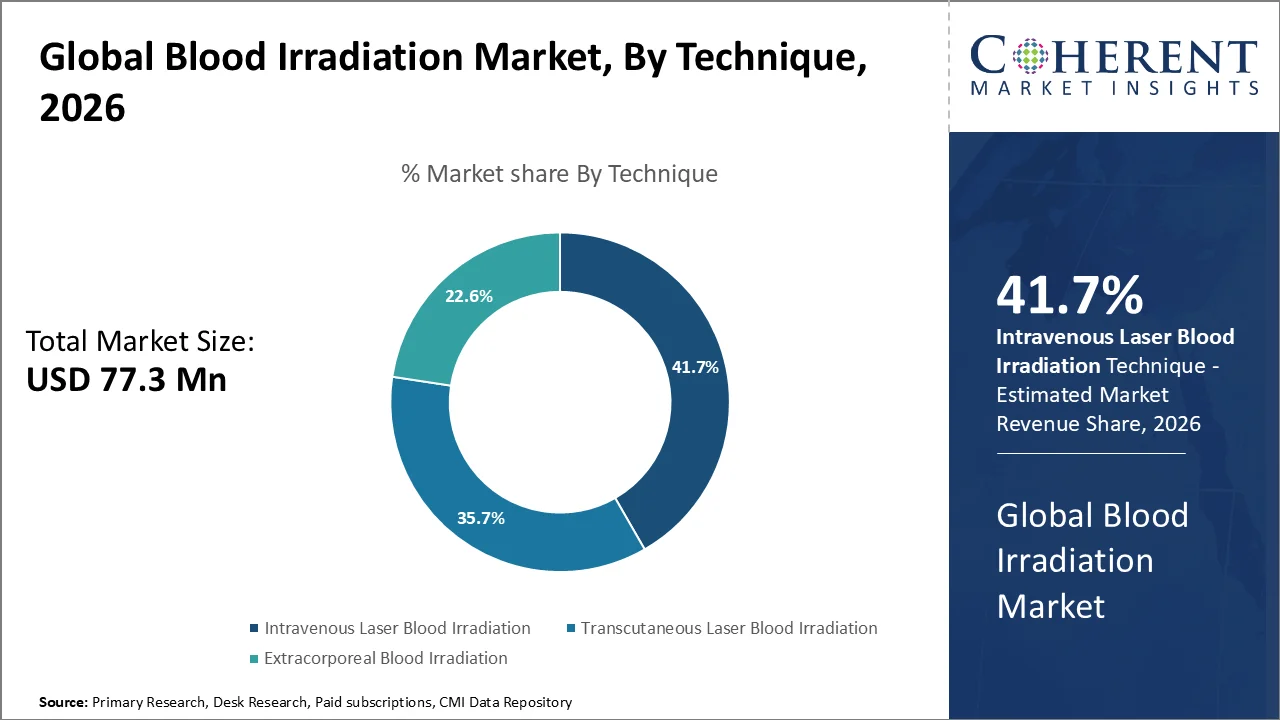
- Intravenous Laser Blood Irradiation hold the largest market share of 41.7% in 2026 owing to its growing burden of chronic diseases. About 60% of Americans live with at least one chronic disease, contributing to substantial health and economic burdens.
- Hospitals expected to hold largest market share of 38.8% in 2026 owing to the rising number of hematology and oncology patients. Global cancer cases are projected to increase by 67%, reaching approximately 34–35 Mn new cases annually by 2050.
- North America is expected to acquire the dominant share of 42.6% in 2026 owing to the strong blood transfusion infrastructure. Approximately 29,000 units of red blood cells are required daily in the U.S., with nearly 16 Mn blood components transfused each year.
Current Events and Their Impact on the Blood Irradiation Market
Current Event | Description and its Impact |
U.S. FDA proposes formal classification of blood irradiators — March 2026 |
|
FDA proposes Class III/PMA pathway for blood irradiators intended to prevent metastasis — March 2026 |
|
Segmental Insights
- Current Industry Events of 2026
- Market Size Estimation
- Regional Breakdown
- Competitive Landscape
- Customer Intelligence
- Segmental Analysis
- Pricing Analysis
- Key Market Drivers, Challenges & Future Trends
- Customized Insights Section
Why is Intravenous Laser Blood Irradiation Acquiring the Largest Market Share?
Intravenous Laser Blood Irradiation hold the largest market share of 41.7% in 2026. The Intravenous Laser Blood Irradiation (ILIB) segment continues to grow as healthcare providers explore photobiomodulation to manage chronic and inflammatory conditions and meet demand for minimally invasive therapies. Researchers report that ILIB may improve blood rheology, oxygen-carrying capacity, immune function, inflammation, oxidative stress, pain, and quality of life. Healthcare providers are also exploring ILIB across cardiovascular, neurological, respiratory, metabolic, and musculoskeletal applications. Ongoing technological advancements and expanding clinical research further encourage adoption, while researchers continue to address the need for standardized protocols and stronger clinical evidence. For instance, in September 2026, Hong Kong-based sleep-tech company Neuro Flow Labs launched a Kickstarter sleep wearable for insomnia that uses 650-nanometer laser irradiation targeting the carotid artery to support metabolism and blood microcirculation.
Which End User segment dominates the market?
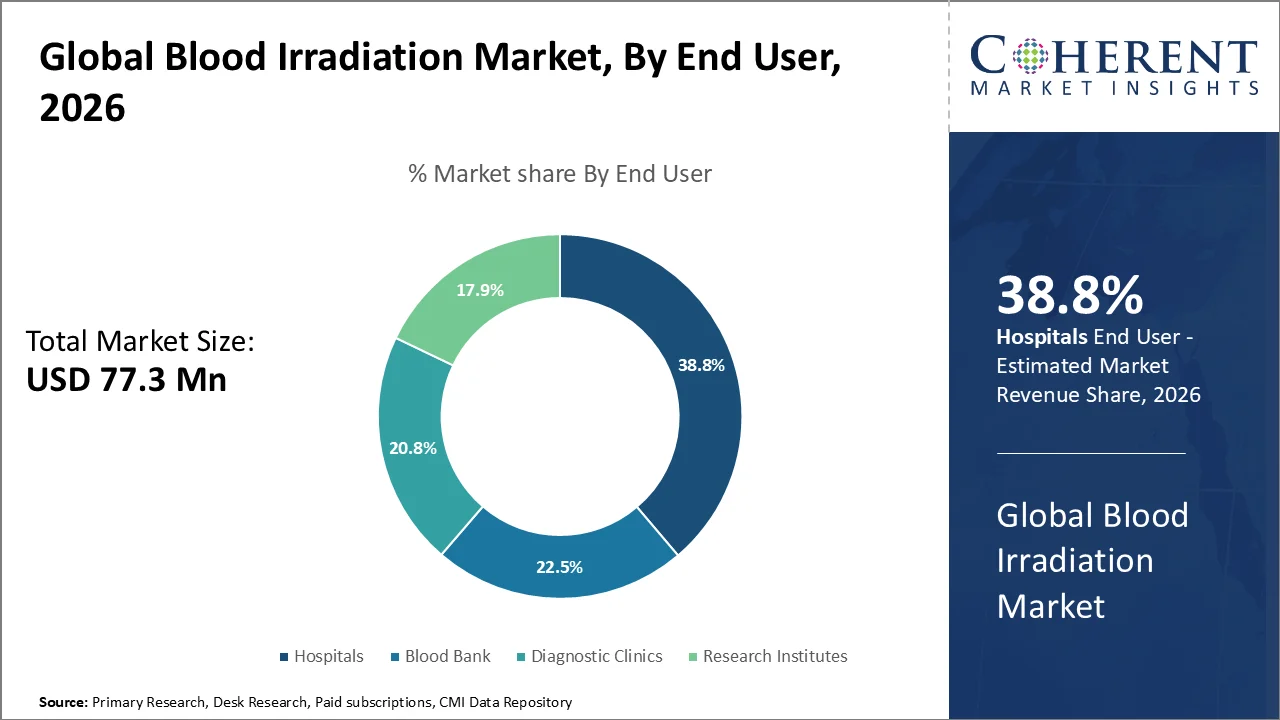
Hospitals expected to hold largest market share of 38.8% in 2026. Hospitals strengthen the Blood Irradiation Market as oncology, hematology, and transplant centers increasingly prioritize safe transfusion practices. Growing use of hematopoietic stem-cell transplantation, immunosuppressive therapies, and treatments for immune disorders increases the demand for irradiated blood components. Approximately 10% of the global population is affected by autoimmune disorders, with their prevalence and incidence continuing to increase worldwide. Healthcare facilities use blood irradiation to reduce the risk of transfusion-associated graft-versus-host disease among vulnerable patients. The expansion of specialized hospitals, advanced transfusion services, and standardized clinical guidelines further encourages hospitals to adopt blood irradiation technologies and improve transfusion safety and management.
Blood Irradiation Market Trends
- X-ray technology is gaining attention as an alternative to gamma irradiation: The UK Joint Professional Advisory Committee (JPAC) recognizes X-ray irradiation as an alternative to traditional gamma irradiation. Its position statement notes that available evidence indicated that gamma and X-ray irradiation at an equivalent dose are likely to have similar biological effects.
- Rising cancer incidence is an important underlying demand driver: According to the International Agency for Research on Cancer (IARC), there were approximately 20 million new cancer cases and 9.7 million cancer deaths globally in 2022. IARC projects that annual new cancer cases could reach 35 million by 2050, representing an approximately 77% increase compared with 2022. The growing population of patients requiring intensive cancer treatment and transfusion support creates a larger potential population requiring specialized blood components.
- Blood-component safety and quality assurance remain global priorities: WHO's Global Status Report on Blood Safety and Availability 2025, published in June 2026, is based on data from 168 countries and assesses blood collection, component preparation, transfusion practices, haemovigilance, regulation, and quality assurance. The report identifies continuing gaps in blood safety, availability, and equitable access, particularly in low- and middle-income countries.
Regional Insights
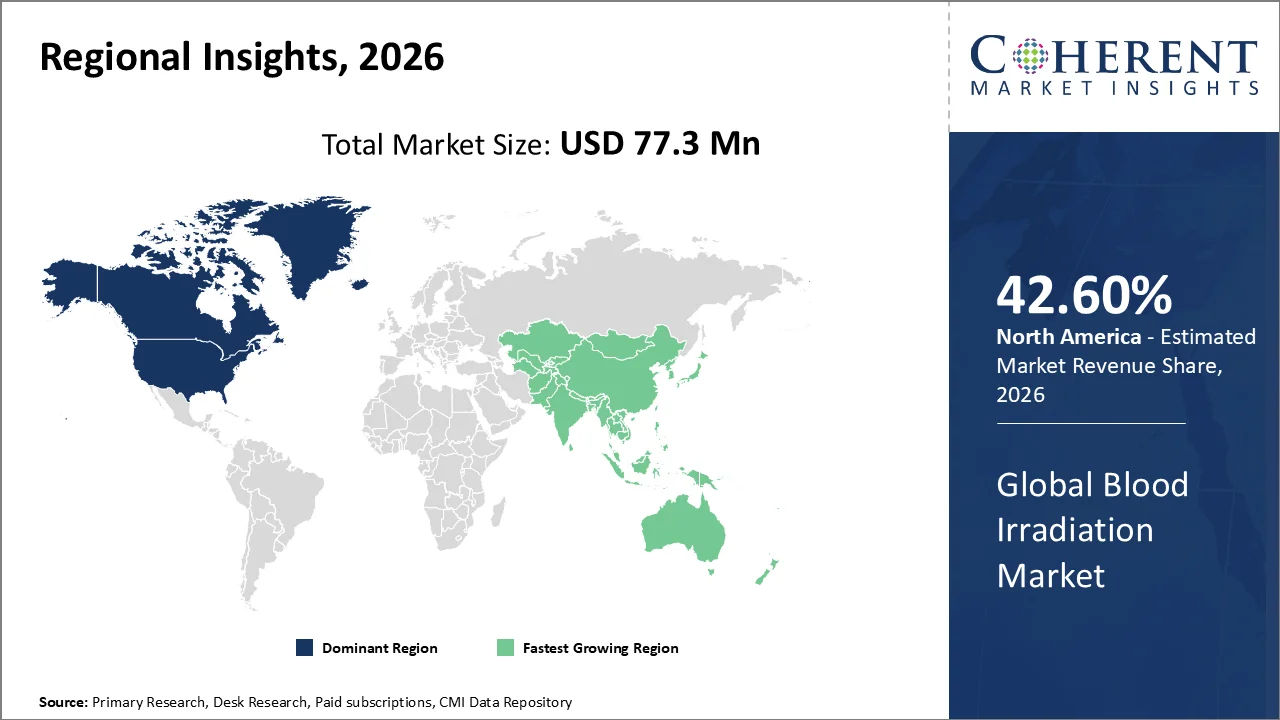
North America dominates owing to greater emphasis on transfusion safety
North America is expected to acquire the dominant share of 42.60% in 2026. North America strengthens the Blood Irradiation Market through its advanced healthcare infrastructure, strong demand for blood transfusions, and emphasis on transfusion safety. The region’s expanding oncology, hematology, and transplantation services increase demand for irradiated blood components among high-risk patients. Hospitals and blood centers adopt advanced irradiation technologies to help prevent transfusion-associated graft-versus-host disease. Supportive regulatory frameworks, growing healthcare investments, established blood banking networks, and continuous technological innovation further encourage healthcare providers to implement blood irradiation technologies across the region. Neurocode USA launched ALZpath Dx, a blood test that measures pTau217 to support Alzheimer’s disease screening, diagnosis, and monitoring.
Asia Pacific Blood Irradiation Market Trends
The Asia Pacific blood irradiation market is expanding as cancer, leukemia, lymphoma, and other chronic diseases increase the need for regular blood transfusions. An aging and immunocompromised population is also driving demand for safer transfusion practices. India’s population aged 60 years and above is estimated at approximately 153 million, with the number projected to increase to around 347 million by 2050. Healthcare providers are increasing investments in advanced infrastructure, while governments are strengthening blood safety systems. Hospitals and blood banks are adopting irradiation technologies as surgical procedures, trauma cases, and awareness of transfusion-related complications continue to rise across the region. The Indian Pharmacopoeia Commission (IPC) launched sensitisation programmes and webinars to train blood-centre officials, strengthen compliance, and promote adherence to national and international quality standards.
United States Blood Irradiation Market Trends
The United States blood irradiation market benefits from healthcare providers’ strong focus on transfusion safety and prevention of transfusion-associated graft-versus-host disease (TA-GVHD). FDA regulations also encourage hospitals and blood banks to adopt reliable irradiation practices for blood products. Growing demand for safer blood components across hospitals, transplant centers, oncology facilities, and blood banks further supports market growth. Manufacturers continue to improve irradiation equipment, quality-control systems, and dose-monitoring technologies, while the country’s established transfusion infrastructure sustains demand for dependable blood irradiation solutions. Philips Healthcare launched a limited release of a light-based catheter guidance system for cath labs, initially targeting endovascular aortic procedures and advancing radiation-free interventional imaging.
Japan Blood Irradiation Market Trends
Japan’s blood irradiation market grows as healthcare providers prioritize transfusion safety and prevent transfusion-associated graft-versus-host disease (TA-GVHD). Japanese guidelines recommend irradiating blood components, except fresh frozen plasma, which supports steady clinical demand. The Japanese Red Cross supplies irradiated blood products nationwide, strengthening adoption. Increasing healthcare needs, ongoing transfusion procedures, advances in transfusion medicine, and strict regulatory requirements encourage hospitals to adopt reliable irradiation practices and enhance patient safety.
Who are the Major Companies in Blood Irradiation Industry
Some of the major key players in Blood Irradiation are Typenex Medical, UVLrx Therapeutics, Best Theratronics, Hitachi Medical Systems, Actemium NDT-PES, Rad Source Technologies, and Gilardoni S.p.A.
Key News
- In June 2026, Birat Medical College in Biratnagar launched Nepal’s first irradiated blood service, providing specially treated blood for cancer patients, transplant recipients, and people with severe health conditions.
Market Report Scope
Blood Irradiation Market Report Coverage
| Report Coverage | Details | ||
|---|---|---|---|
| Base Year: | 2025 | Market Size in 2026: | USD 77.3 Mn |
| Historical Data for: | 2020 To 2024 | Forecast Period: | 2026 To 2033 |
| Forecast Period 2026 to 2033 CAGR: | 5.8% | 2033 Value Projection: | USD 113.4 Mn |
| Geographies covered: |
| ||
| Segments covered: |
| ||
| Companies covered: | Typenex Medical, UVLrx Therapeutics, Best Theratronics, Hitachi Medical Systems, Actemium NDT-PES, Rad Source Technologies, and Gilardoni S.p.A. | ||
Analyst Opinion
- Blood irradiation is not a discretionary safety upgrade; it is a critical transfusion safeguard. TA-GVHD occurs in fewer than 1 case per million transfusions, yet its fatality rate exceeds 90%, making prevention commercially and clinically compelling despite the condition’s rarity.
- Japan represents one of the strongest examples of institutionalized blood irradiation. The Japanese Red Cross supplies irradiated whole blood, red blood cell, and platelet products, using X-ray irradiation at 15–50 Gy to prevent TA-GVHD. Importantly, Japan has reported no confirmed cases of TA-GVHD since irradiated blood products entered clinical supply in 1998, reinforcing the effectiveness of this safety-focused approach.
- The market’s next competitive battleground is technology and workflow efficiency, not awareness. Japan already integrates irradiation directly into blood-product manufacturing, while its reimbursement framework separately recognizes blood irradiation procedures at 110 points for volumes up to 400 mL, with additional units calculated for larger volumes. This institutional integration strongly favors reliable, automated irradiation systems that can support high-throughput transfusion services without compromising product quality.
Speak to the analyst
Want personalized insights?
Take the findings above to one of our principal consultants, or have the report rebuilt around the segments, geographies and competitors you actually track.
Market Segmentation
- By Technique (Revenue, USD Bn, 2021-2033)
- Intravenous Laser Blood Irradiation
- Transcutaneous Laser Blood Irradiation
- Extracorporeal Blood Irradiation
- By End User (Revenue, USD Bn, 2021-2033)
- Hospitals
- Blood Bank
- Diagnostic Clinics
- Research Institutes
- By Region (Revenue, USD Bn, 2021-2033)
- North America
- U.S.
- Canada
- Latin America
- Brazil
- Mexico
- Argentina
- Rest of Latin America
- Europe
- Germany
- U.K.
- France
- Italy
- Spain
- Russia
- Rest of Europe
- Asia Pacific
- China
- India
- Japan
- Australia
- South Korea
- ASEAN
- Rest of Asia Pacific
- Middle East
- GCC
- Israel
- Rest of Middle East
- Africa
- South Africa
- Central Africa
- North Africa
- North America
Sources
Primary Research interviews
- Transfusion medicine specialists
- Hematologists and oncologists
- Blood-bank directors and transfusion laboratory managers
- Medical physicists involved in blood irradiation
- Hospital procurement and biomedical-equipment professionals
- Blood-component processing and transfusion-safety experts
Databases
- PubMed/MEDLINE
- National Center for Biotechnology Information (NCBI)
- ClinicalTrials.gov
- World Health Organization (WHO) Global Health Observatory
- U.S. Food and Drug Administration (FDA) medical-device databases
- National blood and transfusion-service databases
Magazines
- Transfusion News
- AABB News
- Blood Bank Guy
- Medical Device Network
- Diagnostic and Interventional Cardiology
Journals
- Blood
- Transfusion
- British Journal of Haematology
- American Journal of Clinical Pathology
- Vox Sanguinis
- Journal of Clinical Apheresis
- Transfusion Medicine Reviews
Newspapers
- The New York Times
- The Guardian
- The Japan Times
- The Times of India
- The Japan News
- Reuters
Associations
- American Association of Blood Banks (AABB)
- International Society of Blood Transfusion (ISBT)
- British Society for Haematology (BSH)
- Australian and New Zealand Society of Blood Transfusion (ANZSBT)
- European Society for Blood and Marrow Transplantation (EBMT)
- International Society for Blood Transfusion Medicine
- Japanese Society of Transfusion and Cell Therapy
Public Domain sources
- U.S. Food and Drug Administration (FDA)
- World Health Organization (WHO)
- National Institutes of Health (NIH)
- Centers for Disease Control and Prevention (CDC)
- European Medicines Agency (EMA)
- U.S. Nuclear Regulatory Commission (NRC)
- Ministry of Health, Labour and Welfare, Japan
- Japanese Red Cross
- Government of India and National Blood Transfusion Council
- National Health Service (NHS), UK
- NCBI Bookshelf
- Government health and blood-transfusion guidelines
Proprietary Elements
- CMI Data Analytics Tool
- Proprietary CMI Existing Repository of information for last 10 years
Get access to 250+ pages report
Every segment, forecast, competitor profile and data table behind the analysis above — available for instant download.
- ESOMAR Member
- ISO 9001:2015 Certified
- D-U-N-S Registered
- GDPR & CCPA Compliant
Missing comfort of reading report in your local language? Find your preferred language:
Transform your Strategy with Exclusive Trending Reports
Frequently Asked Questions
The Ocular Surgery Market is anticipated to grow at a CAGR of 5.8% with USD 77.3 Mn in 2026 and is expected to reach USD 113.4 Mn in 2033.
The Blood Irradiation Market includes technologies and services used to irradiate blood components and reduce the risk of transfusion-associated graft-versus-host disease (TA-GVHD), and immunosuppressive therapies.
Key drivers include rising blood transfusion volumes, increasing cancer and hematological disorders, and investment in modern blood-bank and hospital infrastructure.
Intravenous Laser Blood Irradiation is identified as the leading technique segment in the provided market assessment.
Hospitals generate strong demand because they manage large numbers of oncology, transplant, and immunocompromised patients who may require irradiated blood components.
Patients receiving chemotherapy, immunosuppressive treatments, or hematopoietic stem-cell transplantation can face elevated risks associated with transfusion.