

Brazil Nuts Market Size and Forecast – 2026 To 2033
The Brazil Nuts Market is estimated to be valued at USD 319.6 Mn in 2026 and is expected to reach USD 509.9 Mn by 2033, exhibiting a compound annual growth rate (CAGR) of 6.9% from 2026 to 2033. This growth reflects increasing consumer demand for nutrient-rich, selenium-based natural snacks and expanding use of Brazil nuts across food, health, and personal care applications.
In January 2026, according to Global Agriculture, Brazil’s agribusiness exports reached a record USD 169.2 billion in 2025, highlighting the country’s strong global position in agricultural trade and reinforcing the export potential for niche products such as Brazil nuts within broader commodity flows. This continued expansion in export performance supports the market’s long-term growth outlook.
Key Takeaways of the Brazil Nuts Market
- Raw Brazil nuts are expected to dominate the product type segment, holding 46.8 % of the market share in 2026, driven by their positioning as minimally processed and nutrient-dense snacking ingredients. However, quality control remains critical, as seen in 2024 when NOW Real Foods recalled Whole & Unsalted Raw Brazil Nuts in the U.S., highlighting vulnerabilities in raw nut supply chains.
- Whole nuts are projected to account for 52.4 % of the market share in 2026, reflecting strong consumer and industry preference for larger kernels used in snacking, gifting, chocolate coating, and premium trail mixes. This trend is reinforced by product innovation, such as Whitakers Chocolates launching milk chocolate Brazil nuts in 2025 using whole kernels for premium confectionery applications.
- The conventional segment is expected to maintain a dominant market share of 78.6 % in 2026, largely due to the reliance on established wild-harvested forest systems rather than certified organic production. In June 2026, World Wide Fund for Nature (WWF) reported that Brazil nut harvesting in Madre de Dios reached an export value of US$ 48 million in 2025, underscoring the scale and importance of conventional supply channels.
- Functional Nutrition Focus: Brazil nuts are increasingly recognized for their high selenium content and overall nutritional value, supporting their use in health-focused products such as snacks, supplements, and nut blends. This trend aligns with growing consumer interest in functional foods.
- Sustainability and Traceability Trend: Traceable sourcing from the Amazon is becoming a key differentiator, as buyers and consumers place greater emphasis on sustainability, ethical sourcing, and forest conservation. This trend is strengthening the premium positioning of Brazil nuts in global markets.
Segmental Insights
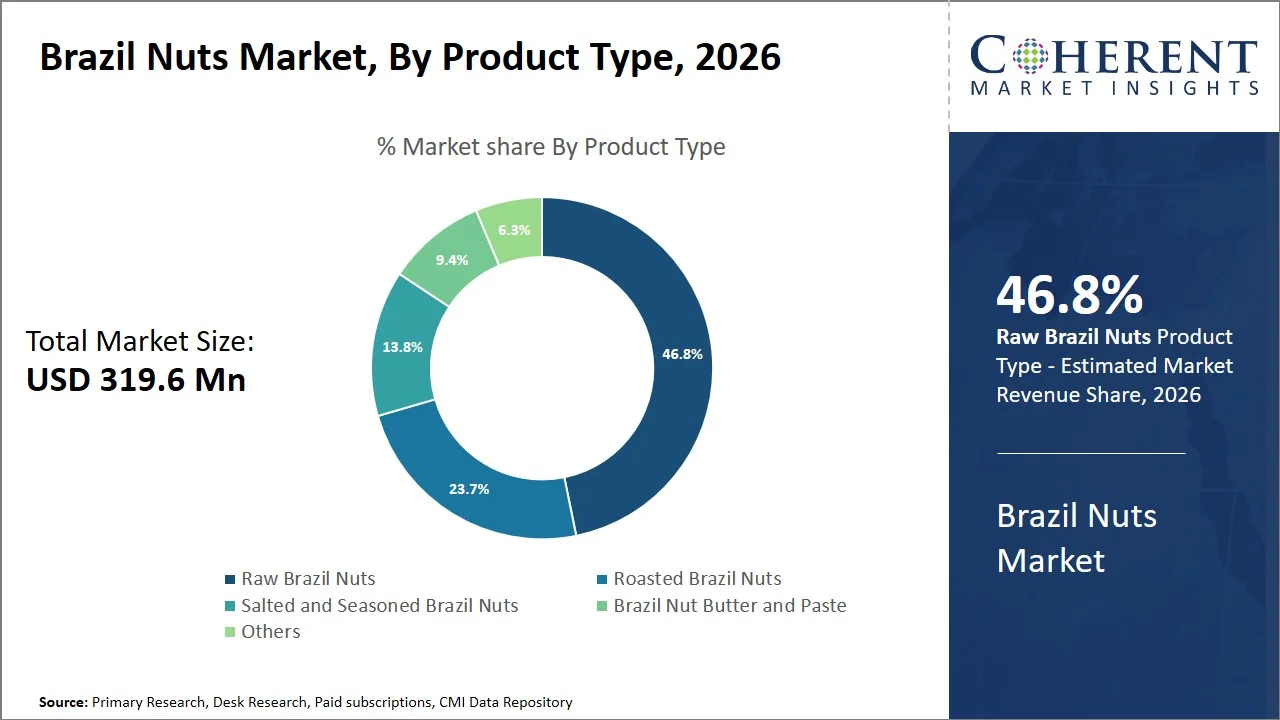
Why Do Raw Brazil Nuts Dominate the Brazil Nuts Market?
Raw Brazil nuts are projected to lead the Brazil nuts market with a share of 46.8% in 2026, offering the maximum versatility in terms of retail packs, roasting lines, flavored nut mixes, bakery inclusions and health-oriented snack formats. Raw kernels are preferred by buyers due to their flexibility to be roasted, salted, coated, chopped, blended, etc., for end-market requirements, thereby minimizing finished product inventory risk. As for the supply side, raw kernels continue to be the primary format in which the kernels are traded, and processed into cleaning, drying, grading, and aflatoxin-control systems before being exported. They are well adopted in snacks, trail mixes, nut butter, premium ingredient and confectionery. In March 2026, the U.S. Food & Drug Administration and Agricultural Marketing Service signed an MOU to coordinate inspection, sampling, and testing of raw peanuts, Brazil nuts, pistachios, and almonds for aflatoxins, strengthening raw nut trade assurance.
- Current Industry Events of 2026
- Market Size Estimation
- Regional Breakdown
- Competitive Landscape
- Customer Intelligence
- Segmental Analysis
- Pricing Analysis
- Key Market Drivers, Challenges & Future Trends
- Customized Insights Section
Why Do Whole Nuts Represent the Largest Form Segment in the Brazil Nuts Market?
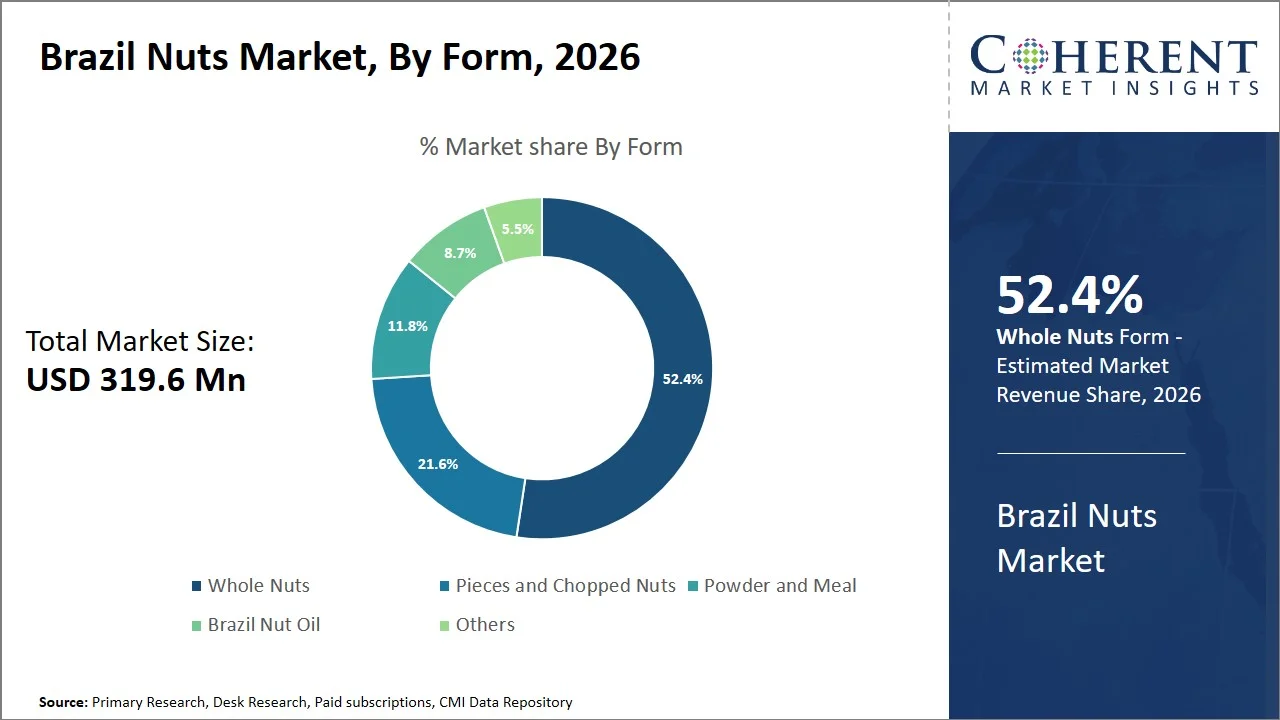
Whole nuts are expected to represent the largest form segment with 52.4% share in 2026, as intact kernels command stronger value in retail packs and are easier for consumers to identify as a premium tree nut. Demand is supported by resealable pouches, mixed nut assortments, clean-label snack packs, gifting formats, and ingredient buyers that require visible nut pieces for texture and appearance. Compared with chopped, meal, or oil formats, whole nuts retain greater price realization because breakage lowers grading value and narrows application use. Supply-side grading systems also support whole-kernel trade, as exporters sort by size, defect level, color, moisture, and kernel integrity. In April 2025, UNECE invited review of the aligned Brazil nut kernels standard DDP-27, defining quality requirements for export-stage Brazil nut kernels and reinforcing standardized whole-kernel trade.
Why Does the Conventional Segment Dominate the Brazil Nuts Market?
The conventional segment is expected to dominate the market with 78.6% share in 2026, as large-volume buyers remain focused on availability, stable pricing, and standard food-safety compliance rather than premium certification. Organic supply is smaller because certification, segregation, audits, documentation, and traceability add cost across forest collection, aggregation, processing, and export. Conventional nuts therefore remain the preferred option for mainstream supermarkets, private-label snack brands, bakery processors, confectionery companies, and foodservice ingredient buyers that need scalable sourcing. This segment also benefits from established bulk logistics and broader supplier participation across producing countries. In February 2026, Brazil’s Ministry of Agriculture confirmed expanded export access for Brazil nuts to Turkey, supporting broader international trade flows and reinforcing supply availability for conventional buyers.
Brazil Nuts Market Dynamics
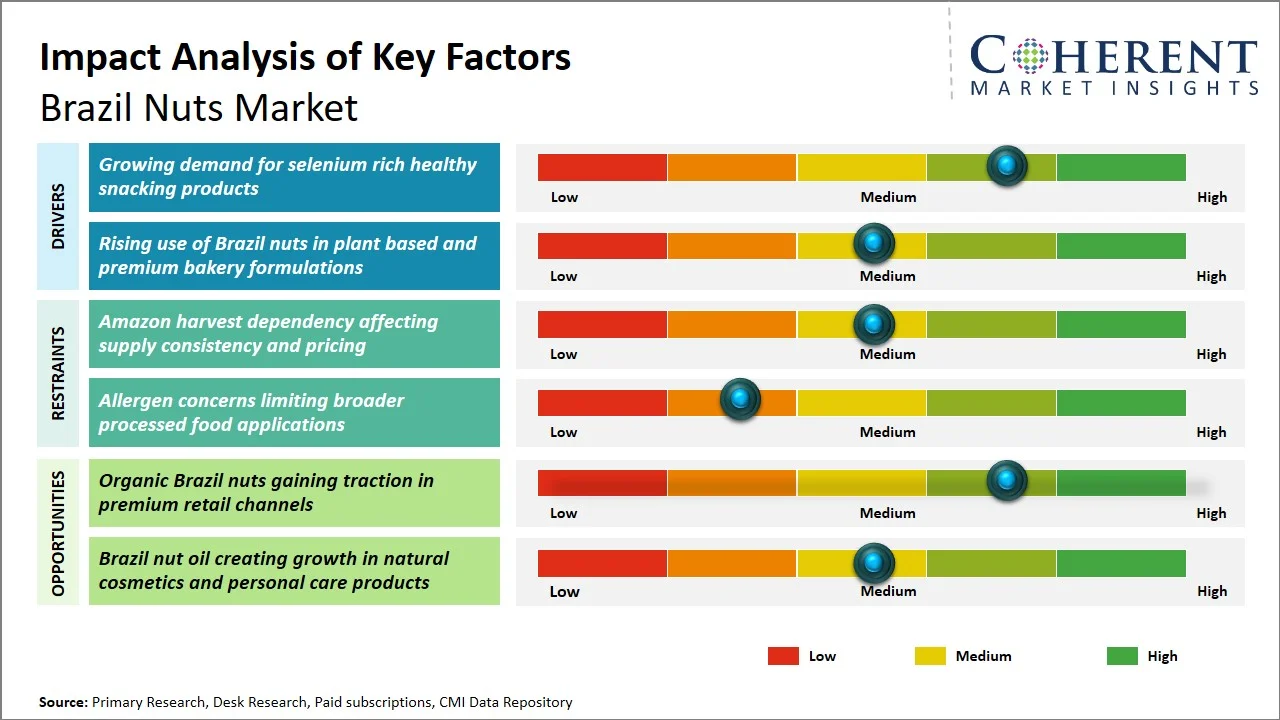
Key Market Drivers
- Growing Demand for Selenium-Rich Healthy Snacking Products: Brazil nuts are gaining stronger adoption in healthy snacking because they offer a clear functional nutrition proposition: natural selenium, plant protein, healthy fats, and clean-label positioning in a single ingredient. This supports demand across premium snack packs, trail mixes, nutrition-led retail assortments, and portion-controlled formats where brands can communicate “small serving, high nutrient value.” The driver is commercially important because Brazil nuts can command premium pricing compared with more commoditized nut varieties, especially in Europe and North America, where wellness-led snacking is mature. In December 2025, researchers reported that Brazil nuts have very high selenium levels and that a single nut may cover the daily requirement, reinforcing their role as a natural selenium food source.
- Rising Use of Brazil Nuts in Plant-Based and Premium Bakery Formulations: Brazil nuts are becoming more relevant in plant-based and premium bakery formulations as they offer natural fat, rich flavor, texture, and micronutrient value without synthetic fortification. Food manufacturers can use Brazil nut flour, meal, chopped kernels, paste, and butter in gluten-free cookies, cakes, cereal bars, confectionery fillings, and clean-label bakery products. The ingredient also supports better utilization of broken kernels and processing by-products, improving value recovery across the supply chain. In December 2025, a Wiley study found that Brazil nut flour can be used as a functional ingredient in reduced-sugar gluten-free cookies, improving texture, composition, and sensory profile.
Emerging Market Trends
- Premiumization of Nut-Based Snacking: Brazil nuts are being marketed as a nut instead of a commodity and are gaining traction as a premium snack ingredient, with their premium flavor and rich nutritional values, and Amazon origin and large kernel size. The shift is impacting how brands market the product in retail stores, notably with more focus on resealable packaging, mixed nut packs, dark chocolate coatings, portion packs, and gifting packs. The other premiumization benefit to suppliers and retailers is the ability to mitigate supply volatility by price realization. The potential is for processors to go beyond bulk raw kernels to product offerings like roasted, lightly salted, chocolate-coated, chopped and functional snack blends. This is especially true for the European and North American markets where consumers are willing to pay more for snack products that are traceable, nutrient rich, and yet indulgent and healthy.
- Traceable and Sustainable Amazon Sourcing: Traceability is becoming a stronger buying requirement in the Brazil nuts market because the product is closely linked to forest livelihoods, biodiversity protection, and ethical sourcing. Buyers are increasingly looking for supply chains that can verify origin, collection practices, food safety controls, and community-linked procurement. This trend is not only reputation-driven; it also supports export access, retailer compliance, and premium brand positioning. Suppliers that can document forest collection, segregation, storage, processing, and quality testing will be better placed to serve supermarkets, organic brands, specialty ingredient buyers, and clean-label snack manufacturers. Over the forecast period, traceable sourcing is expected to become a practical commercial differentiator, especially as buyers reduce exposure to inconsistent, informal, or poorly documented supply chains.
Current Events and their Impact
Current Events | Description and its Impact |
February 2026 – Brazil Opens Export Market for Brazil Nuts to Turkey |
|
December 2025 – CONAB Updates Minimum Prices for Extractive Products for 2026 |
|
June 2026 – U.S. Section 301 Proposed Action Lists Brazil Nuts |
|
Technology Adoption Landscape in the Brazil Nuts Market
Technology | Adoption Level | Key Application Area | Business Impact |
Optical sorting and color grading | High | Kernel defect removal and quality grading | Improves visual quality, reduces rejected lots, and supports premium whole-kernel sales |
Aflatoxin testing and rapid lab screening | High | Export compliance and food safety control | Reduces shipment rejection risk and strengthens buyer confidence |
Controlled drying and moisture management | High | Post-harvest handling and storage | Limits mold risk, protects shelf life, and improves export stability |
Vacuum and nitrogen-flushed packaging | Medium | Retail packs and bulk ingredient storage | Helps reduce rancidity and supports premium shelf-life claims |
Traceability and batch documentation systems | Medium | Forest collection to processing and export | Supports certification, retailer audits, and origin-linked pricing |
Mechanical pressing and flour recovery | Medium | Brazil nut oil, flour, meal, and upcycled ingredients | Adds value to broken kernels and supports bakery, cosmetics, and plant-based applications |
How are Functional Ingredients and Traceable Amazon Sourcing Creating New Growth Opportunities in the Brazil Nuts Market?
The strongest growth opportunity lies in shifting Brazil nuts from bulk nut trading into value-added functional and traceable ingredient platforms. Whole kernels will continue to support premium snacking, but stronger margins can be created through roasted formats, chopped nuts, Brazil nut flour, butter, paste, oil, and bakery-ready ingredients. This allows processors to serve multiple demand pools, including snacks, confectionery, gluten-free bakery, plant-based foods, cosmetics, and dietary supplements. Traceable Amazon sourcing further improves commercial value because buyers can link the product to forest conservation, community income, and clean-label positioning. Companies that invest in quality sorting, aflatoxin control, moisture management, origin documentation, and flexible product formats can reduce supply risk while improving price realization. This opportunity is commercially important because Brazil nuts face natural supply constraints; therefore, value creation will depend more on specification, processing, branding, and certification than on rapid volume expansion.
Market Players, Key Development, and Competitive Landscape
Key Developments
- In July 2026, Bosques Amazónicos (BAM) highlighted new scholarship recipients under its REDD Castañeros Project, supporting children and grandchildren of Brazil nut concessionaire families. This is important for the Brazil Nuts Market because community-linked forest conservation strengthens long-term social sustainability and protects the upstream collector base.
- In July 2025, Truly Nuts! gained industry visibility for bringing wild-harvested Brazil nuts to global consumers, emphasizing nutrition, forest protection, and livelihood support. This is important for the Brazil nuts market because it strengthens premium, sustainability-led positioning and helps connect Amazon-origin supply with international health-focused consumers.
- In August 2024, Natura launched a body care line positioned as the world’s first body lotion concentrate under its Ekos Castanha range, using Brazil nut oil in a lower-plastic refill format. This is important for the Brazil nuts market because it expands Brazil nut oil relevance in sustainable personal care and supports non-food demand diversification.
Competitive Landscape
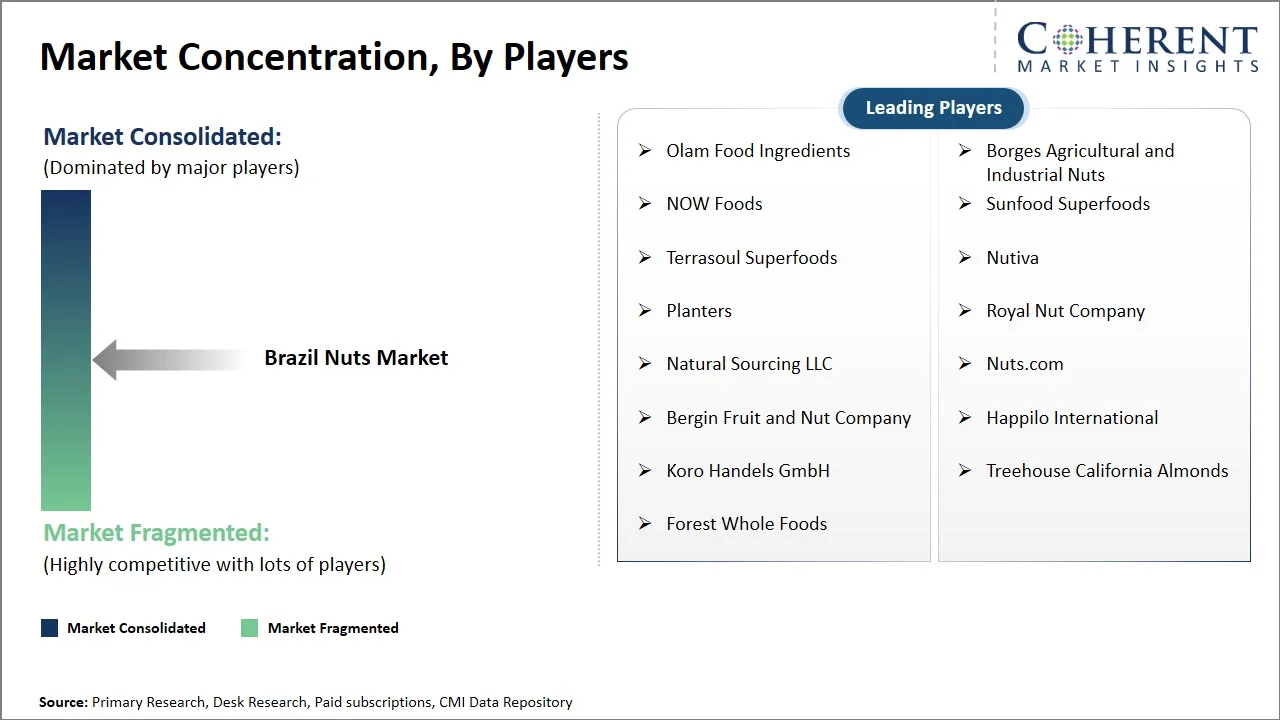
The Brazil nuts market is moderately fragmented, with competition spread across forest collector networks, cooperatives, processors, exporters, specialty nut suppliers, private-label packers, snack brands, ingredient companies, and personal care manufacturers using Brazil nut oil. Competition is shaped by access to reliable Amazon-origin supply, quality consistency, food safety compliance, price control, and ability to serve both retail and industrial buyers.
Key focus areas include
- Product quality and differentiation through whole-kernel grade, size, color, freshness, and low defect levels
- Technology adoption in optical sorting, moisture control, aflatoxin testing, and shelf-life protection
- Pricing and cost competitiveness, especially during harvest shortages and export volatility
- Supply reliability through long-term collector, cooperative, and processor relationships
- Certifications, compliance, and quality control for organic, food safety, fair-trade, and retailer audit requirements
- Distribution reach across supermarkets, specialty stores, e-commerce, ingredient distributors, and B2B food manufacturers
- Product format differentiation across raw, roasted, salted, chopped, flour, butter, paste, and oil formats
- Clean-label, sustainable, organic, and Amazon-origin positioning for premium retail and specialty ingredient channels
Market Report Scope
Brazil Nuts Market Report Coverage
| Report Coverage | Details | ||
|---|---|---|---|
| Base Year: | 2025 | Market Size in 2026: | USD 319.6 Mn |
| Historical Data for: | 2020 To 2024 | Forecast Period: | 2026 To 2033 |
| Forecast Period 2026 to 2033 CAGR: | 6.9% | 2033 Value Projection: | USD 509.9 Mn |
| Segments covered: |
| ||
| Companies covered: | Olam Food Ingredients, Borges Agricultural and Industrial Nuts, NOW Foods, Sunfood Superfoods, Terrasoul Superfoods, Nutiva, Planters, Royal Nut Company, Natural Sourcing LLC, Nuts.com, Bergin Fruit and Nut Company, Happilo International, Koro Handels GmbH, Treehouse California Almonds, and Forest Whole Foods | ||
| Growth Drivers: |
| ||
| Restraints & Challenges: |
| ||
Analyst Opinion (Expert Opinion)
- The Brazil nuts market is expected to remain attractive, but it will not behave like a high-volume plantation-based nut category. Future growth will depend on premium positioning, efficient processing, quality assurance, and stronger value capture from limited wild-harvested supply rather than aggressive volume expansion.
- The most attractive growth pockets are expected in raw Brazil nuts, whole nuts, snack and trail mix applications, bakery and confectionery, and Brazil nut oil for personal care. Europe should remain a high-value market due to premium nut consumption and strong quality expectations, while North America offers strong opportunities in functional snacking and clean-label retail formats.
- The key risks are harvest volatility, aflatoxin contamination, price fluctuation, fragmented collector networks, and inconsistent traceability. Companies should focus on long-term sourcing partnerships, stronger testing infrastructure, premium packaging, origin documentation, and value-added formats such as roasted nuts, Brazil nut flour, paste, butter, and oil to gain competitive advantage.
Speak to the analyst
Want personalized insights?
Take the findings above to one of our principal consultants, or have the report rebuilt around the segments, geographies and competitors you actually track.
Market Segmentation
- Product Type Insights (Revenue, USD Mn, 2021 - 2033)
- Raw Brazil Nuts
- Roasted Brazil Nuts
- Salted and Seasoned Brazil Nuts
- Brazil Nut Butter and Paste
- Others
- Form Insights (Revenue, USD Mn, 2021 - 2033)
- Whole Nuts
- Pieces and Chopped Nuts
- Powder and Meal
- Brazil Nut Oil
- Others
- Nature Insights (Revenue, USD Mn, 2021 - 2033)
- Conventional
- Organic
- Application Insights (Revenue, USD Mn, 2021 - 2033)
- Snacks and Trail Mixes
- Bakery and Confectionery
- Nut Butters and Spreads
- Plant Based Foods
- Personal Care and Cosmetics
- Dietary Supplements
- Others
- Key Players Insights
- Olam Food Ingredients
- Borges Agricultural and Industrial Nuts
- NOW Foods
- Sunfood Superfoods
- Terrasoul Superfoods
- Nutiva
- Planters
- Royal Nut Company
- Natural Sourcing LLC
- Nuts.com
- Bergin Fruit and Nut Company
- Happilo International
- Koro Handels GmbH
- Treehouse California Almonds
- Forest Whole Foods
Sources
Primary Research Interviews
- Brazil nut processors, exporters, shelling and grading units
- Amazon forest collectors, cooperatives, and wild-harvest supply chain participants
- Snack, trail mix, bakery, confectionery, nut butter, plant-based food, supplement, and personal care manufacturers
- Supermarkets, specialty retailers, importers, distributors, and B2B ingredient buyers
Stakeholders
- Key companies: Olam Food Ingredients, Borges Agricultural and Industrial Nuts, NOW Foods, Sunfood Superfoods, Terrasoul Superfoods, Nutiva, Planters, Royal Nut Company, Natural Sourcing LLC, Nuts.com, Happilo International, KoRo Handels GmbH, Forest Whole Foods
- Nut ingredient suppliers, organic certifiers, private-label snack brands, bakery processors, cooperatives, and personal care formulators
Databases
- FAOSTAT, UN Comtrade, ITC Trade Map, Eurostat, USITC DataWeb
- Brazil ComexStat, IBGE, CONAB, USDA FAS, FDA Import Refusal Reports
- Company annual reports, sustainability reports, import-export records, product brochures, and press releases
Industry Publications and Journals
- FoodNavigator, Bakery and Snacks, Food Ingredients First, NutraIngredients, Confectionery News
- Food Chemistry, Nutrients, LWT – Food Science and Technology, Journal of Cleaner Production, Sustainability
Associations
- International Nut and Dried Fruit Council
- Specialty Food Association
- Organic Trade Association
- Plant Based Foods Association
- National Confectioners Association
- IFOAM – Organics International
Public Domain Sources
- FAO, WHO, U.S. FDA, EFSA, European Commission, USDA
- Brazil Ministry of Agriculture and Livestock, CONAB, U.K. Food Standards Agency
Proprietary Elements
- CMI Data Analytics Tool, Proprietary CMI Existing Repository of information for last 10 years
Get access to 250+ pages report
Every segment, forecast, competitor profile and data table behind the analysis above — available for instant download.
- ESOMAR Member
- ISO 9001:2015 Certified
- D-U-N-S Registered
- GDPR & CCPA Compliant
Missing comfort of reading report in your local language? Find your preferred language:
Transform your Strategy with Exclusive Trending Reports
Frequently Asked Questions
The CAGR of the Brazil nuts market is projected to be 6.9% from 2026 to 2033.
The Brazil nuts market is estimated to be valued at USD 319.6 million in 2026 and is expected to reach USD 509.9 million by 2033.
The Brazil nuts market is growing due to the rising demand for selenium-rich healthy snacks and increasing use in plant-based and premium bakery products.
The Brazil nuts market is expected to grow steadily from 2026 to 2033, supported by health-focused snacking, clean-label foods, and expanding food and personal care applications.
Brazil nuts are used in snacks, trail mixes, bakery products, confectionery, nut butters, spreads, plant-based foods, and dietary supplements.
The biggest challenge is supply dependency on Amazon wild harvesting, which can affect availability, pricing, quality consistency, and export stability.
Growing demand for selenium rich healthy snacking products and rising use of Brazil nuts in plant based and premium bakery formulations are the major factors driving the growth of the Brazil nuts market.