

Health Supplementary Food OEM and ODM Market Size and Share Analysis - 2026 To 2033
The health supplementary food OEM and ODM market is anticipated to grow at a CAGR of 7.4% with USD 67.0 Bn in 2026 and is expected to reach USD 110.5 Bn in 2033. The market is growing as people are getting chronic lifestyle diseases (1.3 Bn people globally), and many brands prefer to have their products made by other companies instead of building expensive factories themselves. Using OEM (Original Equipment Manufacturer) and ODM (Original Design Manufacturer) models has become an important strategy in the health supplement industry. These models let brands make new as well as unique products quickly without spending a lot of money on production.
Key Takeaways
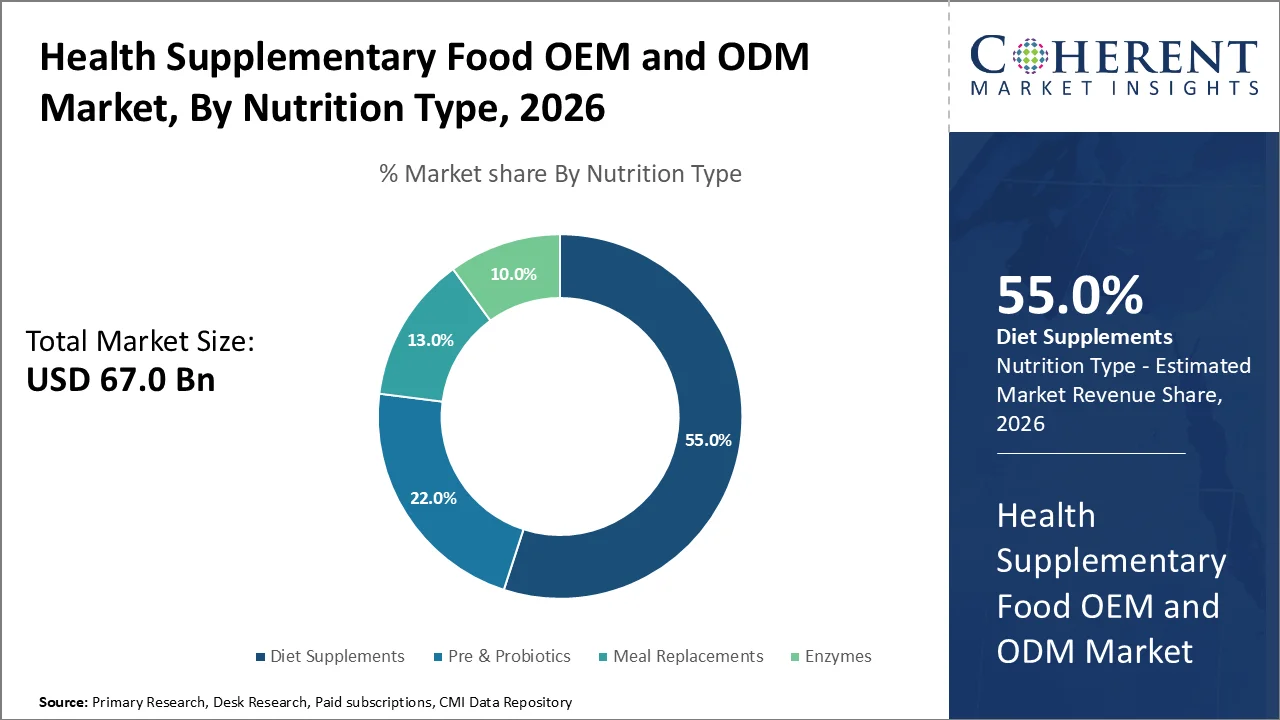
- Diet supplements is expected to account the largest share of 55% in 2026, many people take diet supplements regularly, sometimes daily, which drives consistent demand. Meal replacements or enzymes are less frequent purchases. Around 57–60% of U.S. adults report taking dietary supplements in the last 30 days.
- Capsules will dominate with 44% in 2026, due to convenience, easy swallowing, as well as suitability for customized formulations. World Health Organization (WHO) & International Trade Centre (ITC) reports on dietary supplements shows those oral solid forms, especially capsules, make up nearly 44% of the global market owing to ease of swallowing, accurate dosing, and formulation flexibility.
- Bottle packaging will dominate with 45% in 2026, as it is durable, easy to store, resealable, convenient for daily use, and widely recognized by consumers.
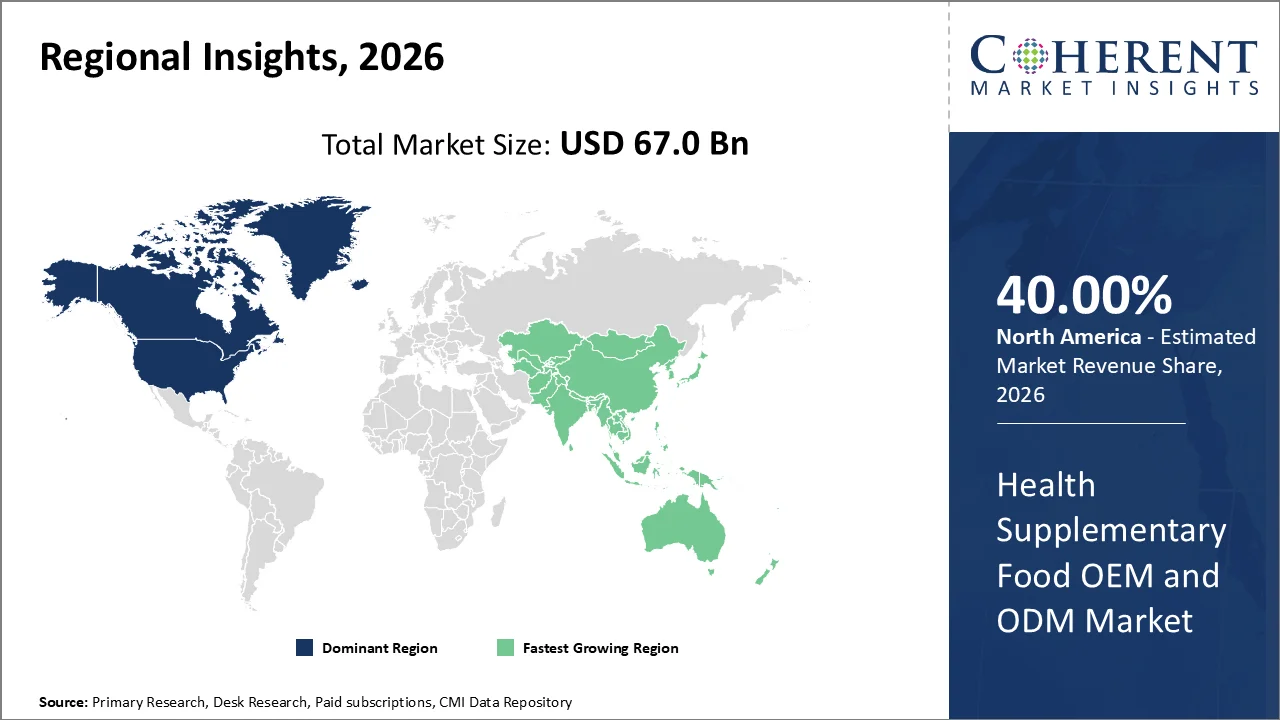
- North America is expected to acquire the dominant share of 40% in 2026, high health awareness and supplement consumption. Dietary supplements are broadly available as well as used by more than one-half of adults and one-third of children in the United States to fill nutrient gaps and optimize health.
Segmental Insights
Why is Diet Supplements Acquiring the Largest Market Share?
Diet Supplement is projected to account for the largest share of nutrition type in 2026, representing approximately 55% of the total volume. Owing to its deeply rooted consumer health trends, lifestyle changes, as well as increasing awareness about personalized nutrition. Obesity is a chronic disease that affects over one billion people in the world and is a major risk factor for cardiovascular disease, type 2 diabetes, as well as cancer.
Diet Supplements, which include vitamins, minerals, herbal extracts, and performance enhancers, have gained high acceptance due to their ability to target specific health needs such as weight management, energy boosting, immunity enhancement, chronic disease prevention, etc.
For example, government health programs, like the U.S. NIH Office of Dietary Supplements, say micronutrients are important for good health. This has made more people want products that give real nutritional benefits. The government of India initiated national programs to prevent, control and combat these deficiencies and their serious consequences. The interventions involved distribution of iodized salt in the endemic areas, administration of semiannual massive dose of vitamin A to young children, and distribution of iron-folic acid tablets to the vulnerable groups.
- Current Industry Events of 2026
- Market Size Estimation
- Regional Breakdown
- Competitive Landscape
- Customer Intelligence
- Segmental Analysis
- Pricing Analysis
- Key Market Drivers, Challenges & Future Trends
- Customized Insights Section
Capsules holds the Largest Market Share
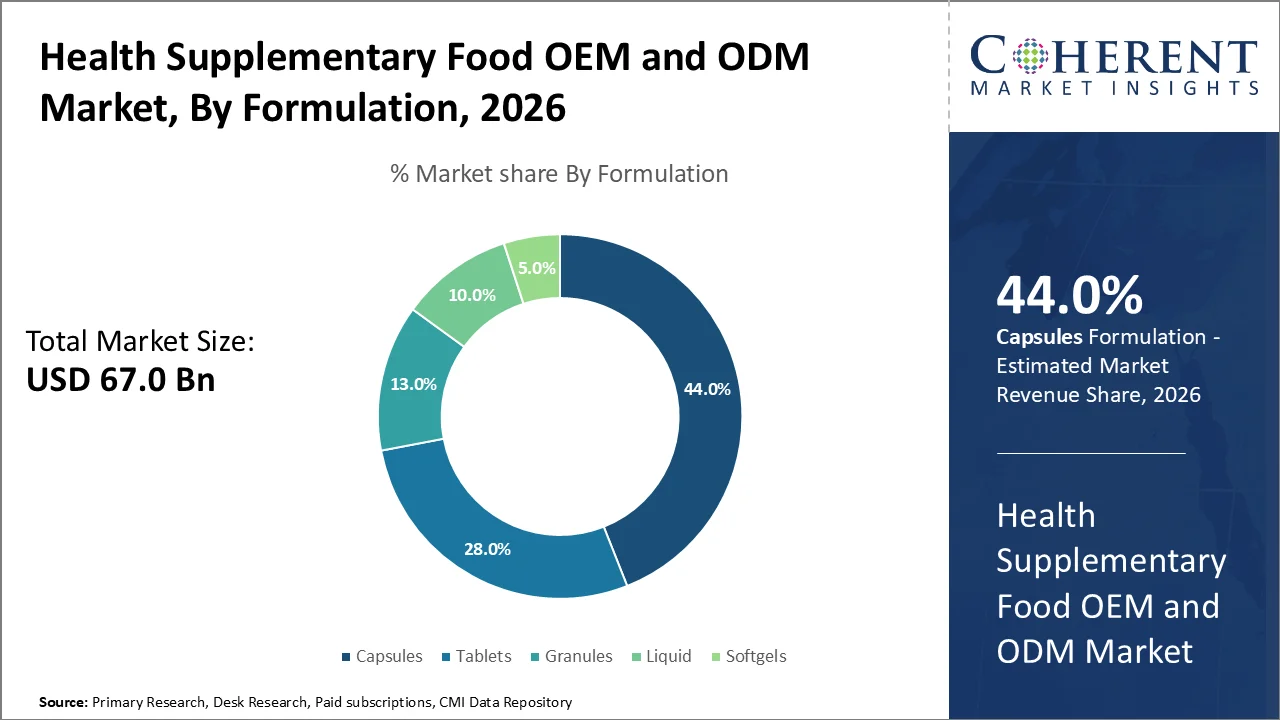
Based on formulation, capsules dominate the market, accounting for a significant 44% share in 2026, primarily due to their widespread consumer acceptance, ease of manufacturing, as well as ability to encapsulate a variety of supplement formulations that are either sensitive to air and light or have unpleasant tastes and odors. Capsules, especially gelatin and vegetarian variants, provide an effective barrier that protects active ingredients from oxidation as well as degradation, thereby improving product stability and shelf-life.
In October 2025, Lonza Capsugel said they are launching a new Organicaps™ capsule at SupplySide Global 2025. It is the only plant-based, USDA organic, quick-release capsule made in North America. Featuring a high oxygen barrier, non-reactive shell, as well as excellent polymer stability, Organicaps™ capsules are designed to help brands stay one step ahead with organic product claims in the growing organic supplements market.
This is particularly important for supplements containing probiotics, oils rich in omega-3 fatty acids, or volatile herbal extracts. Health organizations such as the U.S. Food and Drug Administration (FDA) has clear rules for capsules, making them easy to use and accepted in many markets, especially in North America and Europe, which are usually leaders in health supplements.
Bottle Packaging holds the Largest Market Share
Based on packaging type, bottle packaging dominates the market, accounting for a significant 45% share in 2026. Bottle Packaging has held its dominance primarily due to its strong alignment with consumer preferences for health supplements that needs careful dosing as well as secure storage. The durability along with reusability of bottles makes them a perfect choice for supplements such as vitamins, minerals, herbal extracts, etc., where preservation from air, moisture, as well as contaminants is critical.
Additionally, bottles allow for controlled dispensing caps, droppers, or measuring spoons can be integrated, enabling precise dosage which is vital in health supplements. For instance, major supplement manufacturers such as Nature’s Bounty and Garden of Life package their multivitamins as well as specialty supplements predominantly in plastic or glass bottles, showing trust in this format.
Market Drivers
Precision Manufacturing and Automation is transforming the Health Supplementary Food OEM and ODM Industry
Advanced technologies like automated capsule filling, continuous tablet manufacturing, robotic packaging, as well as AI-driven production optimization are transforming supplement production. Leading companies such as Lonza Group, Catalent, Thorne Health, etc., have adopted these systems, achieving high-speed capsule filling, continuous solid dosage manufacturing, and precise robotic dosing.
The impact of these technologies is significant: production time is lowered by 40–60%, dosage accuracy reaches 99.8%, labor costs drop by 35%, as well as risks of human error and contamination are minimized. This inclination is driving faster, safer, as well as more efficient manufacturing in the health supplement industry.
3D Printing Technology: A major breakthrough in Health Supplementary Food OEM and ODM
3D printing is enabling personalized supplements with custom shapes, dosages, and complex release profiles. Multi-material printing allows combination products in a single tablet. Companies like FabRx, Aprecia Pharmaceuticals, and Multiply Labs are leading the way, making tailored vitamins, rapidly dissolving tablets, as well as robotic 3D-printed supplements.
Using 3D printing has many benefits: it lets companies make custom products for many people, makes testing new designs twice as fast, as well as creates new types of doses that were not possible before. Making products only when needed also reduces storage and makes supplement production easier and faster.
Current Events and Their Impact on the Health Supplementary Food OEM and ODM Market
Current Event | Description and its Impact |
FDA Updates Dietary Supplement Regulations (2026) |
|
EU Novel Foods Regulation Expansion (2025) |
|
Health Supplementary Food OEM and ODM Market Trends
- Personalization Revolution: Escalating demand for customized nutritional formulations tailored to specific demographics, health conditions, as well as lifestyle requirements
- Clean Label Movement: high preference for natural, organic, as well as minimally processed ingredients with transparent labeling. Globally, 30% of product launches carry clean label claims, with no additives or preservatives being the most common.
- Digital Integration: Surge of e-commerce platforms as well as direct-to-consumer models enabling smaller brands to access OEM/ODM services
- Focus on functional foods: People want supplements that mix regular nutrients with probiotics, adaptogens, as well as plant extracts.
- Focus on sustainability: Many people are inclining towards eco-friendly packaging and ingredients. A 2023 report says 82% of buyers will pay more for products with sustainable packaging.
Regional Insights
North America dominates owing to its extensive enterprise digitization initiatives
North America account 40% market share in 2026, owing to its well-established healthcare infrastructure, stringent regulatory framework, as well as high consumer awareness regarding nutritional supplementation. According to the CHPA Survey, 92% Say Supplements Have Had a Positive Impact on Their Health. 83% of voters use dietary supplements to support their wellness needs.
The region benefits from the presence of major pharmaceutical as well as nutraceutical companies that have established robust OEM and ODM partnerships with supplement manufacturers.
The U.S. FDA has clear rules for dietary supplements under the DSHEDA law, making it easier for OEM and ODM companies to operate. These rules have encouraged many contract manufacturers to open factories in states like California, New York, and Texas.
Asia Pacific Health Supplementary Food OEM and ODM Market Trends
The Asia-Pacific region is poised to be the fastest-growing region through 2026-2033, expanding at a CAGR of approximately 7.5%. Driven by the rapid expansion of domestic manufacturing capabilities as well as increasing consumer awareness about health and wellness. This accelerated growth is fueled by high investments from local government authorities in biotechnology as well as nutraceutical manufacturing infrastructure, particularly in countries like China, India, South Korea, etc. the Singapore government have committed USD28 billion under the RIE2025 plan, with a strong pipeline of translational as well as AI-driven biomedical sciences initiatives expected under RIE2030.
China's 13th Five-Year plan gave a lot of support to build local health supplement factories, helping companies like By-Health and Infinitus create top-quality OEM and ODM facilities. In India, the PLI program for medicines helped the nutraceutical OEM sector grow, and companies like Hindustan Unilever and Dabur increased their contract manufacturing.
Advanced Research and Development Capabilities is Accelerating the Health Supplementary Food OEM and ODM Market Demand in United States
The U.S. leads the market because of strong research and development. Groups like the NIH and universities research supplements and help create new products. The American Botanical Council and the Council for Responsible Nutrition give advice to help companies follow rules and work together, making the industry more professional and bringing in business.
Additionally, the U.S. has strong supply chains that link raw materials from countries like China and India with local manufacturers who make as well as package products for sale in North America.
The proximity to major population centers as well as established distribution channels through retailers like CVS, Walgreens, Whole Foods Market, etc., creates compelling value propositions for brands seeking comprehensive OEM and ODM services that extend beyond manufacturing to include packaging, labeling, along with logistics support.
China Health Supplementary Food OEM and ODM Market Trends
China contributes the highest share in the Health Supplementary Food OEM and ODM market in APAC owing to its well-established manufacturing infrastructure as well as comprehensive supply chain ecosystem. The dominance of the country is supported by its massive production capacity, with over 3,000 certified health supplement manufacturing facilities as reported by the China Food and Drug Administration (CFDA).
China's leadership position is supported by its advanced pharmaceutical as well as nutraceutical manufacturing capabilities, supported by Special Economic Zones like Guangdong and Jiangsu provinces that house numerous international OEM and ODM operations.
The Chinese government's "Made in China 2025" initiative has majorly boosted the country's pharmaceutical as well as health supplement manufacturing sector, with state-backed investments exceeding USD50 billion in biotechnology and pharmaceutical infrastructure development.
Who are the Major Companies in Health Supplementary Food OEM and ODM Industry
Some of the major key players in Health Supplementary Food OEM and ODM Market include, Cosmax Inc., Kolmar Korea, Japan Supplement Foods Co., Ltd., Health Sources Nutrition Co., Ltd., Goerlich Pharma GmbH, API Co., Ltd., Syngen Biotech Co., Ltd., OriBionatureSdnBhd, Nutricare Co.,Ltd, and NOVAREX Co., Ltd
Key News
- In August 2025, Informa Markets conducted Vitafoods Asia 2025 from 17–19 September 2025 at the Queen Sirikit National Convention Center (QSNCC) in Bangkok. The event played a key role in advancing Thailand's food and nutraceutical industries, aligning with the region's growing shift toward preventive healthcare and wellness.
- In May 2025, Cosmax NBT announced that the global beauty and health manufacturer had relocated their dietary supplement manufacturing operations which were originally in Texas to Korea. The move to the East Asia location was a strategic decision aimed at strengthening supply chain efficiency, better serving capabilities to their global customers, and product quality.
Market Report Scope
Health Supplementary Food OEM and ODM Market Report Coverage
| Report Coverage | Details | ||
|---|---|---|---|
| Base Year: | 2025 | Market Size in 2026: | USD 67.0 Bn |
| Historical Data for: | 2020 To 2024 | Forecast Period: | 2026 To 2033 |
| Forecast Period 2026 to 2033 CAGR: | 7.4% | 2033 Value Projection: | USD 110.5 Bn |
| Geographies covered: |
| ||
| Segments covered: |
| ||
| Companies covered: | Cosmax Inc., Kolmar Korea, Japan Supplement Foods Co., Ltd., Health Sources Nutrition Co., Ltd., Goerlich Pharma GmbH, API Co., Ltd., Syngen Biotech Co., Ltd., OriBionatureSdnBhd, Nutricare Co.,Ltd, and NOVAREX Co., Ltd | ||
| Growth Drivers: |
| ||
| Restraints & Challenges: |
| ||
Analyst Opinion
- Personalization isn’t just a trend, it’s driving real demand. In 2025, global personalized supplements reached USD 18.2 billion, with companies like FabRx scaling 3D-printed, tailor-made vitamins.
- Automation and precision manufacturing are transforming production. Lonza’s automatic capsule machines made 400,000 capsules per hour in 2025, making production faster and keeping quality the same.
- Clean labels along with sustainability are now very important for selling products. A 2025 Mintel report says 73% of people will pay extra for eco-friendly, clear products, as a result ODMs are utilizing recyclable packaging and robots.
- China dominates the Asia-Pacific OEM/ODM market, adopting GMP-compliant, cost-efficient facilities to distribute global brands.
- In short, companies that focus on personalized products, automation, sustainability, and following rules are set for strong as well as profitable growth in the health supplement OEM/ODM industry.
Speak to the analyst
Want personalized insights?
Take the findings above to one of our principal consultants, or have the report rebuilt around the segments, geographies and competitors you actually track.
Market Segmentation
- By Nutrition Type (Revenue, USD Bn, 2021-2033)
- Enzymes
- Pre & Probiotics
- Meal Replacements
- Diet Supplements
- By Formulation (Revenue, USD Bn, 2021-2033)
- Capsules
- Tablets
- Granules
- Liquid
- Softgels
- By Packaging Type (Revenue, USD Bn, 2021-2033)
- Bottle Packaging
- Containers & Jars
- Gastrointestinal Diseases
- Lamizip Packaging
- Three Sided Seal Pack
- Stick Packaging
- Blister Packaging
- Box Packaging
- Others
- By Region (Revenue, USD Bn, 2021-2033)
- North America
- U.S.
- Canada
- Latin America
- Brazil
- Mexico
- Argentina
- Rest of Latin America
- Europe
- Germany
- U.K.
- France
- Italy
- Spain
- Russia
- Rest of Europe
- Asia Pacific
- China
- India
- Japan
- Australia
- South Korea
- ASEAN
- Rest of Asia Pacific
- Middle East
- GCC
- Israel
- Rest of Middle East
- Africa
- South Africa
- Central Africa
- North Africa
- North America
Sources
Primary Research Interviews
- Health supplement OEM manufacturers and executives
- ODM service providers and contract manufacturers
- Nutraceutical industry specialists and consultants
- Regulatory affairs managers in health supplement sector
- Others
Databases
- IBISWorld Industry Reports Database
- Euromonitor Passport Database
- Others
Magazines
- Nutraceuticals World Magazine
- Natural Products INSIDER Magazine
- Nutritional Outlook Magazine
- SupplySide Magazine
- Others
Journals
- Journal of Functional Foods
- Food & Function Journal
- Nutrients Journal
- Others
Newspapers
- Food Business Magazine
- Natural Products Business News
- Nutrition Business Journal
- Global Cosmetic Industry News
- Others
Associations
- Council for Responsible Nutrition (CRN)
- International Alliance of Dietary/Food Supplement Associations (IADSA)
- American Herbal Products Association (AHPA)
- Global Organization for EPA and DHA Omega-3s (GOED)
- Others
Public Domain Sources
- U.S. Food and Drug Administration (FDA) databases
- World Health Organization (WHO) publications
- European Food Safety Authority (EFSA) reports
- National Institutes of Health (NIH) databases
- Others
Proprietary Elements
- CMI Data Analytics Tool
- Proprietary CMI Existing Repository of information for last 10 years
Get access to 250+ pages report
Every segment, forecast, competitor profile and data table behind the analysis above — available for instant download.
- ESOMAR Member
- ISO 9001:2015 Certified
- D-U-N-S Registered
- GDPR & CCPA Compliant
Missing comfort of reading report in your local language? Find your preferred language:
Transform your Strategy with Exclusive Trending Reports
Frequently Asked Questions
The Health Supplementary Food OEM and ODM market is expected to reach USD 110.5 Bn in 2033.
Major players operating in the global health supplementary food OEM and ODM market include Cosmax Inc., Kolmar Korea, Japan Supplement Foods Co., Ltd., Health Sources Nutrition Co., Ltd., Goerlich Pharma GmbH, API Co., Ltd., Syngen Biotech Co., Ltd., OriBionatureSdnBhd, Nutricare Co.,Ltd, and NOVAREX Co., Ltd.
The major factors restraining growth of the health supplementary food OEM and ODM market are side effects and complications caused by products indicated for health supplementary food OEM and ODM.
The rising prevalence of chronic diseases and government initiatives, investments, and funding for health supplementary food research and development are driving the global health supplementary food OEM and ODM market growth.
The health supplementary food OEM and ODM market is anticipated to grow at a CAGR of 7.4% between 2026 and 2033.
Among regions, North America is expected to account for a largest market share in the global Health Supplementary Food OEM and ODM market over the forecast period.
Dietary Supplement OEM refers to the process where Original Equipment Manufacturers produce supplements according to the specifications set by brand owners.