

Global Bridge Construction Market Size and Forecast – 2026 To 2033
The global bridge construction market is expected to grow from USD 1,280 Bn in 2026 to USD 1,750 Bn by 2033, registering a compound annual growth rate (CAGR) of 4% from 2026 to 2033. The global bridge construction market is driven by the growing expansion of expressway, highway, and high-speed rail networks. On April 3, 2026, National Highways Authority of India issued Letter of Award (LOA) for the construction of four lane expressway from Vadhavan Port to Tava Village on NH-48 in Maharashtra, India. The project has been awarded to Joint Venture Kumar Infraprojects Limited and Shinde Developers Pvt. Ltd. for an amount of USD 23.60 billion on Engineering, Procurement and Construction (EPC) mode. (Source: Press Information Bureau)
Key Takeaways of the Global Bridge Construction Market
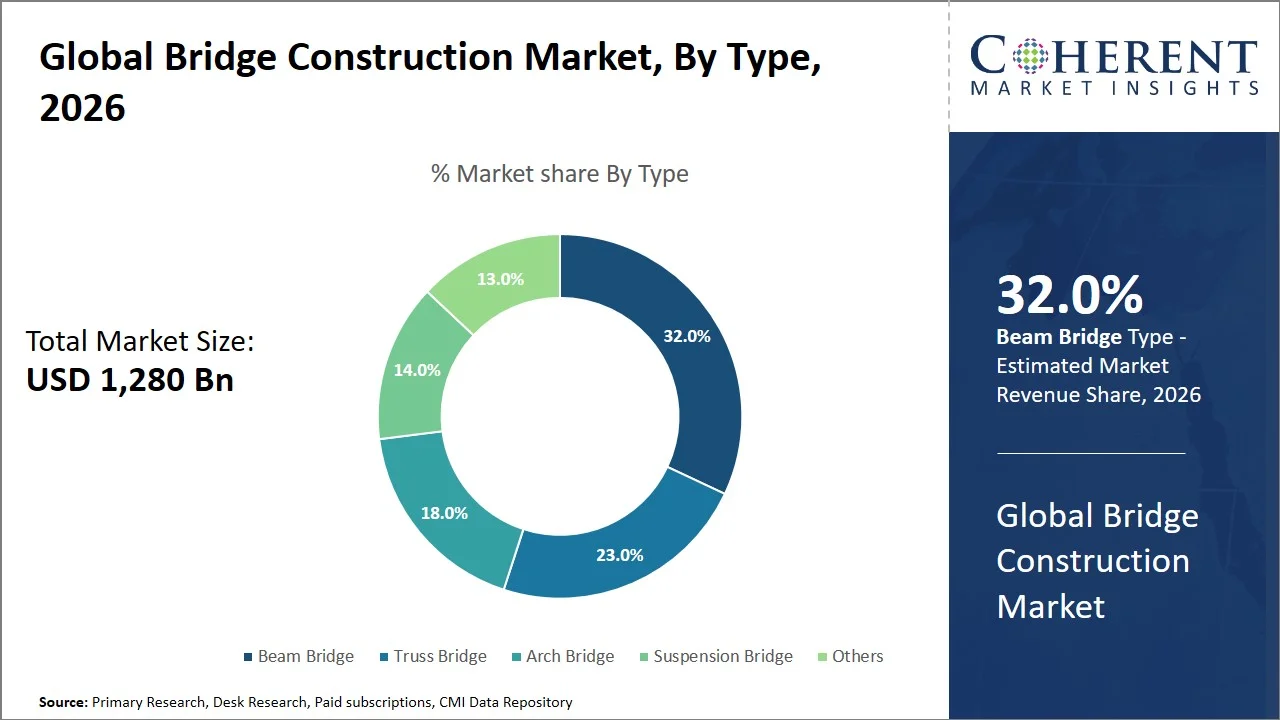
- The beam bridge segment is expected to account for 32.0 % of the global bridge construction market share in 2026. Growing cross-border connectivity and logistics corridors are driving the growth of the segment. On October 24, 2025, Noatum Logistics, an AD Ports Group company, signed a preliminary agreement with Hafeet Rail, developer and operator of the first cross-border railway network connecting Oman and the U.A.E, to establish a new rail service between Sohar in Oman and Abu Dhabi in the U.A.E. (Source: AD Ports Group)
- The concrete segment is estimated to capture 43.0 % of the market share in 2026. The adoption of advanced construction materials and prefabrication technologies is majorly driving the growth of the segment. On September 24, 2025, Holcim Australia commenced construction on a new high-capacity plant at Badgerys Creek to produce low-carbon ECOPact concrete. (Source: Holcim)
- The conventional construction segment is estimated to capture 31.0 % of the market share in 2026. Increasing replacement and rehabilitation of aging bridges is driving the growth of the segment. On January 29, 2025, Skanska announced that it has been awarded a USD 450 million contract to build a new fixed-span, high-rise bridge that will replace the current 2.8-mile-long Lindsay C. Warren Bridge over the Alligator River, connecting Tyrrell and Dare counties in North Carolina, U.S.
- Asia Pacific is expected to dominate the bridge construction market in 2026 with a market share of 48.0 %. Increasing adoption of digital twins and BIM in bridge design across Asia Pacific is driving the growth of the regional market. For instance, Larsen & Toubro demonstrates integrated BIM, AI, GIS technology, and digital twin platforms for big engineering, procurement, and construction and transportation infrastructure projects such as bridges and corridors.
- North America is expected to account for 22.0 % share in 2026 and is projected to record the fastest growth over the forecast period. Demand for climate-resilient and disaster-resistant bridges in North America is primarily driving the growth of the regional market. On February 13, 2026, Aecon Group Inc., Fraser Crossing Partners and the Province of British Columbia inaugurated the stal̕əw̓asəm (Riverview) Bridge, providing a modernized connection between Surrey and New Westminster, Canada. The new, four-lane, cable-stayed bridge replaces the nearly 90-year-old Pattullo Bridge over the Fraser River and features wider lanes for passenger and commercial vehicles.
- Accelerated adoption of smart bridges and structural health monitoring systems: Bridge projects are increasingly integrating IoT sensors, AI-based monitoring, and real-time data analytics to continuously assess structural integrity. This shift is improving predictive maintenance, reducing lifecycle costs, and enhancing safety by enabling early detection of stress, corrosion, and load-related issues.
- Rising use of modular and prefabricated construction techniques: Governments and contractors are increasingly adopting precast segments and smart bridge components to save construction time, minimize site disruption and improve quality control. This trend is more noticeable in urban locations, where transit congestion and limited building windows are more common.
Segmental Insights
Why Does Beam Bridge Dominate the Global Bridge Construction Market?
The beam bridge segment is expected to account for 32.0% of the global bridge construction market share in 2026. Beam bridges are the predominant mode of bridge building all over the world due to the basic structural design, cost-effectiveness, and convenience of construction when compared to the more sophisticated types of bridges. They do not require as many specialist materials and engineering processes, thereby reducing building time and overall project expenses. This makes them particularly ideal for short to medium span applications in highways, railways and rural infrastructure projects where rapid deployment and budget effectiveness are essential considerations. On April 30, 2026, The Portal North Bridge Replacement project received the 2026 Engineering Project of the Year Award from the American Society of Highway Engineers (ASHE) New Jersey Section. The award was presented during ASHE New Jersey’s annual Engineering Awards program at Forsgate Country Club and recognizes large‑scale transportation projects delivered across New Jersey that demonstrate engineering excellence and complexity.
- Current Industry Events of 2026
- Market Size Estimation
- Regional Breakdown
- Competitive Landscape
- Customer Intelligence
- Segmental Analysis
- Pricing Analysis
- Key Market Drivers, Challenges & Future Trends
- Customized Insights Section
Why is Concrete the Most Preferred Material?
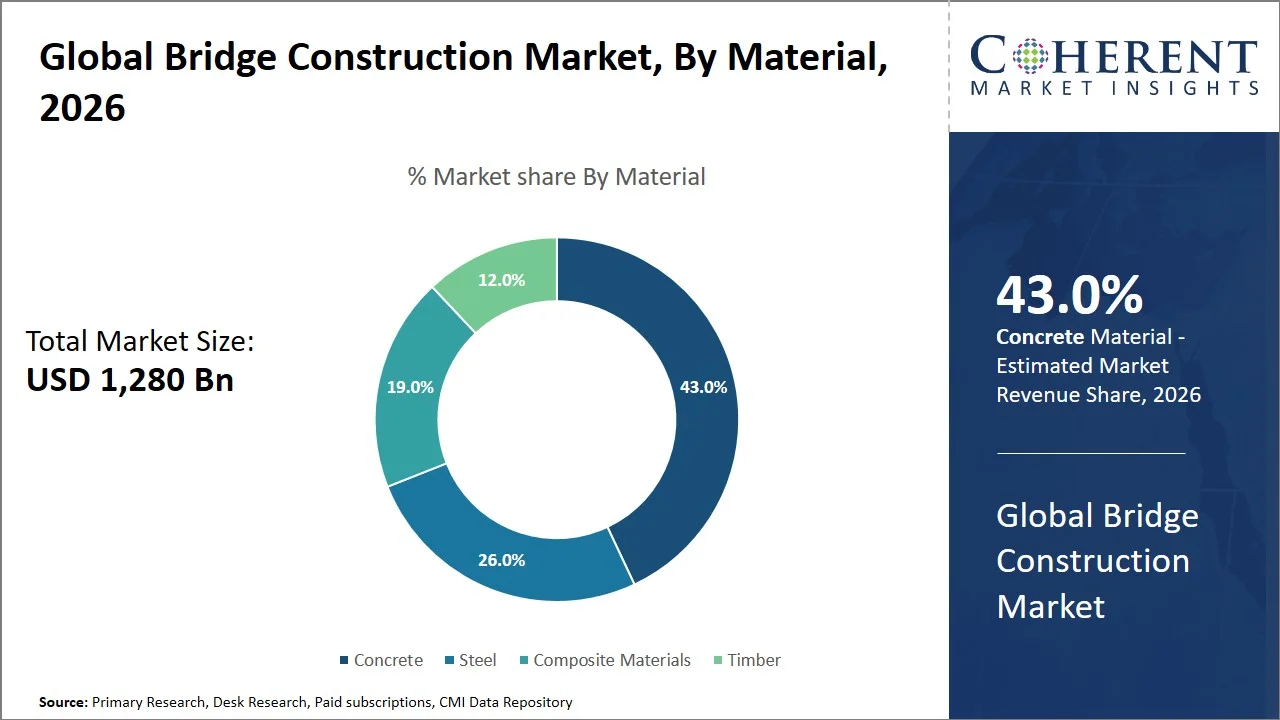
The concrete segment is expected to account for 43.0% of the global bridge construction market share in 2026. Concrete is the most favored material for bridge building because of its great compressive strength, durability and long service life under heavy traffic and adverse weather conditions. It is also commonly available and relatively low-cost compared to alternative materials such as steel or composites, making it well-suited for large-scale infrastructure projects. In addition, concrete can be easily cast into a variety of shapes and structural systems, therefore enabling a versatility in bridge architecture. Concrete also has a high resilience to weathering, corrosion and fire, thus reducing long term maintenance requirements.
Conventional Construction Dominates the Global Bridge Construction Market
The conventional construction segment is expected to account for 31.0% of the global bridge construction market share in 2026. The reliance on known engineering methods, machinery and qualified workers, which eliminates technical uncertainties and allows for a predictable project delivery, keeps traditional construction dominant in bridge projects. It is particularly preferred in areas where infrastructure development is carried out under conventional contracting models and where contractors and government agencies value reliability above novel and experimental construction approaches. It also provides more flexibility to address site-specific difficulties, which is appropriate for varying geographical and environmental settings.
Currents Events and their Impact
Current Events | Description and its Impact |
U.S. Infrastructure Investment and Jobs Act (IIJA, 2021–ongoing implementation) |
|
European Union Green Deal Infrastructure Regulations |
|
Bridge Construction Market Dynamics
Market Drivers
Rising government expenditure on transportation infrastructure
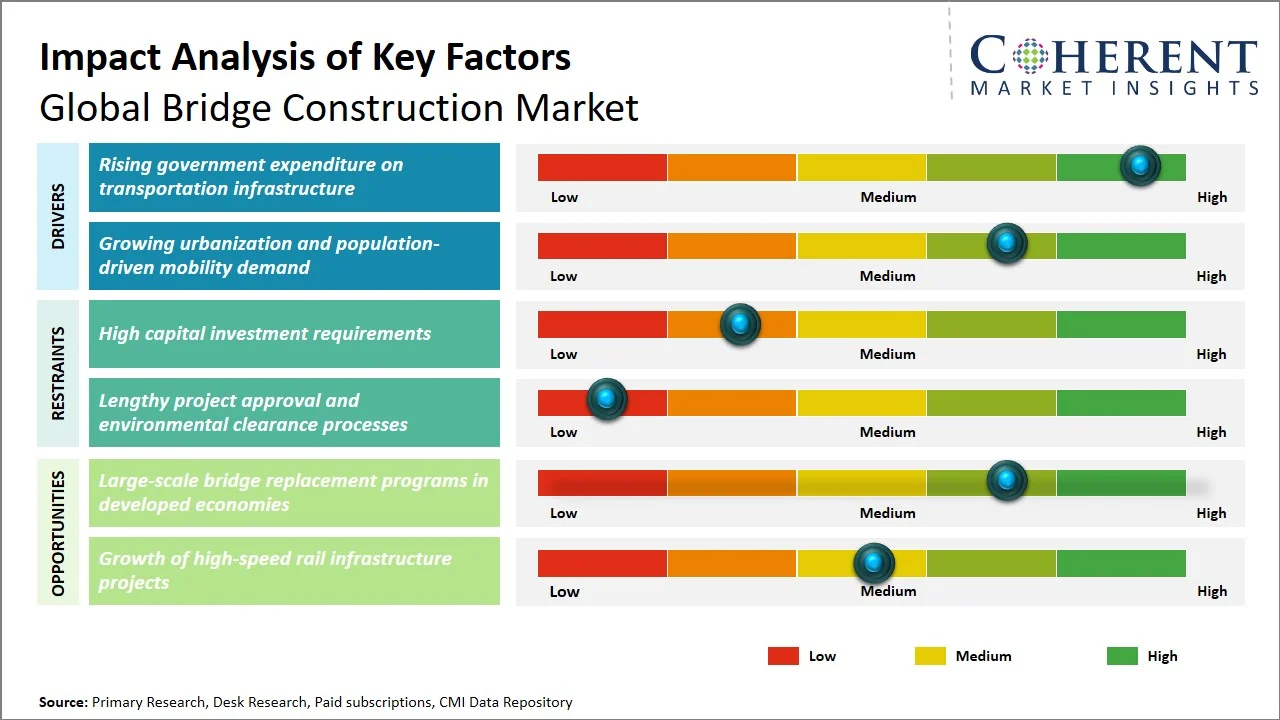
The global bridge construction market is mainly driven by rising government spending on transportation infrastructure as governments are consistently increasing their budgets to enhance connectivity, mobility and economic productivity. This translates into greater investment in the building of new bridges and the expansion and improvement of existing highway and railway networks to meet the needs of expanding urban populations and freight demand. More public money, often via stimulus and infrastructure recovery plans, is also accelerating project approvals and delivery times. So construction firms are seeing a steady stream of large-scale bridge projects across both developed and emerging parts of the world.
On April 30, 2026, Welspun Enterprises was awarded a large contract for constructing a six-lane partially elevated highway corridor on NH-753F in Maharashtra, India under a government-to-government infrastructure program. The award represents a major public investment in transport infrastructure to improve freight mobility and reduce congestion along one of the economic corridors in India.
Growing urbanization and population-driven mobility demand
The need for enhanced transportation networks, especially bridges that connect growing cities and suburban areas, is significantly driving increasing urbanization and population-driven mobility demand. As population moves to the cities, transportation becomes heavily congested and new road and rail infrastructure is needed to allow seamless flow of passengers and commodities. This increasing strain for mobility will also lead to the development of new connecting corridors and the upgrading of current bridge systems to accommodate larger load capacities and faster travel times. As a result, bridge building is increasing in both heavily populated metropolitan areas and fast-growing peri-urban areas.
On December 17, 2025, Siemens Mobility and VinSpeed signed a strategic relationship to facilitate the building of the proposed high-speed rail network in Vietnam. The project is intended to increase mobility between major urban centers experiencing high population development and rising transportation demand.
Emerging Trends
- Expansion of sustainable and low-carbon bridge materials: Increasing focus on minimizing the environmental impact of bridge construction and operation by employing sustainable materials such as high-performance concrete, recycled steel, and carbon-reducing construction methods. Contractors are being compelled by sustainability standards to follow greener design approaches in accordance with national climate targets.
- Integration of digital engineering tools such as BIM and digital twins: Building information modeling (BIM) and digital twin technologies are becoming mainstream in big bridge projects, leading to improved design coordination, clash detection, cost estimation, and lifecycle simulation. These tools are increasing project efficiency and decreasing delays and budget overruns.
Regional Insights

Why is Asia Pacific a Strong Market for Bridge Construction?
Asia Pacific is expected to account for a market share of 48.0% in 2026. In Asia Pacific, a wave of bridge construction is being pushed by national connectivity projects and cross-border infrastructure development. Mega projects in China, such as the Hong Kong–Zhuhai–Macau Bridge, and the ongoing development of the Yangtze River bridge network, are examples of the constant investment in complicated long-span constructions. India is also undertaking projects like Dhola–Sadiya Bridge and the new bridges under the Bharatmala Pariyojana to boost highway connectivity between states. Southeast Asian countries are also building critical river and coastal bridges to assist trade corridors under ASEAN logistical integration. These projects demonstrate a strong combination of urban expansion, industrial corridors and inter-city transport upgrades across the region.
Why Does the North America Bridge Construction Market Exhibit High Growth?
North America is projected to account for 22.0% of the global bridge construction market and is expected to register the fastest growth. Replacement and rehabilitation of aged infrastructure is a primary driver of bridge construction activity in North America, with large upgrades being pushed through federal and state level projects. One key focus in the U.S. is replacing structurally failing bridges like those across the Northeast Corridor and interstate highway system. That includes projects like the Brent Spence Bridge extension between Kentucky and Ohio. Canada is also building big infrastructure like the Gordie Howe International Bridge between Windsor and Detroit to facilitate cross-border trade. These initiatives are focused on improving structural safety, freight efficiency and upgrading extensively used transit corridors.
Global Bridge Construction Market Outlook for Key Countries
Why is China Emerging as a Major Hub in the Bridge Construction Market?
China’s bridge construction market consists of gigantic engineering feats as part of the country’s transport and economic strategy. Landmark examples are the Danyang–Kunshan Grand Bridge on the high-speed rail network and the Hong Kong–Zhuhai–Macau Bridge, a feat of modern marine and tunnel-bridge hybrid engineering. Additional bridges crossing rivers in the Yangtze and Pearl River deltas continue to enable fast urban development and industrial linkage. These projects are indicative of the robust state-backed execution capacity and continued expansion of high-speed rail and expressway networks.
Is U.S. the Next Growth Engine for the Bridge Construction Market?
The bridge construction market in the U.S. is driven by aging infrastructure repair, replacement, and resilience-oriented modifications. The replacement of the Tappan Zee Bridge with the Governor Mario M. Cuomo Bridge and the rebuilding of the I-95 and I-10 bridge corridors reflect a sweeping modernization push. The Francis Scott Key Bridge replacement project also illustrates the heightened focus on structural safety in the wake of high-profile catastrophes. These advances are a step towards robust, climate-adaptive and long-life infrastructure design on major transit corridors.
Germany Bridge Construction Market Analysis and Trends
The bridge construction activity in the country is focused on upgrading key transport corridors and replacing outdated highway and railway bridges. The A100 urban freeway bridges in Berlin and many crossings over the Rhine River are being strengthened and modernized to carry more freight traffic across Europe. Another major focus is on upgrades to rail bridges under Deutsche Bahn modernization plans, notably in crowded freight lanes. These initiatives emphasize durability, ease of maintenance and integration into Germany’s high-density logistics network.
India Bridge Construction Market Analysis and Trends
India’s bridge construction market is quickly growing with projects for highway, river-crossing and regional connections under national infrastructure programmes. Notable examples include Bogibeel Bridge in Assam that improves rail and road connectivity across Brahmaputra River and Atal Setu in Mumbai that improves urban coastal mobility. Under Bharatmala and Sagarmala programmes, many bridges are being constructed to facilitate freight routes and access to ports. These initiatives show a great desire for interstate transportation, logistical efficiency, and regional economic integration.
Japan Bridge Construction Market Analysis and Trends
Japan’s bridge construction market is strongly driven by seismic resilience requirements and aging infrastructure replacement. The Akashi Kaikyō Bridge is still a famous technical achievement and highway bridges around Tokyo and Osaka are being reinforced to improve their earthquake resilience. Many older, post-war bridges are being replaced or retrofitted under national disaster preparedness initiatives. Such measures are a reflection of Japan’s ongoing focus on structural safety, catastrophe prevention and long-term reliability of infrastructure.
Global Bridge Construction Market - Aging Bridge Inventory by Country (2026 Estimates)
Country | Total Bridge Inventory (Approx.) | Bridges Considered Aging |
U.S. | 623,000 | 272,000 |
Japan | 730,000 | 420,000 |
Germany | 130,000 | 52,000 |
France | 250,000 | 95,000 |
U.K. | 190,000 | 70,000 |
China | 1,080,000 | 215,000 |
India | 175,000 | 42,000 |
Canada | 85,000 | 31,000 |
Australia | 55,000 | 21,000 |
South Korea | 39,000 | 11,000 |
Global Bridge Construction Market - Smart Bridge Monitoring Installations (2026)
Region | Installed Smart Bridge Monitoring Systems (Units) |
Asia Pacific | 18,500 |
North America | 12,400 |
Europe | 10,800 |
Latin America | 2,100 |
Middle East & Africa | 1,700 |
How are Large-Scale Bridge Replacement Programs in Developed Economies Creating New Growth Opportunities in the Bridge Construction Market?
Sustained demand in the bridge building industry is driven by the demand for the modernization of old infrastructure that has surpassed its design life, offering considerable growth potential in large-scale bridge replacement programs in developed nations. Countries such as the U.S., Germany and Japan are busy replacing structurally defective bridges and redesigning outdated bridges to meet today’s safety, load-bearing and climate-resiliency standards. This has resulted in a steady stream of projects for engineering firms, construction contractors and suppliers of materials, particularly steel, high-performance concrete and innovative composite systems. Also, these programs are supporting the implementation of novel construction techniques including rapid bridge construction, modular section replacement, and digital design tools, which are revolutionizing execution models and enhancing project efficiency.
On May 6, 2026, Skanska announced it has been awarded a large design-build contract by the Massachusetts Bay Transportation Authority to replace the century-old North Station Draw One Bridge in Boston, U.S. The project includes the construction of new lift-span bridge infrastructure and upgraded rail systems to improve operational reliability and passenger capacity.
Market Players, Key Development, and Competitive Intelligence

Key Developments
- On May 22, 2026, the National High Speed Rail Corporation Limited completed and launched several steel and PSC bridges, including a 100-meter steel bridge and multiple river crossings in Gujarat under the bullet train corridor. These developments are part of a broader high-speed rail infrastructure rollout involving viaducts, river bridges, and elevated segments.
- On February 6, 2024, the transportation infrastructure business of Larsen & Toubro won a prestigious project contract to construct the Palashbari to Sualkuchi Cable-Stayed Bridge across the river Brahmaputra in Assam, India. The project has been awarded by the Public Works Roads Department (PwRD), Assam to construct a 12.21 km bridge with approaches connecting Palashbari and Sualkuchi. The bridge will directly connect both the towns.
Competitive Landscape
The global bridge building market is driven by the presence of huge multinational engineering and construction corporations, as well as strong regional contractors supported by government infrastructure initiatives. The market is quite competitive with the presence of significant firms such as VINCI, ACS Group, China State Construction Engineering Corporation, Skanska and Bechtel actively engaged in large scale highway, rail and mega bridge projects. The projects are largely implemented through public-private partnerships and government contracts, where bidding competitiveness and cost-efficiency play a key role. Consolidation moves and strategic partnerships with technology suppliers are increasingly seen to boost skills in digital engineering, modular construction and complicated bridge design execution.
Market Report Scope
Bridge Construction Market Report Coverage
| Report Coverage | Details | ||
|---|---|---|---|
| Base Year: | 2025 | Market Size in 2026: | USD 1,280 Bn |
| Historical Data for: | 2020 To 2024 | Forecast Period: | 2026 To 2033 |
| Forecast Period 2026 to 2033 CAGR: | 4% | 2033 Value Projection: | USD 1,750 Bn |
| Geographies covered: |
| ||
| Segments covered: |
| ||
| Companies covered: | AECOM, Balfour Beatty, Bouygues Construction, China Communications Construction Company, China Railway Group, China State Construction Engineering Corporation, Fluor Corporation, Grupo ACS, HOCHTIEF, Kiewit Corporation, Samsung C&T Corporation, Skanska, VINCI Construction, Larsen and Toubro, Bechtel Corporation | ||
| Growth Drivers: |
| ||
| Restraints & Challenges: |
| ||
Analyst Opinion (Expert Opinion)
- The need for bridge construction is expected to be sustained by infrastructure renovation initiatives and the growing needs for transportation connections in both developed and emerging nations. It is also pointed out that the use of new construction technologies and materials is being expedited to improve the productivity of the project and the longevity of the structure. Sustainability and lifecycle cost optimization are more emphasized, which is driving design and procurement decisions. Also, there is a perception that steady government financing and multi-year plans for infrastructure development are adding to long-term market stability.
- Future outlook of the bridge construction market is likely to be influenced by increased expenditures in smart infrastructure, climate resilient bridge designs, and large scale urban connection projects. Demand for replacement of aged bridge assets will continue to be robust in developed nations, and emerging regions are expected to see growth from new highway and rail construction initiatives. Digital twin technology, AI-based monitoring systems and modular building processes should change the way projects are delivered, with more use of such technologies. Sustainability driven policies and carbon reduction targets are also expected to increasingly affect material choices and building processes in global markets.
Speak to the analyst
Want personalized insights?
Take the findings above to one of our principal consultants, or have the report rebuilt around the segments, geographies and competitors you actually track.
Market Segmentation
- Type Insights (Revenue, USD Billion, 2021 - 2033)
- Beam Bridge
- Truss Bridge
- Arch Bridge
- Suspension Bridge
- Others
- Material Insights (Revenue, USD Billion, 2021 - 2033)
- Concrete
- Steel
- Composite Materials
- Timber
- Construction Method Insights (Revenue, USD Billion, 2021 - 2033)
- Conventional Construction
- Incremental Launching
- Segmental Construction
- Modular Construction
- Cable-Stayed Construction
- Regional Insights (Revenue, USD Billion, 2021 - 2033)
- North America
- U.S.
- Canada
- Latin America
- Brazil
- Argentina
- Mexico
- Rest of Latin America
- Europe
- Germany
- U.K.
- Spain
- France
- Italy
- Russia
- Rest of Europe
- Asia Pacific
- China
- India
- Japan
- Australia
- South Korea
- ASEAN
- Rest of Asia Pacific
- Middle East
- GCC Countries
- Israel
- Rest of Middle East
- Africa
- South Africa
- North Africa
- Central Africa
- North America
- Key Players Insights
- AECOM
- Balfour Beatty
- Bouygues Construction
- China Communications Construction Company
- China Railway Group
- China State Construction Engineering Corporation
- Fluor Corporation
- Grupo ACS
- HOCHTIEF
- Kiewit Corporation
- Samsung C&T Corporation
- Skanska
- VINCI Construction
- Larsen and Toubro
- Bechtel Corporation
Sources
Primary Research Interviews
- Bridge Construction Contractors & Engineers
- Civil Infrastructure Project Developers
- Government & Public Works Department Officials
- Steel & Concrete Material Suppliers
Journals
- Journal of Bridge Engineering (ASCE)
- Journal of Structural Engineering
- International Journal of Civil & Structural Engineering
Associations
- International Bridge, Tunnel and Turnpike Association (IBTTA)
- American Institute of Steel Construction (AISC)
- International Federation for Structural Concrete (FIB)
- American Society of Civil Engineers (ASCE)
Public Domain Sources
- U.S. Federal Highway Administration (FHWA) – National Bridge Inventory
- World Bank – Infrastructure & Transport Data
- European Commission – Transport Infrastructure Reports
- United Nations Economic Commission for Europe (UNECE) – Infrastructure Statistics
Proprietary Elements
- CMI Data Analytics Tool
- Proprietary CMI Existing Repository of Information for the Last 10 Years
Get access to 250+ pages report
Every segment, forecast, competitor profile and data table behind the analysis above — available for instant download.
- ESOMAR Member
- ISO 9001:2015 Certified
- D-U-N-S Registered
- GDPR & CCPA Compliant
Missing comfort of reading report in your local language? Find your preferred language:
Transform your Strategy with Exclusive Trending Reports
Frequently Asked Questions
The global bridge construction market is expected to stand at USD 1,280 Bn in 2026 and is expected to reach USD 1,750 Bn by 2033.
The CAGR of the global bridge construction market is projected to be 4% from 2026 to 2033.
Urbanization increases traffic demand, requiring more bridges and expanded transport networks.
Bridge replacement is important because many structures are aging and no longer meet safety standards.
Rising government expenditure on transportation infrastructure and growing urbanization and population-driven mobility demand are the major factors driving the growth of the global bridge construction market.
High capital investment requirements and lengthy project approval and environmental clearance processes are the major factors hampering the growth of the global bridge construction market.
In terms of type, the beam bridge segment is estimated to dominate the market revenue share in 2026.