

Global Catalyst Regeneration Market Size and Forecast – 2026-2033
The global catalyst regeneration market is estimated to be valued at USD 5,768.2 Mn in 2026 and is expected to reach USD 9,196.0 Mn by 2033, exhibiting a compound annual growth rate (CAGR) of 6.9% from 2026 to 2033.
Key Takeaways of the Catalyst Regeneration Market
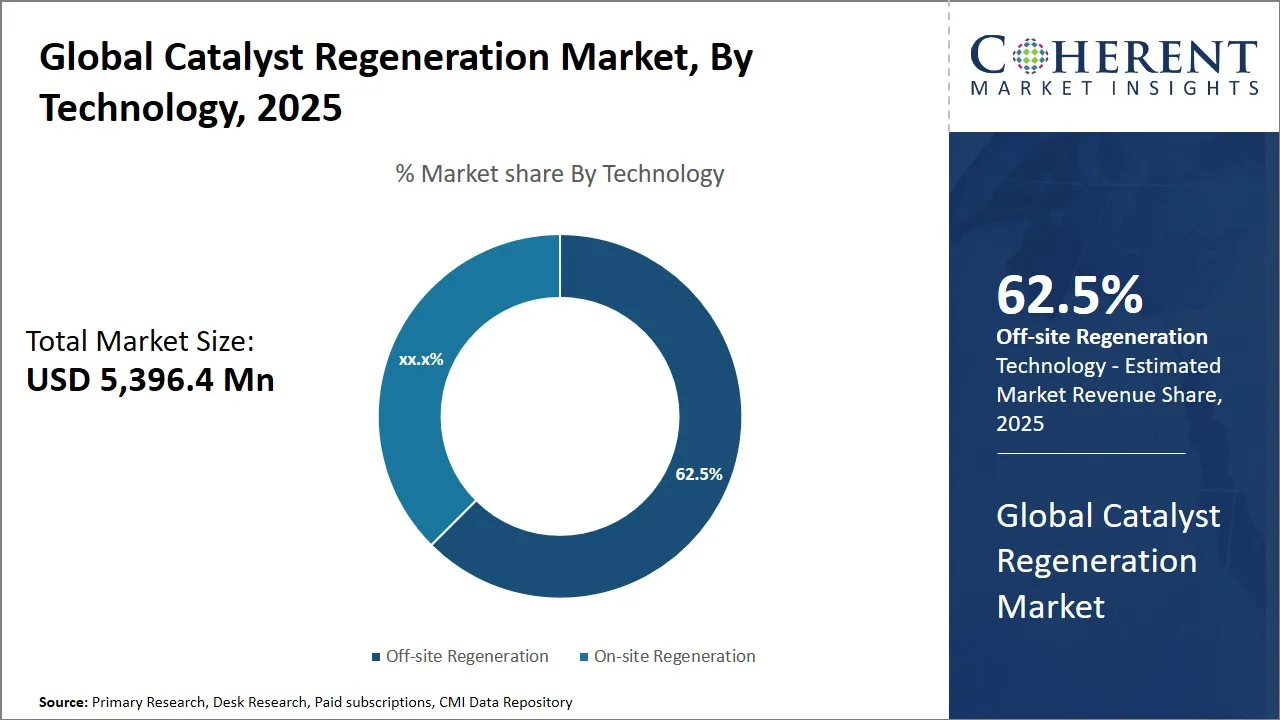
- Off-site regeneration segment is expected to account for 63.5 % of the global catalyst regeneration market share in 2026.
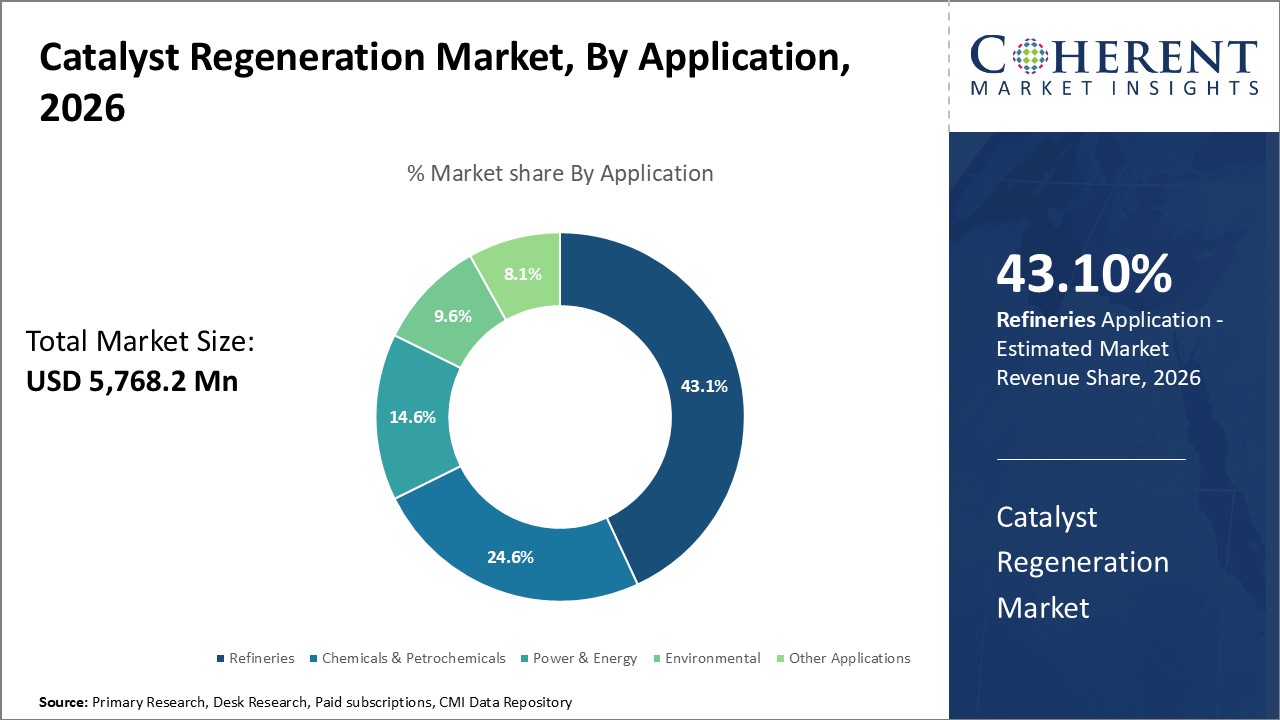
- The refineries segment is projected to hold 43.1 % of the catalyst regeneration market share in 2026.
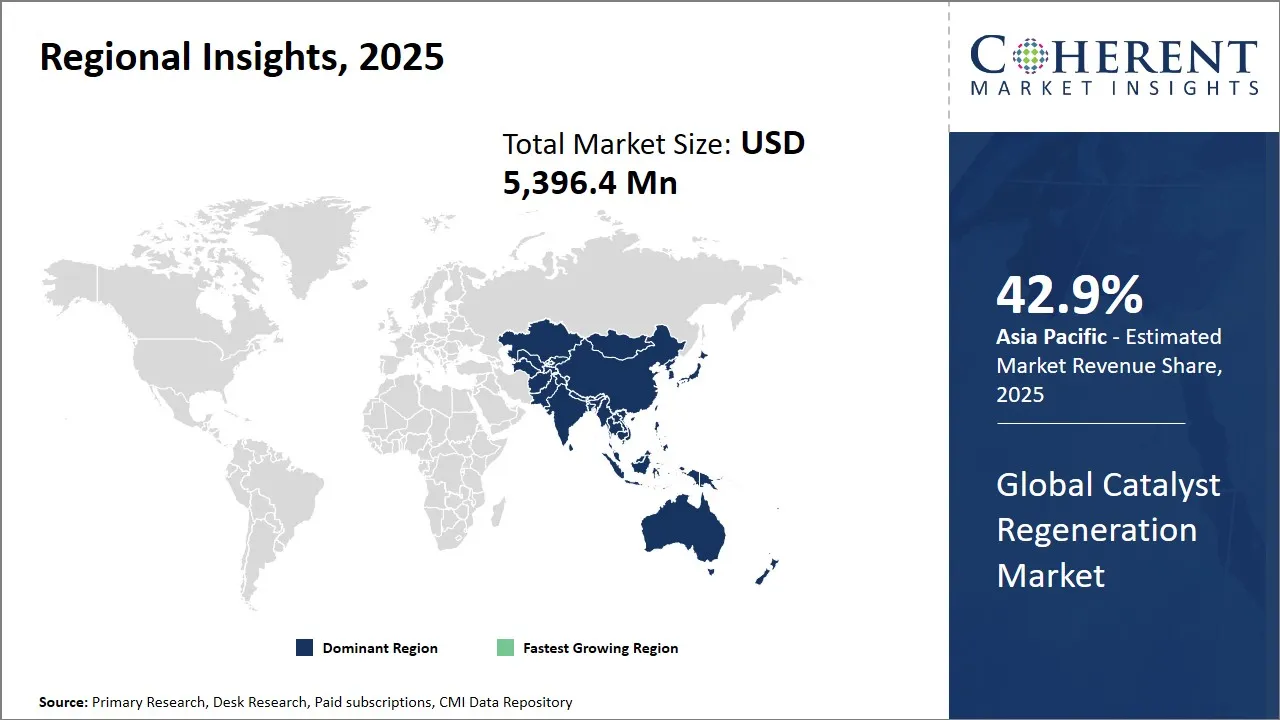
- Asia Pacific dominates and lead growth in the catalyst regeneration market in 2026 with a 42.9 % share.
Market Overview
One of the major trends that facilitate the catalyst regeneration market is the increased attention that is paid to environmental regulations and sustainable industrial practices that encourage companies to increase catalyst life and minimize the amount of waste. There is also the growth of regeneration technologies including better thermal and chemical treatment processes that are improving the performance of catalysts and decreasing turnaround times. The growing demand on efficient systems of emissions control, as well as the increasing investments in refining capacity, also contribute to the further growth of the market in the nearest future.
Current Events and Its Impact
Current Events | Description and its Impact |
Aramco–Sinopec expansions: Yasref, KSA (April 9, 2025) |
|
India hazardous-waste rule updates |
|
Segmental Insights
- Current Industry Events of 2026
- Market Size Estimation
- Regional Breakdown
- Competitive Landscape
- Customer Intelligence
- Segmental Analysis
- Pricing Analysis
- Key Market Drivers, Challenges & Future Trends
- Customized Insights Section
Catalyst Regeneration Market Insights, By Technology - Off-site Regeneration Segment Dominates the Market Due to Superior Operational Efficiencies and Enhanced Catalyst Performance
Off-site regeneration segment is expected to hold 63.5% of the global catalyst regeneration market share in 2026, due to the fact that it enables a more comprehensive and controlled restoration of the catalyst activity as opposed to on-site techniques. Off-site regeneration plants are specially made with advanced equipment’s and controlled conditions that can enable the accurate regulation of temperature, controlled atmosphere and proper elimination of contaminants on spent catalysts. This careful procedure produces catalysts which are more active, selective and have a longer operational life when repurposed in the industrial processes.
The other major driver that has enhanced the growth in the off-site regeneration business is the rising demand by the industries that need high-purity and high-activity catalysts to sustain the quality of the products and regulatory compliance. Off-site plants capitalize on the modern technologies like fluidized bed regeneration, thermal desorption, and chemical treatment processes that can hardly be practiced on-site because of space and security reasons. This will be such that, greatly deactivated or poisoned catalysts are reactivated adequately, reducing the frequency of replacement hence lowering the operational expenses.
Catalyst Regeneration Market Insights, By Application – Refineries Segment Dominates the Market driven by Stringent Fuel Quality Standards and Refinery Process Optimization
The refinery segment is projected to command 43.1% of the catalyst regeneration market share in 2026, due to catalysts being of center focus in enabling the significant refining processes like hydrocracking, catalytic reforming, hydrotreatment, and fluid catalytic cracking. The processes have to be catalyzed to ensure that the yield is optimized, the quality of the fuel is enhanced and harmful emissions minimized. But with time, the activity of catalyst is reduced because of coke formation, deposition of metal, and poisoning. A regeneration process is therefore necessary to refurbish the catalytic efficiency assuring that the refineries can meet the changing fuel specifications and environmental standards.
The growing emphasis around the world on the lowering of levels of sulfur and other pollutants in transportation fuels is one of the current growth drivers in this segment. Euro VI, Tier 3 and other regulatory requirements across the world require low-sulfur diesel and gasoline. To conform, refineries are very dependent on selective and active catalysts that are constantly on the move thus necessitating effective methods of catalyst regeneration that would not interfere with its operation.
Regional Insights
Asia Pacific Catalyst Regeneration Market Analysis and Trends
The fastest growth is in the global catalyst regeneration market in Asia Pacific, where it will have a 42.9% share in 2026. The expansion of the region is also supported by the fast-growing industrial activities in China, India, South Korea and Southeast Asia. The growth drivers are increased demand of petrochemical products, the manufacture of automobiles, and the enforcement of more stringent environmental regulations that promote the use of catalysts (reuse and regeneration).
Market advancement is also further spurred by government efforts of encouraging green technologies and self-reliance in industries. The rise of regional leaders, e.g. Sinopec (China) and Jubilant Life Sciences (India), makes the local ecosystem more robust, which decreases the level of imported products and enhances innovation. The regions robust growth curve is also supported by favorable trade policies as well as technology transfer programs.
Global Catalyst Regeneration Market Outlook for Key Countries
U.S. Catalyst Regeneration Market Analysis and Trends
The U.S. is a pioneer in the catalyst regeneration market given the fact that the country has developed chemical and refining industries and has progressive regulatory policies which are aimed at reducing emissions and promoting sustainability. The major players such as W.R. Grace & Co. and Albemarle Corporation control the industry, and they have been putting a lot of money in research and development to enhance the catalyst recovery rate and regeneration procedures.
The high-tech infrastructure, as well as a highly professional workforce, facilitates the implementation of innovative technologies, which makes the U.S. an innovation center in terms of catalyst lifecycle management.
China Catalyst Regeneration Market Analysis and Trends
The China market for catalyst regeneration is rapidly growing, supported by the development of the petrochemical and automotive sector. Sinopec and China National Petroleum Corporation (CNPC) are domestic firms that are making substantial contributions to the market through the establishment of in-house regeneration plants and setting up of eco-friendly technologies. The policies implemented by the government to control pollution and principles of the circular economy make industry participants focus on catalyst recycling and regeneration in order to minimize waste and reliance on imports.
Germany Catalyst Regeneration Market Analysis and Trends
Germany remains a catalyst regeneration market leader in Europe with solid chemical industry and a focus on sustainable manufacturing. Such companies as BASF and Evonik Industries play an important role, with their advanced regeneration technology meeting the high environmental expectations of Europa. The well-developed research institutions in the country have also collaborated with the industry players in innovating the processes of catalyst regeneration ensuring that the country remains one of the technological leaders.
India Catalyst Regeneration Market Analysis and Trends
The market for catalyst regeneration is actively growing in India since the nation is advancing its refining and chemical manufacturing plants. Regeneration services have been scaled up due to the efforts of companies like Jubilant Life Sciences and Indian oil Corporation that have contributed to these growing needs of the industries. Favorable government policies around Make in India and environmental friendliness are also pushing investments in the local regeneration plants that would avoid expensive disposal of catalysts and their importation.
Regional Refinery Capacity and Catalyst Consumption Trends
- China’s refining capacity nearly doubled from 10.6 million bpd in 2005 to 18.8 million bpd in 2025, with major projects launching in 2025 despite some closures.
- India’s refinery throughput is projected to reach 5.9 million bpd by 2026, driven by expansions and new greenfield projects, supporting both fuel production and petrochemical output.
- North America and Europe maintain substantial refinery capacity but face slower growth; investment in advanced refining and tight environmental regulations are driving demand for high-performance and sustainable catalysts.
- Asia Pacific (particularly China and India) and the Middle East are building new capacity to meet rising domestic and regional demand. For example, projects like Indian Oil Corporation's Gujarat and Saudi Aramco-backed complexes in China are contributing to this growth.
- Catalyst consumption trends match refinery investments: rapid growth in Asia Pacific; steady demand, with a sustainability focus, in North America and Europe; smaller but rising usage in the Middle East & Africa as new refineries are commissioned.
Market Players, Key Development, and Competitive Intelligence
Key Developments
- On November 5, 2025, Global Standard Air (GSA) launched its proprietary hydrogen dryer in Seoul, featuring a palladium catalyst system for ultra-high-purity hydrogen. The unit emphasizes performance, energy efficiency, and sustainability, setting a new benchmark in hydrogen purification for industrial and clean energy sectors.
- On October 2025, Ketjen Corporation sold its 50% stake in Eurecat SA and its Isomerization Catalysts business to Axens SA. Axens will now fully own Eurecat, a leader in catalyst regeneration and recycling. Ketjen will continue collaborating with Eurecat on advanced catalyst technologies under a long-term agreement.
Top Strategies Followed by Global Catalyst Regeneration Market Players
- Established market leaders invest heavily in research and development to create high-performance, innovative products that meet evolving industry standards and regulatory requirements. These firms focus on sustained product improvement that will focus on enhancing the efficiency, durability as well as environmental friendliness of the catalysts. Their international expansion initiative is strengthened by expansion of distribution channels and opening of regional offices especially in the emerging markets where industrial growths and environmental protection laws are compelling demand of their catalyst regeneration services.
- As an example, Albemarle corporation, Axens Group, and Eurecat SA spend a lot on R&D to promote catalyst regeneration efficiency and sustainability. Axens concentrates on the hydroprocessing catalyst regeneration technologies that minimize the carbon footprint and increase the catalyst life cycle.
- The mid-level firms on the market for catalyst regeneration concentrate on the balance between quality and the pricing, addressing the needs of the price-sensitive customers with the reliable yet affordable solutions. These competitors tend to focus on efficiency operational and lean manufacturing as a means of cutting costs but not performance, which makes their products a viable alternative to high-end products made by bigger companies.
- For example, Hadidor Topsoe can be used as an illustration of offering mid-cost regeneration services centered on hydrodesulfurization (HDS) catalysts, finding a balance between cost and performance to attract independent refiners.
- These smaller catalyst regeneration companies are more likely to carve possible niches in this competitive environment, with the product features, customized solutions, or novel technologies having specific regional or industrial applications. These smaller companies tend to embrace the latest technology solutions like modern materials science or automation to make a difference and be competitive despite the small resources.
- For example, Cat Tech, the company offers on-site catalyst services and partial regeneration of small refineries with safety and continuity of operations. Asian Pacific and European experts in the field of regeneration are incorporating automation-based temperature regulation and sophisticated materials analytics to provide high-resolution regeneration.
Market Report Scope
Catalyst Regeneration Market Report Coverage
| Report Coverage | Details | ||
|---|---|---|---|
| Base Year: | 2025 | Market Size in 2026: | USD 5,768.2 Mn |
| Historical Data for: | 2020 To 2024 | Forecast Period: | 2026 To 2033 |
| Forecast Period 2026 to 2033 CAGR: | 6.9% | 2033 Value Projection: | USD 9,196.0 Mn |
| Geographies covered: |
| ||
| Segments covered: |
| ||
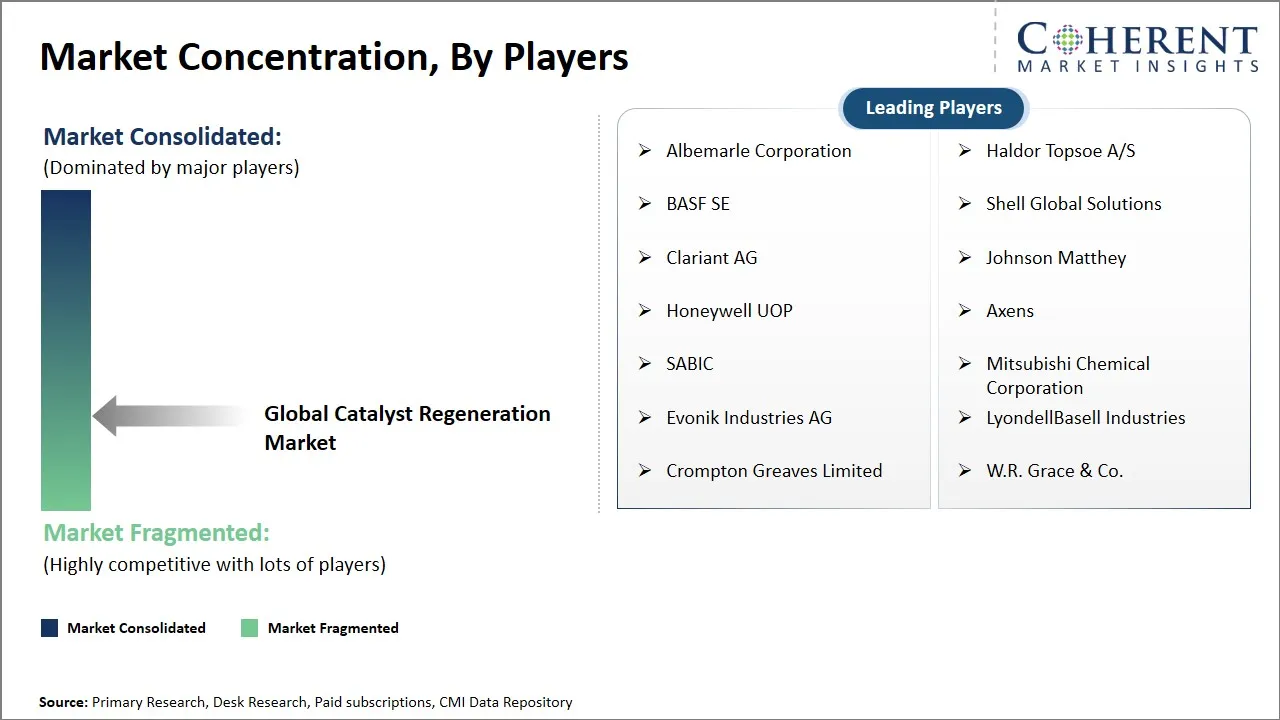
| Companies covered: | Albemarle Corporation, Haldor Topsoe A/S, BASF SE, Shell Global Solutions, Clariant AG, Johnson Matthey, Honeywell UOP, Axens, SABIC, Mitsubishi Chemical Corporation, Evonik Industries AG, LyondellBasell Industries, Crompton Greaves Limited, and W.R. Grace & Co. | ||
| Growth Drivers: |
| ||
| Restraints & Challenges: |
| ||
Catalyst Regeneration Market Dynamics
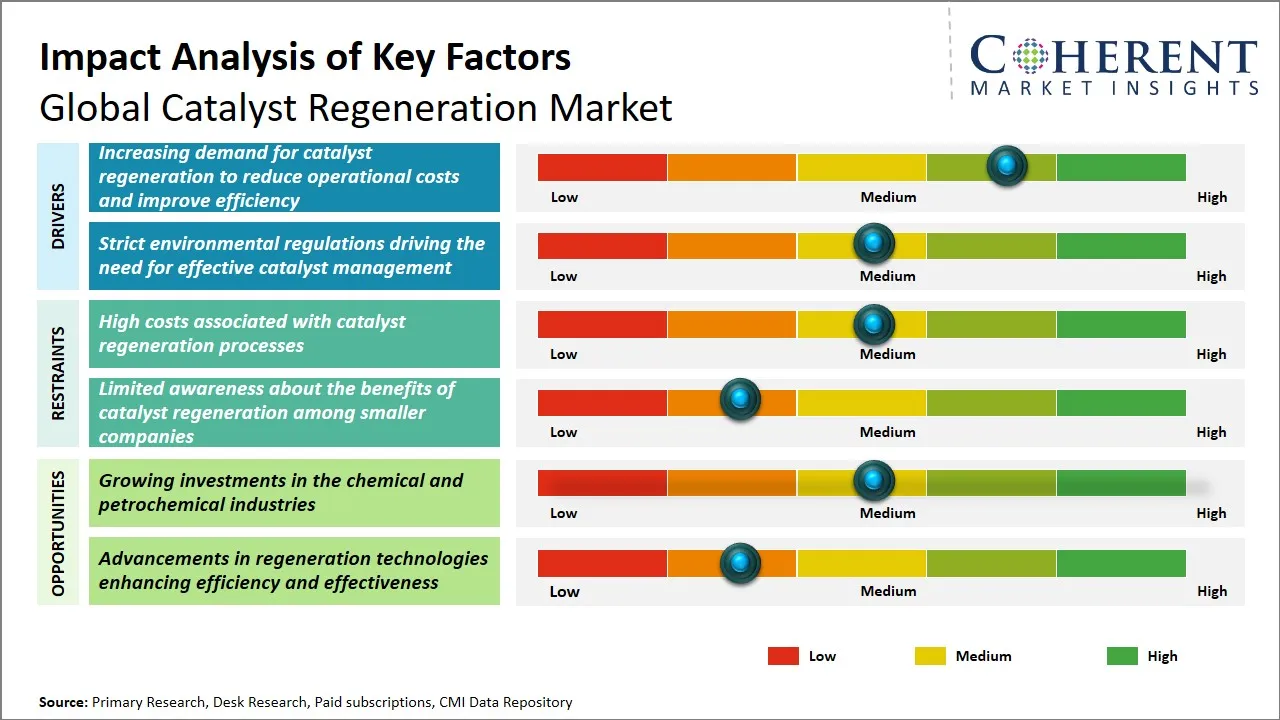
Catalyst Regeneration Market Driver - Increasing Demand for Catalyst Regeneration to Reduce Operational Costs and Improve Efficiency
One of the major forces that have contributed to the development of the catalyst regeneration market in the world is the increasing focus on the reduction of operational costs and maximization of process efficiency in diverse industries, such as petrochemicals, refining, and chemical manufacturing. Regeneration of catalysts is a cost-efficient method to replace entirely catalysts and recover catalyst activity and life. This reclamation does not only reduce the capital expenditure of buying new catalysts that are very expensive but it also reduces downtime in the production cycle and hence leads to efficiency in overall operations.
In another case of Reliance Industries Ltd. periodic catalyst regeneration was implemented in its Jamnagar refinery and the frequency of catalyst replacement decreased 35 and the operating cost was significantly cut.
Catalyst Regeneration Market Opportunity - Growing Investments in the Chemical and Petrochemical Industries
The future of catalyst regeneration is expected to be bright of the world owing to the rising investments in chemical and petrochemical industry across the globe. With the growth of these industries to satisfy the increasing demand of petrochemical products in the world, the focus on efficiency and sustainability has been amplified leading to the use of catalyst regeneration technologies. Firms are currently working hard to modernize their old plants and build new factories and this has resulted in the high demand of high-quality catalyst regeneration services as a way of sustaining the activity of the super catalyst, lower operational expenses, and minimize the duration of downtime.
For example, a petrochemical changing its reforming or cracking unit (to comply with low-sulphur-clean-fuel requirements) will require high-activity catalysts. Rather than disposing the spent catalyst, one can provide it to a regeneration service company such as Evoniks to restore it to almost its starting level of activity.
Analyst Opinion (Expert Opinion)
- The global catalyst regeneration market has experienced a tremendous growth due to the current tendency in the industries towards sustainability and cost-effectiveness of the chemical operations. The 2023 Catalysis Society Conference and the 2022 Global Refining & Petrochemicals Conference provided illicit insights into the progress in the field, and firms such as Johnson Matthey and Haldor Topsoe were noted to have advanced in the field of catalyst management and regeneration technologies.
- The recent response of the markets to the environmental legislation and necessity of economic feasibility in the practice is illustrated by the case of Johnson Mattheys recent introduction of a proprietary regeneration service that extends the life of catalysts and minimizes waste. At these conferences, it was pointed out that effective catalyst regeneration is critical to reduce downtime and the cost of operations, especially in refining and petrochemical industries. Difficulties like the complicated nature of the regeneration processes and the necessity of highly skilled workers were, however, often identified as obstacles to wider usage.
- The businesses that aim at creating ease-to-use technologies and offer extensive training to the operators are likely to improve their positions in the market. Finally, the expansion of the catalyst regeneration market globally will rely on its innovation in supporting the changing needs of efficiency and sustainability of processes in the industries.
Speak to the analyst
Want personalized insights?
Take the findings above to one of our principal consultants, or have the report rebuilt around the segments, geographies and competitors you actually track.
Market Segmentation
- Technology Insights (Revenue, USD Mn, 2021 - 2033)
- Off-site Regeneration
- On-site Regeneration
- Application Insights (Revenue, USD Mn, 2021 - 2033)
- Refineries
- Chemicals & Petrochemicals
- Power & Energy
- Environmental
- Other Applications
- Regional Insights (Revenue, USD Mn, 2021 - 2033)
- North America
- U.S.
- Canada
- Latin America
- Brazil
- Argentina
- Mexico
- Rest of Latin America
- Europe
- Germany
- U.K.
- Spain
- France
- Italy
- Russia
- Rest of Europe
- Asia Pacific
- China
- India
- Japan
- Australia
- South Korea
- ASEAN
- Rest of Asia Pacific
- Middle East
- GCC Countries
- Israel
- Rest of Middle East
- Africa
- South Africa
- North Africa
- Central Africa
- North America
- Key Players Insights
- Albemarle Corporation
- Haldor Topsoe A/S
- BASF SE
- Shell Global Solutions
- Clariant AG
- Johnson Matthey
- Honeywell UOP
- Axens
- SABIC
- Mitsubishi Chemical Corporation
- Evonik Industries AG
- LyondellBasell Industries
- Crompton Greaves Limited
- R. Grace & Co.
Sources
Primary Research Interviews
- R&D Director – Leading Catalyst Manufacturer
- Procurement Manager – Major Chemical Industry Supplier
- Product Development Head – Well-Known Catalyst Brand
- Sustainability Manager – Catalyst Certification Body
Stakeholders
- Manufacturers
- End-use Sectors
- Chemical Processing
- Petroleum Refining
- Environmental Technology (e.g., catalytic converters)
- Industrial Manufacturing
- Regulatory & Certification Bodies
- E-commerce Platforms and Industrial Distributors
- Technology Integration Players: AI-based process optimization and catalyst performance analytics
Databases
- UN Comtrade Database
- India Import Export (EXIM) Database
Magazines
- Catalysts & Chemicals Magazine – Trends in catalyst technology and regeneration
- Industrial Chemistry Review – Innovations in catalyst regeneration processes
- Global Catalyst Insights – Market trends and growth opportunities
- Chemical Processing News – Advances in catalyst technologies and environmental policies
Journals
- Journal of Catalysis – Research on catalyst regeneration methods and efficiency
- Applied Catalysis B: Environmental – Environmental applications and impacts of catalyst regeneration
- Chemical Engineering Journal – Process engineering of catalyst regeneration
- Industrial & Engineering Chemistry Research – Advances in catalyst regeneration technologies
- Catalysis Today – Emerging trends in catalyst recovery and regeneration
Newspapers
- The Financial Times – Market growth and investment trends in catalyst technologies
- The Guardian – Environmental regulations impacting catalyst reuse
- Asia Chemical Industry Journal – Growth of catalyst regeneration technologies in Asia Pacific
- European Chemical News – Regulatory policies and innovation in catalyst regeneration
Associations
- American Catalysis Society (ACS)
- International Association of Catalysis
- European Catalyst Association (ECA)
- Council for Chemical Industry Standards
- Environmental Protection Agency (EPA)
Public Domain Sources
- U.S. Environmental Protection Agency (EPA) – Guidelines on catalyst regeneration and disposal
- European Commission – Regulations on chemical catalysts and waste management
- World Health Organization – Safety standards related to chemical catalysts
Proprietary Elements
- CMI Data Analytics Tool, Proprietary CMI Existing Repository of information for last 8 years.
Get access to 250+ pages report
Every segment, forecast, competitor profile and data table behind the analysis above — available for instant download.
- ESOMAR Member
- ISO 9001:2015 Certified
- D-U-N-S Registered
- GDPR & CCPA Compliant
Missing comfort of reading report in your local language? Find your preferred language:
Transform your Strategy with Exclusive Trending Reports
Frequently Asked Questions
The global catalyst regeneration market is estimated to be valued at USD 5,768.2 Mn in 2026 and is expected to reach USD 9,196.0 Mn by 2033.
The CAGR of the global catalyst regeneration market is projected to be 6.9% from 2026 to 2033.
Increasing demand for catalyst regeneration to reduce operational costs and improve efficiency and strict environmental regulations driving the need for effective catalyst management are the major factors driving the growth of the global catalyst regeneration market.
High costs associated with catalyst regeneration processes and limited awareness about the benefits of catalyst regeneration among smaller companies are the major factors hampering the growth of the global catalyst regeneration market.
In terms of technology, the off-site regeneration is estimated to dominate the market revenue share in 2026.
Albemarle Corporation, Haldor Topsoe A/S, BASF SE, Shell Global Solutions, Clariant AG, Johnson Matthey, Honeywell UOP, Axens, SABIC, Mitsubishi Chemical Corporation, Evonik Industries AG, LyondellBasell Industries, Crompton Greaves Limited, and W.R. Grace & Co. are the major players.
Asia Pacific is expected to lead the global catalyst regeneration market in 2026.