

Global Civil Engineering Market Size and Forecast – 2026 - 2033
The Global Civil Engineering Market is estimated to be valued at USD 9.82 Tn in 2026 and is expected to reach USD 15.26 Tn by 2033, exhibiting a compound annual growth rate (CAGR) of 6.5% from 2026 to 2033.
Key Takeaways of the Civil Engineering Market
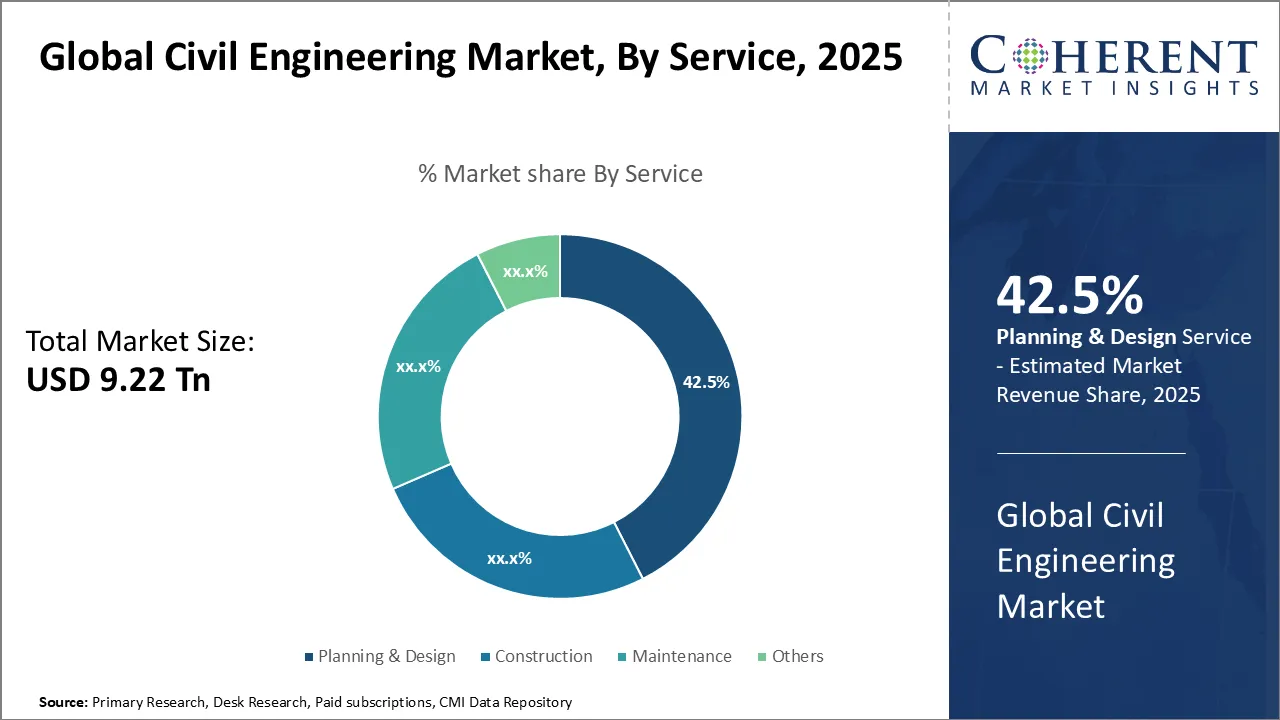
- The planning & design segment is expected to account for 43.5% of the global civil engineering market in 2026, driven by its pivotal role in defining the entire project lifecycle.
- The infrastructure segment is projected to hold a 40.5% share of the global civil engineering market in 2026, fueled by its crucial contribution to economic growth and public welfare.
- The government segment is expected to hold a 40.5% share of the global civil engineering market in 2026, owing to its key role as a financier, regulator, and client for the majority of major civil engineering projects.
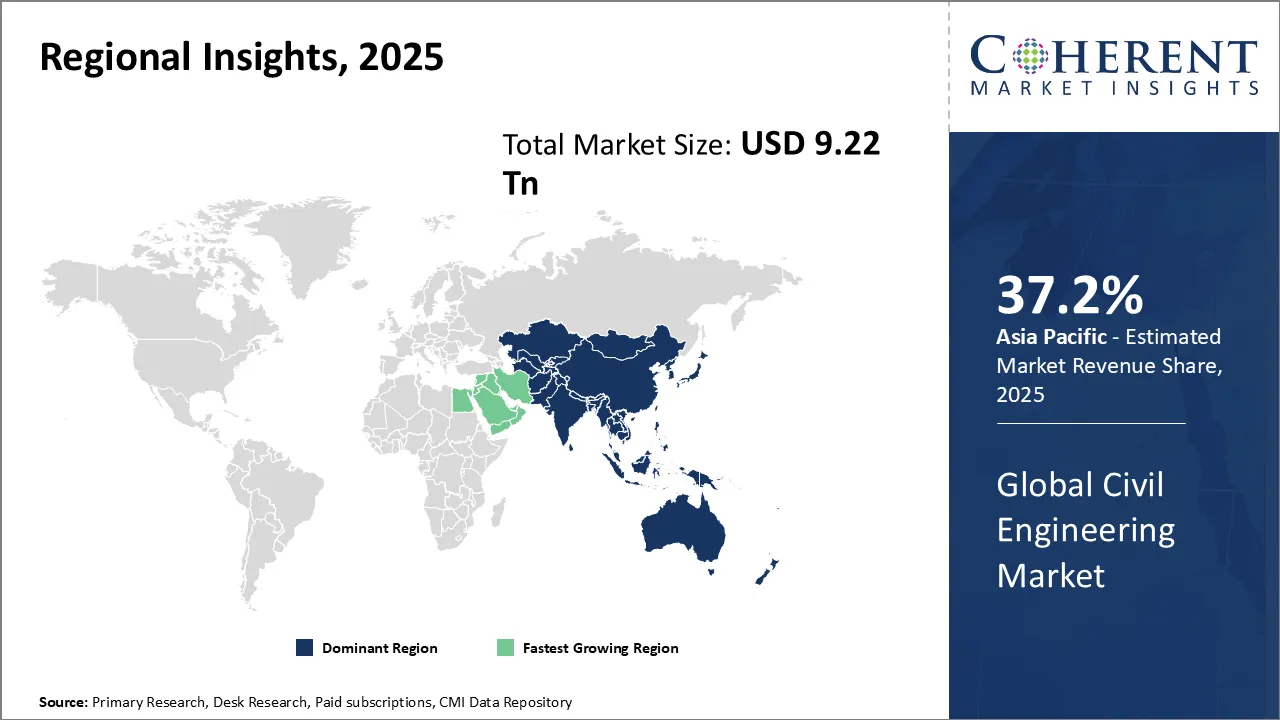
- Asia Pacific is projected to lead the global civil engineering market in 2026 with a 37.2 % share, driven by robust infrastructure development, rapid urbanization, and increasing government investments in public infrastructure. The Middle East and Africa, with a 9.5% share in 2026, will be the fastest-growing region, fueled by booming construction projects, infrastructure modernization efforts, and government-backed initiatives for smart city development.
Market Overview
Current trends in the civil engineering market highlight a strong focus on sustainable and green construction practices, driven by environmental regulations and social responsibility. The integration of digital technologies such as Building Information Modeling (BIM), automation, and the Internet of Things (IoT) is enhancing project efficiency and reducing costs. Furthermore, emerging economies are witnessing rapid infrastructure development, while the increasing emphasis on resilient infrastructure to withstand climate change impacts is shaping project priorities globally, thereby influencing market dynamics significantly.
Current Events and Its Impact
Current Events | Description and its impact |
Surge in Government Infrastructure Investments (e.g., India’s 2024-25 Budget, US IIJA/IRA) |
|
Adoption of Advanced Technologies (AI, BIM, Digital Twin, IoT) |
|
Segmental Insights
- Current Industry Events of 2026
- Market Size Estimation
- Regional Breakdown
- Competitive Landscape
- Customer Intelligence
- Segmental Analysis
- Pricing Analysis
- Key Market Drivers, Challenges & Future Trends
- Customized Insights Section
Civil Engineering Market Insights, By Service - The Planning & Design Segment Leads, Driven by the Foundation of Innovation and Precision in Civil Engineering Services
Planning & Design segment is expected to contribute 43.5% share of the global civil engineering market in 2026, owing to its critical role in shaping the entire project lifecycle. This segment acts as the blueprint stage where vision turns into actionable strategies, determining the feasibility, functionality, and sustainability of civil infrastructure. The increasing complexity and scale of civil engineering projects demand advanced planning and sophisticated design techniques, driving significant investment in this service area.
Governments and private entities alike are under growing pressure to deliver projects that withstand environmental challenges and align with climate-conscious policies. This trend propels the need for innovative design methodologies integrating cutting-edge technologies like Building Information Modeling (BIM), geographic information systems (GIS), and 3D modeling. These tools not only improve accuracy and reduce errors but also facilitate better stakeholder collaboration and resource management during the planning phase.
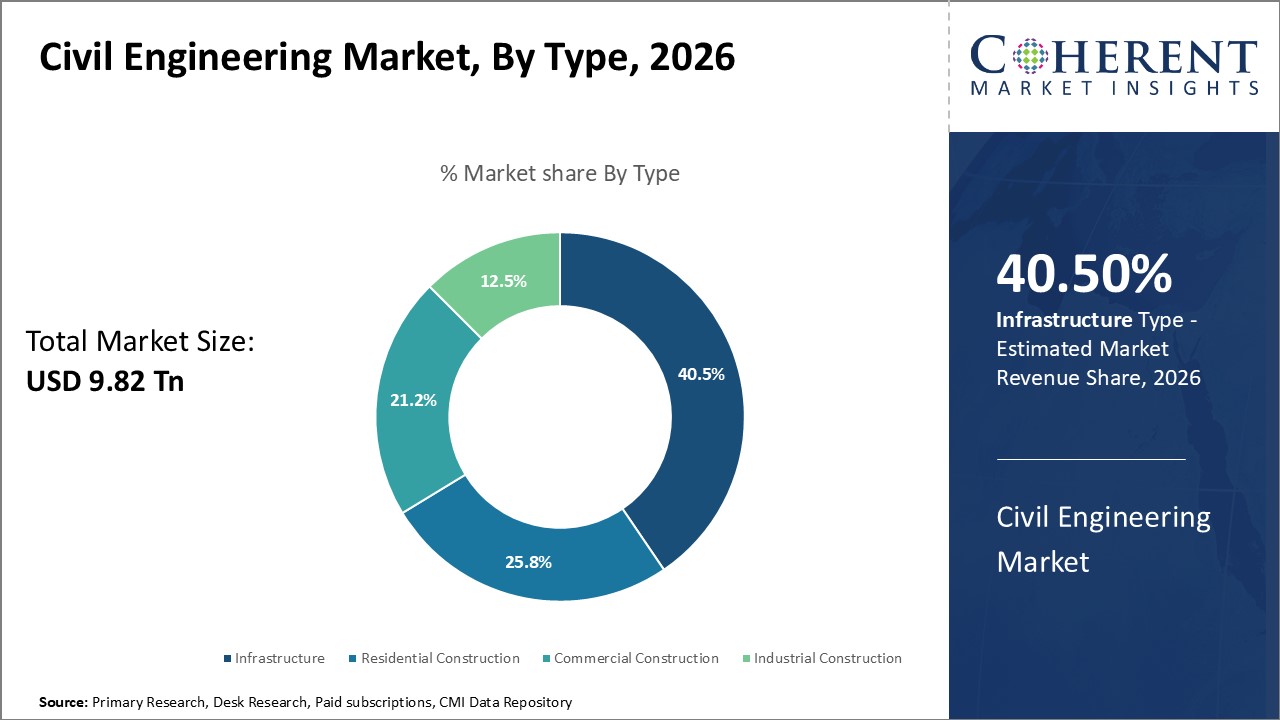
Civil Engineering Market Insights, By Type – The Infrastructure Segment Leads Due to Serving as the Growing Backbone of the Civil Engineering Industry
Infrastructure segment is expected to hold 40.5% share of the global civil engineering market in 2026, driven by its pivotal role in economic development and public welfare. Infrastructure encompasses critical projects like highways, bridges, railways, airports, water supply systems, and energy grids—projects that serve as the backbone for urban and rural connectivity and essential services.
The foremost factor propelling growth in the infrastructure segment is the urgent need to replace and upgrade aging structures globally. Many developed regions face the challenge of deteriorating infrastructure-built decades ago, necessitating large-scale renovation and modernization projects to ensure safety, efficiency, and sustainability.
Civil Engineering Market Insights, By End User – The Government Segment is Driving the Market, Fueled by Policies and Public Investment Initiatives
Government segment is expected to hold 40.5% share of the global civil engineering market in 2026, due to its central role as a financier, regulator, and client for most major civil engineering projects. Government involvement spans various infrastructure development, maintenance, and redevelopment initiatives that form the foundation for economic growth and societal well-being.
The key driver in this segment is the government’s mandate to develop and maintain public infrastructure aimed at stimulating economic development, ensuring public safety, and enhancing connectivity. Large-scale infrastructure projects such as highways, water treatment plants, public transit, schools, and hospitals are typically funded or co-funded by government bodies at local, regional, and national levels. This consistent investment ensures a steady pipeline of projects within the civil engineering sector.
Regional Insights
Asia Pacific Civil Engineering Market Analysis and Trends
The Asia Pacific region is projected to lead the market with a 37.2% share in 2026, and is driven primarily by rapid urbanization, extensive infrastructure development, and governmental investments in public works. Countries like China, India, Japan, and South Korea have robust construction activities supported by strong domestic demand and expanding transportation networks. The presence of an extensive ecosystem comprising both large multinational corporations and numerous local contractors fosters innovation and project execution capabilities.
For instance, China’s urbanization rate is driving massive infrastructure projects, including the development of smart cities like Xiong'an New Area and the Greater Bay Area in Guangdong. These projects are contributing significantly to the demand for construction and public works.
Middle East and Africa Civil Engineering Market Analysis and Trends
The Middle East and Africa region is expected to exhibit the fastest growth in the market contributing 9.5% share in 2026, due to accelerating investments in infrastructure to diversify economies away from oil dependency, especially in countries like the United Arab Emirates, Saudi Arabia, and South Africa. The region benefits from favorable government policies encouraging foreign direct investment and large-scale infrastructure programs aiming to enhance transportation, energy, and urban development sectors.
Saudi Arabia’s Vision 2030 and U.A.E’s Expo 2020 legacy projects exemplify this trend. The market ecosystem is bolstered by a mix of local engineering firms and international players such as Bechtel and Vinci, bringing advanced engineering skills and fostering capacity building. Trade relations and influx of expatriate expertise also provide advantages, enabling rapid project delivery and innovative engineering solutions.
Global Civil Engineering Market Outlook for Key Countries
U.S. Civil Engineering Market Trends
The U.S. civil engineering market is characterized by strong resilience and technological innovation. Driven by the need to repair and upgrade aging infrastructure alongside new developments in smart cities and sustainable construction, the U.S. hosts key players such as AECOM, Jacobs Engineering Group, and Fluor Corporation. Government funding initiatives supporting infrastructure modernization and energy transition projects enhance market opportunities. The presence of advanced engineering technologies, integrated project management practices, and stringent regulatory frameworks shape market dynamics and push players toward innovation.
China Civil Engineering Market Trends
China continues to lead as the epicenter of civil engineering activities, propelled by unmatched infrastructure ambitions encompassing high-speed rail networks, urban transit, and large-scale water and energy projects. State-owned giants like China Railway Construction Corporation and China Communications Construction Company dominate project execution, backed by supportive government policies and strategic economic planning. The ecosystem thrives on vertical integration, enabling the handling of massive projects with efficiency and scale. China’s trade ties facilitate resource availability, reinforcing its market supremacy in civil engineering.
India Civil Engineering Market Trends
The market in India is expanding rapidly, driven by initiatives focused on urban infrastructure, affordable housing, and enhanced transportation networks like metros and highways. Larsen & Toubro, a key domestic player, has been pivotal in delivering complex projects, supported by both public and private sector investments. Government programs such as the National Infrastructure Pipeline provide sustained momentum, while a growing middle-class population fuels demand for improved infrastructure. Increased foreign partnerships and international financing further enhance India’s market prospects.
Germany Civil Engineering Market Trends
Germany’s civil engineering market is noted for its emphasis on sustainability, precision engineering, and innovation in construction technologies. Leading firms like HOCHTIEF and Bilfinger specialize in infrastructure rehabilitation, green building practices, and smart infrastructure integration, reflecting strict environmental and safety regulations. The country’s well-developed industrial base and strong export-oriented trade relations ensure availability of advanced materials and solutions. Government policies encouraging renewable energy infrastructure and urban renewal projects shape trends and foster market stability.
Environmental Impact Data
- Environmental impact data in the civil engineering market focuses on systematically tracking and reducing the carbon footprint of major infrastructure projects, as well as monitoring the adoption of sustainable construction practices. Carbon emission data is collected throughout the project lifecycle, encompassing emissions from material production, transportation, on-site machinery, electricity usage, water consumption, and labor. Data collection methods include a mix of automated systems (for electricity and water), manual statistics (for fuel and labor), and greenhouse gas inventories that account for all emission sources associated with a project. Establishing a baseline and tracking emissions over time is essential, allowing for the measurement of progress against reduction targets and compliance with regulatory requirements.
- Sustainability measures are tracked by recording the integration of green technologies such as energy-efficient equipment, renewable energy systems, and low-carbon materials. The adoption of innovative digital tools like Building Information Modeling (BIM) and Life Cycle Assessment (LCA) enhances the accuracy and timeliness of environmental data, enabling better decision-making and optimization of resource use. Additionally, the dataset captures the implementation of best practices such as waste minimization, recycling, and adherence to environmental standards and certifications.
Market Players, Key Development, and Competitive Intelligence

Key Developments
- In January 2024, Vermont Corridor Partners (VCP), a joint venture led by AECOM, conducted the Vermont Transit Corridor Planning and Environmental Study. The study proposes a comprehensive Bus Rapid Transit (BRT) and rail enhancement plan along Vermont Avenue, the second-busiest transit route of LA Metro, stretching from Hollywood Boulevard to 120th Street. The joint venture will focus on planning, design, and implementation, with an emphasis on mobility access, equity, and community needs.
- In September 2023, Jacobs collaborated with the non-profit organization Bridges to Prosperity to build a suspended footbridge over a river, enhancing safety and convenience for the local communities. The team contributed to every aspect of the project, including filling the abutment with rock and concrete, building approach ramps, hoisting cables, setting the sag, assembling and launching the swings, installing decking, manually adding fencing, and painting the towers.
- In December 2023, Fluor Corporation was awarded a contract by Dow to build the world's first Net-Zero Scope 1 and Net-Zero Scope 2 Integrated Ethylene Cracker and Derivatives Complex in Fort Saskatchewan, Alberta, Canada. This project involves expanding and upgrading Dow's existing manufacturing facilities as part of the larger program.
Top Strategies Followed by Global Civil Engineering Market Players
- Established industry leaders in the civil engineering sector invest heavily in research and development (R&D), dedicating substantial resources to innovate high-performance products that meet the evolving demands of infrastructure projects. Companies like Larsen & Toubro (L&T) and Bechtel prioritize technological advancements, such as sustainable materials and smart construction solutions, to differentiate themselves from competitors.
- For example, L&T has pioneered the use of green concrete and sustainable building materials in its construction projects.
- Mid-level enterprises in the civil engineering sector adopt a more pragmatic approach to competition by focusing on cost-effective solutions that offer a balanced blend of quality and affordability. Their primary target comprises price-sensitive consumers such as small contractors and regional developers who demand reliable yet economical products and services. To enhance their market competitiveness, these firms seek collaborations and joint ventures that allow them to augment their production capacities and incorporate advanced technologies without significant capital expenditures.
- For example, Jaypee Group and Reliance Infrastructure, primarily target price-sensitive consumers, such as small contractors and regional developers who demand reliable yet economical products and services.
- Small-scale players in the civil engineering domain carve out specialized niches by focusing on unique product features or innovative solutions tailored to specific market needs. These firms often adopt cutting-edge technologies such as modular construction, 3D printing, or eco-friendly materials to distinguish their offerings from standardized products.
- For instance, Ecoline Technologies has pioneered the use of recycled plastic bricks in construction, addressing both sustainability and cost concerns. Similarly, 3D Modular Systems specializes in using 3D printing technology to quickly produce custom-designed components for small-scale residential projects, providing flexibility and reducing material wastage.
Market Report Scope
Civil Engineering Market Report Coverage
| Report Coverage | Details | ||
|---|---|---|---|
| Base Year: | 2025 | Market Size in 2026: | USD 9.82 Tn |
| Historical Data for: | 2020 To 2024 | Forecast Period: | 2026 To 2033 |
| Forecast Period 2026 to 2033 CAGR: | 6.5% | 2033 Value Projection: | USD 15.26 Tn |
| Geographies covered: |
| ||
| Segments covered: |
| ||
| Companies covered: | Bechtel Corporation, Fluor Corporation, Kiewit Corporation, Jacobs Engineering Group, Skanska AB, Tetra Tech, Inc., Balfour Beatty, AECOM, Turner Construction Company, Swinerton Builders, Mortenson Construction, McCarthy Building Companies, Granite Construction Incorporated, Clark Construction Group, and Stantec Inc. | ||
| Growth Drivers: |
| ||
| Restraints & Challenges: |
| ||
Civil Engineering Market Dynamics
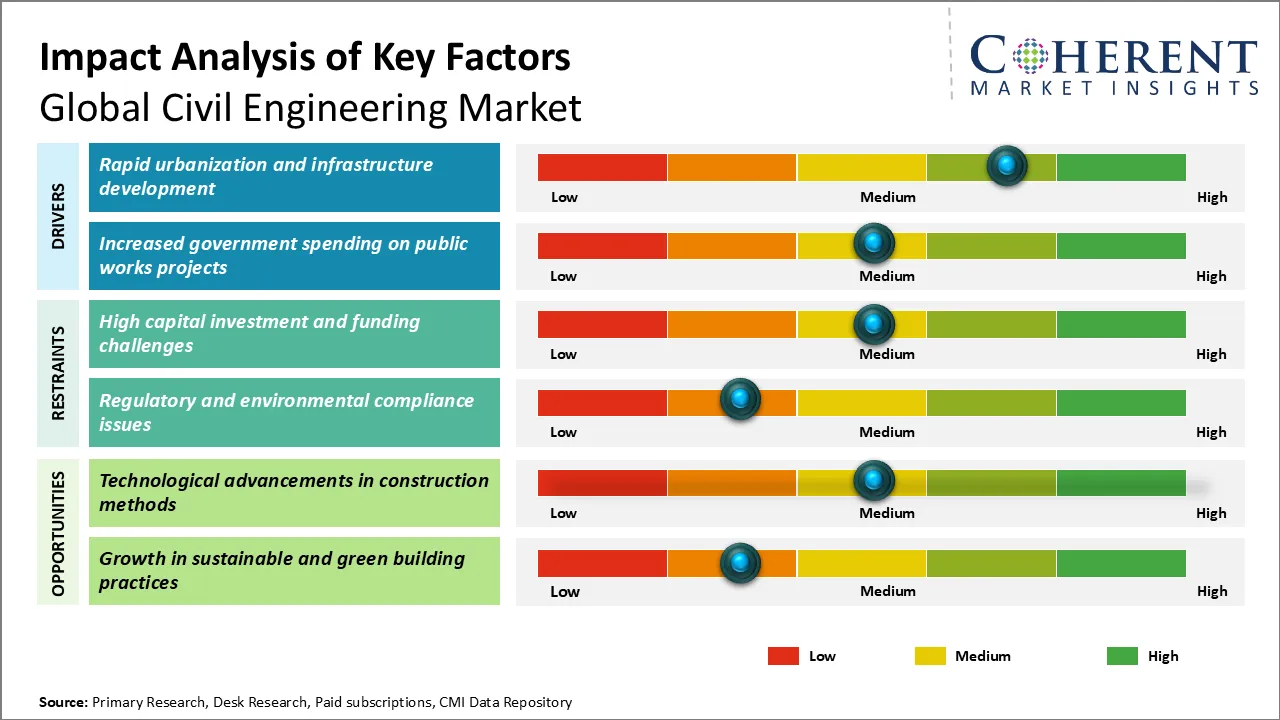
Civil Engineering Market Driver - Rapid Urbanization and Infrastructure Development
The accelerating pace of urbanization across emerging and developed economies is a significant driver propelling the civil engineering market. As population density increases in urban centers, the demand for robust infrastructure such as transportation networks, residential and commercial buildings, water supply systems, and sanitation facilities intensifies. Governments and private sectors are prioritizing large-scale infrastructure projects to accommodate growing urban populations, improve connectivity, and enhance quality of life. This necessitates extensive planning, design, and construction services, directly boosting civil engineering activities.
For instance, developing nations in Asia and Africa are witnessing explosive urban growth, requiring new metro systems, elevated highways, smart city initiatives, and sustainable building technologies. The complexity of modern urban challenges has also evolved civil engineering practices toward integrated solutions that incorporate environmental sustainability, smart technology integration, and resilient design principles capable of withstanding climate change impacts.
Civil Engineering Market Opportunity - Technological Advancements in Construction Methods
One of the most significant opportunities in the global civil engineering market lies in the rapid technological advancements transforming construction methods. Innovations such as Building Information Modeling (BIM), drone surveying, 3D printing, and automation are revolutionizing how civil engineering projects are designed, planned, and executed. BIM technology enables detailed digital representations of infrastructure projects, improving accuracy, reducing errors, and enhancing collaboration among stakeholders.
For instance, prefabricated construction methods can reduce project timelines by 30-50% while maintaining superior quality control, as components are manufactured in controlled environments before on-site assembly. Similarly, 3D printing technology is enabling the construction of complex architectural structures with reduced material waste and labor requirements, as demonstrated by successful residential and commercial projects across Europe and Asia.
Analyst Opinion (Expert Opinion)
- The global civil engineering market is experiencing a transformative phase, driven by advancements in technology and increasing infrastructure investments. Companies like AECOM and Bechtel are at the forefront, implementing innovative project management tools and sustainable construction practices that enhance efficiency and reduce environmental impact.
- Recent conferences, such as the World Engineering Conference and Convention (2023) and the International Conference on Civil Engineering (2022), have showcased successful case studies where digital twin technology and smart city initiatives have revolutionized urban planning and construction processes. These events emphasized the critical role of collaboration among stakeholders to address challenges such as urbanization and climate change. As the market adapts to the growing demand for resilient infrastructure and sustainable practices, the global civil engineering sector is well-positioned for robust growth, driven by innovation and a commitment to future-ready solutions.
Speak to the analyst
Want personalized insights?
Take the findings above to one of our principal consultants, or have the report rebuilt around the segments, geographies and competitors you actually track.
Market Segmentation
- Service Insights (Revenue, USD Tn, 2021 - 2033)
- Planning & Design
- Construction
- Maintenance
- Others
- Type Insights (Revenue, USD Tn, 2021 - 2033)
- Infrastructure
- Residential Construction
- Commercial Construction
- Industrial Construction
- End User Insights (Revenue, USD Tn, 2021 - 2033)
- Government
- Private Sector
- Public-Private Partnerships (PPP)
- Regional Insights (Revenue, USD Tn, 2021 - 2033)
- North America
- U.S.
- Canada
- Latin America
- Brazil
- Argentina
- Mexico
- Rest of Latin America
- Europe
- Germany
- U.K.
- Spain
- France
- Italy
- Russia
- Rest of Europe
- Asia Pacific
- China
- India
- Japan
- Australia
- South Korea
- ASEAN
- Rest of Asia Pacific
- Middle East
- GCC Countries
- Israel
- Rest of Middle East
- Africa
- South Africa
- North Africa
- Central Africa
- North America
- Key Players Insights
- Bechtel Corporation
- Fluor Corporation
- Kiewit Corporation
- Jacobs Engineering Group
- Skanska AB
- Tetra Tech, Inc.
- Balfour Beatty
- AECOM
- Turner Construction Company
- Swinerton Builders
- Mortenson Construction
- McCarthy Building Companies
- Granite Construction Incorporated
- Clark Construction Group
- Stantec Inc.
Sources
Primary Research Interviews
- Project Manager – Leading Civil Engineering Construction Firm
- Procurement Director – Major Infrastructure Development Company
- Construction Operations Head – Well-Known Civil Engineering Consultancy
- Sustainability Lead – Global Civil Engineering Certification Body
Stakeholders
- Manufacturers
- End-use Sectors:
- Infrastructure Development (Bridges, Roads, Airports)
- Residential and Commercial Construction
- Public Infrastructure Projects (Government Buildings, Urban Planning)
- Environmental & Sustainability Focused Projects
- Regulatory & Certification Bodies
- E-commerce Platforms and Retailers
- Technology Integration Players: AI-driven construction project management software providers
Databases
- UN Comtrade Database
- India Import Export (EXIM) Database
- Infrastructure Facility Database
Magazines
- Civil Engineering Magazine – Trends in infrastructure development and civil engineering
- Construction Week – Innovations in the global construction market
- Building Design + Construction – Market analysis and insights on civil engineering projects
- Engineering News-Record – Construction industry updates, including civil engineering developments
- Infrastructure Intelligence – Global developments and future trends in civil engineering
Journals
- Journal of Civil Engineering and Construction Technology – New techniques and methodologies in civil engineering
- Construction Management and Economics – Project management, economics, and policy in civil engineering
- Journal of Structural Engineering – Structural designs and innovations in civil engineering
Newspapers
- The Financial Times – Infrastructure market growth and government spending on civil engineering
- The Guardian – News on urban development and the role of civil engineering in urban planning
- Construction News – Major civil engineering projects and industry trends
- The New York Times – Infrastructure needs, investment, and policy in the civil engineering sector
Associations:
- American Society of Civil Engineers (ASCE)
- International Federation of Consulting Engineers (FIDIC)
- European Council of Civil Engineers (ECCE)
- International Association for Bridge and Structural Engineering (IABSE)
- Building Research Establishment (BRE)
Public Domain Sources
- U.S. Department of Transportation (DOT) – Infrastructure funding and regulation in civil engineering
- European Commission – Public Infrastructure and Construction Policy
- International Labour Organization (ILO) – Workforce trends and labor market statistics in construction
Proprietary Elements
- CMI Data Analytics Tool, Proprietary CMI Existing Repository of information for last 8 years.
Get access to 250+ pages report
Every segment, forecast, competitor profile and data table behind the analysis above — available for instant download.
- ESOMAR Member
- ISO 9001:2015 Certified
- D-U-N-S Registered
- GDPR & CCPA Compliant
Missing comfort of reading report in your local language? Find your preferred language:
Transform your Strategy with Exclusive Trending Reports
Frequently Asked Questions
The global civil engineering market is estimated to be valued at USD 9.82 Tn in 2026 and is expected to reach USD 15.26 Tn by 2033.
The CAGR of global civil engineering market is projected to be 6.5% from 2026 to 2033.
Rapid urbanization and infrastructure development and increased government spending on public works projects are the major factors driving the growth of global civil engineering market.
High capital investment and funding challenges and Regulatory and environmental compliance issues are the major factor hampering the growth of global civil engineering market.
In terms of Service, Planning & Design is estimated to dominate the market revenue share in 2026.
Bechtel Corporation, Fluor Corporation, Kiewit Corporation, Jacobs Engineering Group, Skanska AB, Tetra Tech, Inc., Balfour Beatty, AECOM, Turner Construction Company, Swinerton Builders, Mortenson Construction, McCarthy Building Companies, Granite Construction Incorporated, Clark Construction Group, and Stantec Inc. are the major players in the global civil engineering market
Asia Pacific is expected to lead the global civil engineering market in 2026.