

Global Computational Photography Market Size and Forecast – 2026-2033
The Global Computational Photography Market is estimated to be valued at USD 20.75 Bn in 2026 and is expected to reach USD 47.62 Bn by 2033, exhibiting a compound annual growth rate (CAGR) of 12.6% from 2026 to 2033.
Key Takeaways of the Computational Photography Market
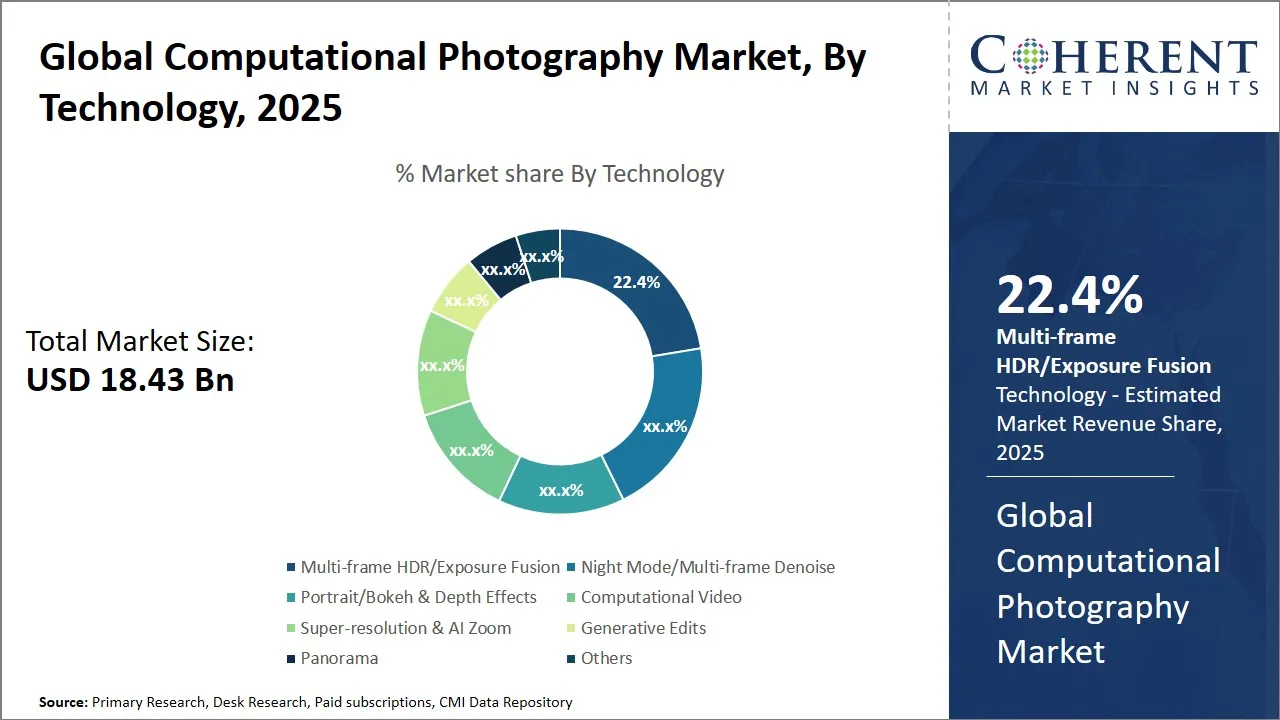
- The multi-frame HDR/exposure fusion segment leads the market holding an estimated share of 23.4 % in 2026.
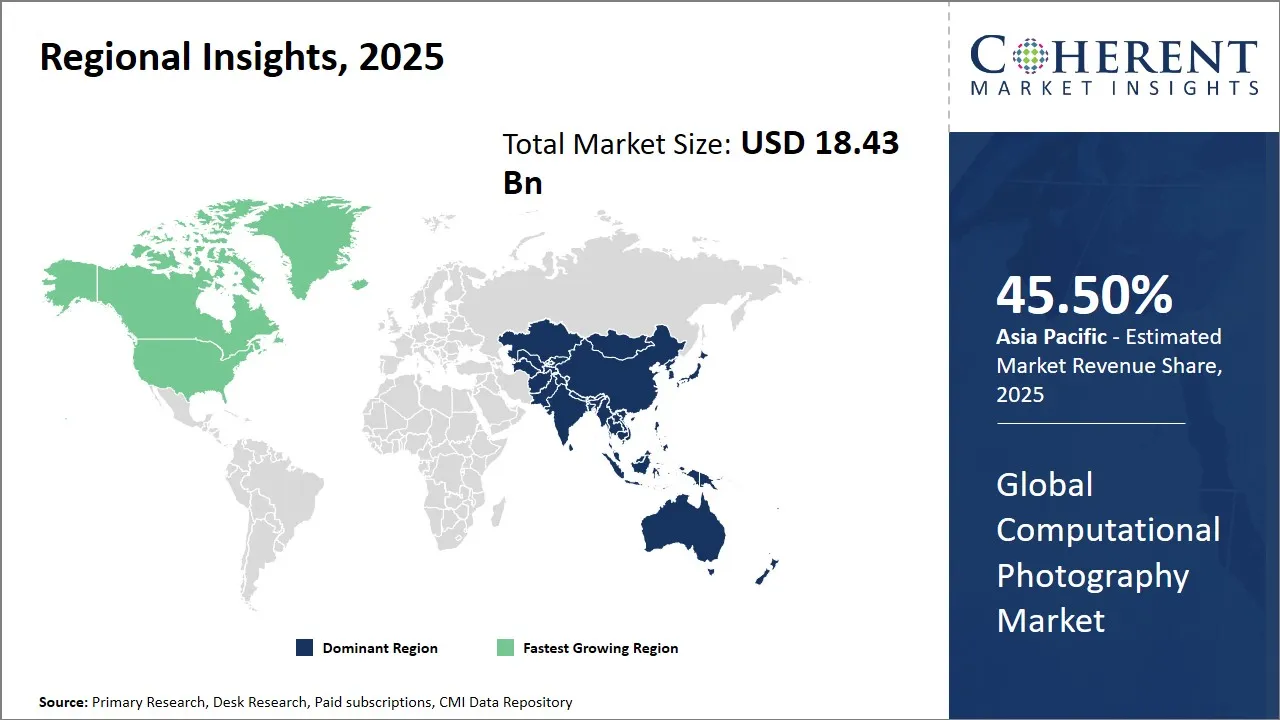
- Asia Pacific is estimated to lead the market with a share of 45.5 % in 2026.
- North America, holding a share of 23.5 % in 2026, is projected to be the fastest growing region.
Market Overview
The market is seeing a rising focus on artificial intelligence and machine learning integration within computational photography, improving features like image recognition, depth mapping, and real-time photo enhancement. Also, the popularity of smartphones equipped with multi-lens cameras and growing applications in augmented reality and virtual reality ecosystems are adding to market growth. Consumer demand for high-quality visual content coupled with advancements in hardware and software will create growth in this dynamic market.
Current Events and Its Impact
Current Events | Description and its impact |
Geopolitical and Trade Developments |
|
Economic and Infrastructure Trends |
|
Segmental Insights
- Current Industry Events of 2026
- Market Size Estimation
- Regional Breakdown
- Competitive Landscape
- Customer Intelligence
- Segmental Analysis
- Pricing Analysis
- Key Market Drivers, Challenges & Future Trends
- Customized Insights Section
Global Computational Photography Market Insights, by Technology – Multi-frame HDR/Exposure Fusion Leads Owing to its Superior Image Enhancement Capabilities
The Multi-frame HDR and Exposure Fusion segment, holding a projected share of 23.4% in 2026, leads the global computational photography market. This technology captures multiple frames at different exposure levels and combines them to create an image with improved dynamic range, making possible better detail preservation in both shadows and highlights.
Consumers are looking for images that closely mimic those taken by high-end DSLR cameras, and this technology enables compact devices to deliver superior results without the need for expensive hardware. Enhanced HDR capabilities contribute to richer colors, improved textures, and balanced luminance, which resonates well with social media users and content creators who rely heavily on smartphone photography. For instance, Google Pixel 9 Pro XL delivers exceptional dynamic range by capturing and merging multiple exposures—resulting in strikingly lifelike images with accurate tone mapping, vivid colors, and minimal artifacts such as ghosting.
Impact of AI on the Computational Photography Market
Artificial Intelligence (AI) has become the cornerstone of computational photography, transforming how images are captured, processed, and enhanced. Modern smartphones rely on AI-powered algorithms for tasks like real-time scene recognition, semantic segmentation, low-light enhancement, and noise reduction. By analyzing multiple frames in milliseconds, AI enables advanced features such as super-resolution zoom, night mode, and bokeh effects that once required professional cameras. Beyond smartphones, AI integration is extending into drones, AR/VR devices, and professional editing tools, making high-quality imaging more accessible across industries. This shift has redefined user expectations, with consumers now prioritizing AI-driven photography capabilities as a key factor in device purchases.
A recent example is Google’s Pixel 9 series (launched August 2024), which introduced features like Zoom Enhance and improved Night Sight Panorama powered by AI-based computational imaging.
Regional Insights
Asia Pacific Computational Photography Market Analysis and Trends
The Asia Pacific, holding an estimated share of 45.5% in 2026, dominates the computational photography market because of the fast smartphone penetration, increasing disposable incomes, and a burgeoning middle class with rising consumer electronics demand. Countries like China, South Korea, Japan, and India are home to major smartphone manufacturers such as Huawei, Samsung, Sony, Xiaomi, and Oppo, which invest a lot in computational photography technologies to differentiate their products.
In January 2026, Samsung launched the Galaxy S25 series with advanced Galaxy AI camera features, including real-time scene optimization, AI-powered low-light enhancement, and generative editing tools. Government initiatives promoting digitalization, innovation hubs, and favorable trade policies have also added to the market growth. Also, the region’s manufacturing dominance and cost advantages have attracted global players to establish production facilities here, adding to technological advancement and market expansion.
North America Computational Photography Market Analysis and Trends
North America, holding a projected share of 23.5% in 2026, exhibits the fastest growth in the global computational photography market because of a highly developed technological ecosystem, robust consumer demand, and strong presence of leading tech giants. The region benefits from significant investments in research and development, supported by favorable government policies pushing innovation and digital transformation.
The presence of major industry players such as Apple, Google, and Qualcomm also push the market, as these companies continue to pioneer breakthroughs in computational photography through smartphone camera advancements and software algorithms. In August 2024, Google introduced the Pixel 9 series, debuting features like Zoom Enhance (AI-based detail reconstruction during zoom) and Night Sight Panorama. Also, North America’s advanced manufacturing capabilities and extensive trade networks make possible efficient supply chain management and quick adoption of new technologies in consumer electronics, reinforcing its leading position.
Global Computational Photography Market Outlook for Key Countries:
U.S. Computational Photography Market Analysis and Trends
The U.S. is characterized by its concentration of leading technology companies such as Apple, Google, and Qualcomm—all of which are at the forefront of computational photography innovation. These companies leverage advanced AI algorithms, image processing software, and hardware integration to enhance camera capabilities in smartphones and professional photography equipment. The supportive ecosystem, including venture capital funding, research institutions, and strong intellectual property protections, sustains constant innovation. Government policies encouraging technology development and global trade partnerships further support a competitive environment that maintains the U.S. as a critical market and innovation hub.
China Computational Photography Market Analysis and Trends
China computational photography market is growing fast because of domestic smartphone players such as Huawei, Xiaomi, Oppo, and Vivo. These companies use sophisticated computational imaging techniques in their camera systems, improving low-light performance, multi-frame processing, and AI-enabled features. The Chinese government’s focus on indigenous technological innovation through initiatives like “Made in China 2026” and investments in AI research add to the country's growth.
Japan Computational Photography Market Analysis and Trends
Japan continues to lead in optical technology innovation within the computational photography market, with companies such as Sony and Olympus leading the market. Sony’s image sensor technologies, widely used globally, are very important in advancing computational imaging capabilities. Government support for innovation and export-oriented trade policies add to the international presence of Japanese firms.
South Korea Computational Photography Market Analysis and Trends
South Korea computational photography market benefits a lot from the presence of Samsung and LG, two multinational corporations that push innovations in camera hardware and software integration. Samsung, in particular, invests substantially in AI-driven image processing and multi-camera setups to enhance mobile photography experiences. The government’s commitment to digital infrastructure development and innovation funding adds to the market growth.
Market Players, Key Development, and Competitive Intelligence
Key Developments
- In July 2025, Dalet, a technology and service provider for media-rich organizations, announced the release of Dalet Flex 2025.6 LTS (long-term support), introducing powerful new capabilities to its flagship media workflow platform. The major release debuts the Secure Share feature, enabling external collaboration without compromising security or control.
- In June 2025, Avid announced the release and immediate availability of its fully integrated, industry-leading news platform, uniting MediaCentral and Wolftech News in a single newsroom solution.
- In May 2025, Tedial, a global provider of media integration and asset management solutions, partnered with Moments Lab, a leader in AI video discovery. This collaboration integrates Moments Lab’s MXT-2 multimodal AI into Tedial’s EVO MAM, powered by its media integration platform, smartWork, enhancing its capabilities with advanced AI-powered features to deliver a superior customer experience.
- In March 2025, Mediaset S.p.A and Evertz collaborated to design, deploy, and successfully launch Mediaset’s next-generation channel origination and playout solution. The solution is a comprehensive, low latency and fully SMPTE ST-2110-based design, utilizing Evertz Mediator automation/MAM, Overture-RT-LIVE integrated playout servers, MAGNUM-OS orchestration, VUE control interfaces and more, to deliver superior efficiencies across Mediaset’s broadcast operations.
Top Strategies Followed by Computational Photography Market Players
- Established players dominate the market primarily through substantial investments in research and development (R&D), enabling them to innovate and launch high-performance, feature-rich products that cater to increasingly sophisticated consumer demands.
- In May 2025, MediaTek introduced the Dimensity 9400e chipset, featuring an 18-bit RAW ISP and AI-powered semantic video segmentation.
- Mid-level players in the computational photography market primarily aim to strike a balance between affordability and quality, catering to price-sensitive consumers who seek innovative features without premium pricing.
- Xiaomi, through its Redmi and Poco smartphone lines, consistently integrates advanced computational photography features (e.g., Night Mode, AI-enhanced portraits) into mid-range devices priced far below flagship competitors.
- Small-scale players in the computational photography market carve out distinct niches by focusing on specialized features, innovative applications, or unique form factors that differentiate them from larger competitors.
- DJI (China), while not a smartphone giant, focuses on drones with computational photography innovations like AI-powered subject tracking, panorama stitching, and enhanced low-light capture in its Mavic and Mini series.
Market Report Scope
Computational Photography Market Report Coverage
| Report Coverage | Details | ||
|---|---|---|---|
| Base Year: | 2025 | Market Size in 2026: | USD 20.75 Bn |
| Historical Data for: | 2020 To 2024 | Forecast Period: | 2026 To 2033 |
| Forecast Period 2026 to 2033 CAGR: | 12.6% | 2033 Value Projection: | USD 47.62 Bn |
| Geographies covered: |
| ||
| Segments covered: |
| ||
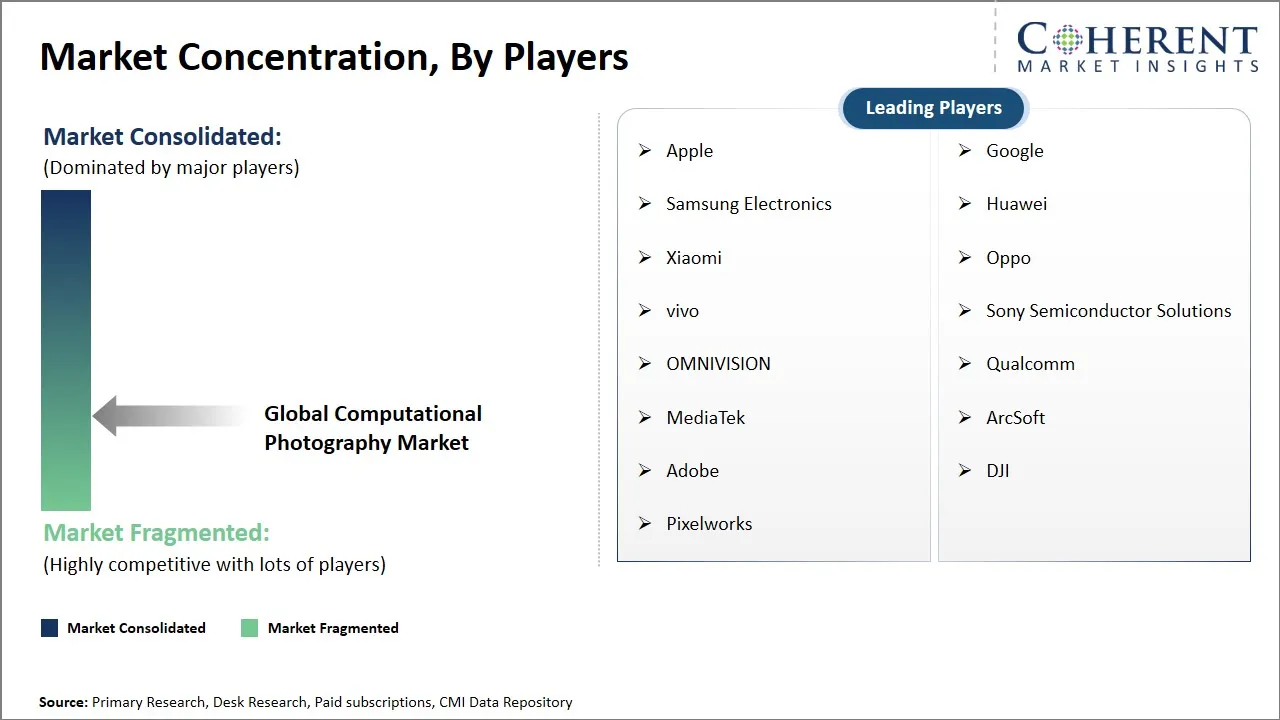
| Companies covered: | Apple, Google, Samsung Electronics, Huawei, Xiaomi, Oppo, vivo, Sony Semiconductor Solutions, OMNIVISION, Qualcomm, MediaTek, ArcSoft, Adobe, DJI, and Pixelworks | ||
| Growth Drivers: |
| ||
| Restraints & Challenges: |
| ||
/p>
Market Dynamics
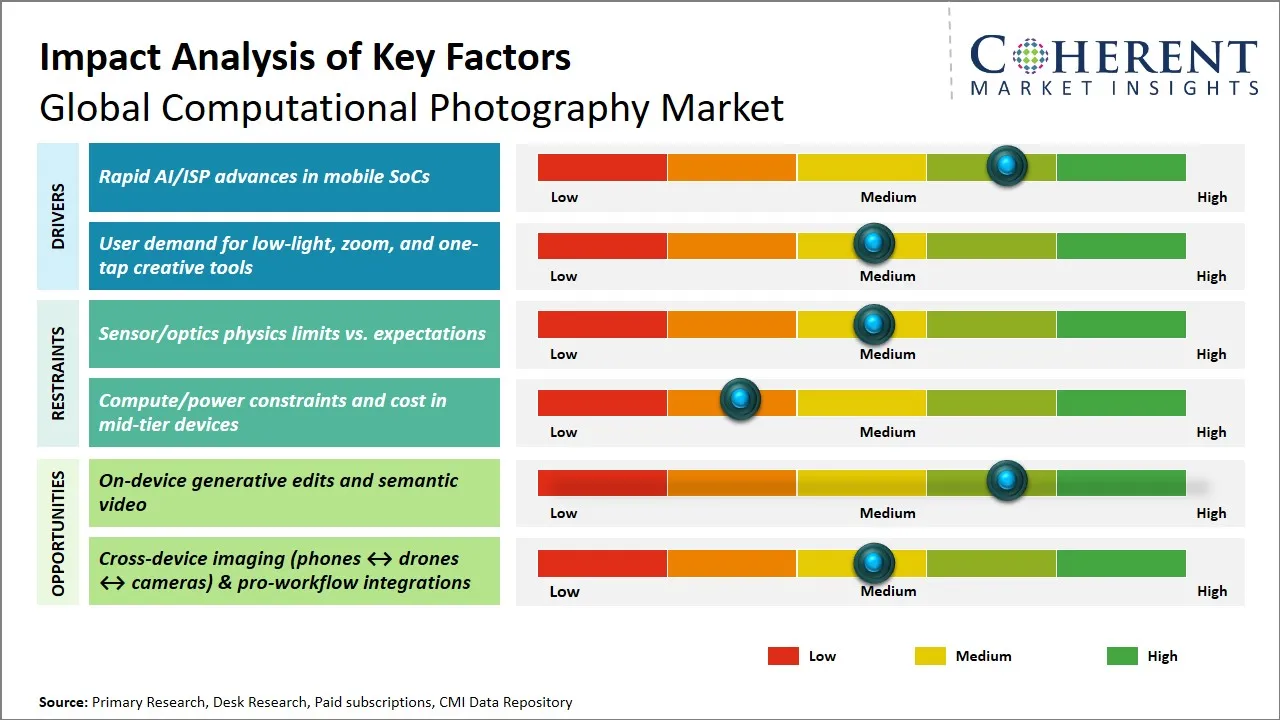
Global Computational Photography Market Driver – Rapid AI/ISP Advances in Mobile SoCs
The continuous evolution of artificial intelligence (AI) algorithms and integrated image signal processors (ISPs) embedded within mobile system-on-chips (SoCs) is significantly driving advancements in computational photography. Modern mobile SoCs leverage sophisticated AI-driven image processing techniques that enable real-time scene recognition, personalized image enhancements, and improved noise reduction, all executed seamlessly on-device without reliance on cloud computing.
In May 2025, MediaTek launched the Dimensity 9400e with an 18-bit RAW ISP and AI-powered semantic video segmentation. These improvements allow smartphones to capture higher-quality images even under challenging conditions such as low light or dynamic range variations. Additionally, AI-enhanced ISPs contribute to more accurate depth mapping and multi-frame fusion, enabling features like portrait mode, night mode, and super-resolution photography.
Global Computational Photography Market Opportunity – On-Device Generative Edits and Semantic Video Integration
As consumer demand for real-time, high-quality image and video enhancements intensifies, the ability to perform complex generative edits directly on devices—such as smartphones, tablets, and cameras—enhances user experience by reducing latency and eliminating dependence on cloud processing. This shift is propelled by advancements in artificial intelligence (AI) and machine learning models optimized for edge computing, enabling features like automatic scene recognition, object removal, and style transformation without compromising privacy or requiring high-bandwidth connections. In August 2024, Google’s Pixel 9 series introduced “Zoom Enhance” and AI Night Sight Panorama, leveraging on-device generative AI to reconstruct details and improve clarity in zoomed or low-light shots.
Furthermore, semantic video technology, which interprets and manipulates video content based on context, offers promising applications such as dynamic background replacement, real-time object tracking, and enhanced video summarization. These capabilities empower content creators, social media users, and professional photographers to produce richer, more engaging visual content effortlessly. Corporations investing in integrating on-device generative algorithms and semantic video functions can capitalize on rising trends in mobile photography, social media engagement, and content creation platforms.
Analyst Opinion (Expert Opinion)
- Emerging technologies like AI-based detail reconstruction, background replacement, and scene relighting are blurring the line between photography and digital content creation. This evolution positions computational photography not just as a tool for capturing reality, but also for generating creative, user-driven visual narratives—a trend strongly led by Google (Pixel 9 series) and Adobe (Lightroom AI tools).
- With SoC advancements (e.g., MediaTek Dimensity 9400e, Qualcomm Snapdragon’s AI ISP), computational photography is extending into real-time semantic video segmentation—enabling smarter stabilization, selective subject focus, and context-aware AR/VR experiences. This represents a major opportunity for immersive applications, gaming, and professional video editing workflows.
- While smartphones dominate today, computational photography is rapidly finding new verticals: drones (DJI’s AI subject tracking), automotive (driver-assist vision systems), and wearable devices (AR glasses with real-time scene enhancement). This diversification suggests that the market’s long-term growth will be fueled not only by handset volumes but by a broader ecosystem of smart imaging devices.
Speak to the analyst
Want personalized insights?
Take the findings above to one of our principal consultants, or have the report rebuilt around the segments, geographies and competitors you actually track.
Market Segmentation
- Technology Insights (Revenue, USD Bn, 2021 - 2033)
- Multi-frame HDR/Exposure Fusion
- Night Mode/Multi-frame Denoise
- Portrait/Bokeh & Depth Effects
- Computational Video
- Super-resolution & AI Zoom
- Generative Edits
- Panorama
- Others
- Regional Insights (Revenue, USD Bn, 2021 - 2033)
- North America
- U.S.
- Canada
- Latin America
- Brazil
- Argentina
- Mexico
- Rest of Latin America
- Europe
- Germany
- U.K.
- Spain
- France
- Italy
- Russia
- Rest of Europe
- Asia Pacific
- China
- India
- Japan
- Australia
- South Korea
- ASEAN
- Rest of Asia Pacific
- Middle East
- GCC Countries
- Israel
- Rest of Middle East
- Africa
- South Africa
- North Africa
- Central Africa
- North America
- Key Players Insights
- Apple
- Samsung Electronics
- Huawei
- Xiaomi
- Oppo
- vivo
- Sony Semiconductor Solutions
- OMNIVISION
- Qualcomm
- MediaTek
- ArcSoft
- Adobe
- DJI
- Pixelworks
Sources
Primary Research Interviews
Stakeholders
- Smartphone Manufacturers
- Camera & Imaging Sensor Manufacturers
- Mobile SoC & ISP Developers
- Drone & Action Camera Companies
- AR/VR Device Makers
- Professional Photographers & Content Creators
- AI & Imaging Software Developers
Databases
- Eurostat
- U.S. Census
- Imaging & Camera Global Database
- OECD
- International Telecommunication Union (ITU)
Magazines
- Imaging Today
- Mobile Camera Insights
- Consumer Electronics Review
- Digital Photography World
Journals
- IEEE Transactions on Computational Imaging
- Journal of Imaging Science & Technology
- International Journal of Computer Vision
- Journal of Electronic Imaging
- Pattern Recognition & Machine Vision Journal
Newspapers
- The Verge (U.S.)
- Nikkei Asia (Japan)
- South China Morning Post (Hong Kong)
- The Guardian (U.K.)
- The Economic Times (India)
Associations
- IEEE Computational Imaging Technical Committee
- International Imaging Industry Association (I3A)
- Mobile Imaging & Photography Association (MIPA)
- Consumer Technology Association (CTA, U.S.)
- Camera & Imaging Products Association (CIPA, Japan)
Public Domain Sources
- U.S. Census Bureau
- EUROSTAT
- United Nations Economic Commission for Europe (UNECE)
- World Bank
- ResearchGate
Proprietary Elements
- CMI Data Analytics Tool, Proprietary CMI Existing Repository of information for last 8 years
Get access to 250+ pages report
Every segment, forecast, competitor profile and data table behind the analysis above — available for instant download.
- ESOMAR Member
- ISO 9001:2015 Certified
- D-U-N-S Registered
- GDPR & CCPA Compliant
Missing comfort of reading report in your local language? Find your preferred language:
Transform your Strategy with Exclusive Trending Reports
Frequently Asked Questions
The global computational photography market is estimated to be valued at USD 20.75 billion in 2026 and is expected to reach USD 47.62 billion by 2033.
The CAGR of global computational photography market is projected to be 12.6% from 2026 to 2033.
Rapid AI/ISP advances in mobile SoCs and user demand for low-light, zoom, and one-tap creative tools are the major factors driving the growth of the global computational photography market.
Sensor/optics physics limits vs. expectations and compute/power constraints and cost in mid-tier devices are the major factors hampering the growth of the global computational photography market.
In terms of Technology, Multi-frame HDR/Exposure Fusion segment is estimated to dominate the market revenue share in 2026.
The future lies in AI-driven, generative, and context-aware imaging, where devices not only capture but also intelligently reconstruct, relight, and enhance scenes in real time. Its scope will expand beyond smartphones into AR/VR, autonomous systems, drones, and professional workflows, making imaging smarter and more immersive.
Multi-frame HDR, exposure fusion, night mode denoising, AI super-resolution, depth-based bokeh, panorama stitching, semantic segmentation, computational video stabilization, and generative edits (like object removal and relighting).