

Global Controlled Environment Agriculture Market Size and Forecast – 2026-2033
The Global Controlled Environment Agriculture Market is estimated to be valued at USD 62.58 Bn in 2026 and is expected to reach USD 163.45 Bn by 2033, exhibiting a compound annual growth rate (CAGR) of 14.7% from 2026 to 2033.
Key Takeaways of the Controlled Environment Agriculture Market
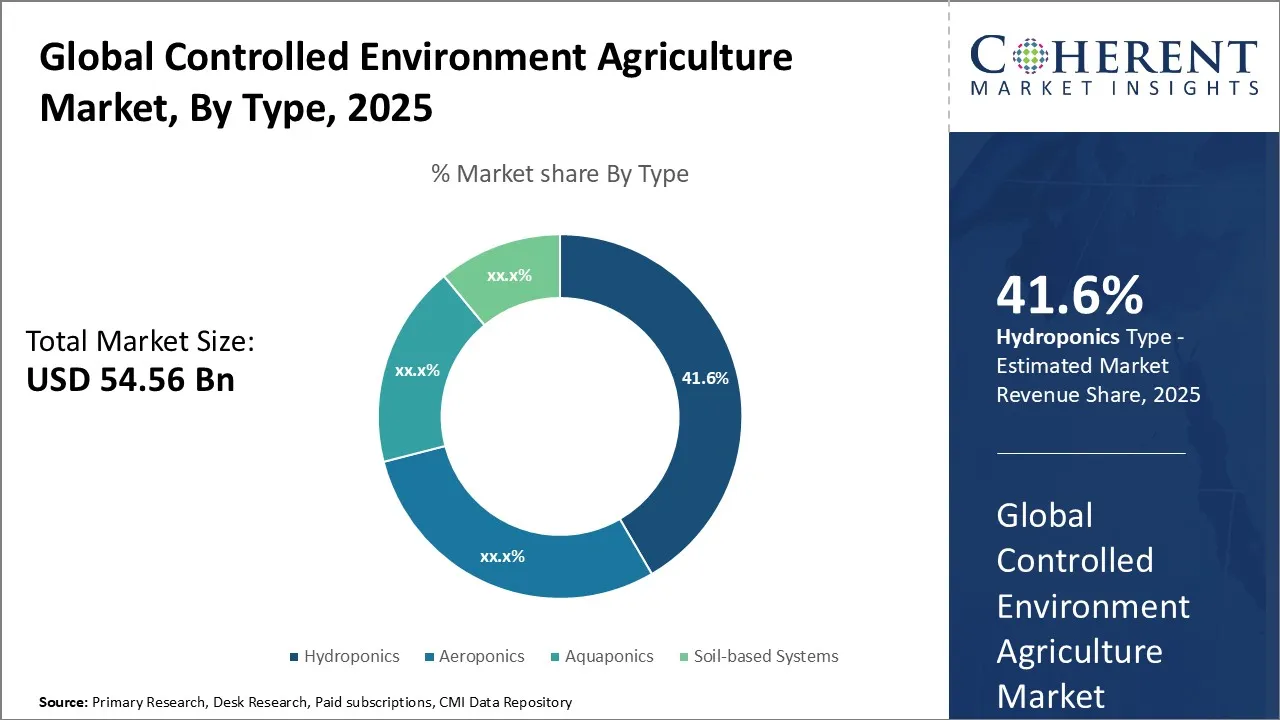
- The hydroponics segment is expected to account for 42.6% of the market share in 2026, attributed to its significant advantages over conventional farming methods.
- The lighting segment is projected to hold 44.5% share of the controlled environment agriculture market in 2026, driven by its essential role in enhancing plant growth and development.
- The fruits and vegetables segment are expected to hold 35.5% share of the controlled environment agriculture market in 2026, fueled by rising health awareness and demand for fresh, quality produce.
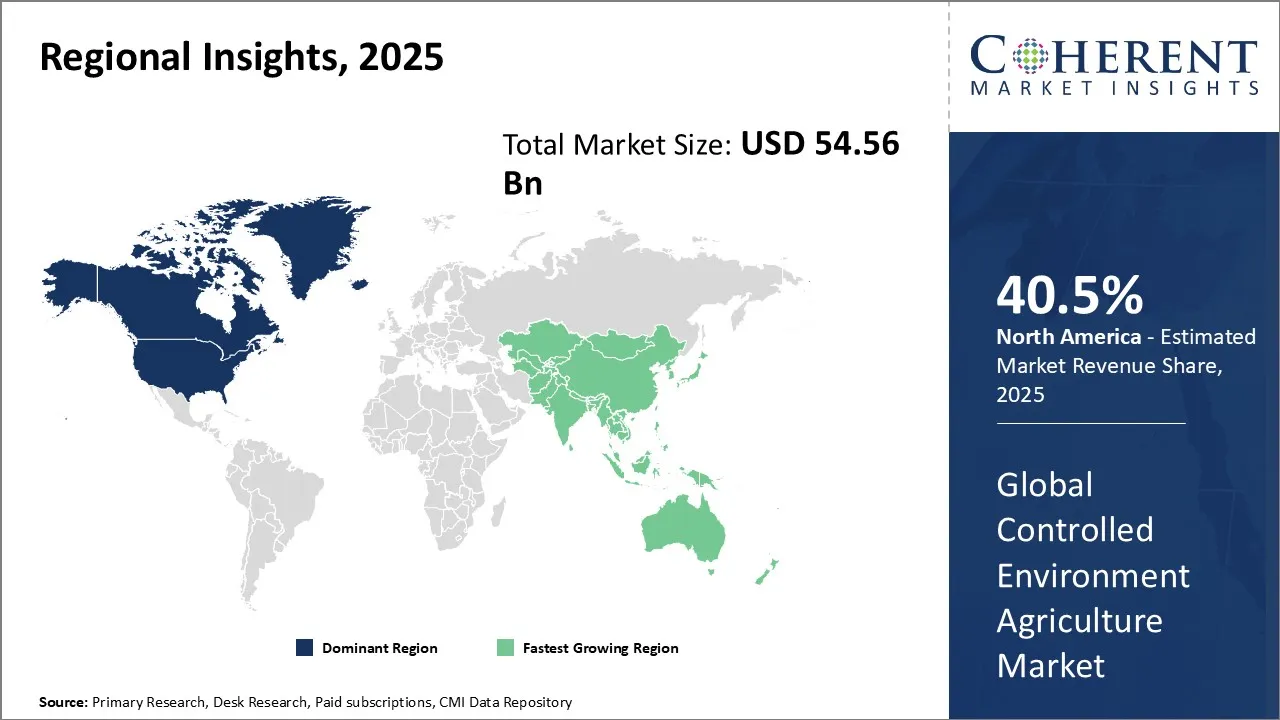
- North America is set to lead the controlled environment agriculture market in 2026 with a 40. 5% share, driven by advanced technological infrastructure and a growing demand for pesticide-free, locally sourced produce. Asia Pacific, with a 11.5% share in 2026, will be the fastest-growing region, fueled by constrained arable land, high urbanization, and changing diets.
Market Overview
The market trend for Controlled Environment Agriculture (CEA) is characterized by the increasing demand for fresh, locally grown produce year-round, coupled with the need for sustainable and efficient farming practices. CEA technologies, such as vertical farming, hydroponics, and aquaponics, are gaining traction due to their ability to optimize crop yields, minimize water usage, and reduce the environmental impact of traditional agriculture. Additionally, the rising popularity of urban farming and the growing concern over food security are expected to drive the adoption of CEA solutions in the coming years.
Current Events and Its Impact
Current Events | Description and its impact |
Launch of 2025 Global CEA Census (May 19, 2025) |
|
Renewable Energy Policy Incentives for Vertical Farms |
|
Segmental Insights
- Current Industry Events of 2026
- Market Size Estimation
- Regional Breakdown
- Competitive Landscape
- Customer Intelligence
- Segmental Analysis
- Pricing Analysis
- Key Market Drivers, Challenges & Future Trends
- Customized Insights Section
Controlled Environment Agriculture Market Insights, By Type – The hydroponics segment leads the market, driven by its role in shaping the future of sustainable agriculture
Hydroponics segment is expected to contribute 42.6% share of the market in 2026, owing to its numerous advantages over traditional farming methods. Hydroponic systems allow for the precise control of nutrient delivery, water usage, and environmental factors, enabling farmers to maximize crop yields while minimizing resource consumption. The ability to grow crops vertically in stacked layers and in controlled environments significantly increases the production capacity per square foot, making hydroponics an attractive option for urban and indoor farming.
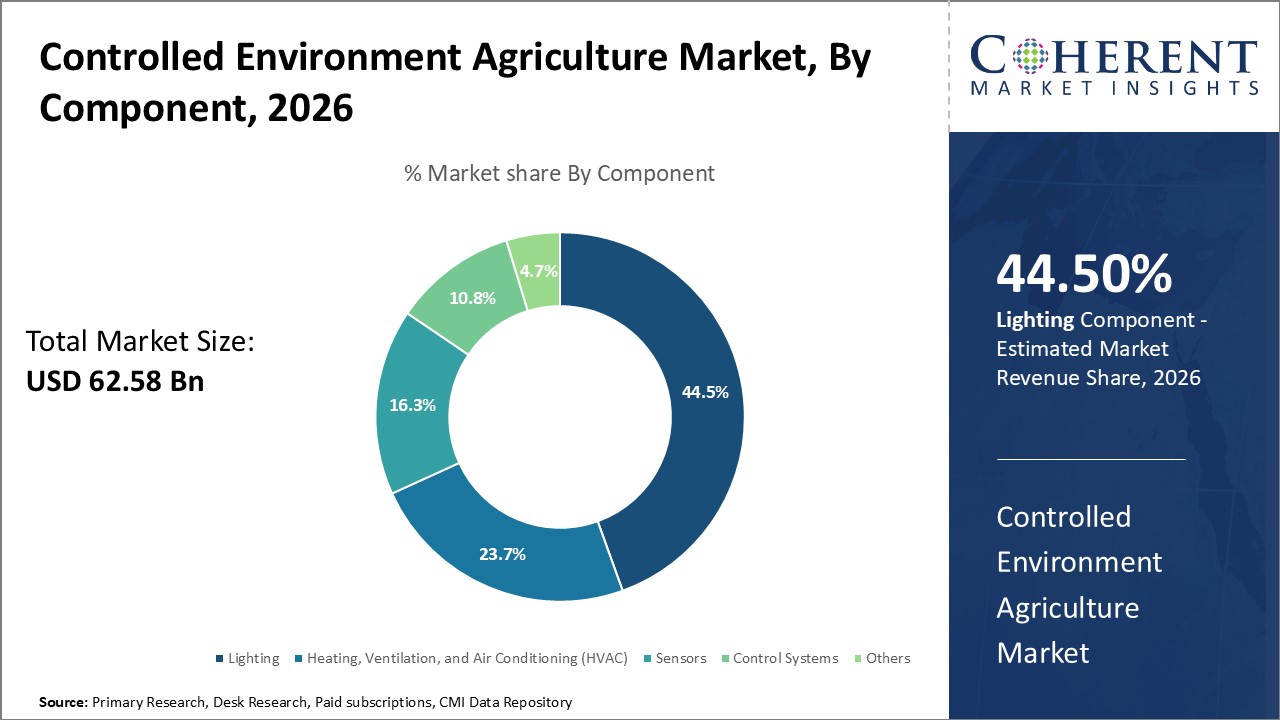
Controlled Environment Agriculture Market Insights, By Component - Lighting segment is propelling market growth by enhancing efficiency and boosting productivity
Lighting segment is projected to contribute 44.5% share of the controlled environment agriculture market in 2026, due to its critical role in optimizing plant growth and development. The advent of LED lighting technology has revolutionized the industry by providing energy-efficient, customizable, and long-lasting lighting solutions tailored to the specific needs of various crops.
LED lighting systems offer precise control over the light spectrum, intensity, and duration, enabling growers to create optimal light recipes that promote faster growth, higher yields, and improved crop quality. The ability to adjust the light spectrum to mimic natural sunlight conditions allows for the cultivation of a wide range of crops, including those that are not native to the local climate, thus expanding the variety of produce available to consumers
Controlled Environment Agriculture Market Insights, By Application- The Fruits and Vegetables segment leads due to the increasing demand for fresh and nutritious products
Fruits and vegetables segment is expected to contribute 35.5% share of the controlled environment agriculture market in 2026, driven by the increasing consumer awareness about the importance of a healthy diet and the growing demand for fresh, high-quality produce. Controlled environment agriculture techniques, such as hydroponics and vertical farming, enable the production of a wide variety of fruits and vegetables ingredients in close proximity to urban centers, reducing the time and distance between harvest and consumption. This shortened supply chain ensures that consumers have access to fresher, more nutritious produce with a longer shelf life, as the crops are not subjected to the stress of long-distance transportation and storage.
Regional Insights
North America Controlled Environment Agriculture Market Analysis and Trends
The North America region is projected to lead the market with a 40.5% share in 2026. The region boasts a well-established agricultural industry, with a strong focus on technological advancements and precision farming techniques. The presence of major players in the controlled environment agriculture sector, such as AeroFarms, Plenty, and Brightfarms, has further bolstered the market's growth. Government support through funding and initiatives promoting sustainable agriculture practices has also played a crucial role in the region's dominance. Additionally, the increasing demand for locally grown, fresh produce year-round has driven the adoption of controlled environment agriculture solutions in North America.
Asia Pacific Controlled Environment Agriculture Market
The Asia Pacific region is expected to exhibit the fastest growth in the market contributing 11.5% share in 2026. The rapid population growth, urbanization, and rising disposable incomes in countries such as China, India, and Japan have significantly driven the demand for fresh, high-quality produce.
For instance, China's urban population is expected to surpass 1 billion by 2026, fueling the demand for fresh produce in cities. Furthermore, limited arable land and water resources in the region have led governments and businesses to invest in controlled environment agriculture (CEA) technologies. In Japan, the introduction of vertical farming has increased crop yields by up to 30% compared to traditional farming methods.
Global Controlled Environment Agriculture Market Outlook for Key Countries
U.S. Controlled Environment Agriculture Market Trends
The U.S. controlled environment agriculture market is driven by the increasing demand for locally sourced, fresh produce and the need to reduce the environmental impact of traditional farming practices. Major players like AeroFarms and Plenty have established large-scale vertical farming facilities in the country, leveraging advanced technologies to optimize crop growth and minimize resource consumption. The U.S. government's support for sustainable agriculture and the growing trend of farm-to-table dining have further fueled the adoption of controlled environment agriculture solutions in the country.
China Controlled Environment Agriculture Market Trends
The China controlled environment agriculture market is experiencing significant growth due to the country's large population, limited arable land, and increasing demand for high-quality, safe produce. The Chinese government has been actively promoting the development of controlled environment agriculture through supportive policies and investments in research and development. Companies like Sananbio and Sinoagri have emerged as key players in the market, implementing advanced technologies such as LED lighting and hydroponic systems to optimize crop production in urban settings.
Japan Controlled Environment Agriculture Market Trends
Japan continues to lead in the adoption of controlled environment agriculture technologies, driven by its limited land resources, aging farming population, and high demand for premium, locally grown produce. The country's advanced technological capabilities and focus on automation have enabled the development of sophisticated controlled environment agriculture systems. Companies like Spread and Mirai have established highly automated vertical farming facilities, showcasing the potential for efficient, sustainable food production in urban areas.
India Controlled Environment Agriculture Market Trends
India controlled environment agriculture market is rapidly expanding, driven by the need to address food security concerns, reduce the environmental impact of agriculture, and meet the growing demand for fresh, high-quality produce. The Indian government has been supporting the adoption of controlled environment agriculture through initiatives such as the National Horticulture Mission and the Pradhan Mantri Krishi Sinchai Yojana. Companies like Junga FreshnGreen and Triton Foodworks have emerged as notable players in the market, implementing hydroponic and vertical farming technologies to produce crops in urban and peri-urban areas.
End User Feedback and Unmet Needs in the Controlled Environment Agriculture Market
Positive User Experience
High-efficiency LED Lighting for Vertical Farming
A prominent vertical farming company highlighted their satisfaction with the use of high-efficiency LED lighting systems integrated into their controlled environment. The system's energy-efficient design significantly reduced operational costs, while providing optimal light spectrums tailored for different plant growth stages. This feature enhanced crop yields by approximately 20%, as the plants received precise lighting conditions, leading to faster growth cycles and higher quality produce.
Impact: This positive feedback emphasizes the critical role of energy-efficient solutions in enhancing productivity while reducing operational expenses. The integration of IoT-based technologies and remote monitoring facilitates better resource management and process optimization, making it a key factor in vertical farm success.
Technological Gaps
There is an evident technological gap when it comes to automation and machine learning integration within CEA systems. Many end users, particularly in smaller-scale operations, express the need for affordable automation systems that can optimize lighting, watering, and nutrient distribution based on real-time data analytics. While advanced systems offer great potential, their high upfront costs and complexity often deter smaller farms from adopting them.
Market Players, Key Development, and Competitive Intelligence
Key Developments
- In April 2025, the Controlled Environment Agriculture Innovation Center—jointly led by Virginia Tech and the Institute for Advanced Learning and Research—advanced efforts to boost food production efficiency. By leveraging cutting-edge indoor farming technologies, the center is cultivating high-yield, nutrient-rich crops in controlled environments.
- In March 2025, Santa Fe Community College announced an Open House for its Controlled Environment Agriculture (CEA) program, scheduled for April 26, 2025, at the Trades and Advanced Technology Center. The event will offer attendees insights into the CEA program along with culinary samples prepared by the college’s Culinary Arts Department.
Top Strategies Followed by Global Controlled Environment Agriculture Market Players
- Established players in the global controlled environment agriculture market are focusing on extensive research and development to innovate high-performance products.
- For example, a pioneer in vertical farming, AeroFarms, has developed proprietary aeroponic technology and LED lighting systems to enhance crop yields with 95% less water usage. The company is also working with Dell Technologies and Nokia on AI-powered farm monitoring systems.
- Mid-level players in the market are concentrating on delivering cost-effective solutions to target price-sensitive consumers. These companies aim to offer quality products at competitive prices, making controlled environment agriculture more accessible to a wider range of customers. Additionally, collaborations with technology providers and production partners help mid-level players enhance their capabilities and market presence.
- For instance, Gotham Greens operates greenhouse farms in urban locations such as New York, Chicago, and Baltimore. By combining hydroponic farming with energy-efficient climate systems, the company reduces operational costs. Its strategic retail partnerships with well-known retailers like Whole Foods Market and Target highlight its successful model of retail integration.
- Small-scale players often focus on niche specialization to differentiate themselves in the competitive landscape. By targeting specific niche markets with unique features or innovative products, these players can carve out a profitable segment. Moreover, small-scale players are adopting cutting-edge technologies to remain competitive and deliver value to their customers.
- For example, Trinity AgTech is a startup providing micro-farm automation systems and container-based vertical farms tailored for urban rooftops and peri-urban farmers. Its localized sensor packages help growers monitor temperature, pH, and lighting at an affordable cost.
Market Report Scope
Report Coverage
| Report Coverage | Details | ||
|---|---|---|---|
| Base Year: | 2025 | Market Size in 2026: | USD 62.58 Bn |
| Historical Data for: | 2020 To 2024 | Forecast Period: | 2026 To 2033 |
| Forecast Period 2026 to 2033 CAGR: | 14.7% | 2033 Value Projection: | USD 163.45 Bn |
| Geographies covered: |
| ||
| Segments covered: |
| ||
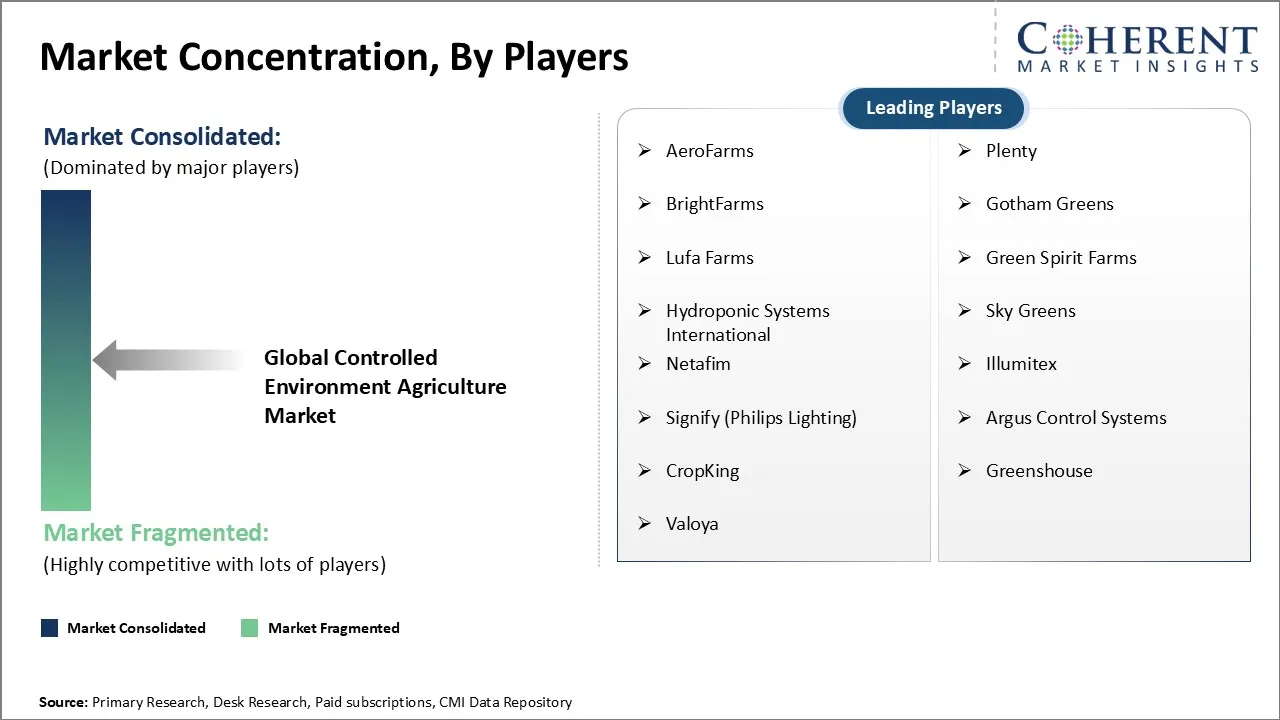
| Companies covered: | AeroFarms, Plenty, BrightFarms, Gotham Greens, Lufa Farms, Green Spirit Farms, Hydroponic Systems International, Sky Greens, Netafim, Illumitex, Signify (Philips Lighting), Argus Control Systems, CropKing, Greenshouse, and Valoya | ||
| Growth Drivers: |
| ||
| Restraints & Challenges: |
| ||
Controlled Environment Agriculture Market Dynamics
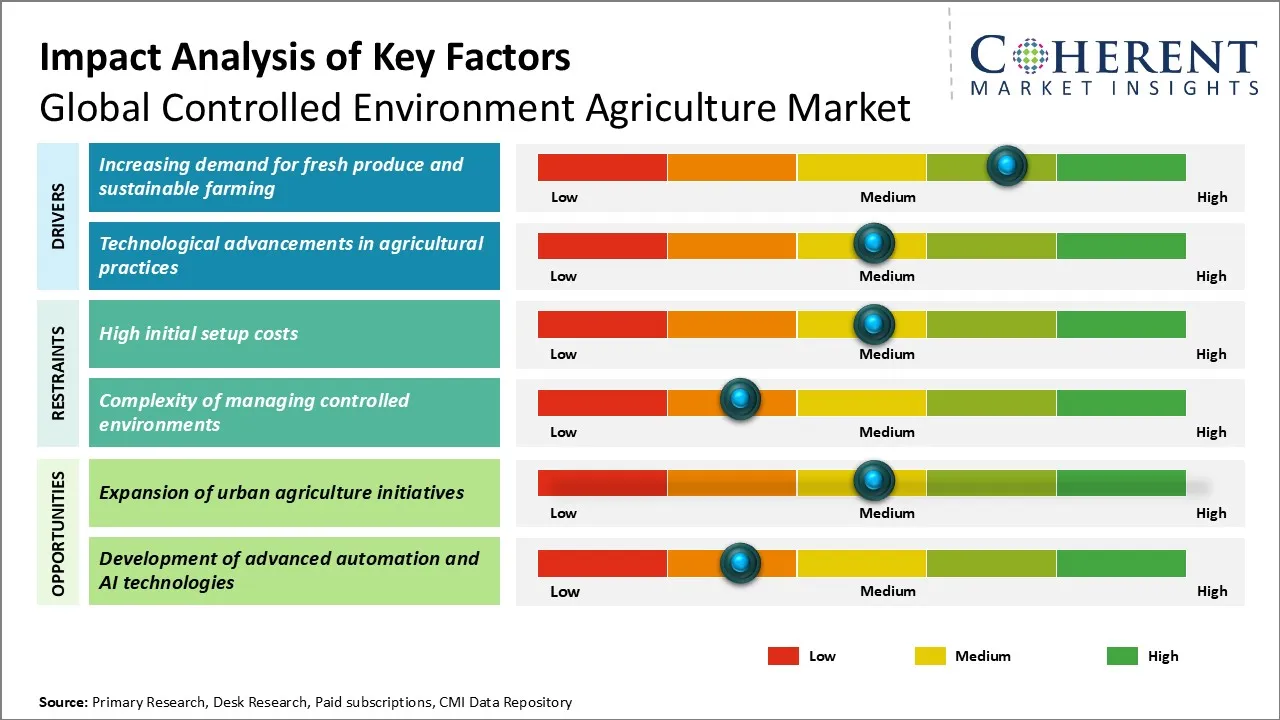
Controlled Environment Agriculture Market Driver - Increasing Demand for Fresh Produce and Sustainable Farming
The global controlled environment agriculture market is experiencing significant growth due to the increasing demand for fresh, high-quality produce and the growing emphasis on sustainable farming practices. Consumers are becoming more health-conscious and are seeking out fresh, nutrient-dense fruits and vegetables year-round. Controlled environment agriculture, such as vertical farming and greenhouse cultivation, enables the production of fresh produce in close proximity to urban areas, reducing transportation costs and ensuring a longer shelf life.
Consumers are becoming more health-conscious and are seeking out fresh, high-quality fruits and vegetables year-round. According to the United Nations Food and Agriculture Organization (FAO), global fruit and vegetable consumption increased by 3% annually between 2000 and 2018, reaching 868 million tons in 2018 (FAO, 2021). This trend is expected to continue, with the World Health Organization (WHO) recommending a minimum of 400g of fruits and vegetables per day for a healthy diet (WHO, 2020).
Controlled Environment Agriculture Market Opportunity - Expansion of Urban Agriculture Initiatives
The expansion of urban agriculture initiatives presents a significant opportunity for the growth of the global controlled environment agriculture market. as the world's population continues to urbanize, there is an increasing demand for fresh, locally grown produce in cities. Controlled environment agriculture techniques, such as vertical farming and rooftop greenhouses, offer a solution to the limited land availability in urban areas. By utilizing these methods, urban farmers can maximize crop yields and produce high-quality, pesticide-free fruits and vegetables year-round, regardless of external weather conditions.
According to the United Nations Department of Economic and Social Affairs, 68% of the global population is projected to live in urban areas by 2050, up from 55% in 2018. This trend, coupled with the increasing awareness about the environmental and health benefits of consuming fresh produce, has led to a surge in urban agriculture projects. These initiatives not only provide access to healthy food options but also contribute to the greening of cities, reduce food miles, and create employment opportunities.
Analyst Opinion (Expert Opinion)
- The controlled environment agriculture market is experiencing rapid growth, fueled by the increasing need for sustainable food production methods in urban settings. Companies like AeroFarms and Plenty are at the forefront, leveraging advanced technologies such as vertical farming and hydroponics to optimize yield while minimizing resource use. Recent conferences, including the Indoor Ag-Con (2022) and the GreenTech Amsterdam (2023), have showcased groundbreaking innovations and best practices in CEA, emphasizing the importance of scalability and energy efficiency.
- These platforms have highlighted the critical role of collaboration among tech developers, agricultural experts, and policymakers to address challenges in food security and climate resilience. As consumer demand for fresh, locally-sourced produce continues to rise, the controlled environment agriculture market is positioned for significant expansion, driven by a commitment to innovation and sustainability in food production.
Speak to the analyst
Want personalized insights?
Take the findings above to one of our principal consultants, or have the report rebuilt around the segments, geographies and competitors you actually track.
Market Segmentation
- Type Insights (Revenue, USD Bn, 2021 - 2033)
- Hydroponics
- Aeroponics
- Aquaponics
- Soil-based Systems
- Component Insights (Revenue, USD Bn, 2021 - 2033)
- Lighting
- Heating, Ventilation, and Air Conditioning (HVAC)
- Sensors
- Control Systems
- Others
- Application Insights (Revenue, USD Bn, 2021 - 2033)
- Fruits and Vegetables
- Flowers and Ornamentals
- Herbs
- Others
- Regional Insights (Revenue, USD Bn, 2021 - 2033)
- North America
- U.S.
- Canada
- Latin America
- Brazil
- Argentina
- Mexico
- Rest of Latin America
- Europe
- Germany
- U.K.
- Spain
- France
- Italy
- Russia
- Rest of Europe
- Asia Pacific
- China
- India
- Japan
- Australia
- South Korea
- ASEAN
- Rest of Asia Pacific
- Middle East
- GCC Countries
- Israel
- Rest of Middle East
- Africa
- South Africa
- North Africa
- Central Africa
- North America
- Key Players Insights
- AeroFarms
- Plenty
- BrightFarms
- Gotham Greens
- Lufa Farms
- Green Spirit Farms
- Hydroponic Systems International
- Sky Greens
- Netafim
- Illumitex
- Signify (Philips Lighting)
- Argus Control Systems
- CropKing
- Greenshouse
- Valoya
Sources
Primary Research Interviews
- R&D Director – Leading Agricultural Technology Provider
- Procurement Manager – Global Agri-tech Firm
- Product Development Head – Vertical Farming Solutions Provider
- Sustainability Manager – Controlled Environment Agriculture Certification Body
Stakeholders
- Manufacturers
- End-use Sectors:
- Agriculture & Farming (Vertical farming, hydroponic, aquaponics)
- Food Processing & Retail (Supermarkets, specialty food retailers)
- Agri-tech Companies focusing on sustainable and high-yield farming practices
- Regulatory & Certification Bodies
- Technology Integration Players: AI and machine learning providers for crop monitoring and yield optimization
- E-commerce Platforms for fresh food sales Technology Integration Players: AI and machine learning providers for personalized skincare solutions
Databases
- UN Comtrade Database
- India Import Export (EXIM) Database
Magazines
- Agri-Tech East – Trends in controlled environment agriculture and tech integration
- Vertical Farm Magazine – Advances in vertical farming techniques and technologies
- Global Agri-Tech Industry – Technology advancements in controlled agriculture
Journals
- International Journal of Agricultural Sustainability – Environmental impact and energy use in CEA
- Bioresource Technology – Advances in hydroponic and aquaponic farming technologies
- Renewable Agriculture and Food Systems – Integration of renewable energy in CEA systems
- Journal of Environmental Management – Environmental benefits of controlled agriculture methods
Newspapers
- Financial Times – Global investment trends in controlled environment agriculture
- Agriculture Business News – Growth of vertical farming in urban areas
- The Grower Magazine – Controlled agriculture market performance and challenges
- World Agriculture News – Government initiatives to promote sustainable farming
- Agri-Tech News – Technological developments in controlled agriculture
Associations
- Controlled Environment Agriculture Alliance
- International Society for Horticultural Science (ISHS)
- Vertical Farming Association
- National Sustainable Agriculture Coalition
- Agricultural Innovation Centre
Public Domain Sources
- EU Commission – Regulations for sustainable farming and controlled environment agriculture standards
- FDA – Guidelines on food safety for produce from controlled environments
- OECD – Policies and sustainability frameworks for agricultural technologies
- UNEP – Best practices in sustainable farming and environmental conservation
- World Bank – Financial support for sustainable agriculture and innovation
- FAO – Food security policies and sustainable agricultural practices
- USDA – Policies on urban farming and innovation in controlled agriculture
Proprietary Elements
- CMI Data Analytics Tool, Proprietary CMI Existing Repository of information for last 8 years.
Get access to 250+ pages report
Every segment, forecast, competitor profile and data table behind the analysis above — available for instant download.
- ESOMAR Member
- ISO 9001:2015 Certified
- D-U-N-S Registered
- GDPR & CCPA Compliant
Missing comfort of reading report in your local language? Find your preferred language:
Transform your Strategy with Exclusive Trending Reports
Frequently Asked Questions
The global controlled environment agriculture market is estimated to be valued at USD 62.58 Bn in 2026 and is expected to reach USD 163.45 Bn by 2033.
The CAGR of the global controlled environment agriculture market is projected to be 14.7% from 2026 to 2033.
Increasing demand for fresh produce and sustainable farming and technological advancements in agricultural practices are the major factors driving the growth of the global controlled environment agriculture market.
High initial setup costs and complexity of managing controlled environments are the major factors hampering the growth of the global controlled environment agriculture market.
In terms of type, hydroponics is estimated to dominate the market revenue share in 2026.
AeroFarms, Plenty, BrightFarms, Gotham Greens, Lufa Farms, Green Spirit Farms, Hydroponic Systems International, Sky Greens, Netafim, Illumitex, Signify (Philips Lighting), Argus Control Systems, CropKing, Greenshouse, and Valoya are the major players.
North America is expected to lead the global controlled environment agriculture market in 2026.