

Global Coworking Spaces Market Size and Forecast – 2026-2033
The global coworking spaces market is estimated to be valued at USD 28.94 Bn in 2026 and is expected to reach USD 72.43 Bn by 2033, exhibiting a compound annual growth rate (CAGR) of 14.0% from 2026 to 2033.
Key Takeaways of the Global Coworking Spaces Market
- The enclosed offices segment leads the market holding an estimated share of 45.6 % in 2026.
- North America is estimated to lead the market with a share of 41.2 % in 2026.
- Asia Pacific, holding an estimated share of 23.2 % in 2026, is projected to be the fastest growing region.
Market Overview
A prominent market trend is the rising preference for technologically advanced coworking spaces that offer integrated digital infrastructure such as high-speed internet, smart meeting rooms, and collaboration tools. Additionally, the growth of startups and freelancers globally continues to fuel the demand, with spaces increasingly tailored to specific professional communities. Sustainability initiatives, including eco-friendly designs and energy-efficient operations, are also shaping the future of coworking, attracting environmentally-conscious tenants and investors.
Segmental Insights
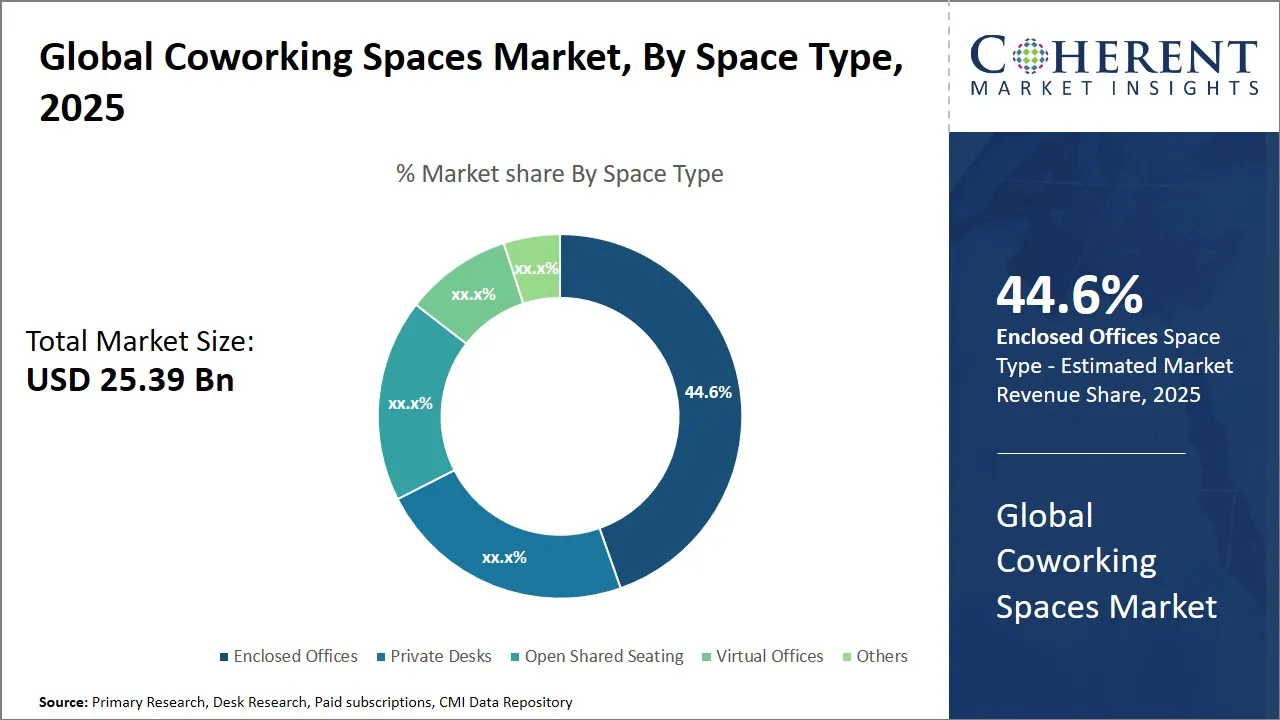
Global Coworking Spaces Market Insights, by Space Type – Enclosed Offices Segment Lead Owing to Increased Demand for Privacy and Customization in Coworking Environments
The enclosed offices segment is projected to account for 45.6% in 2026, driven by an evolving workforce that prioritizes privacy, security, and tailor-made work environments. Unlike open seating or shared desks, enclosed offices offer professionals and businesses a private, distraction-free workspace where confidential discussions and focused tasks can occur uninterrupted. Enclosed offices enable these businesses to comply with stringent regulatory requirements related to data confidentiality and client privacy, which open or shared arrangements cannot easily guarantee. Moreover, the post-pandemic shift toward hybrid work models has increased the preference for dedicated spaces where teams can collaborate face-to-face without the distractions common in open coworking settings.
Customization and branding opportunities within enclosed offices also contribute significantly to their popularity. Members can personalize their spaces to reflect their corporate identity, enabling a sense of ownership and professional ambiance that fosters productivity and team cohesion. Additionally, enclosed offices typically come with dedicated amenities such as locked storage, enhanced soundproofing, and private meeting rooms, further augmenting their appeal. The flexibility of lease terms and scalable office sizes play a vital role in attracting a wide array of tenants to enclosed office solutions. Startups and growing companies appreciate the ability to upscale or downscale their office footprint without the burden of long-term leases or significant capital expenditure.
For instance, WeWork offers “Headquarters by WeWork”, a service that provides private, fully enclosed, customizable office spaces tailored specifically for small and mid-sized enterprises. Unlike open coworking layouts, these enclosed offices are designed for companies needing privacy, regulatory compliance, and branding control.
Furthermore, advancements in office design and technology integration have improved the overall work experience within enclosed offices. Efficient layouts, ergonomic furnishings, and smart office systems enhance comfort and convenience, supporting employee well-being and performance. The incorporation of high-speed internet, secured network access, and video conferencing facilities within enclosed spaces helps businesses operate seamlessly while benefiting from the communal infrastructure offered by coworking centers.
- Current Industry Events of 2026
- Market Size Estimation
- Regional Breakdown
- Competitive Landscape
- Customer Intelligence
- Segmental Analysis
- Pricing Analysis
- Key Market Drivers, Challenges & Future Trends
- Customized Insights Section
Pricing Analysis of the Coworking Spaces Market
Membership Type | Global/National Average | Premium/High-Cost Markets | Budget/Affordable Markets |
Hot Desk (Open Seating) | ~USD 195–USD 206 global average | NYC/SF: USD 400–USD 600 (NYC: up to USD 600; SF: USD 350–550) | Smaller U.S. cities (Wichita/Greensboro): ~USD 99 |
Dedicated Desk | U.S. national average: ~USD 300–USD 387 | NYC: USD 700–1,200; SF: USD 600–1,100 | Smaller metros: USD 250–500; Grand Rapids: USD 189 |
Private Office (1-person) | Launch Workplaces starting at USD 600; global range approx. USD 350–800 | NYC: USD 2,000+; SF: USD 1,500+; Chicago: USD 1,000–1,500 | Smaller markets: USD 500–900 |
Virtual Office | U.S. national median: ~USD 120 | Expensive metros (Naples, FL): ~USD 240; Trenton, NJ: ~USD 215 | Low-cost metros (Rochester NY, College Station TX): ~USD 50–65 |
Regional Insights
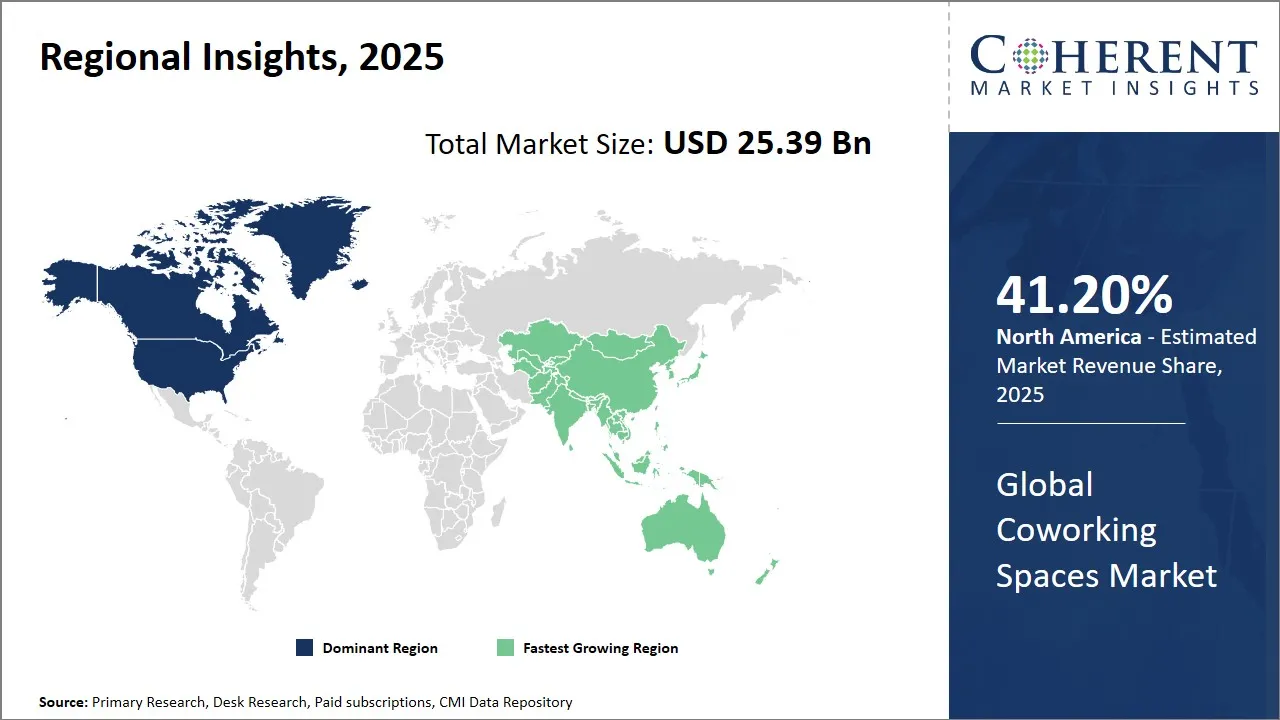
North America Coworking Spaces Market Analysis and Trends
The North America region is projected to lead the market with a 41.20% share in 2026, driven by a mature ecosystem characterized by high urbanization, a large concentration of startups, and a strong presence of global corporate headquarters. The region benefits from progressive government policies encouraging entrepreneurship and flexible work environments, fostering innovation hubs especially in cities like New York, San Francisco, and Toronto. Established players such as WeWork, Regus (IWG), and Industrious have significantly contributed by expanding premium coworking spaces catering to freelancers, SMBs, and multinational companies. Additionally, North America’s advanced technological infrastructure and emphasis on hybrid work models have amplified coworking adoption, while trade dynamics facilitate seamless international business operations, thereby strengthening the region’s market dominance.
Asia Pacific Coworking Spaces Market Analysis and Trends
The Asia Pacific region, holding a share of 23.2% in 2026, is expected to exhibit the fastest growth in the coworking spaces market, driven by rapid urbanization, increasing adoption of flexible work trends, and rising startup ecosystems across major cities including Bangalore, Singapore, Shanghai, and Sydney. Governments across APAC actively promote innovation and entrepreneurial activities through supportive policies and initiatives such as tax incentives and infrastructure development tailored to new businesses. The presence of both global and regional coworking operators like JustCo, The Executive Centre, and Spaces, alongside agile local players, helps meet the diverse the demand from technology, creative industries, and SMEs. Trade openness and the rise of digital ecosystems further boost market development, making APAC a hotspot for coworking expansion.
Coworking Spaces Market Outlook for Key Countries
U.S. Coworking Spaces Market Analysis and Trends
The U.S. benefits from an extensive network of coworking providers, with WeWork leading in scale and innovation, complemented by companies such as Knotel and Industrious that emphasize customized office solutions. Major metropolitan areas foster dynamic ecosystems with high demand for flexible workspaces from technology firms, startups, and professional service organizations. The push towards hybrid working, accelerated by changing workforce policies, has led to increased utilization of coworking spaces, especially in technology hubs like Silicon Valley and New York City.
Germany Coworking Spaces Market Analysis and Trends
Germany continues to lead Europe coworking spaces market with strong governmental support for SMEs and startups, particularly in Berlin and Munich. The country’s emphasis on sustainable urban development and digital transformation drives flexible office space adoption. Operators such as Mindspace and Design Offices have capitalized on this by offering premium coworking environments suited for creative and tech sectors. Germany’s central position within the EU facilitates cross-border business activities, enhancing the market dynamism.
India Coworking Spaces Market Analysis and Trends
India is rapidly evolving, supported by government initiatives like Startup India and Digital India, which fuel entrepreneurship across cities such as Bangalore, Mumbai, and New Delhi. The presence of local providers such as 91springboard and Innov8 alongside global operators like Regus has increased workspace accessibility for a broad base of startups and freelancers. The country’s growing young workforce and expanding IT and service sectors further stimulate the demand for collaborative and cost-effective office solutions.
Singapore Coworking Spaces Market Analysis and Trends
Singapore stands out as a leading coworking hub in Asia Pacific due to its strategic location, business-friendly policies, and a highly developed infrastructure. The government’s focus on supporting tech innovation and startups through grants and smart nation initiatives attracts multinational corporations and entrepreneurs alike. Providers like JustCo and The Hive have expanded aggressively, offering high-end, tech-enabled coworking spaces that align with the city-state’s vision of a future-ready economy.
Brazil Coworking Spaces Market Analysis and Trends
Brazil coworking spaces market is gaining momentum driven by urban regeneration projects and increasing entrepreneurial activity in São Paulo and Rio de Janeiro. Despite economic fluctuations, the demand for flexible office space grows as more companies adopt hybrid working models and SMEs seek affordable, scalable workspace. National players such as WeWork Brazil and local operators including CoW BR facilitate the expansion of coworking culture, supported by evolving trade relations within Latin America.
Market Players, Key Development, and Competitive Intelligence
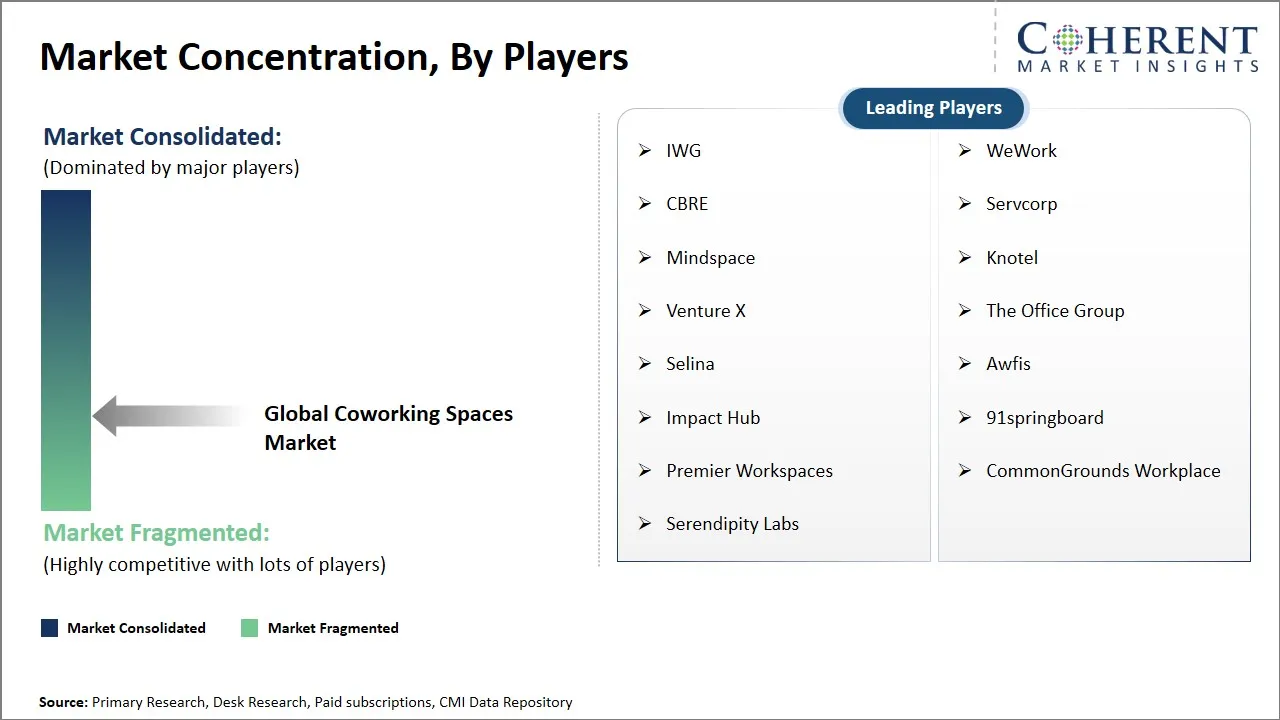
Top Strategies Followed by Coworking Spaces Market Players
- Established players in this arena typically invest heavily in research and development (R&D), aiming to innovate high-performance products that cater to the evolving needs of diverse clientele.
- IWG invested in hybrid work technology platforms and digital booking systems, including partnerships with Microsoft Teams and Zoom for seamless workspace booking integrations.
- Mid-level competitors in the coworking spaces market adopt more cost-conscious yet strategic approaches to remain relevant and competitive.
- Awfis focuses on affordable coworking spaces, offering flexible daily passes, pay-per-use models, and tiered memberships targeting startups and SMEs in cost-sensitive Indian metros.
- Small-scale players, often more agile and innovative, carve out specialized niches within the broader coworking market by focusing on unique features or tailor-made offerings.
- SmartLabs (US) specializes in lab-enabled coworking spaces for life sciences and biotech firms, differentiating itself from general coworking providers.
Key Developments
- In June 2025, SmartLabs, the leading provider of flexible laboratory infrastructure and resourcing solutions, and International Workplace Group (IWG), the world’s largest flexible and hybrid workspace platform with brands including Regus, Spaces, Signature and HQ, announced a 10-year global partnership to meet growing demand for fully managed lab environments in emerging and established life sciences hubs.
- In January 2025, CBRE Group, Inc. announced a definitive agreement to acquire Industrious National Management Company, LLC, a leading provider of flexible workplace solutions. In conjunction with the acquisition, CBRE will create a new business segment called Building Operations & Experience (BOE).
- In October 2024, WeWork, the leading global flexible space provider, today announced the launch of its Coworking Partner Network, an affiliate program of third-party workspaces that delivers increased flexibility and choice to its members.
- In October 2024, Mr. Adam Neumann, the co-founder of WeWork, returned to the coworking business. Just four months after a failed bid to buy back his former company, Mr. Neumann introduced Workflow, a coworking service that seeks to compete with WeWork.
Market Report Scope
Coworking Spaces Market Report Coverage
| Report Coverage | Details | ||
|---|---|---|---|
| Base Year: | 2025 | Market Size in 2026: | USD 28.94 Bn |
| Historical Data for: | 2020 To 2024 | Forecast Period: | 2026 To 2033 |
| Forecast Period 2026 to 2033 CAGR: | 14.0% | 2033 Value Projection: | USD 72.43 Bn |
| Geographies covered: |
| ||
| Segments covered: |
| ||
| Companies covered: | IWG, WeWork, CBRE, Servcorp, Mindspace, Knotel, Venture X, The Office Group, Selina, Awfis, Impact Hub, 91springboard, Premier Workspaces, CommonGrounds Workplace, and Serendipity Labs | ||
| Growth Drivers: |
| ||
| Restraints & Challenges: |
| ||
Market Dynamics
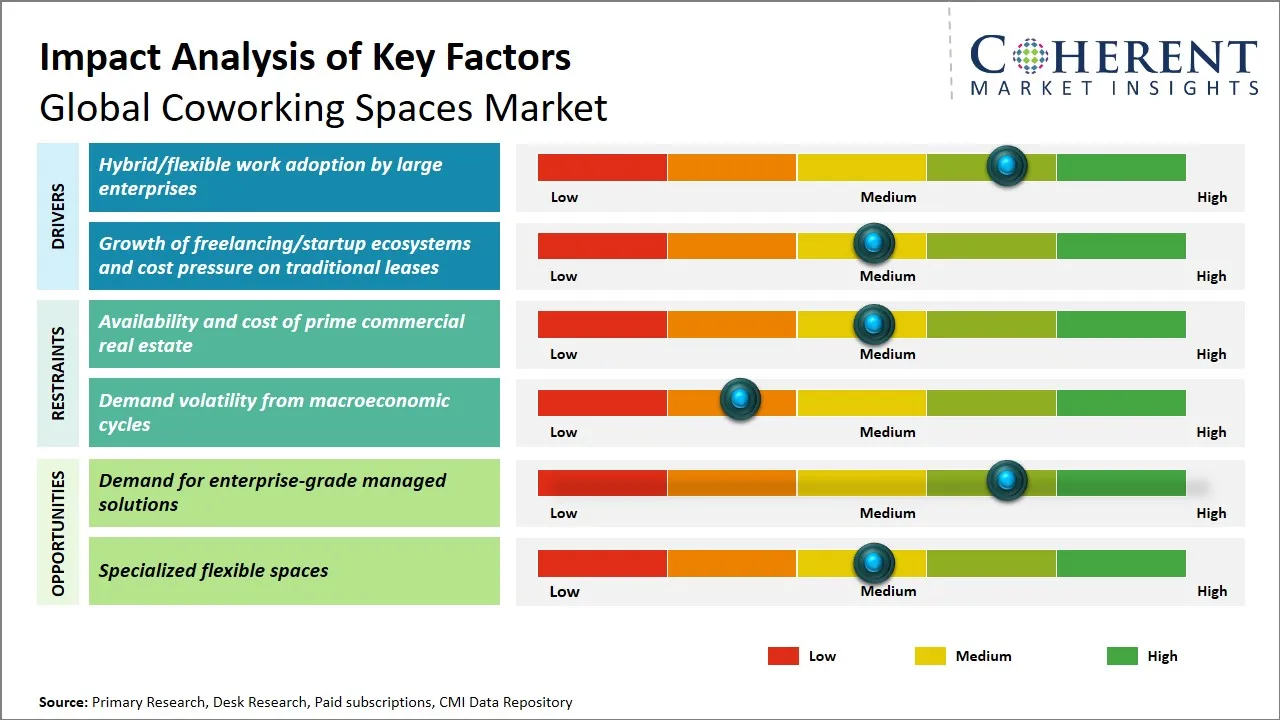
Global Coworking Spaces Market Driver - Hybrid/Flexible Work Adoption by Large Enterprises
As organizations move away from traditional, centralized office setups, they seek adaptable workspace solutions that accommodate a blend of remote and in-office work, enabling employees to choose where and how they work most effectively. Coworking spaces offer a compelling alternative by providing fully equipped environments that support collaboration, creativity, and productivity without the long-term commitments and overhead costs associated with leased office properties. CBRE & Industrious partnership and eventual full acquisition (2025) was driven by rising enterprise demand for hybrid workplace solutions. CBRE reported that Fortune 500 clients increasingly sought flexible space as part of hybrid work programs, making coworking a mainstream enterprise real estate strategy.
Additionally, these spaces allow enterprises to maintain a physical presence in multiple geographic locations, facilitating regional team interactions and client engagements with ease. Large companies also leverage coworking centers to pilot new work models, test workspace needs, and scale operations flexibly in response to fluctuating workforce demands. This shift toward hybrid work arrangements underscores the strategic value of coworking spaces as businesses prioritize agility, employee well-being, and cost efficiency in a dynamic and evolving work landscape.
Coworking Spaces Market Opportunity – Demand for Enterprise-grade Managed Solutions
As large corporations and established enterprises seek flexible workspace options that go beyond traditional coworking amenities, there is a growing preference for customized, secure, and technology-enabled managed services within coworking environments. These enterprises require integrated solutions that combine workspace flexibility with advanced IT infrastructure, data security, and seamless connectivity to support distributed teams and remote work models effectively. Managed solutions offer comprehensive packages including dedicated desks, private offices, IT support, and collaboration tools, catering specifically to the operational and compliance needs of larger organizations.
IWG’s Managed Office Solutions (launched globally in recent years) provide customized, branded, fully serviced office suites for large corporates such as Standard Chartered Bank and Nestlé. Additionally, the rise of hybrid work models post-pandemic has accelerated the adoption of such services, as enterprises aim to optimize costs while maintaining employee productivity and engagement across multiple locations.
Analyst Opinion (Expert Opinion)
- Enclosed offices dominate the market as enterprises increasingly demand secure, private spaces within coworking facilities. They balance the flexibility of short-term leasing with the confidentiality and branding enterprises require, making them a cornerstone of hybrid workplace strategies.
- Hot desks remain the entry point for freelancers, entrepreneurs, and early-stage startups who value affordability and community. Their pay-as-you-go flexibility allows users to minimize costs while accessing professional amenities, fueling demand in price-sensitive markets like India and Southeast Asia.
- The rise of lab-enabled coworking (e.g., biotech labs), creative studios, and hybrid hospitality-work models reflects a shift toward sector-specific coworking. These specialized spaces cater to unique user requirements, providing operators with differentiation and high-margin opportunities in otherwise crowded markets.
Speak to the analyst
Want personalized insights?
Take the findings above to one of our principal consultants, or have the report rebuilt around the segments, geographies and competitors you actually track.
Market Segmentation
- Space Type Insights (Revenue, USD Bn, 2021 - 2033)
- Enclosed Offices
- Private Desks
- Open Shared Seating
- Virtual Offices
- Others
- Regional Insights (Revenue, USD Bn, 2021 - 2033)
- North America
- U.S.
- Canada
- Latin America
- Brazil
- Argentina
- Mexico
- Rest of Latin America
- Europe
- Germany
- U.K.
- Spain
- France
- Italy
- Russia
- Rest of Europe
- Asia Pacific
- China
- India
- Japan
- Australia
- South Korea
- ASEAN
- Rest of Asia Pacific
- Middle East
- GCC Countries
- Israel
- Rest of Middle East
- Africa
- South Africa
- North Africa
- Central Africa
- North America
- Key Players Insights
- IWG
- WeWork
- CBRE
- Servcorp
- Mindspace
- Knotel
- Venture X
- The Office Group
- Selina
- Awfis
- Impact Hub
- 91springboard
- Premier Workspaces
- CommonGrounds Workplace
- Serendipity Labs
Sources
Primary Research Interviews
Stakeholders
- Coworking Space Operators (e.g., WeWork, IWG, Awfis, Industrious)
- Real Estate Developers & Commercial Property Managers
- Corporate Real Estate Executives (Enterprise clients using coworking)
- Freelancers, Startups & SMEs actively using coworking spaces
- Technology Providers (Workspace booking, hybrid work platforms)
- Sustainability Consultants (for green and energy-efficient workspace design)
Databases
- Eurostat
- U.S. Census Bureau
- OECD
- World Bank Data on Urbanization & Employment Trends
- Global Real Estate Transparency Index (JLL)
Magazines
- Workplace Insight
- Commercial Property Executive
- Office Snapshots
- Real Estate Weekly
Journals
- Journal of Corporate Real Estate
- Journal of Property Investment & Finance
- Facilities Journal
- Journal of Real Estate Research
Newspapers
- The Wall Street Journal (U.S.)
- The Guardian (UK)
- The Economic Times (India)
- South China Morning Post (Hong Kong)
Associations
- Global Workspace Association (GWA)
- Flexible Space Association (UK)
- Urban Land Institute (ULI)
- CoreNet Global
- British Council for Offices (BCO)
Public Domain Sources
- U.S. Census Bureau
- EUROSTAT
- United Nations Economic Commission for Europe (UNECE)
- World Bank
- ResearchGate
Proprietary Elements
- CMI Data Analytics Tool
- Proprietary CMI Existing Repository of information for last 8 years
Get access to 250+ pages report
Every segment, forecast, competitor profile and data table behind the analysis above — available for instant download.
- ESOMAR Member
- ISO 9001:2015 Certified
- D-U-N-S Registered
- GDPR & CCPA Compliant
Missing comfort of reading report in your local language? Find your preferred language:
Transform your Strategy with Exclusive Trending Reports
Frequently Asked Questions
The global coworking spaces market is estimated to be valued at USD 28.94 billion in 2026 and is expected to reach USD 72.43 billion by 2033.
The CAGR of the global coworking spaces market is projected to be 14.0% from 2026 to 2033.
Hybrid/flexible work adoption by large enterprises and growth of freelancing/startup ecosystems and cost pressure on traditional leases are the major factors driving the growth of the global coworking spaces market.
Availability and cost of prime commercial real estate and demand volatility from macroeconomic cycles are the major factors hampering the growth of the global coworking spaces market.
In terms of space type, the enclosed offices segment is estimated to dominate the market revenue share in 2026.
It is a segment of flexible workspaces where individuals and companies share office infrastructure and services.
Key users include freelancers, startups, SMEs, and increasingly large enterprises.