

Global Cumene Market Size and Forecast – 2026-2033
According to Coherent Market Insights, the global cumene market is estimated to be valued at USD 17.45 Bn in 2026 and is expected to reach USD 25.55 Bn by 2033, expanding at a compound annual growth rate (CAGR) of 5.6% from 2026 to 2033.
Key Takeaways of the Cumene Market
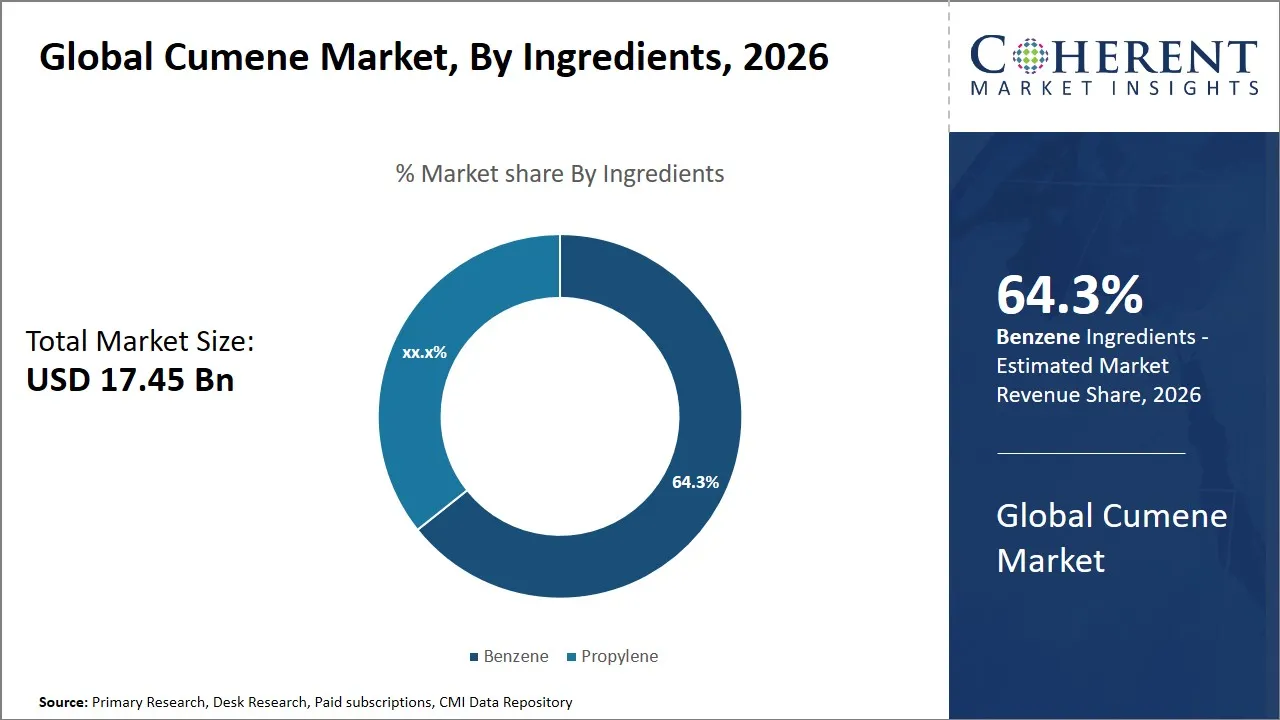
- The benzene segment is expected to account for 64.3 % of the market share in 2026.
- The phenol production segment is expected to capture 46.8 % of the cumene market share in 2026.
- The plastics & polymers segment is projected to hold 34.8 % of the global cumene market share in 2026.
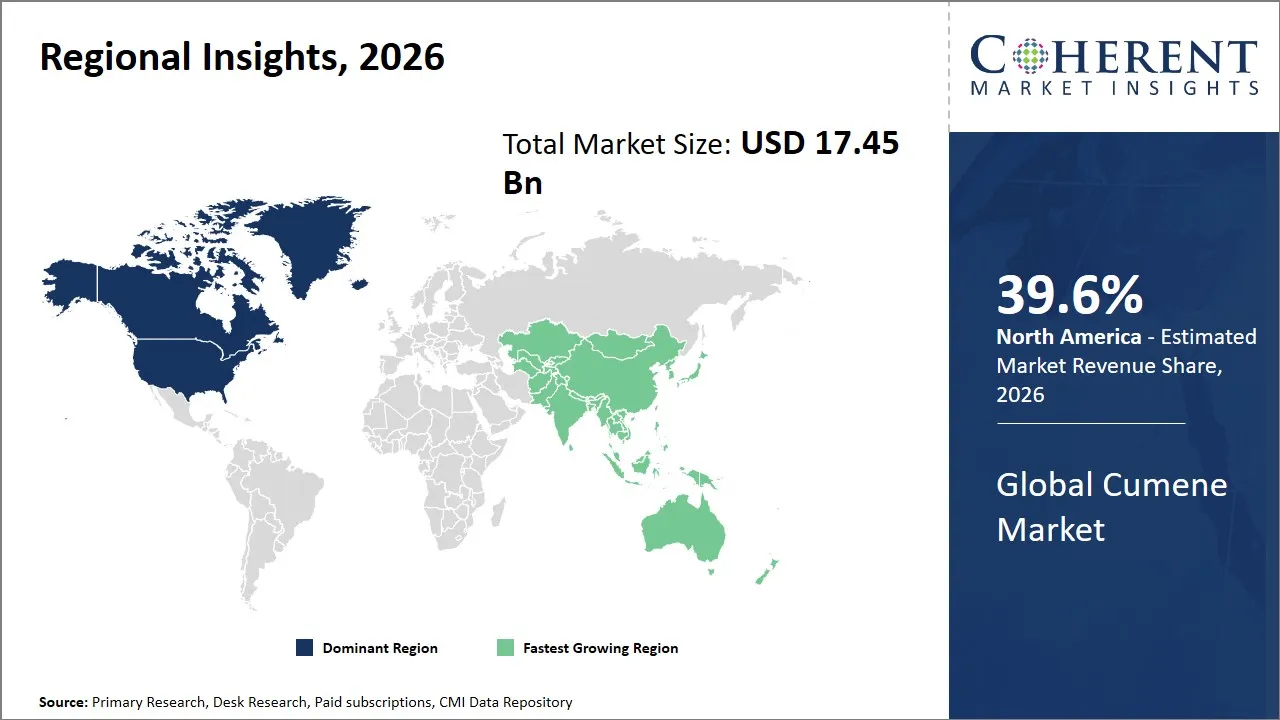
- North America is expected to lead the cumene market with a 39.6 % share in 2026.
- The Asia Pacific region will hold 15.3 % share in 2026 and record the fastest growth.
Market Overview
- Current market trends reveal a rising shift towards sustainable production methods and the integration of advanced super catalyst technologies to enhance efficiency and reduce environmental impact.
- Additionally, expanding applications in emerging economies due to industrial growth and infrastructural development are fueling demand.
- Companies are also focusing on strategic partnerships and capacity expansions to capitalize on evolving market dynamics and meet the growing demand efficiently.
Current Events and Its Impact
Current Events | Description and its Impact |
Escalating Global Trade Tariffs on Chemicals |
|
Regional Capacity Expansion and Vertical Integration (Asia Pacific) |
|
Segmental Insights
- Current Industry Events of 2026
- Market Size Estimation
- Regional Breakdown
- Competitive Landscape
- Customer Intelligence
- Segmental Analysis
- Pricing Analysis
- Key Market Drivers, Challenges & Future Trends
- Customized Insights Section
Why Does the Benzene Segment Dominate the Global Cumene Market?
Benzene segment is expected to contribute 64.3% of the market share in 2026, owing to its pivotal role as a primary raw material for cumene production. The chemical characteristics of benzenes would ensure that it is a good candidate in the alkylation reaction with propylene to produce cumene effectively and in large quantities. Among the leading forces that have encouraged benzenes to conquer the ingredient segment is the fact that it enjoys a high level of availability and locations where it has strong supply channels especially in areas with a strong petrochemical industry. Benzene is an effective and efficient feedstock as compared to other feedstocks because of its availability as a result of crude oil refining and catalytic reforming processes.
In 2023, the United States, being one of the world’s largest producers of benzene, saw over 10 Mn tons of benzene produced, largely as a result of its extensive petrochemical infrastructure. This consistent supply of benzene has been instrumental in maintaining a stable and cost-effective feedstock for cumene production, especially in regions like the Gulf Coast, which is a hub for petrochemical manufacturing.
Why Does the Phenol Production Segment Dominate the Cumene Market?
Phenol production segment is projected to hold 46.8% of the cumene market share in 2026, due to its extensive industrial utility and critical role in producing downstream chemicals. The cumene product in the form of phenol is used as a building block to produce a very wide range of products, mainly plastics, resins, and adhesives. The supremacy of phenol production in the cumene applications is supported by the increasing need to phenolic resin in automotive components, electronics, and construction products where more high-performance, durable polymer is required.
The use of phenol in the manufacture of bisphenol-A (BPA) that is important in polycarbonate plastics and epoxy resins explains a significant portion of cumene-based phenol use. The phenol-based polycarbonates and epoxy resins are in demand in the consumer electronics, packaging and coating industries due to its ability to endure heat, mechanical strength, and clarity. Further, the changing environmental requirements and the need to use lightweight materials in the production of cars has increased the use of such phenol-based plastics hence fueling demand further.
Plastics & Polymers Segment Dominates the Cumene Market
Plastics & polymers segment is expected to command 34.8% of the global cumene market share in 2026, because of the remarkable growth of the requirement of plastic materials, which have been diversified to serve many industrial and consumer needs. Cumenes major derivatives phenol and acetone are used to manufacture polymers such as polycarbonate, resin based on bisphenol-A which are used as building blocks in the manufacture of plastics with different functions and performance properties.
The plastics and polymers sector’s rapid expansion is fueled by increased urbanization, rising consumer spending, and technological advancements that call for lightweight, high-strength materials. These polymers find critical use in packaging, automotive parts, electronics housings, and construction materials, all of which demand materials combining durability with cost efficiency. Furthermore, innovations in polymer science that focus on recyclability and enhanced mechanical properties are amplifying the reliance on phenol-derived polymers, in turn propelling the demand for cumene as an upstream ingredient.
Regional Insights
North America Cumene Market Analysis and Trends
The North America region is projected to lead the market with a 39.6% share in 2026, as the region has a strong petrochemical industry that has the advantage of having the competitive and inexpensive raw materials such as shale gas. The U.S. is a leading player in the world cumene market with huge cumene production capacities and high local demand. The already developed infrastructure and the flourishing chemical industry are the foundation of the further development of the cumene production.
Companies are being encouraged to go green in their operations, environmental regulations and government assistance in developing energy efficient technologies are pushing the companies in the direction of this aspect hence increasing bio-based cumene production.
Asia Pacific Cumene Market Analysis and Trends
The Asia Pacific region is expected to exhibit the fastest growth in the market contributing 15.3% share in 2026, owing to the high concentration of large-scale petrochemical industries in some countries such as China, India, and South Korea. The region also enjoys a high supply of raw materials such as benzene and propylene which are the major feedstock in the manufacture of cumene. The vigorous state programs encouraging the development of industries and chemical production have also pushed the maturity of the market in this case.
Also, established export infrastructures and trade policies have made manufacturers increase their international presence. The key players, including Sinopec (China), Indian Oil Corporation (India), and LG Chem (South Korea), play a major role in the domination of the region as they have an integrated production capacity and invest relentlessly in process optimization and sustainability.
Global Cumene Market Outlook for Key Countries
Is China the Key Growth Driver for the Global Cumene Market?
The cumene market in China is a central location in the world in terms of cumene production facilitated by huge petrochemical complexes which have been granted to leading companies such as Sinopec and PetroChina. The increasing downstream demand in the industries of phenol and acetone in the country is a factor that maintains a healthy market climate. The government policies that encourage energy efficiency and environmental compliance provoke the technological development and slow transition to more environmentally friendly production, making China the keystone of the world supply chain.
Is India Poised to Become a Key Player in the Global Cumene Market?
The India cumene market is growing at a very fast rate and this is due to the increasing number of chemical plants due to increase in consumption of pharmaceuticals, plastics and agrochemicals in the domestic market. The main stakeholders that participate in the capacity building and the improvement of the quality of the cumene production are Indian oil Corporation and Reliance Industries. The Indian government’s aim at developing Make in India and chemical parks provide an environment of enabling business in both local production and export business and supports the Indias presence in the local market.
South Korea Cumene Market Trends
South Korea remains a big power in chemical production with such companies as LG Chem and Lotte Chemical taking the lead. The high technical capacity and integration plans allow efficient cumene and derivatives production. Close cooperation between the state and the business market in the area of innovation, sustainability programs as well as export promotion enhance the competitiveness of South Koreas in the Asia Pacific market.
Saudi Arabia Cumene Market Trends
The Saudi Arabia cumene market is influenced by the high level of investment in a petrochemical infrastructure led by SABIC that is advantaged by the availability of low-cost feedstock that is sourced through the huge natural gas and crude oil reserves. The regulatory system facilitates foreign direct investment and technological advancement with a view of producing exports. The strategic position of the country is an added advantage in terms of the global export, serving Asia, Europe and Africa, which increases the significance of its markets.
U.S. Cumene Market Trends
The U.S. cumene market is marked by the well-established cumene manufacturers such as Dow Chemical and ExxonMobil, which have access to the well-developed refining technologies and the integrated petrochemical ecosystem. The market dynamics are dictated by the emphasis on the innovation, optimization of the processes, and the environmental regulations. The U.S. continues to be a significant force in the cumene arena in the world due to its trade policies and the rising domestic end-use industries in automotive, pharmaceuticals, and specialty chemicals.
Regional Import–Export Dependency Ratio
Region | Import Dependency Ratio (IDR) | Export Dependency Ratio (EDR) | Net Export Ratio |
North America | 30% | 15% | -15% |
Europe | 50% | 40% | -10% |
Asia Pacific | 60% | 50% | -10% |
Market Players, Key Development, and Competitive Intelligence
Key Developments
- In April 2024, Sumitomo Chemical entered a global licensing alliance with KBR to commercialize its cumene-based phenol and acetone production technology. The move is focused on expanding the international deployment of its process portfolio and supporting future cumene-linked capacity additions with improved efficiency and sustainability positioning.
- In December 2023, INEOS Phenol launched Europe’s largest integrated cumene facility in Marl, Germany, expanding regional cumene capacity while reducing carbon intensity through advanced process integration. This is anticipated to support phenol and acetone production across European downstream markets.
- In April 2023, INEOS Phenol completed the acquisition of Mitsui Phenols Singapore Ltd, resulting into capacity addition of 410 kt for cumene and boosting the company’s Asian market presence.
Top Strategies Followed by Global Cumene Market Players
Player Type | Strategic Focus | Example |
Established Market Leaders | Heavy investment in R&D and innovation | An example of how this is done is in the case of Reliance Industries that has come up with new and superior processes of manufacturing cumene that incorporate environmentally friendly processes that do not leave carbon footprints and at the same time the product quality is enhanced. |
Mid-Level Players | Balance cost and sustainability | For example, Reliance Industries Limited has implemented cost-effective production technologies in its Cumene production processes. The company has focused on optimizing its refining processes and improving energy efficiency, which has helped them reduce operational costs. As a result, Reliance Industries can offer more competitive prices while maintaining product quality. |
Small-Scale Players | Niche specialization & innovative variants | For example, Petrochem Middle East has developed a less harmful cumene product line that has less environmental impact, which allows the company to fulfill the needs of customers who want to use more sustainable products. |
Market Report Scope
Cumene Market Report Coverage
| Report Coverage | Details | ||
|---|---|---|---|
| Base Year: | 2025 | Market Size in 2026: | USD 17.45 Bn |
| Historical Data for: | 2020 To 2024 | Forecast Period: | 2026 To 2033 |
| Forecast Period 2026 to 2033 CAGR: | 5.6% | 2033 Value Projection: | USD 25.55 Bn |
| Geographies covered: |
| ||
| Segments covered: |
| ||
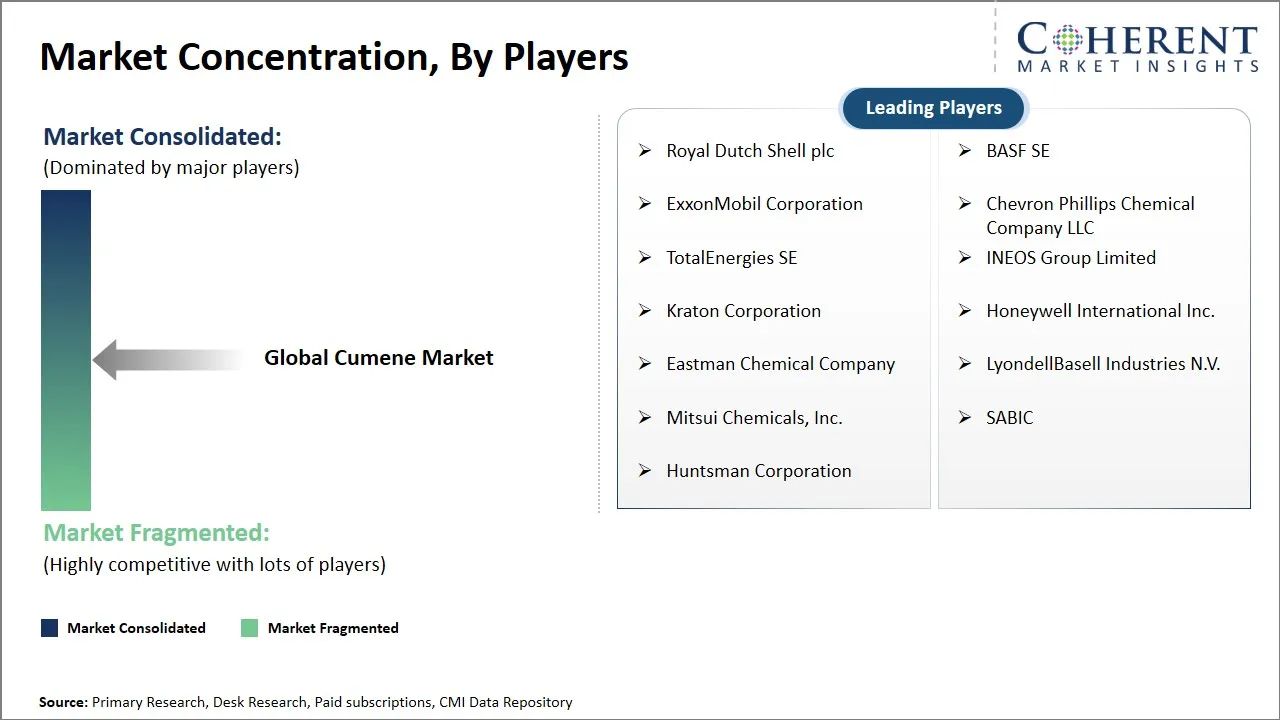
| Companies covered: | Royal Dutch Shell plc, BASF SE, ExxonMobil Corporation, Chevron Phillips Chemical Company LLC, TotalEnergies SE, INEOS Group Limited, Kraton Corporation, Honeywell International Inc., Eastman Chemical Company, LyondellBasell Industries N.V., Mitsui Chemicals, Inc., SABIC, and Huntsman Corporation | ||
| Growth Drivers: |
| ||
| Restraints & Challenges: |
| ||
Cumene Market Dynamics
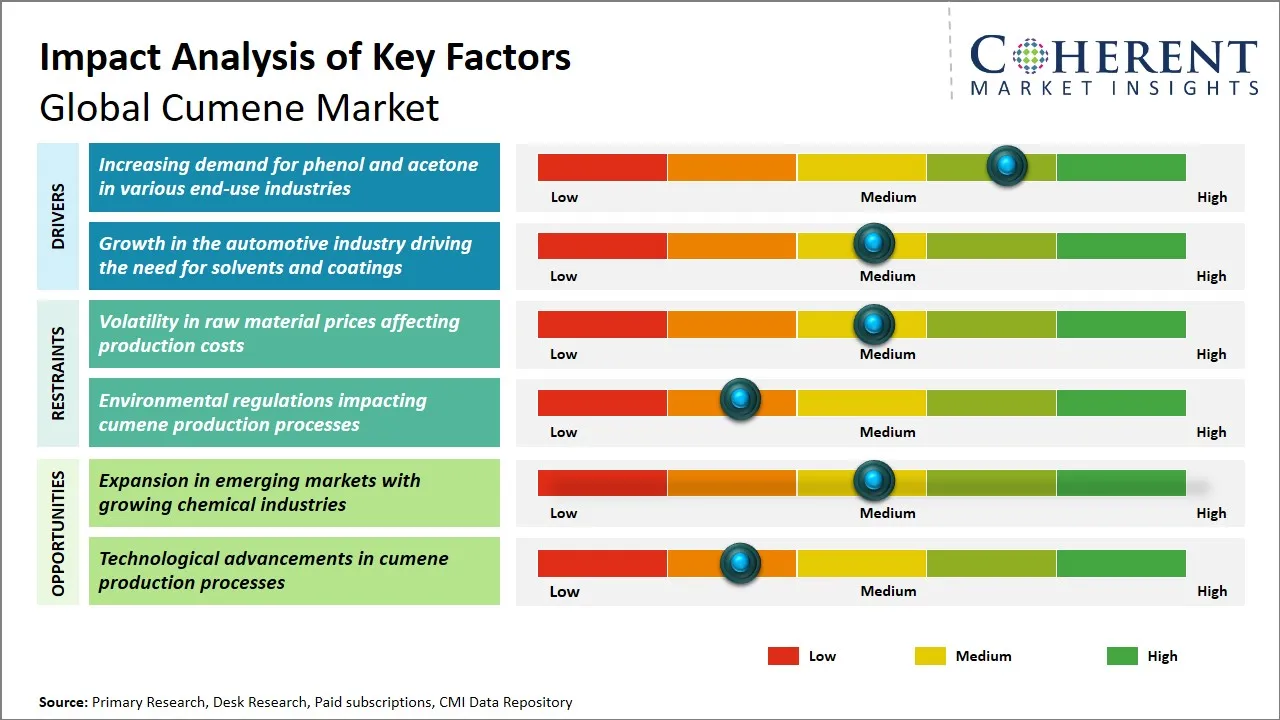
Cumene Market Driver - Increasing Demand for Phenol and Acetone in Various End-use Industries
The rising demand of key derivatives of cumene namely phenol and acetone that have a wide usage in different end-use industries is considerably a driver of the global cumene market. Phenol is a key raw material that is directly consumed in the production of bisphenol A that is the core material used in manufacturing of polycarbonates and epoxy resins that have wide application in automotive, construction, electronics, and packaging industries because of their durability and versatility. At the same time, acetone is a key solvent and intermediate in the manufacturing of methyl methacrylate and bisphenol A and is a significant component of pharmaceuticals, cosmetics, and paints.
In 2022, BASF offered to increase its production capacities of phenol and acetone in Europe to supply the rise in demand in such industries as automotive, electronics, and construction. This is mainly due to the fact that bisphenol A (BPA) which is a primary derivative of phenol is required in the production of polycarbonate plastics that are widely utilized in electric vehicles, packaging, and other durable commodities.
(Source: https://www.basf.com/global/en/media/news-releases/2025/10/p-25-217)
Cumene Market Opportunity - Expansion in Emerging Markets with Growing Chemical Industries
The global cumene market stands to benefit significantly from the rapid industrialization and chemical sector expansion in emerging markets such as India, China, Southeast Asia, and Latin America. There is an upsurge in investments in petrochemical infrastructure in these regions due to the growing demand of downstream products such as phenol and acetone which are highly dependent on cumene as a main feedstock. The growing consumer base and the government efforts aimed at increasing production capacity through programs such as Make in India and Chinas Five -Year Plans are driving the increase in the production of plastics, resins, and adhesives as the all downstream industries driving cumene demand.
For example, Make in India Initiative, in 2023, the Indian government announced that it intends to invest in petrochemical infrastructure to facilitate the production of chemicals. In this effort, investments in new facilities that manufacture phenol and acetone in which cumene is a major feedstock have been influxed. Reliance industries and Indian oil corporation are establishing and expanding chemical industries in India to cater to domestic or foreign demand of chemicals that is increasing the demand of cumene in the region.
Analyst Opinion (Expert Opinion)
- The cumene market has been trending towards a steady growth and this has been attributed to the fact that it plays a vital role in the manufacture of phenol and acetone which are highly needed in the industrial use. The Global Petrochemical Conference (2023) and International Chemical Engineering Summit (2022) also revealed the major achievements of the companies such as BASF and Dow Chemical in the fields of cumene manufacturing processes improving efficiency and sustainability.
- The recent adoption by BASF of a new catalytic process which consumes less energy in the production of cumene is a good example of how the industry has been determined to ensure that its carbon footprint is reduced. The growing trend in using phenolic resins in the automotive and construction industries was also discussed in the forums, thereby driving the consumption of cumene.
- The certain issues like the varying costs of raw materials and political unrest in the supply chains were often mentioned as possible impediments. Those companies, which are concerned with working on the development of strong supply chain strategies and invest into R&D to streamline production processes, will probably have a competitive advantage. Finally, the eventual development of the cumene market will rely on the capacity to respond to the changing industry pressures towards efficiency and sustainability coupled with successful dedication to external market pressures.
Speak to the analyst
Want personalized insights?
Take the findings above to one of our principal consultants, or have the report rebuilt around the segments, geographies and competitors you actually track.
Market Segmentation
- Ingredients Insights (Revenue, USD Bn, 2021 - 2033)
- Benzene
- Propylene
- Application Insights (Revenue, USD Bn, 2021 - 2033)
- Phenol Production
- Acetone Production
- Solvents
- Others (e.g., coatings, resins)
- End-use Industry Insights (Revenue, USD Bn, 2021 - 2033)
- Plastics & Polymers
- Automotive
- Construction
- Electronics
- Consumer Goods
- Others
- Regional Insights (Revenue, USD Bn, 2021 - 2033)
- North America
- U.S.
- Canada
- Latin America
- Brazil
- Argentina
- Mexico
- Rest of Latin America
- Europe
- Germany
- U.K.
- Spain
- France
- Italy
- Russia
- Rest of Europe
- Asia Pacific
- China
- India
- Japan
- Australia
- South Korea
- ASEAN
- Rest of Asia Pacific
- Middle East
- GCC Countries
- Israel
- Rest of Middle East
- Africa
- South Africa
- North Africa
- Central Africa
- North America
- Key Players Insights
- Royal Dutch Shell plc
- BASF SE
- ExxonMobil Corporation
- Chevron Phillips Chemical Company LLC
- TotalEnergies SE
- INEOS Group Limited
- Kraton Corporation
- Honeywell International Inc.
- Eastman Chemical Company
- LyondellBasell Industries N.V.
- Mitsui Chemicals, Inc.
- SABIC
- Huntsman Corporation
Sources:
Primary Research Interviews
- CEO – Leading Cumene Producer (e.g., INEOS or ExxonMobil equivalent)
- Supply Chain Director – Major Petrochemical Distributor
- Production Lead – Phenol and Acetone Manufacturer (Cumene Derivatives)
- Sustainability Officer – Petrochemical Certification Authority
Stakeholders
- Manufacturers
- End-use Sectors
- Phenol Production Industry
- Acetone and Resins Producers
- Paints, Coatings, and Solvents Sector
- Regulatory & Certification Bodies (e.g., EPA for cumene hazards, REACH compliance in EU)
- E-commerce Platforms and Retailers (Alibaba, Industrial Suppliers, Sigma-Aldrich)
- Technology Integration Players: Advanced phenol derivatives and polymer producers using cumene
Databases
- UN Comtrade Database
- India Import Export (EXIM) Database
- USGS Mineral Commodity Summaries (if covering petrochemicals)
- Eurostat Trade Statistics for Chemicals
Magazines
- Chemical Processing Magazine – Trends in petrochemical supply
- Hydrocarbon Processing – Cumene production innovations
- Chemical Week – Supply disruptions in cumene and aromatics
- Petrochemicals Europe – Market dynamics for cumene
Journals
- Chemical Engineering Journal – Cumene synthesis and purification techniques
- Industrial & Engineering Chemistry Research – Cumene process optimization
- Journal of Hazardous Materials – Environmental impact of cumene processing
- Catalysis Today – Alkylation processes for cumene
Newspapers
- The Wall Street Journal – Global petrochemical demand for cumene
- Business Standard (India) – Cumene imports and Asia market growth
- Reuters – Price volatility in cumene and benzene derivatives
- Financial Times – Petrochemical supply chain analysis
Associations
- Phenol, Acetone & Cumene Sector Group (PASG, Cefic)
- American Petroleum Institute (API)
- European Chemical Industry Council (Cefic)
- Aromatics Producers Association (APA, Cefic)
- International Council of Chemical Associations
Public Domain Sources
- EPA – Guidelines for cumene handling and toxicity
- European Commission – REACH regulations on cumene
- World Health Organization – Safety standards for cumene exposure
- USGS – Petrochemical trade assessments (where applicable)
- OECD – Chemical trade and sustainability reports for cumene
Proprietary Elements
- CMI Data Analytics Tool, Proprietary CMI Existing Repository of information for last 8 years.
Get access to 250+ pages report
Every segment, forecast, competitor profile and data table behind the analysis above — available for instant download.
- ESOMAR Member
- ISO 9001:2015 Certified
- D-U-N-S Registered
- GDPR & CCPA Compliant
Missing comfort of reading report in your local language? Find your preferred language:
Transform your Strategy with Exclusive Trending Reports
Frequently Asked Questions
The global cumene market is estimated to be valued at USD 17.45 Bn in 2026 and is expected to reach USD 25.55 Bn by 2033.
Cumene (isopropylbenzene) is an aromatic hydrocarbon used mainly in phenol and acetone production.
It is produced by the Friedel–Crafts alkylation of benzene with propylene using acidic catalysts.
The CAGR of global cumene market is projected to be 5.6% from 2026 to 2033.
Increasing demand for phenol and acetone in various end-use industries and growth in the automotive industry driving the need for solvents and coatings are the major factors driving the growth of the global cumene market.
Volatility in raw material prices affecting production costs and environmental regulations impacting cumene production processes are the major factors hampering the growth of the global cumene market.
In terms of ingredients, benzene is estimated to dominate the market revenue share in 2026.