

Global Data de Identification Market Size and Forecast – 2026-2033
The global data de identification market is estimated to be valued at USD 1.93 Bn in 2026 and is expected to reach USD 5.87 Bn by 2033, reflecting a compound annual growth rate (CAGR) of 17.2% from 2026 to 2033.
Key Takeaways of the Data de Identification Market
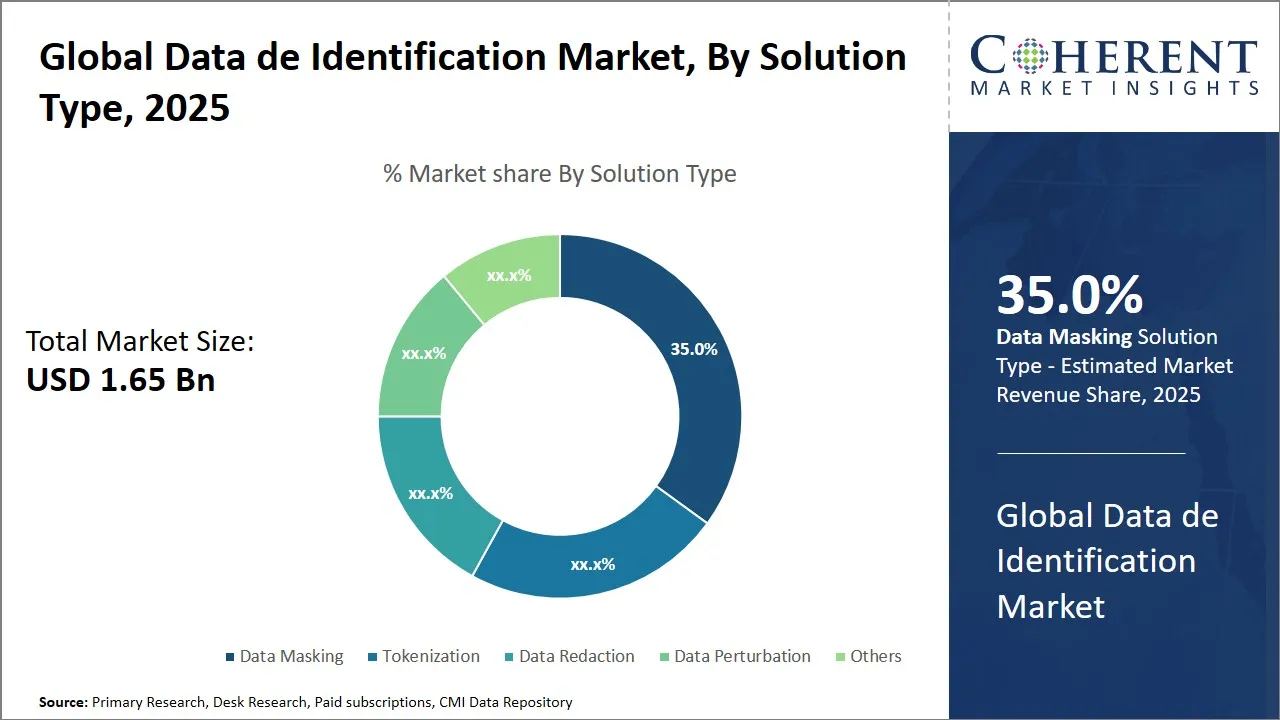
- The data masking segment is expected to accounts for 36% of the data de identification market share in 2026.
- The on-premises segment is projected to capture 48% of the market share in 2026.
- The structured segment is expected to command 42% share in 2026.
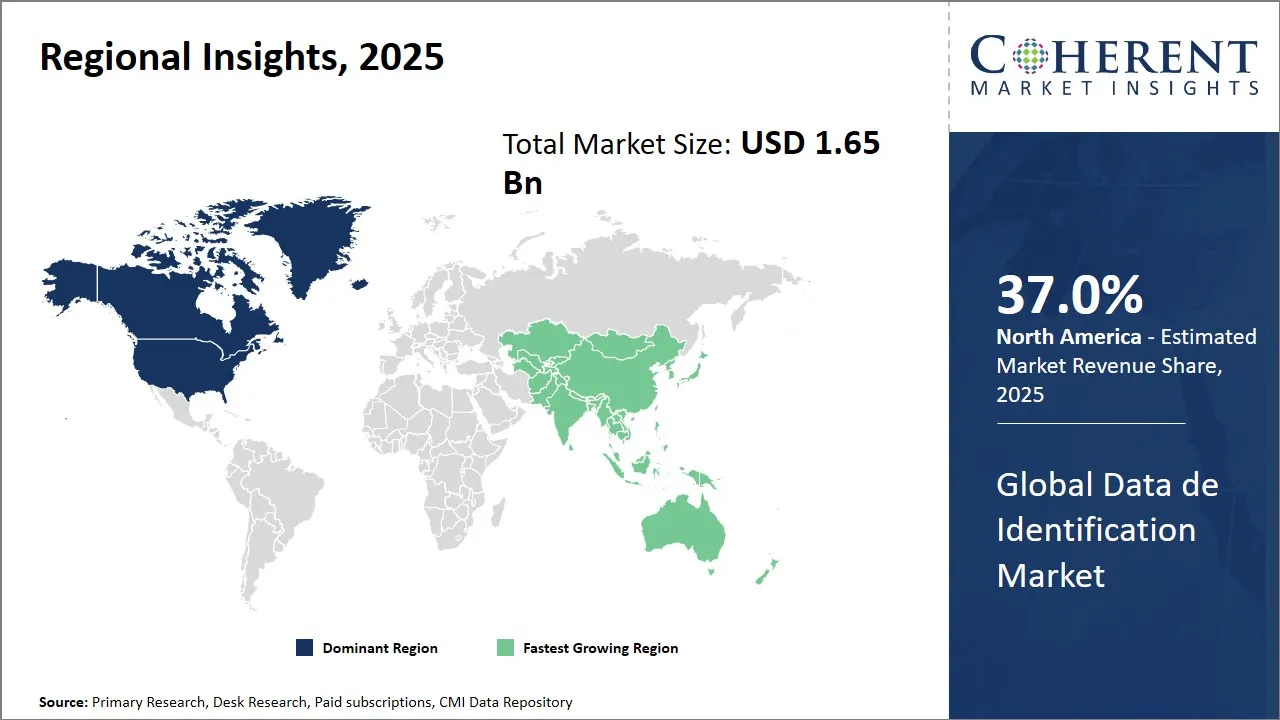
- North America will dominate the data de identification market in 2026 with an estimated 37%
- Asia Pacific will hold 29% share in 2026 and record the fastest growth.
Current Events and Its Impact
Current Events | Description and its Impact |
Topcon Healthcare Platform Launch |
|
Segmental Insights
- Current Industry Events of 2026
- Market Size Estimation
- Regional Breakdown
- Competitive Landscape
- Customer Intelligence
- Segmental Analysis
- Pricing Analysis
- Key Market Drivers, Challenges & Future Trends
- Customized Insights Section
Why Does Data Masking Segment Dominate the Global Data de Identification Market in 2026?
The data masking segment is expected to hold 36.0% of the global data de identification market share in 2026. The rise occurs since it helps companies safeguard private details while keeping daily operations running smoothly - given rules like GDPR, HIPAA, or CCPA set tough standards for data protection, more firms now apply masking methods to stay compliant. Using made-up but realistic data ensures safety during testing; thus, teams handle modified information safely while developing systems or running checks. This approach prevents leaks of actual confidential details by relying on plausible substitutes instead.
One key factor that makes data masking effective lies in its adaptability across sectors such as finance, health, or retail. In medical environments, professionals rely on personal information for analysis, yet these files need protection to prevent identity leaks. Masking keeps the structure intact so systems can still process info safely without risking exposure. Newer tools for real-time and fixed masking also give businesses more ways to apply protection easily, which helps boost usage.
For instance, in August 2025, Oracle updated its data masking and sub-setting capabilities, expanding the library of detectable sensitive data types to 187 kinds (including country-specific identifiers and financial/healthcare fields), improving automated discovery and masking accuracy for large enterprise datasets.
(Source: blogs.oracle.com)
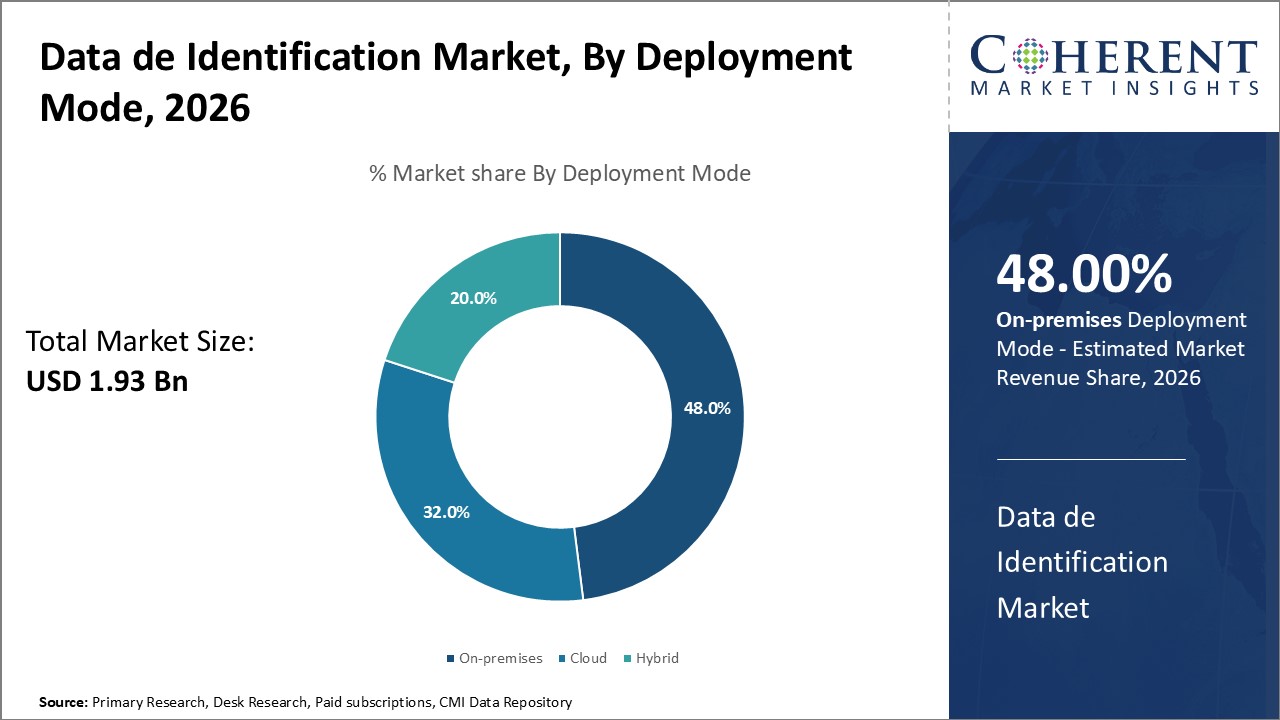
On-Premises Segment Dominates the Global Data de Identification Market
The on-premises segment is expected to hold 48.0% of the data de identification market share in 2026. For businesses needing tight control over critical data, on-site setups are common. In tightly controlled sectors like finance, public administration or medical services, on premises systems are favored due to alignment with rigid regulatory standards. Because these institutions handle vast amounts of private information, full infrastructure authority remains essential.
The option to adjust de-identification methods based on internal rules often leads companies to choose on-site setups. Firms using on premises solutions can link privacy tools smoothly with older systems, while keeping current security layers intact, for better alignment without slowing operations or sharing data externally.
Why is Structured Segment the Most Common Data Type in the Data de Identification Market?
The structured segment is expected to hold 42.0% of the market share in 2026. Data stored in tables, like databases or spreadsheets, is common because businesses use it every day. Since this kind of information often includes private details about people, money, or purchases, keeping it secure is essential. Instead of leaving it exposed, companies protect records using special techniques. Tools that manage clients, internal resources, or finances rely heavily on these systems. Therefore, effective ways to hide identities within table-based formats are increasingly needed.
As structured data has a clear layout, it's simpler to apply privacy methods. Instead of direct removal, tools like masking or token swaps fit smoothly into databases, keeping records private but usable. Owing to this setup, adjustments stay accurate - information keeps its meaning while meeting strict confidentiality rules. In areas such as finance or medical services, where details matter greatly, these safeguards help balance reliability with protection.
For instance, on October 15, 2025, the IPC of Ontario updated and expanded de-identification guidelines for structured data. This update of the IPC’s globally recognized guidelines provides practical steps to help organizations maximize the benefits of data while protecting privacy.
(Source: ipc.on.ca)
Structured vs. Unstructured Data Challenges
Structured Data | Unstructured Data |
Data organized in tabular formats with a predefined schema or fields. | Data without a predefined schema, including text, images, audio, video, and documents. |
~10–20% of enterprise data is structured. | ~80–90% of enterprise data is unstructured, representing the majority of organizational data. |
Lower storage footprint due to organized format. | Higher storage demands due to multimedia, logs, text files, etc. |
Low to moderate data processing complexity, can be processed with SQL and traditional BI. | High data processing complexity, requires advanced tools (NLP, ML, AI) to make data usable. |
Regional Insights
North America Data de Identification Market Analysis and Trends
North America region is projected to lead the market with a 37% share in 2026. The expansion comes from a developed technological environment, strict rules on data privacy, along with major firms already operating in the field. Laws including HIPAA and CCPA push businesses through obligation to adopt de-identifying systems that protect confidential details. Solid industries such as health care, finance, and IT boost regional need at the same time.
Firms such as IBM, Oracle, or Microsoft add value by embedding strong anonymizing methods within broader protection frameworks. On top of this, public funding for cybersecurity innovation helps North America maintain its leading role.
Asia Pacific Data de Identification Market Analysis and Trends
Asia Pacific is expected to exhibit the fastest growth in the market contributing 29% share in 2026. The expansion stems from the region’s fast-growing digital sector, greater use of cloud systems, also shifting rules on data privacy. Nations like India, China, Japan, or South Korea focus on safeguarding information using globally aligned models.
Meanwhile, progress in digital health services, online shopping, plus financial tech drives demand for tools that anonymize personal data effectively. This environment features more startups emerging while multinationals boost funding locally. Key players including Tata Consultancy Services (TCS), NEC Corporation, and Alibaba Cloud push improvements in de-identifying data via new methods applied widely across major fields.
Global Data de Identification Market Outlook for Key Countries
Why is U.S. Emerging as a Major Hub in the Data de Identification Market?
The U.S. market features strict regulations alongside advanced tech systems, creating a central hub for top data anonymization firms. Because of HIPAA and CCPA rules, companies in health care, banking, or public agencies seek compliant tools, driving growth. Firms like IBM and Microsoft lead with broad security platforms, whereas emerging players use AI-driven methods instead, shifting how competition unfolds.
Moreover, the growing use of Electronic Health Records (EHR) in the U.S. is another major factor driving the growth of the market. Electronic health records are now widely used in U.S. medical settings, serving as a key data source for observational research. For instance, the National Library of Medicine published that over 90% of hospitals in the U.S. adopted EHR.
(Source: pmc.ncbi.nlm.nih.gov)
Germany Data de Identification Market Analysis and Trends
Germany's data de identification market grows due to strict GDPR rules, driving firms to adopt better compliance methods. Owing to a solid industrial foundation, alongside digital upgrades in areas like car production and engineering, businesses including SAP and Siemens deliver tailored privacy tech. Support from authorities for smart manufacturing promotes use of masking tools, safeguarding business information while enabling progress in artificial intelligence.
Is Japan the Next Growth Engine for the Data de Identification Market?
Japan stays ahead in balancing technological growth with personal data protection, owing to its APPI law. In healthcare and gadgets, strong demand emerges from real-world needs. Companies like NEC plus Fujitsu deliver effective de-identification tools, keeping data useful but safer. With growing focus on AI or connected devices, smarter privacy solutions become essential.
India Data de Identification Market Analysis and Trends
India's market is growing quickly due to digital changes in public services, finance, or health care, alongside stricter rules on personal data use. Efforts to create stronger data safeguards matching international norms have increased focus on anonymizing information. Firms like Tata Consultancy Services (TCS), also Infosys, are top providers of privacy tools that apply artificial intelligence or advanced algorithms to secure sensitive records.
Brazil Data de Identification Market Analysis and Trends
Brazil's data masking sector advances as stronger rules emerge from the LGPD, inspired by GDPR standards. Because online trade and banking expand rapidly, firms need flexible privacy tools to reduce exposure. Firms such as Stefanini, along with international providers, deliver customized anonymization options fitting local legal needs and technical limits.
Market Players, Key Development, and Competitive Intelligence
Key Developments
- On June 18, 2025, HealthVerity, a leader in privacy protecting technologies, unveiled HealthVerity Notes. This new modular, de-identified dataset is built from over 2.5 billion unstructured clinical EHR notes and employs modern methodologies to preserve full detail.
- On March 18, 2025, Atropos Health announced the launch of Nodal Patient De-identification and Query Time Interval Encoding across the GENEVA OS platform for members of the Atropos Evidence Network.
Top Strategies Followed by Global Data de Identification Market Players
Player Type | Strategic Focus | Example |
Established Market Leaders | Platform Launch | On December 9, 2025, Accenture and Anthropic announced an expansion of their partnership to help enterprises move from AI pilots to full-scale deployment of data services. |
Mid-Level Players | Platform Launch | On December 1, 2025, Skyflow, the leader in data security for modern AI data stack, announced the launch of its Runtime AI Data Security platform for AWS AgentCore. |
Small-Scale Players | Platform Launch | On January 14, 2025, Baffle introduced Data Discovery for GenAI, an AI-powered tool to automatically find, classify, and protect PII with masking, tokenization, and encryption. |
Market Report Scope
Data de Identification Market Report Coverage
| Report Coverage | Details | ||
|---|---|---|---|
| Base Year: | 2025 | Market Size in 2026: | USD 1.93 Bn |
| Historical Data for: | 2020 To 2024 | Forecast Period: | 2026 To 2033 |
| Forecast Period 2026 to 2033 CAGR: | 17.2% | 2033 Value Projection: | USD 5.87 Bn |
| Geographies covered: |
| ||
| Segments covered: |
| ||
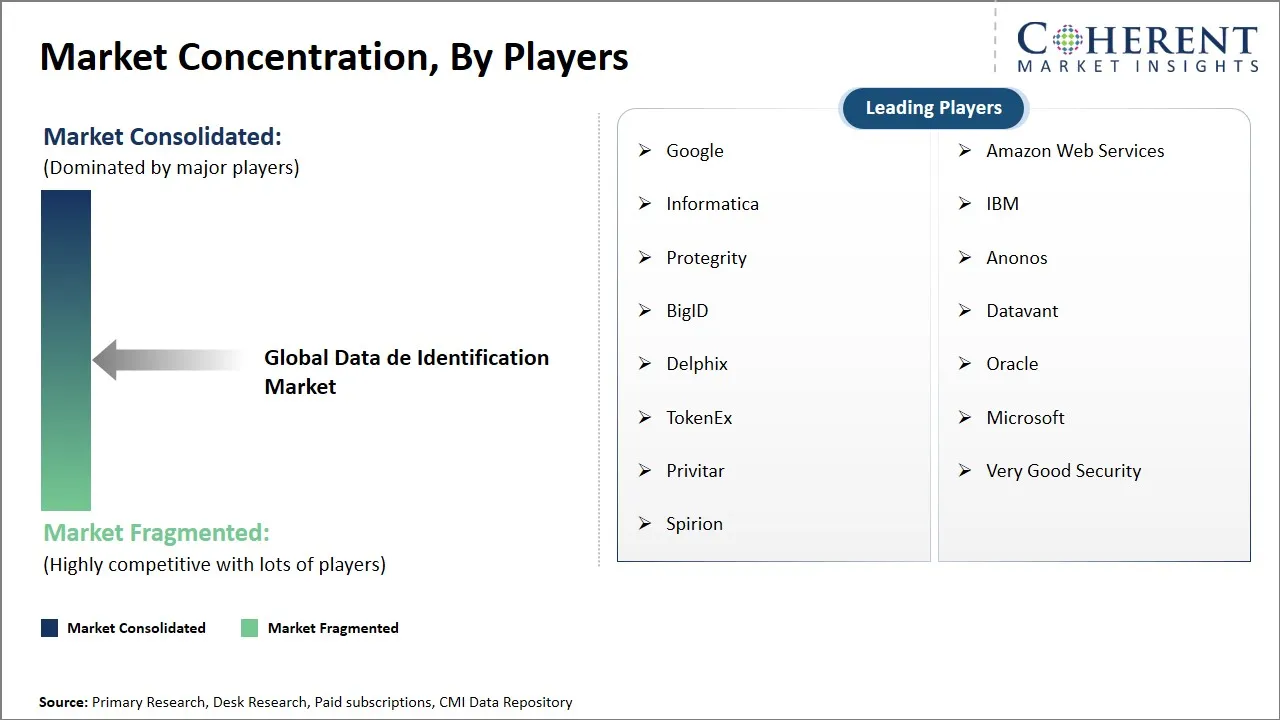
| Companies covered: | Google, Amazon Web Services, Informatica, IBM, Protegrity, Anonos, BigID, Datavant, Delphix, Oracle, TokenEx, Microsoft, Privitar, Very Good Security, and Spirion | ||
| Growth Drivers: |
| ||
| Restraints & Challenges: |
| ||
Global Data de Identification Market Dynamics
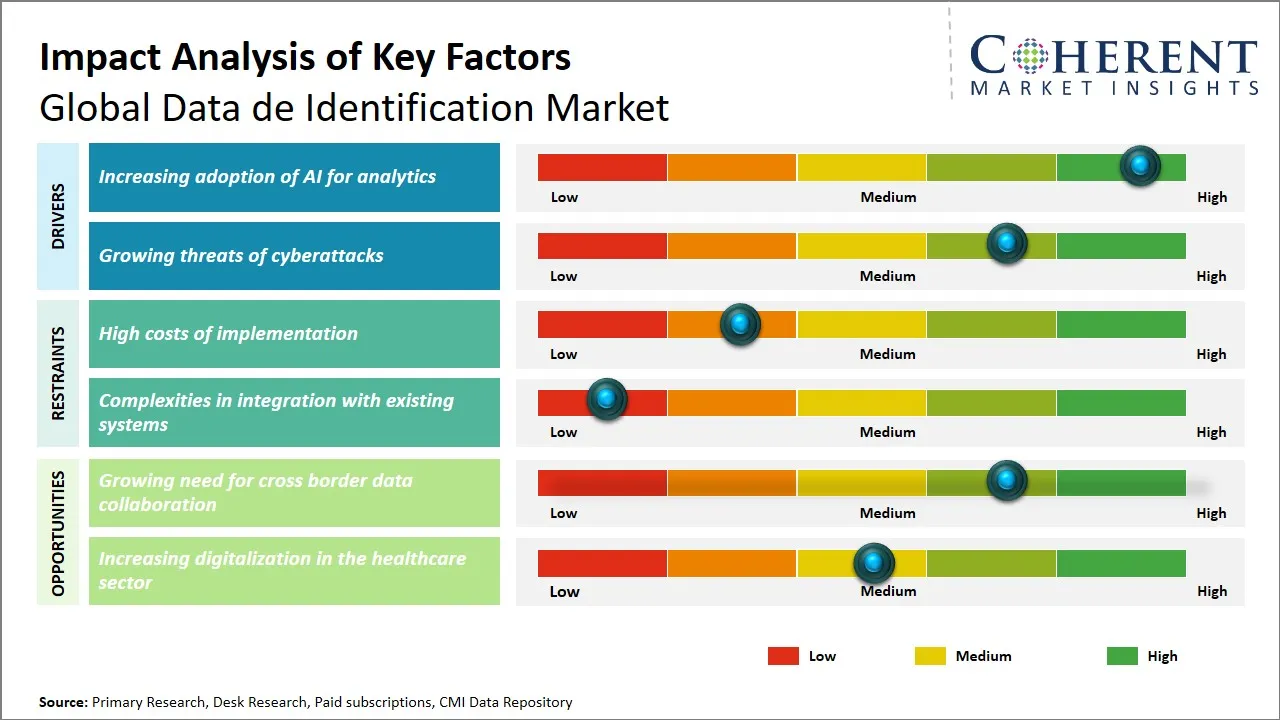
Global Data de Identification Market Driver - Increasing Adoption of AI for Analytics
The growing use of AI tools in many sectors has boosted the importance of strong data privacy practices which increases interest in ways to de-identify data. As companies now rely on smart technology systems that pull useful info from huge amounts of private records, they must follow rules protecting personal details while still using the data well. Although machine learning needs big collections of information to work properly, the danger of leaking identity-linked facts leads firms toward stronger removal tactics like blurring identifiers or replacing them with codes.
The increasing sophistication of AI models, especially in areas such as healthcare, finance, or retail requires stronger methods to anonymize data, reducing the chance of identity exposure while building user confidence. As a result, the close link between artificial intelligence analysis and privacy safeguards helps fuel growth in the worldwide data masking sector.
Global Data de Identification Market Opportunity - Growing Need for Cross Border Data Collaboration
The expanding reach of global business process management along with the fast growth of digital platforms creates strong momentum in the worldwide data anonymization sector, driven by rising needs for international data cooperation. As companies operate across diverse regions, sharing confidential information securely and smoothly between overseas branches, allies, and authorities becomes more urgent. This challenge stands out especially in health services, banking, or drug development, fields where privacy rules differ greatly from one country to another yet joint studies depend on broad datasets collected globally.
In addition, tightening rules like Europe’s GDPR, California’s privacy act, and similar new standards highlight how essential solid masking practices are not just to prevent fines, but also to keep innovation active and processes efficient. Moreover, progress in AI-based tools that hide identities is improving how useful data stays after removing personal details. As this field changes, companies can grow by creating new methods that fit different countries’ rules while building confidence among groups sharing information across borders.
For instance, on December 16, 2025, LSEG and Citi announced a multi‑year partnership agreement to deploy LSEG’s data, analytics and workflow solutions at enterprise scale. The partnership strengthens Citi’s data foundations, supports its broader modernization efforts and enhances the quality and speed of client delivery.
(Source: lseg.com)
Analyst Opinion (Expert Opinion)
- The global data de identification market is expanding quickly as tighter regulations are pushing demand. At the same time, more companies use AI and analytics, which increases need for secure data handling. Growing concern about privacy also plays a role. Firms in healthcare, banking, and tech now spend more on tools that anonymize both organized and raw data without losing usefulness. New methods like smart masking or token swaps help automate protection across big systems. These improvements let businesses apply privacy rules widely and efficiently. As a result, bigger providers gain ground - but smaller, flexible firms find openings too.
- The market’s path depends on rules like GDPR and HIPAA, along with new global privacy standards, yet it's also pushed by rising demands for shared data use worldwide. As secure sharing grows more urgent in mixed and cloud-heavy setups, firms that combine privacy, oversight, and rule adherence will likely pull ahead. Broadly speaking, the field is shifting from mere box-ticking toward enabling safer revenue models and smarter AI efforts, making data anonymization essential for how companies handle information today.
Speak to the analyst
Want personalized insights?
Take the findings above to one of our principal consultants, or have the report rebuilt around the segments, geographies and competitors you actually track.
Market Segmentation
- Solution Type Insights (Revenue, USD Billion, 2021 - 2033)
- Data Masking
- Tokenization
- Data Redaction
- Data Perturbation
- Others
- Deployment Mode Insights (Revenue, USD Billion, 2021 - 2033)
- On-premises
- Cloud
- Hybrid
- Data Type Insights (Revenue, USD Billion, 2021 - 2033)
- Structured
- Semi-Structured
- Unstructured
- Streaming
- End User Insights (Revenue, USD Billion, 2021 - 2033)
- BFSI
- Healthcare and Life Sciences
- Retail and E-commerce
- Telecom and Media
- Government
- Automotive
- Others
- Regional Insights (Revenue, USD Billion, 2021 - 2033)
- North America
- U.S.
- Canada
- Latin America
- Brazil
- Argentina
- Mexico
- Rest of Latin America
- Europe
- Germany
- U.K.
- Spain
- France
- Italy
- Russia
- Rest of Europe
- Asia Pacific
- China
- India
- Japan
- Australia
- South Korea
- ASEAN
- Rest of Asia Pacific
- Middle East
- GCC Countries
- Israel
- Rest of Middle East
- Africa
- South Africa
- North Africa
- Central Africa
- North America
- Key Players Insights
- Amazon Web Services
- Informatica
- IBM
- Protegrity
- Anonos
- BigID
- Datavant
- Delphix
- Oracle
- TokenEx
- Microsoft
- Privitar
- Very Good Security
- Spirion
Sources
Primary Research Interviews
- Healthcare Data Privacy Officers
- Data De-identification Software Vendors
- Healthcare IT Directors
- Regulatory Compliance Managers
Databases
- Healthcare Information and Management Systems Society (HIMSS) Database
- IBM Watson Health Database
- Epic Systems Corporation Database
- Allscripts Healthcare Solutions Database
Magazines
- Healthcare IT News
- Health Data Management Magazine
- Modern Healthcare Technology
- Healthcare Finance Magazine
- HIPAA Journal Magazine
Journals
- Journal of Medical Internet Research
- Health Information Management Journal
- International Journal of Medical Informatics
Newspapers
- Healthcare Dive
- FierceHealthcare
- Modern Healthcare Daily
- Healthcare IT News Daily
- Becker's Health IT Review
Associations
- Healthcare Information and Management Systems Society (HIMSS)
- American Health Information Management Association (AHIMA)
- International Association for Healthcare Security & Safety (IAHSS)
- Health Information Trust Alliance (HITRUST)
Public Domain Sources
- U.S. Department of Health and Human Services (HHS)
- Centers for Medicare & Medicaid Services (CMS)
- Food and Drug Administration (FDA) Guidelines
- European Medicines Agency (EMA) Publications
- World Health Organization (WHO) Reports
Proprietary Elements
- CMI Data Analytics Tool
- Proprietary CMI Existing Repository of information for last 8 years
Get access to 250+ pages report
Every segment, forecast, competitor profile and data table behind the analysis above — available for instant download.
- ESOMAR Member
- ISO 9001:2015 Certified
- D-U-N-S Registered
- GDPR & CCPA Compliant
Missing comfort of reading report in your local language? Find your preferred language:
Transform your Strategy with Exclusive Trending Reports
Frequently Asked Questions
The global data de identification market is estimated to be valued at USD 1.93 Bn in 2026 and is expected to reach USD 5.87 Bn by 2033.
The CAGR of global data de identification market is projected to be 17.2% from 2026 to 2033.
Increasing adoption of AI for analytics and growing threats of cyberattacks are the major factors driving the growth of the global data de identification market.
High costs of implementation and complexities in integration with existing systems are the major factors hampering the growth of the global data de identification market.
In terms of solution type, data masking is estimated to dominate the market revenue share in 2026.
Yes, mid-sized and emerging vendors often innovate rapidly with AI-driven solutions, complementing large enterprise offerings.
Growing demand for international collaboration increases the need for compliant, standardized de-identification processes.