

Global Deep Sea Mining Market Size and Forecast – 2026 To 2033
The Global Deep Sea Mining Market is estimated to be valued at USD 5,598.2 Mn in 2026 and is expected to reach USD 15,631.8 Mn by 2033, exhibiting a compound annual growth rate (CAGR) of 15.8% from 2026 to 2033. The significant rise can be attributed to the rising demand for critical minerals and rare metals like nickel, cobalt, copper, manganese, and rare earth elements, which are vital for the development of electric vehicles, renewable energy systems, electronics, defense technologies, and advanced industrial applications.
The deep ocean exploration, ROV/AUV development, seabed mapping, environmental monitoring systems, investment in deep ocean exploration, and polymetallic nodule collection technologies are all also driving market expansion. In January 2026, National Oceanic and Atmospheric Administration (NOAA) finalized new U.S. deep sea mining regulations that established a streamlined system for exploration licenses and commercial recovery permits under the Deep Seabed Hard Mineral Resources Act. This should enhance clarity for deep seabed mineral projects in the area of regulation, and enable greater commercial investment in the future. (Source: National Ocean Service)
Key Takeaways of the Global Deep Sea Mining Market
- Polymetallic nodules are expected to account for 49.8 % of the market share in 2026. They are a type of deposit that contains nickel, cobalt, copper, and manganese. In April 2026, The Metals Company (TMC) submitted 777 equipment deployments and over 4,800 environmental samples spanning the past decade to ISA DeepData to help validate resources in the permit process. (Source: The Metals Company)
- Remotely Operated Vehicles (ROVs) are projected to account for 41.6 % of the market share in 2026, supported by their critical role in seabed inspection, sampling guidance, and monitoring seabed disturbance during deep-sea operations.
- EV battery metals are expected to capture 43.7 % of the market share in 2026, driven by rising demand from electric vehicles, battery storage, renewable energy systems, and grid infrastructure, which is boosting the consumption of nickel, cobalt, graphite, and rare earth metals
- Asia Pacific is expected to dominate with 55.2 % of the market share in 2026, bolstered by ocean technology initiatives by governments in the region and initiatives to ensure mineral security. Deep Ocean Mission is working on a 6,000-meter manned submersible and an integrated mining system for polymetallic nodules in the Central Indian Ocean and is highlighting the region's ability to build up these capabilities ahead of the finalization of the ISA rules. (Source: Government of India)
- Europe is expected to represent 17.7 % share in 2026 as the fastest-growing region, supported by rising critical mineral security efforts, battery value-chain localization, and stronger EU policy backing for sustainable raw material supply. The European Critical Raw Materials Act sets 2030 benchmarks for domestic extraction, processing, and recycling, creating a clearer investment route for strategic minerals used in EV batteries, renewable energy, electronics, and grid infrastructure.(Source: European Commission)
- Regulatory clarity becomes investment gatekeeper: In the global deep sea mining market, investors are increasingly waiting for clear commercial exploitation rules before committing large-scale capital. The International Seabed Authority’s mining code is still under negotiation, and no commercial deep-sea mining operation has been approved yet, keeping project financing, offtake agreements, and equipment procurement cautious.
- ESG caution reshapes offtake strategy: ESG caution is prompting companies to reassess offtake strategies, as corporate sourcing policies increasingly serve as a key commercial screening tool for deep-sea minerals, particularly across automotive, electronics, and battery value chains. BMW Group, together with WWF and other companies, will not be extracting or investing in deep-ocean minerals until there is greater scientific evidence, transparency and sustainability assurance of the future offtake. (Source: BMW Group)
Segmental Insights
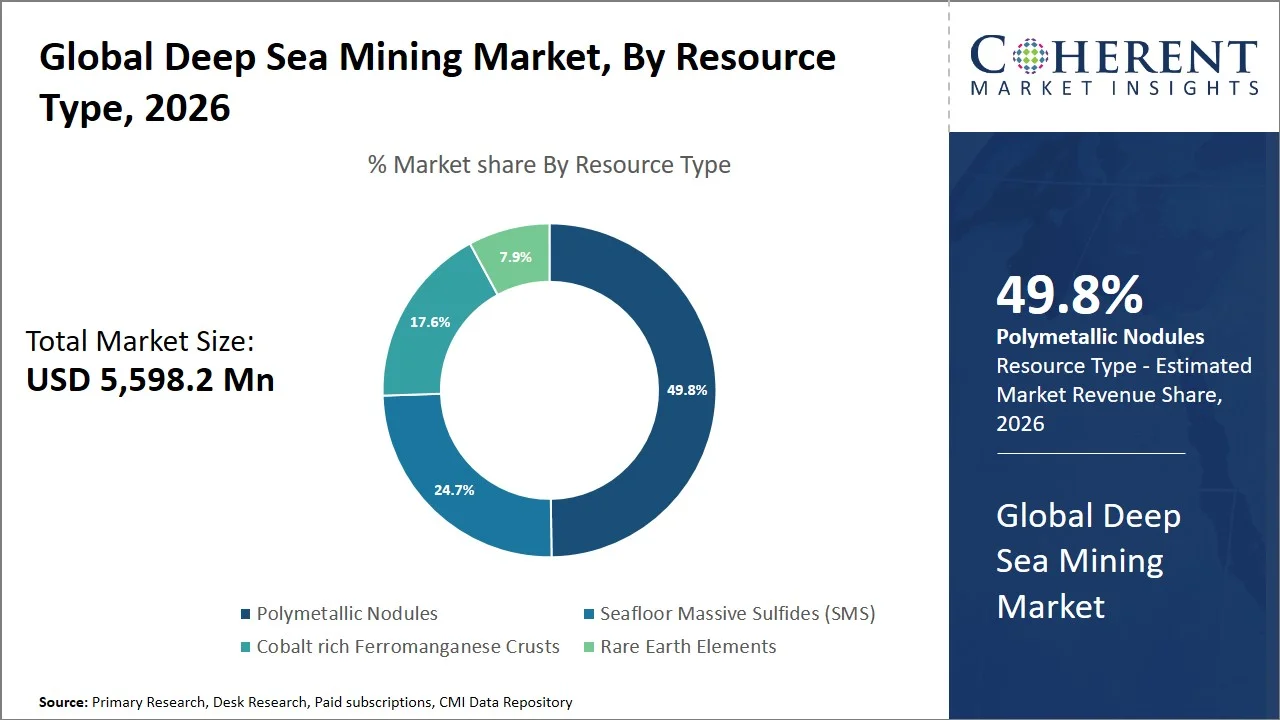
Why Does the Polymetallic Nodules Segment Dominate the Global Deep Sea Mining Market?
The global deep sea mining market is dominated by the polymetallic nodules segment, which is expected to account for 49.8% of the market share in 2026. The segment leads as polymetallic nodules offer concentrated multi-metal resources, including manganese, nickel, copper, cobalt, and trace rare earth elements, within a single deposit type. Nodules are found over relatively wide abyssal plains, and are located on or close to the sediment/water boundary, allowing them to be more easily accessed by collector-based extraction systems. Demand is strongly linked to battery, electronics, and strategic metal supply chains, while supply-side interest is supported by long-running exploration contracts in the Clarion-Clipperton Zone and Indian Ocean. A recent relevant instance is ISA’s active polymetallic nodule contractor framework, which lists multiple contracts extending into 2026, including contractors from China, Japan, Germany, Korea, and India. (Source: International Seabed Authority)
- Current Industry Events of 2026
- Market Size Estimation
- Regional Breakdown
- Competitive Landscape
- Customer Intelligence
- Segmental Analysis
- Pricing Analysis
- Key Market Drivers, Challenges & Future Trends
- Customized Insights Section
Why Does the Remotely Operated Vehicles (ROVs) Segment Represent the Largest Mining Technique Segment in the Market?
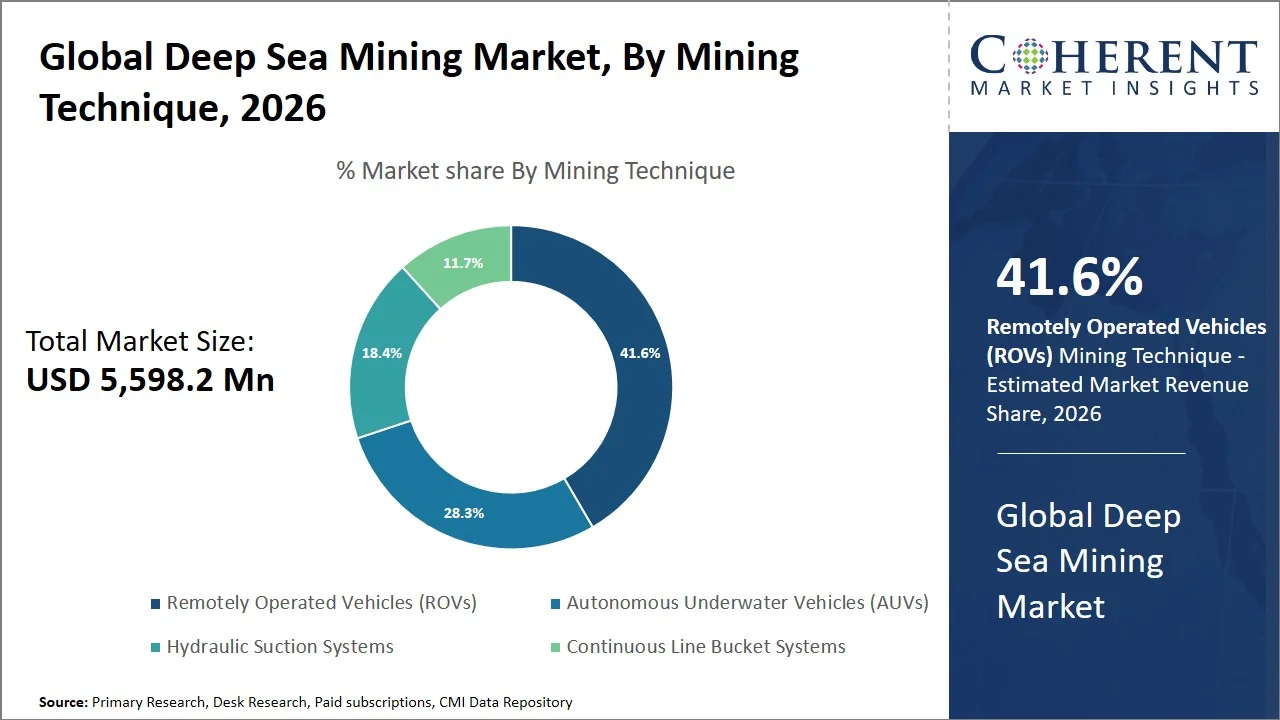
Remotely Operated Vehicles (ROVs) represent the largest mining technique segment, accounting for an estimated 41.6% share in 2026, as deep-sea mining projects depend on them for real-time visual control, precision maneuvering, seabed imaging, and sampling support, and environmental monitoring before full-scale extraction. On the technology side, ROVs remain preferred because they combine human-supervised operation with cameras, manipulators, sensors, and live data transmission, making them useful across exploration, inspection, and early mining trials. In May 2026, National Oceanic and Atmospheric Administration (NOAA)) announced a 28-day Cook Islands expedition using ROVs, mapping technologies, and onsite sensors to explore abyssal plains and support marine resource management, showing the continuing operational relevance of ROV-based seabed assessment. (Source: National Oceanic and Atmospheric Administration (NOAA))
Why Does the EV Battery Metals Segment Dominate the Global Deep Sea Mining Market?
The EV battery metals segment is expected to dominate the application landscape, holding a market share of 43.7% in 2026. This growth can be attributed to the fact that deep-sea deposits are primarily valued for nickel, cobalt, manganese, and copper, which are essential for battery chemistries, charging infrastructure, power electronics, and electrified mobility supply chains. Demand-side momentum comes from automakers and battery manufacturers seeking more diversified mineral sourcing, while supply-side development is increasingly focused on processing routes that can convert nodules into battery- and industry-grade outputs. The segment is also relevant to grid modernization, semiconductors, defense systems, and advanced electronics, strengthening its cross-sector importance. In June 2026, Glomar Minerals and Cobalt Blue advanced four U.S. sites for Project Infinity, a proposed facility to refine 200,000 tons of polymetallic nodules annually into manganese, cobalt sulfate, nickel, copper, and rare earth-bearing residues.
Currents Events and their Impact
Current Events | Description and its Impact |
International Seabed Authority Advances Mining Code Negotiations (March 2026 onward) |
|
U.S. NOAA Updates Deep Seabed Mining Licensing and Permit Regulations (January 2026) |
|
Norway Implements Seabed Minerals Data and Documentation Regulations (September 2025 onward) |
|
(Source: International Seabed Authority, Federal Register, Norwegian Offshore Directorate.)
Global Deep Sea Mining Market Dynamic
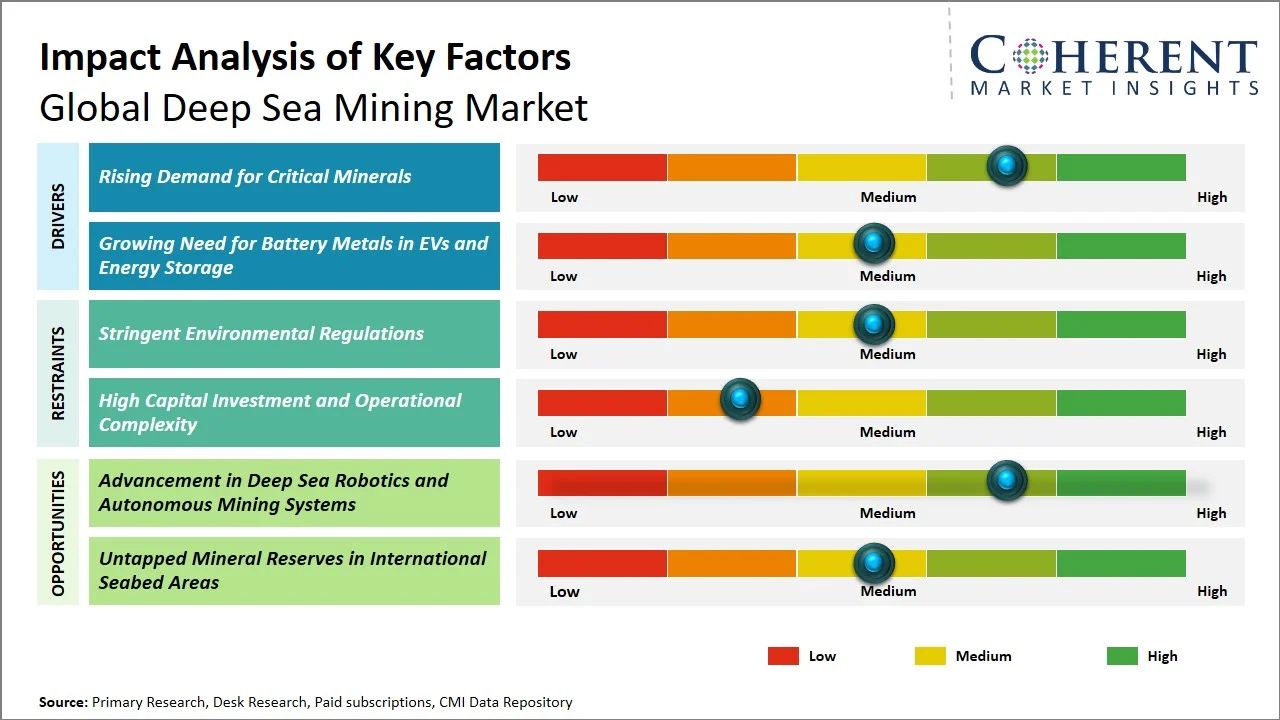
Market Drivers
- Rising Demand for Critical Minerals: Deep sea mining is gaining commercial importance as governments and downstream industries seek additional sources of nickel, cobalt, copper, manganese, and rare earth-bearing materials for clean energy, defense, electronics, and advanced manufacturing. The market is benefiting from supply-security pressure because terrestrial mining and refining remain geographically concentrated, creating pricing, sourcing, and procurement risks for large industrial buyers. In June 2026, G7 leaders issued a declaration recognizing the strategic role of critical mineral value chains and committed to coordinated action on diversification, processing capacity, stockpiling, and standards-based supply chains. This policy direction improves investor confidence in alternative mineral frontiers such as polymetallic nodules and seabed deposits, especially where resources can support long-term non-conventional supply diversification. (Source: G7/G20 Documents Database)
- Growing Need for Battery Metals in EVs and Energy Storage: EVs and stationary energy storage are strengthening the business case for deep sea mining because polymetallic nodules contain several battery-relevant metals in one deposit system, including nickel, cobalt, manganese, and copper. For mining contractors and processors, this creates a multi-metal revenue opportunity linked to cathode materials, grid batteries, charging infrastructure, and electrified transport. In its Global EV Outlook 2026, the International Energy Agency (IEA) noted that lithium prices at the beginning of 2026 were more than twice their level in the same period of 2025, partly due to faster-than-anticipated demand growth, especially from battery energy storage. This illustrates how battery-sector volatility can push automakers, cell producers, and governments to evaluate new upstream supply routes, including seabed minerals. (Source: International Energy Agency)
Emerging Market Trends
- Environmental Baseline Data Becoming a Pre-Commercial Requirement: Deep sea mining is shifting from resource discovery toward evidence-based project qualification, where environmental baseline studies, biodiversity mapping, plume modelling, sediment analysis, and water-column monitoring are becoming central to permitting and buyer acceptance. This trend is commercially important because future project approvals will depend not only on metal content, but also on whether contractors can demonstrate measurable controls over ecological disturbance.
- Shift Toward Selective and Low-Contact Collection Technologies: Deep sea mining technology is moving toward precision collection systems that reduce physical seabed contact, avoid broad sediment disturbance, and improve real-time operational control. This trend is reshaping supplier opportunities across underwater robotics, AI-based object recognition, sensor fusion, navigation software, and subsea monitoring systems. Commercially, lower-contact technologies can help contractors improve regulatory positioning, reduce project opposition, and strengthen future offtake discussions with ESG-sensitive automotive, electronics, and battery customers.
Regional Insights
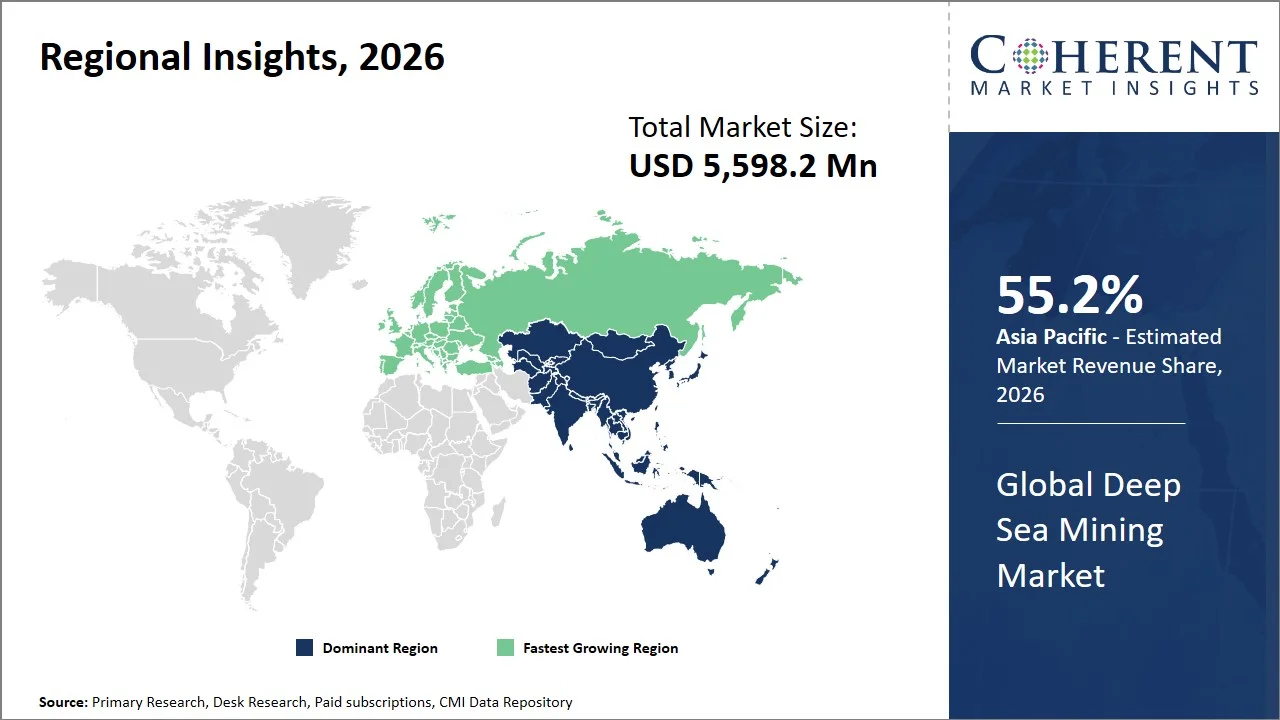
Why Does the Asia Pacific Region Dominate the Global Deep Sea Mining Market?
Asia Pacific is expected to dominate the global deep sea mining market with 55.2% share in 2026, supported by active government-backed seabed mineral programs, strong battery-metal demand, and advanced ocean engineering capabilities across China, Japan, South Korea, and India. The region’s leadership is strengthened by its large EV, electronics, shipbuilding, offshore engineering, and renewable energy manufacturing base, which creates strategic interest in nickel, cobalt, copper, manganese, rare earth elements, and polymetallic sulphides. Regulatory engagement through ISA exploration contracts also gives regional players early access to seabed mineral data and technology learning. A recent instance is India securing exclusive rights in 2025 for polymetallic sulphide exploration in the Carlsberg Ridge, making it the first country to hold two Polymetallic Sulphides (PMS) exploration contracts with International Seabed Authority (ISA). (Source: Press Information Bureau (PIB))
Why is Europe Emerging as the Fastest-Growing Region in the Global Deep Sea Mining Market?
Europe is emerging as the fastest-growing region in global deep sea mining market with 17.7% share in 2026, supported by critical raw material security concerns, offshore engineering expertise, marine robotics capability, and advanced environmental monitoring capacity. The region’s growth is linked to the need to reduce dependence on imported minerals used in batteries, wind power, defense, electronics, and advanced manufacturing. European policy is also strengthening investment in alternative mineral supply chains, which can indirectly support future seabed mineral research, processing, and technology development. On March, 2025, the European Commission approved 47 Strategic Projects under the Critical Raw Materials Act, covering extraction, processing, recycling, and substitution initiatives across EU member states to strengthen domestic raw material capacity. (Source: European Commission)
Global Deep Sea Mining Market Outlook for Key Countries
Why is China Leading Strategic Scale-Up in the Deep Sea Mining Market?
China is a critical country in the global deep sea mining market due to its strong state-backed ocean mineral strategy, advanced marine research capacity, and downstream dominance in critical mineral refining and battery supply chains. Its interest in deep sea mining is commercially important because seabed minerals can support China’s long-term access to nickel, cobalt, copper, manganese, and rare earth-bearing materials for EVs, electronics, renewable energy equipment, and defense technologies. China is also expanding its international seabed cooperation, positioning itself not only as a technology developer but also as a partner in offshore mineral governance and resource access. A recent instance is the February 2025 memorandum of understanding between the Cook Islands and China, focused on sustainable exploration, management, and utilization of seabed mineral resources under international law. (Source: Cook Islands Seabed Minerals Authority)
Why is Japan Advancing Deep Sea Mining for Domestic Mineral Security?
Japan is important in the global deep sea mining market because it has limited domestic terrestrial mineral resources but strong demand from automotive, electronics, robotics, magnets, and defense manufacturing. This creates a clear strategic case for developing seabed rare earths, cobalt-rich crusts, and seafloor massive sulphides within and around its maritime zones. Japan’s advantage lies in its marine science institutions, deep-sea vessels, subsea engineering capability, and state-backed mineral security programs. The country is using deep sea exploration to reduce supply-chain exposure to China-dominated rare earth markets and support domestic high-technology manufacturing In February 2026, Japan successfully conducted rare-earth mud test mining off Minamitorishima Island, as confirmed by Japan’s Ministry of Economy, Trade and Industry during its February 3, 2026 press conference. (Source: Ministry of Economy)
Why is South Korea Building a Strategic Resource Position Through Deep Sea Mining Blocks?
South Korea is an important deep sea mining country due to its high dependence on imported metals and its strong industrial base in batteries, semiconductors, shipbuilding, electronics, and EV components. Access to seabed resources supports South Korea’s long-term strategy to reduce critical mineral vulnerability and strengthen domestic industrial resilience. The country’s role is also backed by technical expertise in ocean science, exploration systems, and seabed mineral assessment. Deep sea mining is particularly relevant for South Korea because manganese nodules, seafloor massive sulphides, and cobalt-rich crusts can support battery materials and advanced manufacturing supply chains. For Instance, December 2025, South Korea’s reported holding of three exclusive deep-sea mining blocks in the Pacific and Indian Oceans, with potential reserves estimated at up to 740 million tons. (Source: Seoul Economic Daily)
Why is South Africa Important as a Marine Mining Capability Hub?
South Africa’s importance in the global deep sea mining market is linked more to marine mining capability, offshore engineering services, and regional mining expertise than to direct polymetallic nodule leadership. The country has a long mining heritage, advanced mineral services ecosystem, and strategic maritime positioning between the Atlantic and Indian Oceans. Its offshore mining relevance is strengthened by marine diamond recovery experience, subsea equipment handling, dry-dock support, and technical know-how that can be applied to future seabed mineral projects. This gives South Africa potential relevance as a services, repair, logistics, training, and marine operations hub for African and South Atlantic seabed activity. For instance, in 2025, Mining Indaba featured on the Benguela Gem in Cape Town’s dry dock, showcasing advanced seabed diamond recovery crawlers and marine mining equipment upgrades. (Source: Mining Indaba)
Why is the U.A.E Emerging as a Strategic Critical Minerals Investment and Trade Hub?
The U.A.E is important in the global deep sea mining market through its role as a capital, logistics, and critical minerals supply-chain hub rather than as a direct seabed mining contractor. Its ports, free zones, sovereign capital, and international investment networks position it to support future mineral trading, processing partnerships, and financing structures linked to seabed-derived nickel, cobalt, copper, manganese, and rare earth materials. The country’s clean energy, defense, and advanced manufacturing ambitions are also increasing its exposure to critical mineral security. Thus, the UAE is a potential gateway for mineral financing, processing partnerships and off-take facilitation across Asia, Africa and Western markets. For Instance, In February 2026, U.A.E.–U.S. framework aimed at strengthening secure supplies of critical minerals and rare earths for defense, advanced technologies, and broader industrial resilience. (Source: UAE Embassy)
Technology Adoption Landscape in the Global Deep Sea Mining Market
Technology | Key Features | Operational Advantage | Market Relevance |
Remotely Operated Vehicles (ROVs) | Real-time video inspection, robotic arms, seabed sampling tools, high-pressure sensors, and operator-controlled navigation | Enables accurate seabed inspection, sample collection, environmental observation, and risk-controlled exploration in extreme-depth conditions | Highly relevant as ROVs support exploration, monitoring, regulatory documentation, and pre-commercial project validation |
Autonomous Underwater Vehicles (AUVs) | Autonomous navigation, bathymetric mapping, sonar imaging, geophysical surveys, and large-area seabed scanning | Reduces vessel dependency and improves survey efficiency across large seabed areas | Important for identifying polymetallic nodules, sulphides, cobalt-rich crusts, and suitable mining zones |
Robotic Nodule Collection Systems | Seabed collector vehicles, robotic pickup mechanisms, navigation systems, and nodule separation capability | Supports controlled collection of polymetallic nodules with improved operational precision | Critical for future commercial extraction of nickel, cobalt, manganese, and copper-rich nodules |
Hydraulic Suction Systems | Suction-based mineral lifting, seabed collection heads, slurry transport, and riser integration | Enables bulk collection and vertical transfer of seabed minerals to surface vessels | Relevant for large-scale mining concepts, especially where high-volume extraction is required |
Selective Low-Contact Harvesting | AI-enabled object detection, robotic arms, sensor-based nodule identification, and reduced seabed contact | Minimizes sediment disturbance and improves environmental positioning of mining projects | Increasingly important as regulators and downstream buyers demand lower-impact mineral sourcing |
Environmental Monitoring Systems | Plume sensors, water-column monitoring, benthic cameras, sediment tracking, and biodiversity mapping | Helps measure ecological impact, support baseline studies, and improve compliance readiness | Essential for project approval, ESG assurance, and long-term acceptance of deep sea mining |
Riser and Lift Systems | Vertical transport pipelines, pumping systems, slurry handling, and surface vessel integration | Transfers collected seabed minerals from deep ocean floors to surface processing vessels | Key commercialization technology required for scaling from pilot mining to full production |
How are technological advancements in subsea robotics creating new growth opportunities in the deep sea mining market?
Technological advancements in subsea robotics, autonomous seabed vehicles, collector systems, and deep-ocean monitoring tools are creating strong growth opportunities in the deep sea mining market. These technologies help improve mineral detection, seabed mapping, precision collection, and environmental impact monitoring, which are critical for commercial-scale extraction of polymetallic nodules, seafloor massive sulfides, and cobalt-rich crusts. Advanced ROVs, AUVs, robotic collectors, and hydraulic lifting systems can reduce operational uncertainty, improve recovery efficiency, and support regulatory compliance through better data collection. For instance, Impossible Metals is developing the Eureka III pilot collector, a hovering seabed vehicle designed to use computer vision and robotic arms to pick polymetallic nodules individually while leaving behind nodules with visible life. This highlights how selective robotic collection can create growth opportunities by improving environmental positioning and commercial readiness. (Source: Impossible Metals)
Market Players, Key Development, and Competitive Intelligence
Key Developments
- In August 2025, The Metals Company released a world-first Pre-Feasibility Study (PFS) for the NORI-D polymetallic nodule project, reporting a project NPV of USD 5.5 billion. This marks an important step toward assessing the commercial viability of deep-sea polymetallic nodule extraction.
- In January 2026, TMC USA submitted a consolidated application to NOAA for an exploration license and commercial recovery permit for polymetallic nodules in the Clarion-Clipperton Zone, covering around 65,000 km², compared with nearly 25,000 km² in its earlier commercial recovery application.
- In May 2026, Allseas signed a commercial agreement to develop, commission, and operate an offshore nodule recovery system with a planned nameplate capacity of 3.0 million wet tons per annum, using two collector vehicles operating at depths of over 4 km. This moves nodule collection technology closer to commercial deployment.
Competitive Landscape
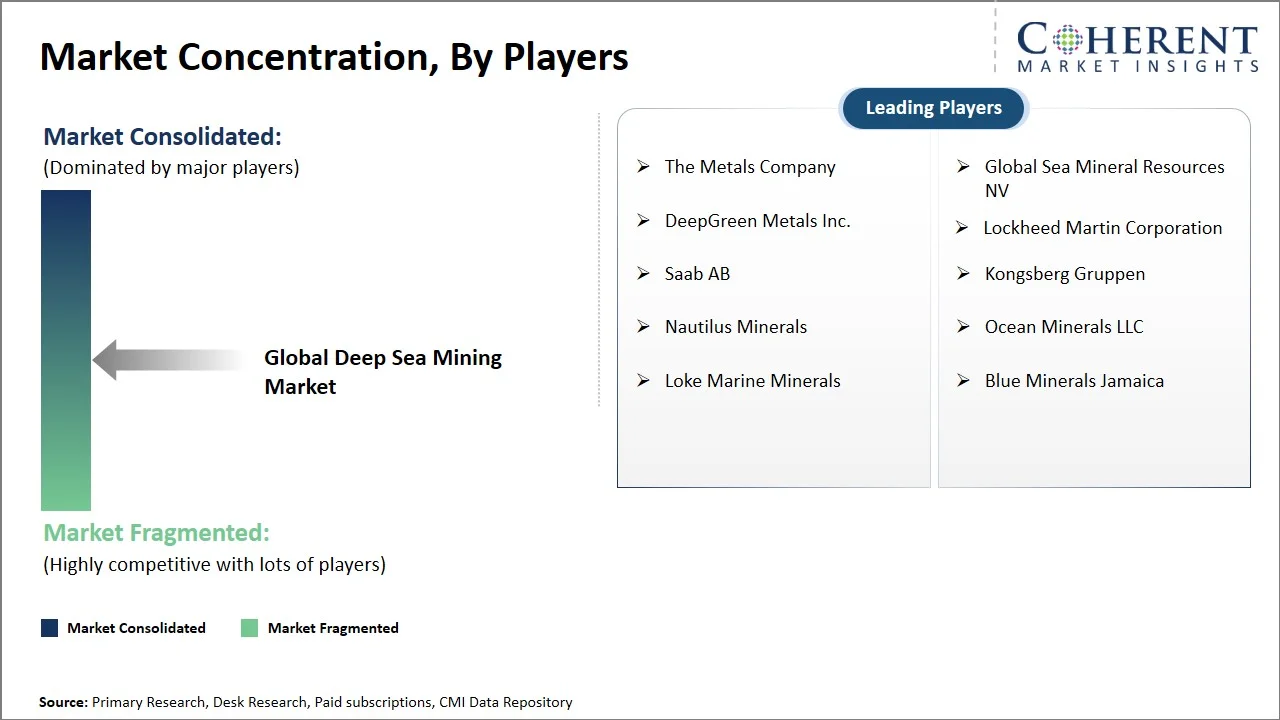
The global deep sea mining market is still at an early and pre-commercial stage, with competition mainly shaped by exploration rights, seabed mineral data, subsea technology capability, environmental compliance, and access to critical mineral value chains. The market includes seabed exploration contractors, offshore engineering companies, marine robotics developers, processing technology providers, and government-backed research institutions. Companies are focusing on polymetallic nodule collection systems, low-impact extraction technologies, environmental monitoring, and downstream processing partnerships to improve commercial readiness. Regulatory approvals, ESG acceptance, and successful pilot-scale operations are expected to strongly influence the future competitive position of market participants.
Key focus areas include
- Development of advanced seabed collection systems for polymetallic nodules, seafloor massive sulfides, and cobalt-rich crusts
- Integration of ROVs, AUVs, AI-based seabed mapping, and real-time environmental monitoring technologies
- Investment in selective and low-contact mining systems to reduce sediment disturbance and improve ESG acceptance
- Expansion of exploration programs in mineral-rich zones such as the Clarion-Clipperton Zone and Indian Ocean seabed areas
- Strategic partnerships between mining companies, offshore engineering firms, governments, and critical mineral processors
- Development of onshore processing technologies for nickel, cobalt, copper, manganese, and rare earth-bearing materials
- Strong focus on regulatory compliance, environmental impact assessment, and long-term ocean biodiversity monitoring
- Competition based on exploration licenses, technical readiness, pilot testing success, resource quality, and downstream offtake potential
Market Report Scope
Deep Sea Mining Market Report Coverage
| Report Coverage | Details | ||
|---|---|---|---|
| Base Year: | 2025 | Market Size in 2026: | USD 5,598.2 Mn |
| Historical Data for: | 2020 To 2024 | Forecast Period: | 2026 To 2033 |
| Forecast Period 2026 to 2033 CAGR: | 15.8% | 2033 Value Projection: | USD 15,631.8 Mn |
| Geographies covered: |
| ||
| Segments covered: |
| ||
| Companies covered: | The Metals Company, Global Sea Mineral Resources NV, DeepGreen Metals Inc., Lockheed Martin Corporation, Saab AB, Kongsberg Gruppen, Nautilus Minerals, Ocean Minerals LLC, Loke Marine Minerals, and Blue Minerals Jamaica | ||
| Growth Drivers: |
| ||
| Restraints & Challenges: |
| ||
Analyst Opinion (Expert Opinion)
- Global deep sea mining market is expected to grow strongly in the long term due to increasing demand for critical minerals in electric vehicles, energy storage, electronics, renewable energy systems, and defense applications. The increasing pressure to diversify nickel, cobalt, copper, manganese and rare earth supply chains is expected to support interest in polymetallic nodules, seafloor massive sulfides and cobalt-rich ferromanganese crusts as alternative mineral sources.
- The most promising prospects are likely to be polymetallic nodules. They contain a variety of commercially important metals and are relatively more accessible for bulk collection from deep seabed regions. Asia Pacific will continue to be the leading region, supported by strong government-backed ocean mineral programs, high consumption of battery metals, advanced marine technology expertise and major downstream manufacturing hubs for EVs, electronics and energy equipment.
- Market players should focus on low impact seabed collection systems, ROVs, AUVs, environmental monitoring technologies and efficient metallurgical processing of multi-metal nodules to gain competitive advantage. Those companies that can demonstrate readiness for regulation, less impact on the environment, good resource data and stable downstream processing partnerships will be better placed to win future demand from the battery, clean energy, electronics and strategic mineral supply chains.
Speak to the analyst
Want personalized insights?
Take the findings above to one of our principal consultants, or have the report rebuilt around the segments, geographies and competitors you actually track.
Market Segmentation
- Resource Type Insights (Revenue, USD Mn, 2021 - 2033)
- Polymetallic Nodules
- Seafloor Massive Sulfides (SMS)
- Cobalt rich Ferromanganese Crusts
- Rare Earth Elements
- Mining Technique Insights (Revenue, USD Mn, 2021 - 2033)
- Remotely Operated Vehicles (ROVs)
- Autonomous Underwater Vehicles (AUVs)
- Hydraulic Suction Systems
- Continuous Line Bucket Systems
- Application Insights (Revenue, USD Mn, 2021 - 2033)
- EV Battery Metals
- Renewable Energy Storage
- Electronics Manufacturing
- Aerospace & Defense
- Industrial Metals
- End-use Industry Insights (Revenue, USD Mn, 2021 - 2033)
- Automotive & Electric Mobility
- Energy & Power
- Electronics
- Industrial Manufacturing
- Defense
- Regional Insights (Revenue, USD Mn, 2021 - 2033)
- North America
- U.S.
- Canada
- Latin America
- Brazil
- Argentina
- Mexico
- Rest of Latin America
- Europe
- Germany
- U.K.
- Spain
- France
- Italy
- Russia
- Rest of Europe
- Asia Pacific
- China
- India
- Japan
- Australia
- South Korea
- ASEAN
- Rest of Asia Pacific
- Middle East
- GCC Countries
- Israel
- Rest of Middle East
- Africa
- South Africa
- North Africa
- Central Africa
- North America
- Key Players Insights
- The Metals Company
- Global Sea Mineral Resources NV
- DeepGreen Metals Inc.
- Lockheed Martin Corporation
- Saab AB
- Kongsberg Gruppen
- Nautilus Minerals
- Ocean Minerals LLC
- Loke Marine Minerals
- Blue Minerals Jamaica
Sources
Primary Research Interviews
- Deep sea mining contractors and polymetallic nodule exploration companies
- Marine geologists, oceanographers, and seabed mineral resource assessment experts
- Offshore mining engineers and subsea equipment specialists involved in nodule collection systems
- ROV, AUV, and underwater robotics technology providers
- Environmental consultants and marine biodiversity experts conducting seabed impact assessments
- Critical mineral processing companies and metallurgical recovery specialists
- Battery materials, EV, electronics, renewable energy, and defense sector procurement experts
- Regulatory, legal, and compliance professionals involved in seabed mineral licensing and marine environmental approvals
- Executives and strategy heads from offshore engineering, subsea technology, and marine mining companies
Stakeholders
- Deep sea mining companies and seabed exploration contractors
- Offshore engineering and subsea technology companies
- ROV, AUV, seabed mapping, and marine robotics manufacturers
- Mineral processing and metallurgical recovery companies
- Battery materials and critical mineral supply-chain companies
- EV manufacturers, electronics companies, renewable energy equipment manufacturers, and defense contractors
- Marine environmental assessment and ocean monitoring service providers
- Shipping, offshore vessel, and marine logistics companies
- Government agencies, ocean research institutes, and seabed mineral authorities
End-use Sectors
- Electric vehicles and battery manufacturing
- Renewable energy storage and grid infrastructure
- Electronics and semiconductor manufacturing
- Aerospace and defense
- Industrial metals and advanced manufacturing
- Offshore engineering and marine technology
- Critical mineral processing and refining
- Energy transition and clean technology industries
Regulatory & Government Bodies
- International Seabed Authority (ISA)
- National Oceanic and Atmospheric Administration (NOAA), U.S.
- U.S. Geological Survey (USGS)
- European Commission – Critical Raw Materials Act
- Norwegian Offshore Directorate
- Ministry of Earth Sciences, India
- Japan Organization for Metals and Energy Security (JOGMEC)
- Ministry of Economy, Trade and Industry (METI), Japan
- Ministry of Oceans and Fisheries, South Korea
- Cook Islands Seabed Minerals Authority
- United Nations Convention on the Law of the Sea (UNCLOS)
Databases
- ISA DeepData Database
- ISA Exploration Contracts Database
- USGS Mineral Resources Data System
- USGS National Minerals Information Center
- NOAA Ocean Exploration Data and Reports
- International Energy Agency Critical Minerals Data Explorer
- UN Comtrade Database
- World Bank World Development Indicators
- OECD Data Portal
- European Commission Raw Materials Information System
- MarineCadastre.gov
- EMODnet Geology Database
Magazines
- Offshore Magazine
- Marine Technology News
- Mining Magazine
- Mining Technology
- Ocean News & Technology
- Subsea World News
- World Mining Magazine
- Engineering & Mining Journal
- International Mining
- Hydro International
Journals
- Marine Policy
- Deep Sea Research Part I: Oceanographic Research Papers
- Deep Sea Research Part II: Topical Studies in Oceanography
- Frontiers in Marine Science
- Nature Geoscience
- Nature Sustainability
- Marine Geology
- Minerals
- Resources Policy
- Journal of Marine Science and Engineering
Associations
- International Marine Minerals Society (IMMS)
- International Seabed Authority (ISA)
- International Marine Contractors Association (IMCA)
- Society for Underwater Technology (SUT)
- International Ocean Institute (IOI)
- The Metals Company Industry Consortium / Partner Network
- International Council on Mining and Metals (ICMM)
- World Ocean Council
- Marine Technology Society
- Deep Ocean Stewardship Initiative (DOSI)
Public Domain Sources
- International Seabed Authority – Exploration contracts, Mining Code updates, environmental guidelines, and DeepData
- NOAA – Deep seabed mining framework, ocean exploration data, and marine resource information
- USGS – Critical mineral statistics, mineral commodity summaries, and seabed mineral resource studies
- International Energy Agency – Critical minerals, EV battery metals, energy storage, and clean energy transition data
- European Commission – Critical Raw Materials Act and strategic raw material policy
- United Nations – UNCLOS framework and ocean governance documents
- World Bank – Mining, trade, infrastructure, and macroeconomic indicators
- OECD – Responsible mineral supply-chain and environmental policy data
- National government ministries – seabed mineral exploration, ocean science, and critical mineral policy updates
- Academic and public research institutions – deep sea biodiversity, seabed ecology, and environmental impact studies
Proprietary Elements
- CMI Data Analytics Tool, Proprietary CMI Existing Repository of information for last 10 years.
Get access to 250+ pages report
Every segment, forecast, competitor profile and data table behind the analysis above — available for instant download.
- ESOMAR Member
- ISO 9001:2015 Certified
- D-U-N-S Registered
- GDPR & CCPA Compliant
Missing comfort of reading report in your local language? Find your preferred language:
Transform your Strategy with Exclusive Trending Reports
Frequently Asked Questions
The CAGR of the global deep sea mining market is projected to be 15.8% from 2026 to 2033.
The global deep sea mining market is estimated to be valued at USD 5,598.2 million in 2026 is expected to reach USD 15,631.8 million by 2033.
In terms of mining technique, Remotely Operated Vehicles (ROVs) are estimated to dominate with 41.6% market share in 2026.
Rising demand for critical minerals and growing need for battery metals in EVs and energy storage are the major factors driving the growth of the global deep sea mining market.
Stringent environmental regulations and high capital investment and operational complexity are the major factors hampering the growth of the global deep sea mining market.
In terms of resource type, polymetallic nodules are estimated to dominate the market revenue share in 2026.
Asia Pacific is expected to lead the global deep sea mining market in 2026.