

Distribution Automation Market Size and Share Analysis - 2026 To 2033
The global distribution automation market is estimated to be valued at USD 33,229.7 Mn in 2026 and is projected to reach USD 63,935.5 Mn by 2033, registering a CAGR of 9.8% during the forecast period (2026-2033). This strong growth is mostly due to increasing adoption of smart grid technologies, rising investments in modernizing aging power infrastructure, and growing integration of renewable energy sources into electricity networks.
Key Takeaways from the Distribution Automation Market Report
- Monitoring and control devices are expected to lead the market with a share of 45.0% in 2026 due to rising demand for real-time grid monitoring, SCADA, sensors, RTUs, and digital grid management. According to the International Energy Agency (IEA), investment in grid digital technologies, including advanced monitoring and control systems, has grown by over 50%.
- Industrial segment is projected to account for the largest market share of 48% in 2026 because large manufacturing facilities and utilities require highly reliable automated power distribution For instance, the IEA reported that global electricity demand grew by 4.3% in 2024, with industry contributing nearly 50% of incremental electricity demand in China.
- Asia Pacific is forecast to dominate the global distribution automation industry with a share of 37% in 2026, owing to increasing investments in smart grids, rapid urbanization, and grid modernization across nations like India and China. The IEA reports that China invested USD 88 billion in transmission and distribution infrastructure in 2025, supporting grid expansion and smart electricity networks.
- North America is set to account for around 29% of the global distribution automation market share in 2026, thanks to extensive grid modernization programs, strong utility investments, and the growing adoption of smart grid technologies. For example, the U.S. Department of Energy (DOE) has awarded up to USD 10.5 billion through its Grid Resilience and Innovation Partnerships (GRIP) Program for grid modernization, distribution automation, and grid resilience projects.
Distribution Automation Market Overview
The global distribution automation market is projected to register strong growth during the forecast period. This is primarily due to increasing modernization of aging power distribution infrastructure, rising investments in smart grid development, and growing adoption of advanced monitoring and control technologies by utilities.
Rising adoption of renewable energy sources, rapid electrification of transportation, and increasing electricity demand are also driving demand for automated distribution networks capable of improving grid reliability, operational efficiency, and outage management. In addition, rising adoption of smart meters and intelligent electronic devices (IEDs) and growing popularity of advanced distribution management systems (ADMS) are set to support market expansion during the forthcoming period.
Distribution automation (DA) comprises various technologies, including sensors, processors, automated switches, and communication systems, that monitor and control electric distribution networks with minimal human intervention. It improves distribution system efficiency by optimizing grid operations and reducing energy losses. Furthermore, it enhances grid reliability by reducing the frequency and duration of power outages through automated fault detection, isolation, and service restoration.
DA also increases grid flexibility by enabling higher integration of distributed energy resources (DERs) into the distribution network. Rising adoption of distribution automation technologies, especially across developing and developed regions, is expected to boost market growth during the forecast period.
Rising demand for grid reliability and resilience is boosting the growth of the distribution automation market. Extreme weather, cyber threats, aging grid infrastructure, and rising electricity demand are increasing the need for a stronger power grid. Distribution automation helps in automatic fault isolation, self-healing distribution networks, reduced outage duration, and improved power quality.
Artificial intelligence (AI) is completely changing the landscape of distribution automation. This advanced technology enables predictive maintenance, asset health monitoring, automated fault diagnosis, load forecasting, vegetation risk prediction, and remaining useful life (RUL) estimation. This shift by utilities from reactive maintenance to predictive asset management to reduce downtime and maintenance costs is expected to foster the growth of the distribution automation market during the forthcoming period.
For example, in 2025, Schneider Electric launched its One Digital Grid Platform, an AI-powered platform that helps utilities improve grid reliability as well as resilience and operational efficiency. The platform includes AI capabilities for predictive analytics, outage restoration estimates, grid troubleshooting, and network model tuning.
Segmental Insights
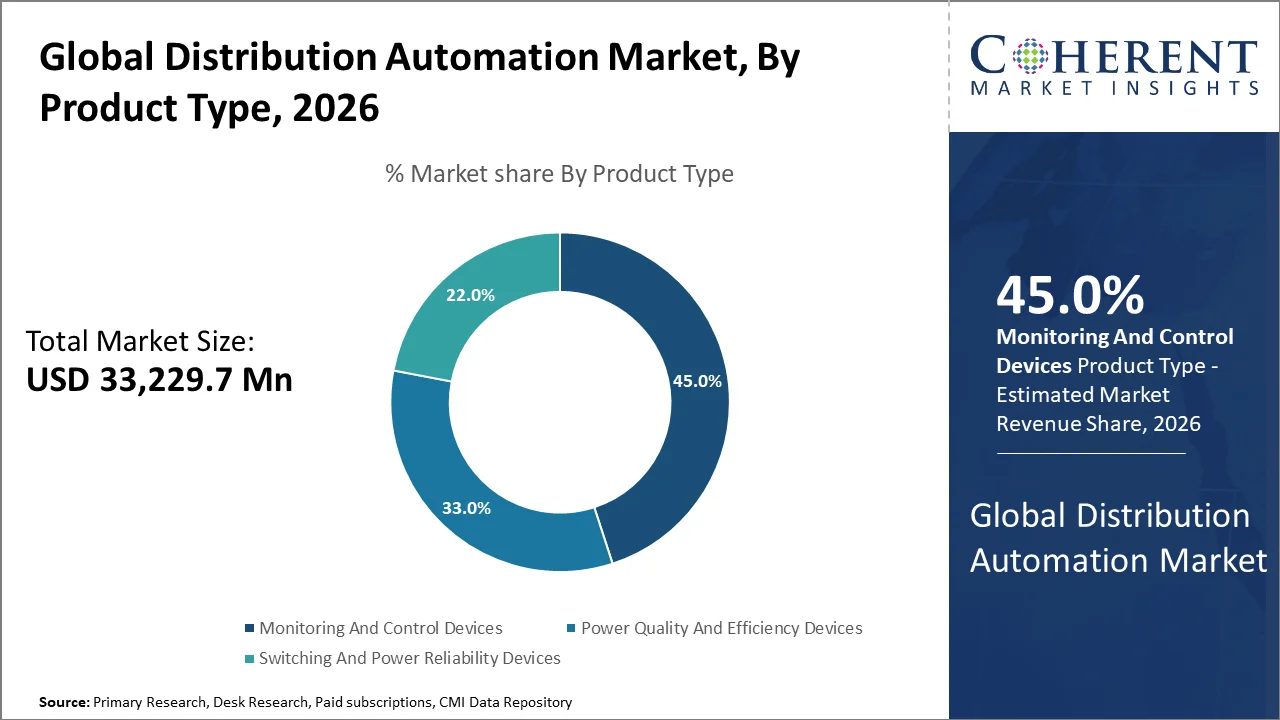
Which Product Type Dominates the Distribution Automation Market?
Monitoring and Control Devices Lead the Market
According to Coherent Market Insights’ latest distribution automation market analysis, monitoring and control devices are slated to lead the market, accounting for a revenue share of 45.0% in 2026. This dominance is attributable to increasing adoption of intelligent electronic devices (IEDs), smart sensors, remote terminal units (RTUs), and advanced feeder monitoring systems across modern power distribution networks.
Utilities across the world are prioritizing real-time grid monitoring, automated fault detection, remote switching, and predictive maintenance to enhance grid reliability, minimize outage durations, and improve operational efficiency. This is driving adoption of advanced monitoring and control devices.
For instance, according to the International Energy Agency (IEA), distribution sector constitutes approximately 75% of all investment in digital infrastructure within the grid network. This includes the installation of sensors, monitoring devices, substation automation, feeders, lines, and transformers. Increasing investments in smart grid infrastructure, integration of distributed energy resources (DERs), and grid modernization projects are other factors driving demand for monitoring and control devices.
- Current Industry Events of 2026
- Market Size Estimation
- Regional Breakdown
- Competitive Landscape
- Customer Intelligence
- Segmental Analysis
- Pricing Analysis
- Key Market Drivers, Challenges & Future Trends
- Customized Insights Section
Which Is the Leading End User of Distribution Automation Solutions?
Distribution Automation Demand Remains High in Industrial Sector
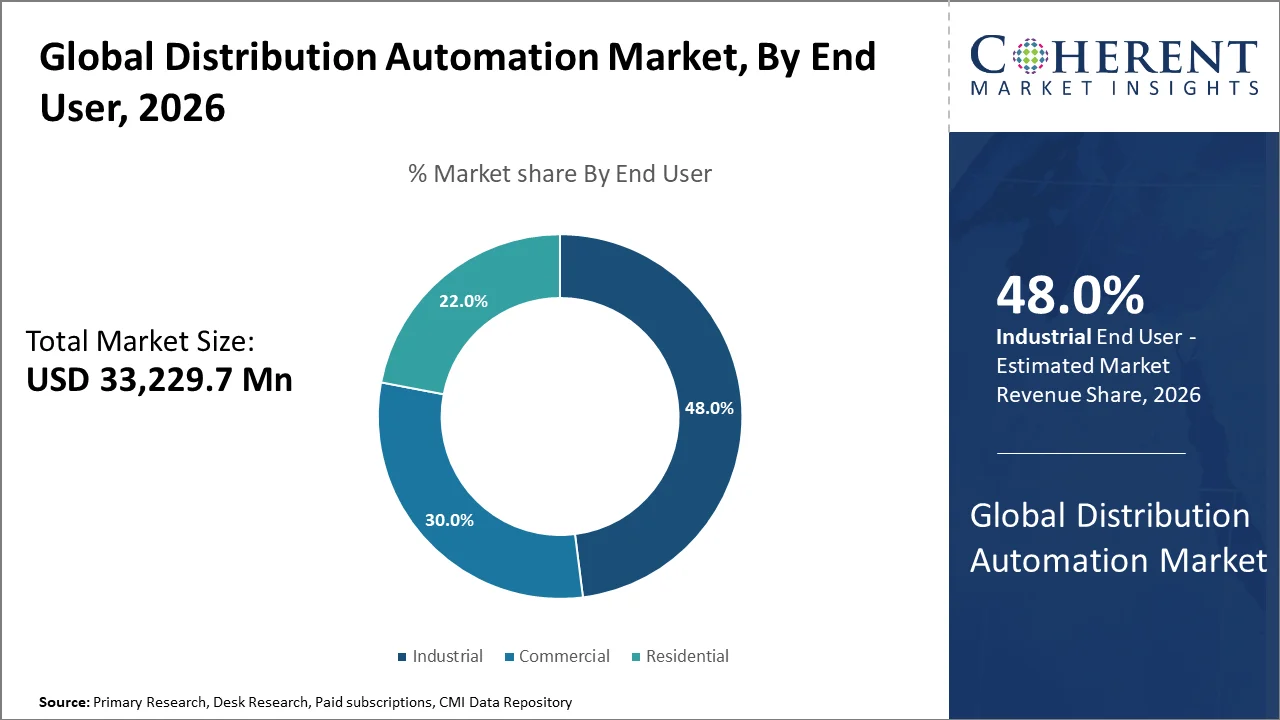
Industrial segment is expected to dominate the market, capturing a share of 48% in 2026. This is mostly due to the sector's high dependence on an uninterrupted and high-quality power supply for continuous manufacturing operations. Likewise, increasing adoption of smart factories and growing investments in industrial electrification and automation are boosting the target segment.
Industries such as oil & gas, chemicals, mining, metals, automotive, pharmaceuticals, and food & beverages require real-time monitoring, fault detection, predictive maintenance, and automated grid control to minimize unplanned downtime as well as improve operational efficiency. As a result, they are increasingly adopting distribution automation products.
Distribution Automation Market Growth Drivers
Increasing Grid Modernization Initiatives
- Increasing grid modernization initiatives are providing a strong impetus for the growth of the distribution automation market. There is an aging infrastructure of electricity distribution in developed countries because most of it was installed many years ago, which leads to increased number of outages and expenses on maintenance works. That is why utilities have started working with automated switches, IEDs, sensors, fault indicators, and SCADA technology. For example,
- In June 2025, the Hellenic Electricity Distribution Network Operator (HEDNO) awarded a contract to Itron to modernize its distribution network by deploying a Meter Data Management (MDM) system for 7.7 million meters and nearly 1 million NB-IoT smart meters. The project aims to enhance real-time grid visibility, operational efficiency, and the integration of distributed energy resources.
- In January 2024, the City of Florence, Alabama, selected Landis+Gyr to deploy advanced metering infrastructure and Gridstream network technology across approximately 49,000 electricity customers to improve grid reliability, operational efficiency, and customer service.
Distribution Automation Market Opportunities
Expansion of Renewable Energy Infrastructure
Rapid expansion of renewable energy sources such as rooftop solar, wind power, battery energy storage systems (BESS), and community microgrids is creating lucrative growth opportunities for the distribution automation market. These distributed energy resources introduce bidirectional power flows and operational variability, which traditional distribution networks were not originally designed to manage.
Distribution automation solutions enable utilities to effectively address these challenges by balancing intermittent renewable generation, monitoring feeder conditions in real time, managing voltage and frequency fluctuations, enhancing DER hosting capacity, and ensuring overall grid stability. According to the International Energy Agency (IEA), global renewable energy capacity is expected to nearly triple by 2030. This, in turn, is expected to propel demand for distribution automation solutions during the forecast period.
Distribution Automation Market Trends
Rise of Self-Healing Distribution Networks
Increasing adoption of self-healing distribution networks is a key growth-shaping trend in the distribution automation market. Many utilities in the contemporary world are deploying automatic feeder restoration, Fault Location, Isolation, and Service Restoration (FLISR), and intelligent switching systems. These capabilities help reduce outage duration and improve network resilience. This transition toward intelligent distribution networks is expected to boost market growth in the coming years.
Current Events and Their Impact on the Distribution Automation Market
Current Event | Description and its Impact |
India accelerates smart meter rollout under the Revamped Distribution Sector Scheme (RDSS) (2026) |
|
Grid modernization policies expand across U.S. states (Q1 2026) |
|
Regional Insights
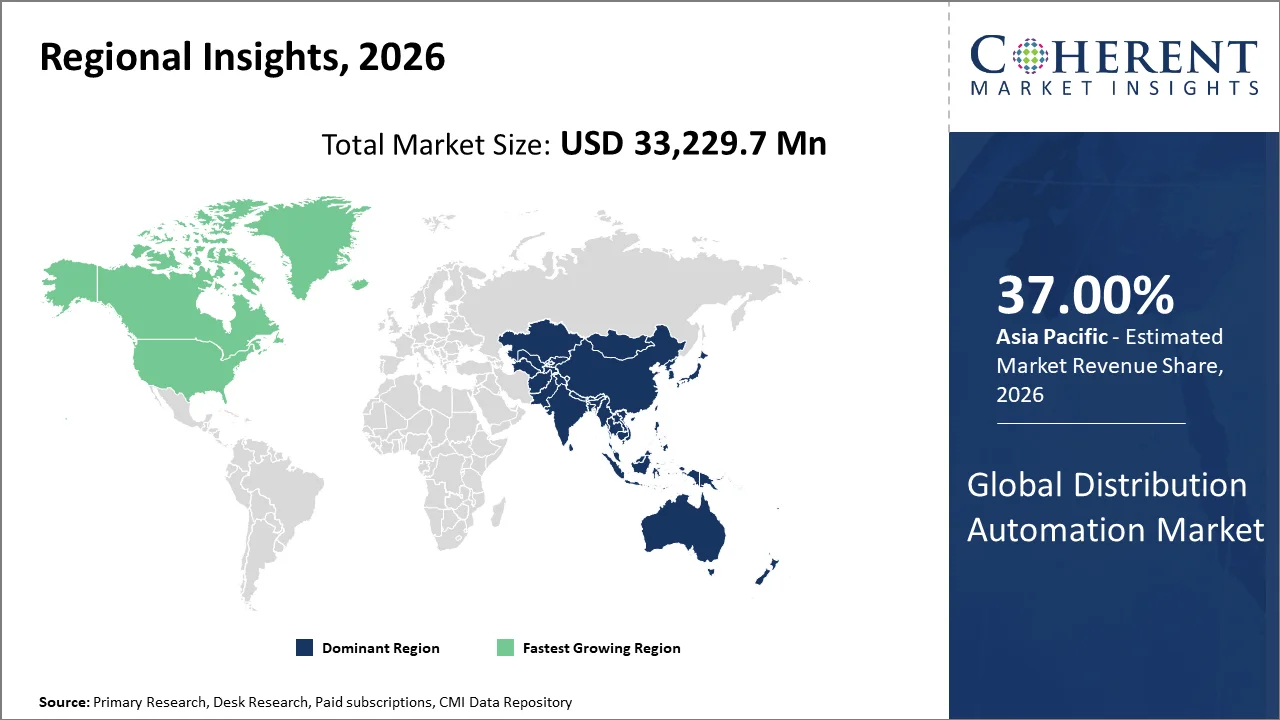
Asia Pacific Remains at the Epicenter of Distribution Automation Market Growth
Asia Pacific is expected to lead the global distribution automation market, accounting for a share of around 37% in 2026. The dominance is mostly due to rapid urbanization, rising electricity demand, large-scale industrial expansion, renewable energy integration, and continuous investments in smart grid infrastructure across China, India, Japan, and Southeast Asia.
Increasing stress on power systems due to surging demand and extreme weather is boosting growth of Asia Pacific distribution automation market. This stress is accelerating the need for automated and self-healing distribution networks. For example, India recorded a peak electricity demand of around 250 GW in 2024, showing the rapid load growth and the need for advanced grid automation to maintain reliability as well as prevent outages.
Grid Modernization Initiatives Boosting Market Growth in North America
North America is expected to offer lucrative growth opportunities to manufacturers of distribution automation products during the forthcoming period, holding a global market share of 29% in 2026. This is due to large-scale grid modernization programs, aging infrastructure replacement, increasing EV charging demand, rising adoption of smart grid technologies such as automated switches and fault detection systems.
Increasing government investments in grid resilience and modernization to mitigate extreme weather disruptions and enhance reliability are playing a key role in boosting North America distribution automation market growth. For instance, the U.S. Department of Energy’s Grid Resilience and Innovation Partnerships (GRIP) program has allocated USD 10.5 billion to strengthen and modernize the electricity grid, including the deployment of advanced automation and digital distribution technologies.
Distribution Automation Market Outlook – Country-wise
U.S. Distribution Automation Market Trends
The United States is projected to remain a key market for distribution automation solutions during the assessment period. This is attributable to ongoing grid modernization programs, rising frequency of heatwaves and storms, increasing EV charging demand, and strong expansion of data centers that are placing higher stress on local distribution networks.
Utilities across the U.S. are increasingly deploying automated reclosers, smart sensors, and fault detection systems to improve grid reliability and reduce outage duration. For example, the Public Utilities Commission of Ohio recently approved AEP Ohio's investment plan for distribution automation grid technology. The project will improve electric service reliability by automatically rerouting power during outages.
China Distribution Automation Market Forecast
The distribution automation market in China is projected to record strong growth over the forecast period. This is due to rapid urbanization, massive expansion of industrial and commercial infrastructure, and rising electricity demand driven by cooling needs and electrification. The country is also accelerating smart grid deployment to manage renewable energy integration and reduce grid instability in major urban clusters such as Shanghai, Beijing, and Guangzhou.
Who are the Major Companies in the Distribution Automation Market?
Some of the major players in distribution automation market are American Electric Power (AEP), Schneider Electric SA, Cooper Power Systems, General Electric Corporation, Dominion Virginia Power, Siemens AG, Électricité de France (EDF), S&C Electric Company, and Pacific Gas and Electric Company.
Key Strategies Adopted by Industry Players
Top manufacturers of distribution automation products are adopting various organic and inorganic strategies to boost their sales as well as gain a competitive edge in the industry. These include new product launches, distribution agreements, collaborations, partnerships, mergers, acquisitions, and joint ventures.
- In March 2026, Schneider Electric launched MCSeT in the UK. MCSeT is a next-generation switchgear solution designed to provide safe, energy-efficient, and future-ready power distribution for commercial, industrial, and utility applications.
- In September 2025, Schneider Electric launched EcoCare Advanced+ for Electrical Distribution to improve electrical system performance. The service helps improve efficiency, safety, and equipment reliability through condition-based maintenance.
- In February 2024, GE Vernova launched GridBeats, a new portfolio of grid automation solutions. The portfolio is designed to enhance grid resilience and improve grid performance.
Market Report Scope
Distribution Automation Market Report Coverage
| Report Coverage | Details | ||
|---|---|---|---|
| Base Year: | 2025 | Market Size in 2026: | USD 33,229.7 Mn |
| Historical Data for: | 2020 To 2024 | Forecast Period: | 2026 To 2033 |
| Forecast Period 2026 to 2033 CAGR: | 9.8% | 2033 Value Projection: | USD 63,935.5 Mn |
| Geographies covered: |
| ||
| Segments covered: |
| ||
| Companies covered: | American Electric Power (AEP), Schneider Electric SA, Cooper Power Systems, General Electric Corporation, Dominion Virginia Power, Siemens AG, Electricite de France (EDF), S&C Electric Company, and Pacific Gas and Electric Company | ||
| Growth Drivers: |
| ||
| Restraints & Challenges: |
| ||
Analyst Opinion (Expert Opinion)
- Grid modernization is becoming a necessity, not an option. Utilities are replacing aging distribution networks with automated switches, sensors, and intelligent control systems to improve power reliability and reduce outage duration. This makes distribution automation a long-term investment priority.
- Rapid growth of renewable energy and distributed energy resources (DERs) is set to increase the need for automation during the forthcoming period. Thanks to renewable energy boom, utilities require real-time monitoring and automated control to maintain grid stability. This is creating high demand for advanced distribution management systems (ADMS) as well as feeder automation and intelligent grid control solutions.
- AI and digital technologies are helping utilities find problems early, reduce maintenance, and run power grids more efficiently. Growing investment in AI-based automation and smart grid technology is driving market growth.
Speak to the analyst
Want personalized insights?
Take the findings above to one of our principal consultants, or have the report rebuilt around the segments, geographies and competitors you actually track.
Market Segmentation
- By Product Type Insights ( Revenue, USD Mn, 2021 - 2033)
- Monitoring And Control Devices
- Power Quality And Efficiency Devices
- Switching And Power Reliability Devices
- By End User Insights ( Revenue, USD Mn, 2021 - 2033)
- Industrial
- Commercial
- Residential
- By Region Insights ( Revenue, USD Mn, 2021 - 2033)
- North America
- U.S.
- Canada
- Latin America
- Brazil
- Argentina
- Mexico
- Rest of Latin America
- Europe
- Germany
- U.K.
- Spain
- France
- Italy
- Russia
- Rest of Europe
- Asia Pacific
- China
- India
- Japan
- Australia
- South Korea
- ASEAN
- Rest of Asia Pacific
- Middle East
- GCC
- Israel
- Rest of Middle East
- Africa
- North Africa
- Central Africa
- South Africa
- North America
Sources
Primary Research Interviews
- Distribution Automation Solution Providers
- Smart Grid Technology Providers
- Utility Companies (Transmission & Distribution)
- Electrical Equipment Manufacturers
- Grid Automation System Integrators
- Power Distribution Engineers
- SCADA and Grid Control Experts
- Smart Metering Solution Providers
- Industry Consultants and Subject Matter Experts
- Senior Executives (CXOs, VPs, Directors, Product Managers)
Databases
- International Energy Agency (IEA)
- International Renewable Energy Agency (IRENA)
- World Bank Open Data
- United Nations Data (UNData)
- Eurostat
- U.S. Energy Information Administration (EIA)
- OECD Data
- International Monetary Fund (IMF) Data
- Energy Institute Statistical Review
- Our World in Data
Magazines
- T&D World
- POWER Magazine
- Electrical Review
- Power Engineering International
- Smart Energy International
- Renewable Energy World
- Utility Products
- Electrical India
Journals
- IEEE Transactions on Power Systems
- IEEE Transactions on Smart Grid
- Electric Power Systems Research
- International Journal of Electrical Power & Energy Systems
- IET Generation, Transmission & Distribution
- Journal of Modern Power Systems and Clean Energy
- Sustainable Energy, Grids and Networks
- Energy Reports
Newspapers
- The Wall Street Journal
- Financial Times
- Reuters
- Bloomberg
- The Economic Times
- Business Standard
- The Hindu BusinessLine
- Nikkei Asia
Associations
- IEEE Power & Energy Society (IEEE PES)
- International Council on Large Electric Systems (CIGRE)
- GridWise Alliance
- Edison Electric Institute (EEI)
- American Public Power Association (APPA)
- European Distribution System Operators (E.DSO)
- International Smart Grid Action Network (ISGAN)
- Distribution Automation User Group (DAUG)
Public Domain Sources
- U.S. Department of Energy (DOE)
- U.S. Energy Information Administration (EIA)
- International Energy Agency (IEA)
- International Renewable Energy Agency (IRENA)
- European Commission – Energy
- National Renewable Energy Laboratory (NREL)
- Federal Energy Regulatory Commission (FERC)
- Ministry of Power (Government of India)
- Central Electricity Authority (CEA)
- Bureau of Indian Standards (BIS)
- Ofgem (UK)
- Australian Energy Market Operator (AEMO)
- World Bank
- United Nations
Proprietary Elements
- CMI Data Analytics Tool
- Proprietary CMI Existing Repository of information for last 10 years
Get access to 250+ pages report
Every segment, forecast, competitor profile and data table behind the analysis above — available for instant download.
- ESOMAR Member
- ISO 9001:2015 Certified
- D-U-N-S Registered
- GDPR & CCPA Compliant
Missing comfort of reading report in your local language? Find your preferred language:
Transform your Strategy with Exclusive Trending Reports
Frequently Asked Questions
The global Distribution Automation Market is estimated to be valued at USD 33,229.7 Mn in 2026.
The global Distribution Automation Market is poised to exhibit a CAGR of 9.8% from 2026 to 2033.
Major growth factors include increasing grid modernization initiatives, rising investments in smart grid infrastructure, and growing integration of renewable energy sources.
Monitoring and control devices are projected to lead the market with a share of 45.0% in 2026.
Some major companies in the Distribution Automation Market include American Electric Power (AEP), Schneider Electric SA, Cooper Power Systems, General Electric Corporation, Dominion Virginia Power, Siemens AG, Électricité de France (EDF), S&C Electric Company, and Pacific Gas and Electric Company.
Asia Pacific, with a 37% share in 2026, is set to lead the market during the forecast period.