

Global DevSecOps Market and Forecast - 2026-2033
The global DevSecOps market is estimated to be valued at USD 11.07 Bn in 2026 and is expected to reach USD 26.05 Bn by 2033, exhibiting a compound annual growth rate (CAGR) of 13.0% from 2026 to 2033.
Key Takeaways of the Global DevSecOps Market
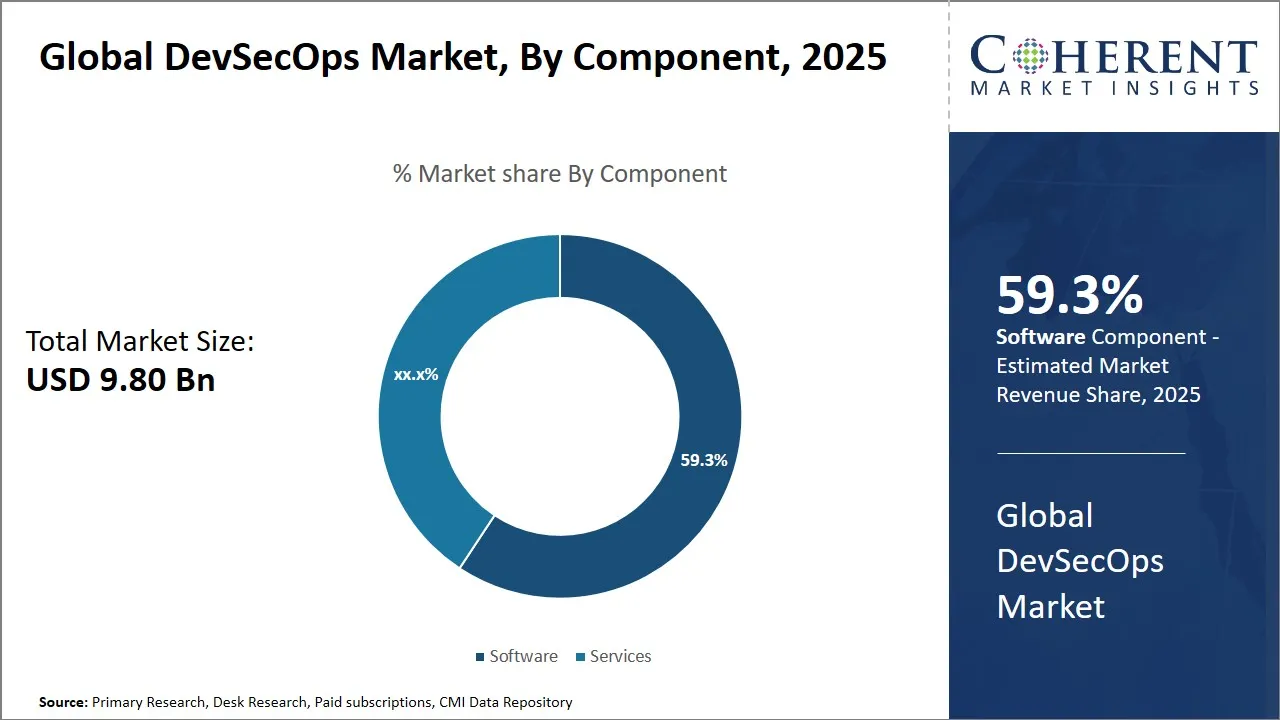
- The software segment is expected to lead the market holding a share of 60.3% in 2026.
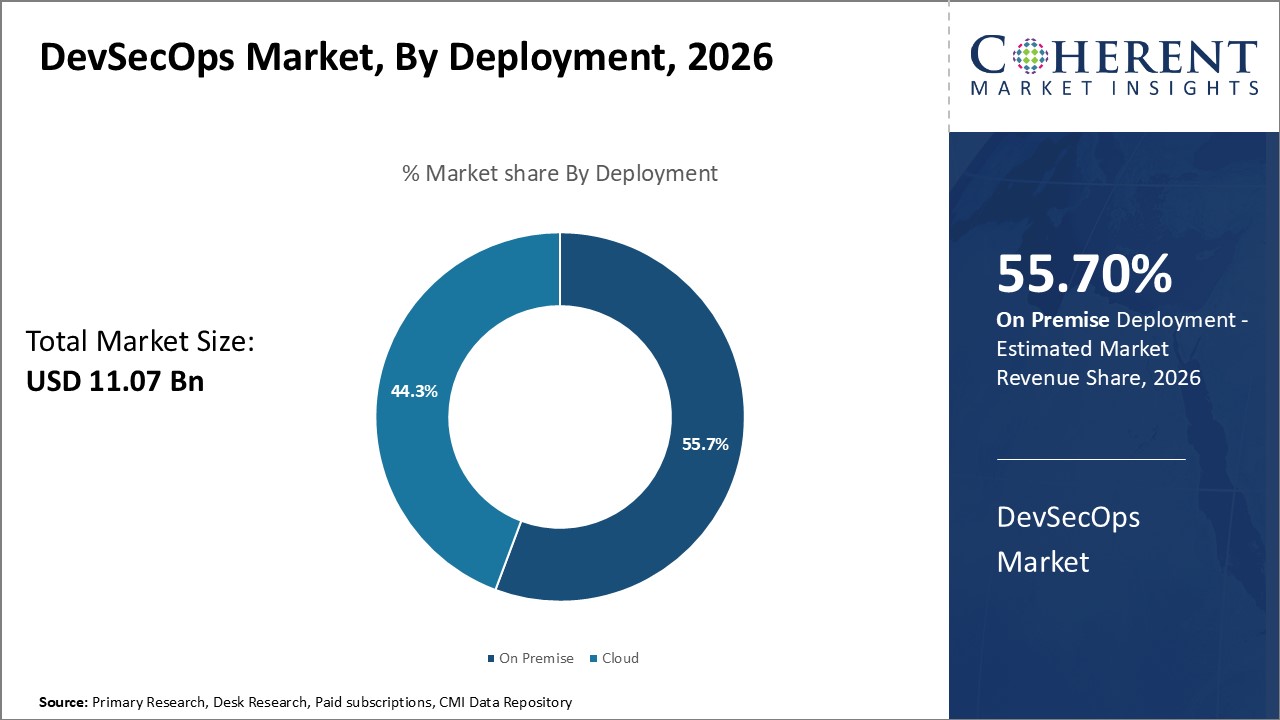
- The on premise segment is projected to hold a prominent market share of 55.7% in 2026.
- The IT and telecom segment is projected to hold 38.6% of the market share in 2026.
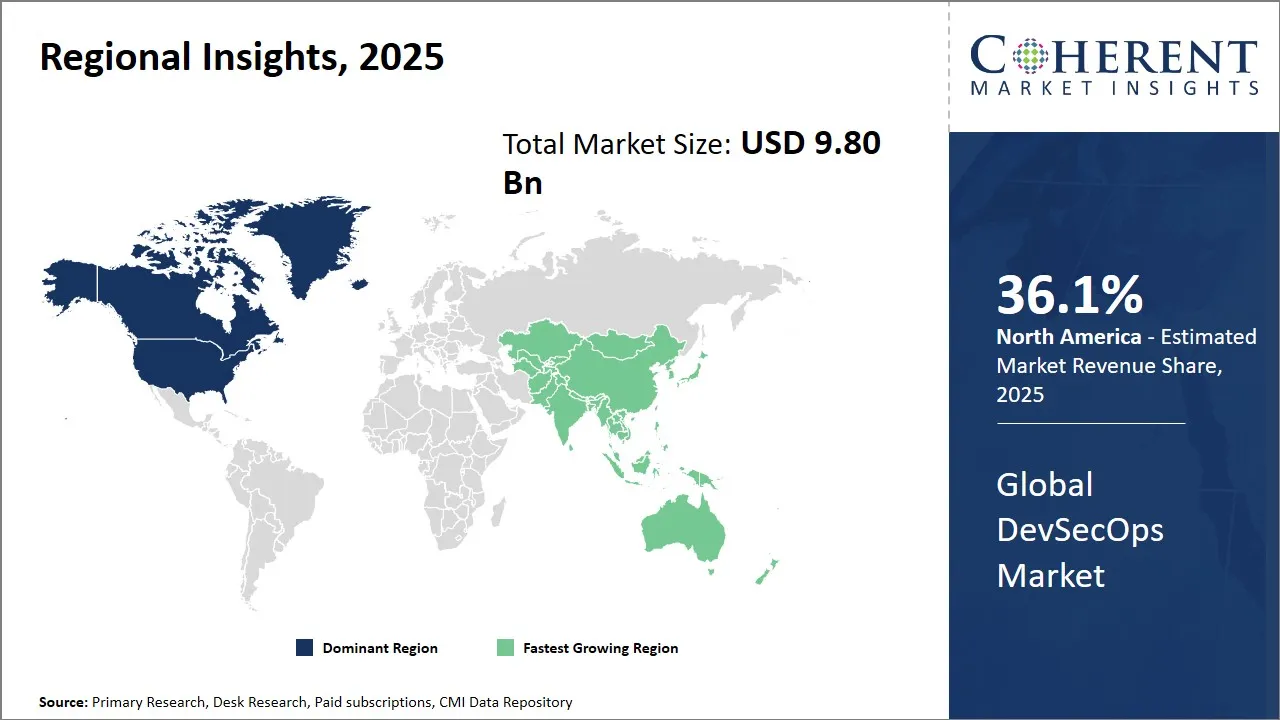
- North America, expected to hold a share of 36.1% in 2026, dominates the market.
- Asia Pacific is expected to be the fastest growing regional market with a share of 25.8% in 2026.
Market Overview
The rapid rise of the global DevSecOps market shows how more sectors are blending security into development and operation workflows, prompted by stronger demand for safer software methods in diverse industries around the world.
The market is moving strongly toward automation, while also embedding security into every stage of software creation. Firms now spend more on DevSecOps solutions that use AI or machine learning alongside live threat data to find weaknesses early. On top of this, rising cloud usage together with stricter regulations pushes growth in DevSecOps. At the same time, focus on fast, flexible workflows strengthens teamwork across dev, security, and ops units.
Current Events and Its Impact
Current Events | Description and its Impact |
Intellipaat Launch Announcement |
|
Checkmarx Recognition |
|
Segmental Insights
- Current Industry Events of 2026
- Market Size Estimation
- Regional Breakdown
- Competitive Landscape
- Customer Intelligence
- Segmental Analysis
- Pricing Analysis
- Key Market Drivers, Challenges & Future Trends
- Customized Insights Section
Global DevSecOps Market Insights, By Component – Software Segment Leads the Market Through Integration and Automation
In terms of component, software contributes the highest share of 60.3% of the market share in 2026. The rise is mainly due to how it connects security with dev and ops processes. Organizations care about safety, which means auto-checks for risks during code rollout now matter just as much as speed. Because of this shift, flexible DevSecOps models gain greater focus - particularly if they align smoothly with existing tools and cloud systems.
As apps grow more complex, smart tools are essential to detect coding errors, evaluate threats, and monitor regulatory demands. Rather than offering a single task, DevSecOps solutions combine several capabilities - such as analyzing source code while building or inspecting active environments to catch flaws early. With teams increasingly using microservices and containerized setups, protection must stay consistent even across split architectures.
Global DevSecOps Market Insights, By Deployment Mode – On Premise Segment Dominance Rooted in Control and Compliance Priorities
The on premise commands the highest share of 55.7% share in 2026. The rise stems mainly from firms seeking tighter oversight of workflows, stronger data protection, or improved handling of threats. Although cloud platforms gain traction, numerous organizations - particularly ones managing confidential details or facing strict rules - opt for self-built systems locally. Doing so helps reduce dangers tied to outside service providers.
On-premise setups give full control over security, yet store information in fixed locations. Since sectors such as finance, public services, or medicine must meet tight regulations, particularly on data residency, they frequently opt for internal servers. When organizations run DevSecOps tools in-house, they gain tighter control over how information moves; at the same time, custom safeguards reduce dependence on external cloud providers’ conditions.
Global DevSecOps Market Insights, By End Use – IT and Telecom Segment Leads due to DevSecOps Adoption Through Digital Transformation Needs
The IT and telecom commands the highest share of 38.6% of the global DevSecOps market share in 2026, fueled by constant innovation and stable systems, while also tackling intricate digital protection needs. This area leads in applying DevSecOps practices due to pressures like ongoing software updates, rising user demands, alongside shifting cyber risks.
One key factor boosting growth here is the rising speed of digital change in IT and telecom firms. Because these sectors must stay ahead, they regularly roll out new apps, services, or upgraded systems. By using DevSecOps, security becomes part of the process early on - this cuts breach risks and speeds up delivery. In telecom, being flexible matters most; technologies like NFV, 5G expansion, and edge computing need safe, automated workflows from day one.
AI-Driven DevSecOps Adoption Trends & Risk Scoring and Compliance Impact
Metric | 2024 | 2025 |
AI Adoption Index (1–10) | 6 | 6 |
Automated Security Coverage (%) | 52 | 52 |
AI-Enhanced Risk Scoring Accuracy (%) | 71 | 71 |
Compliance Automation Level (%) | 46 | 46 |
Compliance Violations Reduction (%) | 24 | 24 |
Regional Insights
North America DevSecOps Market Analysis and Trends
North America is the leader in the global DevSecOps market with an estimated share of 36.1% in 2026. In North America, leadership in the global DevSecOps market comes from a solid tech environment backed by widespread cloud systems, modern cyber defenses, while also including major IT firms. Government actions that support digital change together with stronger security push companies to use combined DevSecOps methods. Major names like IBM, Microsoft, or Cisco operate here, regularly improving tools and services, thus boosting their position in the sector. A mature approach to software creation - paired with heavy spending on automated processes along with protection measures - helps maintain this regional lead.
Asia Pacific DevSecOps Market Analysis and Trends
Asia Pacific DevSecOps market is expected to exhibit the fastest growth and hold a market share of 25.8% in 2026, driven by faster digitization in developing nations, alongside rising use of cloud tools and stronger focus on threats linked to more internet-connected gadgets. In places like India, China, or Singapore, public policies support digital transformation and cyber protection, helping spread DevSecOps practices. A broadening IT service industry together with active startup networks bring steady change across markets. Key players including Infosys, Tata Consultancy Services (TCS), plus Huawei lead efforts in building flexible DevSecOps models suited to varied regional business demands.
DevSecOps Market Outlook for Key Countries
U.S. DevSecOps Market Analysis and Trends
The U.S. market features a developed IT landscape along with many companies focusing on embedding security into software processes. Due to major tech players such as Microsoft, IBM, or Palo Alto Networks being based there, strong investment flows into DevSecOps tools and smart automated defenses. Besides this, standards like NIST recommendations together with cybersecurity rules push organizations in banking, health care, or public services toward safer development methods.
Germany DevSecOps Market Analysis and Trends
Germany prioritizes machine-driven production alongside vehicle manufacturing, areas needing stable code. Owing to tight data protection laws, companies prefer protected coding approaches. Public initiatives linked to smart factories push faster changeover. Major players like SAP or Siemens take charge by embedding safeguards straight into online services. This integration helps organizations manage regulations without slowing down updates.
India DevSecOps Market Analysis and Trends
India continues leading DevSecOps growth in Asia Pacific, driven by a vast IT industry alongside solid software development capabilities. Companies like Infosys, TCS, and Wipro, alongside many emerging tech firms , are pushing new ways to apply security into development workflows for local and international markets. Due to initiatives like Digital India and revised cyber regulations, secure coding has become essential; therefore, there’s growing need for qualified professionals along with broader adoption of combined tools.
China DevSecOps Market Analysis and Trends
China's market is changing fast, prioritizing stronger cybersecurity due to rising use of digital tools and connected devices. Because of new government rules on data safety and network protection, companies now build security into software from the start. Firms like Huawei and Alibaba lead efforts in rolling out DevSecOps systems - combining cloud tech, artificial intelligence, and protective measures - to meet local legal needs and technical demands.
U.K. DevSecOps Market Analysis and Trends
The U.K.'s DevSecOps market grows through solid money transfer services and ongoing government tech upgrades. Instead of generic tools, firms such as BAE Systems and Micro Focus offer custom security setups that meet strict regulations. Alongside this, national focus on digital progress - backed by efforts like the National Cyber Security Strategy - drives businesses toward smarter DevSecOps practices. These changes support faster development while strengthening protection across systems.
Market Players, Key Development, and Competitive Intelligence
Key Developments
- On July 17, 2025, GitLab Inc. introduced the public beta of its new DevSecOps tool called GitLab Duo Agent Platform, that enables smooth teamwork across coders and artificial intelligence assistants. The system supports delayed interaction modes, letting users engage on their own schedule through an integrated orchestration framework built into the broader development environment.
- On January 16, 2024, Snyk, which focuses on securing software early in building, acquired Helios, a firm strong in capturing active application details - to better spot code-related dangers across cloud setups. This step strengthens Snyk’s approach to Application Security Posture Management, enhancing the power of Snyk AppRisk; thus, big companies can manage protection across broad networks with less effort. Merging these tools gives teams sharper views of current risks - speeding up actions while keeping operations simple.
Top Strategies Followed by DevSecOps Market Players
- The global DevSecOps market features constant shifts between large, medium, or smaller companies - each using different tactics to gain stronger footholds. Major firms stay ahead through deep investment into research and development, focusing on breakthroughs in powerful, expandable solutions. Their ongoing focus on innovation allows rollout of enhanced security functions alongside automated systems; these align closely with changing needs from big business customers.
- Mid-tier firms in the DevSecOps space target budget-conscious customers while still ensuring solid performance. Instead of high-end features, they provide practical tools at lower prices - suited for SMEs or teams with limited tech spending power. Their focus shifts toward core functions like automated checks and seamless build processes, meeting standards without costly extras. These offerings fulfill key needs but skip unnecessary complexity found in pricier alternatives.
- Small-scale players carve out niche opportunities within the highly competitive DevSecOps market by focusing on specialized features and innovative product offerings tailored to specific industry needs or unique technical challenges. These players often capitalize on emerging trends such as artificial intelligence driven security analytics, container security, or blockchain-based compliance solutions. By adopting cutting-edge technologies and agile development methodologies, small-scale companies can rapidly innovate and respond to evolving customer requirements, maintaining a competitive position despite limited resources.
Market Report Scope
DevSecOps Market Report Coverage
| Report Coverage | Details | ||
|---|---|---|---|
| Base Year: | 2025 | Market Size in 2026: | USD 11.07 Bn |
| Historical Data for: | 2020 To 2024 | Forecast Period: | 2026 To 2033 |
| Forecast Period 2026 to 2033 CAGR: | 13.0% | 2033 Value Projection: | USD 26.05 Bn |
| Geographies covered: |
| ||
| Segments covered: |
| ||
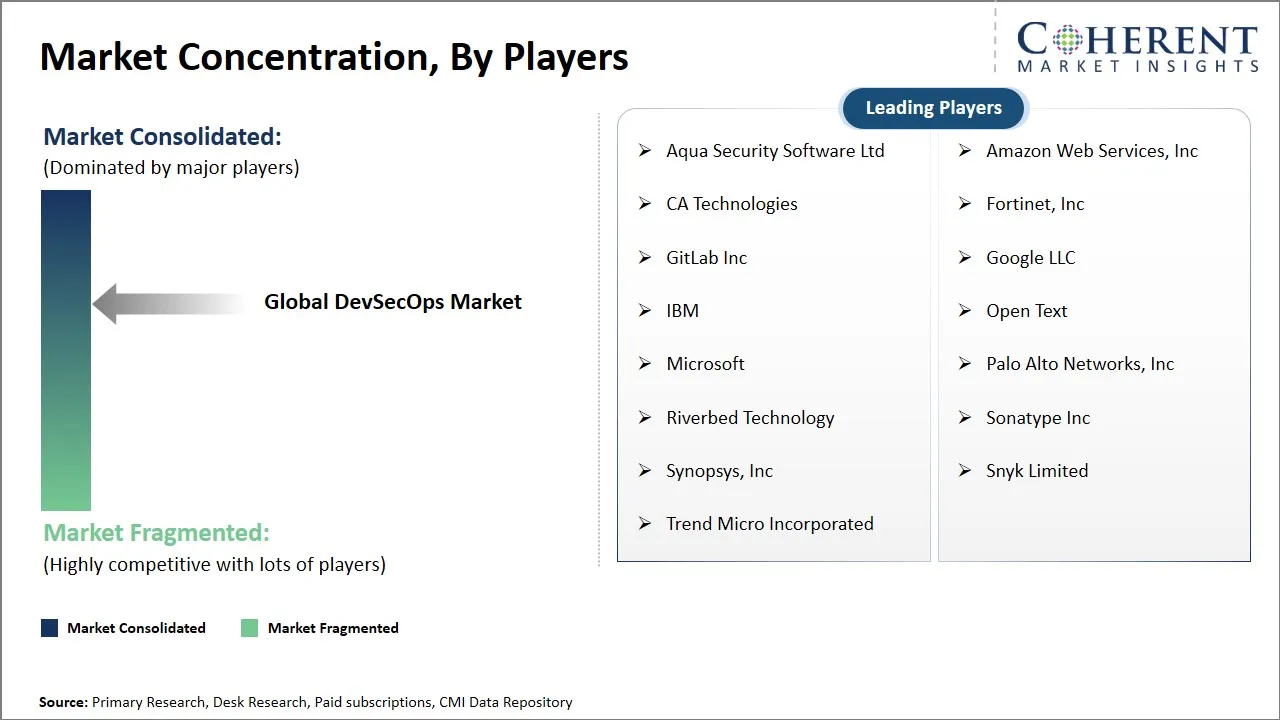
| Companies covered: | Aqua Security Software Ltd, Amazon Web Services, Inc, CA Technologies, Fortinet, Inc, GitLab Inc, Google LLC, IBM, Open Text, Microsoft, Palo Alto Networks, Inc, Riverbed Technology, Sonatype Inc, Synopsys, Inc, Snyk Limited, and Trend Micro Incorporated | ||
| Growth Drivers: |
| ||
| Restraints & Challenges: |
| ||
Market Dynamics
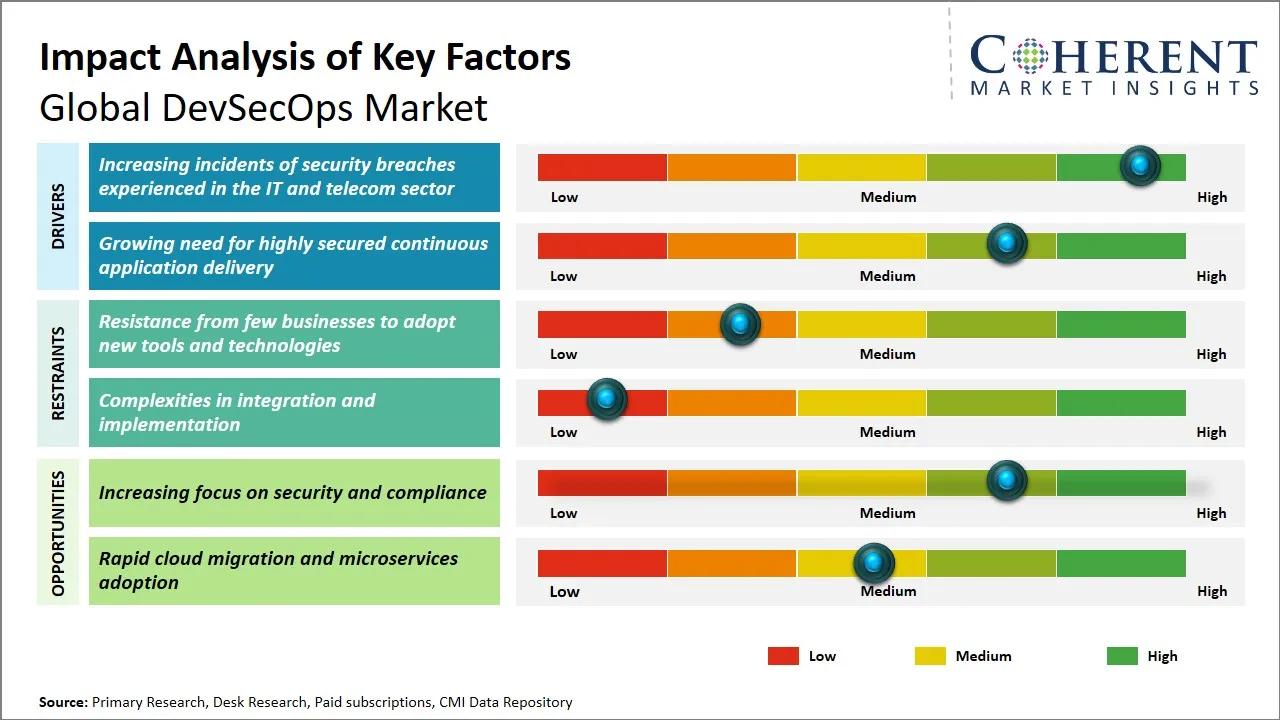
Global DevSecOps Market Driver - Increasing Incidents of Security Breaches Experienced in the IT and Telecom Sector
The rising number of advanced cyberattacks in IT and telecom is pushing companies worldwide to use DevSecOps more often. Because firms now depend heavily on linked networks and cloud setups, risks have grown sharply - so older cyber security methods no longer work well. Fast-paced CI/CD workflows boost delivery speed; however, they can create weaknesses hackers target quickly. For this reason, integrating protection at each stage of software creation has become essential instead of treating it separately. DevSecOps tackles this issue through automated security checks, instant threat spotting, while enabling quick fixes, helping firms act before risks grow. As digital systems expand and tech setups get more complicated, businesses in telecom or IT are focusing on DevSecOps models; these protect private information yet keep user confidence steady.
For instance, in April 2025, South Korea's telecom leader, SK Telecom, suffered a cyber breach which caused private data of around 23 million users to be stolen.
Global DevSecOps Market Opportunity - Increasing Focus on Security and Compliance
The rising focus on safety and rules opens strong potential for the worldwide DevSecOps sector. Because companies are pushing forward with digital upgrades, adding protection at the start of building software is now essential - this helps reduce risks while strengthening app defenses. Guidelines like GDPR, HIPAA, or CCPA push teams to follow safer coding habits along with ongoing rule tracking. By blending creation, safeguards, and system management into one flow, DevSecOps tackles issues through automatic scans, instant threat spotting, plus quicker fixes inside CI/CD workflows.
Enterprises in sectors like banking, health care, or public administration focus more on protection of critical information to keep users’ confidence, so they increasingly adopt DevSecOps methods. Because digital dangers grow harder to predict, companies now integrate safety checks throughout development cycles, which strengthens the role of these frameworks. Such changes lower chances of leaks while helping firms escape large fines for breaking rules. As a result, stricter laws combined with the need to defend software from new attack types push expansion of this market, spark fresh ideas, and boost funding for modern DevSecOps solutions worldwide.
Analyst Opinion (Expert Opinion)
- The global DevSecOps market is growing fast, since companies now place security earlier in development stages. Because more firms use cloud systems, run microservices, and face cyber risks, they’re turning to automation tools that work smoothly within CI/CD workflows. This change isn't just about faster releases - tighter regulations along with expensive late-stage flaws make integration essential. As a result, DevSecOps has become central to operations instead of staying limited or optional.
- The market’s evolving as vendors now focus on integrated systems that handle app security checks, code infrastructure reviews, or live environment safeguards. Strong interest comes from BFSI, health services, sometimes public agencies due to strict rules around sensitive information. In coming years, smart automation using AI, rule-based policies coded directly into workflows, even safer product delivery chains may set top performers apart, making DevSecOps essential for modernization efforts across nations.
Speak to the analyst
Want personalized insights?
Take the findings above to one of our principal consultants, or have the report rebuilt around the segments, geographies and competitors you actually track.
Market Segmentation
- Component Insights (Revenue, USD Bn, 2021 - 2033)
- Software
- Services
- Deployment Insights (Revenue, USD Bn, 2021 - 2033)
- On Premise
- Cloud
- End Use Insights (Revenue, USD Bn, 2021 - 2033)
- IT and Telecom
- BFSI
- Government
- Retail and Consumer Goods
- Manufacturing
- Other
- Regional Insights (Revenue, USD Bn, 2021 - 2033)
- North America
- U.S.
- Canada
- Latin America
- Brazil
- Argentina
- Mexico
- Rest of Latin America
- Europe
- Germany
- U.K.
- Spain
- France
- Italy
- Russia
- Rest of Europe
- Asia Pacific
- China
- India
- Japan
- Australia
- South Korea
- ASEAN
- Rest of Asia Pacific
- Middle East
- GCC Countries
- Israel
- Rest of Middle East
- Africa
- South Africa
- North Africa
- Central Africa
- North America
- Key Players Insights
- Aqua Security Software Ltd
- Amazon Web Services, Inc
- CA Technologies
- Fortinet, Inc
- GitLab Inc
- Google LLC
- IBM
- Open Text
- Microsoft
- Palo Alto Networks, Inc
- Riverbed Technology
- Sonatype Inc
- Synopsys, Inc
- Snyk Limited
- Trend Micro Incorporated
Sources
Primary Research Interviews
- Chief Information Security Officers (CISOs) from Fortune 500 companies
- DevSecOps Platform Vendors and Solution Providers
- Enterprise IT Directors and Security Architects
- DevOps Engineers and Security Practitioners
Databases
- Gartner IT Market Research Database
- IDC Worldwide Security Software Tracker
- Forrester Research Security Database
Magazines
- com Magazine
- Security Magazine
- InfoSecurity Magazine
- Dark Reading
Journals
- IEEE Security & Privacy Journal
- Journal of Information Security and Applications
- ACM Computing Surveys
Newspapers
- The Wall Street Journal (Technology Section)
- Financial Times (Tech & Security Coverage)
- Reuters Technology News
- Bloomberg Technology
Associations
- DevSecOps Foundation
- Cloud Security Alliance (CSA)
- Information Systems Security Association (ISSA)
- International Association of Computer Security Professionals (IACSP)
Public Domain Sources
- NIST Cybersecurity Framework Documentation
- OWASP (Open Web Application Security Project) Reports
- GitHub Security Research Publications
- U.S. Department of Homeland Security Cybersecurity Reports
Proprietary Elements
- CMI Data Analytics Tool
- Proprietary CMI Existing Repository of information for last 8 years
Get access to 250+ pages report
Every segment, forecast, competitor profile and data table behind the analysis above — available for instant download.
- ESOMAR Member
- ISO 9001:2015 Certified
- D-U-N-S Registered
- GDPR & CCPA Compliant
Missing comfort of reading report in your local language? Find your preferred language:
Transform your Strategy with Exclusive Trending Reports
Frequently Asked Questions
The global DevSecOps market is estimated to be valued at USD 11.07 Bn in 2026 and is expected to reach USD 26.05 Bn by 2033.
The CAGR of the global DevSecOps market is projected to be 13.0% from 2026 to 2033.
Increasing incidents of security breaches experienced in the IT and telecom sector and growing need for highly secured continuous application delivery are the major factors driving the growth of the global DevSecOps market.
Resistance from few businesses to adopt new tools and technologies and complexities in integration and implementation are the major factors hampering the growth of the global DevSecOps market.
In terms of component, the software is estimated to dominate the market revenue share in 2026.
Aqua Security Software Ltd, Amazon Web Services, Inc, CA Technologies, Fortinet, Inc, GitLab Inc, Google LLC, IBM, Open Text, Microsoft, Palo Alto Networks, Inc, Riverbed Technology, Sonatype Inc, Synopsys, Inc, Snyk Limited, and Trend Micro Incorporated are the major players.
North America is expected to lead the global DevSecOps market in 2026.