

Global Diameter Signaling Market Size and Forecast – 2026 To 2033
The global diameter signaling market is expected to grow from USD 2.40 Bn in 2026 to USD 5.15 Bn by 2033, registering a compound annual growth rate (CAGR) of 9.4% from 2026 to 2033. The global diameter signaling market is driven by increasing mobile data traffic and video consumption. In August 2025, Huawei Technologies announced plans to deploy 10-Gigabit Ethernet and Fiber-to-the-Room (FTTR) infrastructure across China.
Key Takeaways of the Global Diameter Signaling Market
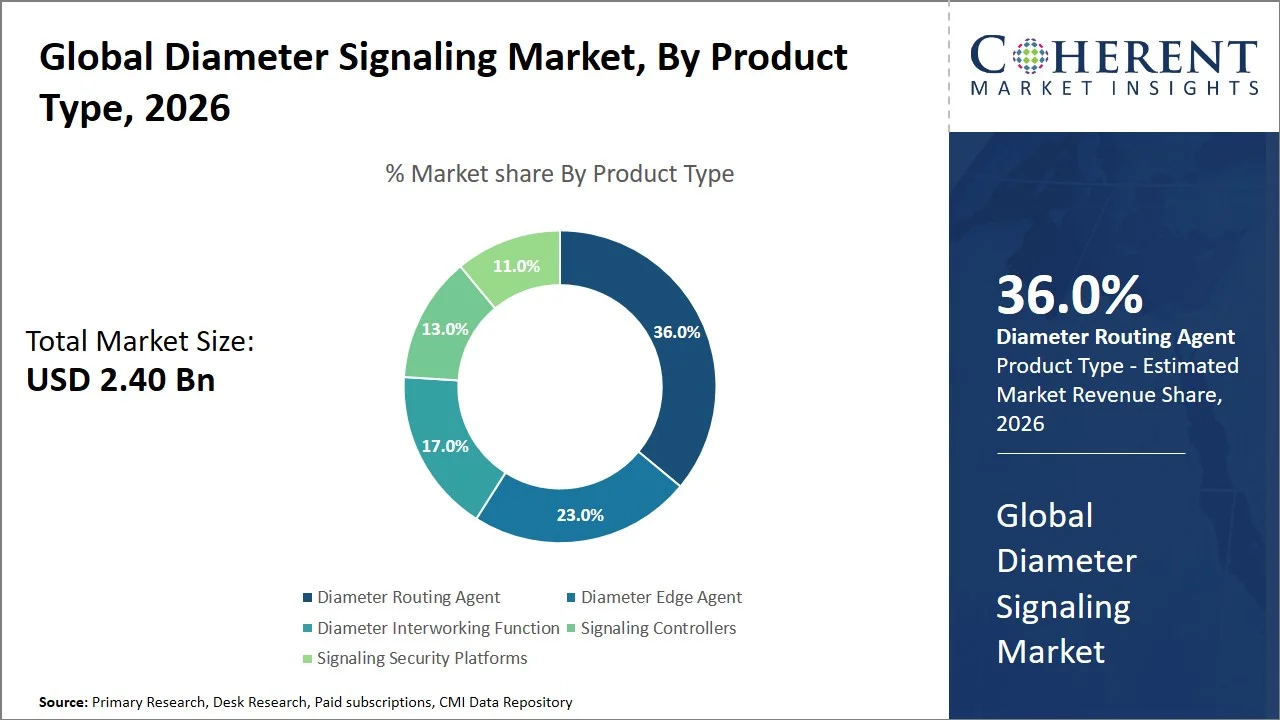
- The diameter routing agent segment is expected to account for 36.0 % of the global diameter signaling market share in 2026. Increasing focus on network security and subscriber authentication is driving the growth of the segment. On February 27, 2025, Aduna and Ericsson announced that its venture partners, AT&T, T-Mobile and Verizon, are set to deliver the first advanced network Application Programming Interfaces (API) for Number Verification and SIM Swap in the U. S. (Source: Ericsson)
- The LTE networks segment is estimated to capture 39.0 % of the market share in 2026. Expansion of cloud-native telecom core architectures is a major factor driving the growth of the segment. On June 12, 2025, Ericsson announced the launch of Ericsson On-Demand, a new solution delivering core network services as a true software-as-a-service (SaaS) platform to communications service providers (CSPs). (Source: Ericsson)
- The policy management segment is estimated to capture 28.0 % of the market share in 2026. Growth in roaming traffic and inter-operator connectivity is driving the growth of the segment. On November 17, 2025, Vodafone Idea introduced a family-focused international roaming offering that provides discounted roaming packages for multiple family members traveling abroad. The initiative was launched to support increasing outbound travel demand and higher roaming usage across partner operator networks worldwide. (Source: Vi)
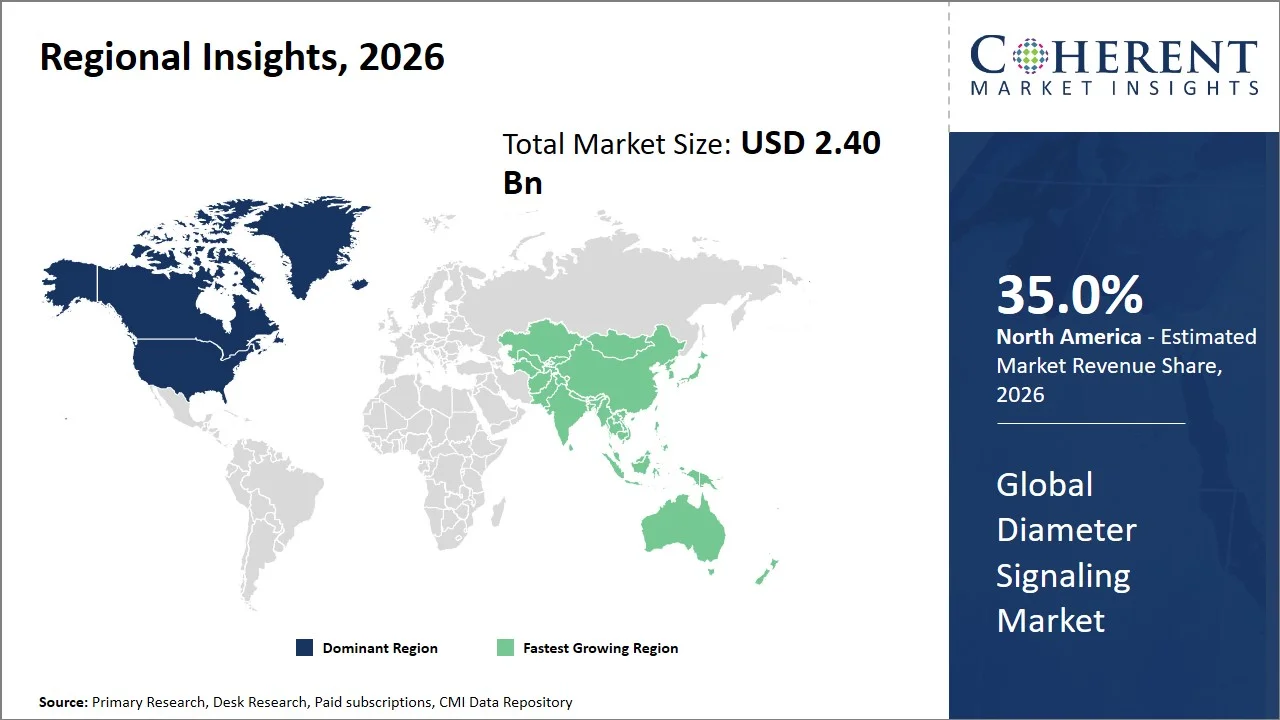
- North America is expected to dominate the diameter signaling market in 2026 with a market share of 35.0 %. A steady growth in telecom cloud transformation projects in North America is driving the growth of the regional market. On February 4, 2025, AT&T announced that it is extending its voice core relationship with Nokia in a multi-year expansion deal that will support the U.S. operator in delivering on its vision of securely providing customer-focused networks and automation that drive new services, faster deployment times, and operational efficiencies. (Source: Nokia)
- Asia Pacific is expected to account for 30.0 % share in 2026 and is projected to record the fastest growth over the forecast period. Increasing investments in mobile broadband infrastructure in Asia Pacific is primarily driving the growth of the regional market. On July 9, 2025, Bharti Airtel and Ericsson announced an expansion of their long-standing relationship with a new agreement to support Bharti Airtel’s rollout of Fixed Wireless Access (FWA) services in India with its core network portfolio. (Source: Ericsson)
- Transition Toward 5G Core and Diameter–HTTP/2 Interworking: Telecom operators are moving to standalone 5G networks and integrating diameter signaling with HTTP/2-based service-based architecture interfaces. Vendors are creating diameter interworking functions and signaling devices that provide seamless communication between legacy LTE cores and next generation 5G infrastructure cores to ensure a smooth transition of services when the network migrates.
- Adoption of Cloud-Native and Virtualized Signaling Platforms: Telecom operators are moving their traditional hardware-based signaling infrastructure to cloud-native, containerized diameter solutions. Virtualized diameter routing agents and signaling controllers running on public, private and hybrid clouds provide higher scalability, cheaper operational costs, faster service launch and better network agility.
Segmental Insights
Why Does the Diameter Routing Agent Segment Dominate the Global Diameter Signaling Market?
The diameter routing agent segment is expected to account for 36.0% of the global diameter signaling market share in 2026. Diameter routing agents are widely used in the industry since they provide the core intelligence for routing, load balancing and handling large amounts of signaling traffic between network parts. As mobile operators increase LTE and 5G rollouts, DRAs are required to ensure efficient signals delivery, network scalability, congestion control and smooth interoperability in complex multi-vendor telecom environments.
On August 26, 2025, Nexign and T-Mobile successfully completed the migration of signaling traffic to Nexign Diameter Routing Agent (DRA) for all 6 million subscribers. Nexign DRA centralizes diameter traffic routing and management, as well as real-time load balancing for all 4G core network functions. (Source: Nexign)
- Current Industry Events of 2026
- Market Size Estimation
- Regional Breakdown
- Competitive Landscape
- Customer Intelligence
- Segmental Analysis
- Pricing Analysis
- Key Market Drivers, Challenges & Future Trends
- Customized Insights Section
Why are LTE Networks the Most Preferred Network Type?
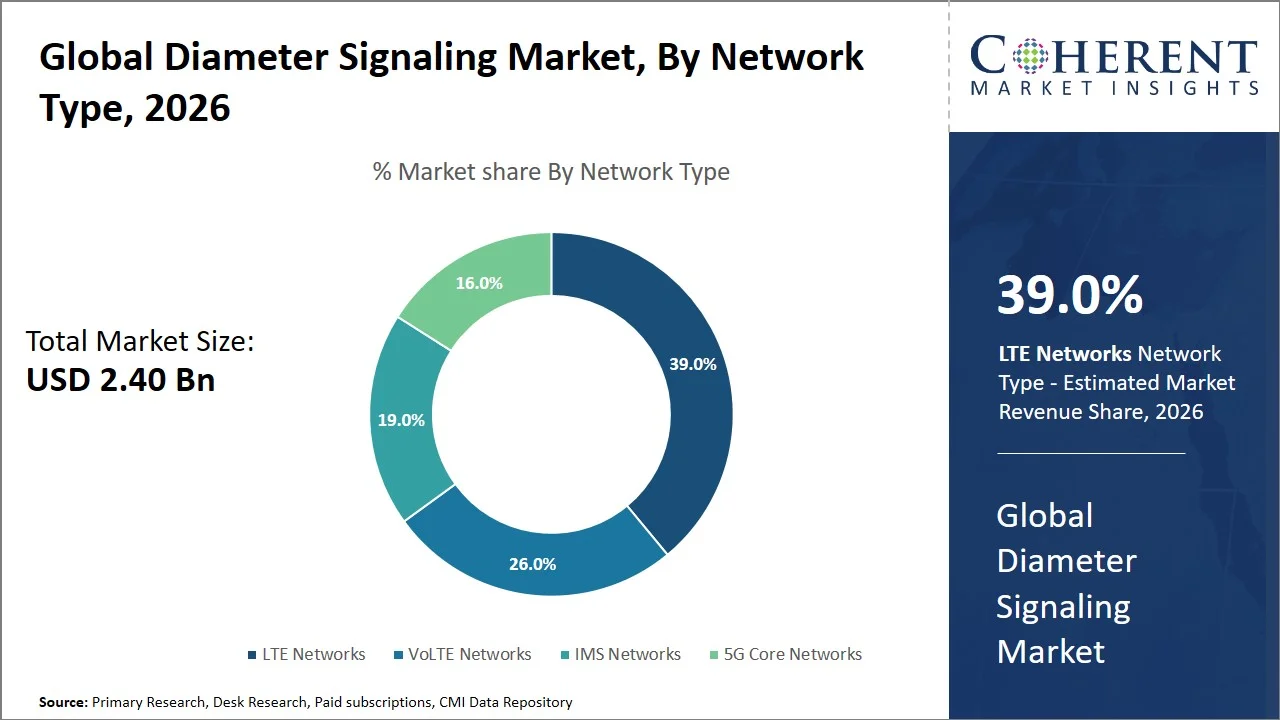
The LTE networks segment is expected to account for 39.0% of the global diameter signaling market share in 2026. LTE networks remain the network of choice as they are built on diameter signaling for key tasks like subscriber authentication, policy control, mobility management and charging. With billions of LTE customers around the world and broad deployment of VoLTE services, LTE networks continue to create a significant amount of signaling traffic, and with the move towards 5G, the need for diameter signaling solutions remains high.
On March 3, 2025, Boost Mobile deployed Nokia’s fully cloud-native 5G Voice Core to enable even faster delivery of advanced services, enhanced network automation, and more efficient cloud utilization than its Open RAN cloud-native network could before. (Source: Nokia)
Policy Management Dominates the Global Diameter Signaling Market
The policy management segment is expected to account for 28.0% of the global diameter signaling market share in 2026. Policy management is the major driving factor for the diameter signaling market. Telecom operators employ diameter based policy control capabilities to govern subscriber data usage, quality of service (QoS), service priority and billing policies in real time. As LTE, VoLTE and 5G services are increasingly being used, the demand for dynamic policy enforcement has expanded substantially, making policy management one of the most widely used diameter signaling applications in mobile networks.
On March 4, 2026, Wind Tre announced its selection of Ericsson to complete the long-term, comprehensive, modernization of its core network, supporting all 4G, 5G Non-Standalone (NSA) and 5G Standalone (SA) subscribers under a seven-year agreement spanning 2026 to 2032. (Source: Ericsson)
Currents Events and their Impact
Current Events | Description and its Impact |
European Union - NIS2 Directive Implementation (2025-2026) |
|
India - Telecommunications (Telecom Cyber Security) Amendment Rules, 2025 |
|
(Source: European Commission, Press Information Bureau)
Diameter Signaling Market Dynamics
Market Drivers
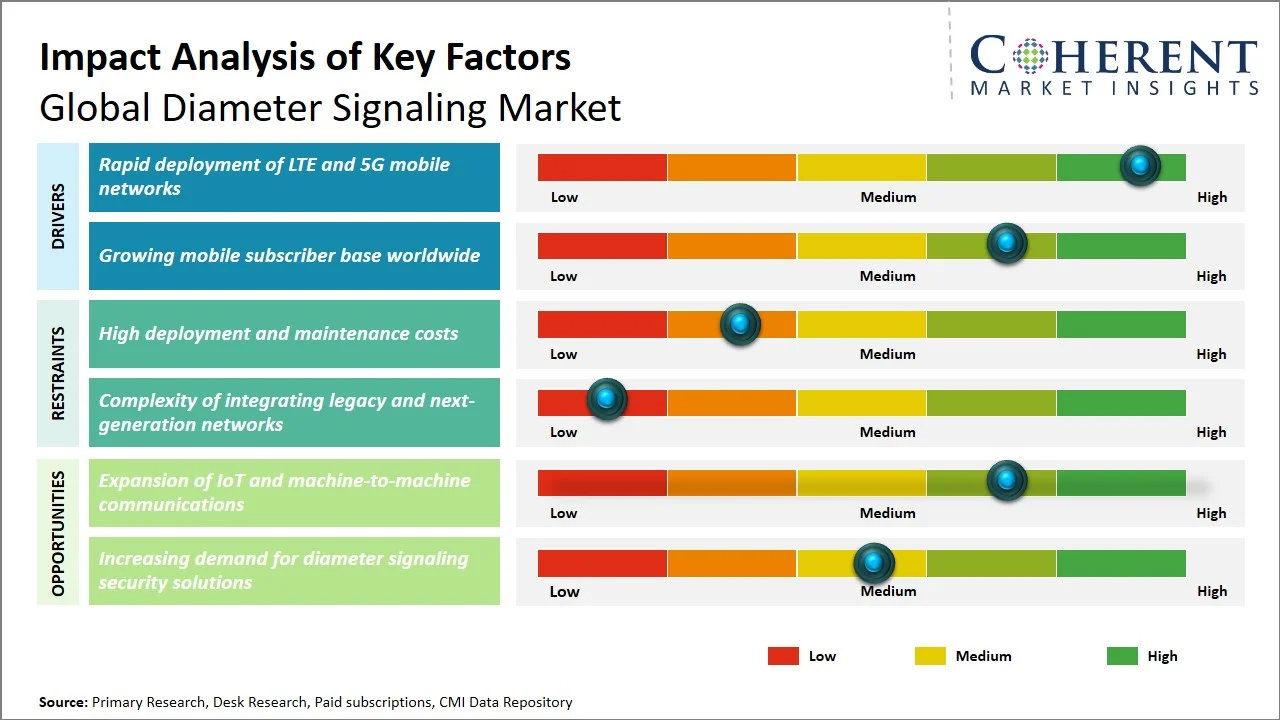
Rapid deployment of LTE and 5G mobile networks
The rapid deployment of LTE and 5G mobile networks is a major driver of the global diameter signaling market. These technologies rely heavily on Diameter protocols for subscriber authentication, policy control, mobility management, charging, and roaming functions. As a result, signaling volumes are much larger as telecom operators around the globe are increasing network coverage and updating key infrastructure to serve the increased mobile data traffic, ultra-low latency services and enormous IoT connectivity. The demand for advanced Diameter routing, traffic management and signaling security solutions continues to grow, as LTE networks continue to service billions of users and 5G deployments accelerate in developed and emerging regions, enabling continuous market growth.
On March 10, 2026, AT&T announced an investment of more than USD 250 billion in the future of U.S. advanced connectivity, building the high-speed networks and resilience required for the next era of innovation and economic growth. (Source: AT&T)
Growing mobile subscriber base worldwide
The growth of mobile subscribers globally is a major driving factor for the global diameter signaling market. Each mobile connection generates additional signaling traffic for authentication, authorization, subscriber data management, policy enforcement, billing, and roaming services. As smartphones proliferate, mobile broadband access improves and economies of the future get more connected, telecom operators are seeing higher volumes of subscriber interactions over LTE and 5G networks. The continued growth in mobile users is driving the need for scalable and efficient diameter signaling solutions that can support higher network loads while ensuring service quality, security and seamless user experiences.
As of May 26, 2026, Indian telecom service providers, Bharti Airtel, BSNL, Reliance Jio, and Vodafone Idea (Vi) recorded gains in wireless subscribers. Data from Telecom Regulatory Authority of India showed that the total number of wireless (mobile and Fixed Wireless Access) subscribers increased from 1,282.3 million at the end of March 2026 to 1,288.9 million at the end of April 2026, registering a monthly growth rate of 0.52%. (Source: Press Information Bureau)
Emerging Trends
- AI-Driven Signaling Traffic Management and Security: Increasingly, artificial intelligence and machine learning technologies are being applied to evaluate signaling traffic trends, improve routing decisions, predict congestion, and detect anomalous behaviors. AI-enabled diameter systems help operators to reduce operational complexity while enhancing subscriber experience, strengthening signaling security and improving network efficiency.
- Growing Demand from Massive IoT and Private 5G Networks: The rapid growth of IoT devices, industrial automation, smart cities, and private 5G networks is creating significant signaling traffic over telecom networks. Diameter signaling solutions are expanding to meet the greater device densities, real-time authentication, policy management and charging functionalities that are needed by enterprise IoT ecosystems and mission-critical private wireless networks.
Regional Insights
Why is North America a Strong Market for Diameter Signaling?
North America is expected to account for a market share of 35.0% in 2026. North America continues to be an important innovation hub for diameter signaling due to aggressive 5G standalone rollouts and massive network upgrade initiatives from operators including AT&T, Verizon and T-Mobile US. Operators in the region are increasingly adopting cloud-native Diameter Routing Agents (DRAs) and signaling controllers to back network slicing, fixed wireless access (FWA) and private 5G services. Increasing worries over signaling-based cyberattacks and roaming fraud are also driving significant investment in signaling security technologies in the region. Vendors such as Oracle Communications, Mavenir and Ribbon Communications have enhanced their cloud-native core and signaling portfolios to enable North American operators’ shift to 5G standalone infrastructures.
In addition, the expansion in network development across the region is driving the growth of the North America diameter signaling market. On November 3, 2025, Verizon Business announced a new Verizon AI Connect deal with Amazon Web Services (AWS) to provide the resilient high-capacity, low-latency network infrastructure essential for the next wave of artificial intelligence (AI) innovation. (Source: Verizon)
Why Does the Asia Pacific Diameter Signaling Market Exhibit High Growth?
Asia Pacific is projected to account for 30.0% of the global diameter signaling market and expected to register the fastest growth. Asia Pacific is characterized by massive signaling traffic from dense mobile subscriber bases and rapid 5G deployment. Carriers in China, India, Japan and South Korea are introducing enhanced Diameter signaling solutions to address the expanding needs for authentication, policy management and roaming. More and more regional telecom providers are marrying diameter platforms with AI-powered traffic analytics and network automation solutions to accommodate the explosion of IoT connection and enterprise 5G installations.
Meanwhile the region is also emerging as a key market for Diameter to HTTP/2 interworking solutions as operators move from LTE EPC architectures to cloud-native 5G cores while retaining interoperability with legacy networks. On February 19, 2025, Ericsson and Telstra announced a partnership to pioneer the first programmable network in Asia Pacific. Customers of Australian communications service provider (CSP) Telstra are set to become the first in the Asia-Pacific region to benefit from a high-performing, programmable network with 5G Advanced capabilities, owing to this major partnership with Ericsson. (Source: Ericsson)
Global Diameter Signaling Market Outlook for Key Countries
Why is the U.S. Emerging as a Major Hub in the Diameter Signaling Market?
The U.S. is a leader in technology adoption in the diameter signaling ecosystem due to widespread 5G standalone deployments and growing private wireless deployments. T-Mobile US has kept up its expansion of the statewide standalone 5G core, while AT&T and Verizon are rushing their cloud-native core transformations that require advanced Diameter routing and policy control capabilities. Today, major network vendors like Oracle Communications and Mavenir are actively delivering signaling infrastructure that supports VoLTE, 5G mobility management and network slicing applications. The increasing deployment of private 5G networks in manufacturing, logistics and defense is creating additional requirements for signaling traffic control.
Is China the Next Growth Engine for the Diameter Signaling Market?
The diameter signaling market in China is primarily driven by the substantial 5G installations by China Mobile, China Telecom and China Unicom. The country’s telecom carriers are still in the process of integrating Diameter signaling infrastructure with massive 5G core networks that power the industrial internet, smart manufacturing, linked vehicles and smart city programs. Chinese equipment providers including Huawei Technologies are also a key contributor to the provision of Diameter routing, policy control and subscriber management solutions. The increased adoption of enterprise private 5G networks in ports, industries and mining activities is contributing to the signaling complexity and the need for sophisticated diameter management solutions.
Germany Diameter Signaling Market Analysis and Trends
The Germany diameter signaling market is fueled by the extensive use of private 5G networks in industrial plants and Industry 4.0 projects. Deutsche Telekom and other operators, as well as enterprise network providers, are building up sophisticated signaling infrastructure to support mission-critical manufacturing communications, autonomous production systems and industrial IoT settings. The increased focus on telecom cybersecurity and compliance with the EU NIS2 framework is driving investments in Diameter firewalls, signaling analytics and network monitoring solutions. The growing ecosystem of industrial private networks in the country demands advanced policy control and subscriber management capabilities, largely dependent on diameter signaling technologies.
Japan Diameter Signaling Market Analysis and Trends
The Japan diameter signaling market is backed by the advanced network modernization projects of KDDI Corporation, NTT DOCOMO, and SoftBank Corp. Japanese operators are progressively building cloud-native core networks and Open RAN architectures that demand strong diameter signaling interoperability and traffic management. The country is also a pioneer in connected transportation, smart infrastructure and industrial IoT applications that create a significant volume of authentication and policy control signalling traffic. Continued investments in autonomous transportation systems, smart industrial facilities and advanced enterprise connectivity solutions are further driving the demand for sophisticated Diameter signaling platforms.
South Korea Diameter Signaling Market Analysis and Trends
South Korea has some of the world’s most advanced commercial 5G networks provided by SK Telecom, KT Corporation and LG Uplus. Telecom operators are early adopters of the standalone 5G core, network slicing, edge computing and ultra-low latency services, all of which demand highly efficient signaling management. As the country is aggressively increasing its 5G corporate deployments in smart manufacturing, robotics, autonomous mobility and digital healthcare, there is significant demand for Diameter routing, policy management and signaling security solutions capable of managing high-density network environments.
Global Diameter Signaling Market - Diameter Signaling Transactions Per Day
Region | Average Diameter Signaling Transactions per Day (Billion Transactions/Day) Share of Global |
North America | 420 |
Europe | 310 |
Asia Pacific | 670 |
Latin America | 120 |
Middle East & Africa | 160 |
Global Diameter Signaling Market - Active Diameter Nodes Installed Globally
Diameter Node Type | Active Installed Nodes Globally (2026) |
Diameter Routing Agents (DRA) | 6,850 |
Policy and Charging Rules Function (PCRF) / Policy Control Function (PCF) | 8,200 |
Home Subscriber Server (HSS) / Unified Data Management (UDM) | 7,450 |
Online Charging System (OCS) / Charging Function | 5,750 |
Diameter Edge Agents (DEA) | 3,600 |
IMS Core Diameter Nodes (CSCF, AS-related Functions) | 3,950 |
Other Diameter Application Nodes | 1,100 |
Total Active Diameter Nodes | 36,900 |
How is the Expansion of IoT and Machine-To-Machine Communications Creating New Growth Opportunities in the Diameter Signaling Market?
The Internet of Things (IoT) and machine-to-machine (M2M) communications boom is creating massive chances for the Diameter signaling market to flourish, as the number of authentication, policy control, subscriber management and billing transactions across telecom networks is rising substantially. Operators deploying millions of connected devices in smart cities, industrial automation, connected vehicles, healthcare monitoring, utilities and logistics applications need advanced diameter signaling solutions to efficiently manage device connectivity, mobility and service quality in real time. Unlike traditional mobile subscribers, IoT ecosystems encourage constant signaling exchanges between devices and network cores, thereby spurring demand for scalable Diameter Routing Agents (DRAs), policy management platforms, and signaling security solutions that can accommodate massive device density while maintaining network reliability, security, and operational efficiency across LTE and 5G infrastructures.
On October 2, 2025, Telia launched a new platform designed to support enterprises in deploying and scaling Internet of Things (IoT) solutions. Businesses in the Nordic region can use Telia IoT Platform to gather, visualize and act on data from connected devices, with AI tools for analysis and optimization included. (Source: Telia)
Market Players, Key Development, and Competitive Intelligence
Key Developments
- On November 13, 2025, Transatel selected Oracle cloud native 5G signaling core to advance its next-generation connectivity services. Leveraging its partnerships with over 300 international mobile carriers, Transatel plans to implement key components of Oracle’s 5G Standalone (SA) core, enhancing secure, scalable, and reliable connectivity for millions of IoT devices.
- On July 29, 2025, Ericsson and AT&T announced that, for the first time, a third-party RAN automation application, an rApp, has successfully performed optimization activity on a Communication Service Provider’s (CSP) live production network. This accomplishment marks a decisive moment in the industry’s move from closed, single-vendor Self-Organizing Networks (SON) toward an open, future-proof architecture based on the standards and frameworks set out by the Open RAN Alliance.
Competitive Landscape
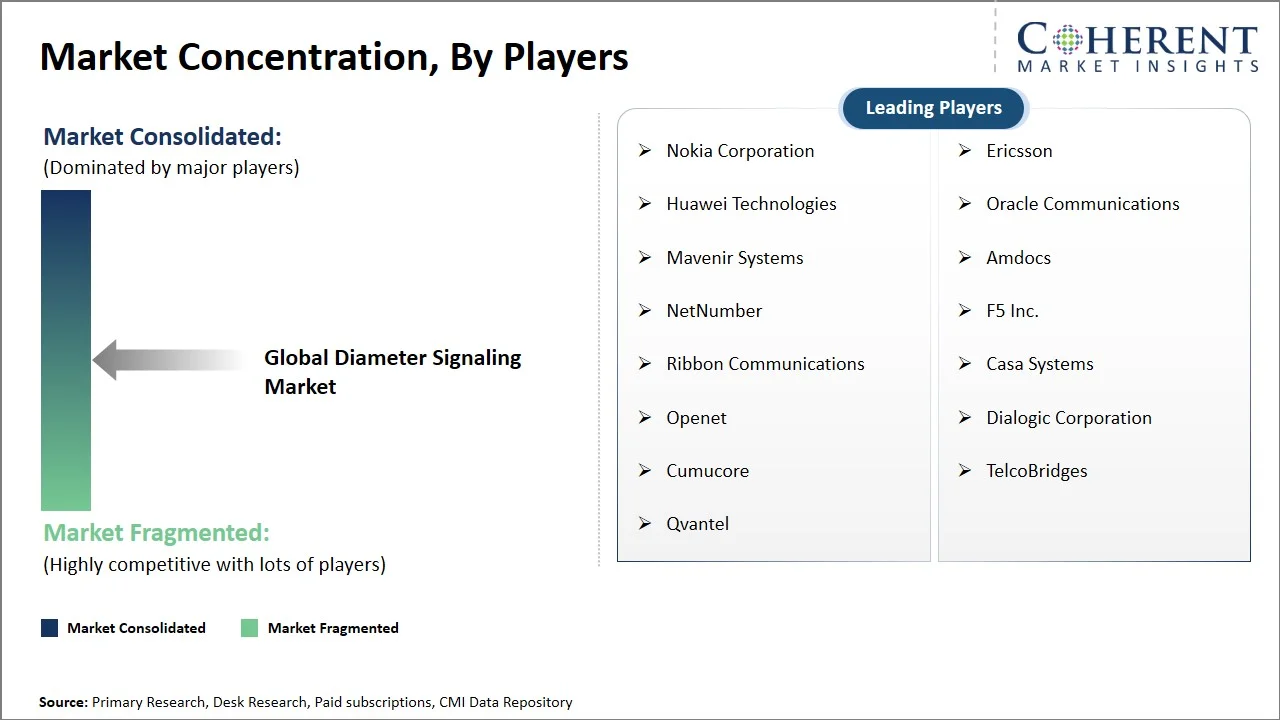
The global diameter signaling market is characterized by the existence of established telecom infrastructure providers and specialized signaling solution suppliers, competing on the parameters of network scalability, cloud-native capabilities, signaling security, and 5G interoperability. Major companies such as Ericsson, Nokia, Huawei Technologies, Oracle Corporation, Mavenir and Ribbon Communications are strengthening their market positions with the help of investments in cloud-native core networks, diameter routing platforms, signaling firewalls and Diameter-to-5G interworking solutions. Among the primary competitive tactics gaining momentum in the industry are strategic alliances with telecom operators, proliferation of virtualized network operations and adoption of AI-powered traffic management capabilities.
Market Report Scope
Diameter Signaling Market Report Coverage
| Report Coverage | Details | ||
|---|---|---|---|
| Base Year: | 2025 | Market Size in 2026: | USD 2.40 Bn |
| Historical Data for: | 2020 To 2024 | Forecast Period: | 2026 To 2033 |
| Forecast Period 2026 to 2033 CAGR: | 9.4% | 2033 Value Projection: | USD 5.15 Bn |
| Geographies covered: |
| ||
| Segments covered: |
| ||
| Companies covered: | Nokia Corporation, Ericsson, Huawei Technologies, Oracle Communications, Mavenir Systems, Amdocs, NetNumber, F5 Inc., Ribbon Communications, Casa Systems, Openet, Dialogic Corporation, Cumucore, TelcoBridges, and Qvantel | ||
| Growth Drivers: |
| ||
| Restraints & Challenges: |
| ||
Analyst Opinion (Expert Opinion)
- The diameter signaling market is being positively affected by the continuous deployment of LTE networks, increasing deployment of standalone 5G cores, and the increasing complexity of signaling traffic generated by IoT and enterprise connection applications. Even if parts of telecom architectures are migrating to service based 5G architectures in a step-by-step manner, the requirement for diameter routing, policy control and signaling security solutions is projected to remain at large scale for a long time of coexistence between LTE and 5G networks. Growth momentum is also being driven by increased operator investments in cloud-native network transformation and cybersecurity modernization initiatives.
- The continued migration to standalone 5G networks, expansion of private wireless infrastructure and the rapid spread of connected devices across industrial and consumer sectors are likely to generate strong growth possibilities. Demand is expected to be driven by the demand for sophisticated diameter interworking features to enable seamless communication between legacy LTE environments and upcoming 5G service-based architectures. Furthermore, higher adoption of AI-enabled signaling analytics, automated traffic orchestration and next-generation signaling security platforms will transform the competitive landscape, while ensuring that diameter signaling will remain a critical component of telecom network operations during the forecast period.
Speak to the analyst
Want personalized insights?
Take the findings above to one of our principal consultants, or have the report rebuilt around the segments, geographies and competitors you actually track.
Market Segmentation
- Product Type Insights (Revenue, USD Billion, 2021 - 2033)
- Diameter Routing Agent
- Diameter Edge Agent
- Diameter Interworking Function
- Signaling Controllers
- Signaling Security Platforms
- Network Type Insights (Revenue, USD Billion, 2021 - 2033)
- LTE Networks
- VoLTE Networks
- IMS Networks
- 5G Core Networks
- Application Insights (Revenue, USD Billion, 2021 - 2033)
- Policy Management
- Charging Systems
- Subscriber Data Management
- Mobility Management
- Roaming Services
- Authorization and Accounting
- End User Insights (Revenue, USD Billion, 2021 - 2033)
- Mobile Network Operators
- Telecom Service Providers
- MVNOs
- Enterprise Private Network Operators
- Regional Insights (Revenue, USD Billion, 2021 - 2033)
- North America
- U.S.
- Canada
- Latin America
- Brazil
- Argentina
- Mexico
- Rest of Latin America
- Europe
- Germany
- U.K.
- Spain
- France
- Italy
- Russia
- Rest of Europe
- Asia Pacific
- China
- India
- Japan
- Australia
- South Korea
- ASEAN
- Rest of Asia Pacific
- Middle East
- GCC Countries
- Israel
- Rest of Middle East
- Africa
- South Africa
- North Africa
- Central Africa
- North America
- Key Players Insights
- Nokia Corporation
- Ericsson
- Huawei Technologies
- Oracle Communications
- Mavenir Systems
- Amdocs
- NetNumber
- F5 Inc.
- Ribbon Communications
- Casa Systems
- Openet
- Dialogic Corporation
- Cumucore
- TelcoBridges
- Qvantel
Sources
Primary Research Interviews
- Telecom Network Operators & Service Providers
- Diameter Signaling Solution Vendors & Developers
- Mobile Virtual Network Operators (MVNOs)
- Telecom Infrastructure Consultants & System Integrators
Magazines
- com Magazine
- IEEE Spectrum (Telecom Edition)
- RCR Wireless News Magazine
- Light Reading Magazine
Journals
- IEEE Transactions on Network and Service Management
- Journal of Network and Computer Applications
- International Journal of Communication Systems (Wiley)
Associations
- GSM Association (GSMA)
- 3rd Generation Partnership Project (3GPP)
- TeleManagement Forum (TM Forum)
- Internet Engineering Task Force (IETF)
Public Domain Sources
- Federal Communications Commission (FCC) Reports
- International Telecommunication Union (ITU) Publications
- European Telecommunications Standards Institute (ETSI) Reports
- U.S. Department of Commerce - National Telecommunications and Information Administration (NTIA)
Proprietary Elements
- CMI Data Analytics Tool
- Proprietary CMI Existing Repository of Information for the Last 10 Years
Get access to 250+ pages report
Every segment, forecast, competitor profile and data table behind the analysis above — available for instant download.
- ESOMAR Member
- ISO 9001:2015 Certified
- D-U-N-S Registered
- GDPR & CCPA Compliant
Missing comfort of reading report in your local language? Find your preferred language:
Transform your Strategy with Exclusive Trending Reports
Frequently Asked Questions
The global diameter signaling market is expected to stand at USD 2.40 Bn in 2026 and is expected to reach USD 5.15 Bn by 2033.
The CAGR of the global diameter signaling market is projected to be 9.4% from 2026 to 2033.
Rapid deployment of LTE and 5G mobile networks and growing mobile subscriber base worldwide are the major factors driving the growth of the global diameter signaling market.
High deployment and maintenance costs and complexity of integrating legacy and next-generation networks are the major factors hampering the growth of the global diameter signaling market.
In terms of product type, the diameter routing agent segment is estimated to dominate the market revenue share in 2026.
5G deployment increases the demand for diameter interworking and signaling management solutions during the transition from LTE to service-based architectures.
Diameter signaling facilitates real-time subscriber authentication, authorization, and policy enforcement across different mobile networks during roaming.