

Global Digital Shelf Market Size and Forecast – 2026 To 2033
The Global Digital Shelf Market is estimated to be valued at USD 4.72 Bn in 2026 and is expected to reach USD 12.32 Bn by 2033, growing at a compound annual growth rate (CAGR) of 14.7% from 2026 to 2033. This robust growth reflects increasing adoption of digital technologies by retailers and manufacturers to improve product visibility, strengthen customer engagement, and streamline commerce operations across marketplaces, brand websites, and other digital selling channels.
The growing role of AI-assisted product discovery is also increasing the importance of accurate catalog, inventory, pricing, and product-content data. In July 2026, Salesforce launched an expanded Agentforce Commerce offering with shopper, buyer, and merchant AI agents connected to catalog, inventory, and order data, while supporting integration with emerging AI shopping channels. Salesforce also reported that AI influenced 20% of global online sales during the 2025 year-end holiday season, highlighting the increasing commercial importance of AI-enabled commerce infrastructure.
Key Takeaways of the Global Digital Shelf Market
- Digital Shelf Analytics is expected to post an estimated 15.6% CAGR during 2026–2033 and hold 35.8% of the global digital shelf market in 2026, reflecting brands’ need to continuously measure search visibility, availability, content quality, reviews, and competitive execution across retailers. In March 2026, CommerceIQ launched Retail AI Agents, including a Shelf Agent that monitors content, availability, assortment, reviews, and search and generates recommended actions.
- Cloud-based deployment is expected to record an estimated 15.2% CAGR during 2026–2033 and represent 84.6% of the global digital shelf market in 2026, supported by rapid implementation, elastic data processing, centralized updates, and easier integration across retailer ecosystems. In February 2024, Inriver made its multi-tenant SaaS PIM, incorporating built-in digital shelf analytics and syndication capabilities, available through Microsoft Azure Marketplace for streamlined cloud deployment and management.
- Large Enterprises are expected to expand at an estimated 14.1% CAGR during 2026–2033 and account for 68.4% of the global digital shelf market in 2026, because multinational brands manage extensive SKU portfolios, retail relationships, geographies, and governance requirements that favor enterprise-scale automation. In February 2026, Salsify reported that customers automated more than 768 million workflow tasks and published over five billion products across the global commerce ecosystem during 2025.
- North America is expected to grow at an estimated 13.8% CAGR during 2026–2033 and command 40.8% of the global digital shelf market in 2026, supported by deep retailer-platform adoption, mature e-commerce operations, retail-media spending, and strong analytics procurement among consumer brands. In August 2026, the U.S. Census Bureau reported second-quarter retail e-commerce sales of USD 340.2 billion, up 12.2% year over year and representing 17.1% of total retail sales.
- Europe is expected to deliver an estimated 15.9% CAGR during 2026–2033 and hold 27.6% of the global digital shelf market in 2026, with expansion supported by cross-border e-commerce complexity, stricter online product-information obligations, and growing demand for compliance-aware content governance. In January 2025, the European Commission highlighted that the General Product Safety Regulation, applicable from December 2024, expanded coverage to products sold online and strengthened economic-operator accountability.
Segmental Insights
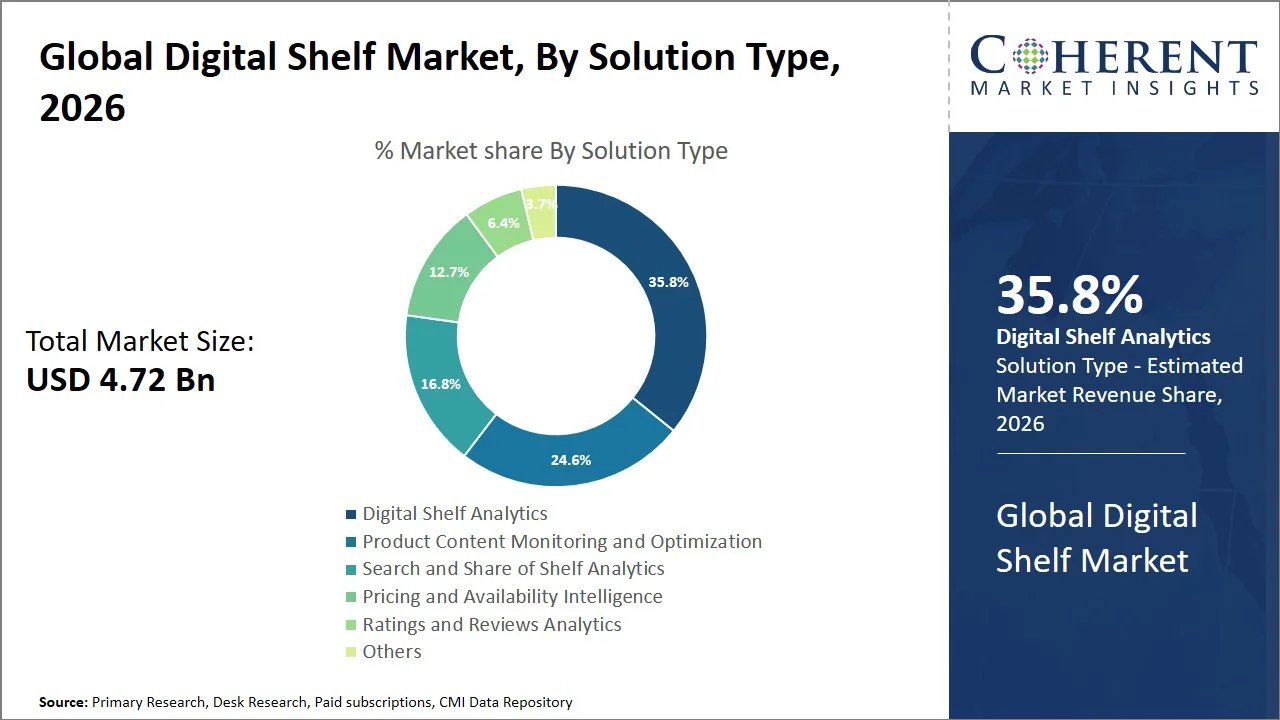
Why Does Digital Shelf Analytics Dominate the Global Digital Shelf Market?
Digital Shelf Analytics is expected to lead the solution-type category with 35.8% of the global digital shelf market in 2026, as brands require continuous measurement of search position, content compliance, pricing, promotions, availability, ratings, and competitive shelf presence across online retailers. Its advantage is the ability to convert fragmented retailer-level signals into prioritized commercial actions rather than simply distributing product content. This is particularly valuable to consumer-goods, beauty, electronics, and grocery companies managing fast-changing assortments and retail-media expenditure. Providers benefit from recurring analytics demand, while brand teams gain a common performance layer across sales, e-commerce, category, and media functions. In December 2024, NielsenIQ and Skai announced a global alliance integrating NIQ Digital Shelf insights covering product content, inventory, pricing, and promotions into Skai’s retail-media platform, demonstrating the increasing operational use of shelf intelligence in commercial decision-making.
- Current Industry Events of 2026
- Market Size Estimation
- Regional Breakdown
- Competitive Landscape
- Customer Intelligence
- Segmental Analysis
- Pricing Analysis
- Key Market Drivers, Challenges & Future Trends
- Customized Insights Section
Why Does Cloud-Based Represent the Largest Deployment Type in the Global Digital Shelf Market?
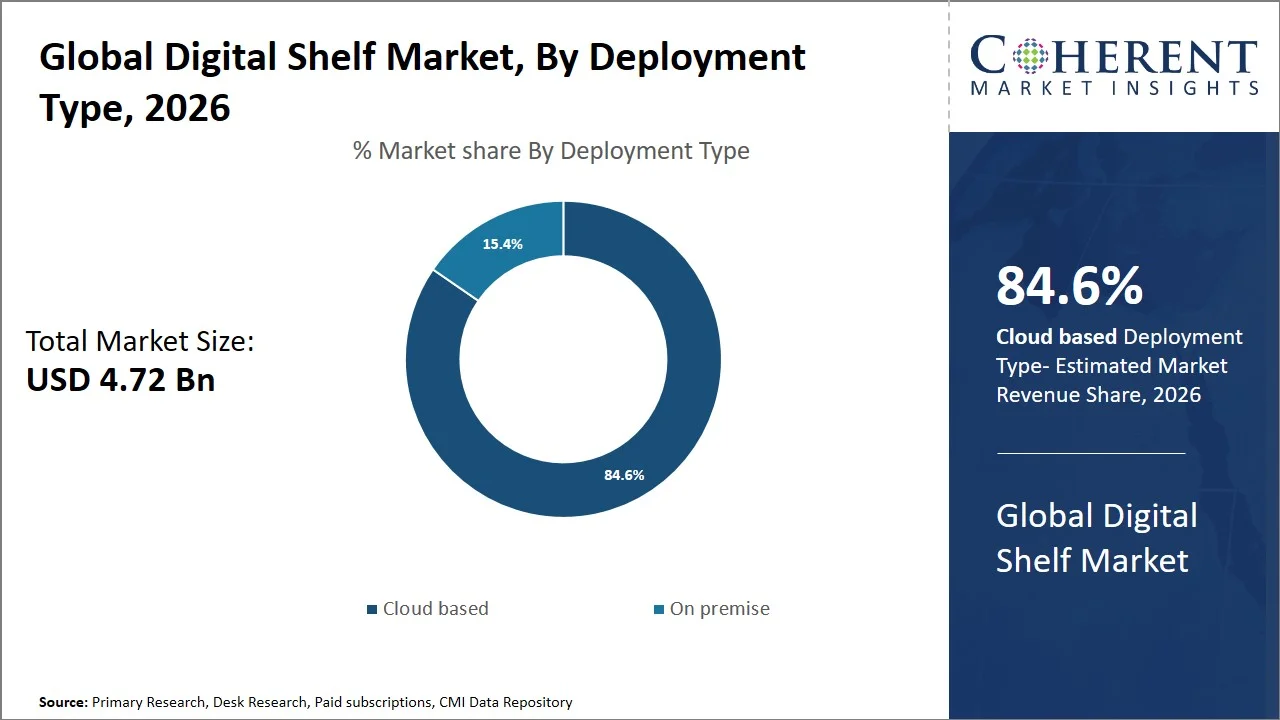
Cloud-based deployment is expected to account for 84.6% of the global digital shelf market in 2026 because digital shelf operations require centralized access to rapidly changing product and retailer data across markets, teams, and commerce channels. SaaS delivery allows providers to update retailer connectors, analytical models, product taxonomies, and workflow capabilities without customers maintaining separate infrastructure at each location. This architecture is particularly suited to brands expanding assortments internationally, where marketing, e-commerce, regulatory, and product-data teams need simultaneous access to one operating environment. Cloud deployment also supports API connectivity with PIM, DAM, marketplaces, commerce platforms, and downstream activation tools, reducing implementation friction as channel requirements change. In July 2025, Akeneo introduced its Summer 2025 Product Cloud release with an AI Data Architect Agent and PX Insights capabilities designed to continuously organize and optimize product information using commerce signals, illustrating continued investment in cloud-centered product-experience infrastructure.
Why Do Large Enterprises Dominate the Enterprise-Size Category of the Global Digital Shelf Market?
Large enterprises are expected to represent 68.4% of the global digital shelf market in 2026 because their digital shelf requirements are structurally more complex than those of smaller organizations. Global manufacturers and consumer brands manage thousands of SKUs, regional variants, multilingual content, multiple retailers, marketplace sellers, promotional cycles, and country-specific product attributes simultaneously. This scale creates stronger demand for enterprise-grade monitoring, automated syndication, governance, competitor tracking, and centralized workflow management. Large organizations can also integrate digital shelf intelligence with PIM, ERP, retail-media, pricing, and business-intelligence systems, allowing shelf performance to influence broader commercial decisions. Consequently, vendors can capture larger subscription values and deeper integration engagements from enterprise customers. In May 2025, Inriver announced a strategic partnership with ChannelEngine combining its product-information and syndication capabilities with marketplace distribution across more than 950 global marketplaces, directly addressing the multi-channel scale required by complex enterprise commerce operations.
Current Events and their Impact
Current Event | Description and Its Impact |
August 2024 – U.S. FTC Final Rule Banning Fake Reviews and Testimonials |
|
April 2025 – UK Digital Markets, Competition and Consumers Act Consumer Rules Take Effect |
|
Global Digital Shelf Market Dynamics
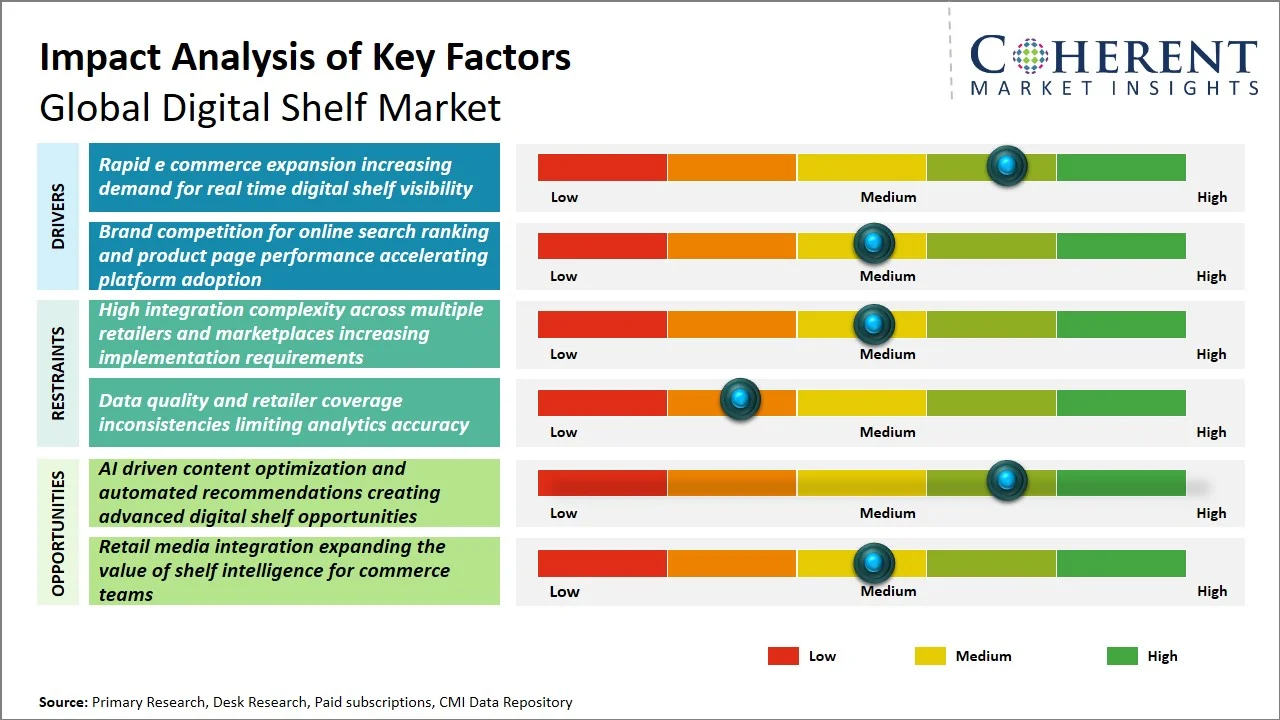
Market Drivers
- Rapid e commerce expansion increasing demand for real time digital shelf visibility: Digital commerce now spans retailer websites, marketplaces, social storefronts, quick-commerce platforms, and AI-assisted shopping, creating a larger and more dynamic digital shelf. Each additional channel increases SKU, pricing, availability, promotion, image, and content-compliance requirements, making periodic manual audits insufficient. Real-time digital shelf platforms help brand, e-commerce, category, and revenue teams identify out-of-stock exposure, content mismatches, listing suppression, and competitive price changes before they affect conversion. Consumer brands, retailers, marketplace sellers, and software vendors therefore benefit from expanding digital commerce channels. In July 2026, Meta launched the Seller app for Facebook Marketplace, providing sellers with AI-powered listing creation, inventory management, a unified buyer inbox, and performance insights. Meta also reported that around 430 million items are listed on Marketplace each month globally, illustrating the expanding volume and complexity of online product listings that increases the need for continuous digital shelf visibility and management.
- Brand competition for online search ranking and product page performance accelerating platform adoption: Online product visibility increasingly depends on search relevance, share of voice, product-page quality, rich attributes, reviews, and the balance between organic and paid placement. This increases demand for platforms that monitor keyword rankings, content completeness, competitor assortment, ratings, imagery, and conversion-oriented attributes. Digital shelf data helps brand and retail-media teams identify whether weak performance results from limited traffic, poor content, inventory gaps, or low search visibility, enabling faster corrective action. The commercial value is especially high in crowded categories where visibility losses can quickly shift shoppers toward competitors. In May 2026, Google announced new Merchant Center AI performance insights for comparing brand share of voice on AI surfaces, alongside conversational product attributes intended to improve discovery in AI-led shopping journeys.
Emerging Market Trends
- Machine-Readable Merchandising for Agentic Product Discovery: Digital shelf optimization is moving beyond conventional retailer SEO toward machine-readable merchandising, where product data must also be understood by conversational search systems and shopping agents. Brands increasingly need structured attributes, use-case information, compatibility details, benefit claims, and contextual product relationships rather than relying only on titles, keywords, and images. This is shifting product information management from simple content storage toward discoverability engineering. PXM providers, feed-management specialists, and digital shelf analytics vendors are positioned to benefit, while brands with fragmented taxonomies or inconsistent product attributes may lose visibility. Over the forecast period, competitive advantage will increasingly depend on how efficiently product data can be enriched, validated, and adapted for both shoppers and machine-mediated recommendation environments.
- Closed-Loop Convergence of Shelf Signals and Commerce Execution: Digital shelf intelligence is increasingly connecting with retail media, pricing, inventory, and sales execution rather than operating as a standalone analytics function. The focus is shifting from simply identifying a shelf issue to understanding its commercial impact and triggering corrective action. Search visibility declines can influence media allocation, availability gaps can suppress advertising, and content deficiencies can initiate enrichment workflows. This changes buyer expectations, as brands increasingly evaluate platforms on actionability, workflow integration, and commercial impact rather than monitoring breadth alone. Integrated commerce platforms should benefit, while standalone tools that mainly generate alerts may face greater pricing pressure. Over the forecast period, the market is likely to favor systems that connect observation, diagnosis, prioritization, and execution within a unified operating environment.
Regional Insights
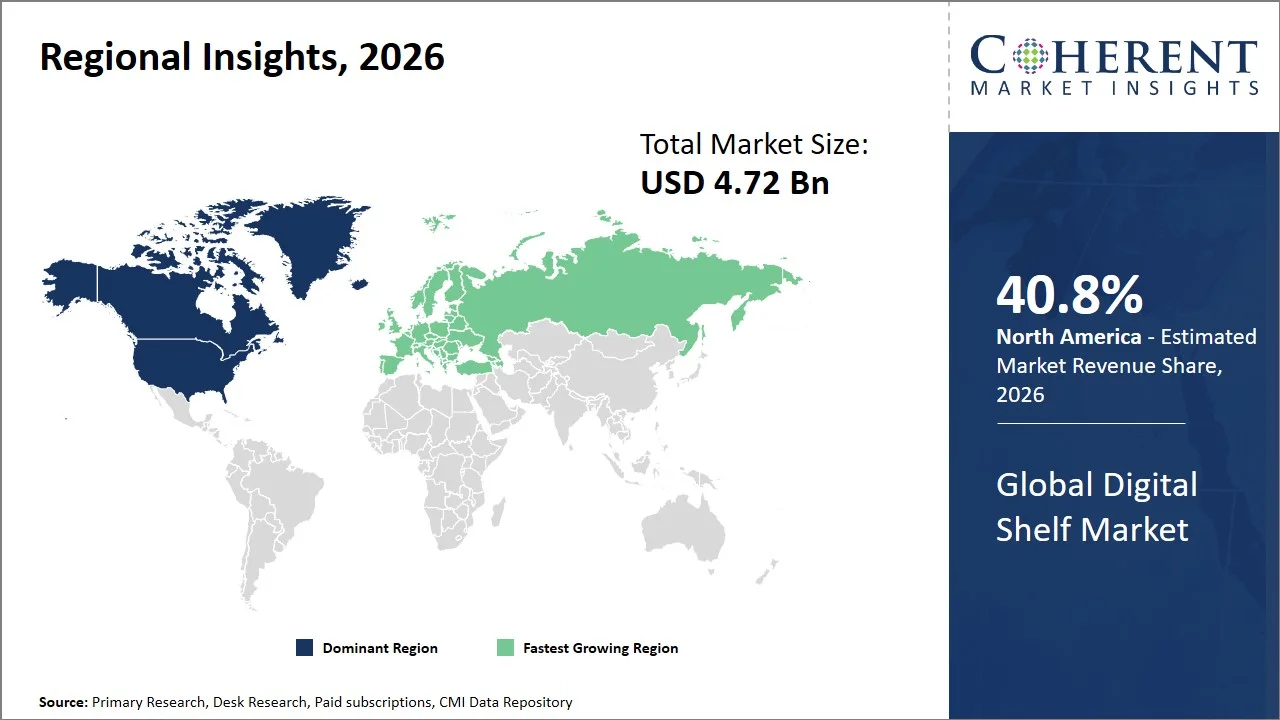
Why Does North America Dominate the Global Digital Shelf Market?
North America leads the digital shelf market with expected market 40.8% share in 2026 because brand manufacturers, retailers, and marketplace sellers operate in one of the world’s most data-intensive omnichannel commerce environments. Large assortments across marketplaces, mass retail, grocery, pharmacy, and direct-to-consumer channels create continuous demand for automated monitoring of product content, search visibility, pricing, stock status, ratings, and competitive share of shelf. The region also has a deep concentration of digital commerce software vendors, retail-media networks, cloud infrastructure, and enterprise consumer-goods companies, shortening adoption cycles for advanced analytics and AI-enabled optimization. Retailers are increasingly connecting catalog quality with advertising efficiency and conversion, making digital shelf intelligence part of commercial execution. In March 2026, Amazon introduced an AI-native Seller Central workspace enabling sellers to visualize performance data, explore competitive insights, assess inventory, and take recommended growth actions.
Why Is Europe Emerging as the Fastest-Growing Region in the Global Digital Shelf Market?
Europe is emerging as the fastest-growing digital shelf region with expected market share 27.6% in 2026 as brands face a complex combination of multilingual commerce, cross-border marketplaces, sustainability disclosure, and product-information compliance. Retailers and manufacturers increasingly require centralized systems that can syndicate accurate attributes, images, claims, availability, and channel-specific content across national storefronts while maintaining data governance. Growth is further supported by retail-media and marketplace expansion, where product-page quality and search positioning influence digital discoverability. Europe’s regulatory direction is creating an additional requirement for structured, verifiable product information, strengthening investment in product-information and digital shelf infrastructure. In July 2026, the European Commission made the Digital Product Passport Registry operational, together with its supporting framework, moving standardized digital product information closer to practical implementation for businesses placing applicable products on the EU market. This strengthens the business case for reliable, centrally managed product data.
Global Digital Shelf Market Outlook for Key Countries
Why Is the U.S. a Key Market for the Digital Shelf Market?
The U.S. is a key digital shelf market because online retail competition is increasingly determined at the product-detail-page, search, retail-media, and marketplace level. Consumer brands must manage extensive SKU portfolios across Amazon, Walmart, retailer websites, grocery platforms, and direct channels, creating strong demand for real-time monitoring of content accuracy, organic ranking, sponsored visibility, pricing, availability, reviews, and competitor activity. The country also concentrates major retailers, consumer-goods companies, advertising technology platforms, and SaaS providers, enabling digital shelf data to integrate closely with merchandising and retail-media workflows. A major growth catalyst is the transition from keyword-led shopping toward conversational and agentic discovery, which increases the importance of structured product data. In October 2025, Walmart announced its OpenAI partnership enabling shopping through ChatGPT with Instant Checkout while also highlighting AI-based enhancement of its product catalog.
Why Is India Important in the Global Digital Shelf Market?
India is becoming increasingly important to the digital shelf market as digital commerce expands beyond large marketplaces into interoperable buyer and seller networks, quick-commerce platforms, and regional-language shopping journeys. Brands and sellers must maintain accurate catalogs, pricing, availability, images, and product attributes across a fragmented channel landscape where assortment changes rapidly and visibility can vary by city or buyer application. This creates demand for scalable content syndication, marketplace monitoring, search optimization, and availability intelligence, particularly across consumer goods, food, beauty, electronics, and local retail. The large base of smaller sellers also increases the need for automated tools that reduce catalog-creation and digital-merchandising costs. In June 2026, Indian government reporting showed ONDC had more than 200 million buyers, 500,000 sellers, presence across 1,000 cities, and nearly 9 million monthly transactions, substantially expanding digitally discoverable product catalogs.
Why Does China Support Growth in the Global Digital Shelf Market?
China supports digital shelf market growth through its enormous marketplace ecosystem, high-frequency online purchasing, content-led commerce, and rapid deployment of AI across merchant operations. Brands competing on major platforms must continually optimize product imagery, descriptions, promotional content, pricing, inventory signals, and search visibility because merchandising cycles are short and campaign intensity is high. Large SKU volumes and frequent promotional events increase the value of automated content generation, assortment monitoring, competitive intelligence, and demand-linked availability analytics. Domestic platforms are also embedding AI directly into seller workflows, raising the performance benchmark for digital shelf execution. In January 2025, JD.com reported that its proprietary Jingdiandian AIGC platform was being used more than 10 million times per day by over 350,000 merchants to generate product images, operational copy, short videos, and other commerce materials, illustrating the scale at which AI-enabled product-content operations are being adopted.
Why Is Germany a Strategic Country in the Digital Shelf Market?
Germany is a strategic digital shelf market because its export-oriented brands and retailers must manage product information across domestic e-commerce, European marketplaces, and multiple language and regulatory environments. German companies place strong emphasis on structured product data, technical accuracy, traceability, and compliance, closely aligning with digital shelf platforms that govern attributes, content quality, channel syndication, and discoverability. The country’s mature retail and industrial base also broaden demand beyond consumer goods into electronics, home products, manufacturing-linked catalogs, and B2B commerce. As AI search becomes another route to product discovery, Germany-based technology providers are extending shelf measurement beyond conventional retailer searches. In July 2026, Berlin-headquartered Productsup introduced AI Visibility, enabling brands to measure product and brand discoverability across ChatGPT, Gemini, Google AI Mode, and Perplexity and connect those insights with product-data optimization.
Why Is Brazil an Important Growth Market for the Digital Shelf Market?
Brazil is an important growth market for digital shelf solutions because it combines a large consumer base with expanding marketplace commerce, retail media, digital payments, and cross-border assortment. Brands selling through major marketplaces and omnichannel retailers must manage product content, promotional pricing, stock availability, reviews, and sponsored visibility across a highly competitive environment. Brazil’s geographic scale and fulfillment complexity make availability intelligence particularly valuable, while mobile-led commerce increases the importance of concise, accurate, conversion-oriented product pages. As marketplace volumes rise, suppliers need stronger tools to identify content gaps, monitor assortment performance, and prioritize investment at SKU level. In August 2026, Mercado Libre reported that Brazil led its second-quarter commerce growth, with FX-neutral GMV increasing 39% year over year and items sold rising 56%. The company also reported wider adoption of AI-based marketplace search and advertising tools, strengthening the relevance of digital shelf optimization.
Technology Adoption Landscape in the Global Digital Shelf Market
Technology | Adoption Level | Key Application Area | Business Impact |
API-Based Product Content Syndication | High | Publishing titles, descriptions, specifications, media, and attributes across retailer and marketplace endpoints | Reduces repetitive manual uploads, accelerates content correction, and improves consistency across channels. |
Automated Retailer Crawling and SKU Entity Matching | High | Monitoring product pages, seller offers, assortment, availability, and listing changes | Creates a comparable cross-retailer shelf view and identifies missing, duplicate, or incorrectly matched listings. |
Search-Rank and Share-of-Shelf Analytics | High | Tracking keyword visibility, category placement, organic ranking, and sponsored presence | Helps commercial teams prioritize content and media actions around measurable discoverability gaps. |
Computer-Vision Content Compliance | Medium | Checking packshots, image quality, brand assets, gallery composition, and retailer-specific visual standards | Scales visual quality assurance and reduces manual review across large product portfolios. |
Guardrailed Generative Product-Content Optimization | Medium | Creating and localizing product descriptions, bullets, attribute enrichment, and channel-specific copy | Shortens content-production cycles while enabling governance around product facts, claims, and brand standards. |
LLM Visibility Monitoring and Structured-Attribute Optimization | Medium | Evaluating product discoverability across conversational and agent-mediated shopping environments | Extends digital shelf measurement beyond conventional retailer search and improves machine-readable product representation. |
How Is B2B Product-Data Intelligence Creating New Growth Opportunities in the Global Digital Shelf Market?
A major underdeveloped opportunity is extending digital shelf intelligence into B2B and industrial e-commerce. Manufacturers and distributors of electrical components, industrial supplies, building products, laboratory equipment, and replacement parts manage complex catalogs where technical attributes, compatibility, certifications, and pack configurations directly influence product discovery and selection. Providers can capture this opportunity through B2B-specific attribute models, distributor monitoring, technical-content validation, and analytics for incomplete or duplicate listings. Adoption will require strong integration with ERP, PIM, distributor portals, and industry classification systems, supported by accurate SKU matching. Specialists with strong domain taxonomies may gain an early advantage, while established platforms can scale by adapting existing syndication and monitoring capabilities. The strongest solutions will connect catalog accuracy with distributor visibility, sales enablement, and channel productivity.
Market Players, Key Development, and Competitive Landscape
Key Developments
- In April 2026, Syndigo announced a partnership with DetailPage to connect shopper-driven analytics with product-content workflows and improve conversion, search relevance, and visibility in AI-enhanced retailer search environments. This is important for the global digital shelf market because it strengthens the link between observed shopper behavior and executable product-page changes, supporting a more outcome-oriented approach to digital shelf optimization rather than treating content compliance as the final objective.
- In October 2025, Salsify launched new AI capabilities including Angie and the Salsify Intelligence Suite, embedding AI-powered automation within product experience management workflows. This is important for the global digital shelf market because it moves AI from standalone content-generation tasks into operational product-data processes, enabling brands to scale enrichment, content distribution, and channel management while preparing product information for emerging agentic-commerce environments.
- In May 2025, CommerceIQ unveiled Ally AI, a suite of role-specific agentic AI teammates designed around e-commerce sales, retail media, category management, and digital shelf workflows. This is important for the global digital shelf market because it demonstrates a shift from dashboards that primarily surface observations toward systems that diagnose performance gaps, recommend actions, and support commerce teams within role-specific operating workflows.
Competitive Landscape
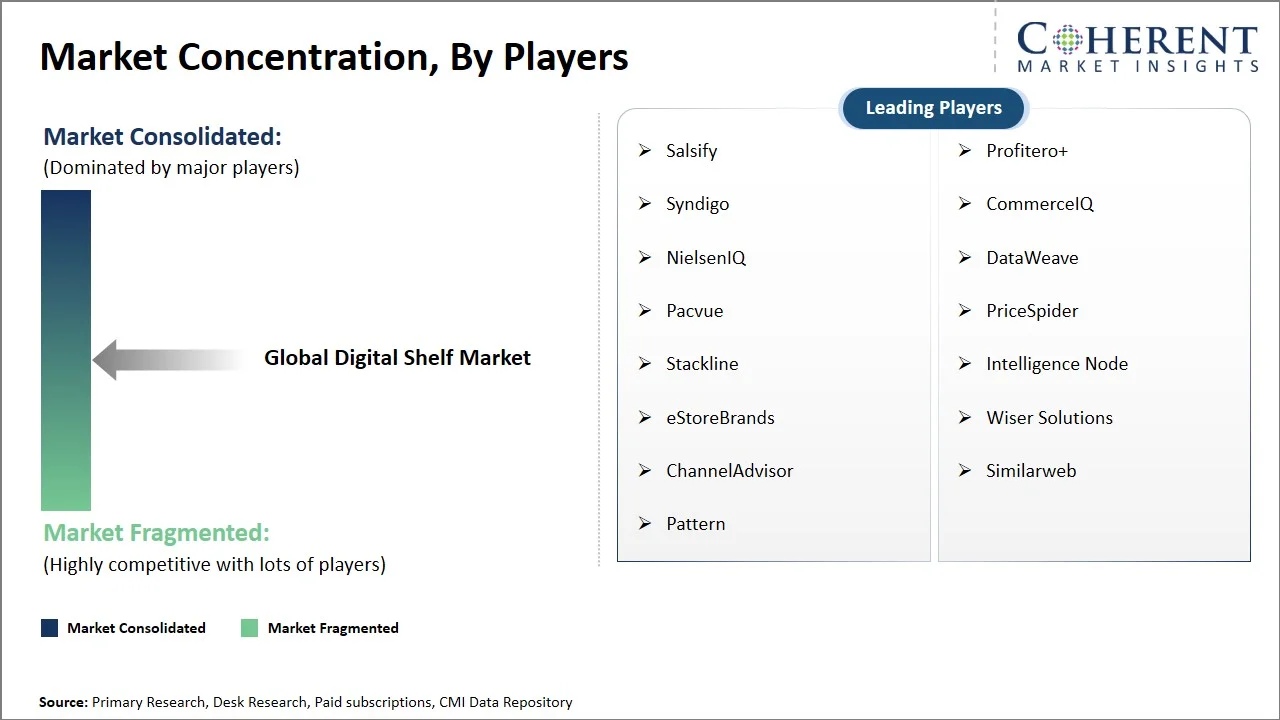
The global digital shelf market is moderately fragmented, with competition spanning dedicated digital shelf analytics specialists, product experience and PIM suites, commerce-intelligence platforms, pricing and assortment monitoring vendors, and broader retail-execution software providers. Enterprise buyers increasingly compare platforms on channel coverage, data freshness, SKU-matching accuracy, integration depth, workflow usability, and their ability to connect observed shelf conditions with commercial decisions. Specialist vendors can differentiate through category-specific analytics and high-frequency monitoring, while broader platforms benefit from integrated product-data governance and enterprise workflows. Pricing remains relevant, but defensible positioning increasingly depends on reliable data collection, scalability, configurable analytics, and support for complex multi-retailer operations.
Key focus areas include
- Retailer and marketplace coverage: Breadth of supported channels and ability to maintain reliable monitoring as retailer environments change.
- SKU and entity-matching accuracy: Correct identification of product variants, bundles, sellers, pack sizes, and comparable competitor products.
- Remediation workflow capability: Ability to move from an identified shelf issue to content correction, escalation, or commercial action.
- Enterprise integration depth: Connectivity with PIM, ERP, BI, retail-media, pricing, inventory, and broader commerce systems.
- Data governance and auditability: Controls around product claims, content changes, seller information, review integrity, and compliance-sensitive attributes.
- Vertical specialization: Category-specific taxonomies, metrics, benchmarks, and onboarding capabilities that reduce implementation complexity.
- Commercial ROI visibility: Pricing architecture and measurement frameworks that demonstrate how shelf improvements influence merchandising and commercial performance.
Market Report Scope
Digital Shelf Market Report Coverage
| Report Coverage | Details | ||
|---|---|---|---|
| Base Year: | 2025 | Market Size in 2026: | USD 4.72 Bn |
| Historical Data for: | 2020 To 2024 | Forecast Period: | 2026 To 2033 |
| Forecast Period 2026 to 2033 CAGR: | 14.7% | 2033 Value Projection: | USD 12.32 Bn |
| Geographies covered: |
| ||
| Segments covered: |
| ||
| Companies covered: | Salsify, Profitero+, Syndigo, CommerceIQ, NielsenIQ, DataWeave, Pacvue, PriceSpider, Stackline, Intelligence Node, eStoreBrands, Wiser Solutions, ChannelAdvisor, Similarweb, Pattern | ||
| Growth Drivers: |
| ||
| Restraints & Challenges: |
| ||
Analyst Opinion (Expert Opinion)
- The market is likely to shift from standalone digital shelf software toward embedded intelligence and managed services integrated with commerce, category, revenue-management, and product-data workflows. Competitive advantage will increasingly depend on workflow integration, channel coverage, and operational support rather than dashboard functionality alone.
- Greater retailer control over product, pricing, search, and recommendation data could disrupt platforms that rely heavily on public-page crawling. Direct integrations, licensed data access, strong entity resolution, and the ability to measure personalized shopping environments are likely to become more important competitive capabilities.
- Market participants should prioritize SKU resolution, structured product data, reliable channel connectors, governance controls, and outcome attribution. Investment should focus on complex multi-channel categories and retailer integrations, while avoiding overreliance on generic content generation or basic monitoring features that are becoming easier to commoditize.
Speak to the analyst
Want personalized insights?
Take the findings above to one of our principal consultants, or have the report rebuilt around the segments, geographies and competitors you actually track.
Market Segmentation
- Solution Type Insights (Revenue, USD Bn, 2021 - 2033)
- Digital Shelf Analytics
- Product Content Monitoring and Optimization
- Search and Share of Shelf Analytics
- Pricing and Availability Intelligence
- Ratings and Reviews Analytics
- Others
- Deployment Type Insights (Revenue, USD Bn, 2021 - 2033)
- Cloud based
- On premise
- Organization Size Insights (Revenue, USD Bn, 2021 - 2033)
- Large Enterprises
- Small and Medium Enterprises
- End User Insights (Revenue, USD Bn, 2021 - 2033)
- Consumer Packaged Goods
- Retail and E commerce
- Food and Beverage
- Beauty and Personal Care
- Consumer Electronics
- Healthcare and Pharmaceuticals
- Others
- Distribution Channel Insights (Revenue, USD Bn, 2021 - 2033)
- Direct Sales
- Indirect Sales
- Regional Insights (Revenue, USD Bn, 2021 - 2033)
- North America
- U.S.
- Canada
- Latin America
- Brazil
- Argentina
- Mexico
- Rest of Latin America
- Europe
- Germany
- U.K.
- Spain
- France
- Italy
- Russia
- Rest of Europe
- Asia Pacific
- China
- India
- Japan
- Australia
- South Korea
- ASEAN
- Rest of Asia Pacific
- Middle East
- GCC Countries
- Israel
- Rest of Middle East
- Africa
- South Africa
- North Africa
- Central Africa
- North America
- Key Players Insights
- Salsify
- Profitero+
- Syndigo
- CommerceIQ
- NielsenIQ
- DataWeave
- Pacvue
- PriceSpider
- Stackline
- Intelligence Node
- eStoreBrands
- Wiser Solutions
- ChannelAdvisor
- Similarweb
- Pattern
Sources
Primary Research Interviews
- Digital shelf software providers, PIM/PXM vendors, e-commerce analytics companies, and retail intelligence platforms
- Brand manufacturers, marketplace sellers, retailers, distributors, and omnichannel commerce operators
- E-commerce, digital marketing, category management, retail media, pricing, product-content, merchandising, and IT executives
Stakeholders
- Digital shelf analytics, product-content syndication, pricing intelligence, and search-visibility solution providers
- Consumer brands, retailers, marketplaces, distributors, and e-commerce agencies
- PIM, DAM, ERP, CRM, retail-media, marketplace-management, and commerce-platform vendors
- Data providers, system integrators, digital agencies, and cloud-service providers
End-use Sectors
- Retail & Consumer Goods
- Food & Beverage
- Healthcare & Life Sciences
- Automotive
- Consumer Electronics, Beauty & Personal Care, Home & Household, and other omnichannel industries
Regulatory and Government Bodies
- U.S. Federal Trade Commission (FTC) and Department of Commerce
- European Commission and national consumer-protection/data-protection authorities
- UK Competition and Markets Authority (CMA) and Information Commissioner’s Office
- Competition and digital-commerce authorities across China, India, Canada, Australia, and other major markets
Databases
- Retailer and marketplace product-page, pricing, availability, ratings, review, and assortment databases
- E-commerce traffic, search-ranking, share-of-shelf, retail-media, and promotional-monitoring databases
- Company annual reports, investor presentations, product documentation, and technology partner databases
- Government e-commerce, retail-sales, digital-economy, and consumer-spending databases
- GS1 product-information and identification resources
Magazines and Journals
- Retail Dive
- Modern Retail
- Digital Commerce 360
- Retail TouchPoints
- InternetRetailing
- Adweek
- Journal of Retailing
- International Journal of Retail & Distribution Management
Associations
- National Retail Federation (NRF)
- GS1
- Interactive Advertising Bureau (IAB)
- World Federation of Advertisers (WFA)
- Ecommerce Europe
- Retail Industry Leaders Association (RILA)
- National and regional e-commerce and retail trade associations
Public Domain Sources
- Retailer and marketplace product-detail pages, search results, category listings, seller portals, and promotional pages
- Product titles, descriptions, images, attributes, pricing, availability, ratings, reviews, and sponsored placements
- Vendor product documentation, API capabilities, solution releases, integrations, partnerships, and customer cases
- Retail-media networks, marketplace policies, seller requirements, and product-content guidelines
- E-commerce adoption, online retail activity, digital advertising, consumer-shopping, and marketplace statistics
Key Standards and Regulations
- EU General Data Protection Regulation (GDPR)
- EU Digital Services Act (DSA) and Digital Markets Act (DMA)
- EU AI Act, where applicable to AI-enabled commerce and product-content applications
- U.S. FTC rules and guidance covering reviews, endorsements, advertising, and deceptive commercial practices
- UK Digital Markets, Competition and Consumers Act
- GS1 Standards and GS1 Digital Link for standardized product identification and structured product information
- Country-specific consumer-protection, privacy, online marketplace, advertising, product-information, and digital-commerce requirements
Proprietary Elements
- CMI Data Analytics Tool, Proprietary CMI Existing Repository of information for last 10 years.
Get access to 250+ pages report
Every segment, forecast, competitor profile and data table behind the analysis above — available for instant download.
- ESOMAR Member
- ISO 9001:2015 Certified
- D-U-N-S Registered
- GDPR & CCPA Compliant
Missing comfort of reading report in your local language? Find your preferred language:
Transform your Strategy with Exclusive Trending Reports
Frequently Asked Questions
The CAGR of global digital shelf market is projected to be 14.7% from 2026 to 2033.
The global digital shelf market is estimated to be valued at USD 4.72 billion in 2026 and is expected to reach USD 12.32 billion by 2033
A digital shelf refers to how products are displayed, discovered, compared, and purchased across online retailers, marketplaces, brand websites, and other digital commerce channels. It includes product content, search visibility, pricing, availability, ratings, reviews, images, and promotional information.
Digital shelf analytics helps brands and retailers monitor product visibility, search rankings, content quality, pricing, availability, competitor activity, and customer reviews across digital commerce channels. These insights support faster merchandising decisions and improve online product performance.
AI-enabled product content optimization, automated SKU matching, search-rank analytics, product content syndication, computer-vision-based content monitoring, and integration with product information management and retail media platforms are shaping the global digital shelf market.
Digital shelf solutions are widely used across consumer packaged goods, food and beverages, beauty and personal care, consumer electronics, healthcare products, home and household goods, apparel, and other industries with significant online and omnichannel sales activity.
Rapid e commerce expansion increasing demand for real time digital shelf visibility and Brand competition for online search ranking and product page performance accelerating platform adoption are the major factors driving the growth of global digital shelf market.