

Global District Energy Services Market Size and Forecast – 2026 to 2033
According to Coherent Market Insights, the global district energy services market is estimated to be valued at USD 12.45 Bn in 2026 and is expected to reach USD 18.23 Bn by 2033, expanding at a compound annual growth rate (CAGR) of 5.6% from 2026 to 2033.
Key Takeaways of the District Energy Services Market
- District heating services segment is expected to capture 42.5% of the global district energy services market share in 2026.
- The fossil fuels (e.g., natural gas, oil, coal) segment is projected to hold 33.9% of the district energy services market share in 2026.
- Combined Heat and Power (CHP) segment is expected to account for 43.9% of the market share in 2026.
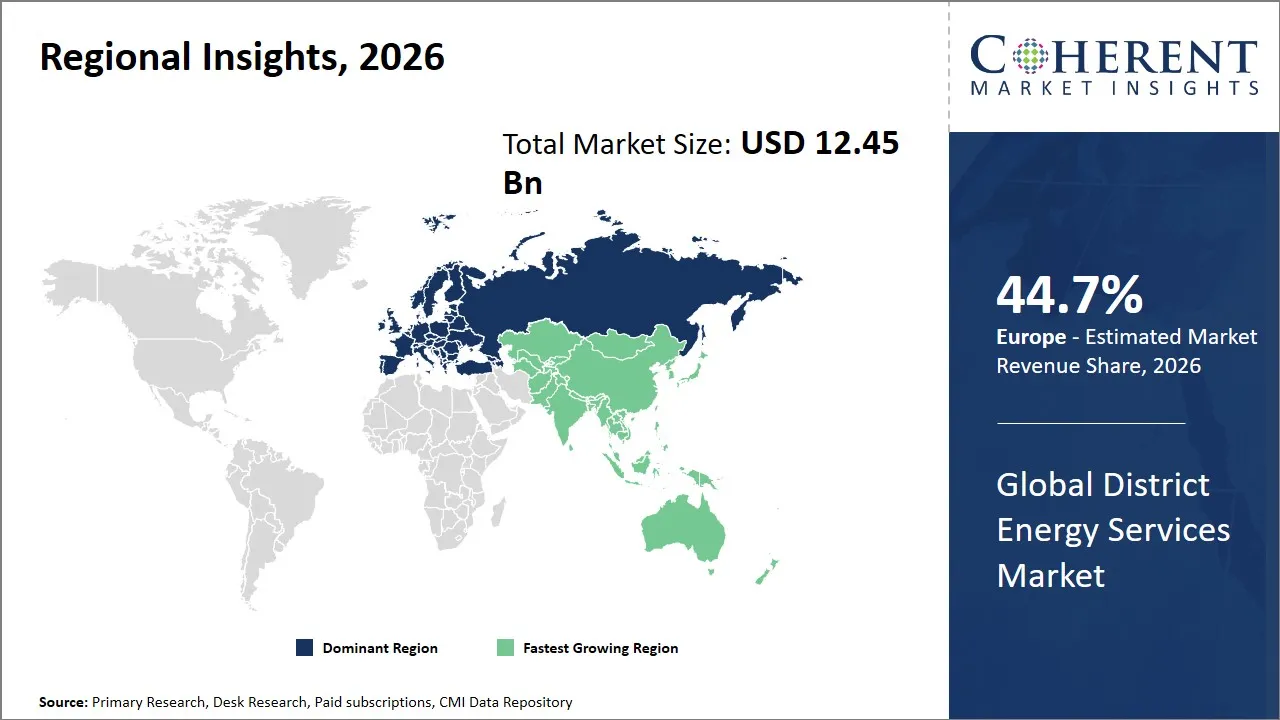
- Europe will dominate the district energy services market in 2026 with an estimated 44.7% share.
- Asia Pacific will hold 18.3% share in 2026 and record the fastest growth.
Market Overview
- A key market trend driving the district energy services market is the growing emphasis on carbon reduction and energy efficiency.
- Governments and private entities are increasingly adopting district energy systems to support climate goals and reduce greenhouse gas emissions.
- Technological advancements such as smart energy grids and integration with renewable energy sources are enhancing system performance, while urbanization and government incentives are accelerating market adoption, positioning district energy services as a pivotal solution for sustainable urban development.
Segmental Insights
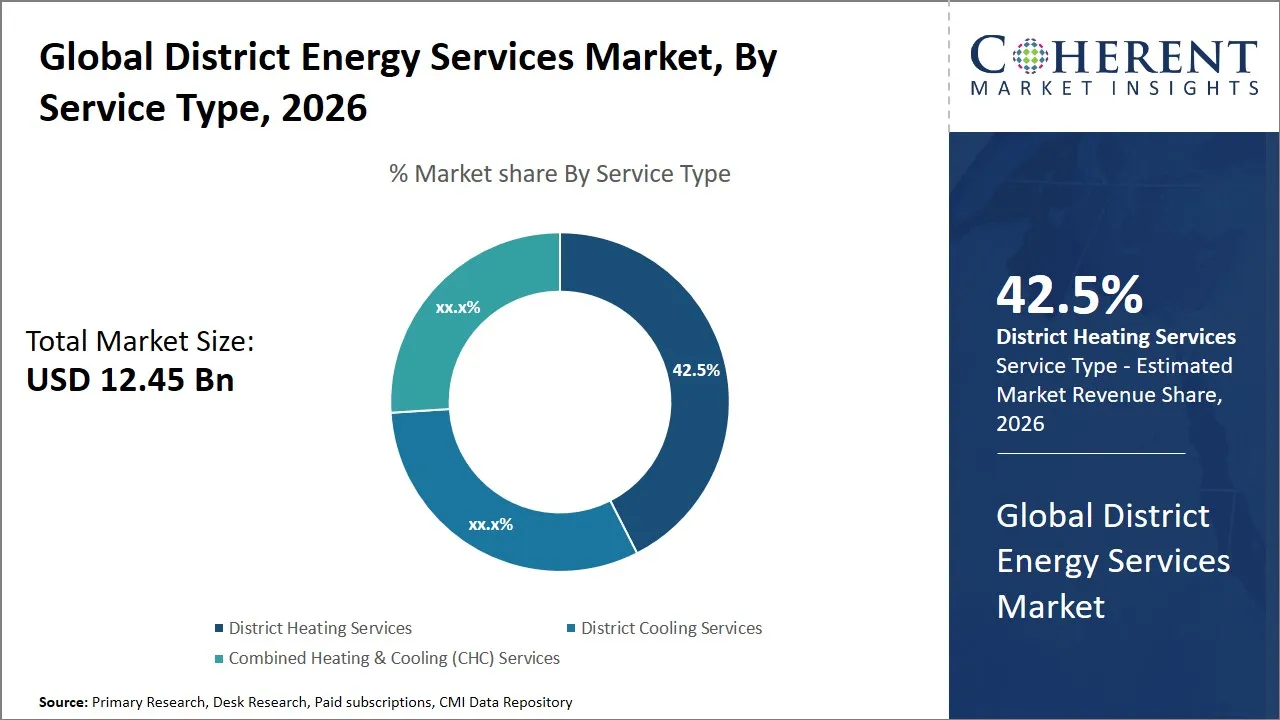
Why Does the District Heating Services Segment Dominate the District Energy Services Market in 2026?
The district heating services segment is projected to account for 42.5% of the global district energy services market in 2026, driven by rising demand for cost-efficient and reliable heating solutions in urban environments. District heating systems are an effective method of central heating and extracting the heat and spreading it to various buildings by a system of insulated pipes.
The efficiency of this model is that it automatically produces greater energy efficiency over that of individual heating units because it uses the maximum amount of fuel, minimizes the amount of heat lost through improper generation and distribution. Copenhagen has one of the most developed district heating networks in the world with more than 95 per cent of the city buildings being served by a centralized system that includes waste-to-energy plants, biomass, and industrial surplus heat.
- Current Industry Events of 2026
- Market Size Estimation
- Regional Breakdown
- Competitive Landscape
- Customer Intelligence
- Segmental Analysis
- Pricing Analysis
- Key Market Drivers, Challenges & Future Trends
- Customized Insights Section
Why Do Fossil Fuels (e.g., Natural Gas, Oil, Coal) Continue to Dominate the Global District Energy Services Market ?
Fossil fuels (e.g., natural gas, oil, coal) segment is estimated to exhibit 33.9% of the market share in 2026. This heavy dependency on the use of fossil fuels is attributable to the existing energy infrastructure, availability of fuel, and reliability in operations. Natural gas, especially, has gained popularity as a fuel choice because of its comparatively cleaner burning nature as compared to coal or oil and because of its presence in most areas. The established supply chains and wide distribution networks of fossil fuels render them easy to obtain sources of district energy systems that can be used to provide energy without any interruption in the different geographies.
Fossil-fueled district energy plants also may share flexibility in their load management, which allows them to rapidly change the amount of heat produced based on the changing demand trends. This flexibility is needed in weather conditions with changing heating requirements and big cities where dependability and responsiveness are paramount.
Combined Heat and Power (CHP) Dominates the Global District Energy Services Market
Combined Heat and Power (CHP) segment is projected to command 43.9% of the market share in 2026. The high adoption rate of CHP technology stems from its ability to simultaneously generate electricity and useful thermal energy from a single fuel source, thereby significantly improving overall energy efficiency. CHP systems use and capture the heat that would go to waste in traditional power generation and as a result achieve fuel efficiencies often in the 80s and this is directly applied through fuel saving and a saving in operating costs.
One of the greatest forces pushing the popularity of CHP technology in district energy services is the fact that the technology is beneficial to the environment. As the world worries more about greenhouse gas emission and air quality, CHP units are a good solution in achieving climate policies by reducing carbon footprints as compared to individual generation of heat and power. CHP systems are also flexible and can be combined with a wide range of fuels, such as natural gas and biomass, allowing the operators to customize a solution to meet both cost and sustainability goals.
Regional Insights
Europe District Energy Services Market Analysis and Trends
The Europe region is projected to lead the market with a 44.7% share in 2026, due to a highly developed market ecosystem with effective policies by the government to make the market environment sustainable and reduce carbon. District energy solutions have long been a significant focus in the European countries as they strive to achieve high climate goals as envisaged by frameworks like the European Green Deal. An established level of infrastructure development, high level of urbanization, and investments in the integration of renewable energy (biomass, geothermal, waste heat recovery, etc.) contribute to the advantageous position of the region.
Some countries such as Denmark and Germany have been at the forefront in terms of developing technologies in district heating and cooling, with the aid of strict regulations and financial incentives. The maturity in the industry is seen through the huge contributions that were made by the prominent companies like Veolia, Danfoss, and Siemens that came up with innovative energy-saving solutions and comprehensive service offerings in the continent. Closer coordination of the activities of state and commercial organizations, as well as inter-regional relations on the trade of energy of the district, contribute to the stable demand and innovation in the services of district energy.
Asia Pacific District Energy Services Market Analysis and Trends
The Asia Pacific region is expected to exhibit the fastest growth in the market contributing 18.3% share in 2026, due to increased urbanization, growing industrialization levels, and rising environmental consciousness. The increase in energy demand in overcrowded nations such as China, Japan, South Korea, and India is driving a centralized and efficient energy. The governments of the region are also becoming more favorable in terms of their policies, such as subsidization of sustainable infrastructure, clean energy objectives, and urban renewal projects, which focus on solutions of district heating and cooling.
The market ecosystem is quickly changing and being facilitated by increasing investments in smart city projects and decentralized clean energy projects. Other leading players in the industry like China Energy Engineering Corporation, MITSUBISHI HEAVY INDUSTRIES, LTD. and Toshiba have tremendously extended their presence due to implementation of state-of-the-art district energy solutions that meet the local demands. Trade relations with technology exchange and joint ventures between the domestic and foreign corporations are increasing the rate of market growth and technological incorporation.
Global District Energy Services Market Outlook for Key Countries
Denmark District Energy Services Market Trends
Denmark is a global leader in district energy services, supported by a long-standing district heating tradition and a strong regulatory framework. The country’s urban energy systems prioritize sustainability, with clear policy incentives that promote low-carbon and renewable heating solutions. Its national district heating system has a significant portion of urban population and incorporates renewable energy sources such as biomass and geothermal heat. Danfoss and HOFOR are companies that facilitate technological innovations and expansions of the systems making Denmark an example of what innovation and energy efficiency should be in district energy services.
Why is China Rapidly Expanding its District Energy Services Market?
The market of district energy services in China is growing at a very high rate given that the country’s government also incorporates district energy in its sustainable urban development and climate objectives. Due to the necessity to minimize air pollution in cities and enhance energy efficiency, modernization of district heating systems is taking place, and the focus is placed on the implementation of clean energy technologies. Large-scale conversion of coal-fired boilers serving district heating networks to gas-fired CHP/boilers, electric boilers, and heat pumps in cities across the Beijing–Tianjin–Hebei region to cut urban PM2.5 and SO₂.
Why is Germany a Front-Runner in the Global District Energy Services Market?
Germany continues to lead with its robust policy framework supporting the Energiewende (energy transition) and a strong industrial base that fosters innovation in district energy. The country emphasizes the integration of renewable energy sources in district heating and cooling, contributing to reduced greenhouse gas emissions. Siemens and Viessmann are among the prominent players enhancing system intelligence and efficiency. Germany’s well-developed regulatory landscape ensures steady investment and continuous improvement in district energy infrastructure.
Japan District Energy Services Market Trends
The market of district energy services in Japan is marked by the growing investments in energy efficiency and climate resiliency due to governmental initiatives in smart cities and sustainable urban development. District energy reforms since Fukushima have increased the uptake of more stable grid through the use of waste heat as a result of industrial processes. MITSUBISHI HEAVY INDUSTRIES, LTD. and Toshiba are the prime players and their interests are centered on innovation in the heat pump technologies and integrated energy systems which serve the urban and industrial applications.
U.S. District Energy Services Market Trends
The U.S. district energy services market is influenced by the increasing interest in the minimization of carbon emissions and redevelopment of deteriorated urban energy infrastructure. The incentives provided by the federal and the state government are aimed at encouraging renewable energy use in the integration of district energy networks in cities with high population density such as New York and Boston.
Firms like Veolia North America and Johnson Controls are important in offering turnkey solutions and service contracts, which maximize the use of energy and emissions. Cooperation among utilities, municipalities, and the personal sector triggers the development of the market and technology.
Urban Density vs. Network Viability Index
Dataset Component | What Is Measured | Why It Matters for the Market |
Urban Population Density (people/km²) | Concentration of residents and buildings within serviceable area | High density is the single biggest determinant of district energy economic viability |
Built-Up Floor Area Density (m²/km²) | Intensity of commercial, residential, and institutional buildings | Higher floor area means higher thermal demand per meter of pipe |
Thermal Demand Density | Heat + cooling load concentration | Below a threshold, networks fail to achieve cost recovery |
Fuel Flexibility & Transition Readiness Index
- The index of fuel flexibility and transition readiness assesses the level at which district energy systems are prepared to cease using fossil fuels without disturbing the assets or triggering a margin shock. It is the practical capacity of the current networks to alternate fuels via retrofit-ready CHP units, multi-fuel boilers, large heat pumps, thermal storage, and the incorporation of waste-heat instead of the theoretical decarbonization goals.
- High-readiness systems are usually located in the dense urban clusters with anchor loads, brief fuel switch schedules and affordable capital per MW, enabling a gradual replacement of gas by biomass and waste heat, or electrification or hydrogen-ready designs.
- Single-fuel lock-in, prolonged retrofit cycles, high risk of downtime, and directness to the carbon pricing are all vulnerabilities that add to the susceptibility of low-readiness systems to stricter regulations and public procurement transitioning to net-zero requirements.
Market Players, Key Development, and Competitive Intelligence
Key Developments
- In June 2025, Caterpillar Inc. announced the results of a fuel flexibility project with District Energy St. Paul that successfully demonstrated a 2.0 MW combined heat and power (CHP) system with a Cat G3516 gas generator set using 100% hydrogen fuel. The CHP system demonstrated maximum efficiency consistent with high-performance generator sets operating entirely on natural gas.
- In March 2025, Adani Energy Solutions Ltd (AESL) expanded its district cooling services (DCS) business. The company has been developing this segment for the past few years and is now setting up large-scale cooling facilities across industrial, commercial, residential, and mixed-use projects.
Top Strategies Followed by Global District Energy Services Market Players
Player Type | Strategic Focus | Example |
Established Market Leaders | Heavy investment in R&D and innovation | ENGIE operates large-scale district heating and cooling systems in Europe and Asia, with renewables, waste heat recovery, and digital optimization, to achieve net-zero requirements. |
Mid-Level Players | Cost-effective solutions with balanced quality | Keppel Infrastructure integrates both district energy and utilities with urban infrastructure developments, lowering the cost per MW of integration. |
Small-Scale Players | Niche specialization & innovative variants | Danfoss is a pioneer in technological depth in making advanced heat exchangers, controls, and digital district energy platforms it is a backbone supplier to utilities around the globe. |
Market Report Scope
District Energy Services Market Report Coverage
| Report Coverage | Details | ||
|---|---|---|---|
| Base Year: | 2025 | Market Size in 2026: | USD 12.45 Bn |
| Historical Data for: | 2020 To 2024 | Forecast Period: | 2026 To 2033 |
| Forecast Period 2026 to 2033 CAGR: | 5.6% | 2033 Value Projection: | USD 18.23 Bn |
| Geographies covered: |
| ||
| Segments covered: |
| ||
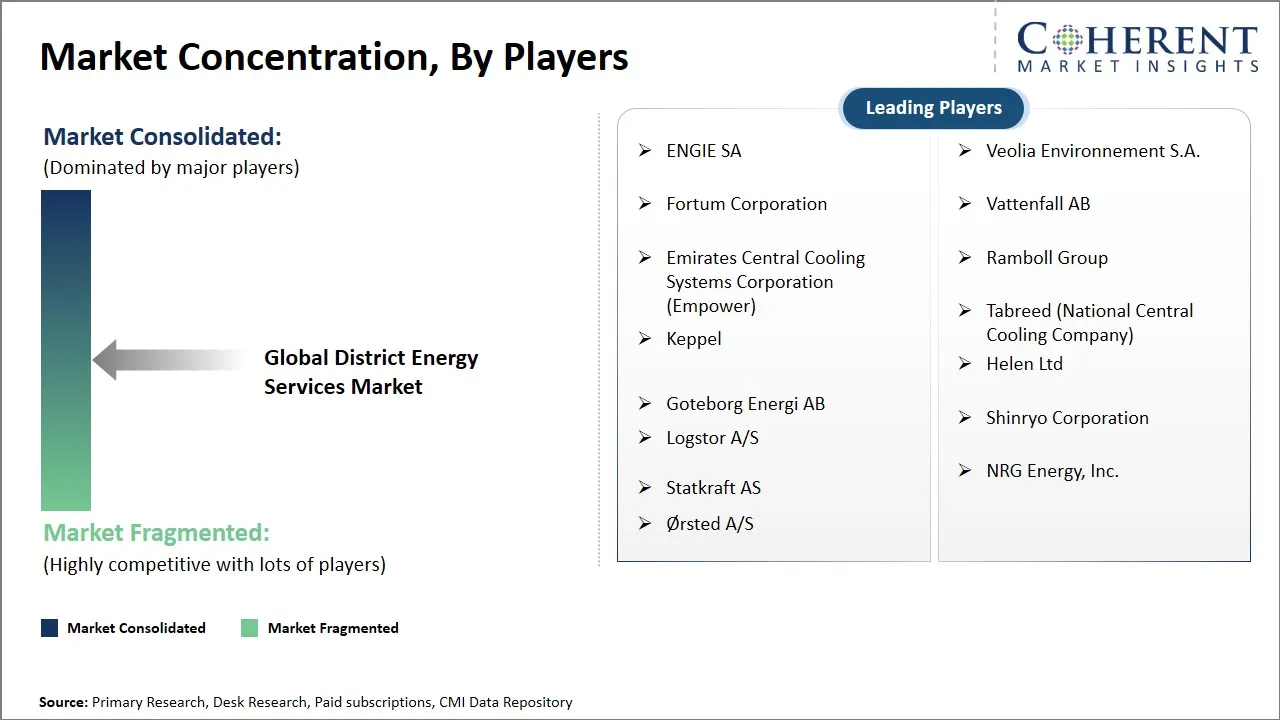
| Companies covered: | ENGIE SA, Veolia Environnement S.A., Fortum Corporation, Vattenfall AB, Emirates Central Cooling Systems Corporation (Empower), Ramboll Group, Keppel, Tabreed (National Central Cooling Company), Goteborg Energi AB, Helen Ltd, Logstor A/S, Shinryo Corporation, Statkraft AS, NRG Energy, Inc., and Ørsted A/S | ||
| Growth Drivers: |
| ||
| Restraints & Challenges: |
| ||
District Energy Services Market Dynamics
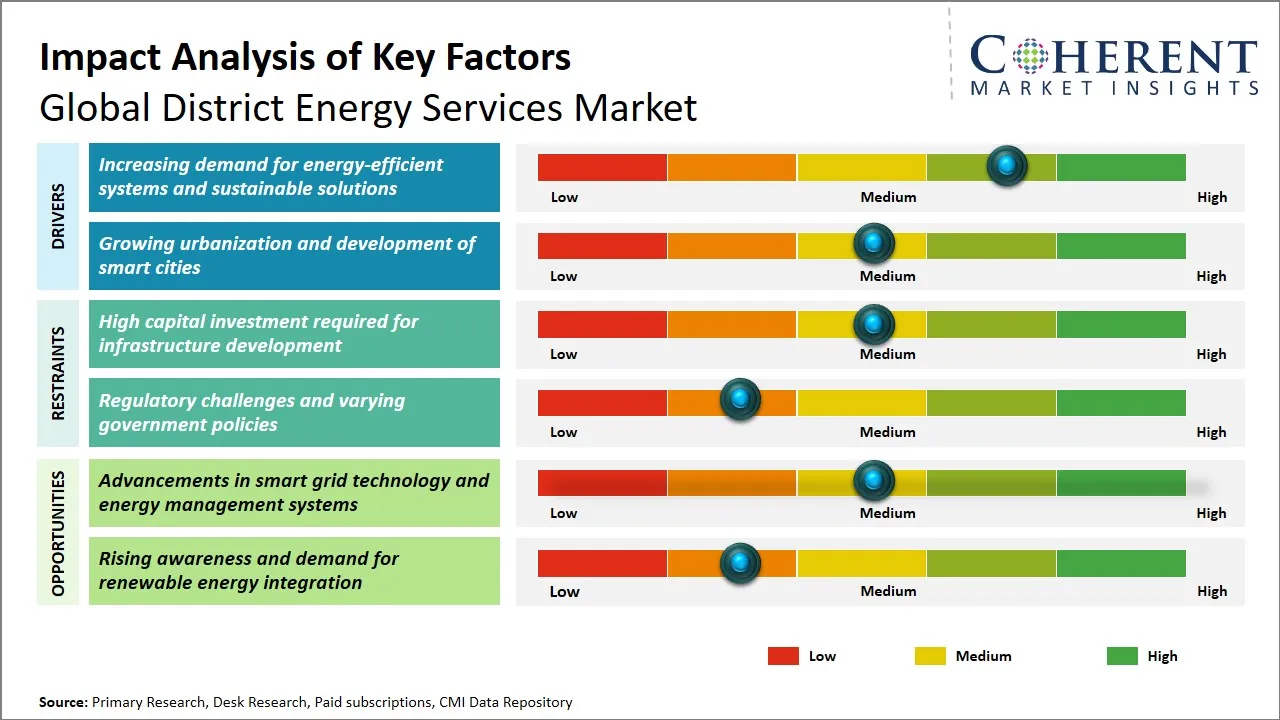
District Energy Services Market Driver - Increasing Demand for Energy-Efficient Systems and Sustainable Solutions
Strong focus on minimizing carbon footprints and improving energy efficiency in different sectors is playing a major role in the adoption of the district energy services worldwide. As people started to be more concerned about the environment with the strict policies and laws of the government directed to the greenhouse emissions, the industries and the municipalities started to find the way to be environmentally friendly and be able to optimize the use of the energies. District energy systems, which are characterized by a capability to deliver centralized heating and cooling and reducing energy waste, are perfectly consistent with these changing priorities.
Moreover, advancements in technology have made these systems more adaptable to green energy integration, further strengthening their appeal. As urbanization accelerates, cities are facing mounting pressure to manage energy resources efficiently while supporting sustainable infrastructure development.
District Energy Services Market Opportunity - Advancements in Smart Grid Technology and Energy Management Systems
The global district energy services market stands to benefit significantly from the rapid advancements in smart grid technology and energy management systems. Smart grids can be integrated to facilitate real-time monitoring, automated control and optimization of energy distribution in district heating and cooling networks, which improves efficiency in operation and minimize energy wastage. These technologies are also enabling the efficiency of demand response which enables district energy providers to respond dynamically to patterns of consumption, weather, and stability of the grid.
For example, SP will also be developing the first brownfield Singapore’s sustainable cooling solution of a town center at Tampines. Upon its full completion, SP will be having a total 118,500 RTs of cooling capacity on its district cooling networks, making it the largest producer of district cooling solutions in Singapore.
Analyst Opinion (Expert Opinion)
- The district energy services market is experiencing significant momentum, driven by a global push for energy efficiency and sustainability in urban environments. The experience of the International District Energy Association Annual Conference (2023) and the Global Energy Transition Forum (2022) revealed the most important innovations, and such companies as ENGIE and Veolia are on the forefront of action at integrated energy solutions.
- The introduction of a smart district heating system recently by ENGIE and the use of renewable energy sources which include biomass and solar to power the system is an example of how the industry is endeavoring to ensure a decreased carbon footprint whilst improving energy reliability. The talks at these conferences pointed to the growing interest in decarbonization plans and the district energy contribution to overall city sustainability. Nevertheless, problems with initial capital expenditure and the necessity of regulatory frameworks to facilitate the construction of infrastructure were often mentioned as reasons to limit the wider adoption.
- The firms investing in new financing models and cooperating with local authorities are likely to develop a big market share. Finally, the development of the district energy services market will depend on its capability to provide flexible, efficient, and sustainable energy services that can be adjusted to the dynamic demands of urban population in the world which is becoming more energy-conscious.
Speak to the analyst
Want personalized insights?
Take the findings above to one of our principal consultants, or have the report rebuilt around the segments, geographies and competitors you actually track.
Market Segmentation
- Service Type Insights (Revenue, USD Bn, 2021 - 2033)
- District Heating Services
- District Cooling Services
- Combined Heating & Cooling (CHC) Services
- Energy Source Insights (Revenue, USD Bn, 2021 - 2033)
- Fossil Fuels (e.g., Natural Gas, Oil, Coal)
- Renewables
- Biomass
- Solar Thermal
- Geothermal
- Waste Heat Recovery
- Technology Insights (Revenue, USD Bn, 2021 - 2033)
- Combined Heat and Power (CHP)
- Boiler-Based Systems
- Chiller-Based Systems
- Heat Pumps
- Solar Thermal
- Geothermal
- Others
- End User Insights (Revenue, USD Bn, 2021 - 2033)
- Residential
- Commercial
- Industrial
- Institutional
- Regional Insights (Revenue, USD Bn, 2021 - 2033)
- North America
- U.S.
- Canada
- Latin America
- Brazil
- Argentina
- Mexico
- Rest of Latin America
- Europe
- Germany
- U.K.
- Spain
- France
- Italy
- Russia
- Rest of Europe
- Asia Pacific
- China
- India
- Japan
- Australia
- South Korea
- ASEAN
- Rest of Asia Pacific
- Middle East
- GCC Countries
- Israel
- Rest of Middle East
- Africa
- South Africa
- North Africa
- Central Africa
- North America
- Key Players Insights
- ENGIE SA
- Veolia Environnement S.A.
- Fortum Corporation
- Vattenfall AB
- Emirates Central Cooling Systems Corporation (Empower)
- Ramboll Group
- Keppel
- Tabreed (National Central Cooling Company)
- Goteborg Energi AB
- Helen Ltd
- Logstor A/S
- Shinryo Corporation
- Statkraft AS
- NRG Energy, Inc.
- Orsted A/S
Sources
Primary Research Interviews
- CEO – Leading District Energy Provider (e.g., Danfoss or Veolia equivalent)
- Supply Chain Director – Major Thermal Energy Distributor
- Operations Lead – Combined Heat and Power (CHP) Plant Operator
- Sustainability Officer – District Heating Certification Authority
Stakeholders
- Providers and Operators
- End-use Sectors
- Commercial Buildings (Offices, Hospitals, Hotels)
- Residential Complexes
- Industrial Facilities (Food Processing, Data Centers)
- Regulatory & Certification Bodies (e.g., EPA for energy efficiency, EU Energy Performance of Buildings Directive)
- Utilities and Energy Retailers (ENGIE, Fortum, national grid operators)
- Technology Integration Players: Smart grid and heat pump integrators for district systems
Databases
- UN Comtrade Database (HS Code for thermal energy services)
- Eurostat Energy Statistics
- IEA District Heating and Cooling Database
- U.S. Energy Information Administration (EIA) District Energy Reports
- India Ministry of Power Energy Statistics
Magazines
- District Energy Magazine – Trends in urban district heating
- Cogeneration & On-Site Power Production – CHP in district systems
- Renewable Energy World – Geothermal and biomass in district energy
- Power Engineering International – Global district energy projects
- Energy Manager Today – Efficiency innovations in district cooling
Journals
- Energy – District energy system optimization models
- Applied Energy – Techno-economic analysis of district heating networks
- Renewable and Sustainable Energy Reviews – Sustainability of district energy
- International Journal of Heat and Mass Transfer – Heat transfer in district pipes
- Energy Policy – Regulatory impacts on district energy adoption
Newspapers
- The Wall Street Journal – Investments in urban district energy infrastructure
- The Guardian – Green transition to low-carbon district heating
- Business Standard (India) – District cooling growth in smart cities
- Financial Times – District energy market expansions in Europe
- Reuters – Price dynamics and supply chain in thermal energy services
Associations
- International District Energy Association (IDEA)
- Euroheat & Power
- District Energy Canada
- European Heating Industry (EHI)
- ASHRAE (American Society of Heating, Refrigerating and Air-Conditioning Engineers)
- Green Cooling Initiative
Public Domain Sources
- EPA – Guidelines for district energy efficiency
- European Commission – Directives on district heating and cooling
- World Health Organization – Indoor air quality in district-served buildings
- IEA – District Heating and Cooling Reports
- OECD – Energy efficiency and district systems reports
Proprietary Elements
- CMI Data Analytics Tool
- Proprietary CMI Existing Repository of information for last 8 years.
Get access to 250+ pages report
Every segment, forecast, competitor profile and data table behind the analysis above — available for instant download.
- ESOMAR Member
- ISO 9001:2015 Certified
- D-U-N-S Registered
- GDPR & CCPA Compliant
Missing comfort of reading report in your local language? Find your preferred language:
Transform your Strategy with Exclusive Trending Reports
Frequently Asked Questions
The global district energy services market is estimated to be valued at USD 12.45 Bn in 2026 and is expected to reach USD 18.23 Bn by 2033.
The CAGR of global district energy services market is projected to be 5.6% from 2026 to 2033.
Increasing demand for energy-efficient systems and sustainable solutions and growing urbanization and development of smart cities are the major factors driving the growth of the global district energy services market.
High capital investment required for infrastructure development and regulatory challenges and varying government policies are the major factors hampering the growth of the global district energy services market.
In terms of service type, the district heating services are estimated to dominate the market revenue share in 2026.
Systems are the physical assets (plants, pipes, substations); services are the activities to develop, operate, optimize, and commercialize those assets.
ENGIE SA, Veolia Environnement S.A., Fortum Corporation, Vattenfall AB, Emirates Central Cooling Systems Corporation (Empower), Ramboll Group, Keppel, Tabreed (National Central Cooling Company), Goteborg Energi AB, Helen Ltd, Logstor A/S, Shinryo Corporation, Statkraft AS, NRG Energy, Inc., and Ørsted A/S are the major players.