

Global Driver IC Market Size and Forecast – 2026-2033
The Global Driver IC Market is estimated to be valued at USD 10.20 Bn in 2026 and is expected to reach USD 15.53 Bn by 2033, exhibiting a compound annual growth rate (CAGR) of 6.2% from 2026 to 2033.
Key Takeaways of the Driver IC Market
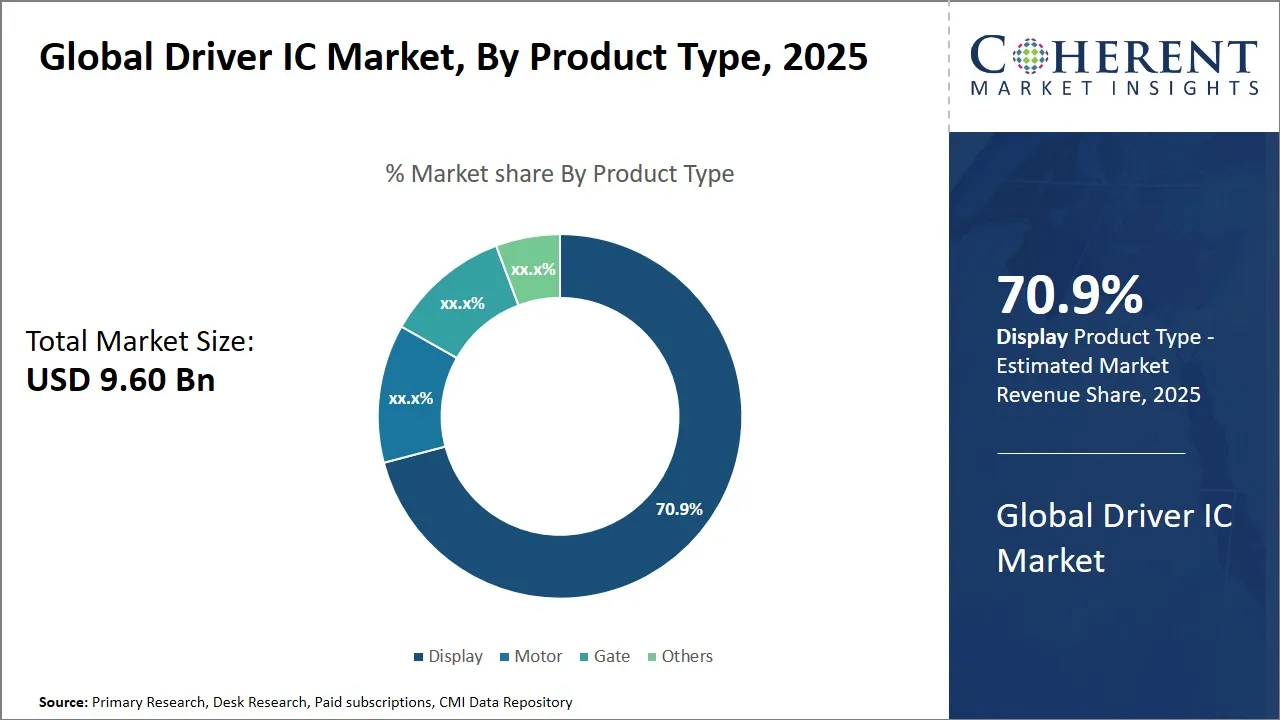
- The display segment leads the market holding an estimated share of 71.9 % in 2026.
- The consumer electronics segment leads the market holding an estimated share of 38.0 % in 2026.
- Asia Pacific is estimated to lead the market with a share of 56.0 % in 2026.
- Europe, holding a share of 12.6% in 2026, is projected to be the fastest growing region.
Market Overview
In terms of market trends, the Driver IC market is witnessing a shift towards greater energy efficiency and miniaturization, driven by the rise of electric vehicles and smart devices. Innovations in semiconductor technology are making possible more compact and reliable driver ICs, which improve performance while reducing power consumption. Additionally, rising adoption of advanced driver-assistance systems (ADAS) is propelling growth, as these systems require sophisticated driver ICs for better control and safety features.
Current Events and Its Impact
Current Events | Description and Impact |
Geopolitical and Trade Developments |
|
Economic and Industry Trends |
|
Segmental Insights
- Current Industry Events of 2026
- Market Size Estimation
- Regional Breakdown
- Competitive Landscape
- Customer Intelligence
- Segmental Analysis
- Pricing Analysis
- Key Market Drivers, Challenges & Future Trends
- Customized Insights Section
Global Driver IC Market Insights, by Product Type – Display Leads Due to its Critical Role in Enhancing Visual Performance and User Interface Across Diverse Applications
The display segment is expected to dominate the global driver IC market, holding a share of 71.9% in 2026. Driver ICs help control and manage the signals sent to display panels, such as OLED, AMOLED, and LCD screens, ensuring sharp visuals, smooth color transitions, and efficient power consumption. Driver ICs are also used in consumer electronics, including smartphones, tablets, laptops, and televisions. Also, flexible and foldable displays, which have recently become popular, also depend on specialized driver ICs to maintain screen durability and functionality without compromising display quality.
Another factor underpinning the growth in the Display driver IC segment is the increasing prevalence of digital signage and large-format displays used in commercial settings like retail, transportation hubs, and advertising.
Also, the rise of smart home devices and IoT applications that incorporate interactive display screens add to the demand for Display driver ICs. As end-users seek enhanced user interfaces with better touch responsiveness and visual clarity, driver ICs have become more sophisticated to meet these expectations.
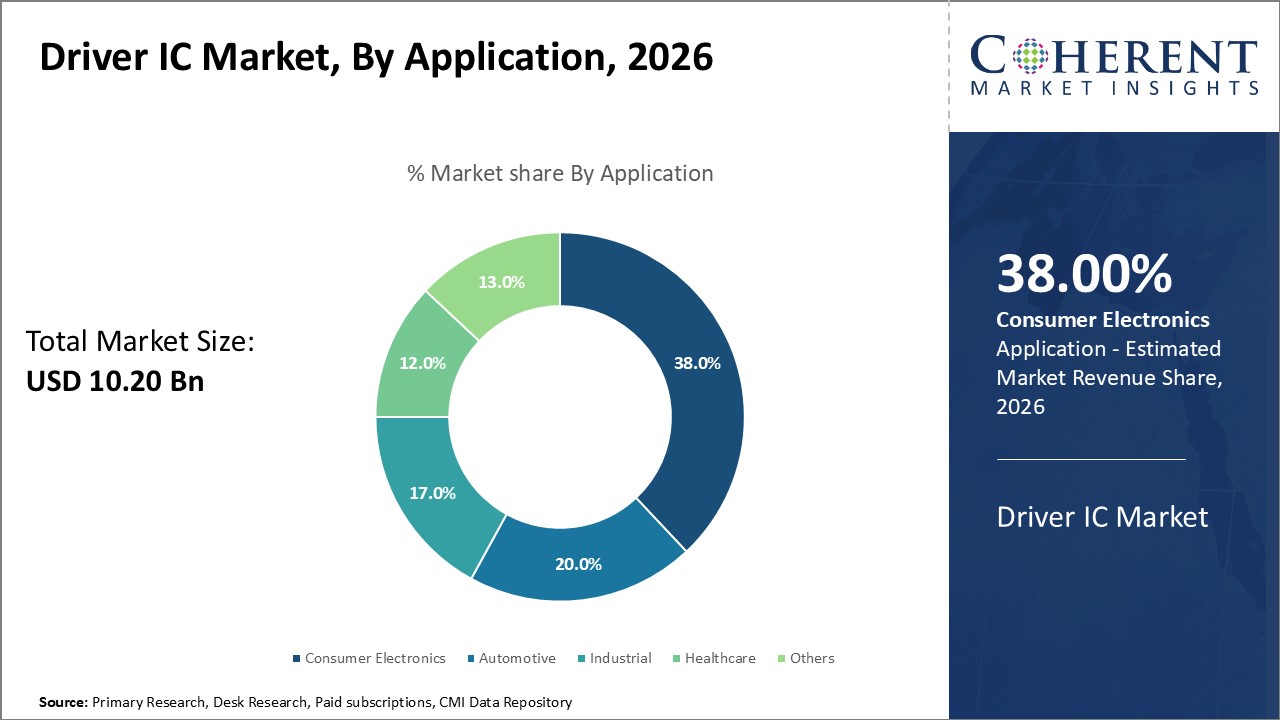
Global Driver IC Market Insights, by Application - Consumer Electronics Lead Driven By Escalating Demand for Smart and Connected Devices
The consumer electronics segment, holding an estimated share of 38.0% in 2026, leads the global driver IC market. The proliferation of smartphones, tablets, wearable devices, smart TVs, and home automation products has intensified the need for highly efficient and compact driver IC solutions that support superior functionality and seamless user experiences.
One of the key contributors to the prominence of the consumer electronics segment is the rapid evolution of mobile communication devices. Modern smartphones have multiple display technologies, touch panels, and motor functionalities such as vibration alerts and camera lens adjustments, all of which need highly specialized driver ICs.
The rising adoption of wearable devices, including smartwatches, fitness trackers, and augmented reality (AR) glasses, further reinforces the growth in this segment. These devices necessitate miniaturized driver ICs with low power consumption and high integration levels to extend battery life and maintain compact form factors, thereby expanding the scope for driver IC applications within consumer electronics.
Additionally, smart home electronics, such as intelligent lighting systems, home security cameras, and smart appliances, also contribute to the high demand for driver ICs in consumer electronics. These products incorporate motor driver ICs for automated mechanisms and display driver ICs for interactive control panels, enabling enhanced user satisfaction and convenience.
Consumer expectations for consistent improvements in display quality, device responsiveness, and multifunctionality also fuel continuous innovation in driver IC designs tailored for consumer electronics. The integration of AI and IoT technologies into consumer products is another emerging factor that boosts demand for sophisticated driver ICs capable of supporting complex control and communication protocols.
Impact of AI in the Driver IC Market
The integration of Artificial Intelligence (AI) is significantly transforming the Driver IC (Integrated Circuit) market, especially in applications requiring adaptive and intelligent control. AI-driven systems in autonomous vehicles, smart lighting, industrial automation, and advanced displays demand driver ICs that are not only power-efficient but also capable of handling real-time data processing. For example, in AI-enabled automotive environments, gate and motor driver ICs are increasingly tailored to support precise, low-latency actuation needed in electric and autonomous vehicles. Similarly, in smart home lighting, AI algorithms control brightness and color temperature based on user behavior, requiring LED driver ICs with dynamic and programmable capabilities.
Samsung’s AI-enhanced OLED TV panels utilize display driver ICs (DDICs) designed to work with onboard AI processors to optimize image rendering in real time. These DDICs can dynamically adjust brightness, color contrast, and refresh rates based on ambient light and content type, providing a more immersive experience.
Regional Insights
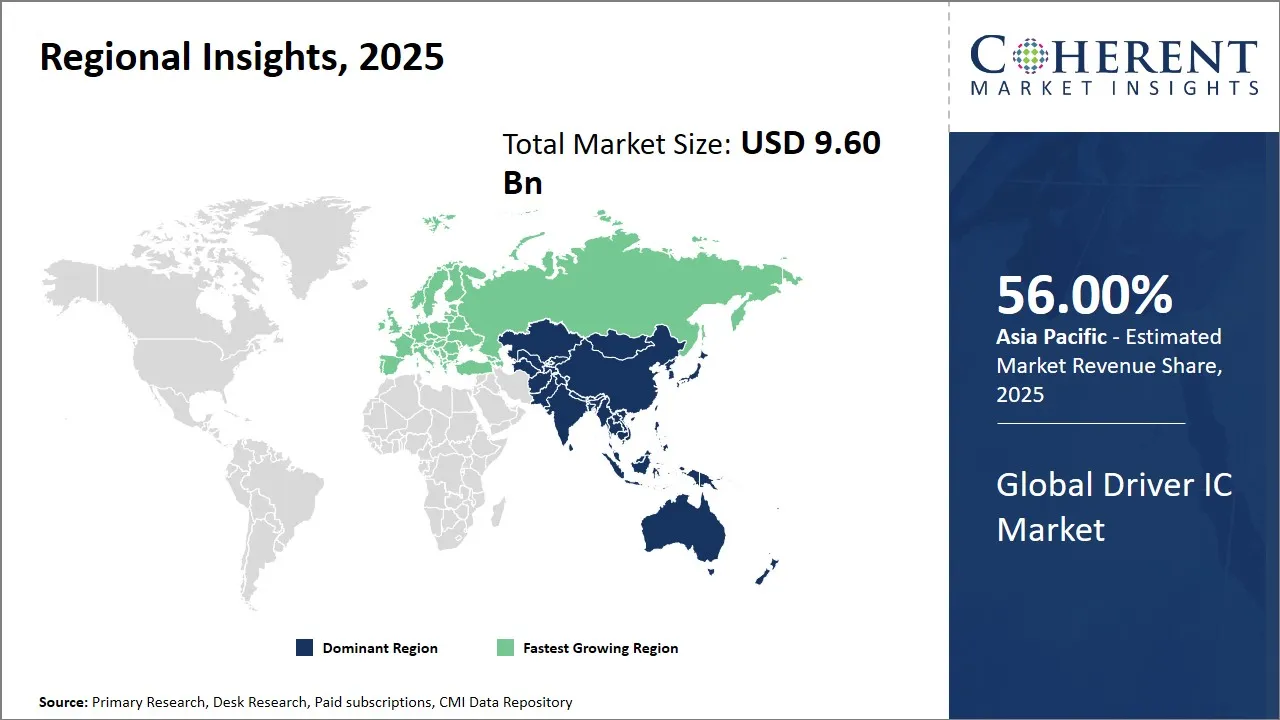
Asia Pacific Driver IC Market Analysis and Trends
Asia Pacific, holding a share of 56.0% in 2026, is expected to dominate the global driver IC market due to several interrelated factors. Rapid industrialization, expanding electronics manufacturing hubs in countries like China, South Korea, and Taiwan, and increasing consumer electronics adoption underpin this trend. Government policies focused on boosting semiconductor fabrication capabilities, incentives for innovation, and export-oriented trade dynamics have cultivated a conducive environment for growth.
Moreover, the escalating demand for driver ICs in automotive electronics—particularly in electric vehicles—and consumer appliances adds momentum. Leading regional players such as Samsung Electronics, MediaTek, and Renesas Electronics significantly contribute to regional growth by leveraging local manufacturing advantages and extensive market reach. In 2026, MediaTek launched its Dimensity OLED Driver IC series tailored for AI-enhanced displays in foldable and ultra-high refresh rate smartphones. These ICs integrate AI-assisted power management and adaptive refresh control
Europe Driver IC Market Analysis and Trends
Europe, holding a share of 12.6% in 2026, is expected to exhibit the fastest growth in the global driver IC market, driven by a combination of technological innovation, automotive leadership, and sustainability-focused policies. The region is home to several premium automotive manufacturers, which fuels demand for advanced gate and motor driver ICs used in electric vehicles, ADAS, and powertrain systems. Additionally, Europe’s push for energy efficiency and green technologies, supported by initiatives like the European Green Deal and Horizon Europe, encourages the development of eco-friendly and high-efficiency IC solutions.
Countries such as Germany, France, and the Netherlands are investing heavily in semiconductor R&D and domestic chip production, supported by the EU Chips Act. Leading European firms like Infineon Technologies and STMicroelectronics play a pivotal role in shaping the region’s growth trajectory, offering advanced driver IC solutions across automotive, industrial, and renewable energy applications. Infineon offers gate driver ICs with built-in functional safety features (ASIL-D compliant) for autonomous and electric vehicle inverters. The ICs include real-time diagnostic capabilities, temperature sensors, and AI-based fault prediction modules.
Global Driver IC Market Outlook for Key Countries
U.S. Driver IC Market Analysis and Trends
The U.S. is characterized by strong technological advancement and extensive innovation in driver IC development. Companies headquartered here, including Texas Instruments and ON Semiconductor, are pioneers in analog and mixed-signal integrated circuits, offering advanced driver ICs for automotive, industrial, and consumer sectors. The U.S. government’s focus on maintaining semiconductor leadership through funding and policy support enhances market competitiveness. Partnerships between academia and industry further facilitate breakthroughs, sustaining the market’s growth momentum.
China Driver IC Market Analysis and Trends
China driver IC market is expanding fast because of its position as the world’s largest electronics manufacturing hub. Government initiatives such as “Made in China 2026” emphasize semiconductor self-reliance, encouraging local production of critical components including driver ICs. Domestic players like Goodix and Will Semiconductor are innovating and scaling operations, while international firms work on joint ventures to capitalize on market demand.
Japan Driver IC Market Analysis and Trends
Japan continues to lead because of its high-precision manufacturing capabilities and a strong presence of semiconductor companies specializing in driver ICs. Renesas Electronics and Toshiba are major players, offering sophisticated ICs for automotive applications, industrial automation, and consumer electronics. The country’s stable regulatory environment and continuous R&D investments, supports the region's market.
South Korea Driver IC Market Analysis and Trends
South Korea sees a dominance of global technology giants such as Samsung Electronics and SK Hynix, which invest heavily in semiconductor research and production. The country's strong manufacturing base and government support through strategic funding programs make for a competitive landscape. South Korea’s growing automotive electronics demand and rapid adoption of smart consumer devices add to the driver IC market growth.
Market Players, Key Development, and Competitive Intelligence
Key Developments
- In June 2025, STMicroelectronics announced the launch of the STGAP4S, a galvanically isolated automotive gate driver designed for use with silicon carbide (SiC) MOSFETs and insulated-gate bipolar transistors (IGBTs). The device supports scalable inverter designs for electric vehicle (EV) powertrains and includes built-in diagnostics and protections to meet ISO 26262 ASIL D functional safety standards.
- In November 2024, MediaTek showcased its latest innovations including the OPPO Find X8 Pro powered by its flagship MediaTek Dimensity 9400 chipset at the 14th Chapter of Mediatek Technology Diaries event "This Chip Changes Everything."
- In December 2022, STMicroelectronics, a global semiconductor player serving customers across the spectrum of electronics applications, released high-power modules for electric vehicles that boost performance and driving range. ST’s new silicon-carbide (SiC) power modules were selected for Hyundai’s E-GMP electric-vehicle platform shared by KIA EV6 and several models.
- In August 2021, Analog Devices, Inc. acquired Maxim Integrated Products, Inc. (NASDAQ: MXIM). The combination strengthened ADI’s position as a high-performance analog semiconductor company with trailing twelve-month revenue of over USD 9 billion, industry leading margins, and free cash flow of over USD 3 billion on a pro forma basis.
Top Strategies Followed by Driver IC Market Players
- Established market leaders heavily invest in research and development to innovate high-performance products that meet the stringent demands of various industries, such as automotive, consumer electronics, and industrial automation.
- TI has significantly expanded its R&D investments in automotive-grade driver ICs, launching the DRV3255-Q1 motor driver. This IC supports 48V mild hybrid systems and integrates advanced diagnostics and protection features, aligning with the shift toward EV and hybrid vehicles.
- Mid-level players target price-sensitive customers, especially in developing economies and industries where affordability is a critical buying criterion.
- Himax focuses on developing low-cost display driver ICs (DDICs) for mid-range smartphones, tablets, and consumer electronics. In 2025, the company expanded its product line with cost-efficient Touch and Display Driver Integration (TDDI) chips to meet rising demand from price-sensitive markets like India and Southeast Asia.
- Small-scale players in the driver IC market differentiate themselves by focusing on niche applications and specialized product features that larger competitors may overlook.
- Power Integrations has carved out a niche in high-efficiency LED driver ICs for industrial and smart lighting applications. Its LYTSwitch-6 family is designed for long-life, high-brightness LEDs with intelligent dimming and protection features.
Market Report Scope
Driver IC Market Report Coverage
| Report Coverage | Details | ||
|---|---|---|---|
| Base Year: | 2025 | Market Size in 2026: | USD 10.20 Bn |
| Historical Data for: | 2020 To 2024 | Forecast Period: | 2026 To 2033 |
| Forecast Period 2026 to 2033 CAGR: | 6.2% | 2033 Value Projection: | USD 15.53 Bn |
| Geographies covered: |
| ||
| Segments covered: |
| ||
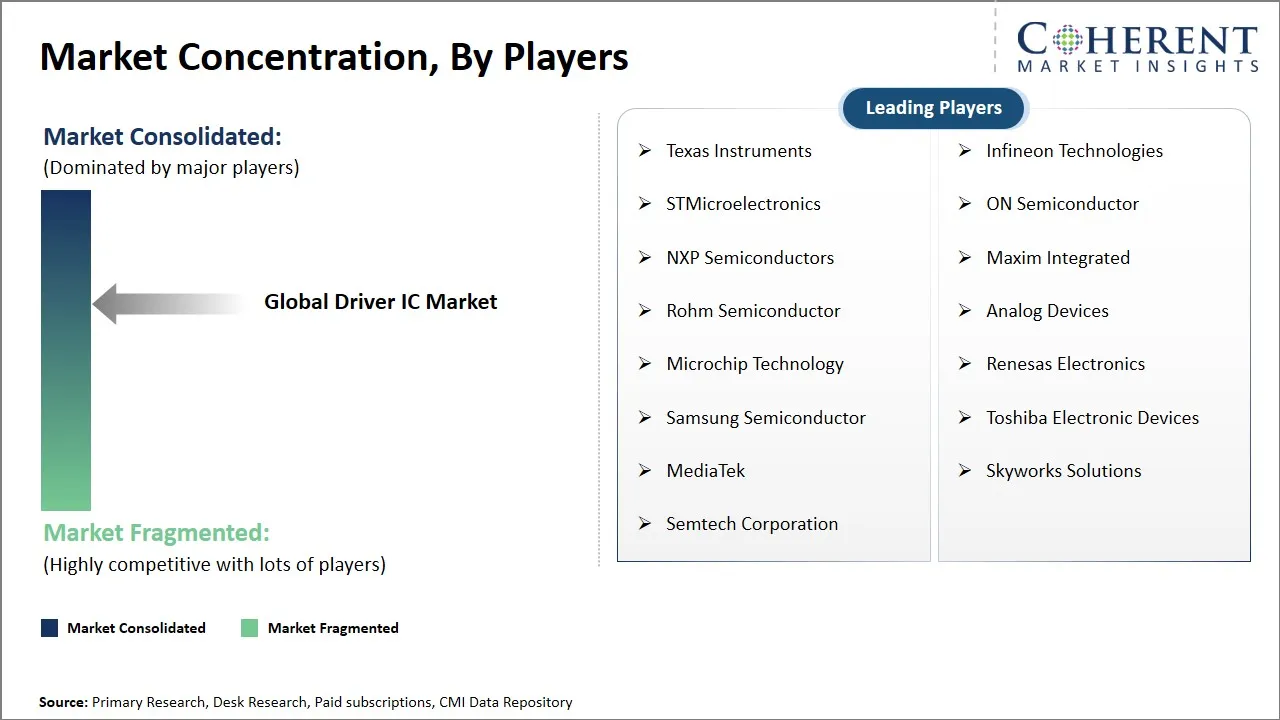
| Companies covered: | Texas Instruments, Infineon Technologies, STMicroelectronics, ON Semiconductor, NXP Semiconductors, Maxim Integrated, Rohm Semiconductor, Analog Devices, Microchip Technology, Renesas Electronics, Samsung Semiconductor, Toshiba Electronic Devices, MediaTek, Skyworks Solutions, and Semtech Corporation | ||
| Growth Drivers: |
| ||
| Restraints & Challenges: |
| ||
Market Dynamics
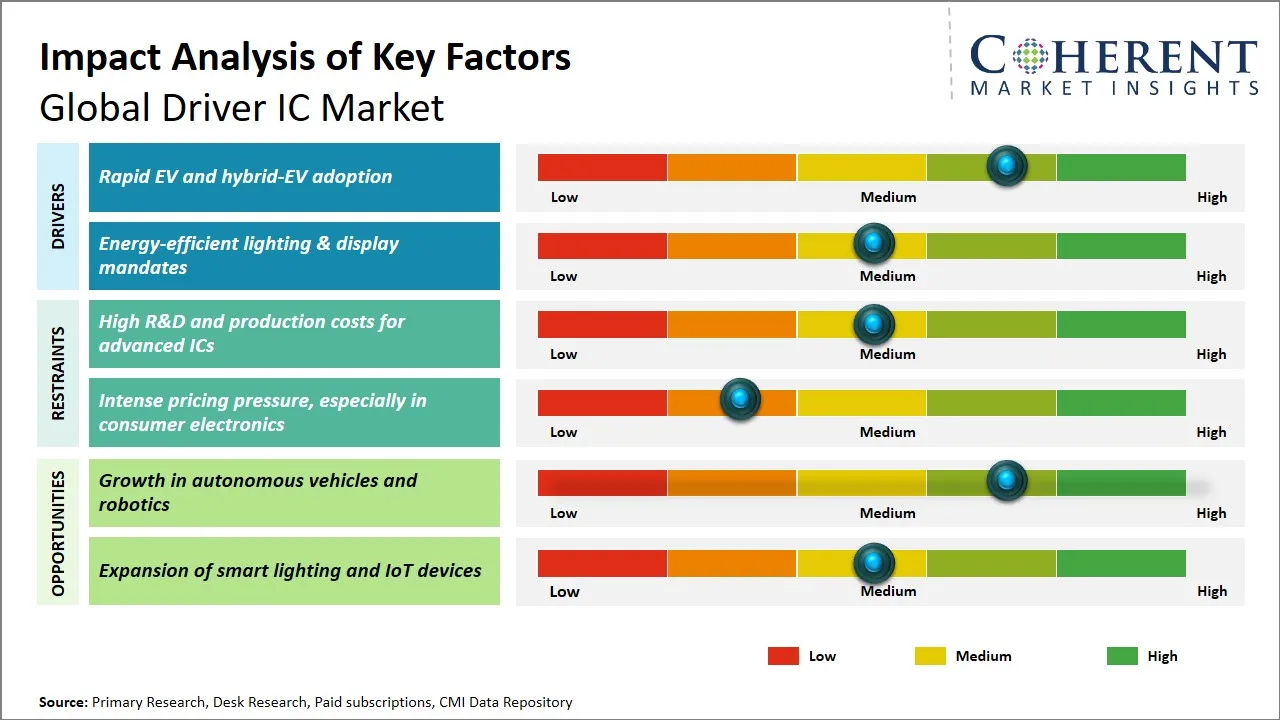
Global Driver IC Market Driver - Rapid EV and hybrid-EV adoption
The increasing adoption of electric vehicles (EVs) and hybrid electric vehicles (HEVs) is significantly driving the demand for advanced driver integrated circuits (ICs), as these components play a crucial role in managing powertrain efficiencies and ensuring optimized control of multiple automotive subsystems. With manufacturers continuously innovating to enhance battery management, power conversion, and motor control, driver ICs are becoming indispensable for improving energy efficiency, thermal management, and overall vehicle performance. STMicroelectronics launched its STDRIVEG600 gate driver IC family specifically designed for automotive inverter and motor control systems in electric and hybrid vehicles.
Additionally, the shift towards electrification involves complex electronic architectures, where driver ICs facilitate precise current regulation and robust switching functionalities required for inverters, converters, and battery management systems. As EVs and HEVs integrate more sophisticated safety, infotainment, and connectivity features, the reliance on reliable and scalable driver ICs further intensifies, reinforcing their significance within automotive electronics.
Global Driver IC Market Opportunity – Expansion Driven by Growth in Autonomous Vehicles and Robotics
Autonomous vehicles rely heavily on sophisticated sensor arrays, cameras, and lidar systems, all of which necessitate high-performance driver ICs to manage signal processing, power regulation, and data communication efficiently. As manufacturers push toward higher levels of vehicle autonomy, the demand for precise, reliable, and energy-efficient driver ICs is expected to surge. Similarly, the robotics sector, encompassing industrial automation, logistics, healthcare, and consumer robots, requires advanced driver ICs to control multiple actuators, sensors, and communication modules within smaller form factors. NXP Semiconductors introduced the FS26 family of safety system basis chips and driver ICs for autonomous driving platforms. These ICs integrate motor and gate driver functionality with built-in fail-operational safety mechanisms, targeted at use cases in ADAS systems, robotic actuators, and LiDAR sensors.
The integration of AI and machine learning in autonomous systems further escalates the complexity and processing requirements, creating additional avenues for innovation in driver IC technology. Furthermore, increasing government investments and incentives to support autonomous vehicle deployment and smart factory setups amplify the market potential.
Analyst Opinion (Expert Opinion)
- Driver ICs are undergoing a significant transformation, evolving from traditional passive control units into intelligent, adaptive components capable of interfacing directly with AI processors. This shift is especially evident in emerging applications such as high-end displays, electric vehicle (EV) power modules, and smart lighting systems. In these use cases, driver ICs are expected to support real-time feedback, self-adjusting performance parameters, and greater energy efficiency—all critical for enabling AI-driven environments.
- At the same time, the adoption of wide-bandgap materials such as Gallium Nitride (GaN) and Silicon Carbide (SiC) is accelerating. These advanced materials allow driver ICs to operate at higher voltages and switching frequencies with greater efficiency and lower heat dissipation. As a result, they are increasingly preferred in EVs, industrial motor drives, and robotic systems where performance reliability is paramount, gradually replacing traditional silicon-based ICs.
- Additionally, as the demand for compact and immersive mobile devices grows, innovations such as TDDI (Touch and Display Driver Integration) and system-on-chip driver ICs are enabling thinner, multifunctional displays. These technologies support the development of foldables, wearables, and AR/VR devices, redefining the future of human-machine interaction.
Speak to the analyst
Want personalized insights?
Take the findings above to one of our principal consultants, or have the report rebuilt around the segments, geographies and competitors you actually track.
Market Segmentation
- Product Type Insights (Revenue, USD Bn, 2021 - 2033)
- Display
- Motor
- Gate
- Others
- Application Insights (Revenue, USD Bn, 2021 - 2033)
- Consumer Electronics
- Automotive
- Industrial
- Healthcare
- Others
- Regional Insights (Revenue, USD Bn, 2021 - 2033)
- North America
- U.S.
- Canada
- Latin America
- Brazil
- Argentina
- Mexico
- Rest of Latin America
- Europe
- Germany
- U.K.
- Spain
- France
- Italy
- Russia
- Rest of Europe
- Asia Pacific
- China
- India
- Japan
- Australia
- South Korea
- ASEAN
- Rest of Asia Pacific
- Middle East
- GCC Countries
- Israel
- Rest of Middle East
- Africa
- South Africa
- North Africa
- Central Africa
- North America
- Key Players Insights
- Texas Instruments
- Infineon Technologies
- STMicroelectronics
- ON Semiconductor
- NXP Semiconductors
- Maxim Integrated
- Rohm Semiconductor
- Analog Devices
- Microchip Technology
- Renesas Electronics
- Samsung Semiconductor
- Toshiba Electronic Devices
- MediaTek
- Skyworks Solutions
- Semtech Corporation
Sources
Primary Research Interviews
Stakeholders
- Semiconductor Manufacturers and Fab Operators (e.g., Process Engineers, R&D Heads)
- Electronics and Consumer Device OEMs (e.g., Display Module Integrators, Product Managers)
- Automotive Tier-1 Suppliers and EV OEMs (e.g., Powertrain Engineers, Sourcing Heads)
- Robotics and Industrial Automation System Integrators
- Display and Lighting Module Designers (e.g., LED, OLED specialists)
- Energy-Efficient Systems Consultants and Power Electronics Experts
Databases
- Japan Semiconductor Trade and Statistics Bureau
- U.S. Bureau of Industry and Security (BIS)
- Asia Pacific Semiconductor Council (APSC)
- OECD Science, Technology and Innovation Indicators
- European Commission Digital Economy and Society Index (DESI)
Magazines
- Semiconductor Digest
- Power Electronics News
- Electronics Weekly
- Smart Devices & Circuits Magazine
Journals
- IEEE Journal of Solid-State Circuits
- Microelectronics Journal
- Journal of Semiconductor Technology and Science
- Advanced Intelligent Systems
Newspapers
- Nikkei Asia – Semiconductor Desk
- The Economic Times (India) – Electronics Special
- South China Morning Post – Tech & Supply Chain Section
- The Wall Street Journal – Tech and Innovation
Associations
- Global Semiconductor Alliance (GSA)
- Automotive Electronics Council (AEC)
- International Display Metrology Association (IDMA)
- Power Electronics Industry Association (PEIA)
- Flexible Electronics and Display Center (FEDC)
Public Domain Sources
- U.S. Census Bureau
- EUROSTAT
- United Nations Industrial Development Organization (UNIDO)
- World Bank
- ResearchGate
Proprietary Elements
- CMI Data Analytics Tool, Proprietary CMI Existing Repository of Information for the Last 8 Years
Get access to 250+ pages report
Every segment, forecast, competitor profile and data table behind the analysis above — available for instant download.
- ESOMAR Member
- ISO 9001:2015 Certified
- D-U-N-S Registered
- GDPR & CCPA Compliant
Missing comfort of reading report in your local language? Find your preferred language:
Transform your Strategy with Exclusive Trending Reports
Frequently Asked Questions
The global driver IC market is estimated to be valued at USD 10.20 billion in 2026 and is expected to reach USD 15.53 billion by 2033.
The CAGR of the global driver IC market is projected to be 6.2% from 2026 to 2033.
Rapid EV and hybrid-EV adoption and energy-efficient lighting & display mandates are the major factors driving the growth of the global driver IC market.
High R&D and production costs for advanced ICs and intense pricing pressure, especially in consumer electronics are the major factors hampering the growth of the global driver IC market.
In terms of product type, display is estimated to dominate the market revenue share in 2026.
Texas Instruments, Infineon Technologies, STMicroelectronics, ON Semiconductor, NXP Semiconductors, Maxim Integrated, Rohm Semiconductor, Analog Devices, Microchip Technology, Renesas Electronics, Samsung Semiconductor, Toshiba Electronic Devices, MediaTek, Skyworks Solutions, and Semtech Corporation are the major players in the global driver IC market.
The rise of OLED, mini-LED, and foldable displays is driving innovation in display driver ICs, with growing demand for integrated Touch and Display Driver Integration (TDDI) solutions in smartphones, tablets, and wearables.