

Global Dual Carbon Battery Market Size and Forecast – 2026 To 2033
The Global Dual Carbon Battery Market is estimated to be valued at USD 126.8 Mn in 2026 and is expected to reach USD 413.6 Mn by 2033, exhibiting a compound annual growth rate (CAGR) of 18.4% from 2026 to 2033. This robust growth is supported by increasing demand for sustainable, fast-charging, and efficient energy storage solutions across automotive, renewable energy, electronics, and industrial applications.
Dual carbon battery technology is gaining attention as it uses carbon-based electrodes and can support lower-cost, safer, and more environmentally aligned battery development. In November 2025, Springer Nature published a review in the Korean Journal of Chemical Engineering highlighting that dual-ion batteries can reduce cost pressures, improve safety, and support applications in electric vehicles, grid storage, portable electronics, and home energy storage, strengthening the commercial outlook for dual carbon battery adoption. (Source: Springer Nature)
Key Takeaways of the Global Dual Carbon Battery Market
- Lithium ion dual carbon battery is expected to with 58.6 % of the market share in 2026, as lithium-based dual-ion architecture offers the most practical bridge between established Li-ion supply chains and carbon-electrode innovation. In February 2024, RSC Advances published research on dual carbon fiber batteries using Li+ and PF6− intercalation, supporting technical validation of lithium-based dual-carbon designs.
- Pouch cells are expected to dominate the cell format segment with 36.8 % of the market share in 2026, supported by flexible packaging, lighter module design, and suitability for mobility, drone, and compact energy-storage applications. In October 2022, PJP Eye stated that it had commercialized a pouch-type cell in 2018 and installed it in electric bicycles, e-scooters, and drones in 2019, proving early application fit.
- Automotive is expected to hold 36.2 % of the market share in 2026, as automakers prioritize fast-charging, safer, and longer-life battery platforms for EV differentiation. In September 2024, Toyota announced that METI certified its next-generation BEV battery development and production plan, including battery production from 2026 and all-solid-state battery R&D, reinforcing OEM appetite for advanced chemistries.
- Asia Pacific is expected to remain the dominant region with 39.4 % of the market share in 2026, supported by Japan’s battery innovation base, China’s cell manufacturing ecosystem, and regional EV supply-chain integration. In June 2026, Japan’s METI revised its Battery and Power Industry Strategy, targeting stronger domestic manufacturing, global battery-related sales growth, and commercialization of next-generation batteries.
- North America is expected to be the fastest-growing region with 26.7 % of the market share in 2026, supported by localization of battery materials, recycling, and advanced component manufacturing. In March 2026, the U.S. Department of Energy announced up to USD 500 million to expand critical materials processing, battery manufacturing, and recycling, strengthening readiness for emerging chemistries including graphite-rich systems.
- OEM-Led Commercialization: Dual carbon battery adoption is likely to move through strategic OEM partnerships rather than open retail channels, as performance validation, pack integration, warranty design, and safety qualification require close cooperation between cell developers, vehicle platforms, and energy-storage integrators. This model can shorten pilot-to-scale timelines and improve bankability for early commercial deployments.
- Critical-Mineral-Light Value Proposition: The market direction is shifting toward chemistries that reduce dependence on constrained metals while preserving charging speed, safety, and lifecycle performance. Dual carbon batteries fit this positioning by offering a differentiated sustainability narrative for customers facing procurement risk, ESG scrutiny, and recycling pressure across mobility, electronics, industrial, and stationary-storage applications.
Segmental Insights
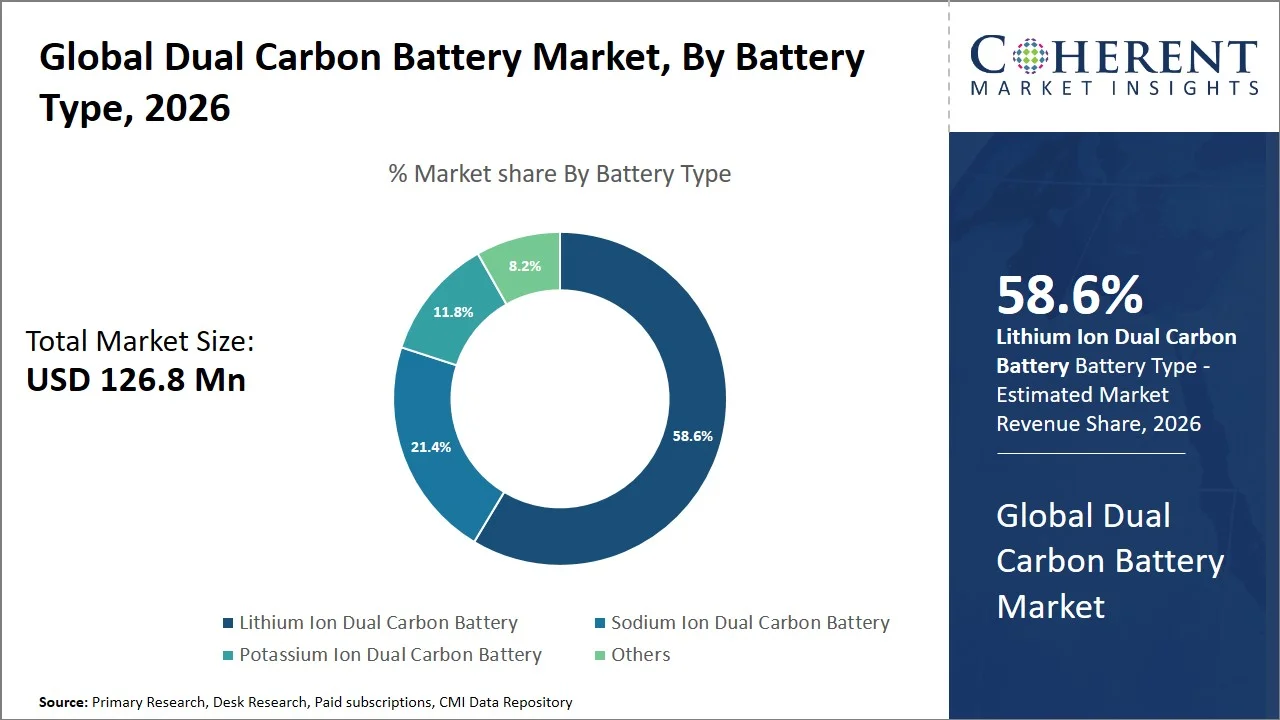
Why Does Lithium Ion Dual Carbon Battery Dominate the Global Dual Carbon Battery Market?
Lithium ion dual carbon battery is expected to dominate the market with 58.6% share in 2026, as it offers the lowest commercialization risk among dual carbon chemistries. The segment benefits from established lithium-ion manufacturing know-how, existing electrolyte supply chains, qualified graphite processing capacity, and mature battery management systems. Demand is strongest from EV pilots, stationary storage developers, and advanced electronics manufacturers seeking safer, high-voltage, carbon-electrode systems without fully moving away from lithium-based infrastructure. Supply-side scalability is also stronger because lithium salts, graphite anodes, coating lines, and formation processes are already industrialized. In March 2026, Journal of Materials Chemistry A published a lithium-based fluorination/defluorination dual-carbon battery design using graphite anodes, Li-based concentrated electrolytes, and LiF-carbon cathodes, showing technical progress toward higher-capacity dual-carbon systems. (Source: Royal Society of Chemistry)
- Current Industry Events of 2026
- Market Size Estimation
- Regional Breakdown
- Competitive Landscape
- Customer Intelligence
- Segmental Analysis
- Pricing Analysis
- Key Market Drivers, Challenges & Future Trends
- Customized Insights Section
Why Do Pouch Cells Represent the Largest Cell Format in the Global Dual Carbon Battery Market?
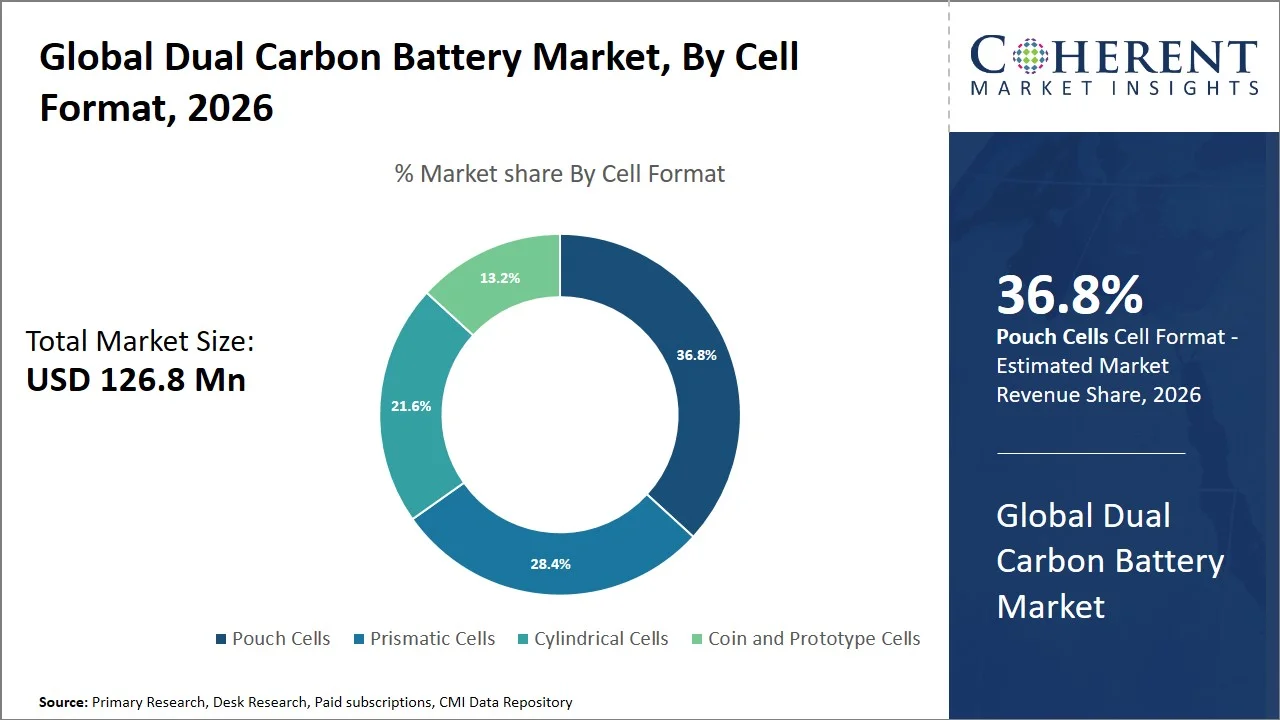
Pouch cells are expected to represent the largest cell format with 36.8% share in 2026, as dual carbon batteries are still moving through prototype, pilot, and early commercial validation phases where flexible cell engineering is critical. Pouch formats allow faster electrode-stack modification, easier thermal testing, lower weight, and better space utilization than rigid cylindrical or coin formats. Demand is concentrated among mobility platforms, drones, compact storage systems, and OEM validation programs that require configurable pack shapes before final module design. From the supply side, pouch manufacturing supports multilayer stacking, fast design iteration, and scalable pilot production without locking developers into fixed cylindrical tooling. In April 2026, Graphene Manufacturing Group reported that its graphene aluminum-ion cells doubled energy density performance and maintained output across fast-charge cycling, while its development roadmap shows the move from coin cells to pouch-cell prototypes and commercialization steps. (Source: Graphene Manufacturing Group Ltd)
Why Does Automotive Dominate the Global Dual Carbon Battery Market?
Automotive is expected to dominate the market with 36.2% share in 2026, as vehicle electrification creates the strongest demand for battery systems that can combine fast charging, improved safety, longer cycle life, and lower dependence on constrained battery metals. Dual carbon batteries are attractive for EV and light mobility applications because carbon-based electrodes can support high-power operation and stronger thermal stability, making them relevant for premium EVs, urban mobility, fleet vehicles, and future aircraft concepts. Automakers also prefer technologies that can be integrated into existing pack architectures while reducing warranty and fire-risk exposure. In April 2025, Contemporary Amperex Technology Co., Limited (CATL) unveiled Freevoy Dual-Power Battery, Naxtra passenger EV battery, and second-generation Shenxing Superfast Charging Battery, highlighting the automotive industry’s shift toward multi-chemistry, high-power battery platforms with customized performance. (Source: Contemporary Amperex Technology Co., Limited)
Global Dual Carbon Battery Market Dynamics
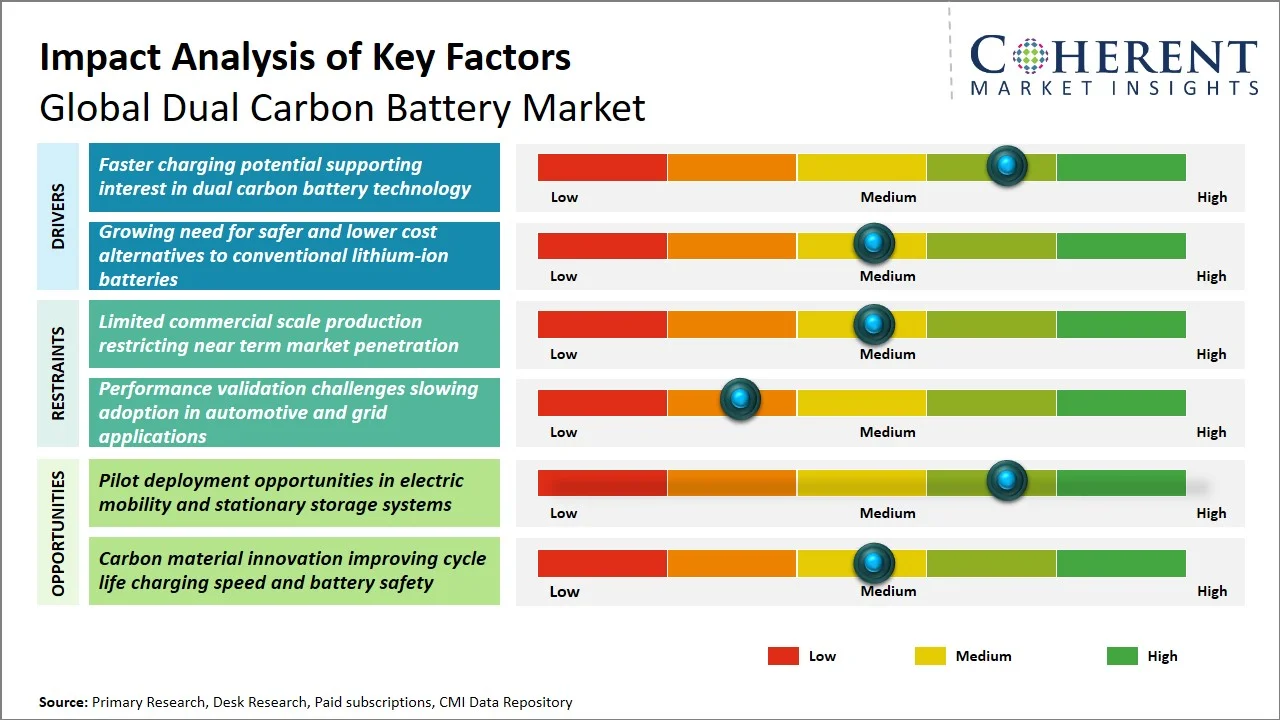
Key Market Drivers
- Faster Charging Potential Supporting Interest in Dual Carbon Battery Technology: Faster charging is becoming a critical purchase and investment factor across EVs, light mobility, drones, industrial equipment, and distributed energy storage, making dual carbon batteries commercially attractive due to their carbon-electrode design and high-power potential. The technology’s value proposition is strongest where downtime directly affects asset utilization, fleet productivity, and consumer acceptance. As charging-speed expectations rise, battery developers are increasingly focusing on electrode architectures that improve ion transport, reduce heat accumulation, and maintain cycle stability under high-rate charging. This supports investment in dual carbon systems, especially lithium-ion dual carbon and pouch-cell formats. In May 2025, BASF and Group14 announced a market-ready silicon-anode solution delivering faster charging, higher energy density, and durability, reflecting the broader industry shift toward high-rate battery materials and validating the commercial pull for fast-charging alternatives.
- Growing Need for Safer and Lower Cost Alternatives to Conventional Lithium Ion Batteries: Safety, cost volatility, and dependence on transition metals are pushing manufacturers and end users to evaluate battery chemistries that reduce fire risk and material-cost exposure. Dual carbon batteries benefit from this shift because carbon-based electrodes can reduce reliance on cobalt, nickel, and other constrained materials while supporting safer thermal behavior. Demand is especially relevant in stationary storage, compact electronics, medical devices, and urban mobility applications where safety certification, lifecycle cost, and supply reliability influence procurement decisions. Supply-side interest is also increasing as companies seek chemistries compatible with scalable carbon materials and simplified recycling pathways. In April 2026, India’s Department of Science & Technology (DST) reported development of a composite electrode material for aluminum-ion batteries aimed at making batteries affordable, safe, stable, and long-lasting, showing rising public-sector focus on safer alternatives to lithium-ion systems.
Emerging Market Trends
- Shift Toward Carbon-Rich and Metal-Light Battery Architectures: The global dual carbon battery market is moving toward battery systems that reduce exposure to expensive and supply-constrained metals while improving recyclability and lifecycle economics. Carbon-rich electrode designs are gaining strategic relevance because they can support a more resilient raw material base, lower sensitivity to critical mineral price swings, and stronger alignment with sustainability-led procurement. This trend is particularly important for OEMs and energy storage integrators that must balance performance, compliance, and long-term supply security. For dual carbon battery developers, the opportunity lies in positioning carbon electrodes not only as a technical differentiator but also as a procurement-risk reduction tool. As customers increasingly evaluate total cost of ownership, traceability, and end-of-life handling, carbon-based systems can become more attractive for early commercial pilots and premium niche applications.
- Pilot-Scale Validation Becoming the Bridge to Commercial Adoption: Dual carbon batteries are increasingly being evaluated through pilot procurement, OEM testing, prototype formats, and controlled application trials rather than immediate mass deployment. This trend reflects the market’s current stage: technology interest is strong, but buyers still require evidence on cycle life, charge retention, temperature stability, safety, and pack-level performance. Pouch cells and coin/prototype cells remain important in early validation because they allow rapid material testing and design changes before production tooling is locked. Automotive, electronics, and energy storage customers are expected to adopt dual carbon batteries first in use cases where fast charging, safety, and lightweight design provide measurable value. The market’s next phase will depend on moving from laboratory performance to repeatable pilot manufacturing, quality consistency, and credible certification pathways.
Current Events and their Impact
Current Events | Description and its Impact |
October 2024 – U.S. Treasury and IRS Final 45X Advanced Manufacturing Production Credit Rules |
|
July 2025 – European Commission Rules on Waste Battery Recycling Efficiency and Material Recovery |
|
October 2025 – China Export Controls on Lithium Batteries and Artificial Graphite Anode Materials |
|
Regional Insights
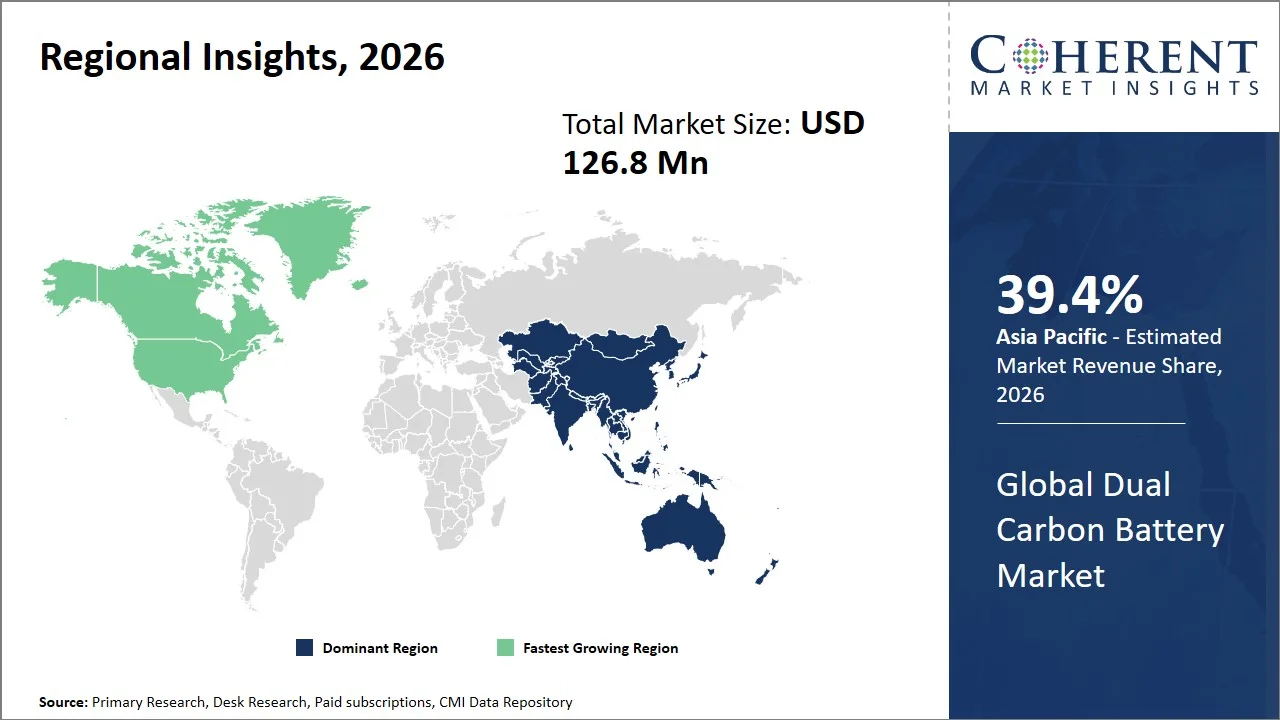
Why Does Asia Pacific Dominate the Global Dual Carbon Battery Market?
Asia Pacific is expected to dominate the global dual carbon battery market with 39.4% share in 2026, supported by concentrated battery manufacturing capacity, strong carbon-material processing capabilities, and advanced cell-development ecosystems in China, Japan, and South Korea. The region has a stronger route from laboratory chemistry to pilot production because it already hosts integrated suppliers of graphite, electrolytes, separators, pack assembly, and EV platforms. Demand is also reinforced by high EV production, electronics manufacturing, drones, and stationary storage projects, where fast-charging and safer battery formats are commercially relevant. In March 2026, New Energy and Industrial Technology Development Organization (NEDO) highlighted Japan’s Green Innovation Fund work on next-generation storage batteries and recycling technologies, including efforts to strengthen automotive battery supply chains and reduce procurement risk for critical materials. (Source: NEDO)
Why is North America Emerging as the Fastest-Growing Region in the Global Dual Carbon Battery Market?
North America is expected to be the fastest-growing region with 26.7% share in 2026, as the U.S. and Canada accelerate domestic battery-material production, EV supply-chain localization, and advanced cell commercialization. The region is gaining importance for dual carbon batteries because customers are looking for safer, high-power, and lower critical-mineral-risk chemistries that can reduce dependency on Asian battery imports. Strong demand from EV manufacturers, defense applications, grid storage, and data-center backup systems supports pilot procurement and co-development models. In September 2025, Sila announced the start of operations at its Moses Lake, Washington automotive-scale silicon anode plant, showing North America’s increasing ability to industrialize next-generation battery materials beyond conventional Li-ion supply chains. (Source: Sila)
Global Dual Carbon Battery Market Outlook for Key Countries
Why is China a Key Market for the Global Dual Carbon Battery Market?
China is a key market for the global dual carbon battery market due to its unmatched battery manufacturing scale, graphite-processing base, EV ecosystem, and ability to commercialize emerging chemistries rapidly through integrated industrial clusters. The country’s strength lies in the full battery value chain, including carbon materials, electrode coating, cell assembly, pack integration, and large downstream demand from electric mobility and energy storage. Dual carbon battery developers can benefit from China’s mature supplier network and strong testing environment, although competition is intense and cost pressure remains high. In November 2025, China’s State Council white paper reported that the country had nearly 17.35 million EV charging facilities by the end of August 2025, creating a large infrastructure base for fast-charging battery adoption.
Why is Japan Important in the Global Dual Carbon Battery Market?
Japan is important in the global dual carbon battery market because it combines advanced electrochemistry research, high-quality materials engineering, and strong automotive battery development capabilities. Japanese companies are particularly relevant for dual carbon batteries as the market requires precision in electrolyte design, carbon electrode stability, safety testing, and compact cell engineering. The country’s electronics and automotive industries also create demand for high-reliability batteries in EVs, drones, robotics, and premium consumer devices. In January 2026, Idemitsu announced plans for a large-scale lithium sulfide production facility to support Toyota’s all-solid-state BEV battery roadmap for 2027–2028, reflecting Japan’s continued investment in next-generation battery platforms and material supply security.
Why Does South Korea Support Growth in the Global Dual Carbon Battery Market?
South Korea supports growth in the global dual carbon battery market through its strong secondary battery manufacturers, advanced cell-processing know-how, and export-oriented EV battery supply chain. The country is commercially relevant because firms in the country are experienced in scaling high-performance cells, working with global automakers, and qualifying batteries for demanding automotive and electronics applications. This creates a supportive environment for dual carbon battery pilots, especially where pouch-cell manufacturing, safety validation, and OEM partnerships are required. In January 2026, Korea.net reported that South Korea filed 10,624 secondary battery patent applications in 2025, up 14.4%, led by large battery companies such as LG Energy Solution, Samsung SDI, and SK On.
Why is the U.S. a Strategic Market for the Global Dual Carbon Battery Market?
The U.S. is a strategic market for the global dual carbon battery market due to its focus on reshoring battery materials, reducing graphite supply-chain dependency, and supporting high-value battery applications across EVs, defense, grid storage, and industrial electrification. Dual carbon battery developers can benefit from U.S. demand for safer chemistries, fast-charging performance, and domestic sourcing compliance. The country is also attractive for pilot manufacturing because automakers and battery-material companies are building localized supply agreements for anode and carbon-based materials. In January 2025, Vianode signed a multi-billion-dollar long-term supply agreement with General Motors for EV battery-grade synthetic anode graphite, strengthening North American battery-material localization.
Why is Germany a Strategic Country in the Global Dual Carbon Battery Market?
Germany is a strategic country in the global dual carbon battery market because of its premium automotive base, advanced engineering ecosystem, strict quality standards, and strong interest in reducing Europe’s reliance on imported battery cells. German automakers and suppliers need next-generation batteries that improve charging performance, safety, lifecycle value, and supply-chain resilience. Dual carbon batteries can gain relevance in Germany through high-performance EV validation, specialty industrial applications, and future battery R&D programs linked to automotive electrification. In August 2025, Porsche stated that Cellforce would focus on battery cell and system development after realigning its battery activities, reinforcing Germany’s role as a high-end battery R&D and engineering hub even as manufacturing strategies adjust.
Technology Adoption Landscape in the Global Dual Carbon Battery Market
Technology | Adoption Level | Key Application Area | Business Impact |
Dual carbon electrode architecture | Medium | EV pilots, electronics, stationary storage | Supports safer, high-voltage, metal-light battery differentiation |
Pouch cell prototyping | High | Pilot cells, mobility packs, drones | Enables faster design iteration, lightweight packaging, and pack customization |
High-purity graphite processing | High | Carbon electrodes and anode/cathode materials | Improves conductivity, consistency, cycle stability, and supplier qualification |
Advanced electrolyte formulation | Medium | Lithium-ion and sodium-ion dual carbon systems | Enhances ion mobility, voltage stability, and fast-charge performance |
Battery management systems | High | Automotive, industrial, energy storage | Improves safety monitoring, charge control, and warranty confidence |
Recycling and carbon-material recovery | Medium | Battery end-of-life and circular supply chains | Reduces compliance risk and supports sustainable procurement positioning |
How are Fast-Charging Mobility Applications and Metal-Light Battery Chemistries Creating New Growth Opportunities in the Global Dual Carbon Battery Market?
Fast-charging mobility and metal-light battery chemistry represent the strongest opportunity zone for the Global Dual Carbon Battery Market. EVs, two-wheelers, drones, and compact industrial equipment need batteries that can reduce charging downtime without compromising safety or cycle life. Dual carbon batteries fit this need because their carbon-based electrode structure can support high-power behavior while reducing dependence on expensive transition metals. Commercial opportunity is strongest in applications where buyers value safety, lightweight design, and faster recharge more than maximum energy density alone. This creates room for premium pilot deployments, OEM validation programs, and specialized packs for urban mobility and distributed energy storage. Manufacturers can also use dual carbon positioning to differentiate on sustainability, raw-material resilience, and recyclability. Over the forecast period, companies that combine stable cell performance, scalable pouch-format manufacturing, and credible safety certification can move faster from research procurement to commercial supply agreements.
Market Players, Key Development, and Competitive Intelligence
Key Developments
- In May 2026, Nyobolt raised USD 60 million in Series C funding at a USD 1 billion valuation to accelerate ultra-fast, high-power energy technology for autonomous machines, physical AI applications, and AI data centers. The company stated that its batteries support high-intensity 24/7 operations and offer strong durability, making the development relevant to fast-charging battery demand that also supports interest in dual carbon battery platforms
- In April 2026, Graphene Manufacturing Group reported a major performance update for its graphene aluminum-ion battery technology, developed with the University of Queensland under a joint development agreement with Rio Tinto and supported by the Battery Innovation Center. GMG stated that its cells doubled energy density performance since December 2025 and maintained performance over hundreds of cycles at a 6-minute fast-charging rate, strengthening the commercial case for carbon/graphene-based high-power batteries
Competitive Landscape
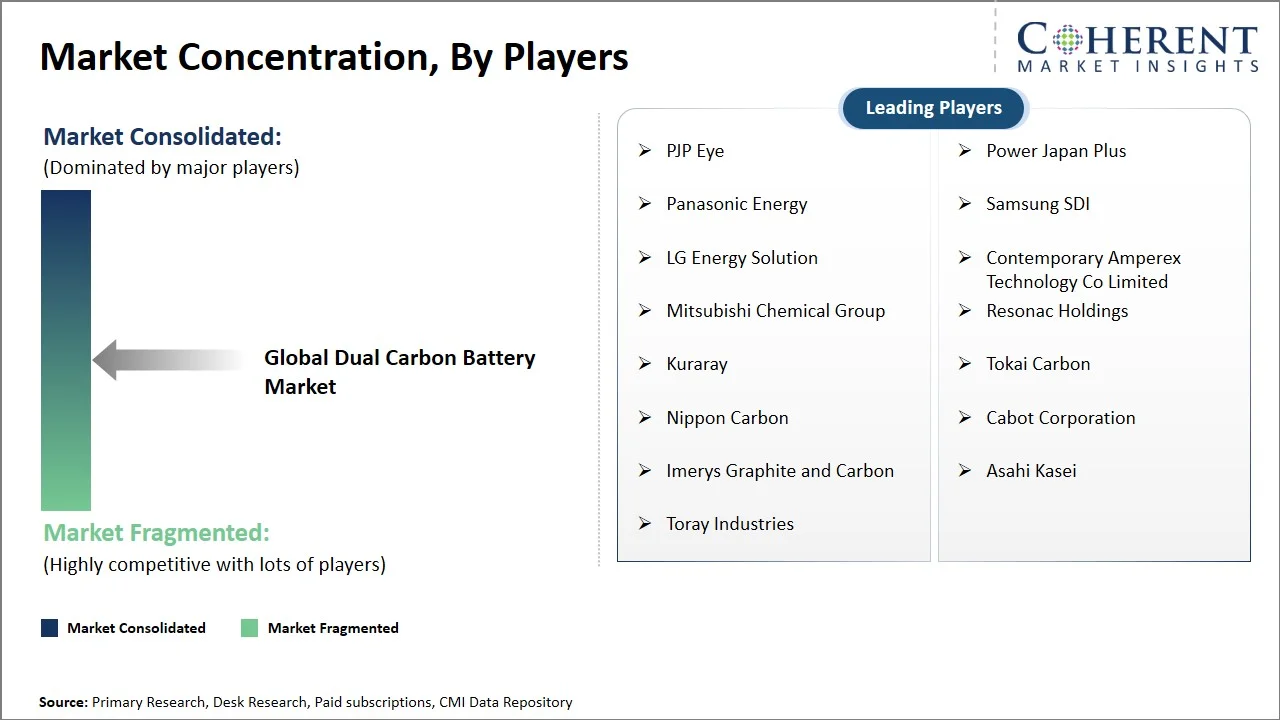
The global dual carbon battery market remains technology-led and moderately fragmented, with competition spread across battery startups, carbon material developers, university spin-offs, advanced battery manufacturers, and energy storage integrators. The market is still in an early commercialization phase, so players compete less on volume and more on performance validation, intellectual property, electrode chemistry, pilot manufacturing capability, and strategic customer access.
Key focus areas include
- Product quality and differentiation: Companies compete on charge rate, cycle life, voltage stability, thermal safety, and carbon-electrode performance.
- Technology adoption and process efficiency: Strong focus remains on electrode coating, electrolyte optimization, pouch-cell engineering, and scalable pilot production.
- Pricing and cost competitiveness: Players aim to reduce exposure to cobalt, nickel, and other expensive materials through carbon-rich battery designs.
- Capacity expansion and supply reliability: Early movers must secure graphite, carbon fiber, electrolyte, separator, and cell-assembly partners before large-scale contracts.
- Certifications, compliance, and quality control: Safety testing, transport certification, battery passport readiness, and recycling compliance are becoming critical.
- Specification differentiation: Cell format, voltage window, cycle performance, charge tolerance, and application-specific pack design influence customer selection.
- Partnerships and supplier agreements: OEM collaboration, research procurement, pilot programs, and contract manufacturing are central to commercialization.
- Sustainable positioning: Carbon-based chemistry, recyclability, and lower critical-mineral reliance are key messages for ESG-focused customers.
Market Report Scope
Dual Carbon Battery Market Report Coverage
| Report Coverage | Details | ||
|---|---|---|---|
| Base Year: | 2025 | Market Size in 2026: | USD 126.8 Mn |
| Historical Data for: | 2020 To 2024 | Forecast Period: | 2026 To 2033 |
| Forecast Period 2026 to 2033 CAGR: | 18.4% | 2033 Value Projection: | USD 413.6 Mn |
| Geographies covered: |
| ||
| Segments covered: |
| ||
| Companies covered: | PJP Eye, Power Japan Plus, Panasonic Energy, Samsung SDI, LG Energy Solution, Contemporary Amperex Technology Co Limited, Mitsubishi Chemical Group, Resonac Holdings, Kuraray, Tokai Carbon, Nippon Carbon, Cabot Corporation, Imerys Graphite and Carbon, Asahi Kasei, and Toray Industries | ||
| Growth Drivers: |
| ||
| Restraints & Challenges: |
| ||
Analyst Opinion (Expert Opinion)
- The global dual carbon battery market is expected to remain a high-growth, innovation-driven market over the forecast period, supported by demand for safer, faster-charging, and metal-light battery alternatives. Commercial adoption will likely begin in specialized mobility, electronics, and stationary storage applications before broader EV-scale deployment.
- The strongest growth pockets are expected in lithium-ion dual carbon batteries, pouch-cell formats, automotive applications, OEM partnerships, and Asia Pacific manufacturing ecosystems. North America is likely to gain momentum as policy incentives, domestic material sourcing, and advanced battery pilots improve regional competitiveness.
- Key risks include limited commercial-scale validation, electrolyte stability challenges, graphite supply concentration, certification delays, and competition from sodium-ion, silicon-anode, LFP, and solid-state technologies. Companies should focus on application-specific performance proof, safety certification, material traceability, and OEM co-development to build a defensible market position.
Speak to the analyst
Want personalized insights?
Take the findings above to one of our principal consultants, or have the report rebuilt around the segments, geographies and competitors you actually track.
Market Segmentation
- Battery Type Insights (Revenue, USD Mn, 2021 - 2033)
- Lithium Ion Dual Carbon Battery
- Sodium Ion Dual Carbon Battery
- Potassium Ion Dual Carbon Battery
- Others
- Cell Format Insights (Revenue, USD Mn, 2021 - 2033)
- Pouch Cells
- Prismatic Cells
- Cylindrical Cells
- Coin and Prototype Cells
- End-use Industry Insights (Revenue, USD Mn, 2021 - 2033)
- Automotive
- Energy and Utilities
- Electronics
- Industrial
- Research and Pilot Projects
- Others
- Sales Channel Insights (Revenue, USD Mn, 2021 - 2033)
- OEM Partnerships
- Direct Supply Agreements
- Research and Pilot Procurement
- Regional Insights (Revenue, USD Mn, 2021 - 2033)
- North America
- U.S.
- Canada
- Latin America
- Brazil
- Argentina
- Mexico
- Rest of Latin America
- Europe
- Germany
- U.K.
- Spain
- France
- Italy
- Russia
- Rest of Europe
- Asia Pacific
- China
- India
- Japan
- Australia
- South Korea
- ASEAN
- Rest of Asia Pacific
- Middle East
- GCC Countries
- Israel
- Rest of Middle East
- Africa
- South Africa
- North Africa
- Central Africa
- North America
- Key Players Insights
- PJP Eye
- Power Japan Plus
- Panasonic Energy
- Samsung SDI
- LG Energy Solution
- Contemporary Amperex Technology Co Limited
- Mitsubishi Chemical Group
- Resonac Holdings
- Kuraray
- Tokai Carbon
- Nippon Carbon
- Cabot Corporation
- Imerys Graphite and Carbon
- Asahi Kasei
- Toray Industries
Source
Primary Research Interviews
- Dual carbon battery developers and carbon-electrode battery technology companies
- Lithium ion, sodium ion, and potassium ion dual carbon battery technology developers
- Carbon electrode, graphite, hard carbon, activated carbon, graphene, and carbon fiber material suppliers
- Battery cell manufacturers producing pouch, prismatic, cylindrical, and prototype/coin cells
- Electrolyte, separator, binder, current collector, and battery additives supplier
- EV battery pack manufacturers, automotive OEMs, two-wheeler EV companies, drone manufacturers, and e-mobility platform developers
- Energy storage system integrators, utility-scale storage developers, renewable energy project developers, and grid storage solution providers
- Consumer electronics, industrial equipment, robotics, and backup power battery users
- Battery testing laboratories, certification agencies, safety testing experts, and electrochemistry researchers
- Battery recycling companies, carbon material recovery companies, and circular battery supply-chain consultants
Stakeholders
- Dual carbon and carbon-based battery technology developers: PJP Eye, Power Japan Plus, Graphene Manufacturing Group, Skeleton Technologies
- Battery cell and energy storage manufacturers: Panasonic Energy, Samsung SDI, LG Energy Solution, Contemporary Amperex Technology Co. Limited, Toshiba Energy Systems & Solutions, Murata Manufacturing
- Carbon and graphite material suppliers: Mitsubishi Chemical Group, Resonac Holdings, Tokai Carbon, Nippon Carbon, Cabot Corporation, Imerys Graphite & Carbon, SGL Carbon, GrafTech International
- Specialty carbon, activated carbon, and polymer/carbon material companies: Kuraray, Asahi Kasei, Toray Industries, Kureha Corporation, Showa Denko Materials
- Battery component suppliers: electrolyte producers, separator manufacturers, binder suppliers, foil/current collector suppliers, and conductive additive companies
- End-use sectors: Electric vehicles, two-wheelers, drones, consumer electronics, renewable energy storage, grid-scale storage, industrial backup systems, data centers, robotics, and pilot research applications
- Supporting ecosystem: Battery management system providers, module and pack assemblers, contract cell manufacturers, battery testing laboratories, recycling companies, and specialty chemical distributors
- Regulatory and certification bodies: U.S. Department of Energy, European Commission, Japan METI, China MIIT, Korea MOTIE, BIS India, IEC, UL Solutions, SAE International, UN ECE, and ISO
Databases
- U.S. Department of Energy – battery manufacturing, critical materials, storage technology, and clean energy funding data
- European Commission Battery Regulation and battery policy database – sustainability, recycling, carbon footprint, and battery passport requirement
- Japan METI and NEDO – next-generation battery strategy, Green Innovation Fund projects, and storage battery supply-chain initiatives
- China MIIT and Ministry of Commerce – battery manufacturing policies, graphite export controls, and new energy vehicle supply-chain updates
- Korea MOTIE and Korea Battery Industry Association – secondary battery manufacturing, technology, and export ecosystem data
- IEA Global EV Outlook and Batteries and Secure Energy Transitions – EV battery demand, energy storage, and chemistry trends
- IRENA – critical materials, EV battery materials, and renewable energy storage outlook
- USGS Mineral Commodity Summaries – graphite, lithium, and other battery material supply data
- UN Comtrade Database – trade flows for graphite, carbon materials, lithium batteries, battery cells, and battery components
- ITC Trade Map – import/export analysis for batteries, graphite electrodes, carbon products, and energy storage components
- Google Patents, WIPO Patentscope, and Espacenet – patents related to dual carbon batteries, dual-ion batteries, carbon electrodes, and fast-charging battery systems
Magazines / Industry Publications
- Battery Technology
- Batteries International
- Energy Storage News
- PV Magazine Energy Storage
- Power Technology
- Charged EVs
- InsideEVs
- Electrive
- Green Car Congress
- Benchmark Mineral Intelligence
- Battery Materials Review
- BEST Magazine
- EE Power
- Energy Digital
- TechCrunch Climate
- CleanTechnica
Journals
- Journal of Power Sources
- Energy & Environmental Science
- Advanced Energy Materials
- Journal of Materials Chemistry A
- Nature Energy
- Nature Communications
- ACS Energy Letters
- Electrochimica Acta
- Batteries & Supercaps
- Energy Storage Materials
- Carbon
- Carbon Energy
- Nano Energy
- Journal of The Electrochemical Society
- RSC Advances
- Korean Journal of Chemical Engineering
- Applied Energy
- Materials Today Energy
Newspapers / Credible News Sources:
- Reuters – battery supply chain, graphite trade, EV battery manufacturing, and energy storage investments
- Financial Times – critical minerals, battery strategy, and global EV industry developments
- The Wall Street Journal – battery commercialization, clean technology investment, and automotive supply chains
- CNBC – EV battery industry, clean energy technology, and manufacturing investments
- The Japan Times – Japanese battery innovation and industrial policy updates
- The Korea Herald – South Korean battery sector and policy updates
- China Daily – China EV, battery manufacturing, and energy storage industry updates
- The Hindu BusinessLine – India battery storage, EV, and energy transition developments
Associations
- International Energy Agency
- International Renewable Energy Agency
- Global Battery Alliance
- Battery Council International
- Recharge – The Advanced Rechargeable & Lithium Batteries Association
- European Battery Alliance
- Korea Battery Industry Association
- Japan Battery Association
- China Industrial Association of Power Sources
- SAE International
- International Electrotechnical Commission
- Institute of Electrical and Electronics Engineers
- Electrochemical Society
- Materials Research Society
- Graphene Flagship
- European Carbon and Graphite Association
Public Domain Sources
- U.S. Department of Energy – battery manufacturing grants, critical materials strategy, and energy storage initiatives
- U.S. Environmental Protection Agency – battery recycling, hazardous waste, and sustainability guidance
- European Commission – EU Battery Regulation, recycling efficiency, battery passport, and carbon footprint rules
- Japan METI – battery strategy, storage battery industry policy, and next-generation battery support
- NEDO – Green Innovation Fund projects, battery R&D, recycling technologies, and next-generation storage programs
- China Ministry of Industry and Information Technology – new energy vehicle and battery manufacturing policy updates
- China Ministry of Commerce – graphite and battery-related export control rules
- Korea MOTIE – rechargeable battery strategy, battery manufacturing support, and technology policy
- UN ECE – electric vehicle battery safety and transport-related regulations
- IEC – battery safety, performance, and testing standards
- ISO – battery quality, safety, sustainability, and environmental management standards
- USGS – graphite, lithium, and critical mineral supply data
- IEA – EV battery demand, battery chemistry mix, and stationary storage deployment trends
- IRENA – renewable energy storage, critical minerals, and battery value-chain analysis
Proprietary Elements
- CMI Data Analytics Tool, Proprietary CMI Existing Repository of information for last 10 years.
Get access to 250+ pages report
Every segment, forecast, competitor profile and data table behind the analysis above — available for instant download.
- ESOMAR Member
- ISO 9001:2015 Certified
- D-U-N-S Registered
- GDPR & CCPA Compliant
Missing comfort of reading report in your local language? Find your preferred language:
Transform your Strategy with Exclusive Trending Reports
Frequently Asked Questions
The CAGR of the global dual carbon battery market is projected to be 18.4% from 2026 to 2033.
Dual carbon batteries use carbon-based materials in both electrodes, helping improve charging speed, safety, cycle life, and sustainability compared to conventional lithium-ion battery designs.
Dual carbon batteries are mainly used in electric vehicles, energy storage systems, consumer electronics, industrial equipment, drones, and research-based pilot projects.
The global dual carbon battery market is estimated to be valued at USD 126.8 million in 2026 and is expected to reach USD 413.6 million by 2033.
Faster charging potential supporting interest in dual carbon battery technology and growing need for safer and lower cost alternatives to conventional lithium ion batteries are the major factors driving the growth of the global dual carbon battery market.
Limited commercial scale production restricting near term market penetration and performance validation challenges slowing adoption in automotive and grid applications are the major factors hampering the growth of the global dual carbon battery market.
In terms of battery type, lithium ion dual carbon battery is estimated to dominate the market revenue share in 2026.