

Global Edible Cake Paint Market Size and Forecast – 2026 To 2033
The Global Edible Cake Paint Market is estimated to be valued at USD 78.4 Mn in 2026 and is expected to reach USD 129.2 Mn by 2033, exhibiting a compound annual growth rate (CAGR) of 7.40% from 2026 to 2033. Growth is supported by the increasing commercialization of customized celebration cakes, visually distinctive bakery products, and food-safe decorative colors suitable for fondant, buttercream, icing, cookies, and confectionery. Social-media-oriented designs are also encouraging professional decorators and home bakers to purchase premium metallic, pearlescent, matte, and ready-to-use paints.
In January 2026, Finsbury Food Group launched the U.K.’s first cake-only bento box in Tesco, positioning the product as an Instagram-worthy format for birthdays, social gatherings, gifting, and smaller celebration occasions. The launch demonstrates how visually engaging and personalized cake formats are moving from specialist bakeries into mainstream retail, creating wider commercial opportunities for edible decorating colors and finishing products.
Key Takeaways of the Global Edible Cake Paint Market
- Ready to use liquid paint is expected to hold 63.8% of the global edible cake paint market in 2026 because it removes mixing variability, shortens decorating time, and supports repeatable coverage across professional bakeries and home-based businesses. In April 2026, Colour Mill detailed its Paint Blend formula as a straight-from-the-bottle range spanning matte and metallic shades, reinforcing convenience-led portfolio development.
- The metallic segment is expected to represent 38.4% of the market share in 2026 because small painted accents can create premium visual impact across celebration cakes, cookies, macarons, and chocolate pieces without materially changing the base product. In March 2025, a verified decorator review on Rainbow Dust’s official Cake Art Paint page reported layered gold coverage, fast drying, and no smudging or transfer.
- Cakes and cupcakes are expected to account for 44.6% of the market share in 2026 because their broad, visible surfaces accommodate lettering, portraits, gradients, themed artwork, and premium finishing, while frequent celebration purchases sustain color replenishment. In April 2025, Dawn Foods identified graduation-themed cakes and school-logo cupcakes as seasonal bakery opportunities, illustrating the commercial value of design-led customization.
- North America is expected to account for 34.2% of the market share in 2026, supported by a dense supplier base, established specialty retail, professional decorator education, and strong links between ingredient brands and bakery purchasers. In September 2025, IBIE in Las Vegas hosted 1,005 exhibitors on a sold-out 451,100-square-foot show floor, demonstrating the region’s deep commercialization infrastructure.
- Europe is expected to hold 30.1% of the market share in 2026 and expand the fastest as manufacturers invest in compliant natural pigments, application testing, and premium patisserie solutions suited to varied national requirements. In December 2025, European Food Safety Authority (EFSA) issued a positive scientific opinion on Jagua blue, opening a route toward EU authorization for a heat-stable color applicable to baked goods and instant icings.
- Multi-Surface Product Engineering for Wider Application Compatibility: Edible paint suppliers are prioritizing formulas that perform consistently across fondant, crusted buttercream, ganache, royal icing, cookies, macarons, and chocolate. Broader substrate compatibility reduces purchasing complexity for decorators and improves inventory productivity for retailers. It also strengthens brand loyalty because buyers can standardize techniques around a trusted system, creating opportunities for coordinated brushes, palettes, shade sets, and finishing accessories.
- Tutorial-Led Digital Selling and Customer Education Strategies: Visual education is becoming integral to product commercialization as buyers often evaluate opacity, drying behavior, brush control, and finished appearance before purchase. Brands that connect tutorials, creator partnerships, and project-based kits can shorten the learning curve and improve conversion. This approach favors agile online assortments, rapid seasonal merchandising, and content-supported launches that compete on demonstrated outcomes rather than color names alone.
Segmental Insights
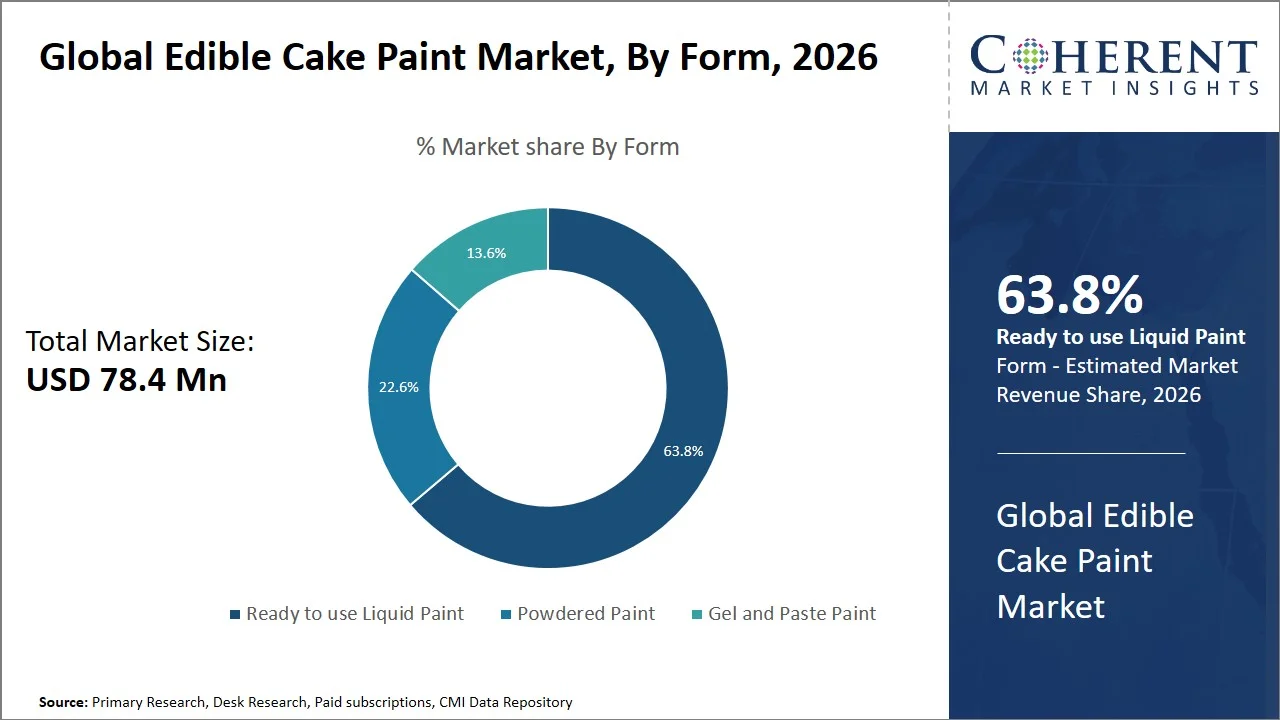
Why Does Ready to use Liquid Paint Dominate the Global Edible Cake Paint Market?
Ready to use liquid paint is expected to capture 63.8% of the global edible cake paint market in 2026 because it fits time-sensitive decorating workflows better than formats requiring activation, dilution, or shade reconstruction. Consistent viscosity allows decorators to move directly from bottle to palette, improving batch repeatability and reducing pigment waste across fondant, royal icing, chilled buttercream, macarons, and sugar decorations. The format also supports compact retail packaging, starter kits, and online shade bundles, giving manufacturers higher cross-selling potential with brushes, stencils, and palettes. Professional buyers benefit from predictable drying and coverage, while home bakers face a lower technical entry barrier. In July 2026, Oterra launched liquid versions of Jungle Blue and Arctic Blue, emphasizing immediate dispersion, uniform coloration, and elimination of pre-mixing, which strengthens the upstream formulation case for convenient liquid decorating systems.
- Current Industry Events of 2026
- Market Size Estimation
- Regional Breakdown
- Competitive Landscape
- Customer Intelligence
- Segmental Analysis
- Pricing Analysis
- Key Market Drivers, Challenges & Future Trends
- Customized Insights Section
Why Does Metallic Represent the Largest Finish Type in the Global Edible Cake Paint Market?
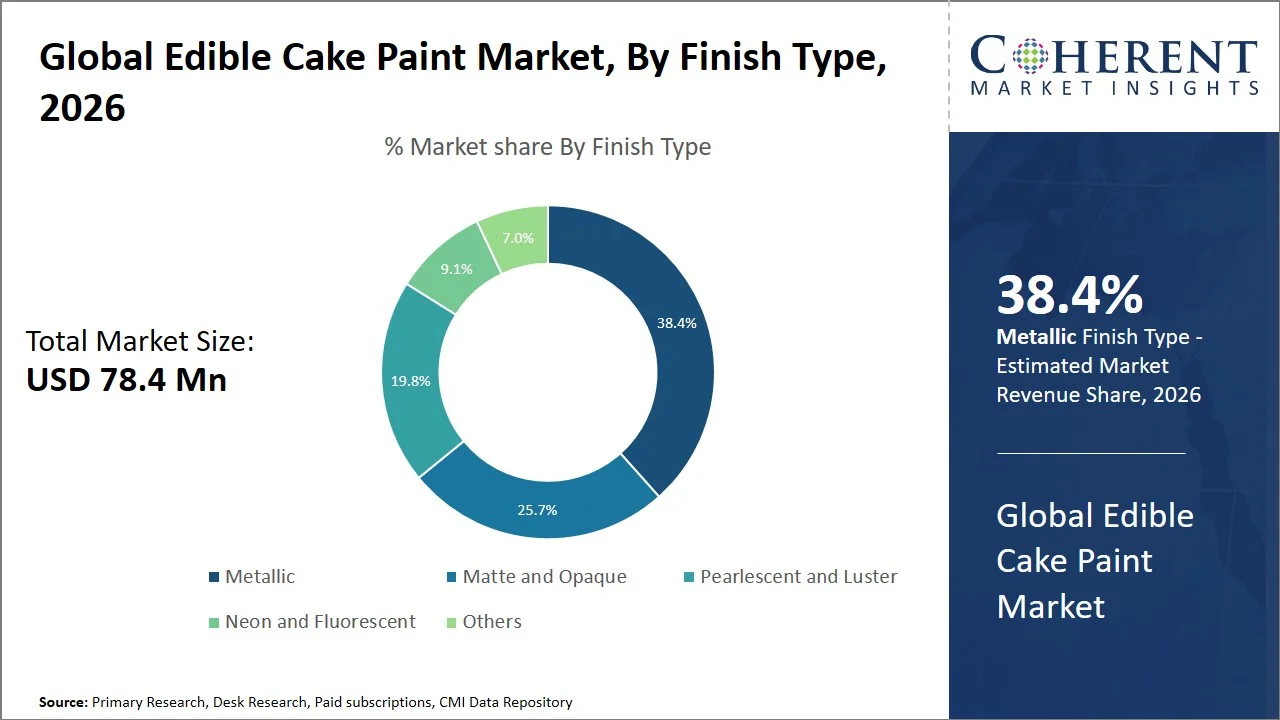
Metallic is expected to represent 38.4% of the global edible cake paint market in 2026 because reflective finishes create a premium appearance using limited surface coverage, helping decorators raise the perceived value of celebration products without redesigning the underlying cake. Gold, silver, bronze, and rose-gold paints are suited to borders, lettering, molded details, stenciling, geode effects, and accent work on fondant, chocolate, royal icing, and firm buttercream. For suppliers, metallic ranges support higher-value shade portfolios, coordinated finish sets, and professional-grade positioning. Product performance depends on pigment suspension, adhesion, rub resistance, and regulatory suitability, making formulation quality a stronger competitive factor than color breadth alone. In July 2026, the U.S. Food and Drug Administration updated its color-additive inventory confirming mica-based pearlescent pigments as permanently listed for confections and frostings, subject to specified use limitations.
Why Do Cakes and Cupcakes Dominate the Application Category of the Global Edible Cake Paint Market?
Cakes and cupcakes are expected to account for 44.6% of the global edible cake paint market in 2026 because these products combine frequent celebration demand with surfaces that support both broad coverage and precise artistic detailing. Tiered cakes accommodate portraits, florals, gradients, lettering, textures, and metallic accents, while cupcakes allow decorators to reproduce a coordinated theme across multiple units for parties, corporate events, and gifting. Their compatibility with fondant, crusted buttercream, ganache, icing plaques, and molded decorations broadens paint consumption across professional studios and home businesses. Manufacturers can build application-led kits around weddings, birthdays, seasonal occasions, and children’s themes, improving repeat purchases and tutorial-based online conversion. In July 2025, The Cake Decorating Company published a geode birthday cupcake tutorial that used gold edible paint as the finishing detail, demonstrating paint’s role in commercially replicable, themed cupcake decoration.
Current Events and their Impact
Current Event | Description and Its Impact |
California AB 2316 Signed – September 2024 |
|
West Virginia Food Dye Law – March 2025 |
|
Health Canada Permitted Food Colours List Updated – October 2025 |
|
Global Edible Cake Paint Market Dynamics
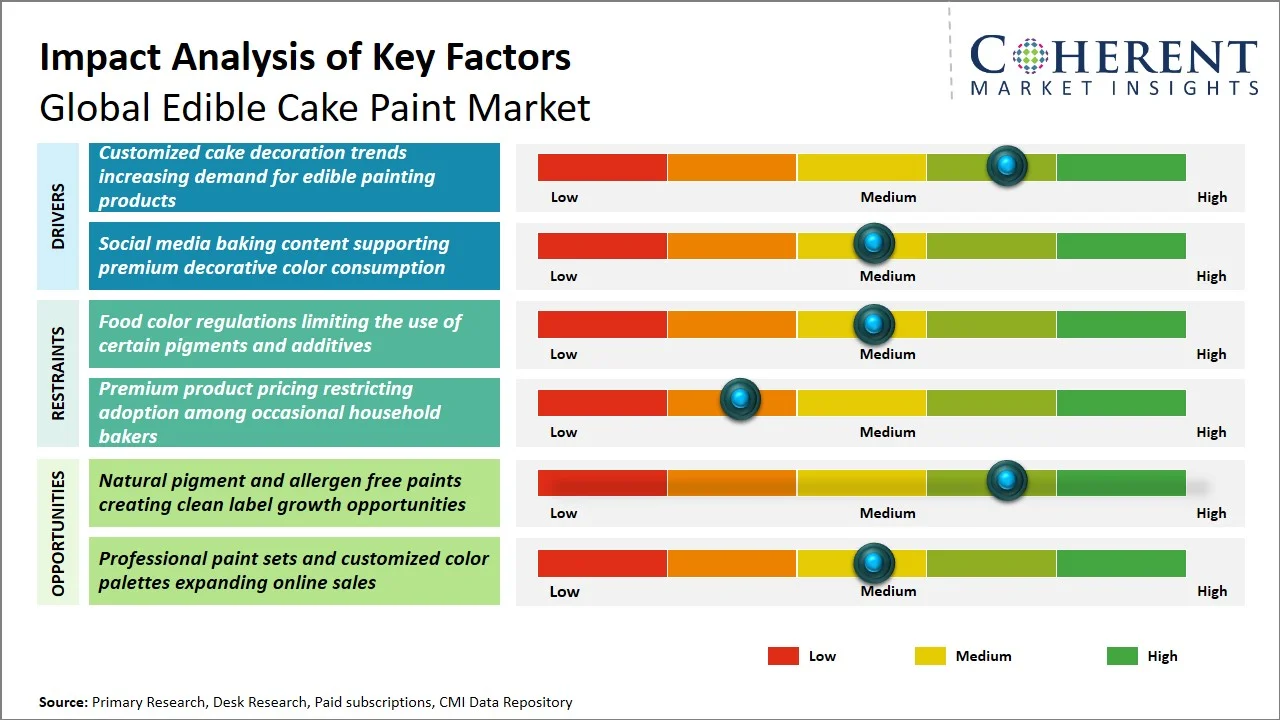
Key Market Drivers
Customization Converts Cake Decoration into a Premium Service
Customized cake decoration is expanding the addressable market for edible cake paint by converting visual design into a chargeable bakery service rather than a finishing afterthought. Wedding studios, independent cake artists, hotel pastry teams, and home-based businesses use painted lettering, portraits, florals, textures, and themed illustrations to differentiate orders without investing in complex molds or printed toppers. This increases demand for coordinated shade ranges, fine-detail brushes, opaque bases, and products compatible with fondant, royal icing, and firm buttercream. Suppliers benefit through premium kits and occasion-led assortments, while decorators gain greater pricing flexibility and faster design iteration. In December 2024, Pinterest identified “Chaos Cakes” as a 2025 trend and promoted personalized, unconventional cake artwork through commissioned creator collaborations, signaling commercial interest in highly individualized visual concepts.
Creator Tutorials Expand Product-Led Purchasing
Social-media baking content supports premium decorative color consumption by turning advanced techniques into repeatable, product-led demonstrations. Short videos allow viewers to compare opacity, layering, brush control, drying behavior, and finish quality before purchasing, reducing uncertainty around specialist edible paints. Creators also compress the product-discovery cycle: a single tutorial can introduce a new color combination, application surface, and tool set while linking audiences directly to online sellers. Brands, specialty retailers, culinary educators, and independent decorators benefit because instructional content raises technique confidence and stimulates multi-item purchases rather than isolated color sales. In March 2025, TikTok’s Pi Day program featured cake artist Robert Lucas demonstrating a measured, design-intensive cake project within the platform’s STEM learning initiative, illustrating how educational creator content can make sophisticated decoration processes accessible and commercially replicable.
Emerging Market Trends
Performance-Engineered Clean-Label Formulations
Clean-label reformulation is moving beyond ingredient replacement toward performance optimization. Manufacturers must maintain brightness, opacity, metallic effects, and shelf stability using plant-derived or exempt colors that can respond differently to light, pH, fat, and moisture. Suppliers with application laboratories, pigment expertise, and strong regulatory documentation will gain an advantage. Competition will increasingly depend on consistent performance across fondant, buttercream, chocolate, royal icing, and cookies.
Project-Based Decorating Systems
Edible cake paint suppliers have begun to supply whole decorating systems, which include cake colors, tools, instructions and accessories. Customized palettes, brush sets, stencils, guides and refill formats can help increase basket value and the likelihood of repeat purchase. Specialist retailers and direct-to-consumer brand benefit from easy project implementation and minimization of product misuse. Instead of simply being about shade, competition is becoming more about ease-of-use, how to apply shade and guaranteed results, at various levels of ability.
Regional Insights
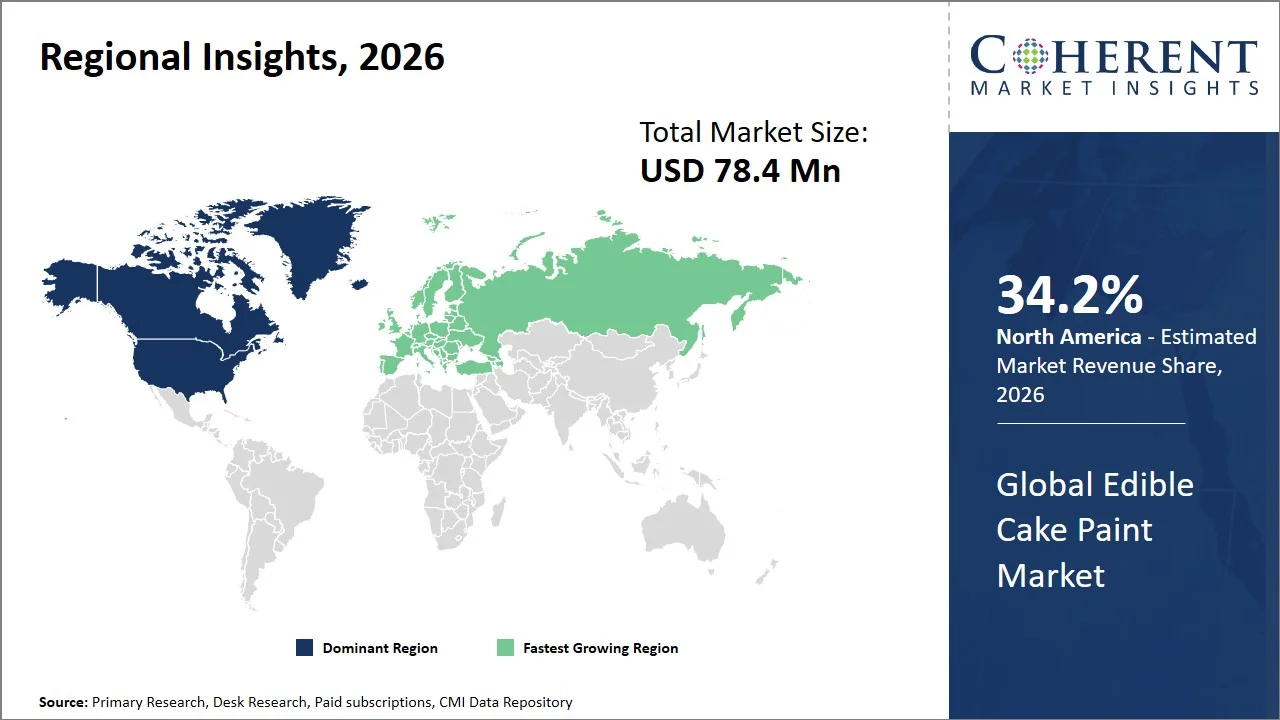
Why Does North America Dominate the Global Edible Cake Paint Market?
North America is expected to account for 34.2% of the global edible cake paint market in 2026, supported by a mature cake-decorating culture, strong specialty baking retail, widespread e-commerce access, and high participation from professional bakers, home-based decorators, and culinary schools. Demand is reinforced by frequent celebration-led purchases, premium customization, and the use of edible paints across fondant, buttercream, cookies, macarons, and chocolate surfaces. Regional suppliers also benefit from established color-ingredient expertise, efficient warehousing, and broad distribution into craft, foodservice, and industrial bakery channels. In March 2025, Döhler North America acquired Premier Juices, adding fruit-based ingredients, blending, packaging, warehousing, and quality-control capabilities while strengthening its natural colors and integrated ingredient offering. This improves the regional ecosystem for developing cleaner-label, application-specific edible decorating products.
Why is Europe Emerging as the Fastest-Growing Region in the Global Edible Cake Paint Market?
Europe is expected to represent 30.1% of the global edible cake paint market in 2026 and emerge as the fastest-growing region as premium patisserie, artisan bakery, home baking, and specialty confectionery create demand for differentiated visual finishes. Growth is also supported by retailer scrutiny of ingredient declarations, interest in naturally derived pigments, and the need for formulations that remain compliant across multiple national markets. Suppliers able to document color authorization, substrate suitability, and finished-product use levels are likely to gain an advantage with professional buyers. In November 2025, the European Commission updated its guidance on food-additive categories, explicitly covering cakes, muffins, biscuits, macarons, pastries, and related decorations, coatings, and fillings under the fine-bakery framework. The clarification supports more consistent product development and compliance planning for edible paint manufacturers serving Europe.
Global Edible Cake Paint Market Outlook for Key Countries
Why is the U.S. a Key Market for the Global Edible Cake Paint Market?
The U.S. is a key market for edible cake paint because it combines a large celebration-cake economy with extensive specialty retail, strong online purchasing, active creator-led product discovery, and a broad base of commercial and independent decorators. Buyers typically seek ready-to-use colors that deliver consistent opacity, rapid drying, and compatibility with fondant, royal icing, crusted buttercream, cookies, and confectionery. The country also has substantial technical capabilities in color formulation, food-safety testing, packaging, and direct-to-consumer merchandising. Regulatory changes are accelerating portfolio reformulation and creating room for natural alternatives. In May 2025, the U.S. Food and Drug Administration approved three color additives from natural sources, expanding the palette available for food manufacturers. This supports innovation in cleaner-label edible paints while increasing the importance of stability, shade consistency, and compliant labeling.
Why is India Important in the Global Edible Cake Paint Market?
India is becoming increasingly important in the global edible cake paint market as urban bakery chains, cloud kitchens, independent home bakers, culinary academies, and online ingredient sellers expand access to professional decorating materials. Demand is concentrated around birthdays, weddings, festivals, and customized gifting, where hand-painted fondant, metallic detailing, and themed cupcakes command higher value. Domestic manufacturers can compete through smaller pack sizes, climate-stable formulations, regional color palettes, and affordable kits designed for first-time users. At the same time, food-safety enforcement raises the value of verified food-grade ingredients and traceable supply. In November 2025, the Food Safety and Standards Authority of India listed enforcement action against the use of industrial dye Auramine in food products. The action strengthens the commercial case for certified edible colors, clearer labeling, and dependable sourcing among bakery decorators and ingredient retailers.
Why Does China Support Growth in the Global Edible Cake Paint Market?
China supports growth in the edible cake paint market through its large bakery-manufacturing base, dense e-commerce infrastructure, expanding café and patisserie formats, and strong capacity for producing pigments, packaging, brushes, and decorating accessories. Product demand is shaped by visually elaborate celebration cakes, social-media-led presentation, seasonal gifting, and the rapid commercialization of new bakery concepts. Local suppliers can scale quickly through integrated manufacturing clusters, while overseas brands gain access through distributors, marketplaces, and professional exhibitions. In December 2025, the China Bakery Exhibition’s autumn edition was scheduled in Shenzhen alongside a major hospitality and foodservice show, linking bakery, patisserie, ingredients, equipment, foodservice, and downstream buyers on one platform. This type of industry integration supports faster supplier discovery, application testing, and commercialization of edible paint ranges across professional and home-baking channels.
Why is Germany a Strategic Country in the Global Edible Cake Paint Market?
Germany is a strategic country for the global edible cake paint market because its bakery and confectionery sector places strong emphasis on product quality, ingredient compliance, process reliability, and premium finishing. The market offers opportunities for natural-color systems, precise metallic and matte effects, and professional products that perform predictably on marzipan, fondant, biscuits, pastries, and chocolate decorations. Germany also functions as an innovation and distribution gateway for wider European markets through ingredient companies, equipment suppliers, trade fairs, and artisan networks. In May 2025, iba in Düsseldorf brought together 985 exhibitors from 46 countries and 49,115 visitors from 149 countries across 100,000 square meters. The scale of the event demonstrates Germany’s role in connecting bakery decision-makers with new ingredients, decoration concepts, application methods, and commercial partnerships.
Why is Brazil an Important Growth Market for the Global Edible Cake Paint Market?
Brazil is an important growth market for edible cake paint because its large bakery and confectionery network serves frequent birthdays, weddings, seasonal celebrations, and impulse-led dessert purchases. Decorated cakes, brigadeiro-based creations, chocolate items, and customized sweets provide multiple surfaces for metallic, pearlescent, matte, and hand-painted effects. Growth opportunities are strengthened by independent bakeries, professional confectioners, training communities, social-commerce sellers, and regional distributors that can introduce affordable colors in smaller formats. Suppliers must also account for warm-climate stability and compatibility with chocolate, fondant, and sugar-based decorations. In July 2025, Puratos Brazil presented bakery, confectionery, and chocolate concepts at FIPAN, including reinvented traditional sweets, fruit-based variations, innovative formats, and sustainable presentation. The development highlights Brazil’s active professional ecosystem for visually differentiated bakery and confectionery products.
Technology Adoption Landscape in the Global Edible Cake Paint Market
Technology | Adoption Level | Key Application Area | Business Impact |
High-Shear Pigment Dispersion | High | Ready-to-use liquid and gel paint production | Produces uniform pigment distribution, reduces settling, and improves brush consistency across batches. |
Spectrophotometric Color Matching | High | Shade development and production quality control | Improves batch-to-batch accuracy and enables repeatable custom shades for professional bakery buyers. |
Rheology-Control Systems | High | Liquid, gel, and paste formulations | Balances brush flow, surface adhesion, opacity, and drip resistance on vertical or curved cake surfaces. |
Microencapsulation of Natural Pigments | Medium | Powdered paints and stability-sensitive natural colors | Protects pigments against moisture, oxygen, and light while extending usable shelf life. |
Plating-Grade Pigment Processing | Medium | Powder colors, metallic effects, chocolate, and fat-based applications | Improves dispersibility and shade uniformity where conventional water-soluble colors perform poorly. |
Food-Safe Airbrush Atomization | Medium | Gradients, broad coverage, stencil work, and high-volume decoration | Accelerates application, improves finish consistency, and expands professional use beyond hand brushing. |
How are Certified Inclusive Formulations Creating New Growth Opportunities in the Global Edible Cake Paint Market?
Allergen-aware, vegan, and religiously compliant edible paint systems represent an underdeveloped opportunity because professional decorators increasingly serve mixed-diet events but often assemble colors, carriers, alcohol-based activators, and finishing agents from separate suppliers. A verified system covering pigment origin, carrier composition, cross-contact controls, and certification status would reduce procurement risk for bakeries, caterers, culinary schools, and export-oriented distributors. Companies can capture this opportunity through water-based and alcohol-free variants, clearly documented vegan formulations, halal and kosher certification, multilingual technical sheets, and application testing on fondant, buttercream, chocolate, and royal icing. The strongest commercial model would combine certified core colors with premium metallic or pearlescent extensions and region-specific labeling. Participation requires traceable raw-material sourcing, dedicated quality assurance, migration and stability testing, and disciplined change-control procedures. Established color specialists have an advantage in compliance infrastructure, but focused new entrants can compete through transparent formulation, smaller order quantities, and direct relationships with independent decorators and specialty baking retailers.
Market Players, Key Development, and Competitive Intelligence
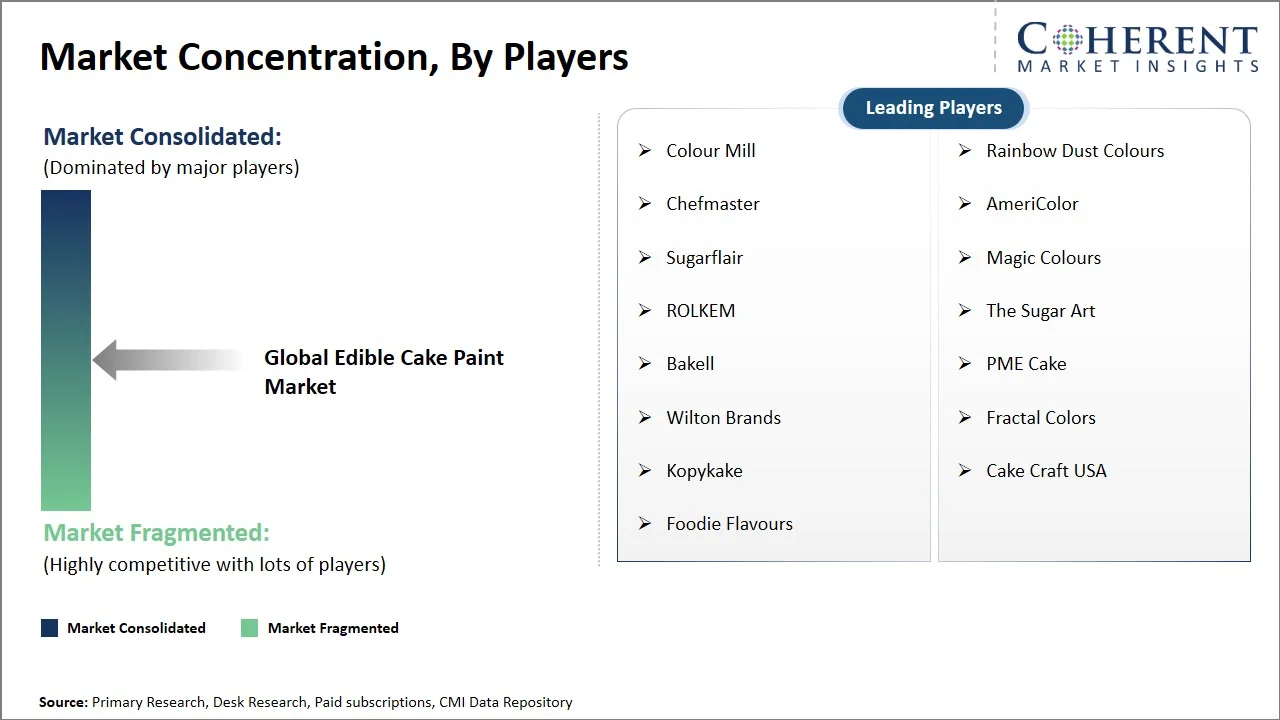
Key Developments
- In April 2026, GNT opened its first dedicated sales and application office in China for its plant-based EXBERRY color portfolio. The Shanghai facility includes an application laboratory for customer training, formulation support, concept development, and stability testing. This is important for the global edible cake paint market because localized technical support can shorten product-development cycles and improve access to clean-label pigment systems for Chinese bakery and decorating-product manufacturers.
- In March 2026, Prodalim inaugurated a Natural Colors R&D Center in Slovenia to advance color technologies derived from fruits, vegetables, algae, and spices. The facility will support tailor-made development for bakery and other food applications. This is important for the global edible cake paint market because dedicated application testing can improve natural pigment stability, shade customization, and compatibility with different icing and cake-decoration systems.
- In April 2025, Phytolon and Ginkgo Bioworks completed a development milestone for fermentation-derived natural food colors, substantially improving production efficiency for color strains intended for applications including baked goods, toppings, and icings. This is important for the global edible cake paint market because fermentation-based production could broaden pigment supply, reduce dependence on agricultural extraction, and improve the cost competitiveness of clean-label red, yellow, orange, pink, and purple formulations
Competitive Landscape
The global edible cake paint market is fragmented, comprising specialist decorating brands, food-color formulators, bakery-ingredient suppliers, regional manufacturers, private-label producers, and craft-oriented online sellers. Competition centers on pigment safety, shade intensity, opacity, application control, surface compatibility, regulatory documentation, and dependable product availability. Large ingredient companies contribute formulation science and scale, while smaller specialists compete through rapid shade launches, decorator relationships, compact packaging, and niche finishes. Regional suppliers remain important where local labeling rules, price sensitivity, and distributor access influence purchasing.
Key focus areas include
- Application performance: Brushability, drying time, rub resistance, and coverage determine professional acceptance.
- Regulatory assurance: Documented pigment authorization and accurate ingredient declarations reduce distributor risk.
- Finish differentiation: Metallic, pearlescent, matte, opaque, and fluorescent effects support premium positioning.
- Pack-size architecture: Small consumer bottles, professional refills, and curated sets address different purchasing economics.
- Supply consistency: Stable pigment sourcing and repeatable shades are critical for decorators completing multi-stage orders.
- Channel access: Specialty baking stores, marketplaces, direct websites, and B2B distributors require different merchandising models.
- Private-label capability: Flexible formulation and low minimum-order quantities help retailers create exclusive product ranges.
- Technical support: Surface-specific instructions and troubleshooting strengthen customer retention and reduce negative reviews.
Market Report Scope
Edible Cake Paint Market Report Coverage
| Report Coverage | Details | ||
|---|---|---|---|
| Base Year: | 2025 | Market Size in 2026: | USD 78.4 Mn |
| Historical Data for: | 2020 To 2024 | Forecast Period: | 2026 To 2033 |
| Forecast Period 2026 to 2033 CAGR: | 7.40% | 2033 Value Projection: | USD 129.2 Mn |
| Geographies covered: |
| ||
| Segments covered: |
| ||
| Companies covered: | Colour Mill, Rainbow Dust Colours, Chefmaster, AmeriColor, Sugarflair, Magic Colours, ROLKEM, The Sugar Art, Bakell, PME Cake, Wilton Brands, Fractal Colors, Kopykake, Cake Craft USA, and Foodie Flavours | ||
| Growth Drivers: |
| ||
| Restraints & Challenges: |
| ||
Analyst Opinion (Expert Opinion)
- Market leadership is likely to depend increasingly on substrate-specific and jurisdiction-ready portfolios rather than the number of colors offered. Suppliers that organize products according to fondant, buttercream, chocolate, royal icing, and cookie performance—and provide the corresponding compliance documentation should gain stronger professional loyalty than brands competing mainly through novelty shade additions.
- Hybrid digital-decoration workflows could materially reshape the market. Commercial decorators may combine image-design software, edible printing, precision airbrushing, and manual paint finishing to reproduce complex designs more efficiently. Standalone hand-paint products could face pressure in repeat-order applications, while suppliers integrating paints with printable templates, stencil systems, and controlled spraying technologies may capture greater workflow value.
- Manufacturers should prioritize natural pigment stability, diverse raw-material sourcing, alcohol-free systems, and multi-country regulatory documentation. Investment should focus on products that solve verified application problems rather than oversized novelty portfolios that create slow-moving inventory. Partnerships with culinary educators, specialty distributors, and professional decorators can improve validation, while disciplined pricing is necessary to offset the higher formulation and testing costs associated with compliant premium colors.
Speak to the analyst
Want personalized insights?
Take the findings above to one of our principal consultants, or have the report rebuilt around the segments, geographies and competitors you actually track.
Market Segmentation
- Form Insights (Revenue, USD Mn, 2021 - 2033)
- Ready to use Liquid Paint
- Powdered Paint
- Gel and Paste Paint
- Finish Type Insights (Revenue, USD Mn, 2021 - 2033)
- Metallic
- Matte and Opaque
- Pearlescent and Luster
- Neon and Fluorescent
- Others
- Application Insights (Revenue, USD Mn, 2021 - 2033)
- Cakes and Cupcakes
- Cookies and Biscuits
- Fondant and Sugarcraft
- Chocolates and Confectionery
- Others
- Distribution Channel Insights (Revenue, USD Mn, 2021 - 2033)
- Online Retail
- Specialty Baking Stores
- Supermarkets and Hypermarkets
- Direct B2B Sales
- Others
- Regional Insights (Revenue, USD Mn, 2021 - 2033)
- North America
- U.S.
- Canada
- Latin America
- Brazil
- Argentina
- Mexico
- Rest of Latin America
- Europe
- Germany
- U.K.
- Spain
- France
- Italy
- Russia
- Rest of Europe
- Asia Pacific
- China
- India
- Japan
- Australia
- South Korea
- ASEAN
- Rest of Asia Pacific
- Middle East
- GCC Countries
- Israel
- Rest of Middle East
- Africa
- South Africa
- North Africa
- Central Africa
- North America
Sources
Primary Research Interviews
- Edible cake paint manufacturers, food-color formulators, bakery ingredient suppliers, private-label producers, importers, distributors, specialty retailers, and e-commerce sellers
- R&D, formulation, production, quality, regulatory, packaging, marketing, distribution, and sales executives
- Professional decorators, pastry chefs, bakery owners, confectioners, culinary instructors, and home-baking businesses
Stakeholders
- Pigment and food-color suppliers, packaging companies, brush and airbrush providers, testing laboratories, and certification agencies
- Commercial bakeries, cake studios, confectionery manufacturers, hotels, restaurants, caterers, cafés, culinary schools, and supermarket bakeries
- Wholesalers, online marketplaces, distributors, importers, exporters, and logistics providers
End-use Sectors
- Celebration cakes, wedding cakes, customized cakes, and cupcakes
- Cookies, biscuits, macarons, gingerbread, and royal-icing products
- Fondant, gum paste, modeling chocolate, marzipan, and sugarcraft
- Chocolates, confectionery, cake pops, edible toppers, and dessert decorations
Regulatory and Government Bodies
- U.S. FDA, USDA, and state food-safety authorities
- European Commission, EFSA, UK FSA, and Food Standards Scotland
- Health Canada, CFIA, FSSAI, China NHC, SAMR, and General Administration of Customs
- Brazil ANVISA, Food Standards Australia New Zealand, and Codex Alimentarius Commission
Databases
- UN Comtrade, ITC Trade Map, WTO Statistics, Eurostat, World Bank, OECD, and UNIDO
- USITC DataWeb, U.S. Census, Statistics Canada, UK Trade Info, India DGCI&S, China Customs, and Brazil Comex Stat
- FDA Color Additive Status List, EU Food Additives Database, EFSA OpenFoodTox, Health Canada additive lists, and Codex GSFA
- PubMed, ScienceDirect, Scopus, Espacenet, company filings, product catalogues, pricing records, and distributor databases
Magazines and Journals
- Baking & Snack, Baking Business, Bake Magazine, British Baker, Food Business News, FoodNavigator, and ConfectioneryNews
- Food Chemistry, Journal of Food Science, LWT, Foods, Food Additives & Contaminants, and International Journal of Gastronomy and Food Science
Associations
- American Bakers Association
- Retail Bakers of America
- International Association of Color Manufacturers
- Natural Food Colours Association
- Federation of Bakers
- CAOBISCO
- AIB International
- International Dairy Deli Bakery Association
Public Domain Sources
- Food-additive approvals, labeling rules, food-safety notices, import regulations, and enforcement actions
- Annual reports, press releases, product catalogues, technical data sheets, ingredient declarations, and certificates of analysis
- Patents, stability studies, toxicological assessments, retail listings, distributor records, trade data, and professional decorating tutorials
Key Standards and Regulations
- U.S. Federal Food, Drug, and Cosmetic Act, Title 21 CFR, FSMA, GMP, and allergen-labeling requirements
- EU Regulations 1333/2008, 231/2012, and 1169/2011
- UK food-additive and labeling requirements
- FSSAI food-additive, packaging, labeling, and safety regulations
- China GB 2760 and GB 7718 standards
- Canadian Food and Drug Regulations and Health Canada additive lists
- Brazil ANVISA and Codex requirements
- ISO 22000, HACCP, FSSC 22000, BRCGS, and GMP standards
Proprietary Elements
- CMI Data Analytics Tool
- Proprietary CMI Existing Repository of information for last 10 years.
Get access to 250+ pages report
Every segment, forecast, competitor profile and data table behind the analysis above — available for instant download.
- ESOMAR Member
- ISO 9001:2015 Certified
- D-U-N-S Registered
- GDPR & CCPA Compliant
Missing comfort of reading report in your local language? Find your preferred language:
Transform your Strategy with Exclusive Trending Reports
Frequently Asked Questions
The CAGR of the global edible cake paint market is projected to be 7.40% from 2026 to 2033.
The global edible cake paint market is estimated to be valued at USD 78.4 Mn in 2026 and is expected to reach USD 129.2 Mn by 2033.
Metallic finish leads the market due to its widespread use in premium cakes, cookies, fondant decorations, and confectionery products.
Cakes and cupcakes account for the highest demand because they offer broad surfaces for customized artwork, lettering, themes, and decorative finishes.
Online retail is the leading distribution channel, supported by wider product availability, shade comparison, tutorial-based purchasing, and direct access to specialty decorating brands.
Customized cake decoration trends increasing demand for edible painting products and social media baking content supporting premium decorative color consumption are the major factors driving the growth of the global edible cake paint market.
Food color regulations limiting the use of certain pigments and additives and premium product pricing restricting adoption among occasional household bakers are the major factors hampering the growth of the global edible cake paint market.