

Halal Food Market Size and Forecast — 2026-2033
Halal Food Market is estimated to be valued at USD 1,426.57 Bn in 2026 and is expected to reach USD 3,356.15 Bn in 2033, exhibiting a compound annual growth rate (CAGR) of 13.0% from 2026 to 2033. Halal Food are food items that are free from components that are prohibited for consuming by for Muslim community, according to the Islamic law. These foods are prepared, processed, produced, manufactured, and stored in cleaned utensils and machinery according to laws of Islamic community. According to the World Health Organization (WHO), 2021 the global Muslim population is expected to grow twice as fast as non-Muslims by 2030. By 2030, Muslims are expected to comprise over a quarter of the global population. Moreover, according to the WHO, the global population of Muslims is around 2.0 Bn in 2023. Increasing use of halal products by general population globally is expected to drive growth of the global halal food market over the forecast period.
However, the increased demand for halal food in the retail sector helped to offset some of these losses.
Global Halal Food Market - Growth Drivers
- Growing Muslim population all over the globe
Growing Muslim population around the world leads to market's expansion. Increasing demand for halal-certified food from Muslims due to the encouragement of food safety and sanitation is anticipated to fuel market expansion. For instance, the Muslim population in 2023 is 2.0 bn and it is expected to reach 3 bn by 2060.
- Government initiatives and regulations
Governments in many Muslim-majority countries are taking steps to support the growth of the halal food industry. For instance, the Malaysia government launched the Halal Industry Master plan 2030 that aims to make Malaysia a global halal club. Moreover, the Government of Indonesia introduced mandatory halal labelling and certification rules in 2019, owing to which consumers prefers halal food nowadays.
- Increasing non- Muslim interest in halal food
Growing interest in halal food among non-Muslim consumers, as halal food is healthier and safer leads to increasing demand for halal products in non-Muslim countries. For instance, in 2020, the global halal food market is increasing the popularity of halal-certified restaurants in non-Muslim countries such as the U.K`S Halal Food Festival, and growing demand for premium halal products such as organic halal meat in the U.S.
Global Halal Food Market - Restraints
- Lack of Standardization
One of the major challenges faced by the global halal food market is the lack of standardization in the certification process. Different countries have different halal certification procedures that can create confusion and make it difficult for businesses to expand into new market. Some countries can require specific slaughter methods, while others may have additional requirements for the handling and processing of halal products. Moreover, there is a lack of clarity on halal ingredients is also leads to hinder the growth of the market. For instance, there is a lack of clarity on which ingeredients are halal and which are not. This can lead to confusion among consumers and manufacturers, and can also result in non-halal ingredients being used in halal food products.
Figure 1. Global Halal Food Market, By Distribution Channel, 2026
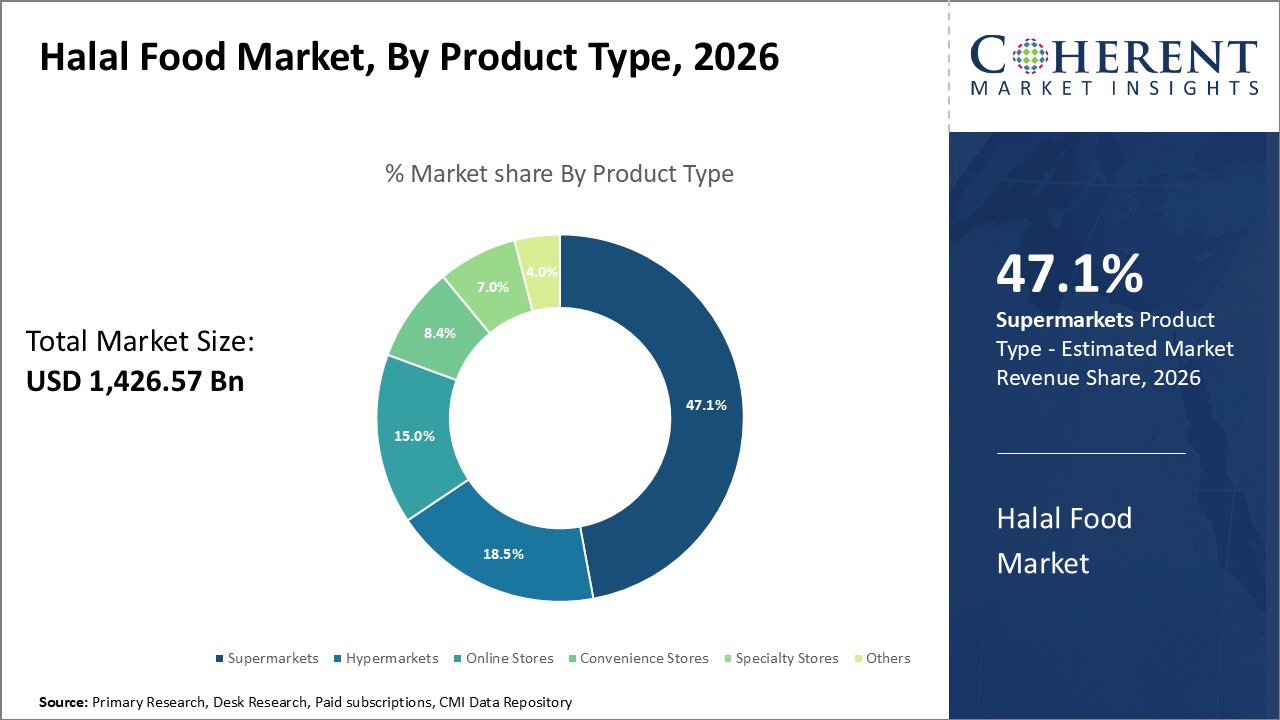
Among distribution channel, the supermarket segment accounted for the largest revenue share of 47.10% in 2026 in the global halal food market. Growing presence of supermarket chains is fuels the segment growth. For instance, according to U.S. Department of Agriculture (U.S.DA) 2020report, modern retail channels, such as supermarkets, hypermarkets and convenience stores, have a combined 3,914 outlets and represent around 26 percent of total sales. Traditional grocery retailers have 113,724 and represent 74 percent of total sales. Small traditional grocers remain the dominant retail outlet in Egypt Moreover, promotional and marketing activities in form of offering lucrative discounts on products, wide variety of products available, and fair presence of private label products are some of the key factors attributing to rapid growth of this segment.
- Current Industry Events of 2026
- Market Size Estimation
- Regional Breakdown
- Competitive Landscape
- Customer Intelligence
- Segmental Analysis
- Pricing Analysis
- Key Market Drivers, Challenges & Future Trends
- Customized Insights Section
Halal Food Market Report Coverage
| Report Coverage | Details | ||
|---|---|---|---|
| Base Year: | 2025 | Market Size in 2026: | USD 1,426.57 Bn |
| Historical Data for: | 2020 To 2024 | Forecast Period: | 2026 To 2033 |
| Forecast Period 2026 to 2033 CAGR: | 13.0% | 2033 Value Projection: | USD 3,356.15 Bn |
| Geographies covered: |
| ||
| Segments covered: |
| ||
| Companies covered: | Cargill Inc., Al Islami Foods, QL Resources Sdn Bhd, Haoyue Group, Kawan Food Berhad, BRF S.A., Saffron Road Food, | ||
| Growth Drivers: |
| ||
| Restraints & Challenges: |
| ||
Global Halal Food Market– Recent Developments
- In January 2016, Kawan Food Berhad is one of Malaysia's leading exporter and largest manufacturer of frozen Asian food delicacies worldwide, invested US$ 0.0258 billion for the expansion of product demand of its manufacturing facility at Selangor Halal Hub in Pulau Indah, Malaysia. The objective was to cater to increasing demand for its food products.
- In 2021, Crescent Foods, an U.S.-based pioneer in premium hand-cut halal meat and poultry products, introduced turnkey foodservice program for university and college dining halls, nationally. The company will provide extensive range of products including turkey (seasonally), hand-cut beef, lamb, and chicken products for on-campus dining including restaurants.
- In 2022, Chicken Cottage limited is a UK-based fast food chain. The company is the master franchisor and owner of the "Chicken Cottage" brand. Announced to enter the East African market with the help of franchising partnership agreement with Express Kitchen, a subsidiary of All About Health AAH Limited, to develop their business line.
- In 2021, Nigeria entered into partnership with OneAgrix for better Agriculture and Halal market access under African Continental Free Trade Area (AfCFTA). With this partnership, Nigeria will gain better market access by using OneAgrix’s trading platform both globally and regionally.
Global Halal Food Market– Regional Insights
Asia Pacific held the largest revenue share of 57.5% in the global halal food market in 2026, and is expected to maintain its dominance over the forecast period. Furthermore, Asia Pacific region is projected to be fastest growing region in the global halal food market during the forecast period. The growth of Asia Pacific halal food market is attributed to presence of Halal Certification authorities in Asia Pacific that are gaining trust of consumers. For instance, Department of Islamic Development of Malaysia has 56 halal certification bodies in 33 economies such as China, Taiwan, and others. This helps halal certified products to develop extensive distribution and business across Asia Pacific.
Figure 2. Global Halal Food Market, By Region, 2026
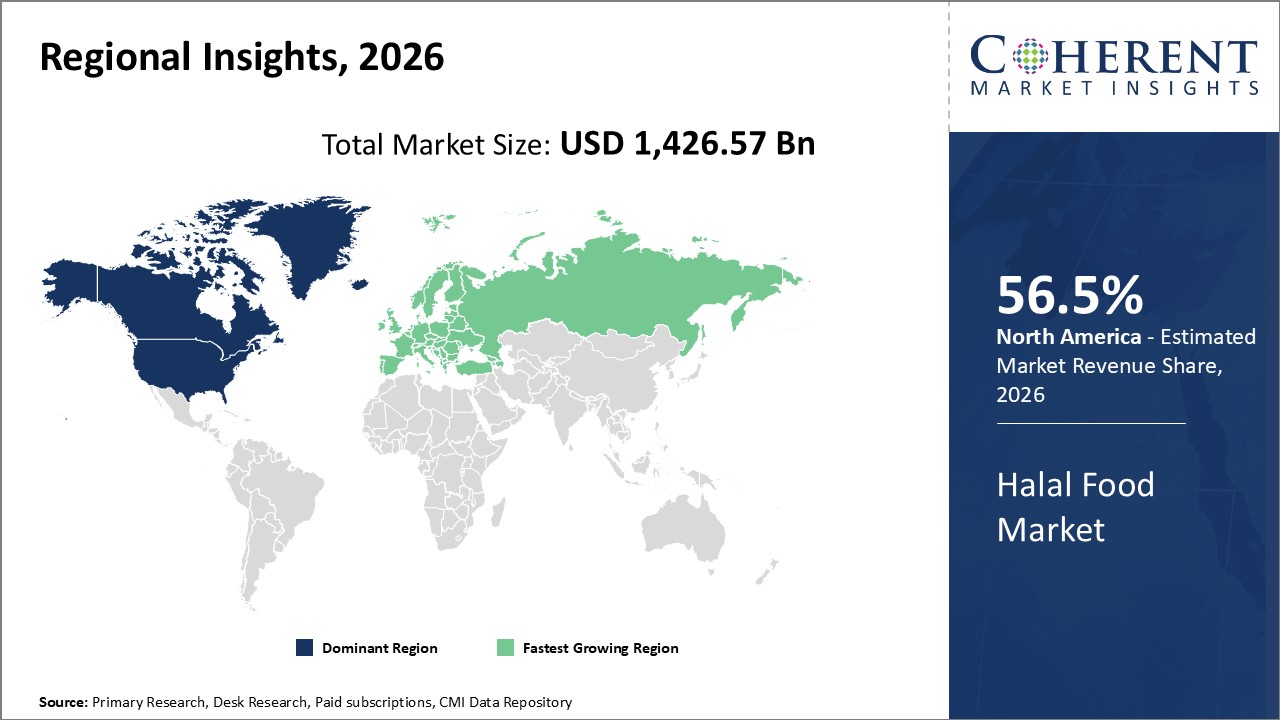
During the forecast period of 2023–2030, Europe is expected to experience the fastest growth, due to rising trend of certified products in this region. Moreover, growing consumer awareness of product will boost market growth in this region. For instance, in 2020, O’Tacos, a France-based fast-food chain, announced the launch of halal-certified French-style meat and vegetable wraps in Italy.
Global Halal Food Market – Key Players
Major players operating in the global halal food market include Cargill Inc., Al Islami Foods, QL Resources Sdn Bhd, Haoyue Group, Kawan Food Berhad, BRF S.A., and Saffron Road Food.
Sources
Primary Research Interviews
- Halal food processors (BRF, Al Islami, Midamar, Saffron Road)
- Halal certification body auditors (JAKIM, MUIS, ESMA)
- Retail category managers in Muslim-majority markets and halal export markets
Databases
- SMIIC halal standards
- State of the Global Islamic Economy Report data (DinarStandard)
Magazines
- Salaam Gateway
- Food Business News
Journals
- Journal of Islamic Marketing (Emerald)
Newspapers
- Reuters Commodities
Associations
- World Halal Food Council
- JAKIM (Malaysia)
Public Domain Sources
- UAE ESMA/MoIAT
- Saudi SFDA
Proprietary Elements
- CMI Data Analytics Tool, Proprietary CMI Existing Repository of information for last 10 years.
Definition: All food that is permissible to eat according to the teachings of Islam is called Halal food. This is essentially any food that does not fall into the category of Haram (or forbidden) . In Islam, all foods and beverages are Halal except for those that were explicitly forbidden in the Quran.
Get access to 250+ pages report
Every segment, forecast, competitor profile and data table behind the analysis above — available for instant download.
- ESOMAR Member
- ISO 9001:2015 Certified
- D-U-N-S Registered
- GDPR & CCPA Compliant
Missing comfort of reading report in your local language? Find your preferred language:
Transform your Strategy with Exclusive Trending Reports
Frequently Asked Questions
The Halal Food Market is estimated to be valued at USD 1,426.57 Bn in 2026, and is expected to reach USD 3,356.15 Bn by 2033.
Global halal food market is estimated to reach US$ 2,306.2 Bn by 2033.
Major players operating in the market include Cargill Inc., Al Islami Foods, QL Resources Sdn Bhd, Haoyue Group, Kawan Food Berhad, BRF S.A., and Saffron Road Food.
Lack of standardization of halal food products is one of the major factors that is expected to hamper of the market
Increasing Muslim population, government initiatives and regulations of halal products are some of the major factors that are expected to propel growth of the market over the forecast period.
The CAGR of the Halal Food Market is projected to be 13.0% from 2026 to 2033.
Among region, Asia Pacific is expected to hold dominant position in the market