

Global eFuse Market Size and Forecast – 2026-2033
The Global eFuse Market is estimated to be valued at USD 6.1 Mn in 2026 and is expected to reach USD 8.6 Mn by 2033, exhibiting a compound annual growth rate (CAGR) of 5.1% from 2026 to 2033.
Key Takeaways of the eFuse Market
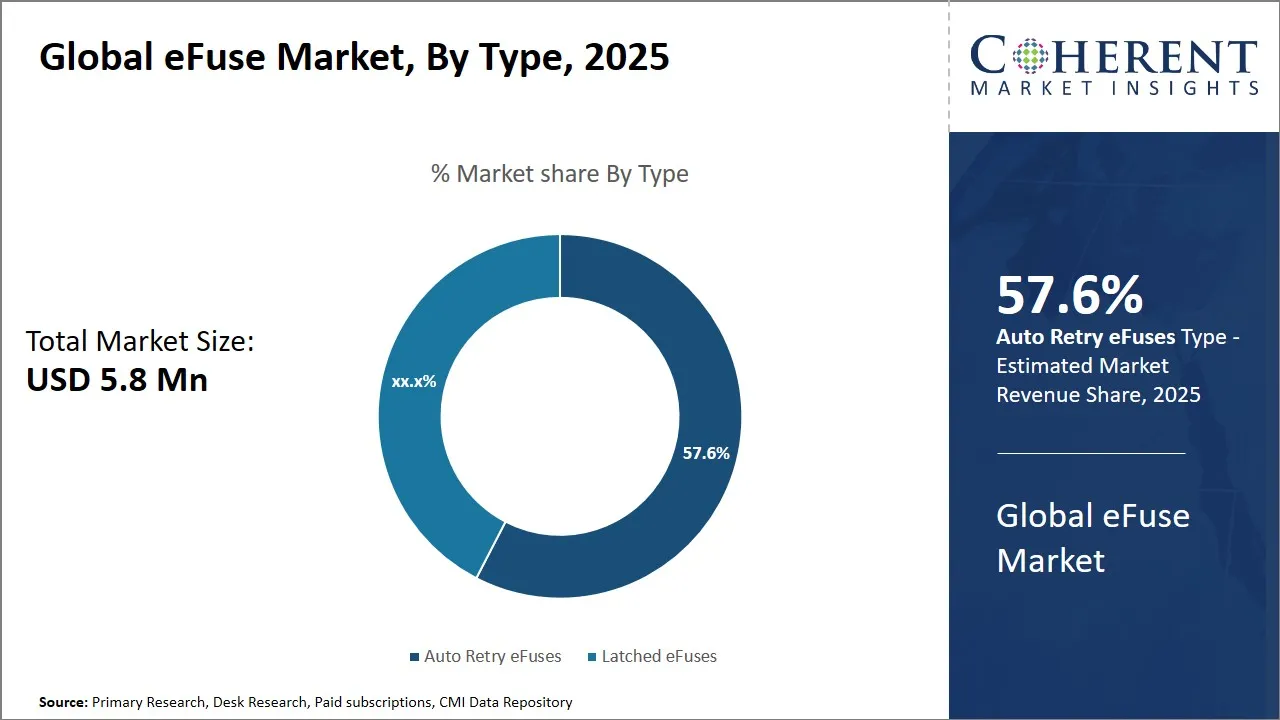
- The Auto-retry eFuses leads the market holding an estimated share of 58.6 % in 2026.
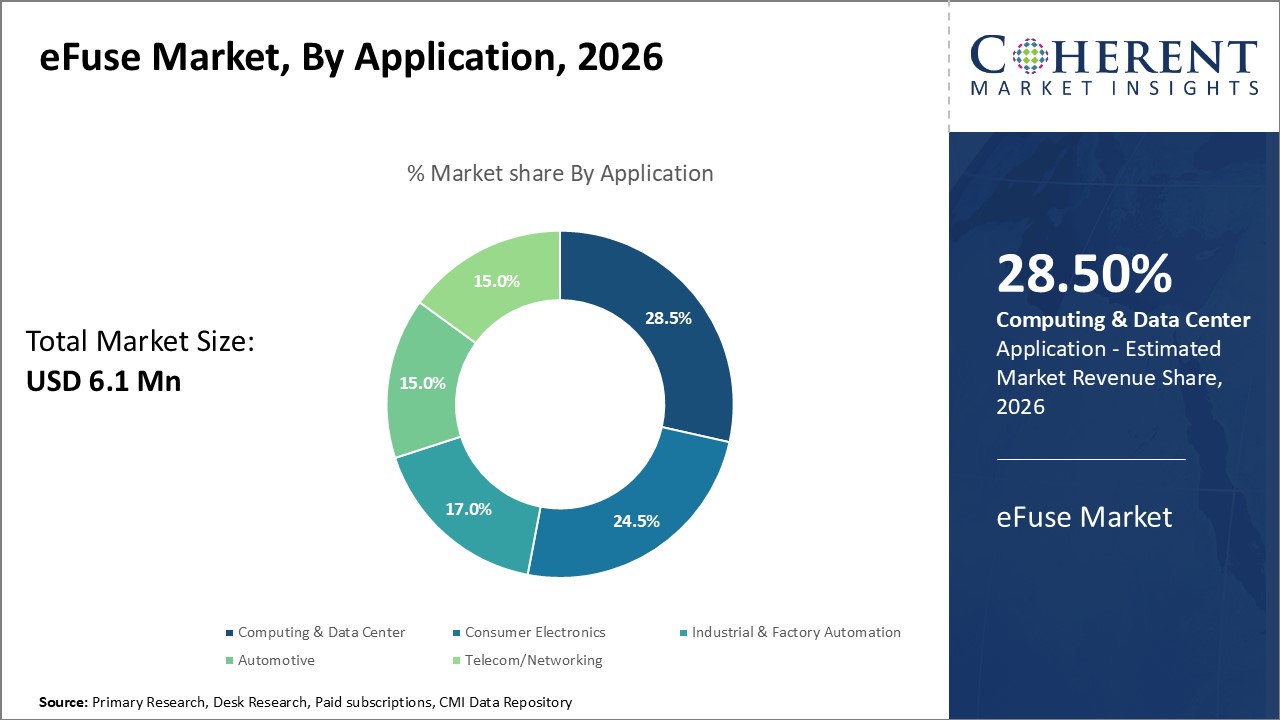
- The Computing & Data Center segment leads the market holding an estimated share of 28.5% in 2026.
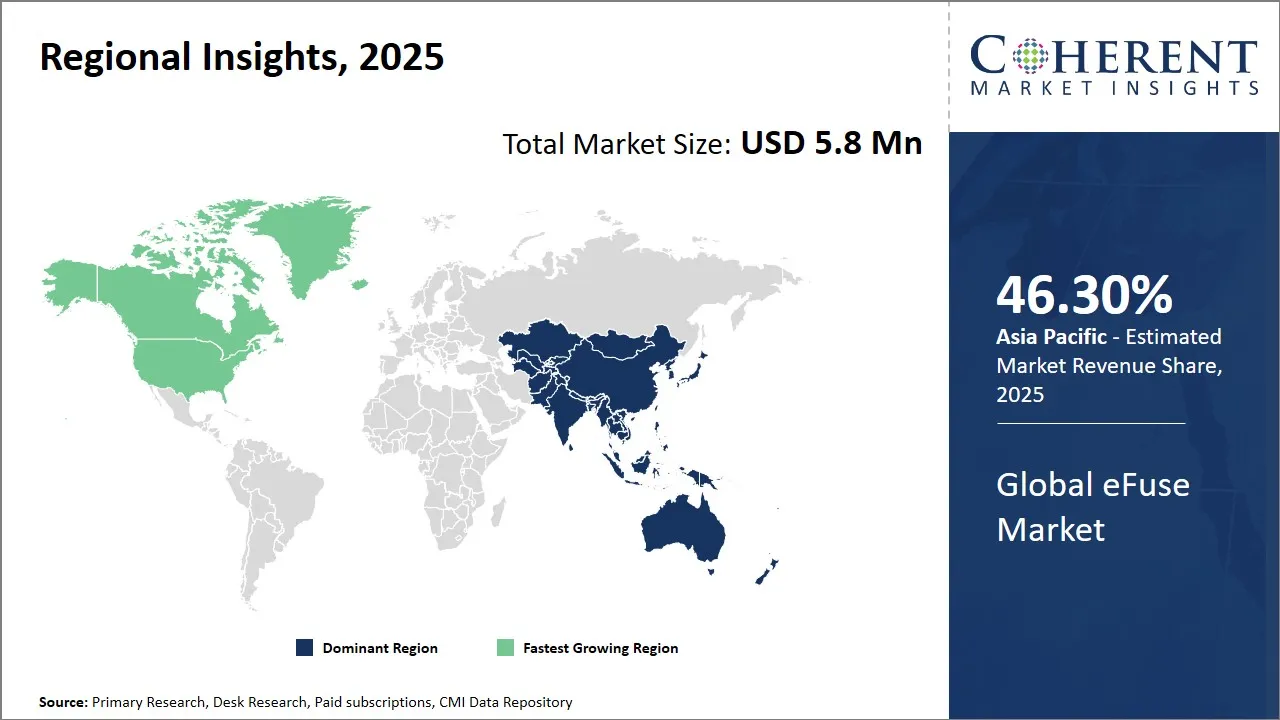
- Asia Pacific is estimated to lead the market with a share of 46.3 % in 2026. North America, holding a share of 26.4% in 2026, is projected to be the fastest growing region.
Market Overview
Current market trends indicate a strong focus on enhancing the reliability and efficiency of eFuse components, with innovations targeting lower power consumption and faster response times. The proliferation of IoT devices and electric vehicles is further accelerating demand, as these applications require robust protection against overcurrent conditions. Additionally, growing investments in smart grid infrastructure and consumer electronics are key factors propelling the market expansion and encouraging the development of smarter, integrated eFuse solutions.
Current Events and Its Impact
Current Events | Description and its impact |
Geopolitical and Trade Developments |
|
Economic and Infrastructure Trends |
|
Regional Growth Dynamics |
|
Segmental Insights
- Current Industry Events of 2026
- Market Size Estimation
- Regional Breakdown
- Competitive Landscape
- Customer Intelligence
- Segmental Analysis
- Pricing Analysis
- Key Market Drivers, Challenges & Future Trends
- Customized Insights Section
Global eFuse Market Insights, by Type – Auto Retry eFuses Dominate Owing to Their Enhanced Reliability and Operational Efficiency
The dominance of Auto Retry eFuses, holding an estimated share of 58.6% in 2026, in the global eFuse market is largely attributed to their unique capability to automatically restore the circuit after an overcurrent or short-circuit event without manual intervention. This feature significantly enhances system uptime and reduces downtime, which is critical across many modern electronic applications. Auto Retry eFuses continuously monitor the current flow and temporarily shut off power when an anomaly is detected, then immediately attempt to re-enable the circuit. This automatic retry mechanism minimizes service interruptions and helps in maintaining overall system stability.
One of the primary factors driving growth in the auto retry eFuses segment is the increasing complexity and miniaturization of electronic devices. As technologies shrink in form factor while increasing in performance, there is a greater need for intelligent and adaptive protection devices that can prevent damage without frequent resets or manual checks. Auto retry eFuses meet this requirement by offering smarter protection solutions that align well with the fast-paced demands of modern electronics.
Additionally, the growing adoption of renewable energy systems and electric vehicles, both of which rely heavily on sophisticated power management modules, also supports the prominence of auto retry eFuses. These devices offer critical protection to battery packs, power distribution networks, and inverters by isolating fault currents and automatically restoring normal operation after transient faults. This reduces maintenance costs and enhances safety, further driving preference for these eFuses.
Global eFuse Market Insights, by Application – Computing & Data Center Dominates Due to the Critical Need for Reliable Power Protection and Uninterrupted Operations
The Computing & Data Center segment is expected to hold the largest share of 28.5% in the global eFuse market in 2026 primarily because of the immense dependence on continuous power supply and high system availability in these environments. Data centers and computing infrastructures support critical operations for enterprises globally, hosting services ranging from cloud computing to big data analytics, which must function non-stop. This creates an uncompromising need for effective overcurrent and fault protection to prevent system failures, data loss, and costly downtime.
A key driver fueling eFuse demand in this segment is the increasing power density and complexity of servers and networking devices. Higher power demands translate into a greater risk of electrical faults, making advanced protective components like eFuses essential for safeguarding sensitive electronics. eFuses help shield systems against unexpected faults, protecting expensive hardware and preserving data integrity in environments where failures can lead to significant operational and financial repercussions.
Moreover, the rapid expansion of cloud services and data centers due to digitization trends boosts power management requirements. With the increasing adoption of virtualization, edge computing, and artificial intelligence workloads, data centers must ensure optimal power delivery and immediate fault isolation without interrupting overall performance. eFuses provide precise current monitoring and quick response to anomalies, making them ideal for these applications.
Energy efficiency and thermal management are other critical concerns in computing and data center infrastructures. eFuses contribute by preventing excessive current flows that can lead to overheating, thereby improving system reliability and reducing cooling needs. This aligns well with sustainability goals increasingly prioritized in data center design and operation.
Additionally, data centers are progressively integrating modular and scalable designs, requiring versatile and compact power protection components. eFuses fit conveniently into these architectures, supporting easy upgrades and maintenance without major disruptions. Their low-profile design and integrated protective functionalities simplify power distribution units and server power supplies, promoting streamlined system designs.
Impact of AI on the eFuse Market
Artificial Intelligence (AI) is significantly influencing the global eFuse market by accelerating demand in high-performance computing and data center infrastructure. The surge in AI training workloads, particularly for large language models and deep learning applications, has driven the shift toward 48 V power distribution in server racks to reduce losses and improve efficiency. This architecture requires advanced high-current eFuses with precise current limiting, fast fault response, and telemetry capabilities to ensure system reliability. As hyperscalers and AI hardware providers deploy thousands of AI accelerator nodes, eFuse adoption in backplanes, GPU power rails, and redundant power supply lines is becoming a critical design element.
A tangible example is Microsoft’s AI data center expansion in 2024–2025, which incorporated NVIDIA H100-based clusters with 48 V rack power designs. These deployments integrated high-current eFuses, such as Texas Instruments’ TPS1685, to protect high-voltage busbars feeding GPU accelerators.
Regional Insights
North America eFuse Market Analysis and Trends
North America, holding an estimated share of 46.3% in 2026, dominates the global eFuse market, driven by a well-established electronics and semiconductor industry ecosystem, along with robust government support for innovation and manufacturing capabilities. The region benefits from a strong presence of key semiconductor companies and research institutions focusing on advanced protection solutions such as eFuses. Government policies promoting technological advancement, cybersecurity, and the adoption of energy-efficient components further bolster market stability. Trade dynamics, including strong ties with Asia Pacific suppliers and global distributors, ensure a steady component supply and market accessibility. Prominent companies such as Texas Instruments, Analog Devices, and ON Semiconductor actively contribute by developing high-performance eFuse products tailored to automotive, data center, and industrial sectors within North America.
Asia Pacific eFuse Market Analysis and Trends
The Asia Pacific, holding a projected share of 26.4% in 2026, exhibits the fastest growth in the eFuse market, propelled by rapid industrialization, expanding electronics manufacturing hubs, and increasing demand for semiconductor protection devices in consumer electronics and automotive sectors. The ecosystem in countries like China, South Korea, Japan, and Taiwan, characterized by a vast network of semiconductor fabs, OEMs, and suppliers, enables the swift adoption and integration of eFuse technologies. Supportive government policies aimed at semiconductor self-reliance and infrastructure development amplify this trajectory. Trade relations within the region, tightly interwoven through supply chain collaborations, allow accelerated market penetration. Key players such as Renesas Electronics, Infineon Technologies, and STMicroelectronics have significantly boosted the market growth by localizing production and innovation to meet regional demands.
Global eFuse Market Outlook for Key Countries
U.S. eFuse Market Analysis and Trends
The U.S. holds a strategic position due to its pioneering semiconductor industry and cutting-edge R&D capabilities. The presence of major companies, including Texas Instruments and ON Semiconductor, drives product innovation focusing on automotive electronics, cloud data centers, and high-reliability applications. Federal support for technology advancements and a focus on domestic manufacturing under initiatives such as the CHIPS Act foster the market expansion. The U.S. also serves as a major innovation hub, setting global standards for eFuse performance and integration.
China eFuse Market Analysis and Trends
China is characterized by rapid manufacturing scale-up and government backing aimed at attaining semiconductor independence. The robust electronics manufacturing landscape demands enhanced circuit protection, boosting eFuse adoption in consumer electronics and electric vehicles. Chinese companies, along with multinational corporations like Infineon and Renesas, are expanding manufacturing footprints here to serve growing domestic and export markets. Policies encouraging local semiconductor innovation create conducive conditions for the market growth.
Japan eFuse Market Analysis and Trends
Japan continues to lead as a critical player with a focus on high-quality and reliability-conscious sectors such as automotive and industrial electronics. Major companies such as Renesas Electronics leverage Japan’s advanced manufacturing ecosystem and extensive R&D base to develop sophisticated eFuse devices. The country’s emphasis on innovation and collaboration between industry and government agencies sustains its strong market position, catering to both domestic demands and global exports.
South Korea eFuse Market Analysis and Trends
South Korea's market thrives on its vibrant semiconductor and consumer electronics industries, supported by conglomerates like Samsung and SK Hynix indirectly driving demand for semiconductor protection components including eFuses. Government investment in semiconductor technology and favorable trade policies complement this growth. Additionally, local and international players collaborate to optimize product offerings for high-performance computing and mobile applications, enhancing market maturity.
Germany eFuse Market Analysis and Trends
Germany represents a significant European market owing to its strong automotive sector and industrial automation industries that integrate eFuse technology extensively. Companies like Infineon Technologies, headquartered in Germany, play a pivotal role in pioneering reliable power management and protection solutions. The country’s focused policy on Industry 4.0 and sustainable manufacturing fosters continued demand for advanced eFuse devices in complex industrial ecosystems and high-performance automotive platforms.
Market Players, Key Development, and Competitive Intelligence
Top Strategies Followed by eFuse Market Players
- Established market leaders prioritize heavy investments in research and development (R&D) to pioneer high-performance and reliable eFuse solutions that cater to the evolving needs of industries such as automotive, consumer electronics, and telecommunications.
- Texas Instruments (U.S.) is investing heavily in R&D for advanced power protection ICs, exemplified by its TPS1685 launch in March 2025.
- Mid-level competitors in the eFuse market typically adopt strategies centered on offering cost-effective yet reliable solutions.
- Diodes Incorporated (U.S./Asia) has expanded its APEC series eFuses with competitively priced devices that meet essential protection needs for consumer and industrial markets without high-end telemetry features.
- Small-scale eFuse producers carve out their niche by concentrating on specialized product features or highly innovative solutions that target specific applications or underserved segments.
- Wayon Electronics (China) focuses on niche automotive-grade eFuses for 12 V and 24 V auxiliary systems, targeting local EV and bus manufacturers.
Key Developments
- In August 2025, Alpha and Omega Semiconductor Limited (AOS), a designer, developer, and global supplier of a broad range of discrete power devices, wide bandgap power devices, power management ICs, and modules, announced the release of its AOZ17517QI series, a 60A eFuse in a compact 5mm x 5mm QFN package. AOS optimized this new eFuse product series for 12V power rails in servers, data centers, and telecom infrastructure.
- In March 2025, Texas Instruments (TI) debuted new power-management chips to support the rapidly growing power needs of modern data centers. TI's new TPS1685 is the industry's first 48V integrated hot-swap eFuse with power-path protection to support data center hardware and processing needs.
- In November 2024, Infineon launched five PROFET Wire Guard devices come in the proven TSDSO-14 and TSDSO-24 packages. They offer full pin-to-pin compatibility within the family and high compatibility with PROFET +2 12V devices and are targeting currents of up to 27 A.
- In October 2024, Toshiba Electronics Europe GmbH added 2 new products to its electronic fuse (eFuse IC) offering. The TCKE903NL and TCKE905ANA products are reusable, thereby reducing maintenance costs and recovery time for equipment repairs, and support various functions to protect power supply line circuits.
Market Report Scope
eFuse Market Report Coverage
| Report Coverage | Details | ||
|---|---|---|---|
| Base Year: | 2025 | Market Size in 2026: | USD 6.1 Mn |
| Historical Data for: | 2020 To 2024 | Forecast Period: | 2026 To 2033 |
| Forecast Period 2026 to 2033 CAGR: | 5.1% | 2033 Value Projection: | USD 8.6 Mn |
| Geographies covered: |
| ||
| Segments covered: |
| ||
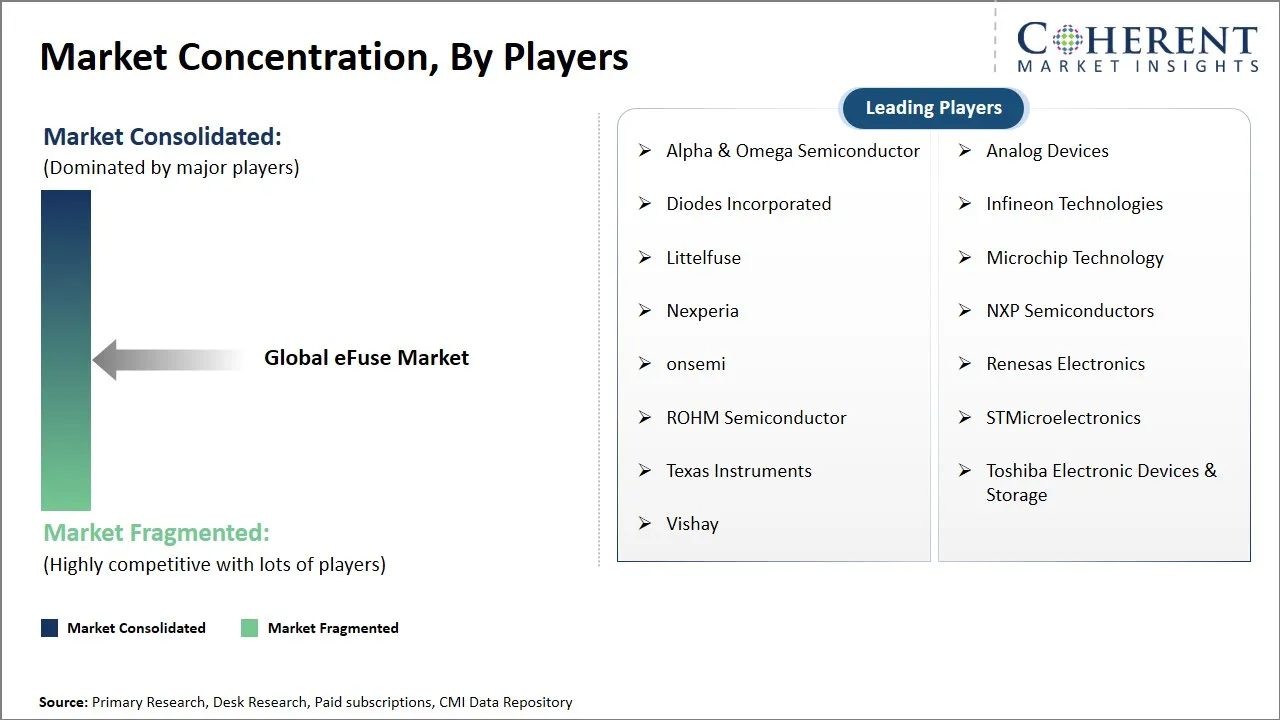
| Companies covered: | Alpha & Omega Semiconductor, Analog Devices, Diodes Incorporated, Infineon Technologies, Littelfuse, Microchip Technology, Nexperia, NXP Semiconductors, onsemi, Renesas Electronics, ROHM Semiconductor, STMicroelectronics, Texas Instruments, Toshiba Electronic Devices & Storage, and Vishay | ||
| Growth Drivers: |
| ||
| Restraints & Challenges: |
| ||
Market Dynamics
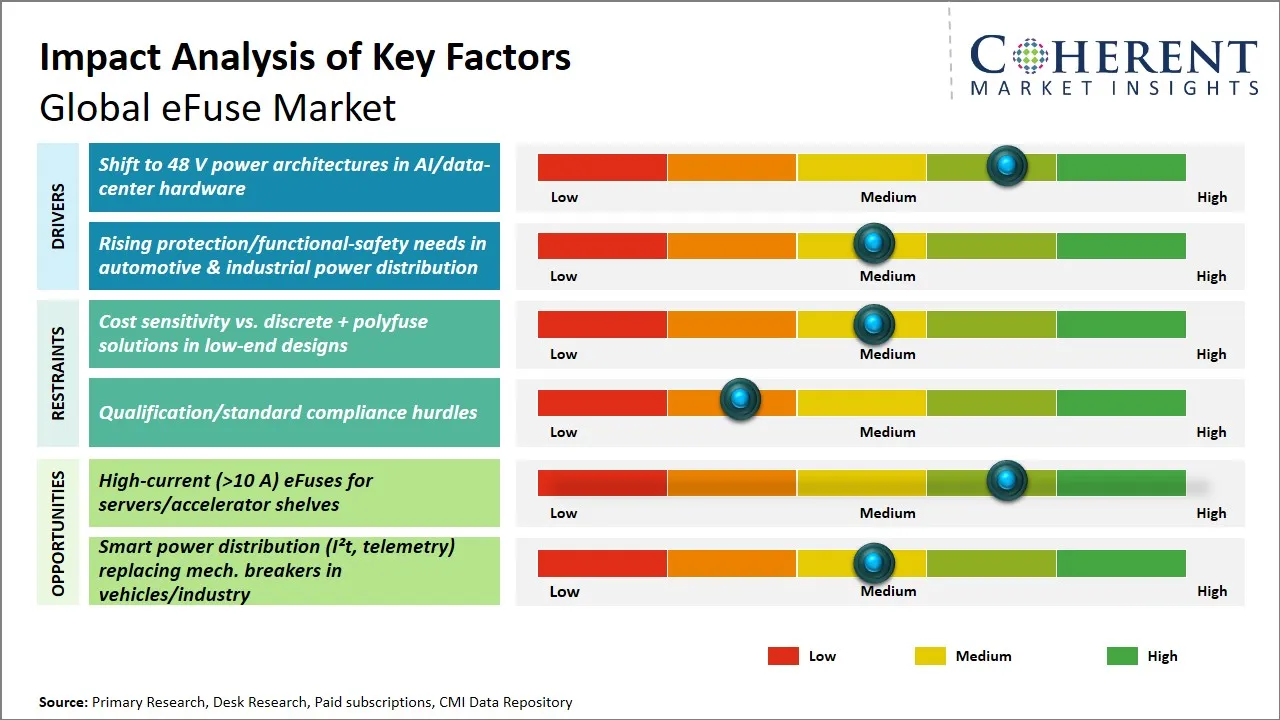
Global eFuse Market Driver – Shift to 48 V power architectures in AI/data-center hardware
The ongoing transition towards 48 V power architectures, particularly in AI and data-center hardware, is significantly driving the demand for eFuse technologies. As data centers and AI systems increasingly rely on high-performance processing units, power delivery requirements have become more complex, with greater current loads and tighter voltage tolerances. The adoption of 48 V platforms enables improved power efficiency and reduced cabling complexity compared to traditional 12 V systems, but this shift also brings challenges related to protecting sensitive components from overcurrent and short-circuit scenarios. An instance is Meta’s 2024 deployment of AI training clusters based on NVIDIA H100 GPUs, where the company adopted 48 V rack-level power distribution to reduce copper losses and improve efficiency.
eFuses, with their ability to provide precise, fast-acting overcurrent and overvoltage protection, become critical in safeguarding these advanced architectures. Moreover, eFuses support faster recovery and reduce downtime in these environments, enhancing overall system reliability. This architectural evolution creates a pressing need for sophisticated eFuse solutions designed to handle elevated voltage levels while maintaining compact form factors and thermal efficiency, further propelling their integration into modern AI and data-center power management systems.
Global eFuse Market Opportunity – Adoption of High-Current (>10 A) eFuses for Servers and Accelerator Shelves
The rapidly growing demand for advanced computing infrastructure, particularly in data centers, AI applications, and high-performance computing (HPC), presents a significant opportunity for the global eFuse market through the adoption of high-current (>10 A) eFuses tailored for servers and accelerator shelves. Modern servers and accelerator units, such as GPUs and FPGAs, require robust power management solutions capable of handling elevated current loads while ensuring device protection and system reliability.
High-current eFuses offer precise overcurrent protection, fast response times, and reduced power loss, making them ideal for safeguarding critical components in densely packed, high-power environments. This trend aligns with the industry’s push towards greater energy efficiency and enhanced operational uptime, which are paramount in hyperscale data centers and cloud computing infrastructures. Alpha & Omega Semiconductor’s AOZ17517QI, launched in August 2025, a 60 A eFuse specifically designed for high-current rails in AI servers, storage arrays, and accelerator shelves.
Moreover, the integration of high-current eFuses facilitates more compact and modular power delivery architectures in accelerator shelves, effectively supporting scalability without compromising safety. As server manufacturers and cloud service providers prioritize resilient and efficient power management, demand for specialized high-current eFuses is expected to escalate, driving innovation in semiconductor design and manufacturing processes. This emerging use case underscores a strategic avenue for eFuse suppliers to expand their product portfolios and capture value in the expanding ecosystem of high-performance server power solutions.
Analyst Opinion (Expert Opinion)
- The rapid adoption of 48 V rack power in AI training clusters and hyperscale data centers is positioning high-current, telemetry-enabled eFuses as a critical component for safe, efficient power delivery. This trend is expected to expand further as large language model workloads push power densities beyond traditional design norms.
- Beyond conventional automotive auxiliary systems, eFuses are emerging as solid-state replacements for mechanical relays and fuses in EV battery packs, charging systems, and power distribution units. Their microsecond-level fault isolation and diagnostic capabilities make them ideal for safety-critical e-mobility applications.
- The rise of Industry 4.0 and factory electrification is driving the use of eFuses in programmable power panels, robotics, and industrial IoT nodes. Advanced eFuses with remote monitoring can help predictive maintenance systems prevent costly downtime in mission-critical manufacturing environments.
Speak to the analyst
Want personalized insights?
Take the findings above to one of our principal consultants, or have the report rebuilt around the segments, geographies and competitors you actually track.
Market Segmentation
- Type Insights (Revenue, USD Mn, 2021 - 2033)
- Auto Retry eFuses
- Latched eFuses
- Application Insights (Revenue, USD Mn, 2021 - 2033)
- Computing & Data Center
- Consumer Electronics
- Industrial & Factory Automation
- Automotive
- Telecom/Networking
- Regional Insights (Revenue, USD Mn, 2021 - 2033)
- North America
- U.S.
- Canada
- Latin America
- Brazil
- Argentina
- Mexico
- Rest of Latin America
- Europe
- Germany
- U.K.
- Spain
- France
- Italy
- Russia
- Rest of Europe
- Asia Pacific
- China
- India
- Japan
- Australia
- South Korea
- ASEAN
- Rest of Asia Pacific
- Middle East
- GCC Countries
- Israel
- Rest of Middle East
- Africa
- South Africa
- North Africa
- Central Africa
- North America
- Key Players Insights
- Alpha & Omega Semiconductor
- Analog Devices
- Diodes Incorporated
- Infineon Technologies
- Littelfuse
- Microchip Technology
- Nexperia
- NXP Semiconductors
- onsemi
- Renesas Electronics
- ROHM Semiconductor
- STMicroelectronics
- Texas Instruments
- Toshiba Electronic Devices & Storage
- Vishay
Sources
Primary Research Interviews
Stakeholders
- Semiconductor Manufacturers
- Power Management IC Designers and Engineers
- Component Distributors and Supply Chain Managers
- Automotive OEMs and Tier-1 Suppliers
- Data Center Infrastructure Providers (e.g., Equinix, Microsoft Azure hardware teams)
- Industrial Automation Equipment Manufacturers
- Electronics Design Consultants specializing in power protection circuits
Databases
- World Semiconductor Trade Statistics (WSTS)
- U.S. International Trade Commission (USITC)
- Global Semiconductor Alliance (GSA) Data Center
- OECD
- Asia Electronics Industry Database
Magazines
- Electronic Design Magazine
- Power Electronics News
- EE Times
- Asia Electronics Review
Journals
- IEEE Transactions on Power Electronics
- Microelectronics Reliability Journal
- International Journal of Electronics and Electrical Engineering
- IEEE Transactions on Industrial Electronics
Newspapers
- Nikkei Asia (Japan)
- The Economic Times (India)
- The Wall Street Journal (U.S.)
- China Daily (China)
Associations
- Semiconductor Industry Association (SIA)
- International Electrotechnical Commission (IEC)
- Institute of Electrical and Electronics Engineers (IEEE)
- Automotive Electronics Council (AEC)
- Power Sources Manufacturers Association (PSMA)
Public Domain Sources
- U.S. Census Bureau
- EUROSTAT
- United Nations Industrial Development Organization (UNIDO)
- World Bank
- ResearchGate
Proprietary Elements
- CMI Data Analytics Tool, Proprietary CMI Existing Repository of information for last 8 years
Get access to 250+ pages report
Every segment, forecast, competitor profile and data table behind the analysis above — available for instant download.
- ESOMAR Member
- ISO 9001:2015 Certified
- D-U-N-S Registered
- GDPR & CCPA Compliant
Missing comfort of reading report in your local language? Find your preferred language:
Transform your Strategy with Exclusive Trending Reports
Frequently Asked Questions
The global eFuse market is estimated to be valued at USD 6.1 million in 2026 and is expected to reach USD 8.6 million by 2033.
The CAGR of global eFuse market is projected to be 5.1% from 2026 to 2033.
Shift to 48 V power architectures in AI/data-center hardware and rising protection/functional-safety needs in automotive & industrial power distribution are the major factors driving the growth of the global eFuse market.
Cost sensitivity vs. discrete + polyfuse solutions in low-end designs and qualification/standard compliance hurdles are the major factors hampering the growth of global eFuse market.
In terms of Type, Auto Retry eFuses segment is estimated to dominate the market revenue share in 2026.
Alpha & Omega Semiconductor, Analog Devices, Diodes Incorporated, Infineon Technologies, Littelfuse, Microchip Technology, Nexperia, NXP Semiconductors, onsemi, Renesas Electronics, ROHM Semiconductor, STMicroelectronics, Texas Instruments, Toshiba Electronic Devices & Storage, and Vishay are the major players.
An eFuse is an integrated circuit that provides electronic overcurrent, overvoltage, and short-circuit protection, often with programmable settings and auto-retry or latch-off modes.