

Global Electric Arc Furnaces Market Size and Forecast – 2026 To 033
The global electric arc furnaces market is expected to grow from USD 3.95 Bn in 2026 to USD 5.75 Bn by 2033, registering a compound annual growth rate (CAGR) of 5.5% from 2026 to 2033. The global electric arc furnaces market is driven by the spontaneous expansion of infrastructure and construction activities globally. On March 30, 2026, United States Steel successfully restarted Blast Furnace B at its Granite City Works facility in Illinois, U.S. The facility is now producing steel, following the company’s previously announced plans to bring the furnace online to meet customer demand. (Source: United States Steel)
Key Takeaways of the Global Electric Arc Furnaces Market
- The alternating current EAF segment is expected to account for 57.0 % of the global electric arc furnaces market share in 2026. Improved energy efficiency and lower operating costs of modern alternating current EAFs is a prime factor driving the growth of the segment. For example, SMS Group GmbH deployed AI-based systems such as EAFXpert and Metallics Optimizer, which optimize scrap mix and furnace operation in real time. (Source: SMS Group)
- The standard EAF segment is estimated to capture 46.0 % of the market share in 2026. The standard EAF segment is majorly driven by the expansion of steel recycling infrastructure across the globe. On April 5, 2025, Tata Steel Nederland announced that it is targeting recycling of 120 million kg of old tin by 2026, as part of its circular steel production system (ZEREMIS). (Source: Tata Steel)
- The ferrous metals segment is estimated to capture 53.0 % of the market share in 2026. The development of renewable energy-powered EAF facilities is expected to drive the growth of the segment. On March 1, 2026, GM Steel received final approval in 2026 for a USD 450 million EAF green steel mill in Toowoomba, Australia, designed to operate 24/7 using contracted renewable electricity supply. (Source: GM Steel)
- Asia Pacific is expected to dominate the electric arc furnaces market in 2026 with a market share of 43.0 %. Rapid industrialization and infrastructure development in Asia Pacific countries is a major factor driving the growth of the regional electric arc furnaces market. On December 20, 2025, Vietnam began construction planning for a USD 7.7 billion rail link connecting China–Hanoi–Haiphong, part of a broader USD 129 billion infrastructure program covering 234 projects including ports, airports, and urban developments.
- North America is expected to account for 22.0 % share in 2026 and is projected to record the fastest growth over the forecast period. Modernization of aging steel plants in North America is expected to drive the growth of the regional market. On November 4, 2025, United States Steel outlined its next era of growth in its partnership with Nippon Steel, including significant capital investments and world‑class technology sharing that will forge the future of the American steel industry. (Source: United States Steel)
- Green Steel Production and Decarbonization: Steel producers are quickly adopting EAF technology that produces much lower carbon emissions than typical blast furnace steelmaking. To hit net-zero ambitions and higher environmental standards, companies are boosting their usage of recyclable scrap metal, renewable energy & power and low-carbon production techniques.
- Growth of Ultra-High Power (UHP) and Energy-Efficient Furnaces: Steel makers are investing in UHP electric arc furnaces which provide faster melting cycles, higher throughput and reduced energy usage per ton of steel produced. Increasingly, new installations are incorporating advanced electrode systems, waste heat recovery technology, and smart power management solutions.
Segmental Insights
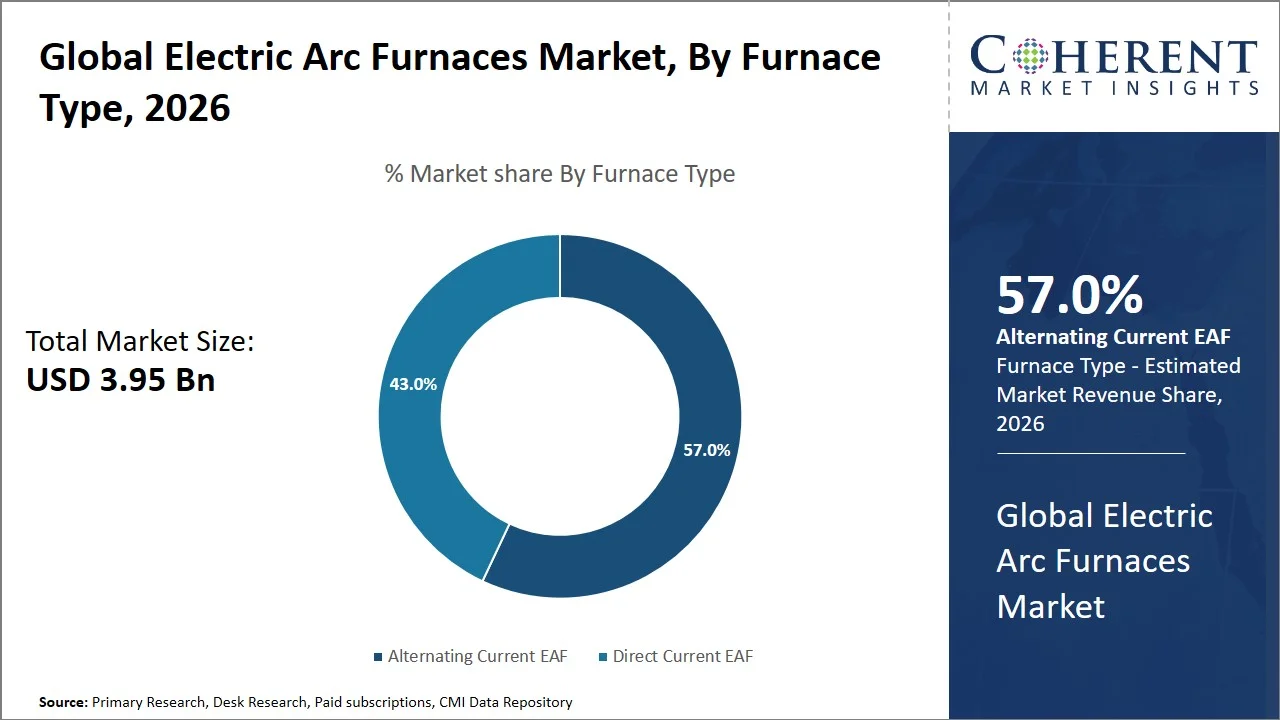
Why Does Alternating Current EAF Dominate the Global Electric Arc Furnaces Market?
The alternating current EAF segment is expected to account for 57.0% of the global electric arc furnaces market share in 2026. The AC electric arc furnace (EAF) is the dominant furnace in the market due to its simpler design and lower capital investment than the DC EAF. Most steel facilities globally are already equipped for AC furnace operations, which makes upgrades, maintenance, worker training and spare part availability more cost effective. This economic advantage has led to the extensive use of AC EAF by big integrated steel manufacturers as well as micro mills, thus sustaining the overwhelming market share of AC EAF. On September 1, 2025, Algoma Steel achieved first heat in its new Danieli Digimelter AC EAF-based facility, marking a full transition from integrated steelmaking to AC EAF operations. The project is built around standard AC furnace architecture with digital AC power systems (Q-One) rather than DC systems due to lower complexity and integration cost. (Source: Danieli)
- Current Industry Events of 2026
- Market Size Estimation
- Regional Breakdown
- Competitive Landscape
- Customer Intelligence
- Segmental Analysis
- Pricing Analysis
- Key Market Drivers, Challenges & Future Trends
- Customized Insights Section
Why is Standard EAF the Most Preferred Technology?
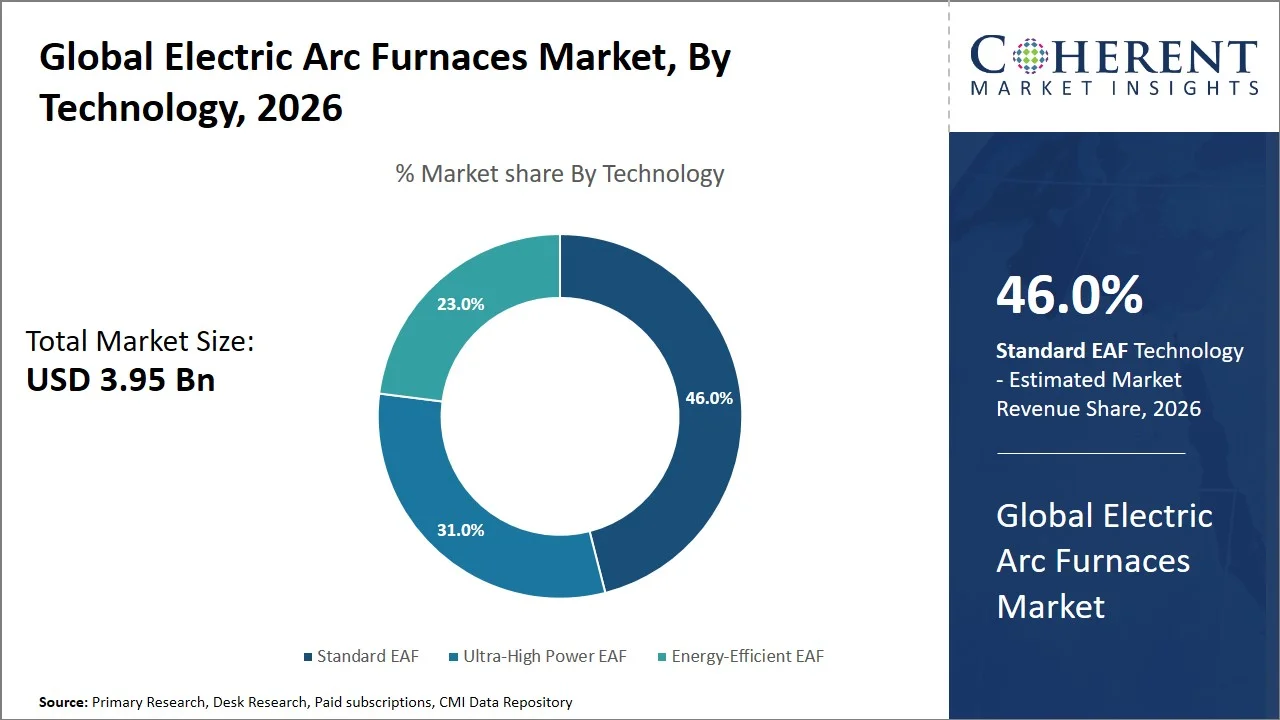
The standard EAF segment is expected to account for 46.0% of the global electric arc furnaces market share in 2026. Standard EAFs are the favored technology, since they provide a good compromise between production efficiency, operating cost and installation cost. Their proven technology, broad industry recognition and ability to process a wide range of scrap materials make them the ideal choice for steel producers who require reliable and inexpensive steelmaking. On March 11, 2026, POSCO launched a 2.5 million ton/year standard EAF plant at Gwangyang, South Korea, focused on replacing part of blast furnace output with scrap-based steel production. The company selected a conventional EAF configuration due to its proven reliability and scalability for mass steel production. (Source: GMK Center)
Ferrous Metals Dominate the Global Electric Arc Furnaces Market
The ferrous metals segment is expected to account for 53.0% of the global electric arc furnaces market share in 2026. Ferrous metals dominate the EAF industry, as electric arc furnaces are typically used to melt and recycle steel scrap to produce new steel products. The largest application segment is EAFs for ferrous metal processing, owing to the significant global demand for steel in construction, automotive, infrastructure and manufacturing industries. On April 15, 2026, the German government has expressed unified support for the EU Automotive Package, endorsing the inclusion of low-carbon materials such as green steel as part of compliance mechanisms. (Source: Eurometal)
Currents Events and their Impact
Current Events | Description and its Impact |
European Union Carbon Border Adjustment Mechanism (CBAM) |
|
U.S. EPA New Source Performance Standards for Electric Arc Furnaces |
|
(Source: European Commission, Environmental Protection Agency)
Electric Arc Furnaces Market Dynamics
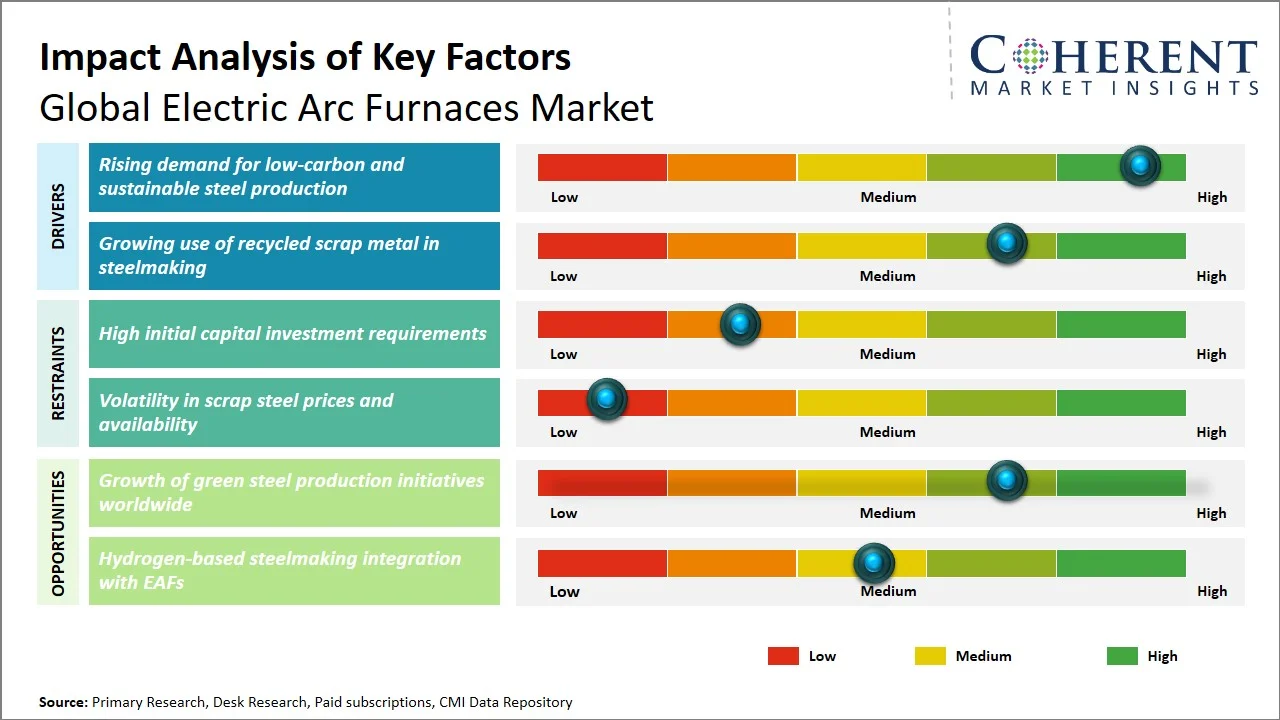
Market Drivers
Rising demand for low-carbon and sustainable steel production
The increasing demand for low carbon and sustainable steel production is pushing the adoption of Electric Arc Furnaces (EAFs) as they create much lower carbon emissions in comparison to traditional blast furnace steelmaking. Stricter environmental legislation, corporate sustainability pledges and growing customer preference for green steel are helping to drive the development of EAF technology and the rising use of recycled scrap metal in manufacturing processes.
On April 27, 2026, Stegra announced the construction of a fully decarbonized steel plant in Boden, Sweden, combining renewable electricity, hydrogen-based iron reduction, and downstream EAF steelmaking. The plant is designed to produce 2.5 million tons/year of low-carbon steel for automotive and industrial buyers starting in 2026. (Source: Stegra)
Growing use of recycled scrap metal in steelmaking
The increasing use of recycled scrap metal in steelmaking is a major driver for the electric arc furnaces market. EAFs can efficiently convert scrap steel into high-quality steel products, reducing the use of raw materials and environmental impact. As the focus on resource saving, circular economy practices and cost-efficient manufacturing grows, steel producers are motivated to take advantage of the opportunities to ramp up scrap-based steelmaking through the use of EAF technology.
On June 13, 2025, SSAB announced that it has signed an agreement to purchase high-quality automotive steel scrap from Volvo Cars’ Olofström production plant in Sweden to be recycled and used at SSAB’s mill in Oxelösund to produce decarbonized steel. SSAB will start receiving high-quality automotive steel scrap with a ramp up during 2026 and the full volume from 2027 onward. (Source: SSAB)
Emerging Trends
- Integration of Digitalization and Industry 4.0: Modern EAF facilities are progressively integrating artificial intelligence (AI), machine learning, IoT sensors, and sophisticated process automation. These technologies offer real time monitoring of furnace operations, predictive maintenance, optimum energy use and improved productivity and decreased down time.
- Expansion of Scrap Recycling and Circular Economy Models: Growing investments in global metal recycling infrastructure owing to rising focus on sustainable manufacturing and growth in scrap recycling and circular economy models. EAFs are growing in popularity to convert recycled steel into high quality finished goods, as availability of scrap increases and governments push circular economy efforts. This reduces dependence on virgin raw materials and reduces total costs of production.
Regional Insights
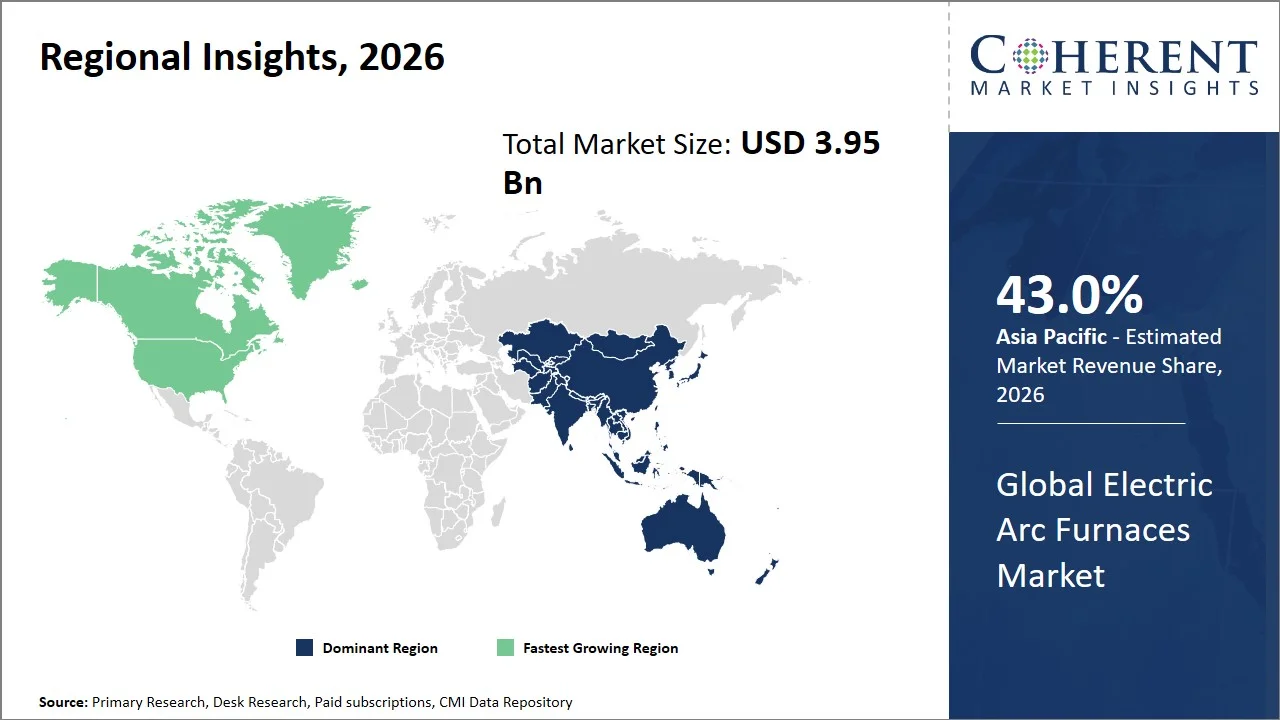
Why is Asia Pacific a Strong Market for Electric Arc Furnaces?
Asia Pacific is expected to account for a market share of 43.0% in 2026. Asia Pacific is estimated to contribute the highest contribution to the electric arc furnaces market owing to the increasing investments in scrap-based steelmaking in China, India, Japan, and South Korea. A good example is the commissioning of scrap-based EAF plant of Tata Steel in Ludhiana, India and Japanese steelmakers are investing billions of dollars in EAF conversions to achieve regional decarbonization targets and reduce dependence on blast furnace operations.
Moreover, facility expansions and infrastructure developments are also expected to boost the growth of the regional market. On December 3, 2025, InfraBuild expanded its recycling-linked steel production system by adding new EAF furnace bowls at its Laverton plant, increasing capacity by 25% and strengthening its integrated scrap collection and processing network across Australia. (Source: Infrabuild)
Why Does the North America Electric Arc Furnaces Market Exhibit High Growth?
North America is projected to account for 22.0% of the global electric arc furnaces market and is expected to register the fastest growth. North America is an established market for EAF, where more than 70% of steel output is already generated using EAF technology. EAF capacity continues to grow, with companies such as Nucor Corporation and Steel Dynamics, Inc. leading the way. For example, Nucor’s plate mill in Brandenburg, Kentucky, uses state-of-the-art EAF technology to produce about 1.2 million tons of steel plate each year to support infrastructure, renewable energy and manufacturing projects across the U.S.
In addition, the continuous modernization of steel production facilities in the region is also aiding the growth of the electric arc furnaces market in North America. On September 4, 2025, the Board of Directors at United States Steel approved the next phase of capital investment plans, marking another milestone in the strategic partnership between Nippon Steel and U. S. Steel. The cooperative efforts between the two industry leaders have already yielded significant successes. Nippon Steel experts have worked closely with United States Steel’s integrated mills in the North American Flat-Rolled, Big River Steel Works and Tubular Products segments to enhance operational efficiencies, among other achievements. (Source: United States Steel)
Global Electric Arc Furnaces Market Outlook for Key Countries
Why is China Emerging as a Major Hub in the Electric Arc Furnaces Market?
As part of its carbon-neutrality plan and to cut emissions from traditional blast furnace steel production, China is ramping up the usage of EAFs. The government has encouraged more scrap use and cleaner steelmaking. This has led to the expansion of EAF facilities by large manufacturers such as China Baowu Steel Group, especially in coastal locations, where scrap is more available and renewable power can be better integrated.
Is the U.S. the Next Growth Engine for the Electric Arc Furnaces Market?
The U.S. is one of the world's most EAF-intensive steel markets, with EAFs making up a majority of domestic steel production. Nucor Corporation’s recent investments in electric arc furnace-based sheet and plate facilities and Commercial Metals Company’s micro-mill expansions are geared to meet construction and infrastructure demand while reducing production emissions compared to conventional, fully integrated steel mills.
Japan Electric Arc Furnaces Market Analysis and Trends
Japan’s electric arc furnaces market is in the midst of a dramatic upheaval, with major steelmakers moving towards low-carbon production methods. Nippon Steel Corporation announced intentions to invest in EAF projects in 2025. JFE Steel Corporation is building a large-scale EAF with an annual production capacity of around 2 million tons at its Kurashiki Works to facilitate the manufacturing of green steel products.
India Electric Arc Furnaces Market Analysis and Trends
India is one of the fastest growing EAF markets, supported by increasing scrap availability, government decarbonization measures and rising steel demand. A notable example is Tata Steel Limited’s Ludhiana EAF facility, India’s first large-scale scrap-based electric arc furnace (EAF) plant, with an annual capacity of 0.75 million tons and substantially lower carbon emissions, with other EAF projects underway to support the country’s aim of increasing steel capacity to over 300 million tons by 2030.
Global Electric Arc Furnaces Market - Scrap Steel Import/Export Volumes
Top Scrap Steel Exporters | Export Volume (Million Tons) | Top Scrap Steel Importers | Import Volume (Million Tons) |
U.S. | 13.22 | India | 11.99 |
Japan | 4.95 | Belgium | 5.00 |
Germany | 4.73 | Netherlands | 3.47 |
France | 3.93 | Italy | 3.00 |
Canada | 1.83 | South Korea | 2.50 |
How is the Growth of Green Steel Production Initiatives Worldwide Creating New Growth Opportunities in the Electric Arc Furnaces Market?
The worldwide transition to green steelmaking is offering major development prospects for the Electric Arc Furnaces (EAF) industry, as EAFs are the most extensively used low-carbon steelmaking process, particularly when driven by renewable electricity and scrap steel. Major steel manufacturers are investing in EAF-based green steel projects to reach net-zero targets and comply with policies such as carbon pricing and CBAM, for example large scale EAF conversion projects by businesses such as ArcelorMittal in Europe and Nippon Steel Corporation in Asia. The shift is creating a need worldwide for modern, energy-efficient EAF systems, hydrogen-ready steelmaking integration and high-quality scrap processing infrastructure.
On October 30, 2025, POSCO and BHP signed an agreement in 2025 to develop a hydrogen-based near zero emissions steel pilot plant in Pohang, South Korea, using electric smelting furnace technology. The facility is planned for 300,000 tons/year output starting around 2028, marking a major step in scaling green steel supply chains. (Source: BHP)
Market Players, Key Development, and Competitive Intelligence
Key Developments
- On April 21, 2025, Hyundai Motor Group and POSCO announced an agreement to cooperate in the steel and battery sectors as both parties seek to strengthen global competitiveness. Under the agreement, POSCO Group plans to collaborate with Hyundai Motor Group through an equity investment in the Group’s recently announced Electric Arc Furnace (EAF) integrated steel mill project in Louisiana, U.S.
- On September 11, 2024, Tata Steel announced that it is investing USD 1.45 billion in a new Electric Arc Furnace at Port Talbot, U.K., which is expected to cut 90% of site CO₂ emissions by replacing blast furnace production with scrap-based EAF steelmaking. The project is explicitly designed to supply low-carbon steel for U.K. construction and manufacturing demand under tightening climate regulations.
Competitive Landscape
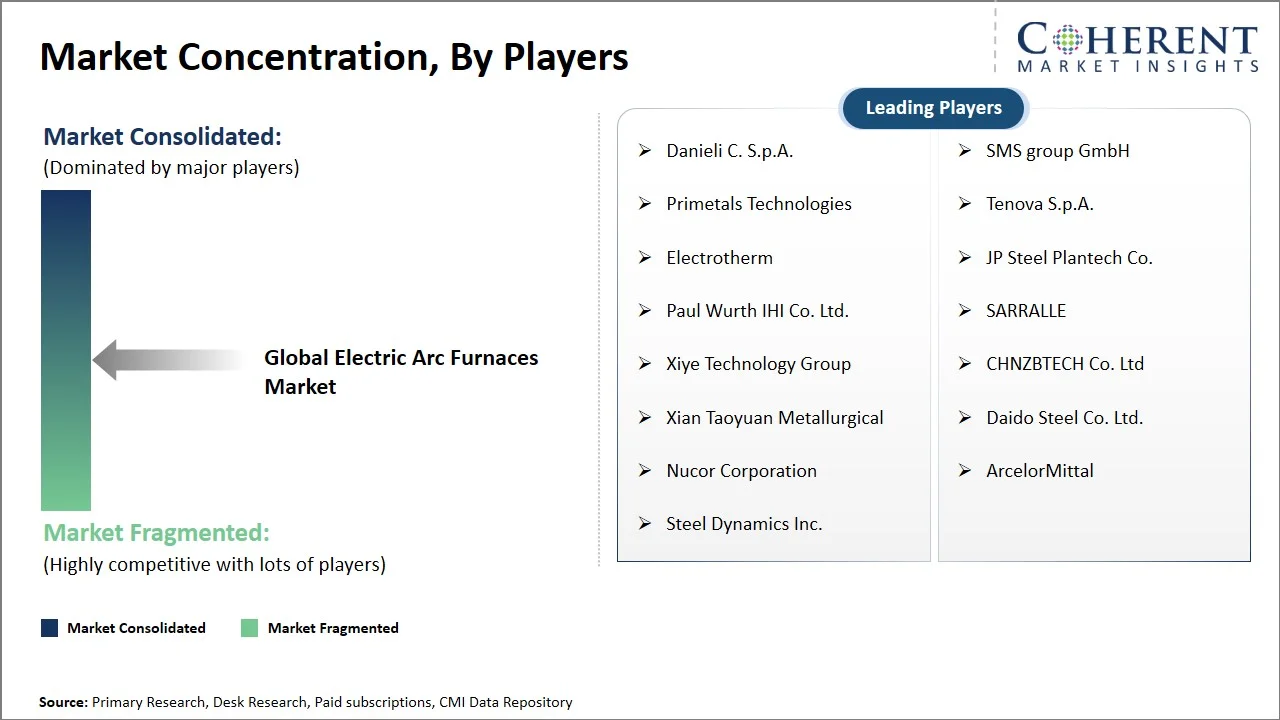
The electric arc furnaces industry is dominated by a few large players, with global plant makers and vertically integrated steel mills battling for technology leadership and capacity development projects. Danieli & C. is in fierce competition with companies such as. S.p.A., SMS group GmbH and Tenova S.p.A. which are consistently developing ultra-high power and energy efficient furnace systems. At the same time, companies like Nucor Corporation and ArcelorMittal are also adding their own steelmaking capacity using EAFs, adding to the competition among technology suppliers and end-user producers.
Market Report Scope
Electric Arc Furnaces Market Report Coverage
| Report Coverage | Details | ||
|---|---|---|---|
| Base Year: | 2025 | Market Size in 2026: | USD 3.95 Bn |
| Historical Data for: | 2020 To 2024 | Forecast Period: | 2026 To 2033 |
| Forecast Period 2026 to 2033 CAGR: | 5.5% | 2033 Value Projection: | USD 5.75 Bn |
| Geographies covered: |
| ||
| Segments covered: |
| ||
| Companies covered: | Danieli C. S.p.A., SMS group GmbH, Primetals Technologies, Tenova S.p.A., Electrotherm, JP Steel Plantech Co., Paul Wurth IHI Co. Ltd., SARRALLE, Xiye Technology Group, CHNZBTECH Co. Ltd, Xian Taoyuan Metallurgical, Daido Steel Co. Ltd., Nucor Corporation, ArcelorMittal, and Steel Dynamics Inc. | ||
| Growth Drivers: |
| ||
| Restraints & Challenges: |
| ||
Analyst Opinion (Expert Opinion)
- The electric arc furnaces market is expected to be increasingly pushed by decarbonization laws, availability of scrap steel and energy efficiency advancements in steel manufacturing processes. Regulatory pressure to manufacture low-carbon steel and increased acceptance of circular economy models by the major steel producing economies is driving the strong growth. However, there are concerns with respect to the volatility of electricity prices and limits on scrap supplies, which may impact the short-term investment decisions.
- The move to green steel manufacturing is likely to increasingly shape the electric arc furnaces market, with near-total reliance on renewable energy and high-quality scrap recycling predicted. With the expansion of hydrogen-compatible EAF systems and advanced digital furnace optimization technologies, the coming years will likely see a redefinition of production efficiency norms. The steel industry is predicted to increase capacity at a strong pace in Asia Pacific and North America as the industry is expected to upgrade old infrastructure and line with global net-zero goals.
Speak to the analyst
Want personalized insights?
Take the findings above to one of our principal consultants, or have the report rebuilt around the segments, geographies and competitors you actually track.
Market Segmentation
- Furnace Type Insights (Revenue, USD Billion, 2021 - 2033)
- Alternating Current EAF
- Direct Current EAF
- Technology Insights (Revenue, USD Billion, 2021 - 2033)
- Standard EAF
- Ultra High Power EAF
- Energy Efficient EAF
- Application Insights (Revenue, USD Billion, 2021 - 2033)
- Ferrous Metals
- Non Ferrous Metals
- Capacity Insights (Revenue, USD Billion, 2021 - 2033)
- Up to 50 Tons
- 50 to 150 Tons
- Above 150 Tons
- End User Insights (Revenue, USD Billion, 2021 - 2033)
- Steel Industry
- Foundries
- Metal Recycling Facilities
- Specialty Metal Producers
- Regional Insights (Revenue, USD Billion, 2021 - 2033)
- North America
- U.S.
- Canada
- Latin America
- Brazil
- Argentina
- Mexico
- Rest of Latin America
- Europe
- Germany
- U.K.
- Spain
- France
- Italy
- Russia
- Rest of Europe
- Asia Pacific
- China
- India
- Japan
- Australia
- South Korea
- ASEAN
- Rest of Asia Pacific
- Middle East
- GCC Countries
- Israel
- Rest of Middle East
- Africa
- South Africa
- North Africa
- Central Africa
- North America
- Key Players Insights
- Danieli C. S.p.A.
- SMS group GmbH
- Primetals Technologies
- Tenova S.p.A.
- Electrotherm
- JP Steel Plantech Co.
- Paul Wurth IHI Co. Ltd.
- SARRALLE
- Xiye Technology Group
- CHNZBTECH Co. Ltd
- Xian Taoyuan Metallurgical
- Daido Steel Co. Ltd.
- Nucor Corporation
- ArcelorMittal
- Steel Dynamics Inc.
Sources
Primary Research Interviews
- Steel manufacturers and producers
- Electric arc furnace equipment manufacturers
- Raw material suppliers and distributors
- Technology solution providers
Magazines
- Steel Times International
- Metal Bulletin Magazine
- Iron & Steel Technology Magazine
- Steel Business Briefing
Journals
- Journal of Iron and Steel Research International
- Steel Research International
- Metallurgical and Materials Transactions
Associations
- World Steel Association (WSA)
- American Iron and Steel Institute (AISI)
- European Steel Association (EUROFER)
- China Iron and Steel Association (CISA)
Public Domain Sources
- International Trade Administration reports
- Government steel industry publications
- OECD Steel Market Developments
- Regional economic development reports
Proprietary Elements
- CMI Data Analytics Tool
- Proprietary CMI Existing Repository of information for last 10 years
Get access to 250+ pages report
Every segment, forecast, competitor profile and data table behind the analysis above — available for instant download.
- ESOMAR Member
- ISO 9001:2015 Certified
- D-U-N-S Registered
- GDPR & CCPA Compliant
Missing comfort of reading report in your local language? Find your preferred language:
Transform your Strategy with Exclusive Trending Reports
Frequently Asked Questions
The global electric arc furnaces market is expected to stand at USD 3.95 Bn in 2026 and is expected to reach USD 5.75 Bn by 2033.
The CAGR of the global electric arc furnaces market is projected to be 5.5% from 2026 to 2033.
Rising demand for low-carbon and sustainable steel production and growing use of recycled scrap metal in steelmaking are the major factors driving the growth of the global electric arc furnaces market.
High initial capital investment requirements and volatility in scrap steel prices and availability are the major factors hampering the growth of the global electric arc furnaces market.
In terms of furnace type, the alternating current EAF segment is estimated to dominate the market revenue share in 2026.
They emit significantly less CO₂ because they primarily use recycled scrap instead of iron ore reduction with coal.
Green steel is steel produced with low or zero carbon emissions using renewable energy and scrap-based EAFs or hydrogen processes.