ELECTRIC CAR MARKET SIZE AND SHARE ANALYSIS - GROWTH TRENDS AND FORECASTS (2026-2033)
Electric Car Market, By Vehicle Type (Battery Electric Vehicles (BEVs), Plug-in Hybrid Electric Vehicles (PHEVs), and Hybrid Electric Vehicles (HEVs)), By Battery Type (Lithium-Ion, Solid-State, and Nickel-Metal Hydride), By Range (150-300 miles, Below 150 miles, and Above 300 miles), By Geography (North America, Latin America, Asia Pacific, Europe, Middle East, and Africa)
- Published In : 30 Mar, 2026
- Code : CMI7429
- Page number : 141
- Formats :
Excel and PDF
- Industry : Automotive and Transportation
- Historical Range : 2020 - 2024
- Base Year : 2025
- Estimated Year : 2026
- Forecast Period : 2026-2033
Electric Car Market Size and Trends- (2026-2033)
Global electric car market is estimated to be valued at USD 533.00 Bn in 2026 and is expected to reach USD 2,499.06 Bn by 2033, exhibiting a compound annual growth rate (CAGR) of 24.7% from 2026 to 2033.
Key Takeaways
- Based on Vehicle Type, the Battery Electric Vehicles (BEVs) segment is expected to lead the market with 69.8% share in 2026, favorable government regulations drive adoption of Battery Electric Vehicles.
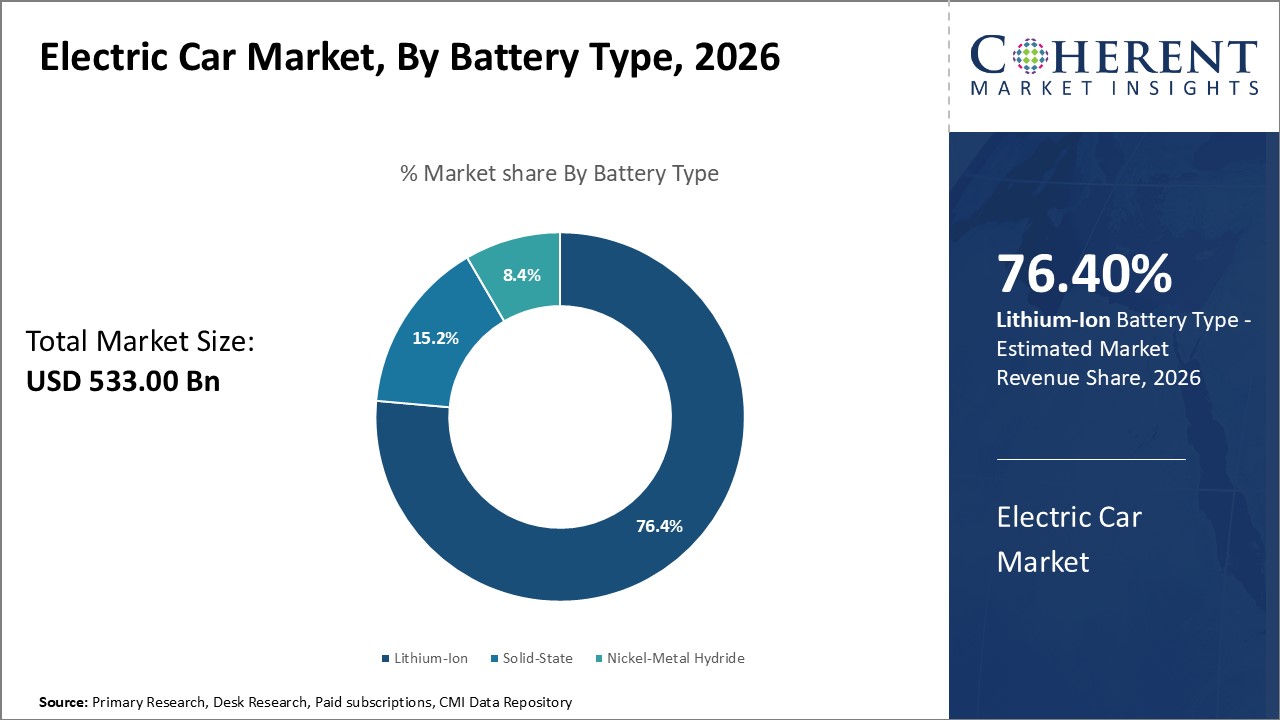
- Based on Batter Type, the lithium-ion segment is expected to hold 76.4% share of the market in 2026, driven by performance advantages.
- Based on Range, the 150-300 miles segment is projected to account for 58.7% share of the market in 2026, balancing affordability, energy density, and daily driving needs without range anxiety.
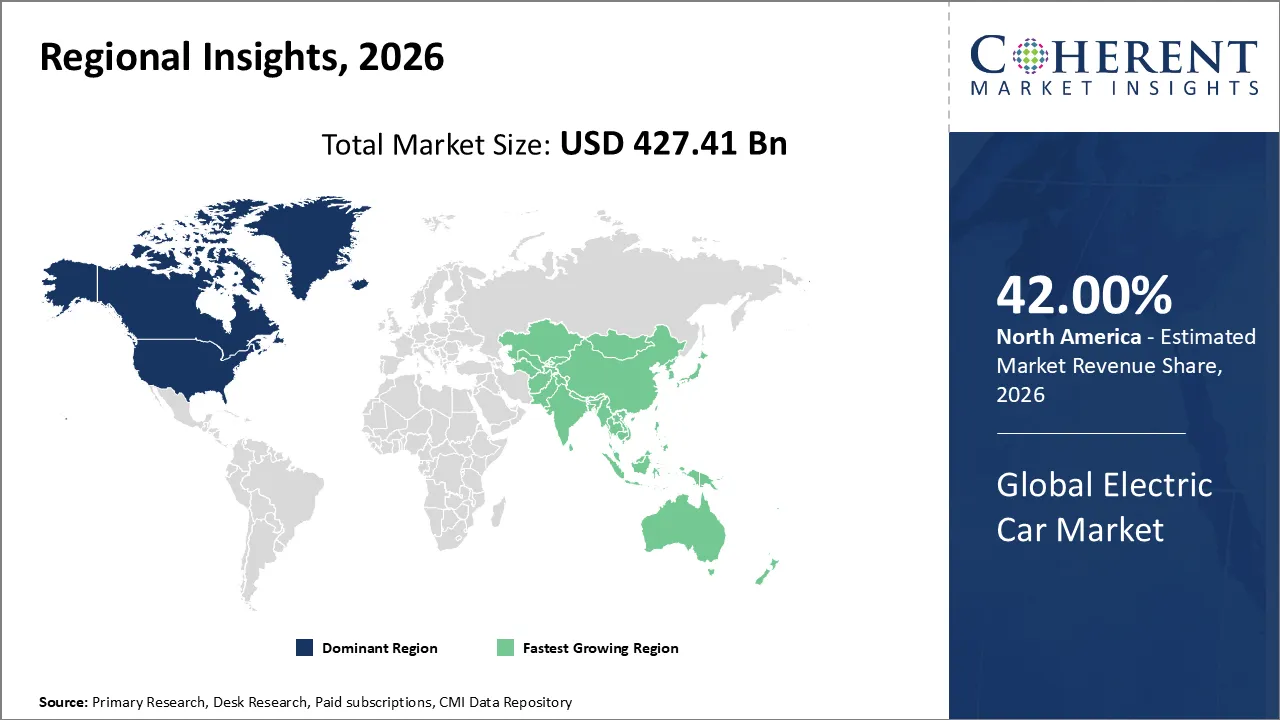
- Based on Region, North America I set to lead the electric car market with 42% share in 2026. While, Asia Pacific is anticipated to be the fastest growing region.
To learn more about this report, Download Free Sample
Market Overview
Global electric car market is expected to witness strong growth over the forecast period driven by factors such as government regulations and subsidies toward adoption of electric vehicles, improving electric vehicle charging infrastructure, and rising environmental concerns. Additionally, declining battery prices and ongoing battery innovation are also contributing toward increasing electric car sales over conventional vehicles. OEMs are heavily investing in developing electric vehicles with advanced technologies and longer driving range to appeal customers. Moreover, growing consumer preference for technologically advanced and low maintenance vehicles is further supporting the market growth. However, high vehicle cost as compared to gasoline cars and range anxiety continue to remain major challenges for widespread adoption of electric cars. Nevertheless, advancements in battery technologies are expected to make electric cars more affordable in the coming years.
Current Events and Its Impacts on the Electric Car Market
|
Current Event |
Description and its Impact |
|
European Union Regulatory and Policy Shifts |
|
|
Technological Breakthroughs and Innovation Race |
|
Uncover macros and micros vetted on 75+ parameters: Get instant access to report
Will Global EV Sales Surpass 30% of All Cars by 2030?
|
Region |
Sales |
Key Drivers |
Leading Companies |
|
United States |
~20% of new car sales |
Federal tax credits, Tesla’s dominance, Ford & GM’s affordable EV platforms, expanding charging infrastructure |
Tesla, GM, Ford, Rivian |
|
Europe |
~35% of new car sales (Norway >90%) |
Strict EU emission regulations, subsidies, strong charging networks, consumer preference for sustainability |
Volkswagen, BMW, Mercedes-Benz, Renault, Volvo |
|
India |
~5% of new car sales |
Government incentives (FAME-II), Tata’s affordable EVs, rising fuel costs, urban pollution concerns |
Tata Motors, Mahindra, Maruti Suzuki |
|
Japan |
~15% of new car sales |
Transition from hybrids to EVs, Toyota’s EV push, government support for clean mobility |
Toyota, Nissan, Honda |
|
South Korea |
~20% of new car sales |
Heavy investment in battery tech, Hyundai & Kia’s global EV exports, government subsidies |
Hyundai, Kia, LG Energy Solution, Samsung SDI |
Uncover macros and micros vetted on 75+ parameters: Get instant access to report
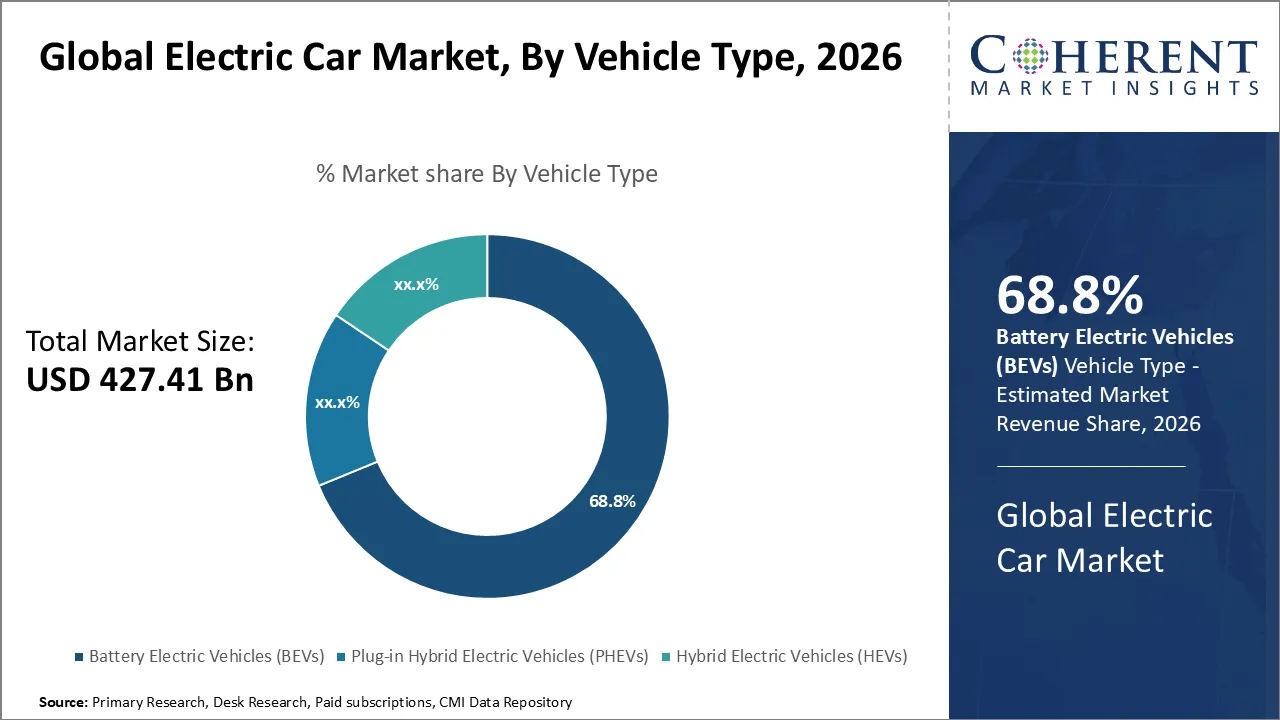
Electric Car Market Insights, By Vehicle Type - Favorable government regulations drive adoption of Battery Electric Vehicles
In terms of vehicle type, battery electric vehicles (BEVs) segment is estimated to contribute the highest market share of 69.8% in 2026 owing to favorable government regulations and incentives. Various governments around the world are offering subsidies and tax benefits to promote sales of electric vehicles. For instance, the U.S. government offers a federal tax credit of up to US$7,500 for the purchase of new BEVs. Similarly, the U.K. government offers grants of up to US$3,500 for the purchase of eligible electric vehicles. Such initiatives significantly lower the upfront cost of BEVs for customers and make them more affordable compared to other vehicle types like PHEVs or HEVs.
For instance, in August 2025, Suzuki's first battery electric vehicle, the e VITARA, launched its plant in Gujarat, India. It has a BEV powertrain, ALLGRIP-e 4WD, and a new HEARTECT-e platform. It has been sold in more than 100 countries. Suzuki's TDSG joint venture also started making lithium-ion batteries for hybrid cars.
To learn more about this report, Download Free Sample
Electric Car Market Insights, By Battery Type - Lithium-ion segment dominance driven by performance advantages
In terms of battery type, the lithium-ion segment is estimated to contribute the highest market share of 76.4% in 2026 owing to its performance advantages over other battery technologies. Lithium-ion batteries offer higher energy density which allows for increased driving range on a single charge compared to older technologies like NiMH. The battery is also lighter in weight which boosts the vehicle's fuel efficiency. Moreover, Lithium-ion batteries have faster charged capabilities and a longer operating life over multiple charge-discharge cycles.
For instance, in May 2025, General Motors unveiled new prismatic battery cells with plenty of lithium manganese (LMR) for future electric vehicles. These lithium-ion batteries, which are expected to be available by 2028, have 33% more energy density, cost less, and are lighter. They were made with LG Energy Solution to make GM's electric trucks and SUVs have a longer range, be more efficient, and cost less.
Electric Car Market Insights, By Range - 150-300 miles segment drives consumer acceptance
In terms of range, the 150-300 miles segment is estimated to contribute the highest market share of 58.7% in 2026 as it offers an optimal balance between driving distance and battery costs. This range adequately meets the daily commute needs of most customers without range anxiety. It also alleviates concerns around running out of charge midway to the destination. At the same time, batteries with capacity enough to deliver this range have higher energy density versus below 150 miles variants, without the high battery costs associated with above 300 miles vehicles.
For instance, in October 2025, Chery launched a prototype of a flying car and introduced Kunpeng solid-state batteries. These high-tech batteries can hold up to 600 Wh/kg of energy and assist electric vehicles go 600 to 800 kilometers. They support 150–300 miles of all-electric driving for plug-in hybrids and extended-range EVs, changing the way we move along with the way batteries are made in the future.
Regional Insights
To learn more about this report, Download Free Sample
North America Electric Car Market Analysis & Trends
North America has dominated the global electric car market. The region is expected to hold 42.0% of the market share in 2026. The U.S. is home to Tesla, one of the pioneering companies in the electric vehicle space. Tesla has led the mass adoption of electric cars in the region with its affordable Model 3 sedan and higher-end Model S and Model X vehicles. This has inspired other major automakers like Ford, GM, and Volkswagen to introduce their own electric car lineups in the U.S. electric car market. The presence of companies like Tesla and new offerings from traditional manufacturers have driven electric car sales quite significantly in the U.S. and Canada. North America also has a well-established charging infrastructure network owing to the early focus on EVs, making it easier for consumers to own electric vehicles.
For instance, In May 2023, Volkswagen Group, one of the world's largest automakers, announced a partnership with Electrify America, a subsidiary of Volkswagen dedicated to building electric vehicle charging infrastructure in the U.S. This collaboration aims to enhance the charging experience for Volkswagen EV owners by expanding the Electrify America network and integrating advanced technologies like Plug&Charge into Volkswagen's ID.4 electric SUV starting in early 2026.
Asia Pacific Electric Car Market Analysis & Trends
Asia Pacific region, especially China, is emerging as the fastest growing market for electric cars globally. The Chinese government has implemented strong regulations and policies to promote eco-friendly vehicles. Substantial subsidies are provided to buyers of electric cars, while production of such vehicles is encouraged through tax incentives for manufacturers. This supportive regulatory environment has led to massive investments by global automakers in China's EV industry. Companies have also localized their electric vehicle production in China to cater to the strong and increasing domestic demand.
For instance, in December 2026, Taiwan's Foxtron, a partnership between Foxconn and Yulon Motor, showed off the Bria EV. It costs between $28,600 and $36,540 and is Taiwan's first electric vehicle to be sold around the world. The Bria makes Foxtron's EV goals stronger and makes Taiwan a strong competitor in the global EV market.
Electric Car Market Outlook Country-Wise
The U.S. Electric Car Market Trends
The market for electric cars in the U.S. is strong due to government incentives, stricter emissions rules, and more places to charge them. People are more interested in Tesla, Ford, and GM as they lead the way in new ideas. Rising fuel costs, awareness of the environment, and affordable EV platforms all help make EVs more popular, making the U.S. a key global EV growth hub.
For instance, in August 2026, Ford announced it would make a new affordable EV platform and a midsize electric truck in the U.S. The platform decreases costs, makes EVs more accessible, and works with a variety of vehicles. This plan makes Ford more competitive with Tesla, GM, and Rivian, with the goal of speeding up the global adoption of electric vehicles.
China Electric Car Market Trends
China's electric car market is competitive owing to strict emission rules, strong government policies, and subsidies. BYD, NIO, and SAIC make a broad range of things in China, which makes them cheaper and more innovative. China has the largest and most rapidly increasing EV market in the world due to the continues to construct more charging stations, people are becoming more aware of the environment, and the country wants to export more EVs.
For instance, in October 2026, Hyundai released the Elexio SUV, an electric vehicle, along with its new new energy vehicle strategy for China. The plan focuses on BEVs and PHEVs, which is in line with China's goals for clean transportation. The Elexio adds to Hyundai's electric vehicle lineup, putting the company in competition with BYD and Tesla in the world's dominant electric vehicle market
Market Report Scope
Electric Car Market Report Coverage
| Report Coverage | Details | ||
|---|---|---|---|
| Base Year: | 2026 | Market Size in 2026: | USD 533.00 Bn |
| Historical Data for: | 2020 To 2024 | Forecast Period: | 2026 To 2033 |
| Forecast Period 2026 to 2033 CAGR: | 24.7% | 2033 Value Projection: | USD 2,499.06 Bn |
| Geographies covered: |
|
||
| Segments covered: |
|
||
| Companies covered: |
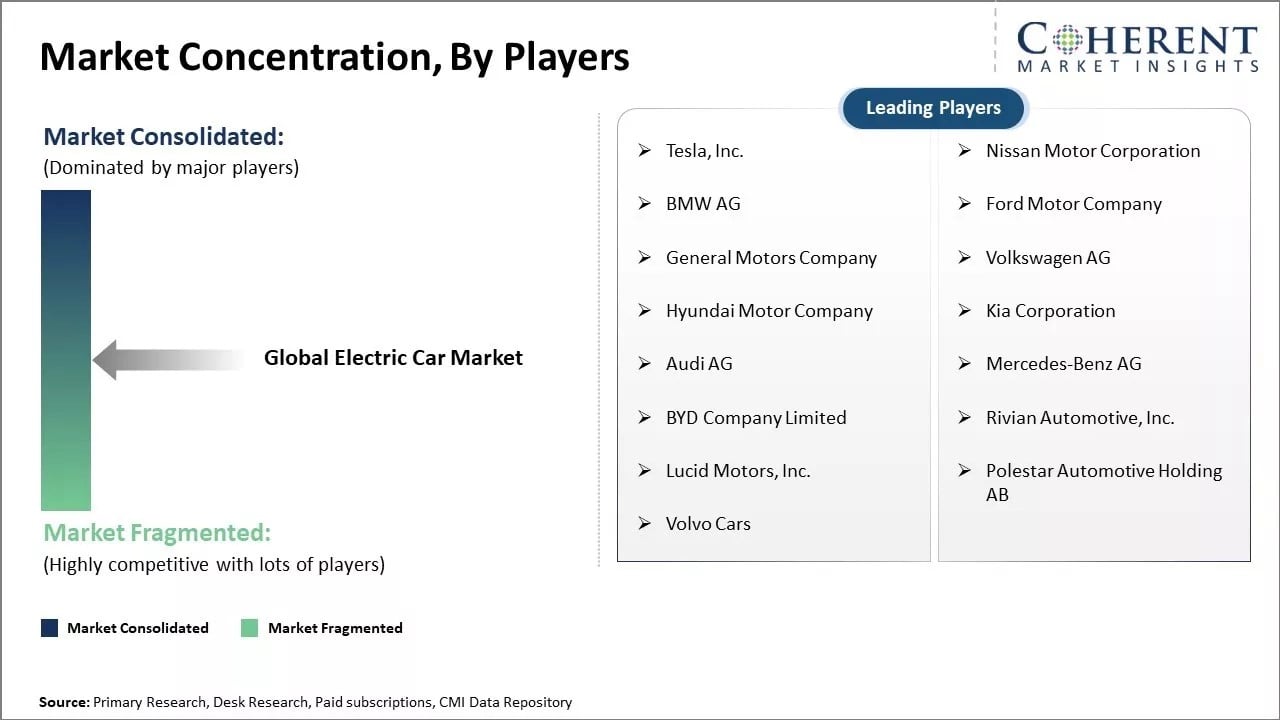
Tesla, Inc., Nissan Motor Corporation, BMW AG, Ford Motor Company, General Motors Company, Volkswagen AG, Hyundai Motor Company, Kia Corporation, Audi AG, Mercedes-Benz AG, BYD Company Limited, Rivian Automotive, Inc., Lucid Motors, Inc., Polestar Automotive Holding AB, and Volvo Cars |
||
| Growth Drivers: |
|
||
| Restraints & Challenges: |
|
||
Uncover macros and micros vetted on 75+ parameters: Get instant access to report
Electric Car Market Driver
Are rising government incentives boosting electric car market adoption?
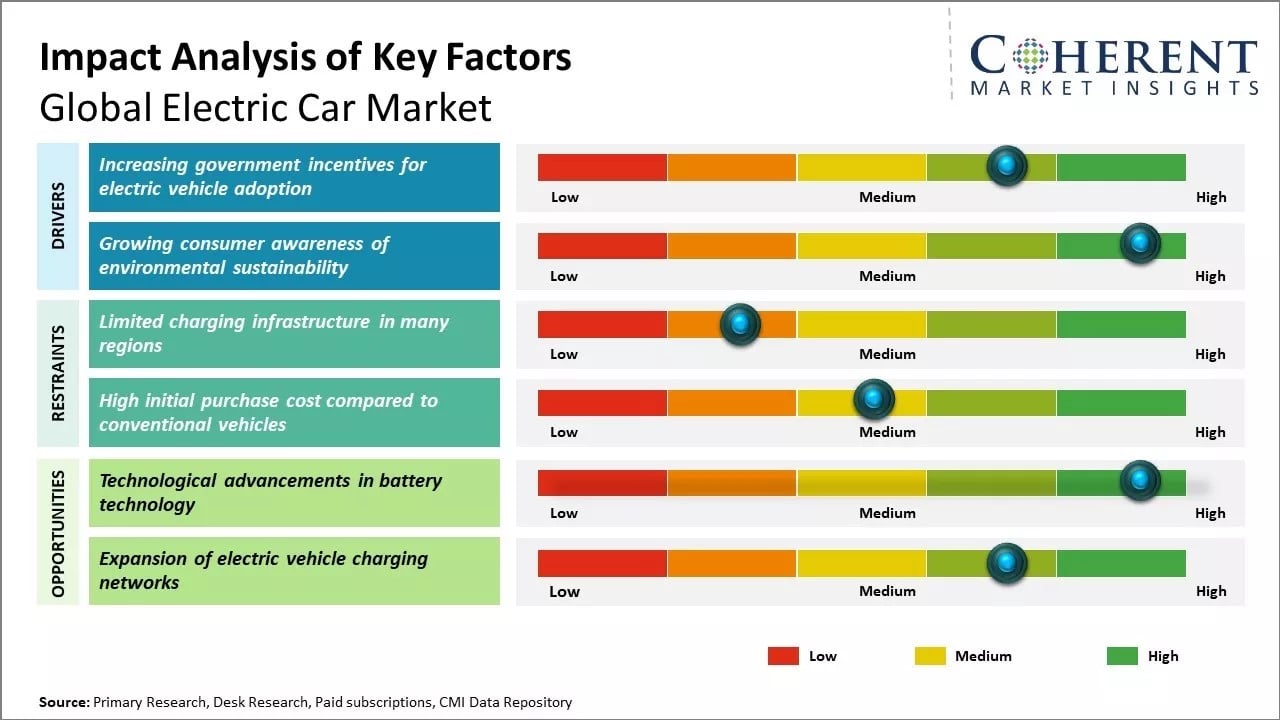
Many governments such as China, India, U.S., etc. around the world are strongly encouraging consumers to shift from conventional internal combustion engine vehicles to electric vehicles. They realize that the widespread adoption of EVs is crucial to reducing pollution levels and curbing climate change. Various incentive schemes have been launched to make EVs more affordable for buyers and bring down their upfront costs. Major countries like the U.S., China, France and Germany offer tax credits or rebates upon purchase of an eligible electric vehicle. Some nations also provide benefits such as exemption from road tax or toll fees for EVs. Since vehicle running costs are significantly lower for EVs, total cost of ownership is lower than gasoline or diesel cars over time. This financial encouragement from governments is definitely nudging more customers to opt for electric vehicles.
For instance, In April 2025, BYD, a leading manufacturer of new energy vehicles, officially launched its latest pure electric vehicle model, the BYD SEAGULL, in Colombia. First unveiled at the Colombian Auto Show the previous year, this compact electric hatchback is expected to appeal greatly to Colombian youth, who will appreciate its modern design, innovative electric features, and affordability. The launch event attracted over 600 media representatives and clients, earning recognition from local media as the best new product launch event of the year in Colombia.
Is rising consumer awareness of sustainability boosting electric car market demand?
People globally are increasingly worried about deteriorating air quality and the alarming pace of global warming. There is a strong sentiment that urgent action needs to be taken to reduce emissions from the transportation sector which accounts for a sizable share of overall pollution. Electric vehicles, with their zero tailpipe emissions, are seen as an important part of the solution. Younger generations especially demonstrate a strong enthusiasm to adopt greener solutions and lifestyles. Automakers too have upped their promotional efforts highlighting the eco-friendly nature of their EVs. With much discussion around sustainability and climate change on various media platforms, environmental consciousness has risen manifold in recent years. This has positively impacted the perception around electric vehicles and more individuals now see them as a way to shrink their carbon footprint. Charging infrastructure build-out in major cities and standardization of technology have also made EVs a more viable option than before.
Electric Car Market Opportunity
High initial purchase cost compared to conventional vehicles
While the high initial purchase price of electric vehicles continues to be a barrier compared to conventional internal combustion engine vehicles, it also presents a significant opportunity for growth and adoption in the global market. The upfront cost tends to be higher for electric vehicles due to the cost of the battery pack. However, total lifetime ownership costs are lower for electric vehicles due to lower fuel and maintenance expenses. As battery technology continues to advance, prices are expected to decline substantially in the coming years which will help close the purchase price gap. Some countries and regions are already implementing purchase incentives like taxes exemptions to defray the higher upfront costs and make electric vehicles more affordable for consumers. For example, the UK government recently increased grant funding for electric vehicles to help more customers overcome the battery cost hurdle.
Market Concentration and Competitive Landscape
To learn more about this report, Download Free Sample
Analyst Opinion (Expert Opinion)
- The global market for electric cars is growing rapidly. By 2026, sales are expected to have reached more than 20 million units per year, which is about one in four new cars sold around the world. This growth is based on sales from previous years, when they were higher than 17 million units. This shows that consumers are still interested and that more models are becoming available in more segments. China is still the largest market, making up most of the world's sales. In 2025, there are expected to be more than 14 million units sold. Europe is still doing well, with electric cars making up more than 20% of new car registrations in major markets. The US is still growing slowly, with electric cars making up more than 10% of new vehicle sales.
- Monthly sales trends show that adoption is speeding up, with deliveries exceeding 2 million units in a single month, showing that demand is growing in both the premium and mid-range segments. Battery systems are getting better, with higher energy density and the use of lithium-iron-phosphate chemistry. These changes are making batteries cheaper and more affordable. More charging stations and longer driving ranges make it easier for more people to use electric cars, even though there are still gaps in the infrastructure in some areas.
- The electric car market is becoming more mainstream thanks to a wider range of vehicles, government incentives, and a rise in people becoming aware of the need for sustainability. Market trends show that production and stock on the road will keep growing, making electric vehicles a key part of future global mobility.
Electric Car Industry News
- In April 2024, BMW Group, a leading premium automobile manufacturer, announced a long-term strategic partnership with Rimac Technology, a Croatia-based company specializing in electric vehicle technology. This collaboration focuses on the co-development and co-production of innovative high-voltage battery solutions for selected battery-electric vehicle (BEV) projects. By leveraging the complementary strengths and expertise of both companies, the partnership aims to enhance their capabilities in the electric mobility sector.
- In March 2024, Nissan Motor Co., a prominent Japan-based automotive manufacturer, and Honda Motor Co., another leading automaker, signed a non-binding memorandum of understanding (MoU) to explore potential collaboration in producing key components for electric vehicles (EVs) and developing artificial intelligence for automotive software platforms. While the specific scope of the partnership is still under discussion, both companies are open to working together in various regions, as highlighted by Nissan's CEO, Makoto Uchida. Honda's CEO, Toshihiro Mibe, emphasized the urgency of this collaboration, stating, "We are strapped for time and need to be speedy." This strategic partnership aims to help both companies achieve economies of scale in EV production, especially as they face intense competition from emerging players like BYD and Tesla.
- In October 2023, Hyundai Motor Company, a leading South Korea-based automotive manufacturer, and Kia Corporation, its sister company, merged their electric vehicle divisions to streamline operations. This strategic consolidation aims to enhance efficiency and innovation in their EV production efforts, allowing both companies to better compete in the rapidly evolving electric vehicle market. The merger comes as they face increasing competition from global players, further underscoring their commitment to advancing electric mobility and meeting growing consumer demand for sustainable transportation solutions.
- In July 2023, Nissan Motor Co., a leading Japan-based automotive manufacturer known for its innovative electric vehicles, announced plans to increase its production capacity for electric vehicles in North America. This initiative is part of Nissan's strategy to enhance its competitiveness in the growing EV market, particularly as it seeks to meet rising consumer demand and adapt to the evolving automotive landscape. The expansion aligns with the company's broader goals to boost electrified vehicle sales and strengthen its manufacturing capabilities in the region.
- In March 2023, Ford Motor Company, a prominent American automaker known for its innovative vehicles, announced its acquisition of an electric vehicle (EV) battery startup to enhance its electric vehicle technology. This strategic move is part of Ford's broader initiative to improve its battery production capabilities and meet the growing demand for electric vehicles, as the company aims to significantly increase its EV output in the coming years. The acquisition aligns with Ford's commitment to investing heavily in sustainable transportation solutions and advancing its position in the competitive EV market.
Market Segmentation
- Vehicle Type Insights (Revenue, USD Bn, 2026 - 2033)
- Battery Electric Vehicles (BEVs)
- Plug-in Hybrid Electric Vehicles (PHEVs)
- Hybrid Electric Vehicles (HEVs)
- Battery Type Insights (Revenue, USD Bn, 2026 - 2033)
- Lithium-Ion
- Solid-State
- Nickel-Metal Hydride
- Range Insights (Revenue, USD Bn, 2026 - 2033)
- 150-300 miles
- Below 150 miles
- Above 300 miles
- Regional Insights (Revenue, USD Bn, 2026 - 2033)
- North America
- U.S.
- Canada
- Latin America
- Brazil
- Argentina
- Mexico
- Rest of Latin America
- Europe
- Germany
- U.K.
- Spain
- France
- Italy
- Russia
- Rest of Europe
- Asia Pacific
- China
- India
- Japan
- Australia
- South Korea
- ASEAN
- Rest of Asia Pacific
- Middle East
- GCC Countries
- Israel
- Rest of Middle East
- Africa
- South Africa
- North Africa
- Central Africa
- Key Players Insights
- Tesla, Inc.
- Nissan Motor Corporation
- BMW AG
- Ford Motor Company
- General Motors Company
- Volkswagen AG
- Hyundai Motor Company
- Kia Corporation
- Audi AG
- Mercedes-Benz AG
- BYD Company Limited
- Rivian Automotive, Inc.
- Lucid Motors, Inc.
- Polestar Automotive Holding AB
- Volvo Cars
Sources
Primary Research Interviews
- Electric Vehicle (EV) Manufacturers
- Battery Pack & Energy Storage System Integrators
- Electric Motor and Powertrain Technology Providers
- Automotive Power Electronics Engineers
- EV Charging Infrastructure Consultants
- Others
Databases
- Bloomberg Terminal
- Thomson Reuters Eikon
- IHS Markit
- Euromonitor International
- S&P Global Market Intelligence
- Others
Magazines
- Electrive.com
- Automotive News
- EV Magazine
- Green Car Reports
- Others
Journals
- Journal of Power Sources
- International Journal of Electric and Hybrid Vehicles
- Energy & Environmental Science
- IEEE Transactions on Transportation Electrification
- Others
Newspapers
- Financial Times
- The Wall Street Journal
- Reuters
- Bloomberg News
- Others
Associations
- Electric Drive Transportation Association (EDTA)
- International Energy Agency (IEA) – EV Initiative
- European Automobile Manufacturers Association (ACEA)
- Society of Automotive Engineers (SAE International)
- Others
Public Domain Sources
- U.S. Department of Energy (DOE) – Vehicle Technologies Office
- International Energy Agency (IEA)
- European Commission – Mobility and Transport
- World Bank Open Data
- National Renewable Energy Laboratory (NREL)
- Others
Proprietary Elements
- CMI Data Analytics Tool
- Proprietary CMI Existing Repository of Information for the Last 8 Years
Definition: Global electric car market refers to the worldwide industry for electric vehicles that are powered solely or partially by electricity. It includes fully electric vehicles that are powered only by batteries and plug-in hybrid electric vehicles that can run on both electricity and gasoline. The market involves the research, development, manufacturing, and sales of electric cars across all major regions and countries worldwide.
Share
Share
About Author
Gautam Mahajan is a Research Consultant with 5+ years of experience in market research and consulting. He excels in analyzing market engineering, market trends, competitive landscapes, and technological developments. He specializes in both primary and secondary research, as well as strategic consulting across diverse sectors.
Missing comfort of reading report in your local language? Find your preferred language :
Transform your Strategy with Exclusive Trending Reports :
Frequently Asked Questions
EXISTING CLIENTELE
Joining thousands of companies around the world committed to making the Excellent Business Solutions.
View All Our Clients