

Global Elemental Analysis Market Size and Forecast – 2026-2033
The global elemental analysis market is estimated to be valued at USD 2.06 Bn in 2026 and is expected to reach USD 3.24 Bn by 2033, exhibiting a compound annual growth rate (CAGR) of 6.7% from 2026 to 2033.
Key Takeaways of the Global Elemental Analysis Market
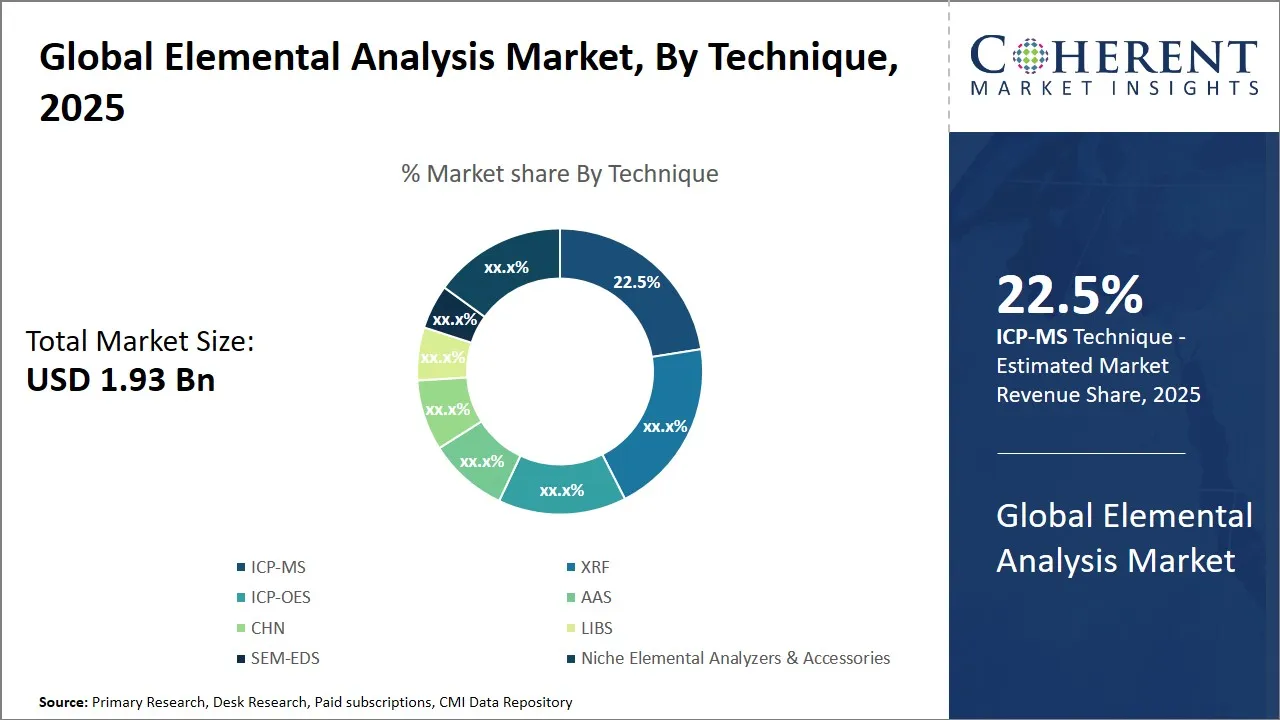
- The ICP-MS segment is expected to lead the market holding a share of 23.5 % in 2026.
- The benchtop segment is projected to dominate with a share of 63.3% n 2026.
- Asia Pacific, holding a share of 36.5% in 2026, is projected to dominate the market.
- North America, holding an estimated share of 29.8% in 2026, shows the fastest growth in the market.
Market Overview
The market is seeing a lot of adoption of advanced technologies such as portable analyzers and real-time monitoring systems, which add to accuracy and efficiency in elemental analysis. Additionally, growing applications in pharmaceuticals, environmental testing, and electronics manufacturing are propelling innovation. The growing focus on regulatory compliance and sustainability is also adding to the use of elemental analysis for detecting contaminants and ensuring product safety.
Current Events and Its Impact
Current Events | Description and its Impact |
Geopolitical and Trade Developments |
|
Economic and Infrastructure Trends |
|
Segmental Insights
- Current Industry Events of 2026
- Market Size Estimation
- Regional Breakdown
- Competitive Landscape
- Customer Intelligence
- Segmental Analysis
- Pricing Analysis
- Key Market Drivers, Challenges & Future Trends
- Customized Insights Section
Global Elemental Analysis Market Insights, By Technique – ICP-MS Leads Because of its Unparalleled Sensitivity and Multi-Element Detection Capabilities
ICP-MS holds an estimated 23.5% share in 2026, driven by its ultra-trace sensitivity, ability to detect multiple elements simultaneously, and broad regulatory relevance across environmental, pharmaceutical, and food safety testing. Innovations such as collision/reaction cell (CRC) technology have reduced spectral interferences, adding to its suitability for complex matrices.
Its versatility across liquids, solids, and digested samples, along with continuous improvements in software, automation, and reliability, makes Inductively Coupled Plasma Mass Spectrometry (ICP-MS) the preferred tool for high-precision elemental quantification.
In 2024, Thermo Fisher launched the iCAP MX ICP-MS platform, with improved interference-removal capabilities and faster multi-element analysis.
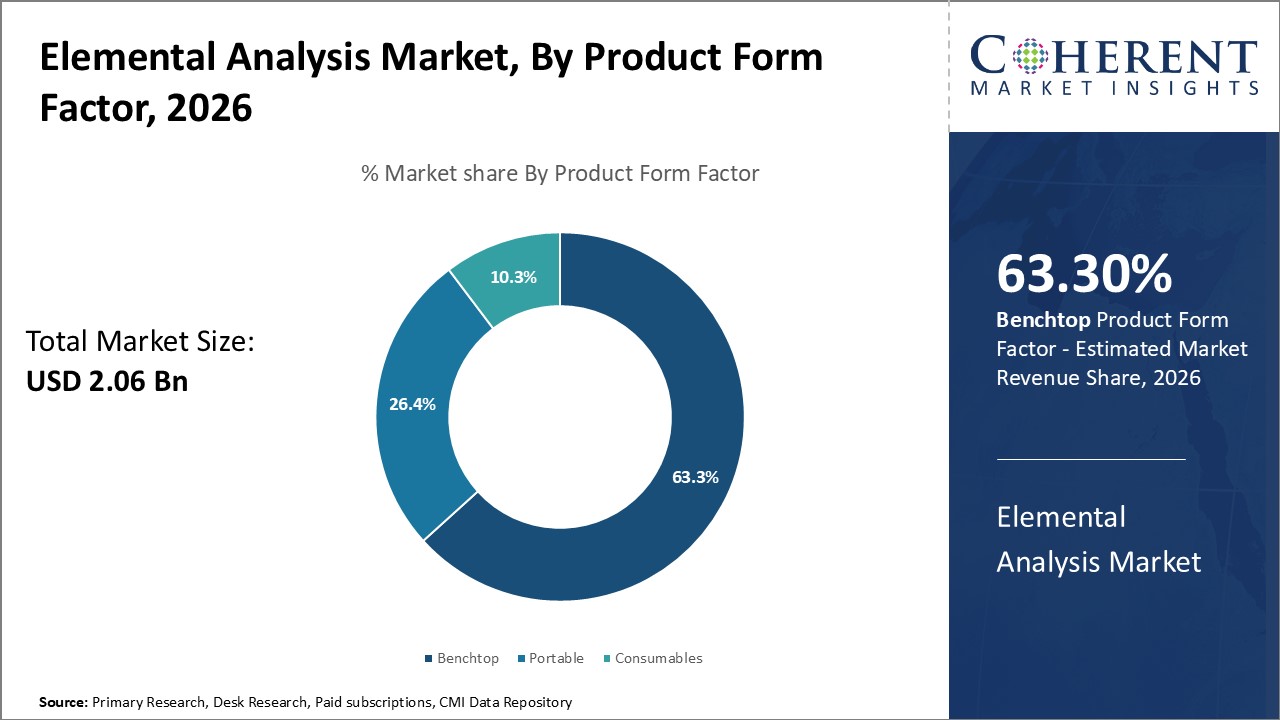
Global Elemental Analysis Market Insights, By Product Form Factor – Benchtop Dominates the Market Because of their Balance of Performance, Flexibility, and Laboratory Integration
Benchtop is projected to hold 63.3% share in 2026, due to their balance of performance, space efficiency, and workflow integration. They offer high accuracy, automation, and multi-sample compatibility while removing the infrastructure demands of full floor-standing models.
Their compact footprint suits QC labs, R&D centers, and academic facilities that need high analytical performance without extensive lab redesign. Improvements in intuitive interfaces, automation, and broader consumable support have further added to adoption across industries, including pharma, environment, mining, and education.
In 2024, Malvern Panalytical introduced the Revontium benchtop XRF analyzer, offering lab-grade elemental detection in a small footprint, allowing fast deployment in both R&D and quality-control environments.
Pricing Analysis of the Elemental Analysis Market
Technique/Instrument Type | Typical Price Range (USD) |
ICP-MS (Inductively Coupled Plasma Mass Spectrometry) | USD 150,000 – USD 500,000+ |
ICP-OES (Optical Emission Spectroscopy/AES) | USD 46,000 – USD 70,000+ |
XRF (X-Ray Fluorescence) – Benchtop | USD 25,000 – USD 150,000+ |
XRF – Handheld/Portable | USD 15,000 – USD 60,000+ |
AAS (Atomic Absorption Spectroscopy) | USD 10,000 – USD 60,000+ |
Regulation-by-Application Mapping + Region-wise Permissible Limits
Application (Regulation) | Region/Regulator | Key analytes (perm. limit) |
Drinking water — national limits (parametric/MCL/guideline) | U.S. (EPA) | Lead (action level): 0.010 mg/L (10 µg/L); Copper (action level): 1.3 mg/L. |
WHO (Guidelines for Drinking-water Quality) | Lead: 0.01 mg/L (10 µg/L); Arsenic: 0.01 mg/L (10 µg/L); Mercury: 0.006 mg/L (6 µg/L) | |
European Union (Drinking Water Directive, recast DWD) | Lead: 5 µg/L (parametric value to be met by 12 Jan 2026); transitional provisions allow up to 10 µg/L shorter term. | |
China (GB 5749-2006/updated standard) | Lead: 0.01 mg/L (10 µg/L); Cadmium: 0.005 mg/L (5 µg/L); Mercury: 0.001 mg/L (1 µg/L) (selected metals). | |
India (IS 10500:2012/CPCB) | Lead: 0.01 mg/L; Cadmium: 0.003 mg/L (3 µg/L); Mercury: 0.001 mg/L (1 µg/L) (acceptable limits). | |
Food safety — heavy metals in foods (max levels) | European Union (Commission Reg. 1881/2006 & amendments) | Examples: processed cereal-based foods for infants: Lead ≤ 0.02 mg/kg; Cadmium in cereals/vegetables varies (e.g., 0.05–0.1 mg/kg depending on commodity). |
Codex Alimentarius (FAO/WHO) | General example: cereals ~Cd 0.1 mg/kg, Lead 0.1–0.2 mg/kg (commodity-dependent); fish/seafood mercury often 0.5 mg/kg (many fish) to 1.0 mg/kg (predatory fish). | |
U.S. (FDA) | Bottled water (quality standard) — Lead ≤ 5 µg/L (0.005 mg/L); Draft/Action levels for baby foods & juices: FDA’s “Closer to Zero” guidance proposes ~5–20 ppb (µg/kg or µg/L) depending on food/juice (industry guidance/action levels under development). | |
China/India (food standards) | Commodity-specific limits (e.g., China GB standards & India FSSAI set limits for Pb, Cd, As, Hg in rice, seafood, baby foods). Typical ranges overlap Codex/EU but vary by commodity. | |
Pharmaceuticals — elemental impurities (ICH Q3D/USP) | Global (ICH/EMA/FDA/USP adoption) | Permitted Daily Exposures (oral, µg/day) — Lead: 5 µg/day; Cadmium: 5 µg/day; Arsenic (inorganic): 15 µg/day; Mercury: 30 µg/day (selected Class-1 elements). |
Surface water/ambient water quality (human & aquatic life criteria) | U.S. (EPA) — AWQC/Human health & aquatic life criteria | Metals are hardness-dependent; example EPA human-health aquatic life criteria for Lead & Cadmium are low µg/L or sub-µg/L (representative values depend on hardness). |
EU (Water Framework Directive/Daughter Directives/BREFs) | No single global numeric — member states set standards; EU requires monitoring & BAT for discharges; aquatic quality objectives for heavy metals are typically µg/L or lower. | |
Industrial wastewater discharge (effluent limits for heavy metals) | India (Central Pollution Control Board/Environment Rules) | Representative industry effluent limits (examples): Cadmium 0.2 mg/L, Lead 0.1 mg/L, Mercury 0.01 mg/L — (limits vary by industry & treatment). |
U.S. (NPDES/state permits) | No universal numeric — NPDES permits set industry/state-specific effluent limits; toxic metals limits often in low 10s–100s µg/L depending on receiving water/aquatic criteria & BAT. | |
EU (Industrial discharge limits/IED & local permits) | Limits set by member states/per BREF-based BAT conclusions; typical metal discharge limits are in the range of 0.01–0.5 mg/L depending on metal & industry. |
CapEx/OpEx Cost Analysis for Elemental Analysis Labs
Equipment Type/Lab Investment Area | Expected CapEx (USD) | OpEx Components & Typical Annual Cost | Efficiency/ROI When Replacing Legacy Systems |
ICP-MS Systems | USD 120,000 – USD 380,000 |
| 40–60% reduction in analysis time, lower LOD enables multi-element runs -> ROI in 2–3 yrs from higher throughput & reduced reruns |
ICP-OES/ICP-AES | USD 70,000 – USD 170,000 |
| 25–40% cost savings vs. older OES systems; higher stability reduces downtime -> ROI 2–4 yrs |
AAS (Flame/Graphite Furnace) | USD 20,000 – USD 95,000 |
| Legacy AAS has high manual labor; modern automation gives 20–30% labor savings -> ROI 3–4 yrs |
WDXRF/EDXRF | USD 40,000 – USD 350,000 |
| Newer XRF systems save 30–50% on sample prep & reagent use -> ROI 2–3 yrs |
CHNS/O Elemental Analyzers | USD 40,000 – USD 120,000 |
| Improved automation & stability reduce reruns by 20–40% -> ROI 2–3 yrs |
Microwave Digestion Systems | USD 20,000 – USD 80,000 |
| Cuts digestion time from 2–6 hrs → 20–40 min, massively increasing ICP throughput -> ROI within 1–2 yrs |
Sample Prep Automation (Dilutors, Robotic Platforms) | USD 15,000 – USD 150,000 |
| Automation reduces manual labor by 30–70%, increases reproducibility -> ROI 1–2 yrs |
Cleanrooms/Clean Benches (ISO 5–8) | USD 8,000 – USD 250,000 |
| Essential for ultra-trace work; reduces contamination, boosting data quality -> ROI 3–5 yrs |
Lab Information Management System (LIMS) | USD 10,000 – USD 250,000 (depending on scale) |
| Cuts manual data entry by 60–85%; compliance automation reduces audit risk -> ROI 1–3 yrs |
High-Purity Gas Infrastructure | USD 6,000 – USD 40,000 |
|
Regional Insights
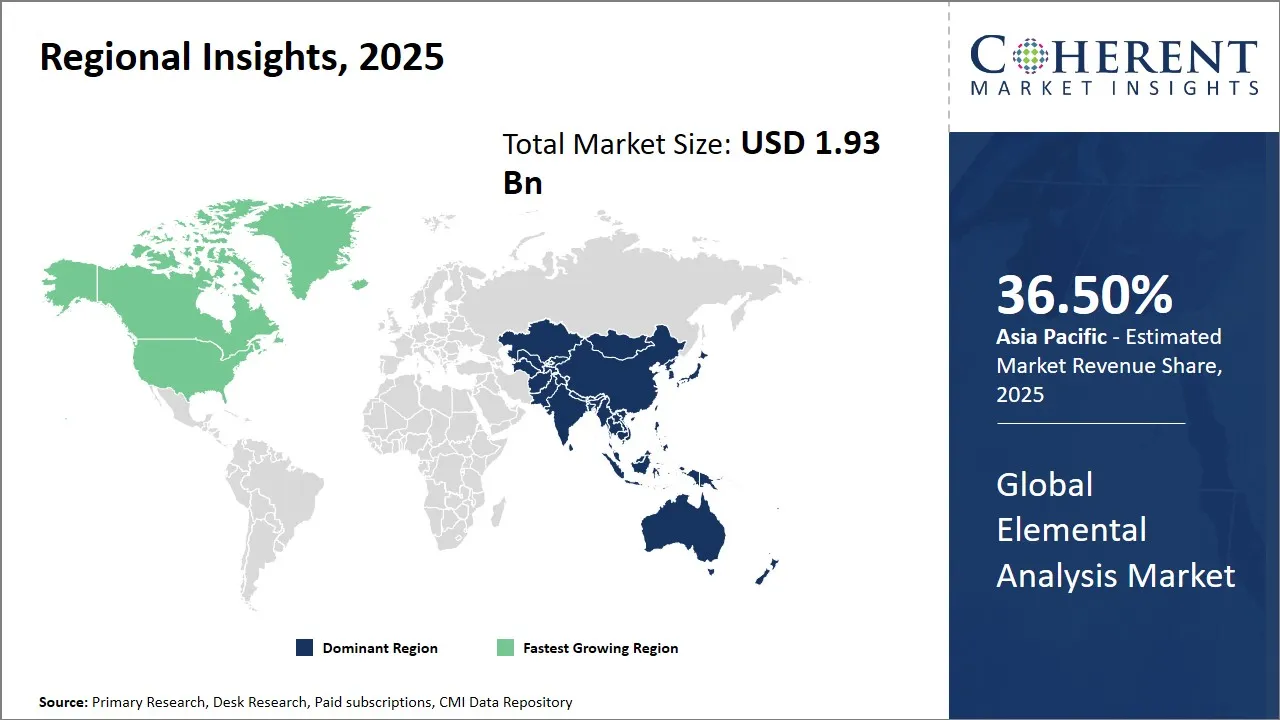
Asia Pacific Elemental Analysis Market Analysis and Trends
The Asia Pacific region, holding an estimated share of 36.5% in 2026, dominates the elemental analysis market owing to its rapidly expanding manufacturing sectors, chemical industries, and infrastructure development activities. Emerging economies like China, India, and South Korea are witnessing increasing adoption of elemental analysis technologies primarily driven by growing environmental concerns, stringent government regulations, and rising investments in research and development activities.
The surge in pharmaceutical and consumer electronics industries supplements demand for precise elemental analysis tools. Export-import trade relations and infrastructure investments under economic initiatives further bolster market expansion. Notable companies such as Shimadzu Corporation, Bruker Corporation, and JEOL Ltd. are actively expanding their footprint in Asia Pacific by establishing regional offices and manufacturing facilities, allowing faster customer support and localized innovation that caters to specific regional requirements.
North America Elemental Analysis Market Analysis and Trends
North America, holding an estimated share of 29.8% in 2026, shows the fastest growth in the global elemental analysis market because of a well-established industrial base and a robust ecosystem of research and development. The presence of numerous advanced manufacturing industries, pharmaceuticals, environmental testing labs, and academia fuels demand for precise elemental analytical instruments and services. Supportive government policies such as stringent environmental regulations and safety standards make market demand, promoting investment in cutting-edge analytical technologies.
Trade dynamics also favor North America, with the U.S. being a big importer and exporter of sophisticated analytical equipment. Key companies such as Agilent Technologies, Thermo Fisher Scientific, and PerkinElmer have invested a lot in innovative solutions, adding to North America’s leadership by offering advanced mass spectrometry, X-ray fluorescence, and atomic absorption spectroscopy instruments to meet diverse industry needs. The strong collaboration between private sectors and public research institutions enhances the market’s maturity and technological advancement.
Global Elemental Analysis Market Outlook for Key Countries
U.S. Elemental Analysis Market Analysis and Trends
The U.S. elemental analysis market sees its advanced technological infrastructure and presence of prominent elemental analysis solution providers like Thermo Fisher Scientific and Agilent Technologies. The country’s strict regulatory norms for environmental safety and quality control push industries to use state-of-the-art elemental analysis instruments. Also, significant government funding supporting scientific research and innovation adds to the adoption of high-precision analytical equipment across pharmaceutical, aerospace, and materials science sectors. These dynamics sustain the U.S. as a big hub for market innovation and product development.
Germany Elemental Analysis Market Analysis and Trends
Germany elemental analysis market thrives due to its strong industrial base in automotive, chemical, and manufacturing sectors. The country’s focus on quality assurance, compliance with the European Union’s rigorous regulatory frameworks, and focus on sustainability promote the use of advanced elemental analysis technologies. Companies such as Bruker and Analytik Jena play pivotal roles by providing tailored analysis solutions that meet Germany’s high standards for precision and reliability. Germany’s commitment to Industry 4.0 also fuels the addition of elemental analysis with data analytics and automation, making the market stronger.
China Elemental Analysis Market Analysis and Trends
China is a central player in Asia Pacific’s fast-growing elemental analysis market, because of fast industrialization and government-backed initiatives promoting environmental monitoring and pollution control. Increasing industrial exports require strict quality certification, making demand for advanced elemental analytical instruments. Local and international companies collaborate to enhance presence, with Shimadzu Corporation and Thermo Fisher Scientific operating extensive distribution and service networks. China’s growing pharmaceutical and electronics sectors also contribute a lot to market growth by increasing the need for complex material characterization.
India Elemental Analysis Market Analysis and Trends
India elemental analysis market is growing fast, determined by expanding pharmaceutical manufacturing, chemical industries, and growing environmental regulations. The government’s focus on research infrastructure and environmental compliance makes opportunities for domestic and multinational companies. Agilent Technologies and Bruker have been proactive in establishing partnerships with local institutions and enterprises to deliver cost-effective and accessible elemental analysis solutions. Also, India’s development in nanotechnology and materials science research further makes demand for high-end elemental analysis instruments.
Japan Elemental Analysis Market Analysis and Trends
Japan continues to lead in innovation within the elemental analysis market, using its strength in electronics, automotive, and materials engineering industries. The country benefits from companies like JEOL Ltd. and Hitachi High-Technologies, which make cutting-edge analytical instruments with high precision and performance. Japan’s stringent quality standards and consistent investment in R&D encourage widespread adoption of elemental analysis technologies for quality control and regulatory compliance. The focus on innovation and advanced manufacturing techniques keeps Japan at the forefront of global trends.
Market Players, Key Development, and Competitive Intelligence
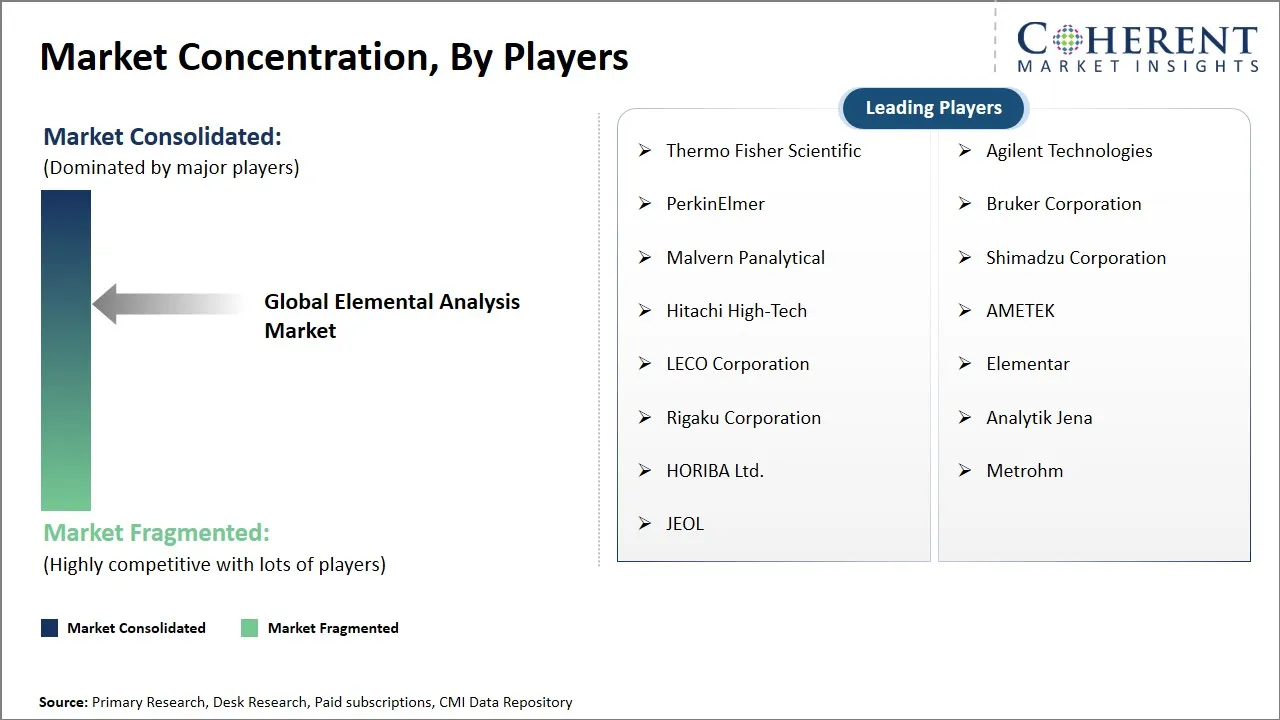
Key Developments
- In October 2024, Thermo Fisher Scientific launched the Thermo Scientific iCAP MX Series ICP-MS to simplify trace element analysis with inductively coupled plasma mass spectrometry (ICP-MS). The launch includes a new single quadrupole Thermo Scientific iCAP MSX ICP-MS and triple quadrupole Thermo Scientific iCAP MTX ICP-MS designed for environmental, food, industrial and research labs to analyze routine and challenging trace elements to detect and mitigate harmful substances.
- In July 2024, Malvern Panalytical, a global leader in the analytics of material and life sciences, agreed to acquire Micromeritics - a world leader in analytical instrumentation for the physical characterization of particles, powders, and porous materials.
- In April 2024, Malvern Panalytical announced the launch of Revontium, the world’s first compact XRF spectrometer, at Analytica Munich. This new instrument delivers powerful elemental analysis with outstanding ease of use in a compact 0.4 m2 footprint, for the optimal balance between precision and efficiency.
- In April 2024, PerkinElmer, a leading global analytical services and solutions provider, launched its NexION 1100 ICP-MS. The NexION 1100 ICP-MS is a robust and reliable system with a unique, single-analyzer three-quad design providing effective, yet simple, interference removal for accurate, and repeatable results.
Top Strategies Followed by Elemental Analysis Market Players
- Established market leaders primarily invest heavily in research and development (R&D) to innovate high-performance elemental analyzers that meet rigorous industry standards and emerging application needs.
- Thermo Fisher Scientific (2024) invested in advanced R&D for its iCAP RQplus ICP-MS system, introducing improved interference-removal technology, enhanced robustness, and automated workflows to maintain leadership in ultra-trace analysis.
- Mid-level companies in the elemental analysis market adopt differentiated strategies centered around delivering cost-effective yet reliable products.
- Analytik Jena (2024) expanded its PlasmaQuant series (PQ 9100/9500 ICP-OES) with improved efficiency but at a significantly lower cost of ownership—positioned specifically for cost-sensitive environmental and industrial labs, especially in Asia and Latin America.
- Small-scale players in the global elemental analysis market differentiate themselves by specializing in niche product areas or incorporating innovative features that address specific user pain points.
- Elementar (2024) strengthened its niche in CHNS/O and isotope ratio elemental analysis with its UNICUBE and vario ISOTOPE select systems—highly specialized instruments serving academic, geochemical, and organic material research markets rather than competing across all elemental techniques.
Market Report Scope
Elemental Analysis Market Report Coverage
| Report Coverage | Details | ||
|---|---|---|---|
| Base Year: | 2025 | Market Size in 2026: | USD 2.06 Bn |
| Historical Data for: | 2020 To 2024 | Forecast Period: | 2026 To 2033 |
| Forecast Period 2026 to 2033 CAGR: | 6.7% | 2033 Value Projection: | USD 3.24 Bn |
| Geographies covered: |
| ||
| Segments covered: |
| ||
| Companies covered: | Thermo Fisher Scientific, Agilent Technologies, PerkinElmer, Bruker Corporation, Malvern Panalytical, Shimadzu Corporation, Hitachi High-Tech, AMETEK, LECO Corporation, Elementar, Rigaku Corporation, Analytik Jena, HORIBA Ltd., Metrohm, and JEOL | ||
| Growth Drivers: |
| ||
| Restraints & Challenges: |
| ||
Market Dynamics
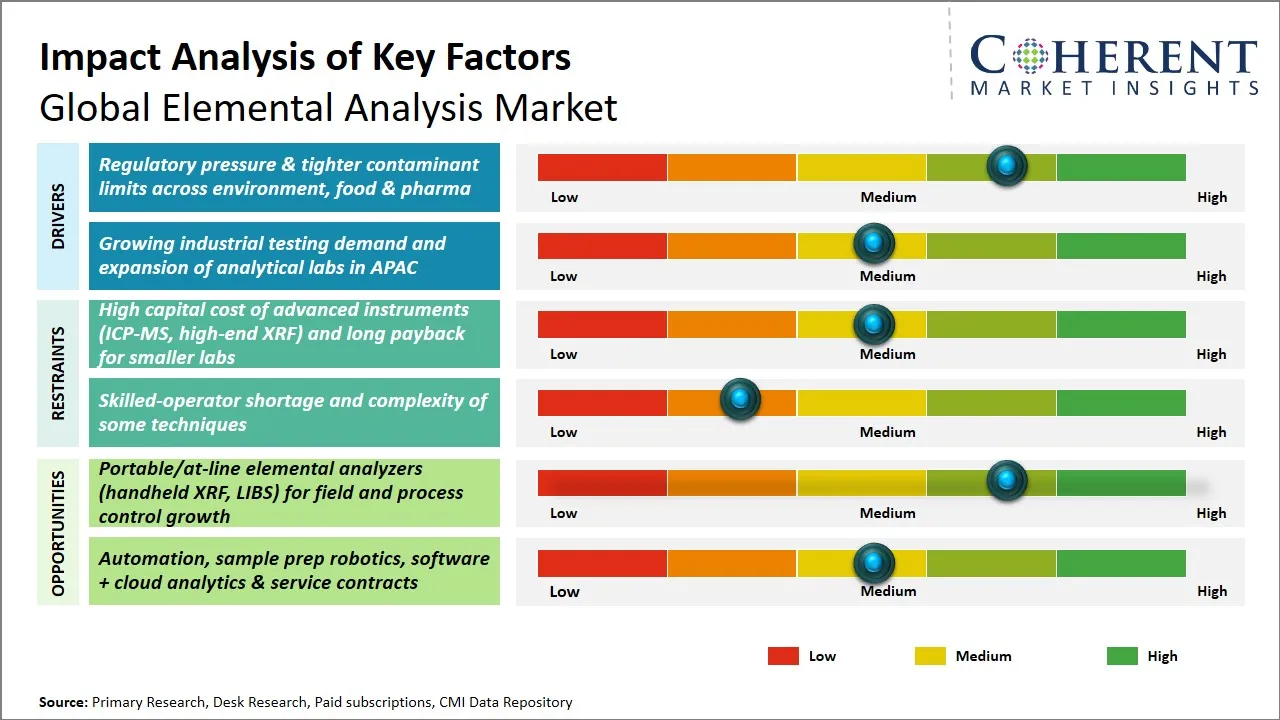
Global Elemental Analysis Market Driver – Regulatory Pressure & Tighter Contaminant Limits Across Environment, Food & Pharma
Stricter regulations in environmental testing, food safety, and pharmaceuticals are accelerating the adoption of advanced elemental analysis systems. Governments now enforce lower permissible limits for heavy metals in water, soil, food products, and drug formulations, requiring highly sensitive techniques like ICP-MS and ICP-OES for compliance. Regulatory bodies such as the FDA, EPA, EFSA, and EMA increasingly mandate ultra-trace metal testing, pushing labs and manufacturers to upgrade to high-accuracy, high-throughput instruments to avoid non-compliance risks, penalties, and recalls.
In 2024, the U.S. EPA updated its Lead and Copper Rule, tightening permissible lead levels in drinking water systems—resulting in a measurable spike in ICP-MS procurement by municipal and contract testing laboratories.
Global Elemental Analysis Market Opportunity – Expansion of Portable and At-Line Elemental Analyzers for Field and Process Control
Rapid, on-site elemental testing is creating strong demand for portable XRF and LIBS instruments. Industries such as mining, environmental inspection, recycling, and metal manufacturing increasingly rely on handheld and at-line analyzers for real-time decision-making, reduced lab dependency, and faster process control. Advances in miniaturization, battery life, and IoT connectivity further boost the appeal of field-deployable devices, enabling continuous monitoring and improving operational efficiency.
In 2024, Bruker launched the TRACER 5g handheld XRF system, designed for high-precision field analysis in mining, archaeology, and environmental testing—demonstrating growing industry investment in portable elemental technologies.
Analyst Opinion (Expert Opinion)
- The industry is increasingly constrained by soaring ownership costs, as high-end ICP-MS and WDXRF systems require expensive consumables, gases, and maintenance contracts—costs that many mid-tier and emerging-economy labs simply cannot absorb, ultimately slowing market penetration despite technological advancements.
- Regulatory complexity is becoming a double-edged sword; while compliance drives demand, constant updates across U.S. FDA, EPA, EU REACH, and global food/pharma standards overwhelm smaller labs that lack resources for rapid system upgrades, creating a widening capability gap between top-tier laboratories and everyone else.
- The market is suffering from an acute shortage of skilled analytical chemists, and instrument vendors have not yet solved the training bottleneck. Even highly automated systems still require expertise in calibration, sample prep, and interference correction—meaning many labs struggle to fully utilize the very instruments they invest heavily in.
Speak to the analyst
Want personalized insights?
Take the findings above to one of our principal consultants, or have the report rebuilt around the segments, geographies and competitors you actually track.
Market Segmentation
- Technique Insights (Revenue, USD Bn, 2021 - 2033)
- ICP-MS
- XRF
- ICP-OES
- AAS
- CHN
- LIBS
- SEM-EDS
- Niche Elemental Analyzers & Accessories
- Product Form Factor Insights (Revenue, USD Bn, 2021 - 2033)
- Benchtop
- Portable
- Consumables
- Regional Insights (Revenue, USD Bn, 2021 - 2033)
- North America
- U.S.
- Canada
- Latin America
- Brazil
- Argentina
- Mexico
- Rest of Latin America
- Europe
- Germany
- U.K.
- Spain
- France
- Italy
- Russia
- Rest of Europe
- Asia Pacific
- China
- India
- Japan
- Australia
- South Korea
- ASEAN
- Rest of Asia Pacific
- Middle East
- GCC Countries
- Israel
- Rest of Middle East
- Africa
- South Africa
- North Africa
- Central Africa
- North America
- Key Players Insights
- Thermo Fisher Scientific
- Agilent Technologies
- PerkinElmer
- Bruker Corporation
- Malvern Panalytical
- Shimadzu Corporation
- Hitachi High-Tech
- AMETEK
- LECO Corporation
- Elementar
- Rigaku Corporation
- Analytik Jena
- HORIBA Ltd.
- Metrohm
- JEOL
Sources
Primary Research Interviews
Stakeholders
- Analytical Instrument Manufacturers
- Elemental Analysis System Providers
- Laboratory Directors & QA/QC Managers in environmental, pharma, and food labs
- Contract Research Organizations (CROs) specializing in elemental testing and impurity profiling
- Process Control Managers in mining, metallurgy, and specialty chemicals
- Environmental Compliance Officers and Regulatory Consultants
- Semiconductor Materials Testing Experts
- Field Technicians using portable XRF/LIBS analyzers
- Distributors & Channel Partners of analytical instrumentation
- Industry Experts specializing in trace metal analysis, contamination control, and lab automation
Databases
- International Laboratory Equipment Index (ILEI)
- U.S. Analytical Instruments Register (USAIR)
- Global Trace Metals Monitoring Database (GTMMD)
- OECD Analytical Science Repository
- Environmental Compliance Data Archive (ECDA)
- Food Safety Contaminant Tracking System (FSCTS)
Magazines
- Analytical Science Today
- Lab Equipment & Technology Review
- Spectroscopy World
- Environmental Testing Insight
- Pharma Quality & Compliance Magazine
Journals
- Journal of Analytical Atomic Spectrometry (JAAS)
- Spectrochimica Acta – Atomic Spectroscopy Series
- Applied Spectroscopy Reviews
- International Journal of Environmental Analytical Chemistry
- Journal of Pharmaceutical Analysis & Impurities Control
Newspapers
- The Science & Technology Herald
- Lab Industry Daily
- Environmental Monitor News
- Materials Analysis Times
- The Industrial Process Observer
Associations
- International Society for Trace Element Research (ISTER)
- Global Council for Analytical Instrumentation (GCAI)
- American Society for Spectral Analysis (ASSA)
- European Federation of Applied Spectroscopy (EFAS)
- Asia-Pacific Analytical Chemistry Alliance (APACA)
Public Domain Sources
- US Geological Survey (USGS) – Mineral & Element Data Archives
- U.S. Census Bureau
- EUROSTAT
- United Nations Industrial Development Organization (UNIDO)
- World Bank Open Data
- ResearchGate (Open-access scientific literature)
- UNECE – Environmental Monitoring & Reporting Framework
Proprietary Elements
- CMI Data Analytics Tool
- Proprietary CMI Existing Repository of Information for the last 8+ years
Get access to 250+ pages report
Every segment, forecast, competitor profile and data table behind the analysis above — available for instant download.
- ESOMAR Member
- ISO 9001:2015 Certified
- D-U-N-S Registered
- GDPR & CCPA Compliant
Missing comfort of reading report in your local language? Find your preferred language:
Transform your Strategy with Exclusive Trending Reports
Frequently Asked Questions
The global elemental analysis market is estimated to be valued at USD 2.06 billion in 2026 and is expected to reach USD 3.24 billion by 2033.
The CAGR of the global elemental analysis market is projected to be 6.7% from 2026 to 2033.
Regulatory pressure & tighter contaminant limits across environment, food & pharma and growing industrial testing demand and expansion of analytical labs in APAC are the major factors driving the growth of the global elemental analysis market.
High capital cost of advanced instruments (ICP-MS, high-end XRF) and long payback for smaller labs and skilled-operator shortage and complexity of some techniques are the major factors hampering the growth of the global elemental analysis market.
It is the measurement of chemical elements in a sample using techniques such as ICP-MS, ICP-OES, XRF, AAS, and CHNS/O analyzers.
Yes, handheld XRF and LIBS are rapidly growing for field testing and process control.
In terms of technique, the ICP-MS segment is estimated to dominate the market revenue share in 2026.