

Geocomposites Market Size and Forecast — 2026 - 2033
The Global Geocomposites Market size is estimated to be valued at USD 2.4 billion in 2026 and is expected to reach USD 4.6 billion by 2033, exhibiting a compound annual growth rate (CAGR) of 9.8% from 2026 to 2033.
Overview
Geocomposites are engineered materials composed of two or more geosynthetic components, such as geotextiles, geomembranes, geogrids, or geonets. These products are designed to perform multiple functions simultaneously, including drainage, filtration, separation, reinforcement, and protection. Geocomposites are used in civil engineering and construction applications such as roads, landfills, retaining walls, tunnels, and erosion control systems. Their multifunctional design improves performance efficiency and reduces installation complexity.
Key Takeaways
The Drainage Geocomposites segment dominates the Geocomposites market share due to its critical role in facilitating water dissipation in infrastructure applications, with robust demand from road and highway projects contributing significantly to market revenue.
The Construction end-user industry leads segment growth, driven by increased government funding and rapid urbanization, demanding sustainable and resilient infrastructure solutions.
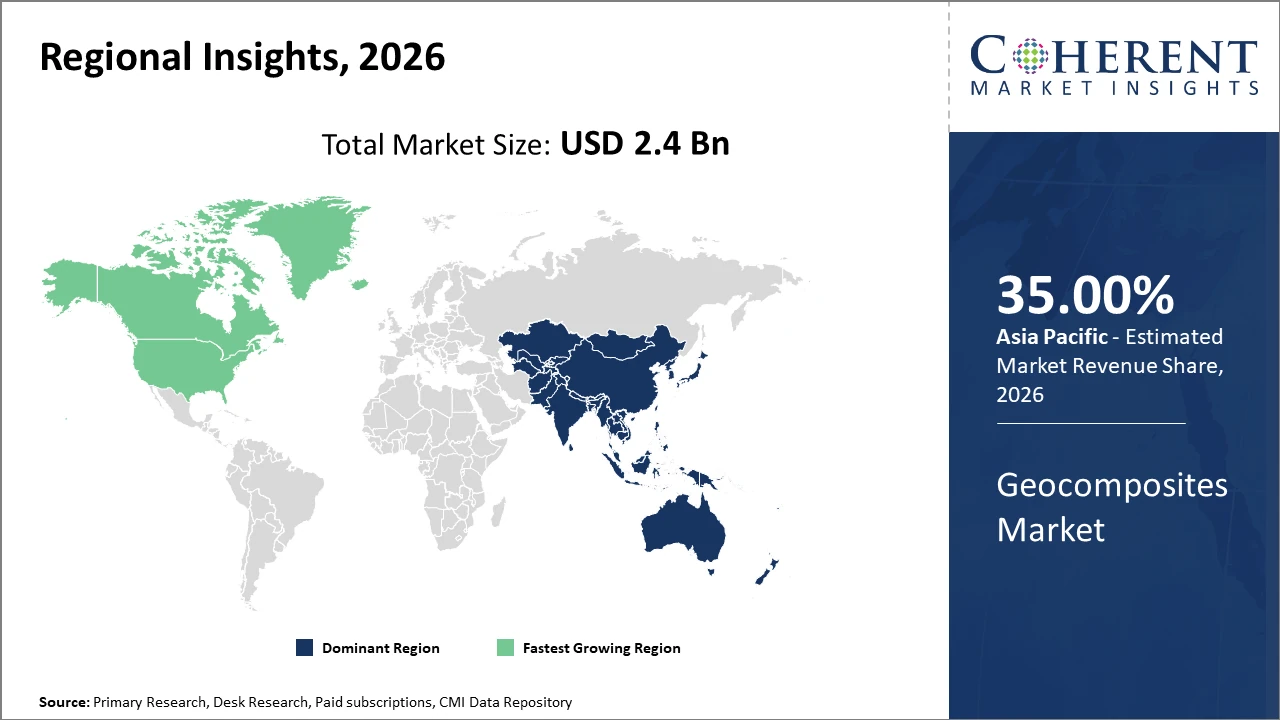
Regionally, Asia Pacific stands out as the fastest-growing market owing to aggressive infrastructural developments and government incentives boosting the utilization of advanced geocomposites.
Meanwhile, North America retains market dominance attributed to established industrial ecosystems, stringent environmental regulations, and a comprehensive supply chain network supporting significant market revenue concentration.
Geocomposites Market Segmentation Analysis
Geocomposites Market Insights, By Product Type
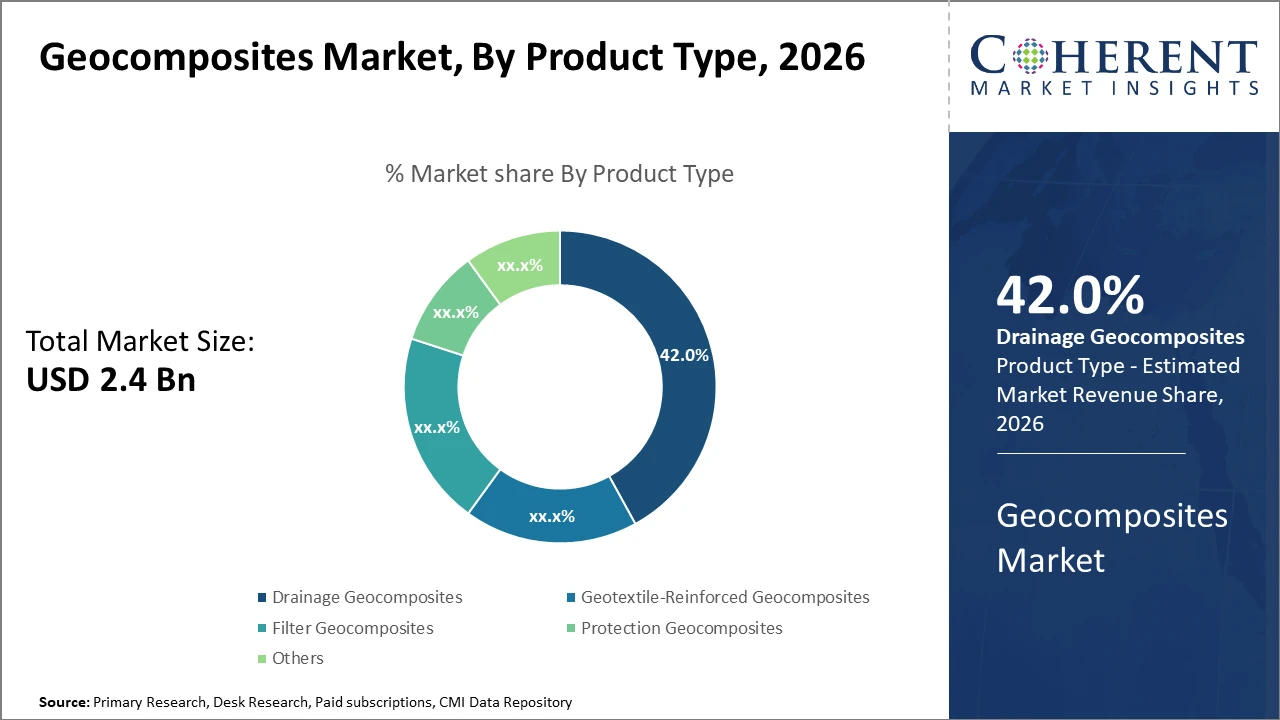
Drainage Geocomposites dominate the market share with 42%. This dominance is owed to the critical role drainage geocomposites play in facilitating water flow control in roadways and engineered structures, reducing waterlogging and improving longevity. The fastest-growing subsegment is Protection Geocomposites, driven by escalating demand for soil erosion prevention in construction and mining sectors. Filter Geocomposites serve specific filtration needs while Geotextile-Reinforced variants bolster structural integrity in settlement-prone areas.
Geocomposites Market Insights, By Application
Road & Highway claiming the largest share at 38%. This is propelled by unprecedented infrastructure spending globally, where geocomposites optimize pavement performance and drainage. The fastest expansion is observed in landfill and waste management applications, reflecting growing environmental regulation compliance and the necessity for resilient landfill liners. Water Management applications benefit from urbanization-induced demand for flood control and stormwater management. Railways and others, including tunneling and coastal protection, account for smaller but steadily growing portions supported by regional infrastructure schemes.
Geocomposites Market Insights, By End-User
Construction commands a dominant share of 45%. The sector’s dominance is fueled by multifaceted usage of geocomposites in highways, urban development, and marine engineering projects. Agricultural applications are on the rise, primarily utilizing geocomposites for drainage and soil stabilization, representing the fastest-growing segment within end users. Mining benefits from erosion control and structural reinforcement, while environmental applications focus on landfill, water containment, and remediation efforts.
Geocomposites Market Trends
Market trends demonstrate an increasing integration of eco-friendly materials within the market, enabling companies to meet tightening environmental regulations and sustainability goals.
For instance, in 2025, approximately a quarter of new product launches featured bio-based polymers, highlighting industry adaptation to circular economy demands.
Smart geocomposite systems embedded with sensors are gaining momentum, reflecting a growing emphasis on infrastructure monitoring and predictive maintenance, which further enhances market growth prospects.
Geocomposites Market Insights, By Geography
Asia Pacific Geocomposites Market Analysis and Trends
In the Asia Pacific region, the dominance in the market is driven by expansive civil infrastructure projects, rapid urbanization, and favorable government policies promoting sustainable construction. Countries such as China and India are substantial contributors, with a combined market share exceeding 35%. Investment in green infrastructure and adoption of advanced materials have propelled the region’s stature as a global production hub.
North America Geocomposites Market Analysis and Trends
Meanwhile, North America exhibits the fastest growth with a CAGR of approximately 11.2%, substantiated by stringent environmental regulations and continuous technological advancement led by key players like TenCate and HUESKER. The region benefits from mature infrastructure demands and high market penetration, fostering innovation and enhanced application scope.
Geocomposites Market Outlook for Key Countries
USA Geocomposites Market Analysis and Trends
The USA's market is buoyed by considerable federal infrastructure funding directed toward transportation and environmental projects, which increased by 15% in 2025 alone. Leading market players have invested heavily in domestic manufacturing capacities and introduced innovative product lines, such as high-performance drainage geocomposites designed specifically for extreme weather resilience. Strategic partnerships with state agencies have also enabled faster adoption rates, solidifying the USA’s role in driving global market dynamics.
China Geocomposites Market Analysis and Trends
China's market has expanded rapidly due to massive infrastructure and urban development programs combined with national sustainability mandates. The country accounted for nearly 22% of the market share in 2025, driven by large-scale investments in smart city projects and waste management facilities incorporating advanced geocomposite materials. Domestic companies are increasingly collaborating with international producers, leading to enhanced technological diffusion and capacity growth, underpinning China’s positioning as a pivotal market in Asia Pacific.
Analyst Opinion
The rising production capacity of innovative geocomposite materials is a critical supply-side indicator influencing the market landscape. In 2025, several manufacturers increased their output by over 15%, ensuring availability aligns with accelerating infrastructure projects worldwide. This production boost corresponds with a 12% increase in market revenue recorded in Q1 2026, reflecting mounting supply responsiveness.
From a demand perspective, diversified applications beyond traditional civil engineering, such as water management and waste containment, are expanding the market scope significantly. For example, adoption in landfill lining solutions grew by 18% year-on-year in 2025, marking a shift toward sustainability trends influencing procurement decisions in both public and private sectors.
Pricing dynamics remain favorable amid raw material cost fluctuations, with geocomposites witnessing a moderate price stability compared to alternative geosynthetics. Import data from Asia Pacific regions show a 7% price adjustment in 2025, balancing cost increases of polymer resins and reinforcing materials without dampening demand.
Market challenges include stricter regulatory frameworks in developed countries impacting manufacturing and export logistics. Despite this, exports from leading producing countries increased by 10% in 2025 due to enhanced compliance measures integrated by key market companies, which support smoother market expansion and improved industry share globally.
- Current Industry Events of 2026
- Market Size Estimation
- Regional Breakdown
- Competitive Landscape
- Customer Intelligence
- Segmental Analysis
- Pricing Analysis
- Key Market Drivers, Challenges & Future Trends
- Customized Insights Section
Market Scope
| Report Coverage | Details | ||
|---|---|---|---|
| Base Year: | 2025 | Market Size in 2026: | USD 2.4 billion |
| Historical Data for: | 2020 To 2024 | Forecast Period: | 2026 To 2033 |
| Forecast Period 2026 to 2033 CAGR: | 9.8% | 2033 Value Projection: | USD 4.6 billion |
| Geographies covered: |
| ||
| Segments covered: |
| ||
| Companies covered: | TenCate Geosynthetics, NAUE GmbH & Co. KG, HUESKER Synthetic GmbH, GSE Environmental Inc., Officine Maccaferri SpA, Propex Operating Company LLC, Jutan Group, Fibertex Nonwovens A/S, Hanwha Azdel, Inc., Low & Bonar PLC. | ||
| Growth Drivers: |
| ||
Geocomposites Market Growth Factors
The market is significantly propelled by escalating infrastructure investments, especially in road and highway construction, where drainage geocomposites enhance durability and reduce maintenance. According to recent infrastructure expenditure reports, construction activities have risen by nearly 14% in key emerging markets during 2025. Increasing regulatory mandates on environmental protection and waste management have accelerated the use of geocomposites in landfill lining and water management applications, contributing to market revenue growth.
Furthermore, technological advancements in composite materials, such as improved polymer matrices and geotextile reinforcements, have enriched product efficiency and longevity, fostering broader adoption. Lastly, rising governmental initiatives to support sustainable construction practices globally are playing a critical role, with Asia Pacific governments allocating over USD 7 billion in 2025 towards green infrastructure projects integrating geocomposites.
Geocomposites Market Development
In September 2024, Tenax S.p.A. announced a strategic partnership to develop smart geocomposites with embedded sensors for road reinforcement applications. These next-generation geocomposites were designed to enable real-time monitoring of soil stability, deformation, and traffic load, helping infrastructure operators improve predictive maintenance, enhance safety, and extend the service life of highways and transport corridors.
In June 2024, Geofabrics Australasia launched a new line of geocomposites made from 100% recycled materials, reinforcing its commitment to sustainable highway and civil infrastructure construction. The product range was developed to reduce environmental impact while maintaining required mechanical performance, supporting circular economy goals and the growing demand for low-carbon infrastructure solutions.
Key Players
Leading Companies of the Market
TenCate Geosynthetics
NAUE GmbH & Co. KG
HUESKER Synthetic GmbH
GSE Environmental Inc.
Officine Maccaferri SpA
Propex Operating Company LLC
Jutan Group
Fibertex Nonwovens A/S
Hanwha Azdel, Inc.
Low & Bonar PLC
Leading market companies have actively engaged in strategic partnerships to expand their geographical footprint and diversify product portfolios. For instance, TenCate Geosynthetics’ collaboration with regional manufacturers in the Asia Pacific resulted in a 20% increase in localized production capacity in 2025. Similarly, HUESKER Synthetic GmbH’s focus on advanced R&D initiatives led to the introduction of high-performance drainage geocomposites, capturing new market revenue streams and bolstering industry share through innovation.
Geocomposites Market Future Outlook
The future outlook for the geocomposites market is positive, with growth driven by infrastructure renewal programs, environmental protection priorities, and demand for efficient construction materials. Increasing investment in transportation networks, waste containment facilities, and resilient urban infrastructure will support demand for high-performance geocomposite solutions. Innovation will focus on engineered material combinations, such as integrating smart sensor layers for real-time moisture monitoring and adaptive drainage control. Sustainability considerations will also promote the use of recyclable and bio-based polymer components in geocomposite manufacturing. As global infrastructure standards evolve, integrated design approaches using geocomposites will become more common, reducing construction timelines and lifecycle costs.
Geocomposites Market Historical Analysis
The geocomposites market evolved from early applications of standalone geosynthetics—such as geotextiles, geomembranes, and geogrids—used in civil and environmental engineering projects. By the late 20th century, engineers recognized that combining multiple geosynthetic layers provided enhanced multifunctional performance: separation, filtration, drainage, reinforcement, and containment in a single product. Early geocomposite solutions addressed specific challenges in road construction and landfill drainage, but as construction methods advanced, more sophisticated applications emerged for erosion control, slope stabilization, and subsurface drainage systems. Improvements in manufacturing technologies and polymer science enabled the reliable bonding of different geosynthetic materials, resulting in products that delivered consistent performance under complex load conditions.
Sources
Primary Research Interviews:
Civil Engineers
Infrastructure Planners
Construction Contractors
Geotechnical Consultants
Project Managers
Databases:
World Bank Infrastructure Data
OECD Construction Statistics
UN-Habitat Reports
Magazines:
Geosynthetics Magazine
Construction World
Civil Engineering Today
Infrastructure Today
Engineering News-Record
Journals:
Geotextiles and Geomembranes
Journal of Geotechnical Engineering
Construction Materials Journal
Soil Mechanics Journal
Engineering Structures Journal
Newspapers:
Financial Times (Infrastructure)
The Economic Times
The Hindu BusinessLine
Reuters Construction
Business Standard
Associations:
International Geosynthetics Society
American Society of Civil Engineers
Institution of Civil Engineers
Indian Geotechnical Society
European Geosynthetics Association
Get access to 250+ pages report
Every segment, forecast, competitor profile and data table behind the analysis above — available for instant download.
- ESOMAR Member
- ISO 9001:2015 Certified
- D-U-N-S Registered
- GDPR & CCPA Compliant
Missing comfort of reading report in your local language? Find your preferred language:
Transform your Strategy with Exclusive Trending Reports
Frequently Asked Questions
Dominant players include TenCate Geosynthetics, NAUE GmbH & Co. KG, HUESKER Synthetic GmbH, and GSE Environmental Inc., which collectively account for a substantial industry share globally due to their expansive product portfolios and strategic market expansions.
The Geocomposites market size is anticipated to nearly double from USD 2.4 billion in 2026 to USD 4.6 billion by 2033, supported by a CAGR of 9.8% driven by infrastructural demands and technological innovations.
The Construction industry represents the largest growth opportunity, fueled by increasing infrastructure projects worldwide and government support for sustainable development initiatives incorporating geocomposites.
Market trends indicate a shift toward multifunctional and sustainable geocomposite products, integration of smart monitoring technologies, and expansion in emerging economies driven by environmental mandates and infrastructural investments.
The competitive landscape is marked by innovation-driven competition focusing on product efficiency and sustainability. Market restraints include regulatory compliance challenges and fluctuations in raw material pricing impacting profitability.
Market players typically adopt strategies involving regional collaborations, product diversification, acquisition of technological capabilities, and localization of production to enhance responsiveness and market penetration.