

Windows Films Market Analysis & Forecast : 2026-2033
The Global Windows Films Market size is estimated to be valued at USD 13.61 Bn in 2026 and is expected to reach USD 20.19 Bn by 2033, growing at a compound annual growth rate (CAGR) of 5.8% from 2026 to 2033.
Key Takeaways
- By Produkt, the Sun Control Films segment is projected to lead the global window films market in 2026 with a share of 47.1% due to the growing need for UV ray protection and better temperature control indoors.
- By Material, Polyester Films are expected to dominate with 38.9% market share in 2026 because of better durability, optical clarity, and ease of installation.
- By Application, the Automotive segment is expected to command 39.3% share of the market by 2026, driven by higher automobile production and devices need glare and heat control.
- By Region, North America is projected to have the highest share of the global window films market in 2026, 37.3%, due to strong regulatory policies on energy consumption and heightened public awareness.
Market Overview
As a result of increasing attention to energy savings, the demand for solar control window films has skyrocketted. The rising global temperature is a big reason for this. These films significantly aid in reducing the dependence on air conditioning by blocking a major portion of both solar heat and infrared wavelengths from entering through the buildings windows. Their use has grown among both commercial and residential end users seeking sustainable options to modify existing window structures. The increasing construction of green buildings has further propelled the uptake of solar control window films.
Current Events and Its Impact on the Global Windows Films Market
Event | Description and Impact |
Rising Energy Costs and Sustainability Regulations |
|
Supply Chain Disruptions and Raw Material Shortages |
|
Technological Advancements in Smart Building Solutions |
|
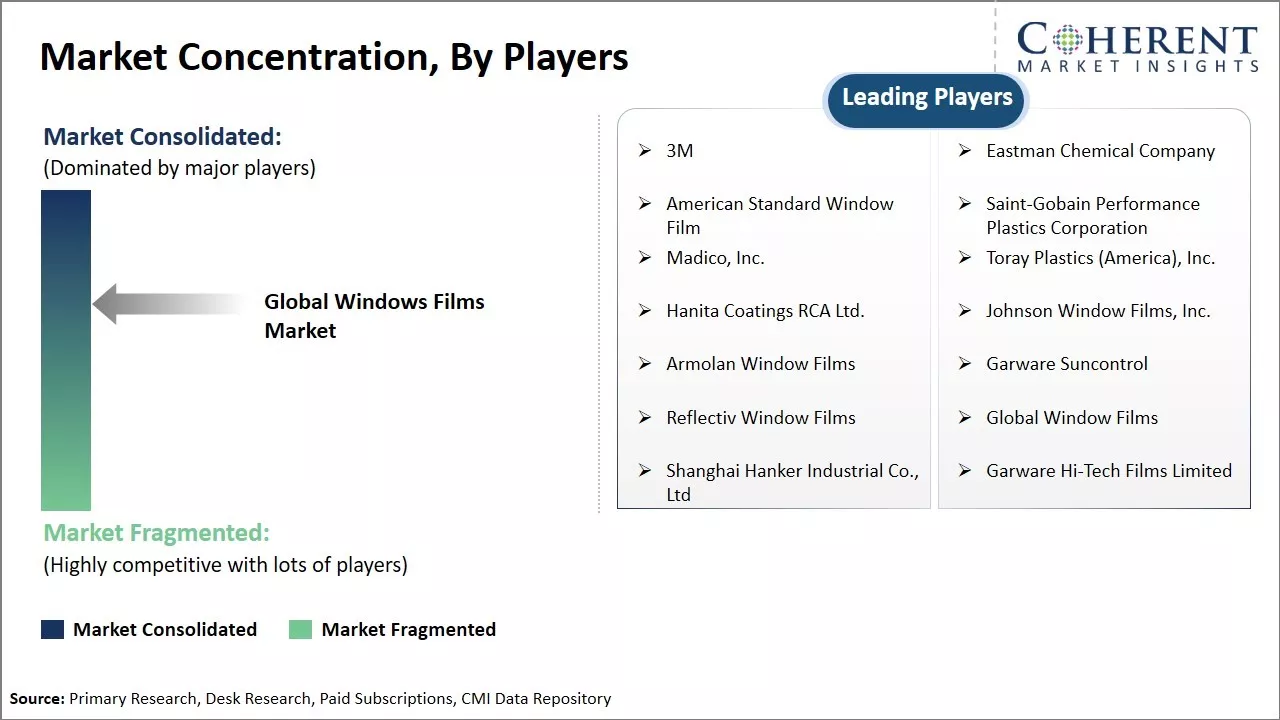
Market Concentration and Competitive Landscape
- Current Industry Events of 2026
- Market Size Estimation
- Regional Breakdown
- Competitive Landscape
- Customer Intelligence
- Segmental Analysis
- Pricing Analysis
- Key Market Drivers, Challenges & Future Trends
- Customized Insights Section
Windows Films Market Driver
- Rising demand for energy-efficiency and eco-friendly buildings
The global trend towards adopting greener and more sustainable construction practices is a major driver behind the growing demand for window films. Governments and regulatory bodies across many countries are introducing stricter building codes and energy efficiency standards to reduce the carbon footprint of the construction industry. This, in turn, is encouraging the widespread use of energy-efficient products and technologies in both commercial and residential buildings.
Window films play a vital role in improving a building's thermal insulation and enabling energy savings. By blocking up to 98% of UV rays and attenuating solar heat gain through windows, these films help significantly lower year-round air conditioning and heating costs. They also enhance indoor comfort by reducing glare and generating less strain on eyes compared to unfiltered window glass.
Various studies have demonstrated that professionally installed window tints can diminish annual cooling electricity usage by around 30%. Government initiatives aimed at promoting green construction through subsidies and tax credits for energy-efficient solutions are also fueling the sales of window films. Both builders as well as homeowners have become more receptive towards these value-added products as they help qualify for rebates while curbing long-term operational expenditures.
Majority of developed nations have implemented stricter Title 24 standards requiring commercial buildings to adopt energy conservation methods including window films. Even in emerging countries, emphasis on sustainability and growing environmental awareness among public is positive for widespread adoption.
- Rising popularity of decorative window films
The global windows films market has been witnessing significant growth driven by the rising popularity of decorative window films among consumers and businesses across the globe. Decorative window films are being widely used these days as an aesthetic option to beautify the exterior or interior of residential and commercial buildings such as homes, offices, malls etc.
These films come in various textures, patterns, and colors and help improve the curb appeal or look of the building facade while also providing functions like UV protection and heat/glare control. As modern consumers and businesses are paying more attention to the aesthetic looks of properties along with functionality, the demand for decorative window films that enhance visual appeal as well as offer technical benefits has steadily increased in the recent past.
People want their homes and offices to look visually appealing, modern and stylish which has boosted the sales of patterned, textured and colored window films. Various types of decorative window films with innovative textures and designs are available which give unique and distinct appearance to the glass windows.
For example, frosted and matte films provide privacy along with fashionable look while textured films like wood grains, stone effects mimic natural materials. Going forward, this rising interest in beautification of spaces is expected to continue driving higher sales of decorative window films as people increasingly use them for visual improvements and self-expression purposes.
According to United Nations Department of Economic and Social Affairs report on Urbanization Trends published in 2022, 68% of the world population is projected to live in urban areas by 2050 which will further fuel the demand for aesthetic films. With more people living and working in urban complexes and remodeling activities, the requirement of attractive window treatments like decorative window films will increase substantially in the coming years. This growing requirement is likely to propel the global decorative windows films market onto a positive growth trajectory over the medium to long term.
Windows Films Market Opportunities: Rising consumer awareness about energy savings
Rising consumer awareness about energy savings is driving the demand for energy-efficient windows films. Additionally, the commercial sector is expected to boost sales as these films aid in temperature control and lower electricity bills for businesses. Growing construction industry worldwide is expanding the overall base of installable windows.
Manufacturers can focus on developing advanced security and decorative window films to target specific industry verticals.
Segmental Insights
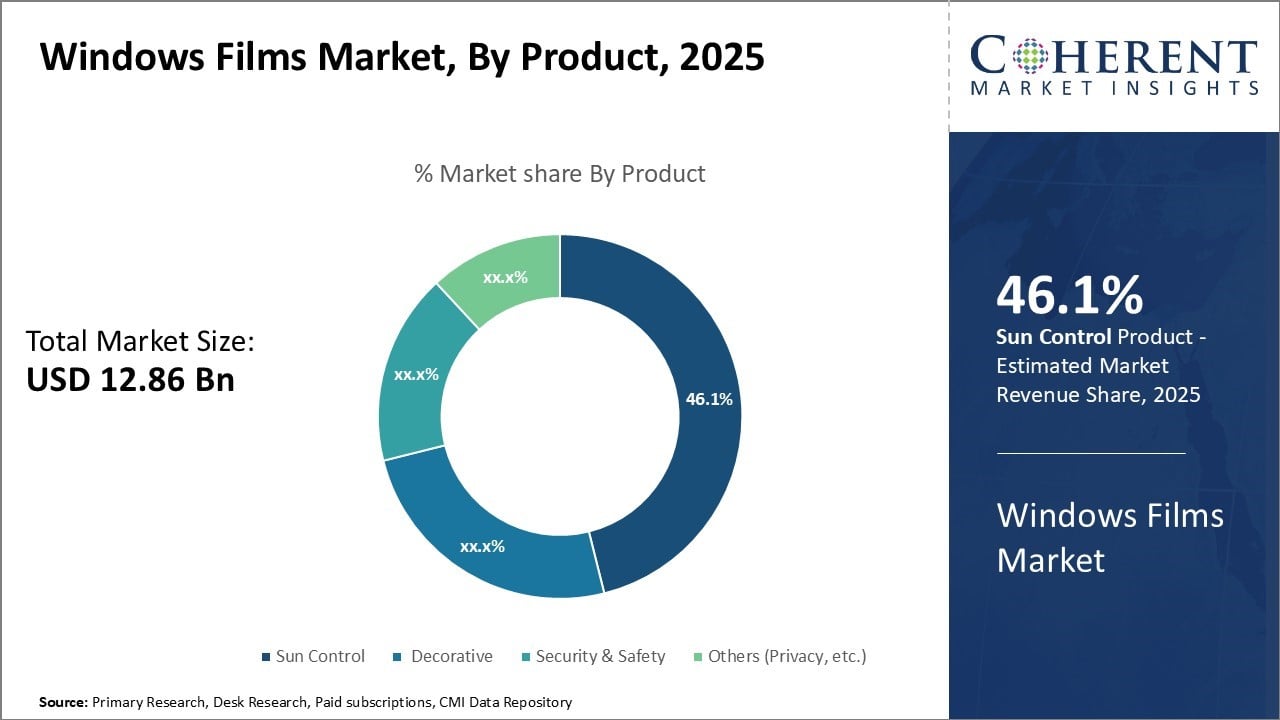
Global Window Films Market Insights, By Product
The sun control films segment is expected to account for 47.1% of the market share based on product in 2026. Sun control films help block infrared and UV rays from penetrating vehicle or building interiors, thus providing superior protection from sunlight. This is the primary driver boosting demand and consumption of sun control films.
Sun control films effectively address such issues by reflecting up to 80% of solar heat and UV rays while maintaining high visible light transmission. This allows natural daylight to pass through but blocks infrared and UV rays. As a result, the temperature inside remains several degrees cooler even under intense sunlight.
Sun control films are increasingly being used in automotive and residential applications where maintaining a comfortable temperature is important. In the automotive segment, manufacturers are using sun control films more often to enhance comfort inside vehicles. The films help keep vehicle cabins cooler, improving the driving experience. In the residential segment, homeowners and building owners favor sun control films as an affordable way to reduce electricity bills for cooling.
The films lower energy consumption of air conditioners by blocking a majority of solar heat at the window layer itself. Countries in hot climates with high intensity of sunlight such as the Middle East and Asia Pacific region constitute some of the largest markets for sun control films. Growing awareness about benefits of sunlight protection along with rising disposable incomes is fueling the use of sun control films in automotive and construction applications.
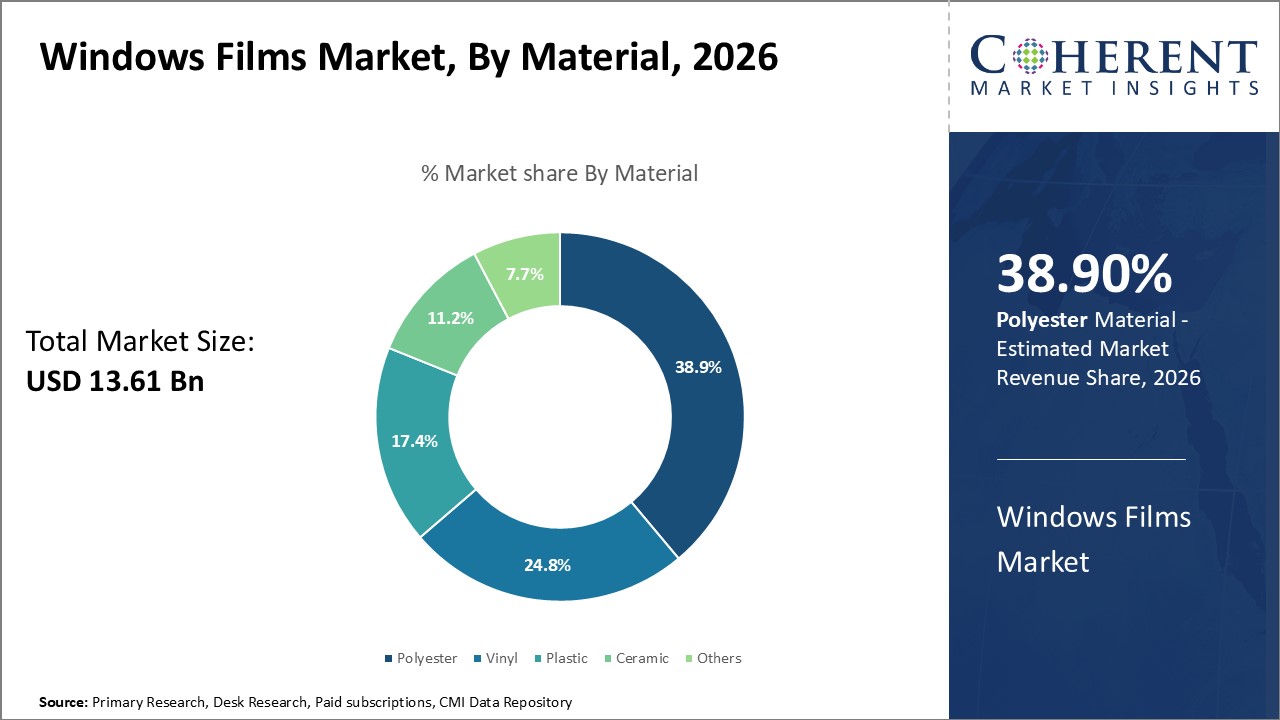
Global Window Films Market Insights, By Material
Among the material segment, polyester films are expected to account for 38.9% of the market share in 2026. Key attributes such as durability, flexibility and printability properties are driving heightened demand for polyester films in the global windows films market. Of the various materials used for manufacturing window films, polyester stands out for its high tensile strength and flexibility.
Films made from polyethylene terephthalate (PET) polyester can withstand stretching, folding, bending and abuse during installation process without sacrificing transparency or performance. This makes polyester films extremely durable and resilient to withstand changing weather or installation conditions over the intended lifespan of 5-10 years.
Additionally, polyester exhibits good chemical resistance to detergents, solvents and plasticizers. It does not break or loses physical properties when exposed to chemicals during manufacturing, cleaning or general wear-and-tear over time. Such superior chemical resistance allows polyester films to maintain clarity and optical characteristics unchanged.
The flexibility of polyester enables wrinkle-free application on curved surfaces like vehicle windows. It can be easily molded to conform to complex geometries without cracking or breaking. This flexibility along with transparency make polyester films an ideal material for car wraps printing and decoration jobs.
Moreover, polyester offers smooth print-receptive surface allowing precise, detailed and long-lasting prints. Various printing technology such as digital, flexo, gravure, and screen printing can be implemented on polyester films. This printability enables use of polyester films for advertising and branding purposes.
Owing to robust mechanical and chemical resistant properties combined with flexibility and printability, polyester based films are increasingly preferred over other materials. This will continue guiding manufacturers to use polyester in a majority of window films, thereby fueling its market share dominance.
Regional Insights
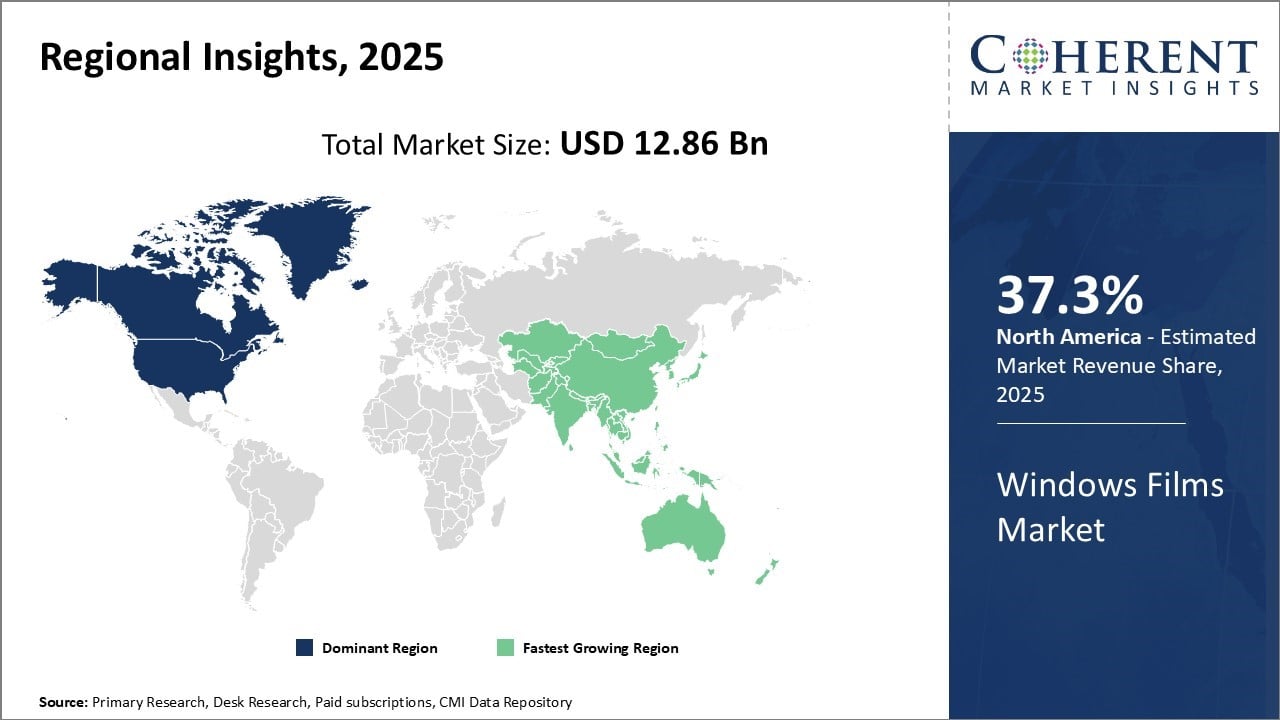
North America Window Films Market Analysis and Trends
North America is expected to dominate the global window films market, accounting for 37.3% of the market share in 2026. The region benefits from the presence of major market players and a well-established construction sector that fuels consistent demand for energy-efficient window solutions. Additionally, the automotive industry in the U.S. and Canada significantly contributes to market expansion, with leading manufacturers increasingly incorporating window films for UV protection, thermal insulation, and aesthetic appeal.
Climatic conditions in states like California and Florida, which experience high levels of solar heat gain, further drive the adoption of solar control and low-emissivity (low-e) window films. Moreover, stringent energy efficiency regulations and building codes across the region are expected to strengthen market growth by encouraging the installation of energy-saving window treatments in both commercial and residential buildings.
Asia Pacific Window Films Market Analysis and Trends
Asia Pacific is projected to witness the fastest growth in the global window films market over the forecast period. Rapid urbanization and infrastructure development in emerging economies such as China and India are key growth drivers. The construction of new residential and commercial spaces, combined with hot climatic conditions in several regions, is boosting the uptake of solar control and insulating window films.
Rising disposable incomes and increasing consumer spending on automotive enhancements are also contributing to market expansion. As domestic automotive production accelerates, demand for aftermarket window films is anticipated to grow in parallel. Heightened awareness about the benefits of energy-efficient window solutions, including reduced cooling costs and enhanced occupant comfort, is expected to create a favorable environment for widespread adoption across the region.
Dominating Countries in the Window Films Market
United States Window Films Market Analysis and Trends
The United States is a major contributor to the North American window films market. The country’s robust automotive industry and strong demand for building energy efficiency solutions support consistent growth. Regulatory mandates emphasizing sustainable construction practices and energy conservation are prompting builders and homeowners to opt for advanced window film technologies. In the automotive sector, consumer preferences for privacy, UV protection, and improved cabin comfort continue to drive demand for high-performance window films.
China Window Films Market Analysis and Trends
China leads the Asia Pacific window films market, propelled by a booming construction sector and surging automobile production. Government-backed initiatives to promote energy efficiency and green building practices are influencing higher adoption rates of solar control and safety window films. Moreover, the increasing penetration of electric vehicles and heightened consumer interest in automotive customization are fostering robust demand for window film solutions tailored to local climate conditions and design preferences.
Market Report Scope
Windows Films Market Report Coverage
| Report Coverage | Details | ||
|---|---|---|---|
| Base Year: | 2025 | Market Size in 2026: | USD 13.61 Bn |
| Historical Data for: | 2020 To 2024 | Forecast Period: | 2026 To 2033 |
| Forecast Period 2026 to 2033 CAGR: | 5.8% | 2033 Value Projection: | USD 20.19 Bn |
| Geographies covered: |
| ||
| Segments covered: |
| ||
| Companies covered: | 3M, Eastman Chemical Company, American Standard Window Film, Saint-Gobain Performance Plastics Corporation, Madico, Inc., Toray Plastics (America), Inc., Hanita Coatings RCA Ltd. , Johnson Window Films, Inc., Armolan Window Films, Garware Suncontrol, Reflectiv Window Films, Global Window Films, Shanghai Hanker Industrial Co., Ltd, and Garware Hi-Tech Films Limited | ||
| Growth Drivers: |
| ||
| Restraints & Challenges: |
| ||
Analyst Opinion ( Expert Opinion)
- Rising global emphasis on energy efficiency and sustainability is a major growth driver, positioning window films as an attractive solution to meet evolving building codes and green certification standards.
- In the construction sector, window films offer a cost-effective retrofit alternative to full glass replacement, especially in commercial and institutional buildings striving to reduce energy consumption.
- The automotive industry continues to be a vital end-use sector, driven by increasing demand for UV protection, enhanced privacy, and custom aesthetics among consumers.
- Inconsistent regulations across countries and doubts regarding product durability and performance longevity remain key challenges for broader market adoption.
- Limited availability of skilled installers, especially in emerging markets, is hindering penetration despite growing demand.
- Significant opportunities lie in smart building ecosystems, where window films integrated with automation and energy management systems enhance overall performance.
- Technological advances in nanotechnology and smart films that adjust opacity based on light or heat exposure are opening premium product segments with higher margins.
- North America maintains a leadership position due to well-established construction sectors and favorable energy policies.
Speak to the analyst
Want personalized insights?
Take the findings above to one of our principal consultants, or have the report rebuilt around the segments, geographies and competitors you actually track.
Windows Films Market Key Developments
- In July 2025, Lintec unveiled a new solar radiation control window film made entirely from recycled PET resin.
- In November 2023, Contra Vision, a pioneer in cutting-edge window film technology, launched privacy window films for applications in homes, businesses, and more.
- In March 2023, High-Performance Optics (HPO), in collaboration with Eastman Chemical Company, launched a selective HEVL (High Energy Visible Light) filtering window film for t he transportation industry in Asia.
- Eastman Chemical Company announced it has acquired Ai-Red Technology (Dalian) Co., Ltd., a manufacturer and supplier of paint protection and window film for auto and architectural markets in the Asia Pacific region.
- In 2022, Avery Dennison Launches New Dusted Crystal Decorative Architectural Window Film.
Market Segmentation
- Product Insights (Revenue, USD Bn, 2021 - 2033)
- Sun Control
- Decorative
- Security & Safety
- Others (Privacy, etc.)
- Material Insights (Revenue, USD Bn, 2021 - 2033)
- Vinyl
- Polyester
- Plastic
- Ceramic
- Others
- Application Insights (Revenue, USD Bn, 2021 - 2033)
- Automotive
- Residential
- Commercial
- Marine
- Others
- Regional Insights (Revenue, USD Bn, 2021 - 2033)
- North America
- U.S.
- Canada
- Latin America
- Brazil
- Argentina
- Mexico
- Rest of Latin America
- Europe
- Germany
- U.K.
- Spain
- France
- Italy
- Russia
- Rest of Europe
- Asia Pacific
- China
- India
- Japan
- Australia
- South Korea
- ASEAN
- Rest of Asia Pacific
- Middle East & Africa
- GCC Countries
- Israel
- Rest of Middle East & Africa
- Key Players Insights
- 3M
- Eastman Chemical Company
- American Standard Window Film
- Saint-Gobain Performance Plastics Corporation
- Madico, Inc.
- Toray Plastics (America), Inc.
- Hanita Coatings RCA Ltd.
- Johnson Window Films, Inc.
- Armolan Window Films
- Garware Suncontrol
- Reflectiv Window Films
- Global Window Films
- Shanghai Hanker Industrial Co., Ltd.
- Garware Hi-Tech Films Limited
Sources
Primary Research Interviews
- Window Film Manufacturers and Suppliers
- Automotive Industry Representatives
- Construction and Building Industry Stakeholders
- Solar Control Film Distributors
- Others
Databases
- Global Trade Atlas Database
- IBISWorld Industry Reports Database
- Euromonitor International Database
- Research and Markets Database
- Others
Magazines
- Glass Magazine
- Window Film Magazine
- Solar Power World Magazine
- Automotive News Magazine
- Construction Specifier Magazine
- Others
Journals
- Journal of Building Engineering
- Solar Energy Materials and Solar Cells
- International Journal of Adhesion and Adhesives
- Others
Newspapers
- The Wall Street Journal
- Financial Times
- Reuters Business News
- Bloomberg News
- Construction Dive
- Others
Associations
- International Window Film Association (IWFA)
- National Glass Association (NGA)
- Solar Energy Industries Association (SEIA)
- Automotive Aftermarket Suppliers Association (AASA)
- Building Owners and Managers Association (BOMA)
- Others
Public Domain Sources
- U.S. Department of Energy Statistics
- European Commission Energy Reports
- World Bank Industrial Statistics
- International Energy Agency (IEA) Publications
- National Institute of Standards and Technology (NIST)
- Others
Proprietary Elements
- CMI Data Analytics Tool
- Film
Get access to 250+ pages report
Every segment, forecast, competitor profile and data table behind the analysis above — available for instant download.
- ESOMAR Member
- ISO 9001:2015 Certified
- D-U-N-S Registered
- GDPR & CCPA Compliant
Missing comfort of reading report in your local language? Find your preferred language:
Transform your Strategy with Exclusive Trending Reports
Frequently Asked Questions
The Windows Films Market size is estimated to be valued at USD 13.61 Bn in 2026, and is expected to reach USD 20.19 Bn by 2033.
The CAGR of the global Market is projected to be 5.8% from 2026 to 2033.
Rising demand for energy-efficiency and eco-friendly buildings and rising popularity of decorative window films are the major factor driving the growth of the global market.
Presence of several local players & lack of quality standards and regulations and volatility in raw material prices are the major factors hampering the growth of the global market.
In terms of product, sun control is estimated to dominate the market revenue share in 2026.
3M, Eastman Chemical Company, American Standard Window Film, Saint-Gobain Performance Plastics Corporation, Madico, Inc., Toray Plastics (America), Inc., Hanita Coatings RCA Ltd. , Johnson Window Films, Inc., Armolan Window Films, Garware Suncontrol, Reflectiv Window Films, Global Window Films, Shanghai Hanker Industrial Co., Ltd, and Garware Hi-Tech Films Limited are the major players.
North America is expected to lead the global market.