

Global Energy Audit Market Size and Forecast – 2026-2033
The Global Energy Audit Market is estimated to be valued at USD 8.82 Bn in 2026 and is expected to reach USD 15.61 Bn by 2033, exhibiting a compound annual growth rate (CAGR) of 8.5% from 2026 to 2033. This growth reflects increasing investments in energy efficiency, regulatory compliance, building performance improvement, and sustainability initiatives across commercial, industrial, and public-sector facilities. The expanding focus on reducing operational costs and carbon footprints is driving wider adoption of energy audit services, including onsite audits, hybrid assessments, benchmarking, and retrofit planning.
For instance, the European Union’s revised Energy Efficiency Directive, which entered into force on October 10, 2023, expanded energy audit obligations for companies with significant energy consumption and strengthened competency requirements for energy auditors and energy service providers. Such regulatory measures are expected to accelerate the adoption of energy audits and support long-term market growth. (Source: European Commission)
Key Takeaways of the Global Energy Audit Market
- Standard energy audit is expected to hold 34.8% share in 2026, as clients prefer a practical audit depth that converts utility data, equipment checks, and savings estimates into actionable retrofit plans. ASHRAE’s Standard 211 establishes consistent procedures for energy audit Levels 1, 2, and 3, while its 2024 addendum links audits with decarbonization assessment rigor. (Source: ASHRAE)
- Onsite audit is expected to account for 48.7% share in 2026, because facility walkthroughs, metering validation, boiler/HVAC checks, and process observations remain difficult to fully replace remotely. DOE’s ITAC program highlights this requirement, with 219 manufacturers across 38 states selected to receive more than USD 40 million in grants for implementing qualified energy assessment recommendations. (Source: U.S. Department of Energy)
- Commercial buildings are expected to capture 37.6% share in 2026, supported by compliance workloads for benchmarking, lease-level efficiency, and retrofit planning across offices, retail assets, hospitals, campuses, and mixed-use properties. The California Energy Commission requires owners of large commercial and multifamily buildings to report energy use annually by June 2025, creating recurring demand for audit-ready energy data. (Source: State of California)
- North America is expected to dominate with 31.2% share in 2026, backed by mature benchmarking platforms, ESCO participation, and policy-linked retrofit activity across the U.S. and Canada. EPA’s Portfolio Manager Data Explorer, launched in 2023, uses data from over 150,000 U.S. commercial and multifamily buildings to support building managers and policymakers. (Source: EPA Press Office)
- Europe is expected to be the fastest-growing region with 29.4% share in 2026, supported by strict energy efficiency regulations, mandatory audit requirements, and rising building renovation activity across EU member states. The revised EU Energy Efficiency Directive requires large energy-consuming enterprises to adopt energy management systems or conduct periodic energy audits, strengthening demand for professional audit services across industrial, commercial, and public-sector facilities. (Source: European Commission)
- Increasing Adoption of Energy Audits for Regulatory Compliance: The growing implementation of mandatory energy efficiency regulations is increasing the demand for energy audit services across commercial buildings, industrial facilities, and public-sector infrastructure. Governments and regulatory bodies are requiring large energy consumers to assess energy usage, identify inefficiencies, and implement conservation measures. Energy audits help organizations comply with benchmarking rules, energy management standards, and efficiency reporting requirements, thereby supporting wider adoption of structured audit services across developed and emerging markets.
- Rising Use of Energy Audits to Reduce Operating Costs and Carbon Emissions: Increasing energy costs and corporate decarbonization targets are encouraging organizations to conduct energy audits to identify avoidable energy losses across HVAC systems, lighting, motors, compressed air systems, boilers, and building controls. Energy audits provide actionable recommendations for reducing utility expenses, improving equipment performance, and lowering carbon emissions. As companies focus on ESG reporting, net-zero commitments, and operational cost optimization, demand for energy audit services is expected to grow steadily.
Segmental Insights
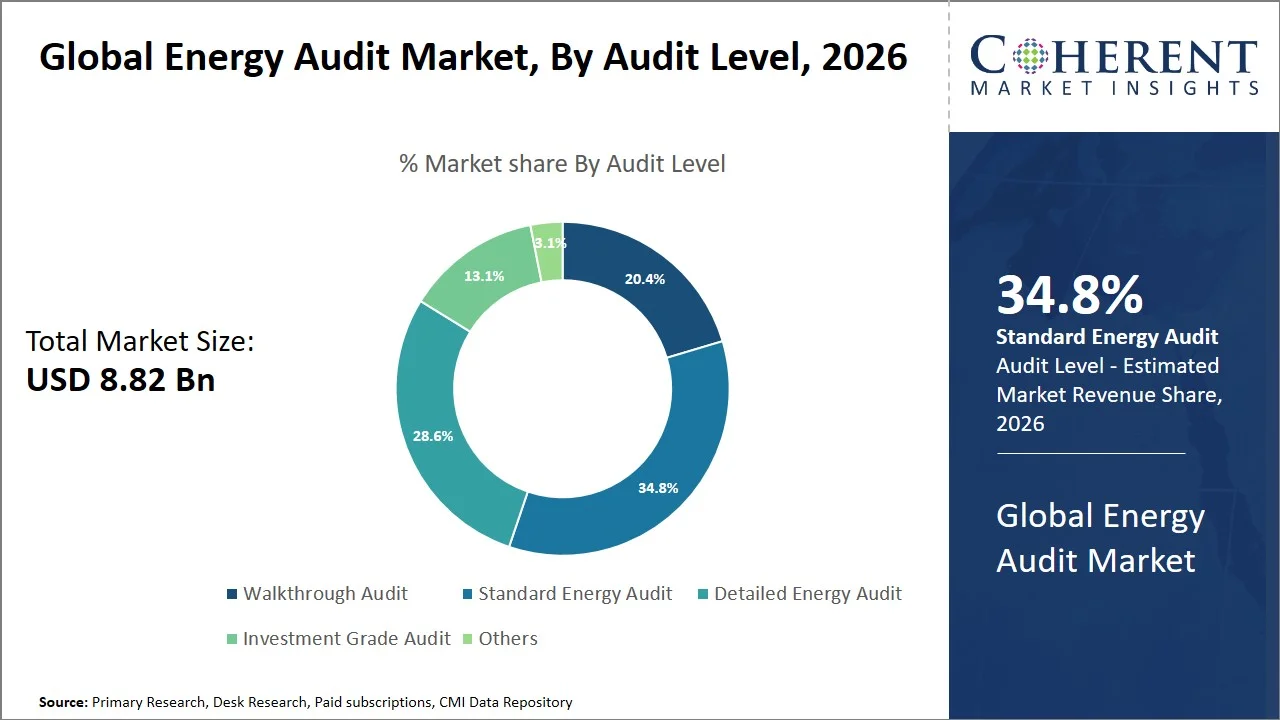
Why Does Standard Energy Audit Dominate the Global Energy Audit Market?
Standard Energy Audit is expected to hold 34.8% share in 2026, as it offers the most practical balance between technical depth, cost, and actionable recommendations. Unlike a basic walkthrough audit, a standard audit includes utility bill review, equipment-level assessment, operating pattern analysis, and identification of energy conservation measures with estimated savings and payback. This makes it highly suitable for commercial buildings, industrial facilities, hospitals, educational campuses, hotels, retail chains, and public-sector facilities seeking measurable efficiency improvements without the higher cost of investment-grade audits. The segment is also supported by regulatory compliance needs, green building certifications, and corporate decarbonization programs, where organizations require documented audit findings to support energy budgeting, retrofit planning, and ESG reporting. For instance, USGBC’s LEED guidance for existing building commissioning includes energy audit requirements aligned with ASHRAE Level 2, Energy Survey and Analysis, which supports the adoption of standard energy audits across commercial and institutional buildings. (Source: U.S. Green Building Council)
- Current Industry Events of 2026
- Market Size Estimation
- Regional Breakdown
- Competitive Landscape
- Customer Intelligence
- Segmental Analysis
- Pricing Analysis
- Key Market Drivers, Challenges & Future Trends
- Customized Insights Section
Why Does Onsite Audit Dominate the Global Energy Audit Market?
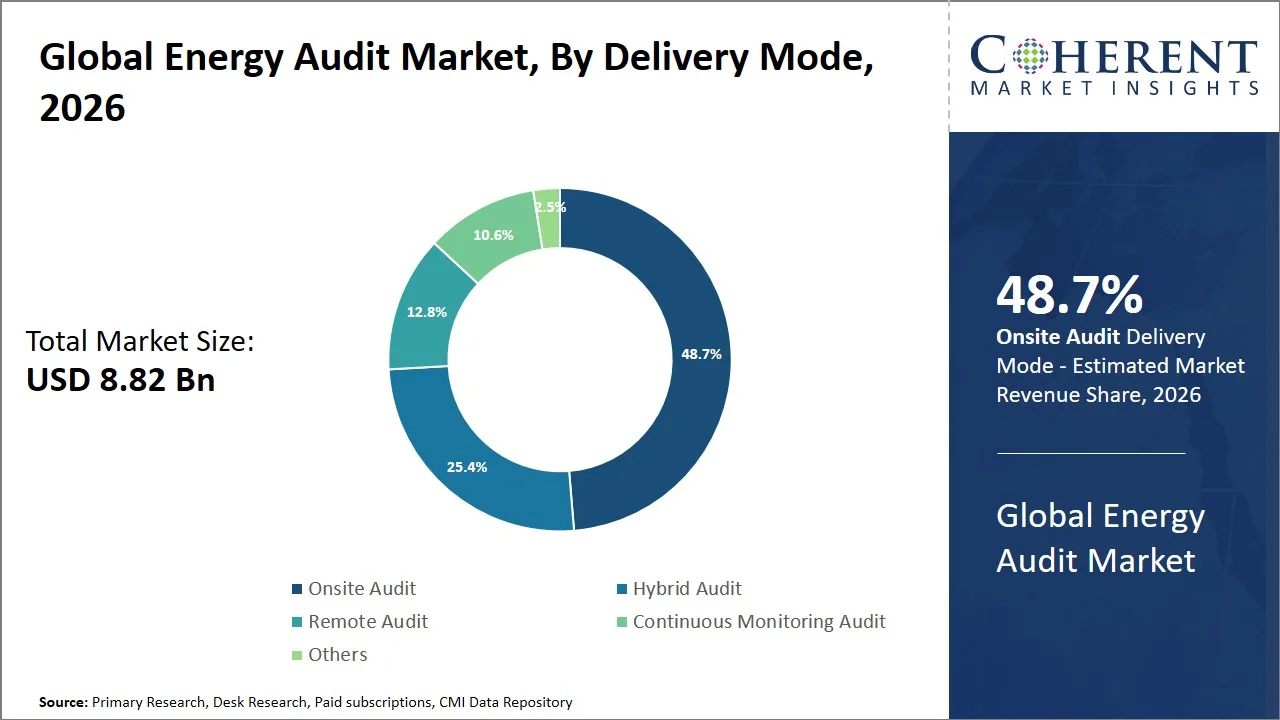
Onsite audit is expected to account for 48.7% share in 2026, as physical inspection remains critical for validating equipment condition, operating practices, control settings, compressed air leaks, steam losses, lighting layouts, and HVAC performance. Demand is strong among industrial facilities, large commercial complexes, hospitals, public buildings, and institutional campuses where audit recommendations must be based on actual site conditions rather than only utility bills or remote data. Supply-side strength comes from certified auditors, engineering consultants, and ESCOs that use onsite measurements, interviews with facility staff, and equipment-level checks to prepare reliable savings estimates. A recent example is New York City’s LL87 program, where owners must submit Energy Efficiency Reports summarizing energy audit and retro-commissioning findings, with the Department requiring use of DOE’s Asset Score Audit Template for reporting. (Source: City of New York)
Why Do Commercial Buildings Dominate the Global Energy Audit Market?
Commercial buildings are expected to capture 37.6% share in 2026, as offices, malls, hotels, hospitals, schools, and mixed-use assets carry high recurring energy costs from HVAC, lighting, elevators, ventilation, refrigeration, and plug loads. Building owners are using audits to control operating expenditure, comply with local performance rules, support green building certification, and prioritize retrofit investments. Demand is strongest where energy disclosure, emissions limits, and tenant sustainability requirements are reshaping asset management. Technology suppliers also support this segment through building automation, smart meters, benchmarking tools, and digital audit templates. A recent instance is New York City’s Local Law 97, under which most buildings over 25,000 sq. ft. must meet greenhouse gas emission limits beginning in 2024, strengthening audit-led compliance planning.
Currents Events and their Impact
Current Events | Description and its Impact |
European Union Expands Energy Audit Obligations under Revised Energy Efficiency Directive (October 2023 onward) |
|
European Union Implements Revised Energy Performance of Buildings Directive (May 2024 onward) |
|
U.S. DOE Strengthens Energy Audit Requirements under Revolving Loan Fund Programs (December 2024 onward) |
|
U.S. Energy Auditor Training Grant Program Supports Audit Workforce Development (2024 onward) |
|
(Source: European Commission, Government Department of Energy)
Global Energy Audit Market Dynamics
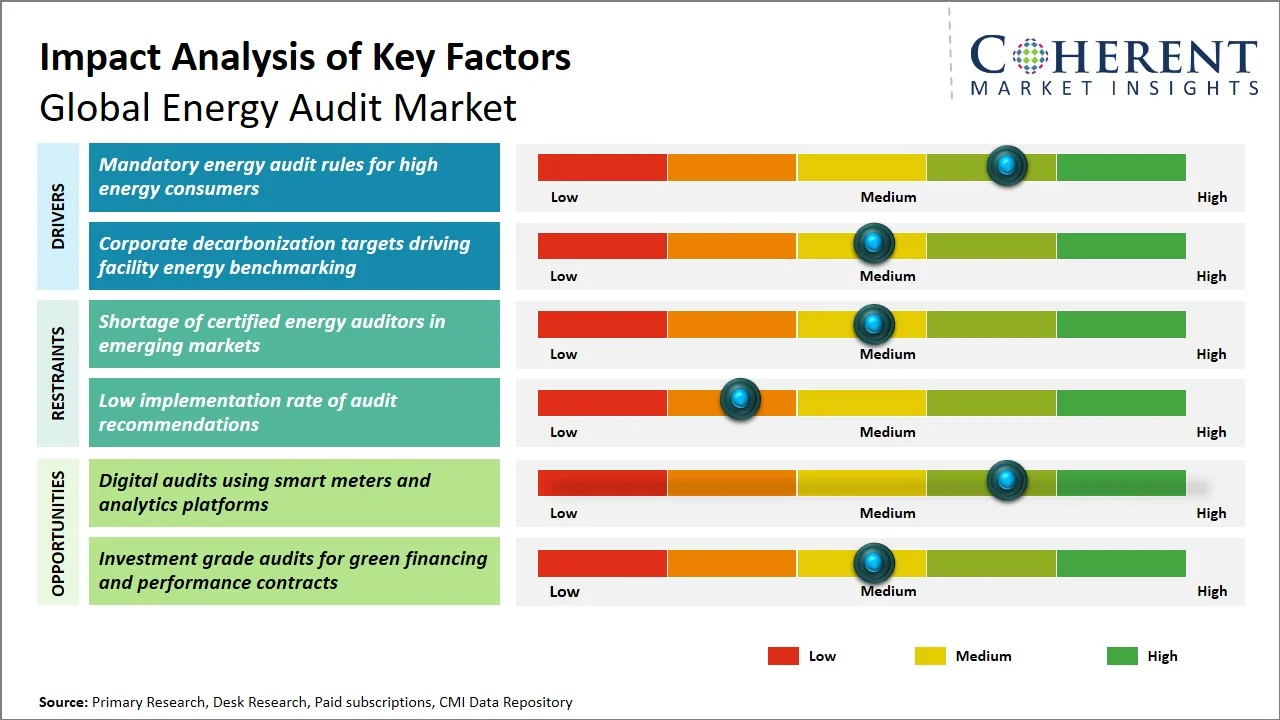
Market Drivers
- Mandatory energy audit rules for high energy consumers: Mandatory audit rules are becoming a major demand trigger for the global energy audit market, as regulators are shifting from voluntary efficiency practices to compliance-based energy management. The EU’s revised Energy Efficiency Directive requires enterprises consuming above 10 TJ of annual energy to conduct energy audits and prepare action plans, while companies above 85 TJ must implement energy management systems unless compliant alternatives are in place. This creates recurring demand for certified auditors, energy managers, monitoring tools, and audit-backed improvement planning across industrial plants, data centers, and large commercial facilities. The regulation also raises the commercial value of standardized audit reporting, as audit findings increasingly support compliance, capital planning, and energy-saving investment decisions. (Source: European Commission)
- Corporate decarbonization targets driving facility energy benchmarking: Corporate net-zero commitments are pushing facility owners to move beyond basic utility tracking toward structured energy benchmarking and audit-led decarbonization roadmaps. Large companies with offices, logistics assets, manufacturing sites, and commercial portfolios need verified energy baselines to identify high-consumption assets, prioritize retrofit budgets, and report progress against emissions reduction targets. This directly supports demand for building audits, portfolio benchmarking, HVAC optimization studies, and carbon-linked energy performance assessments. A relevant market instance is WorldGBC’s Net Zero Carbon Buildings Commitment, which requires signatories to reduce operational carbon from directly controlled assets by 2030, disclose and assess annual asset-level energy demand, and verify progress toward net-zero building performance. (Source: World Green Building Council)
Emerging Trends
- Adoption of Digital and Continuous Energy Audit Platforms: Energy audit providers are increasingly using smart meters, IoT sensors, building management systems, and cloud-based analytics to move audits from one-time site inspections to continuous energy performance tracking. This helps facility owners monitor real-time consumption, detect abnormal energy use, validate savings after retrofits, and make faster operational corrections. Such technology-led auditing is expected to improve audit accuracy and increase demand for remote and hybrid audit services.
- Growing Use of Audit Reports for Retrofit Financing and Decarbonization Planning: Energy audit findings are increasingly being used as financial and strategic documents to support retrofit loans, green building upgrades, ESCO contracts, and corporate decarbonization roadmaps. Facility owners are relying on audit reports to prioritize HVAC upgrades, lighting replacement, insulation improvements, and process efficiency investments based on payback period and emissions reduction potential. This trend is strengthening the role of energy audits in capital planning and sustainability compliance.
Regional Insights
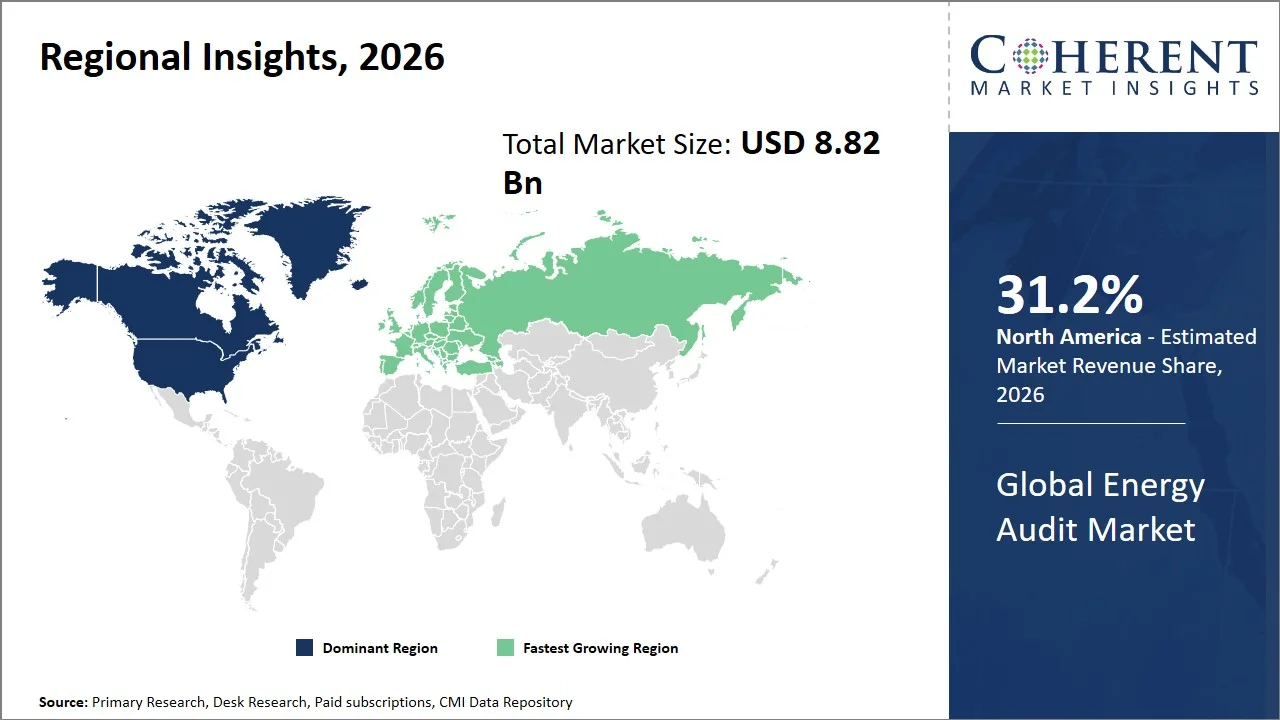
Why is North America a Strong Market for Energy Audit Services?
North America is expected to account for the largest 31.2% share of the global energy audit market in 2026, supported by mature building benchmarking systems, strong ESCO participation, active public-sector efficiency programs, and high adoption of energy management tools across commercial and industrial facilities. global energy audit market particularly benefits from established audit standards, utility incentive programs, building performance policies, and corporate decarbonization commitments that require measurable facility-level energy data. Demand is also supported by large commercial building stock, data centers, healthcare facilities, universities, and industrial plants seeking cost reduction and emissions compliance. In October 2023, For instance highlighting regional strength is EPA’s launch of the ENERGY STAR Portfolio Manager Data Explorer, which provides energy-use insights from over 150,000 U.S. commercial and multifamily buildings to support benchmarking and investment decisions.
Why Does the Europe Energy Audit Market Exhibit High Growth?
Europe is expected to be the fastest-growing region in the global energy audit market, with 29.4% share in 2026, as the region is moving rapidly from voluntary efficiency improvement to regulation-backed building and industrial energy performance management. Demand is being strengthened by stricter EU energy efficiency rules, renovation targets, digital energy performance certificates, national building renovation plans, and rising pressure on companies to reduce operating energy costs. Energy audits are becoming important for retrofit planning, financing access, compliance reporting, and asset-level decarbonization. A recent regulatory instance is the revised Energy Performance of Buildings Directive, which entered into force on May 28, 2024, requires transposition by May 29, 2026, and focuses on accelerating renovation of poor-performing buildings across EU Member States. (Source: European Commission)
Global Energy Audit Market Outlook for Key Countries
Why is China Emerging as a Key Market for Industrial Energy Audits?
China is an important country in the global energy audit market because of its large industrial energy base, heavy manufacturing clusters, and increasing policy pressure to reduce energy intensity. Energy audits and efficiency assessments are becoming more relevant for steel, cement, chemicals, building materials, power, and other high-consumption industries where energy cost control and carbon reduction are linked to government targets. The country’s shift toward tighter monitoring of energy-intensive entities is expected to expand demand for technical assessment, benchmarking, monitoring, and corrective-action planning. A recent instance is China’s state planner ordering provinces to prepare energy-efficiency plans covering entities responsible for around 70% of energy consumption and carbon emissions by the end of 2025, with inspections extended to about 20,000 entities nationally.
Why is the U.S. Leading Energy Audit Adoption and Benchmarking Practices?
The U.S. remains one of the most influential countries in the global energy audit market due to its established ecosystem of energy auditors, ESCOs, utility rebate programs, building performance ordinances, and federal efficiency funding. Commercial buildings, residential retrofit programs, public buildings, universities, and industrial users rely on audits to identify savings, qualify for incentives, and support capital planning. Workforce development is also becoming a critical growth enabler as audit demand increases across building upgrades and decarbonization programs. A recent instance is the U.S. Department of Energy’s Energy Auditor Training Program, which provides grant funding to states for training individuals to conduct energy audits or surveys of commercial and residential buildings, helping expand certified audit capacity.
Why is India Becoming a Compliance-Driven Market for Energy Audits?
India is a key country in the global energy audit market due to its large base of energy-intensive industries, rising commercial building energy use, and compliance-led efficiency framework under the Bureau of Energy Efficiency. Demand is strongly supported by designated consumers in sectors such as aluminum, cement, fertilizers, iron and steel, paper and pulp, railways, textiles, and thermal power, where energy audits help identify savings opportunities and support performance improvement. The market also benefits from expanding industrial capacity, rising electricity costs, and stronger interest in ISO 50001-style energy management. A relevant instance is BEE’s designated consumer framework, under which the government notified mandatory energy audits for designated consumers to identify energy-saving opportunities in energy-intensive industries and establishments. (Source: Bureau of Energy Efficiency)
Why is Brazil Gaining Importance in the Energy Audit Market?
Brazil is important in the global energy audit market because energy efficiency is becoming more relevant for industrial competitiveness, building performance, and electricity demand management. The country’s commercial, public, and residential building sectors create demand for audits linked to equipment optimization, cooling efficiency, lighting upgrades, and energy labeling. Industrial users also represent an opportunity as audits can identify low-cost energy-saving measures and support investment decisions. A recent reference point is Brazil’s Atlas of Energy Efficiency 2025, which highlights the Brazilian Labeling Programme for Buildings, where buildings are classified from A to E, with commercial, service, public, and residential buildings included in the program. The Atlas also notes that buildings account for about 50% of Brazil’s electricity consumption, reinforcing the relevance of audit-led efficiency planning. (Source: Atlas of Energy Efficiency)
Why is Germany a Strong Market for Regulation-Led Energy Audit Services?
Germany is a strategically important country in the global energy audit market due to its strong industrial base, strict energy efficiency legislation, high energy prices, and advanced engineering services ecosystem. Demand is supported by manufacturing plants, commercial facilities, public institutions, and data centers that need structured energy performance reviews, savings plans, and compliance documentation. Germany also benefits from deep experience in energy management systems, ISO 50001 implementation, and energy-efficiency consulting, making audits part of broader operational improvement programs. A recent instance is the Bundestag’s adoption of the Energy Efficiency Act, which created a clearer legal framework for reducing energy consumption and strengthening energy efficiency obligations across the economy.
Technology Landscape of Global Energy Audit Market
Technology | Key Features | Clinical Advantage | Market Relevance | |
Smart Meters and Submetering Systems | Track electricity, gas, steam, water, and equipment-level energy consumption at regular intervals | Improves audit accuracy by identifying peak loads, abnormal consumption, and asset-level inefficiencies | Highly relevant for commercial buildings, industrial plants, campuses, hospitals, and data centers where audits require measurable energy baselines | |
Building Management Systems (BMS/BAS) | Centralized control of HVAC, lighting, ventilation, occupancy, alarms, and building equipment | Helps auditors review operating schedules, setpoints, control errors, and automation gaps | Supports onsite, hybrid, and continuous monitoring audits in large commercial and institutional buildings | |
IoT Sensors and Wireless Data Loggers | Capture temperature, humidity, occupancy, pressure, airflow, vibration, and runtime data | Enables evidence-based diagnosis of equipment behavior and comfort-related energy waste | Increasingly used in walkthrough, detailed, and investment-grade audits to reduce manual measurement time | |
Thermal Imaging and Infrared Inspection | Detects heat loss, insulation gaps, moisture intrusion, electrical hot spots, and steam trap issues | Improves fault visibility without invasive inspection and supports faster corrective action planning | Strong adoption in building envelope audits, industrial utilities audits, electrical systems, and facility maintenance programs | |
AI-Based Energy Analytics | Uses machine learning to identify consumption anomalies, equipment faults, and savings opportunities | Improves audit precision by converting large energy datasets into actionable recommendations | Supports the shift from one-time audits to continuous energy performance monitoring; IEA notes digital data and analytics can improve planning, efficiency, and system performance. (IEA) | |
Cloud-Based Audit Reporting Platforms | Standardized audit forms, data validation, report generation, benchmarking, and jurisdictional submission | Reduces reporting errors and improves consistency across audit teams and multi-site portfolios | Important for compliance-led audits; DOE’s Audit Template is a web-based tool for entering, validating, exporting, and submitting building audit data. (The Department of Energy's Energy.gov) | |
Energy Modeling and Simulation Software | Models building systems, retrofit scenarios, energy savings, payback, and lifecycle costs | Helps convert audit findings into investment-grade retrofit plans and financial decision support | Relevant for detailed audits, investment-grade audits, ESCO projects, and public-sector retrofit programs | |
Digital Twins for Building Energy Performance | Creates a virtual representation of buildings, equipment, occupancy, and operational conditions | Enables scenario testing, predictive maintenance, and continuous optimization after the audit | Gaining relevance among large commercial portfolios, smart buildings, airports, hospitals, and industrial campuses | |
Mobile Audit Applications | Field data capture, equipment tagging, photo documentation, checklist-based inspections, and GPS/location tagging | Speeds up onsite inspections and improves traceability of audit observations | Useful for engineering consultants, ESCOs, facility managers, and TIC firms handling multiple audit assignments | |
How are technological advancements in digital energy audit platforms creating new growth opportunities in the energy audit market?
Technological advancements in digital energy audit platforms, smart meters, AI-based analytics, and cloud reporting tools are creating strong growth opportunities in the energy audit market. These technologies help auditors move beyond manual inspections by capturing real-time energy data, identifying abnormal consumption, validating building performance, and converting findings into retrofit-ready recommendations. This improves audit accuracy, reduces assessment time, and supports wider adoption of hybrid and continuous monitoring audits across commercial buildings, industrial facilities, hospitals, campuses, and data centers. It also increases demand for software-enabled audit services, energy benchmarking tools, and post-audit measurement and verification solutions. For instance, Siemens’ Building X Energy Manager tracks energy consumption, costs, and equipment performance across buildings, helping users optimize performance and support sustainability goals. (Source: Siemens) The development highlights how digital audit technologies are improving decision-making, compliance readiness, and investment planning in energy efficiency projects. (Source: Siemens)
Market Players, Key Development, and Competitive Intelligence
Key Developments
- In April 2026, the Bureau of Energy Efficiency invited applications from Accredited Energy Auditor firms and companies for empanelment under the Perform, Achieve and Trade scheme, strengthening the role of certified audit providers in India’s industrial energy efficiency framework.
- In October 2024, Schneider Electric introduced EcoConsult Audit for Energy Efficiency, a service designed to identify inefficiencies across building energy-consuming systems and provide actionable energy-saving recommendations for facility owners and operators.
- In September 2024, The European Commission published final guidance documents for implementing the revised Energy Efficiency Directive, including Article 11 guidance on energy management systems and energy audits, supporting standardized compliance across EU Member States.
Competitive Landscape
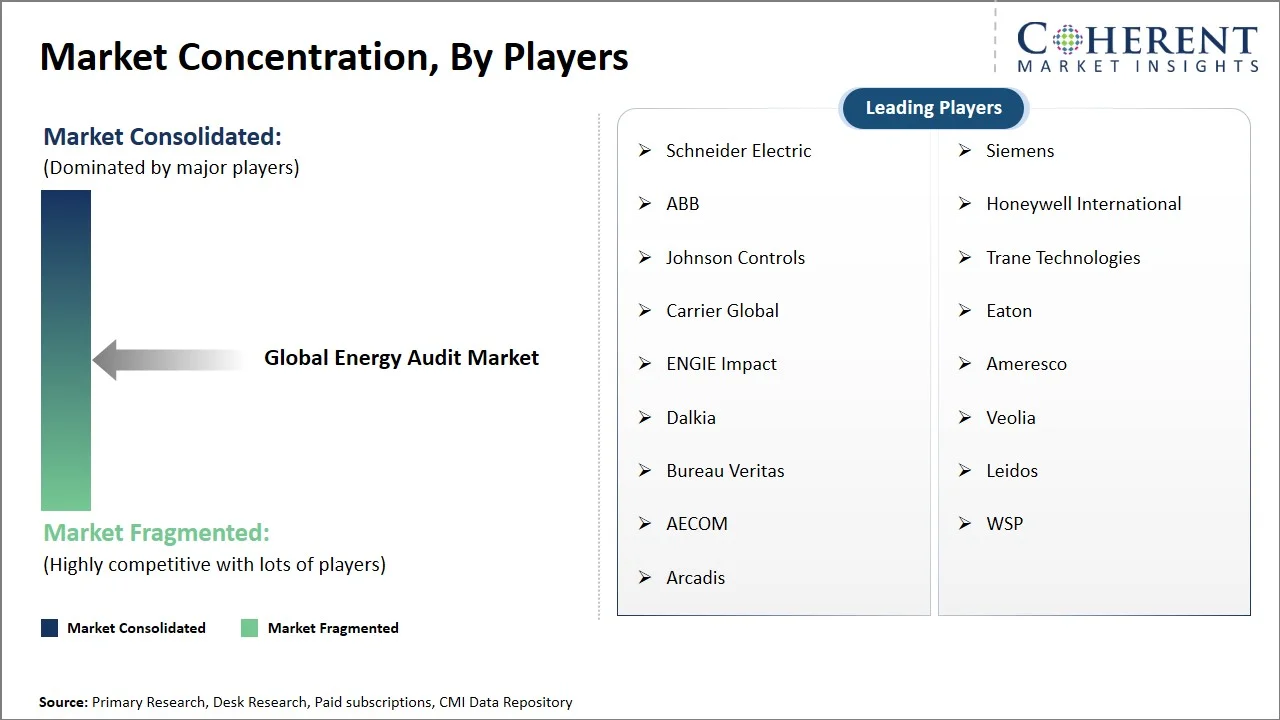
The global energy audit market is moderately fragmented, with energy service companies, engineering consulting firms, testing and certification firms, and facility management providers competing on technical expertise, regulatory knowledge, digital audit tools, and industry coverage. Companies are focusing on building energy benchmarking, industrial efficiency audits, carbon reduction advisory, and audit-backed retrofit planning. Growing regulatory pressure and corporate decarbonization goals are expected to strengthen competition among specialized audit service providers.
Key focus areas include:
- Development of digital and data-driven energy audit platforms for faster assessment
- Expansion of certified auditor networks and technical consulting capabilities
- Integration of smart meters, IoT sensors, and AI analytics into audit services
- Stronger focus on regulatory compliance, ESG reporting, and carbon reduction planning
- Growth in audit-based retrofit advisory, energy savings validation, and financing support
Market Report Scope
Energy Audit Market Report Coverage
| Report Coverage | Details | ||
|---|---|---|---|
| Base Year: | 2025 | Market Size in 2026: | USD 8.82 Bn |
| Historical Data for: | 2020 To 2024 | Forecast Period: | 2026 To 2033 |
| Forecast Period 2026 to 2033 CAGR: | 8.5% | 2033 Value Projection: | USD 15.61 Bn |
| Geographies covered: |
| ||
| Segments covered: |
| ||
| Companies covered: | Schneider Electric, Siemens, ABB, Honeywell International, Johnson Controls, Trane Technologies, Carrier Global, Eaton, ENGIE Impact, Ameresco, Dalkia, Veolia, Bureau Veritas, Leidos, AECOM, WSP, and Arcadis | ||
| Growth Drivers: |
| ||
| Restraints & Challenges: |
| ||
Analyst Opinion (Expert Opinion)
- The global energy audit market is expected to witness steady long-term growth due to stricter energy efficiency regulations, rising electricity costs, and increasing pressure on companies to reduce carbon emissions. As commercial buildings and industrial facilities focus on lowering operating costs, demand for structured energy audits, benchmarking, and retrofit planning is expected to increase.
- The maximum opportunities are likely to emerge in commercial buildings and industrial facilities, especially across North America and Europe, where regulatory compliance, building performance standards, and decarbonization targets are already strong. New opportunities are also expected in China and India as energy-intensive industries adopt mandatory audits and energy management practices.
- To gain a competitive advantage, market participants should invest in digital audit tools, certified auditor networks, AI-based energy analytics, and continuous monitoring services. Strong partnerships with facility managers, ESCOs, industrial clients, and government energy-efficiency programs will help service providers improve adoption and strengthen their market position.
Speak to the analyst
Want personalized insights?
Take the findings above to one of our principal consultants, or have the report rebuilt around the segments, geographies and competitors you actually track.
Market Segmentation
- Audit Level Insights (Revenue, USD Bn, 2021 - 2033)
- Walkthrough Audit
- Standard Energy Audit
- Detailed Energy Audit
- Investment Grade Audit
- Others
- Delivery Mode Insights (Revenue, USD Bn, 2021 - 2033)
- Onsite Audit
- Hybrid Audit
- Remote Audit
- Continuous Monitoring Audit
- Others
- End-use Sector Insights (Revenue, USD Bn, 2021 - 2033)
- Commercial Buildings
- Industrial Facilities
- Public Sector Facilities
- Residential Buildings
- Others
- Audit Focus Area Insights (Revenue, USD Bn, 2021 - 2033)
- Building Systems Audit
- Industrial Utilities Audit
- Process Energy Audit
- Power Distribution Audit
- Others
- Service Provider Insights (Revenue, USD Bn, 2021 - 2033)
- Energy Service Companies
- Engineering Consulting Firms
- Testing Inspection and Certification Firms
- Facility Management Providers
- Others
- Regional Insights (Revenue, USD Bn, 2021 - 2033)
- North America
- U.S.
- Canada
- Latin America
- Brazil
- Argentina
- Mexico
- Rest of Latin America
- Europe
- Germany
- U.K.
- Spain
- France
- Italy
- Russia
- Rest of Europe
- Asia Pacific
- China
- India
- Japan
- Australia
- South Korea
- ASEAN
- Rest of Asia Pacific
- Middle East
- GCC Countries
- Israel
- Rest of Middle East
- Africa
- South Africa
- North Africa
- Central Africa
- North America
Sources
Primary Research Interviews
- Accredited energy auditors and certified energy managers conducting building and industrial audits
- Energy service companies providing audit, retrofit, and performance contracting services
- Facility managers and building operations heads from commercial buildings, hospitals, campuses, and public facilities
- Industrial plant energy managers from cement, steel, chemicals, textiles, power, and manufacturing sectors
- Sustainability heads and ESG managers responsible for energy benchmarking and decarbonization planning
- Engineering consultants, testing and certification firms, and building automation solution providers
Stakeholders
- Energy audit service providers and energy consulting firms
- Energy service companies and ESCO contractors
- Engineering, testing, inspection, and certification companies
- Building automation, smart meter, and energy management software providers
- Utility companies and demand-side management program administrators
- HVAC, lighting, insulation, and industrial efficiency equipment suppliers
End-use Sectors
- Commercial buildings and office complexes
- Industrial facilities and manufacturing plants
- Public sector buildings and government facilities
- Hospitals and healthcare facilities
- Educational institutions and university campuses
- Hotels, malls, retail chains, and mixed-use buildings
- Residential buildings and housing societies
- Data centers and high-energy commercial facilities
Regulatory & Energy Bodies:
- U.S. Department of Energy (DOE)
- U.S. Environmental Protection Agency (EPA)
- European Commission – Energy Efficiency Directive and EPBD
- Bureau of Energy Efficiency (BEE), India
- International Energy Agency (IEA)
- ASHRAE
- ISO – Energy Management Standards
- National and regional building energy code authorities
Databases
- ENERGY STAR Portfolio Manager Database
- U.S. Energy Information Administration (EIA)
- Eurostat Energy Database
- IEA Energy Efficiency Indicators Database
- World Bank Energy and Infrastructure Indicators
- Bureau of Energy Efficiency PAT Database
- ODYSSEE-MURE Energy Efficiency Database
- DOE Building Technologies Office Data Resources
Magazines
- Energy Manager Magazine
- Facility Executive
- Smart Energy International
- Buildings Magazine
- Energy Digital
- HVAC&R News
- Renewable Energy World
Journals
- Energy and Buildings
- Applied Energy
- Energy Efficiency
- Journal of Building Engineering
- Building and Environment
- Renewable and Sustainable Energy Reviews
- Sustainable Energy Technologies and Assessments
Associations
- Association of Energy Engineers (AEE)
- American Society of Heating, Refrigerating and Air-Conditioning Engineers (ASHRAE)
- American Council for an Energy-Efficient Economy (ACEEE)
- U.S. Green Building Council (USGBC)
- World Green Building Council (WorldGBC)
- National Association of Energy Service Companies (NAESCO)
- Chartered Institution of Building Services Engineers (CIBSE)
- Efficiency Valuation Organization (EVO)
Public Domain Sources
- U.S. Department of Energy – Building Energy Audits and Energy Efficiency Programs
- U.S. EPA – ENERGY STAR Portfolio Manager and Building Benchmarking Data
- European Commission – Energy Efficiency Directive and Energy Performance of Buildings Directive
- Bureau of Energy Efficiency – Perform, Achieve and Trade Scheme and Energy Audit Regulations
- International Energy Agency – Energy Efficiency and Digitalization Reports
- UNIDO – Industrial Energy Efficiency Programs
- World Bank – Energy Use and Infrastructure Statistics
- Eurostat – Energy Consumption and Building Efficiency Data
Proprietary Elements
- CMI Data Analytics Tool
- Proprietary CMI Existing Repository of information for last 10 years.
Get access to 250+ pages report
Every segment, forecast, competitor profile and data table behind the analysis above — available for instant download.
- ESOMAR Member
- ISO 9001:2015 Certified
- D-U-N-S Registered
- GDPR & CCPA Compliant
Missing comfort of reading report in your local language? Find your preferred language:
Transform your Strategy with Exclusive Trending Reports
Frequently Asked Questions
The CAGR of the global energy audit market is projected to be 8.5% from 2026 to 2033.
The global energy audit market is valued at USD 8.82 Bn in 2026 and is expected to reach USD 15.61 Bn by 2033.
The U.S. is the largest and most developed country market for energy audits, supported by strong energy benchmarking practices, active ESCO participation, and stringent building energy efficiency regulations.
Yes, the energy audit market is profitable, supported by recurring compliance audits, retrofit advisory, digital monitoring, and corporate decarbonization demand.
Mandatory energy audit rules for high energy consumers and corporate decarbonization targets driving facility energy benchmarking are the major factors driving the growth of the global energy audit market.
Shortage of certified energy auditors in emerging markets and low implementation rate of audit recommendations are the major factors hampering the growth of the global energy audit market.
In terms of audit level, the standard energy audit segment is estimated to dominate the market revenue share in 2026.