

Global Energy Portfolio Management Market Size and Forecast – 2026 To 2033
The global energy portfolio management market is expected to grow from USD 6 Bn in 2026 to USD 12.5 Bn by 2033, registering a compound annual growth rate (CAGR) of 8.2% from 2026 to 2033. The global energy portfolio management market is driven by the rising adoption of cloud-based energy trading platforms. On November 14, 2025, Hitachi Energy announced its new asset modeling powered by PROMOD. Hitachi Energy’s PROMOD software solution has been a cornerstone of grid simulation and production cost modeling and trusted by utilities, independent system operators, developers, researchers, and planners to navigate the evolving complexities of the U.S. and global power systems.
Key Takeaways of the Global Energy Portfolio Management Market
- The software segment is expected to account for 54.0 % of the global energy portfolio management market share in 2026. Growing need for regulatory compliance and risk management is driving the growth of the software segment. In 2025, European Energy Exchange (EEX) launched new REMIT reporting enhancements, in line with amendments to the European Union’s REMIT framework, expanding transaction reporting, market monitoring and compliance services to help market participants meet stricter transparency requirements for wholesale energy markets.
- The cloud segment is estimated to capture 61.0 % of the market share in 2026. Expansion of real-time energy monitoring operations is majorly driving the growth of the segment. On May 5, 2026, Siemens introduced the next generation of Gridscale X, expanding its unified grid software platform with real-time system operations, AI-powered transmission planning, and support for utility-developed applications.
- The utilities segment is estimated to capture 33.0 % of the market share in 2026. Increasing digitalization across utility operations is driving the growth of the segment. On July 21, 2025, GE Vernova announced the acquisition of French AI company Alteia, expanding its GridOS software portfolio with AI-powered visual intelligence that enables utilities to digitally inspect transmission assets, automate grid monitoring, and improve operational decision-making.
- North America is expected to dominate the energy portfolio management market in 2026 with a market share of 37.0 %. Expansion of distributed energy resources management in North America is driving the growth of the regional market. On April 22, 2025, LF Energy announced the foundation’s momentum which includes Canadian utility Hydro-Quebec moving from the General Member level to become a top-tier Strategic Member and new members Southern California Edison and Aetheros. Additionally, the foundation has announced the dates and locations for LF Energy Summit Europe and North America, which will provide venues for stakeholders to learn and collaborate on open source solutions for energy.
- Asia Pacific is expected to account for 28.0 % of the market share in 2026 and is projected to record the fastest growth over the forecast period. Increasing demand for carbon trading portfolio solutions in Asia Pacific is driving the growth of the regional market. On January 30, 2024, AirCarbon Exchange (ACX), the first carbon exchange to launch trading of Article 6 compliant carbon credits in Singapore, announced the expansion of its digital exchange to facilitate regulated and voluntary carbon markets across Asia Pacific and enable companies to operate diversified carbon trading portfolios more efficiently.
- Growing Adoption of AI Driven Portfolio Optimization: Energy companies are increasingly using artificial intelligence and machine learning to optimize generation portfolios, predict energy prices, automate trading decisions, improve demand forecasting, and minimize operational and financial risks across wholesale electricity markets.
- Expansion of Renewable Energy and Distributed Energy Resource Management: The rapid adoption of solar, wind, battery energy storage and distributed energy resources is creating the need for sophisticated portfolio management platforms that can balance intermittent generation, optimize asset utilization and enable virtual power plant operations.
Segmental Insights
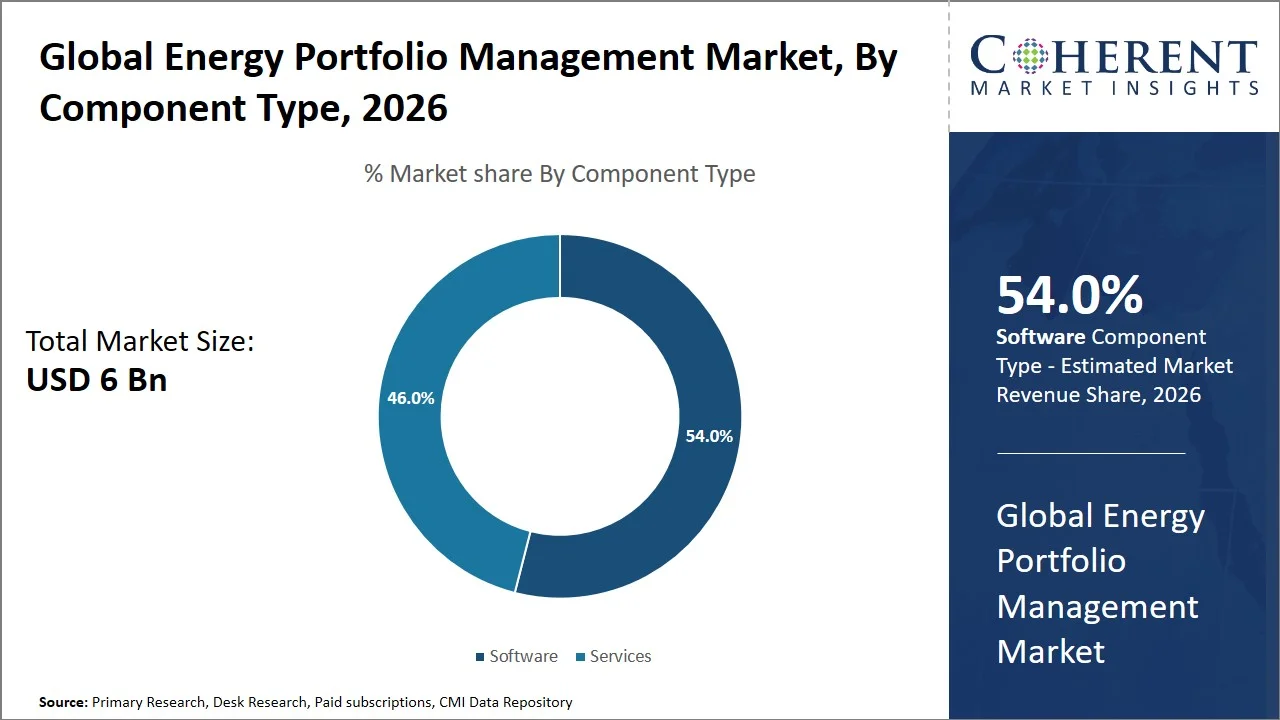
Why Does Software Dominate the Global Energy Portfolio Management Market?
The software segment is expected to account for 54.0% of the global energy portfolio management market share in 2026. The software segment offers real-time data integration, powerful analytics, and automated decision support for complex energy operations. Modern software platforms allow utilities, energy traders and independent power producers to optimize asset performance, predict energy demand and prices, manage trading positions, monitor regulatory compliance and reduce operational risks through a single integrated solution, which is critical for efficient portfolio management in increasingly dynamic energy markets. On March 2, 2026, GE Vernova Inc. announced the completion of the previously announced acquisition of GE Vernova's Proficy software business by TPG, a leading global alternative asset management firm, for USD 600 million.
- Current Industry Events of 2026
- Market Size Estimation
- Regional Breakdown
- Competitive Landscape
- Customer Intelligence
- Segmental Analysis
- Pricing Analysis
- Key Market Drivers, Challenges & Future Trends
- Customized Insights Section
Why is Cloud the Most Preferred Deployment Type?
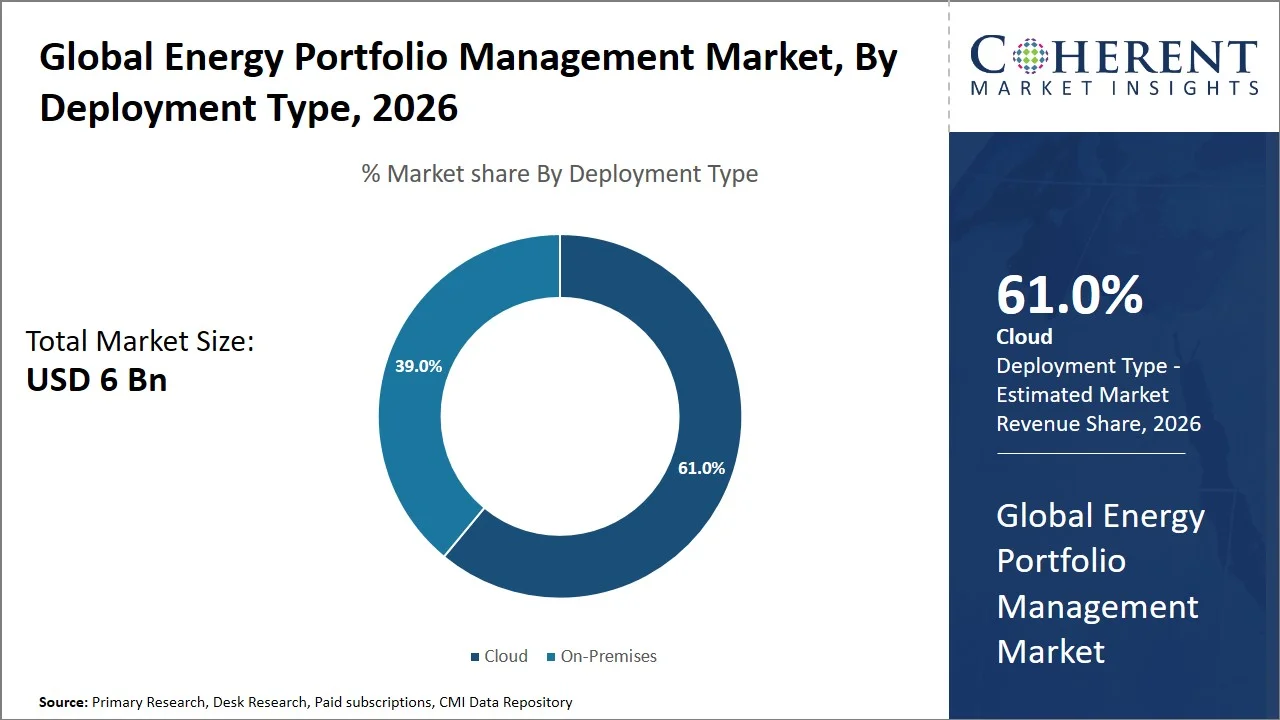
The cloud segment is expected to account for 61.0% of the global energy portfolio management market share in 2026. Cloud deployment is the favored approach commonly used by the industry due to the availability of scalable computing resources and real time access to energy portfolio data without the need for considerable investment in on-premises infrastructure. Energy companies can use cloud-based platforms to analyze large volumes of market and operational data quickly, collaborate remotely, connect with multiple enterprise applications, and roll out software upgrades more easily. As a result, organizations can increase operational agility and lower maintenance costs while accelerating decision making across dispersed energy assets. On December 2, 2025, ABB completed the acquisition of Gamesa Electric’s power electronics business, adding cloud-connected battery energy storage and utility-scale inverter technologies that improve remote monitoring, portfolio optimization and digital energy management across distributed energy assets.
Utilities Dominates the Global Energy Portfolio Management Market
The utilities segment is expected to account for 33.0% of the global energy portfolio management market share in 2026. Utilities are the major adopters of energy portfolio management systems as they have huge generation assets, transmission networks and power procurement activities to manage on an ongoing basis to optimize and mitigate risks. These organizations depend on sophisticated portfolio management platforms to predict demand, balance generation with grid needs, optimize the purchase and sale of power, manage fuel costs and comply with evolving market regulations, which allows them to efficiently manage increasingly complex and diverse energy portfolios. In 2025, ENGIE Australia collaborated with GE Vernova to implement Advanced Extendor Valve technology at the Pelican Point Power Station allowing the utility to improve operational flexibility, optimize generation assets and better manage its power generation portfolio while supporting increasing renewable energy integration.
Currents Events and their Impact
Current Events | Description and its Impact |
European Union Energy Market Integrity and Transparency (REMIT) implementing rules 2026 |
|
India Electricity (Amendment) Rules, 2026 |
|
Energy Portfolio Management Market Dynamics
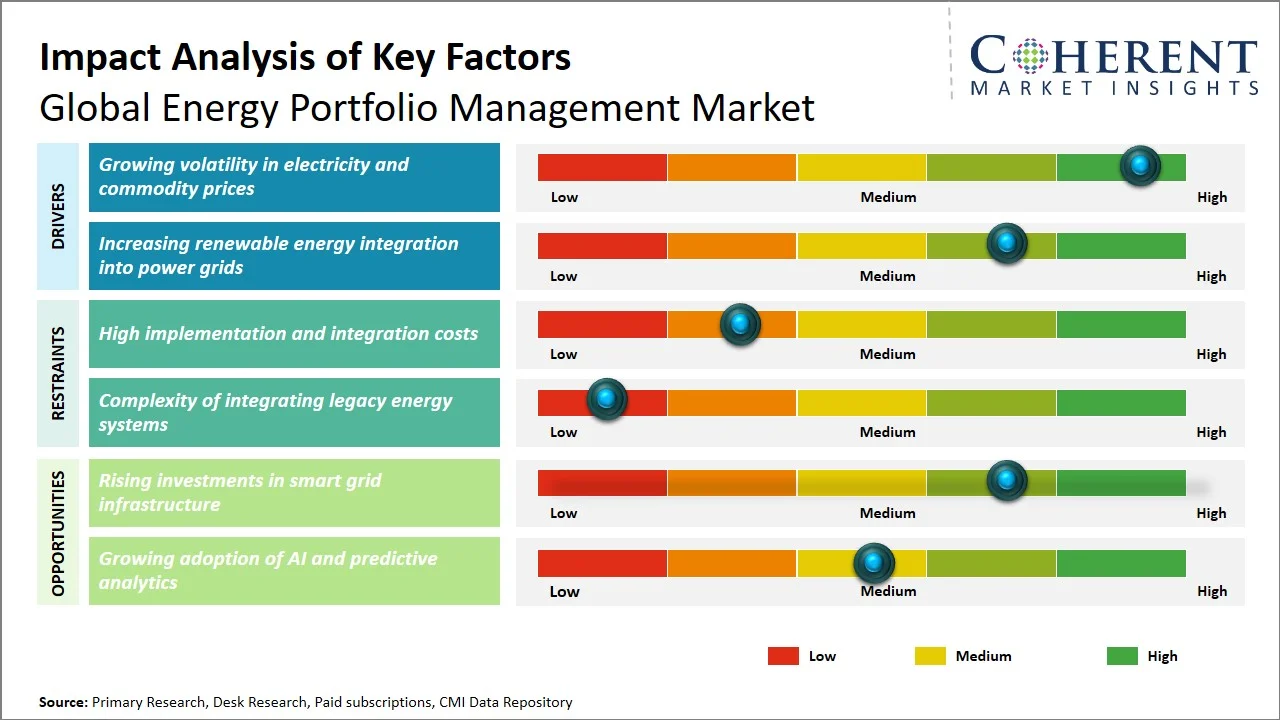
Market Drivers
- Growing volatility in electricity and commodity prices: Increasing volatility in electricity, natural gas, coal and carbon credit prices is forcing organizations to turn to sophisticated energy portfolio management solutions that deliver real time market intelligence, predictive analytics and automated risk management. Utilities, energy traders and industrial energy consumers can use these platforms to enhance their procurement strategies, hedge against price fluctuations, improve the accuracy of their forecasts and make faster trading decisions, helping them to minimize their financial exposure while ensuring that they have a reliable energy supply and continue to be profitable in their operations. On July 8, 2025, India's first electricity futures contracts were launched by Multi Commodity Exchange of India (MCX), enabling power generators, distribution companies and large industrial consumers to hedge against rising electricity price volatility arising from weather fluctuations and changing demand patterns.
- Increasing renewable energy integration into power grids: The fast increase in renewable energy sources such as solar and wind is increasing the complexity of electricity grid operations because of their variable and intermittent generation profiles. Utilities and power producers use energy portfolio management solutions to forecast renewable output, optimize generation scheduling, coordinate battery storage and other flexible resources, and balance supply and demand in real time. This increases grid stability, improves asset utilization, and better integrates clean energy into the power system. On October 16, 2025, the Tennessee Valley Authority (TVA) ramped up the use of grid-enhancing technologies like dynamic line rating and advanced power flow control to increase the capacity of its transmission system and to allow for the addition of ever-greater amounts of renewable electricity into its power system without the need for new transmission corridors.
Emerging Trends
- Increasing Shift Toward Cloud Native Energy Portfolio Management Platforms: Utilities and energy traders are moving away from legacy on premises systems to cloud based platforms that offer real time market visibility, scalable analytics, remote collaboration, faster software updates, and smooth integration with trading, risk management, and enterprise resource planning systems.
- Rising Focus on Carbon Portfolio Management and ESG Integration: Organizations are integrating carbon allowance trading, emissions tracking, renewable energy certificates, and sustainability metrics into energy portfolio management solutions to adhere to changing environmental regulations and meet corporate decarbonization and net zero targets.
Regional Insights
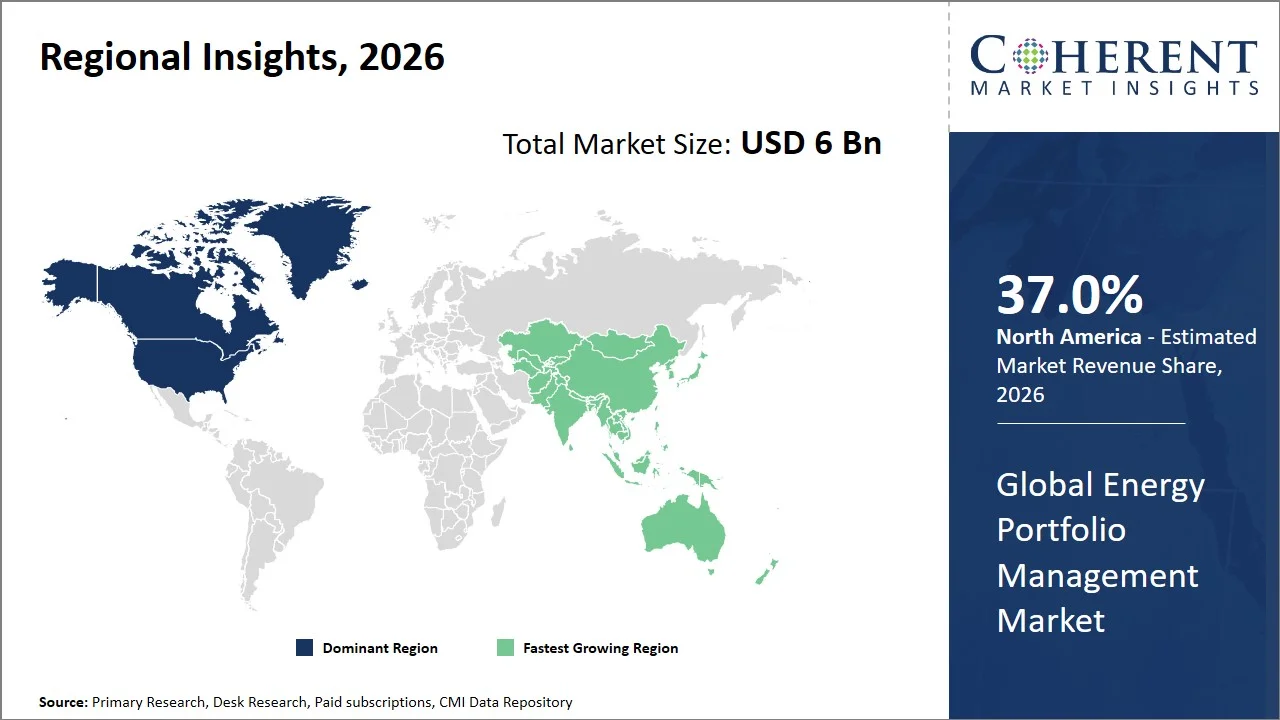
Why is North America a Strong Market for Energy Portfolio Management?
North America is expected to account for a market share of 37.0% in 2026. North America is expected to dominate the energy portfolio management market owing to the highly liberalized electricity markets, increasing renewable energy integration, and complex energy trading ecosystem in the region. Utilities and independent system operators such as PJM, CAISO, ERCOT, NYISO and MISO utilize advanced portfolio management technologies to optimize generation assets, wholesale energy trading, battery storage and demand response programs. Utilities are also increasingly deploying AI-powered forecasting and cloud-based energy trading systems to manage renewable variability and meet expanding grid reliability requirements.
Why Does the Asia Pacific Energy Portfolio Management Market Exhibit High Growth?
Asia Pacific is projected to account for 28.0% of the global energy portfolio management market and is expected to register the fastest growth. Asia Pacific is the fastest expanding regional market as governments speed up electricity market reforms, renewable energy expansion and grid modernization. The need for advanced portfolio optimization software is significant, driven by heavy investment in smart grids, battery energy storage systems and competitive wholesale power markets by countries such as China, Japan, Australia, South Korea and India. Rapid growth of utility-scale solar and wind projects and cross-border electricity trading initiatives in Southeast Asia are also driving the adoption of integrated energy portfolio management platforms.
Global Energy Portfolio Management Market Outlook for Key Countries
Why is the U.S. Emerging as a Major Hub in the Energy Portfolio Management Market?
The U.S. is the largest market given the maturity of its competitive electricity markets and significant use of digital utility technologies. PJM, ERCOT, MISO, CAISO, ISO New England, and NYISO are examples of regional transmission organizations (RTOs) that generate large volumes of market and operational data that require complex portfolio optimization and risk management solutions. Utilities and energy traders are integrating battery storage, renewable generation and AI-powered forecasting into portfolio management systems to optimize participation in day-ahead and real-time electricity markets under Federal Energy Regulatory Commission market regulations.
Is China the Next Growth Engine for the Energy Portfolio Management Market?
As China constructs renewable energy generation and modernizes its power trading system, energy portfolio management systems are being adopted rapidly. The demand for sophisticated portfolio optimization software is on the rise driven by ongoing electricity market reforms, huge deployment of wind, solar and energy storage projects and the creation of unified national power trading platforms. State-owned power firms like China Southern Power Grid are increasingly adopting digital platforms to manage traditional generation and renewable resources, while also supporting carbon reduction goals and boosting grid efficiency.
Germany Energy Portfolio Management Market Analysis and Trends
Germany is still one of the most sophisticated markets in Europe with a big renewable energy base and a very established wholesale electricity trading environment. The country’s Energiewende agenda has dramatically raised the requirement for complex portfolio management systems, able to handle intermittent wind and solar power, battery storage, balancing markets and cross-border electricity trading. Utilities and energy trading companies also use these platforms to optimize the performance of renewable assets while complying with European electricity market transparency and balancing laws.
U.K. Energy Portfolio Management Market Analysis and Trends
The U.K. is also continuing to build its energy portfolio management industry with the rapid deployment of renewable energy, development of offshore wind and increasing flexibility of the electricity market. Utilities, suppliers and energy traders are increasingly using portfolio management software to optimize wholesale electricity procurement, battery storage operations, balancing mechanism participation and power purchase agreements. The country’s shift towards a low-carbon electrical grid and the increased use of flexibility markets are driving investment in cloud-based portfolio optimization and energy trading technologies.
Canada Energy Portfolio Management Market Analysis and Trends
Canada is expanding its energy portfolio management market through rising renewable electricity output, hydropower optimization and interprovincial electricity trade. Provincial utilities and independent power producers are using advanced portfolio management technologies to optimize hydroelectric reservoirs, wind farms, solar projects and battery storage assets, and to improve forecasting and energy trading capabilities. Growing expenditures in grid modernization and clean electricity efforts are driving utilities to embrace digital portfolio management systems that improve operational efficiency and support long-term decarbonization goals.
Global Energy Portfolio Management Market - Carbon Credit Transaction Volumes By Region (2025)
Region | Carbon Credit Transaction Volume (Million tCO₂e) |
Europe | 7,250 |
Asia Pacific | 4,680 |
North America | 2,910 |
Latin America | 920 |
Middle East & Africa | 650 |
How are Rising Number of Investments in Smart Grid Infrastructure Creating New Growth Opportunities in the Energy Portfolio Management Market?
The increasing investments towards smart grid infrastructure is creating lucrative growth opportunities in the energy portfolio management market by providing utilities and energy companies with real time grid data, advanced metering information, and automated network controls for more accurate portfolio optimization. With the development of smart grid allowing integration of renewable energy sources, battery storage systems, distributed energy resources and demand response programs, energy portfolio management platforms have become a necessity for forecasting electricity demand, balancing generation and consumption, optimizing asset dispatch and managing market risks. With the increasing deployment of intelligent grid technologies, it also enables predictive analytics, dynamic pricing strategies and automated energy trading, allowing organizations to increase operational efficiency, improve grid reliability and maximize returns from increasingly complex and decentralized energy portfolios. On June 16, 2026, I Squared Capital announced plans to form a strategic partnership with the U.S. International Development Finance Corporation to establish a new USD 3 billion investment platform focused on developing critical energy infrastructure in South and Southeast Asia.
Market Players, Key Development, and Competitive Landscape
Key Developments
- On November 18, 2025, Schneider Electric announced the availability of its One Digital Grid Platform, a unified, artificial intelligence (AI)-enabled software platform designed to help utilities modernize faster, strengthen grid resilience and reduce energy costs.
- On March 26, 2025, Siemens announced that it has completed the acquisition of Altair Engineering Inc., a leading provider of software in the industrial simulation and analysis market, for an enterprise value of approximately USD 10 billion. With this acquisition, Siemens extends its leadership in simulation and industrial artificial intelligence (AI) by adding new capabilities in mechanical and electromagnetic simulation, high-performance computing (HPC), data science and AI.
Competitive Landscape
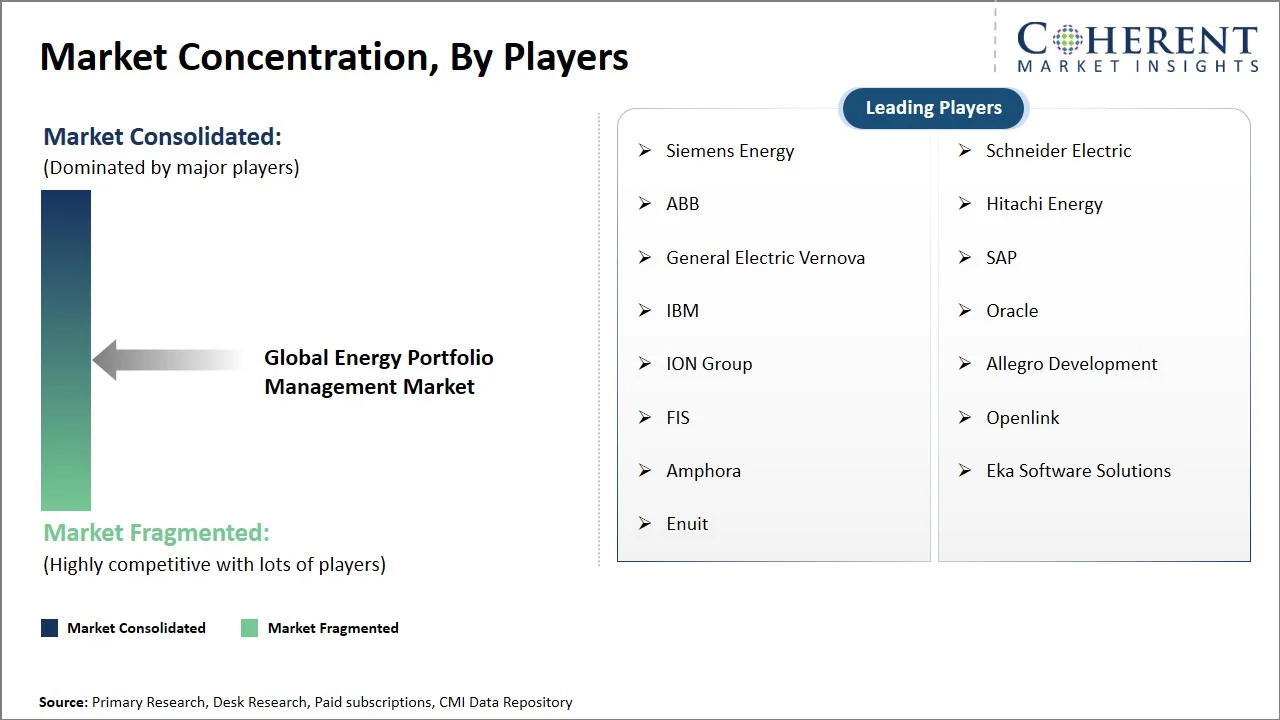
The global energy portfolio management market is competitive with enterprise software providers, energy trading technology vendors, and industrial automation firms competing to build out their platforms with artificial intelligence, cloud native architectures, and advanced analytics. Market participants are increasingly differentiating themselves by integrating energy trading and risk management, renewable asset optimization, battery energy storage management, carbon accounting and regulatory reporting in unified platforms. Utilities, transmission system operators, cloud service providers and renewable energy developers are pursuing strategic alliances to boost interoperability and expedite digital transformation, according to software vendors.
Market Report Scope
Energy Portfolio Management Market Report Coverage
| Report Coverage | Details | ||
|---|---|---|---|
| Base Year: | 2025 | Market Size in 2026: | USD 6 Bn |
| Historical Data for: | 2020 To 2024 | Forecast Period: | 2026 To 2033 |
| Forecast Period 2026 to 2033 CAGR: | 8.2% | 2033 Value Projection: | USD 12.50 Bn |
| Geographies covered: |
| ||
| Segments covered: |
| ||
| Companies covered: | Siemens Energy, Schneider Electric, ABB, Hitachi Energy, General Electric Vernova, SAP, IBM, Oracle, ION Group, Allegro Development, FIS, Openlink, Amphora, Eka Software Solutions, and Enuit | ||
| Growth Drivers: |
| ||
| Restraints & Challenges: |
| ||
Analyst Opinion (Expert Opinion)
- The energy portfolio management market is likely to be increasingly shaped by the convergence of electricity trading, renewable energy optimization and digital grid management, rather than by conventional portfolio management alone. Greater emphasis is expected to be placed on integrated platforms capable of managing physical assets, financial positions, carbon portfolios, and distributed energy resources within a unified operating environment, enabling enhanced operational efficiency, portfolio optimization, and enterprise-wide decision making. Vendors that offer very scalable cloud platforms with embedded artificial intelligence, open integration frameworks and automated compliance capabilities are expected to gain competitive advantage, while solutions with limited interoperability and analytics are expected to see reduced adoption.
- The future of the energy portfolio management industry is projected to be defined by the growth of decentralized energy systems, virtual power plants, long-duration energy storage and increasingly dynamic electricity markets. Portfolio management platforms will likely become smart operational hubs, integrating real-time grid optimization, autonomous trading algorithms, weather-driven forecasting and carbon market management into a unified digital ecosystem. These solutions are expected to play a stronger strategic role in underpinning dependable, low-carbon and data-driven energy systems, through greater integration with smart grid infrastructure, flexible demand management, hydrogen projects and cross-border power trading platforms.
Speak to the analyst
Want personalized insights?
Take the findings above to one of our principal consultants, or have the report rebuilt around the segments, geographies and competitors you actually track.
Market Segmentation
- Component Type Insights (Revenue, USD Billion, 2021 - 2033)
- Software
- Services
- Deployment Type Insights (Revenue, USD Billion, 2021 - 2033)
- Cloud
- On Premises
- End User Insights (Revenue, USD Billion, 2021 - 2033)
- Utilities
- Independent Power Producers
- Energy Traders
- Oil and Gas Companies
- Renewable Energy Companies
- Industrial Energy Consumers
- Regional Insights (Revenue, USD Billion, 2021 - 2033)
- North America
- U.S.
- Canada
- Latin America
- Brazil
- Argentina
- Mexico
- Rest of Latin America
- Europe
- Germany
- U.K.
- Spain
- France
- Italy
- Russia
- Rest of Europe
- Asia Pacific
- China
- India
- Japan
- Australia
- South Korea
- ASEAN
- Rest of Asia Pacific
- Middle East
- GCC Countries
- Israel
- Rest of Middle East
- Africa
- South Africa
- North Africa
- Central Africa
- North America
- Key Players Insights
- Siemens Energy
- Schneider Electric
- ABB
- Hitachi Energy
- General Electric Vernova
- SAP
- IBM
- Oracle
- ION Group
- Allegro Development
- FIS
- Openlink
- Amphora
- Eka Software Solutions
- Enuit
Sources
Primary Research Interviews
- Energy Portfolio Managers & Analysts
- Utility Companies & Independent Power Producers (IPPs)
- Energy Trading & Risk Management (ETRM) Solution Providers
- Renewable Energy Asset Managers
Magazines
- Power Magazine
- Energy Digital
- Renewable Energy World
- Energy Monitor
Journals
- Energy Economics Journal
- Applied Energy Journal
- Journal of Energy Markets
Associations
- International Energy Agency (IEA)
- World Energy Council (WEC)
- Energy Risk Professionals Association (ERPA)
- Association of Energy Engineers (AEE)
Public Domain Sources
- U.S. Energy Information Administration (EIA)
- European Commission Energy Portal
- United Nations Environment Programme (UNEP) – Energy Division
- World Bank Energy Data
Proprietary Elements
- CMI Data Analytics Tool
- Proprietary CMI Existing Repository of information for last 10 years
Get access to 250+ pages report
Every segment, forecast, competitor profile and data table behind the analysis above — available for instant download.
- ESOMAR Member
- ISO 9001:2015 Certified
- D-U-N-S Registered
- GDPR & CCPA Compliant
Missing comfort of reading report in your local language? Find your preferred language:
Transform your Strategy with Exclusive Trending Reports
Frequently Asked Questions
The global energy portfolio management market is expected to stand at USD 6 Bn in 2026 and is expected to reach USD 12.50 Bn by 2033.
The CAGR of the global energy portfolio management market is projected to be 8.2% from 2026 to 2033.
Battery energy storage enhances portfolio flexibility by enabling optimized energy dispatch and market participation.
They provide real-time market analysis, automated trading workflows, and comprehensive risk management capabilities.
In terms of component type, the software segment is estimated to dominate the market revenue share in 2026.
High implementation and integration costs and complexity of integrating legacy energy systems are the major factors hampering the growth of the global energy portfolio management market.
Growing volatility in electricity and commodity prices and increasing renewable energy integration into power grids are the major factors driving the growth of the global energy portfolio management market.