

Global Enterprise Car Rental Market Size and Forecast – 2026-2033
The Global Enterprise Car Rental Market is estimated to be valued at USD 38.54 Bn in 2026 and is expected to reach USD 53.87 Bn by 2033, exhibiting a compound annual growth rate (CAGR) of 4.9% from 2026 to 2033.
Key Takeaways of the Enterprise Car Rental Market
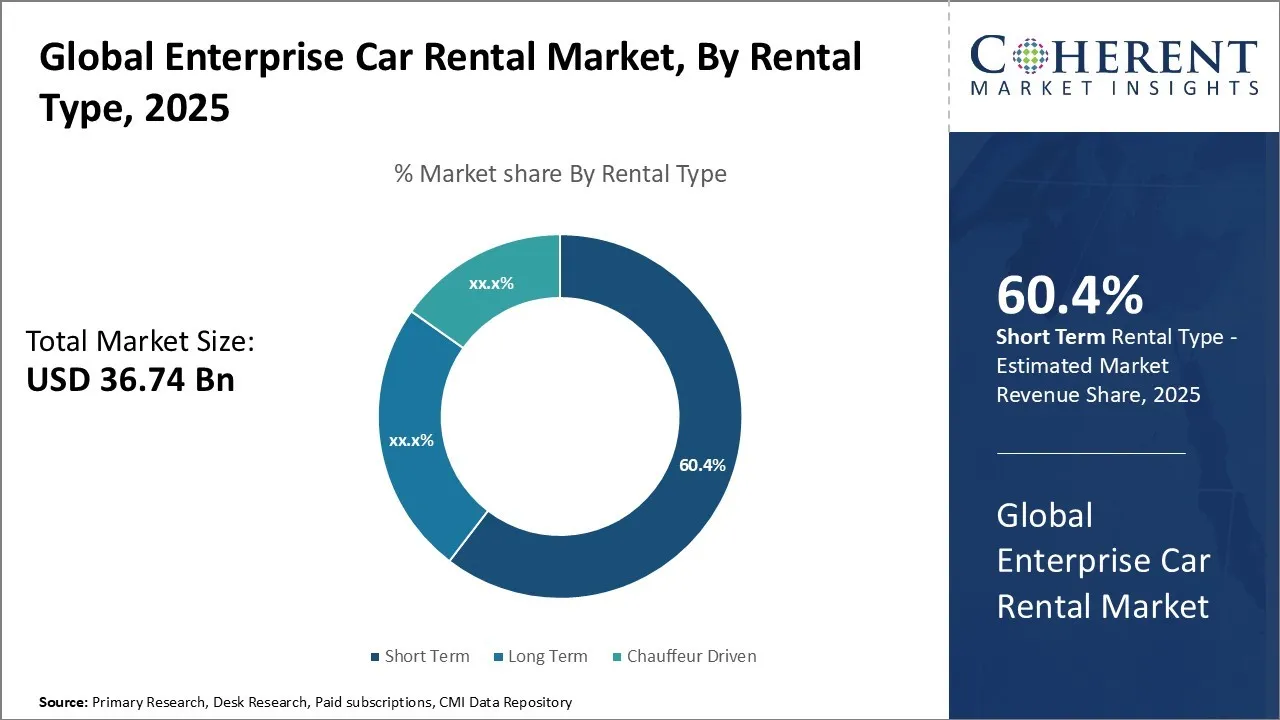
- The short term segment leads the market holding an estimated share of 61.4 % in 2026.
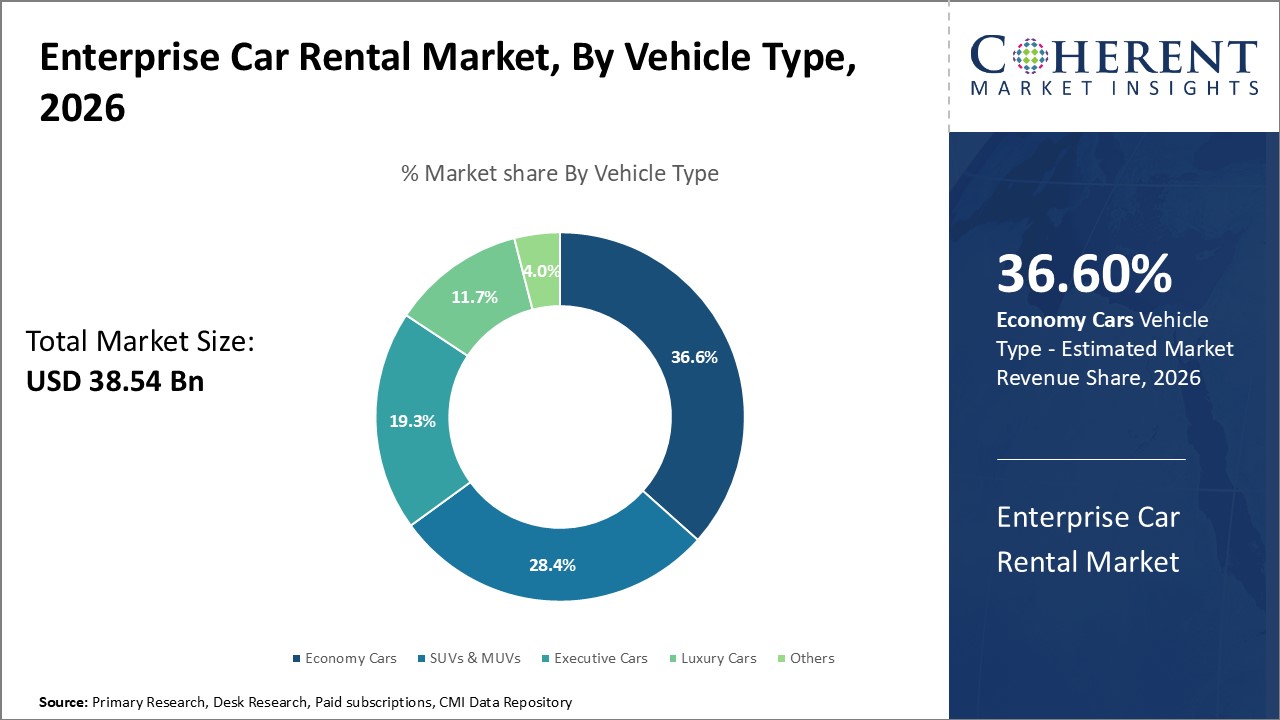
- The economy cars segment is projected to dominate with a share of 36.6% in 2026.
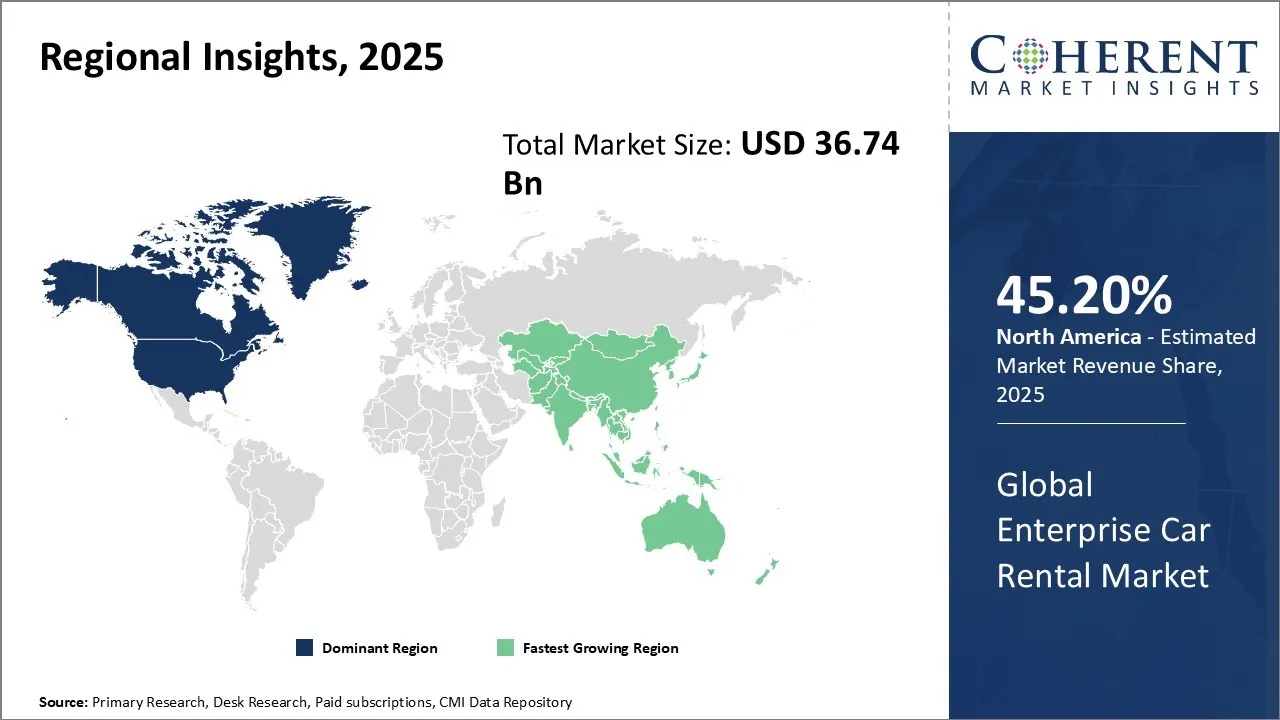
- North America is estimated to lead the market with a share of 45. 2% in 2026.
- Asia Pacific, holding a share of 25. 7% in 2026, is projected to be the fastest growing region.
Market Overview
The market is seeing a lot of emphasis on integration of technology, such as mobile booking platforms and telematics, which improve user experience and operational efficiency. Also, players are shifting toward sustainable practices, with enterprise rental companies spending on electric and hybrid vehicles to meet corporate sustainability goals. These advancements are expected to shape the competitive landscape and drive long-term growth in the enterprise car rental sector.
Current Events and Its Impact
Current Events | Description and its impact |
Geopolitical Developments |
|
Economic and Market Dynamics |
|
Segmental Insights
- Current Industry Events of 2026
- Market Size Estimation
- Regional Breakdown
- Competitive Landscape
- Customer Intelligence
- Segmental Analysis
- Pricing Analysis
- Key Market Drivers, Challenges & Future Trends
- Customized Insights Section
Enterprise Car Rental Market Insights, by Rental Type - Short term dominates the market owing to the increasing demand for flexible and convenient transportation solutions
The short term segment, holding a share of 61.4% in 2026, is expected to dominate the global enterprise car rental market. Short term rentals let customers access vehicles on an as-needed basis without the commitments or financial burdens associated with long-term leases or ownership. Urbanization and increased air travel connectivity adds to the demand for short term rentals because business travelers arriving at airports often seek convenient, short duration vehicles to navigate unfamiliar cities efficiently. Likewise, tourists benefit from short term rentals that provide easy point-to-point transportation options without the hassle of public transit or ride-hailing uncertainties. The rise in domestic and international tourism contributes significantly to this segment’s growth, as short term rentals typically align with the duration of vacations or business trips.
Additionally, advances in technology are making short term rentals more accessible and seamless. Mobile applications and digital platforms enable customers to reserve, unlock, and return vehicles with minimal physical contact and effort. This convenience enhances customer satisfaction and encourages more frequent, spontaneous rentals. The integration of contactless payments and real-time vehicle availability also supports the widespread adoption of short-term rental services.
Environmental awareness is another factor subtly influencing this segment. Short term rentals often provide access to newer, more fuel-efficient, and sometimes electrified vehicles, allowing consumers to reduce their carbon footprint temporarily without owning such cars. This appeals to environmentally conscious users who desire sustainable travel solutions but do not want to commit to owning an electric or hybrid vehicle.
Lastly, corporate clients seeking flexible mobility for their employees contribute to the high share of short term rentals. Organizations benefit from the ability to provide transportation for varying durations depending on project needs or travel policies, helping optimize expense management. All these factors combined underpin the robust demand and market leadership of the short term segment.
Enterprise Car Rental Market Insights, by Vehicle Type – Economy cars contribute the highest share of the market driven by affordability and wide applicability
The dominance of the economy cars segment, holding a share of 36.6% in the global enterprise car rental market in 2026, is largely a reflection of the vehicle category’s strong alignment with customer needs for cost-effective, practical, and easily maneuverable transportation. Economy cars inherently offer a lower price point compared to larger or more luxurious alternatives, making them the preferred choice for a broad customer base including budget-conscious travelers, small families, and daily commuters.
One of the primary growth drivers for economy cars lies in their fuel efficiency. Rising fuel costs and increasing environmental regulations have made fuel economy a critical consideration for renters. Economy cars typically consume less fuel and emit fewer pollutants, which appeals not only to individual renters looking to minimize travel expenses but also to companies with sustainability goals. This combination of cost savings and eco-friendliness enhances the attractiveness of economy vehicles for short commutes, sightseeing, and basic daily transportation needs.
Moreover, the compact size and ease of handling of economy cars make them ideal for urban environments where parking space is limited and traffic congestion is frequent. Customers renting vehicles in busy metropolitan areas prefer economy cars for their agility and reduced parking hassles. The increased rate of urbanization worldwide pushes demand in this segment, as more people require practical solutions for city travel.
Additionally, the availability and variety of economy models across numerous markets contribute to its leading share. Enterprise car rental providers often maintain a large fleet of economy cars due to their universal appeal and lower maintenance costs. This extensive presence ensures higher availability and reliability for customers, reinforcing the segment's popularity.
Price Analysis of the Enterprise Car Rental Market
Region | Economy Daily | SUV Daily | Luxury Daily |
North America (U.S.) | USD 55–75 | USD 85–110 | USD 120–150 |
Europe | USD 60–80 | USD 90–120 | USD 130–160 |
Asia Pacific | USD 50–70 | USD 80–100 | USD 110–140 |
Regional Insights
North America Enterprise Car Rental Market Analysis and Trends
North America, holding an estimated share of 45.2% in 2026, dominates the global enterprise car rental market is driven by a mature and well-established automotive ecosystem, extensive airport networks, and a strong culture of business and leisure travel. The region benefits from robust infrastructure and advanced technology integration, including digital booking platforms and fleet telematics, which enhance customer experience.
Government policies promoting tourism and business travel, combined with stringent regulations on vehicle safety and emissions, have fostered innovation among rental companies. Notable players such as Enterprise Holdings and Avis Budget Group have deep-rooted presence here, leveraging extensive fleet variety and large-scale service networks to capture market share. Furthermore, North America’s diverse urban and suburban geography necessitates high demand for flexible transportation options, solidifying the region’s lead.
Asia Pacific Enterprise Car Rental Market Analysis and Trends
The Asia Pacific region, expected to hold a share of 25.7% of the global enterprise car rental market in 2026, is projected to witness the fastest growth, fueled by rapid urbanization, expanding middle-class populations, and increasing disposable incomes. The region's burgeoning tourism sector, alongside rising corporate travel, stimulates the demand for rental vehicles. Government initiatives aimed at improving road infrastructure and promoting car-sharing services further boost market expansion.
Additionally, countries within Asia Pacific are witnessing a shift in consumer preferences toward self-driven rentals and digital platforms, increasing accessibility to rental services. Key companies like local giant Sg Car Rentals, as well as international operators such as Sixt and Europcar, are actively expanding their footprint, deploying technology-driven solutions and strategic partnerships to capture emerging opportunities. Trade liberalization and favorable foreign investment policies have also facilitated market entry and competition amplification in this region.
Global Enterprise Car Rental Market Outlook for Key Countries
U.S. Enterprise Car Rental Market Analysis and Trends
The U.S. remains highly competitive with major players like Hertz dominating due to their widespread service networks and deep customer loyalty programs. The presence of numerous airports and a strong corporate travel base ensures consistent demand. Innovation in fleet management and investment in electric and hybrid vehicles reflect the market’s adaptation to evolving consumer preferences and environmental regulations. Strategic acquisitions and partnerships are commonplace, enhancing market penetration and fleet optimization.
Germany Enterprise Car Rental Market Analysis and Trends
Germany continues to lead Europe enterprise car rental market with its strong automotive manufacturing industry and extensive road infrastructure. The country is a hub for both business travelers and tourists, supported by efficient train and air connectivity. Companies, such as Sixt and Europcar, have a dominant presence, leveraging technological advancements in mobility solutions, including app-based rentals and fleet electrification aligned with Germany’s sustainability goals. Favorable government policies supporting green mobility bolster innovation and service diversification.
China Enterprise Car Rental Market Analysis and Trends
China enterprise rental car market is expanding rapidly due to urbanization, increased domestic tourism, and a growing preference for private vehicle use without ownership burdens. The government’s investment in smart cities and digital infrastructure propels the adoption of app-based rental services. Domestic players like CAR Inc. and international firms such as Hertz focus on innovation, including integrating AI for customer service and fleet management. Moreover, regulatory reforms aimed at easing vehicle registration and emission standards facilitate the growth of rental services.
Brazil Enterprise Car Rental Market Analysis and Trends
Brazil enterprise car rental market is shaped by rising middle-class consumer spending and the popularity of car rentals for both urban mobility and tourism across its vast geography. Despite infrastructural challenges, growing digital connectivity and increased domestic travel promotion enable market expansion. Companies like Localiza and Unidas dominate by delivering tailored packages for varying customer needs and leveraging digital platforms to streamline reservations and fleet management. Government incentives to support tourism bolster rental demand significantly.
U.A.E. Enterprise Car Rental Market Analysis and Trends
The U.A.E., particularly Dubai and Abu Dhabi, represents a strategic market driven by a high volume of international travelers, luxury tourism, and events. Liberal trade policies and investment in world-class infrastructure support a dynamic car rental ecosystem. Players like Thrifty Car Rental and Europcar cater to premium segments while introducing innovations such as short-term leasing and electric vehicle rentals aligned with the U.A.E.’s sustainable mobility vision. The region’s regulatory environment encourages foreign participation and promotes advanced mobility solutions.
Market Players, Key Development, and Competitive Intelligence
Key Developments
- In January 2025, Enterprise Mobility expanded its footprint in Latin America and the Caribbean to provide more vehicle rental and mobility options for both business and leisure travelers across the region. Enterprise Rent-A-Car branches were opened for the first time ever in Chile and National Car Rental and Alamo branches were opened once again since exiting during the pandemic. This was done through the company’s franchise partner Mediterraneo Automotores S.A., part of Circulo Autos.
- In September 2024, the international mobility service provider, SIXT, announced a franchise partnership with the South Africa-based car rental company, SANI Car Rental. This partnership significantly strengthened SIXT’s market position in South Africa. Starting November 1, 2024, SIXT is offering high-quality car rental services to its customers in South Africa and Namibia.
- In January 2024, rental firm, Hertz Global Holdings, sold about 20,000 electric vehicles, including Teslas, from its U.S. fleet about two years after a deal with the automaker to offer its vehicles for rent. Hertz will instead opt for gas-powered vehicles, it said, citing higher expenses related to collision and damage for EVs even though it had aimed to convert 25% of its fleet to electric by 2024 end.
- In July 2021, The Volkswagen Group took a major step forward in its NEW AUTO strategy to become a leading provider of individual mobility in the electric and fully connected age. In a consortium with London-based asset manager Attestor Limited and Dutch mobility provider Pon Holdings B.V., Volkswagen agreed to launch a recommended takeover offer for Europcar Mobility Group. Europcar is the leading mobility service and rental car company in Europe with over 3,500 stations across 140+ countries and a fleet of over 350,000 vehicles.
Top Strategies Followed by Enterprise Car Rental Market Players
- Established market leaders have a distinct approach, primarily emphasizing heavy investments in research and development (R&D) to innovate high-performance, reliable vehicles and services. Their focus on technological advancement allows them to continuously enhance fleet quality, integrate digital solutions such as seamless booking platforms and connected car features, and meet evolving customer needs.
- In 2023–2024, Hertz invested over USD 4 billion to purchase up to 100,000 Teslas, along with 65,000 Polestar EVs and other electric vehicles from GM.
- Mid-level competitors in the enterprise car rental market pursue a somewhat different trajectory, balancing cost-efficiency with product quality to attract a more price-sensitive customer base, such as small and medium-sized enterprises (SMEs) or budget-conscious corporate clients. These players emphasize offering fleet solutions that maintain quality standards while lowering operating expenses, which appeal to cost-conscious buyers without significant compromise on reliability or service experience.
- Zoomcar offers subscription-based pricing and pay-per-km models, significantly undercutting traditional rental services.
- Small-scale players in the enterprise car rental arena typically carve out niches by catering to specialized needs or introducing innovative products that differentiate them from larger competitors.
- MyChoize Self Drive Cars focused on long-term rentals and premium SUV fleets in metro areas. The company targets long-stay expats, corporate professionals, and premium leisure travelers.
Market Report Scope
Enterprise Car Rental Market Report Coverage
| Report Coverage | Details | ||
|---|---|---|---|
| Base Year: | 2025 | Market Size in 2026: | USD 38.54 Bn |
| Historical Data for: | 2020 To 2024 | Forecast Period: | 2026 To 2033 |
| Forecast Period 2026 to 2033 CAGR: | 4.9% | 2033 Value Projection: | USD 53.87 Bn |
| Geographies covered: |
| ||
| Segments covered: |
| ||
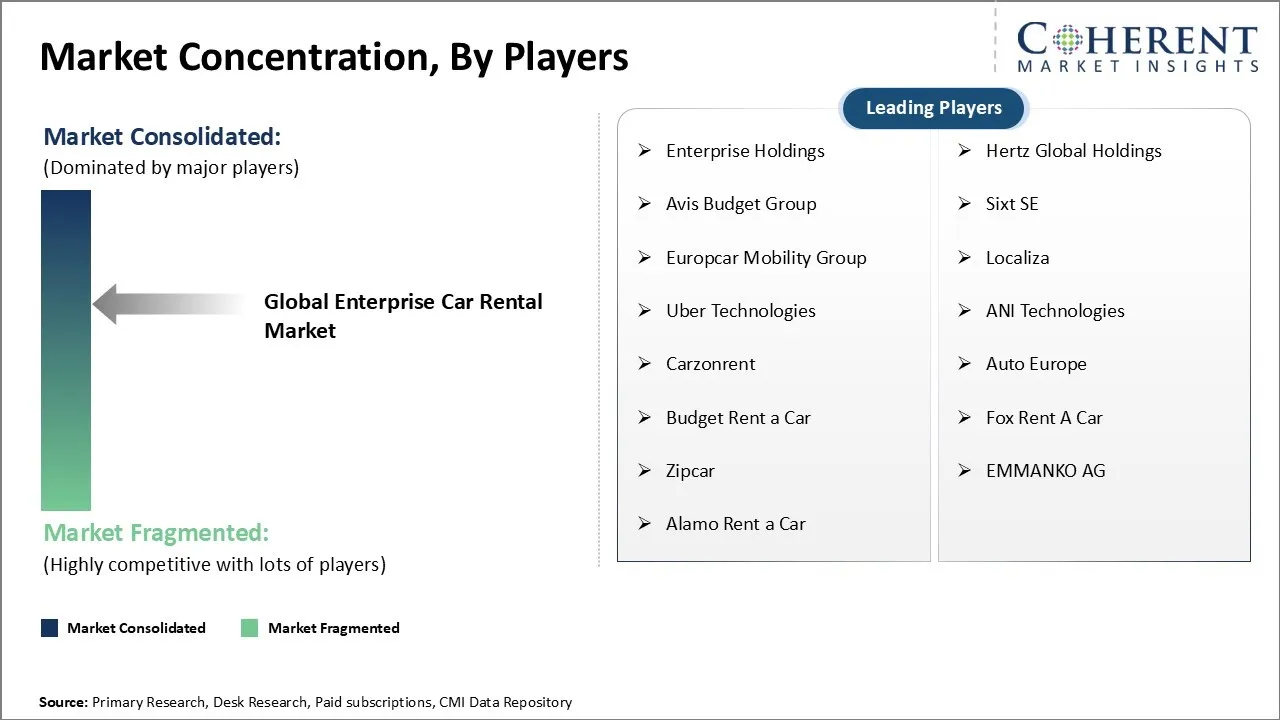
| Companies covered: | Enterprise Holdings, Hertz Global Holdings, Avis Budget Group, Sixt SE, Europcar Mobility Group, Localiza, Uber Technologies, ANI Technologies, Carzonrent, Auto Europe, Budget Rent a Car, Fox Rent A Car, Zipcar, EMMANKO AG, and Alamo Rent a Car | ||
| Growth Drivers: |
| ||
| Restraints & Challenges: |
| ||
Market Dynamics
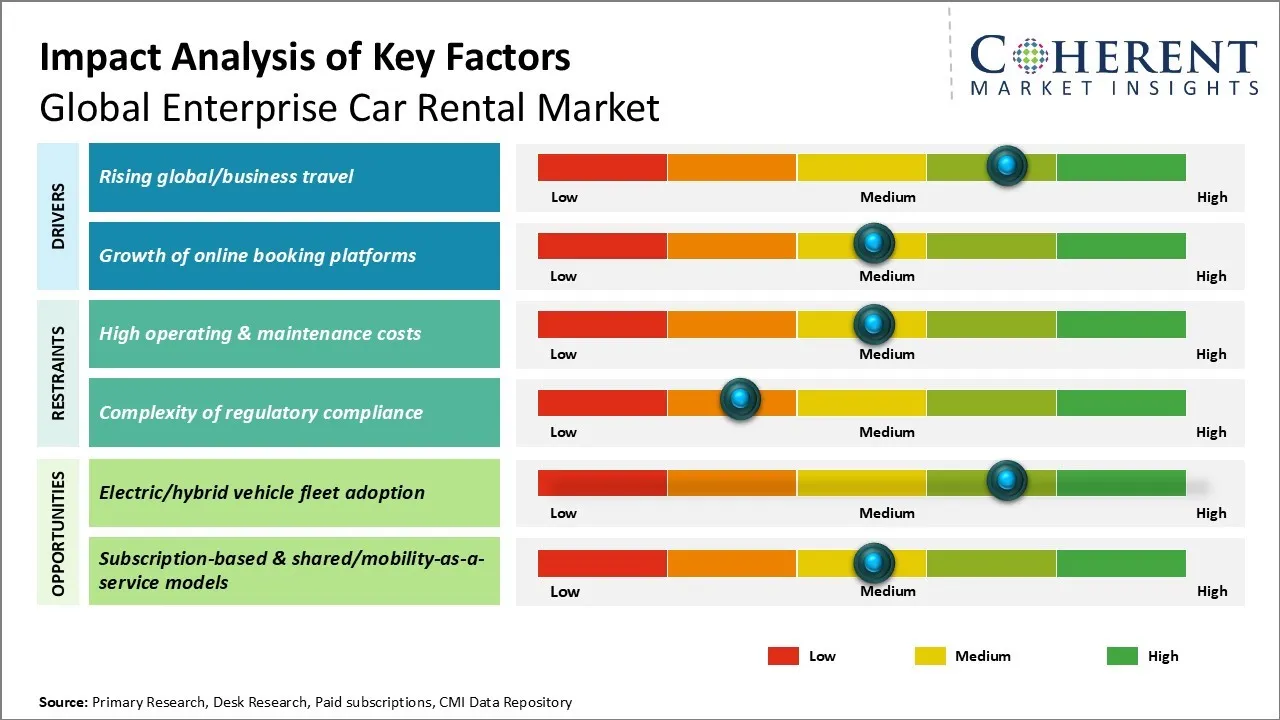
Global Enterprise Car Rental Market Driver - Rising Global/Business Travel
As companies expand their operations internationally and engage in frequent face-to-face meetings, negotiations, and site visits, the need for flexible and convenient transportation solutions grows concurrently. Enterprise car rentals offer travelers the advantage of mobility without the burden of vehicle ownership, enabling seamless navigation across unfamiliar cities and countries. For instance, in January 2024, Enterprise Mobility expanded into Chile, the U.S. Virgin Islands, and the Cayman Islands, citing rising demand from business travelers and international tourists.
Additionally, businesses often prefer rental services for employee travel due to cost efficiency, ease of expense management, and access to a wide range of vehicle options tailored to diverse travel needs. The proliferation of multinational companies and the normalization of cross-border assignments further contribute to this trend, positioning enterprise car rental as a crucial enabler of global business activities.
Global Enterprise Car Rental Market Opportunity - Electric and Hybrid Vehicle Fleet Adoption
With increasing environmental regulations and growing consumer awareness toward sustainable practices, enterprises are strategically expanding their electric and hybrid offerings to meet evolving demand. This shift not only aligns with global efforts to reduce carbon emissions but also addresses the rising operational costs linked to traditional internal combustion engine vehicles. Incorporating electric and hybrid vehicles enables rental companies to differentiate themselves by providing eco-friendly mobility solutions, appealing to a broad demographic of environmentally conscious consumers and corporate clients with green policies.
In 2023, SIXT committed to significantly expanding its electric vehicle fleet in key European markets including Germany, France, the Netherlands, and the UK. The company signed a major agreement with Stellantis to acquire 250,000 vehicles, many of which include electric and plug-in hybrid models across brands like Peugeot, Opel, and Fiat.
Additionally, the proliferation of charging infrastructure worldwide facilitates smoother integration of these vehicles, ensuring rental companies can offer convenient and reliable access to electric fleets. This integration also unlocks opportunities for partnerships with energy providers and charging station companies, creating new revenue streams.
Analyst Opinion (Expert Opinion)
- As global travel resumes post-pandemic, enterprises are reinstituting short-term business travel and regional client servicing—especially in finance, consulting, and pharma. Car rentals offer flexible mobility without the liabilities of fleet ownership, driving demand in urban and tier-2 corridors.
- With international tourism recovering, leisure travelers increasingly prefer rental cars over public transport in regions like Europe, Southeast Asia, and North America. This is especially true for high-mobility tourism clusters such as Iceland, the U.S. West Coast, and Bali.
- Industries like entertainment (film shoots), large-scale events, and logistics (last-mile delivery pilots) often require specialized rental vehicles (vans, SUVs, or branded fleets) for temporary operations—providing a seasonal but lucrative demand stream for agile rental operators.
Speak to the analyst
Want personalized insights?
Take the findings above to one of our principal consultants, or have the report rebuilt around the segments, geographies and competitors you actually track.
Market Segmentation
- Rental Type Insights (Revenue, USD Bn, 2021 - 2033)
- Short Term
- Long Term
- Chauffeur Driven
- Vehicle Type Insights (Revenue, USD Bn, 2021 - 2033)
- Economy Cars
- SUVs & MUVs
- Executive Cars
- Luxury Cars
- Others
- Regional Insights (Revenue, USD Bn, 2021 - 2033)
- North America
- U.S.
- Canada
- Latin America
- Brazil
- Argentina
- Mexico
- Rest of Latin America
- Europe
- Germany
- U.K.
- Spain
- France
- Italy
- Russia
- Rest of Europe
- Asia Pacific
- China
- India
- Japan
- Australia
- South Korea
- ASEAN
- Rest of Asia Pacific
- Middle East
- GCC Countries
- Israel
- Rest of Middle East
- Africa
- South Africa
- North Africa
- Central Africa
- North America
- Key Players Insights
- Enterprise Holdings
- Hertz Global Holdings
- Avis Budget Group
- Sixt SE
- Europcar Mobility Group
- Localiza
- Uber Technologies
- ANI Technologies
- Carzonrent
- Auto Europe
- Budget Rent a Car
- Fox Rent A Car
- Zipcar
- EMMANKO AG
- Alamo Rent a Car
Sources
Primary Research Interviews
Stakeholders
- Fleet Management Heads at Multinational Corporations (e.g., Oil & Gas, Consulting, Pharma)
- Procurement Managers from Corporate Travel Agencies and TMCs
- Heads of Operations from Car Rental Companies and Mobility Solution Providers
- Tourism and Leisure Operators (e.g., Luxury Tour Curators, Online Travel Aggregators)
- Airport Ground Transportation Managers and Urban Transit Planners
- Sustainability Leads from EV Infrastructure Startups and Municipal Mobility Boards
Databases
- National Road Transport Database (NRTD) – U.S.
- Asia-Pacific Urban Mobility Data Repository
- Global Automotive Rental Regulatory Archives (GARRA)
- Federation of Ground Transport Statistics (FGTS)
- Middle East Rental Fleet Registry (MERFR)
Magazines
- Future Mobility Monthly
- Corporate Travel & Ground Transport Review
- Rental Wheels Digest
- EcoFleet & Urban Transport Insights
- EV Horizons Magazine
Journals
- Journal of Urban Transportation Innovation
- Global Mobility Economics & Policy Journal
- International Review of Travel Behavior & Planning
- Smart Cities & Connected Vehicles Quarterly
- Enterprise Transport Systems Journal
Newspapers
- Mobility Times (Global Mobility Section)
- Transit Daily (North America Edition)
- The Global Courier (Transport & Infrastructure Column)
- Asia Automotive Review
- Middle East Mobility Monitor
Associations
- International Association of Mobility Providers (IAMP)
- North American Fleet Operators Consortium (NAFOC)
- Global Urban Travel Alliance (GUTA)
- Asia-Pacific Vehicle Rental Council (APVRC)
- EV Fleet & Rental Transition Forum (EVFR-TF)
Public Domain Sources
- U.S. Department of Transportation (DOT)
- UK Department for Transport – Rental Sector Reports
- National Tourism Boards (Japan, UAE, France, India)
- United Nations Centre for Regional Mobility Studies (UNCRMS)
- Open Mobility Data Hub (OMDH)
Proprietary Elements
- CMI Data Analytics Tool, Proprietary CMI Existing Repository of Information for Last 8 Years
Get access to 250+ pages report
Every segment, forecast, competitor profile and data table behind the analysis above — available for instant download.
- ESOMAR Member
- ISO 9001:2015 Certified
- D-U-N-S Registered
- GDPR & CCPA Compliant
Missing comfort of reading report in your local language? Find your preferred language:
Transform your Strategy with Exclusive Trending Reports
Frequently Asked Questions
The global enterprise car rental market is estimated to be valued at USD 38.54 billion in 2026 and is expected to reach USD 53.87 billion by 2033.
The CAGR of the global enterprise car rental market is projected to be 4.9% from 2026 to 2033.
Rising global business travel and growth of online booking platforms are the major factors driving the growth of the global enterprise car rental market.
High operating & maintenance costs and complexity of regulatory compliance are the major factors hampering the growth of the global enterprise car rental market.
In terms of rental type, short term is estimated to dominate the market revenue share in 2026.
Enterprise Holdings, Hertz Global Holdings, Avis Budget Group, Sixt SE, Europcar Mobility Group, Localiza, Uber Technologies, ANI Technologies, Carzonrent, Auto Europe, Budget Rent a Car, Fox Rent A Car, Zipcar, EMMANKO AG, and Alamo Rent a Car are the major players.
North America is expected to lead the global enterprise car rental market in 2026.