

Ex Vivo Organ Perfusion Systems Market
Market Definition |
|
|
Key Statistics Table
Metrix | Value |
Global Market Size (2026) | USD 537.1 Million |
Forecast Market Size (2033) | USD 850.9 Million |
Growth Rate (CAGR 2026–2033) | 6.8% |
Leading System Type Segment | Normothermia (55.6% share in 2026) |
Leading Organ Type Segment | Kidney (42.6% share in 2026) |
Leading End User Segment | Hospitals and Clinics (55.7% share in 2026) |
Dominant Region | North America (35.5% share in 2026) |
Fastest Growing Region | Asia Pacific (21.1% share in 2026) |
Base Year | 2025 |
Forecast Period | 2026-2033 |
Key Players | TransMedics, Inc., XVIVO Perfusion AB, OrganOx Ltd., Paragonix Technologies, Inc., Bridge to Life Ltd. |
Source: Coherent Market Insights Analysis, July 2026 | |
Global Ex Vivo Organ Perfusion Systems Market Size and Forecast – 2026 To 2033
The global ex vivo organ perfusion systems market is expected to grow from USD 537.1 Mn in 2026 to USD 850.9 Mn by 2033, registering a compound annual growth rate (CAGR) of 6.8% from 2026 to 2033. The market global ex vivo organ perfusion systems is poised for significant expansion, fueled by the surging demand for organ transplantation amid persistent donor organ shortages.
According to the Global Observatory on Donation and Transplantation (WHO-ONT), 173,727 solid organ transplants were performed globally in 2024, the highest ever recorded, with increasing adoption of donation after circulatory death (DCD), highlighting the increasing need for advanced organ preservation technologies such as ex vivo perfusion systems.
Key Takeaways of the Global Ex Vivo Organ Perfusion Systems Market
- Normothermia is projected to hold 55.6 % of the global ex vivo organ perfusion systems market share in 2026, making it the dominant system type segment across North America due to the increasing adoption of advanced organ preservation technologies supported by favorable regulatory approvals. For instance, in September 2021, the U.S. Food and Drug Administration (FDA) approved the Organ Care System (OCS) Heart System by TransMedics for preserving and transporting donor hearts, marking it the first FDA-approved portable normothermic heart perfusion system in the U.S. This approval has accelerated the adoption of normothermic perfusion across U.S. transplant centers.
- Kidney is projected to hold 42.6 % of the global ex vivo organ perfusion systems market share in 2026, making it the dominant organ type segment, across Europe due to the increasing adoption of machine perfusion for deceased donor kidney preservation. For instance, the UK National Institute for Health and Care Excellence (NICE) recommends hypothermic machine perfusion for preserving deceased donor kidneys intended for transplantation, recognizing its benefits over static cold storage in improving graft outcomes. The recommendation has supported broader adoption of kidney perfusion technologies across European transplant programs.
- Hospitals and clinics are projected to hold 55.7 % of the global ex vivo organ perfusion systems market share in 2026, making it the dominant end user segment across North America due to the presence of highly specialized transplant centers and established regulatory frameworks. For instance, the Organ Procurement and Transplantation Network (OPTN) under the U.S. Health Resources and Services Administration (HRSA) mandates standardized organ preservation and transplantation practices for all U.S. transplant programs, encouraging the integration of advanced ex vivo perfusion technologies into hospital-based transplant workflows.
- North America maintains its dominance with an expected share of 35.5 % in 2026, bolstered by the rapid expansion of organ transplantation supported by favorable reimbursement and national transplant initiatives. For instance, the Health Resources and Services Administration (HRSA) awarded USD 67 million in September 2024 to strengthen the U.S. organ donation and transplantation system through improvements in organ procurement, transportation, and transplant infrastructure, creating a supportive environment for advanced organ preservation technologies such as ex vivo perfusion systems.
- Asia Pacific is expected to exhibit the fastest growth with an estimated contribution of 21.1 % share in 2026, propelled by expanding transplant infrastructure and supportive regulatory reforms. For instance, Japan's Ministry of Health, Labour and Welfare (MHLW) revised the Organ Transplant Act and continues to strengthen national organ donation and transplantation programs through the Japan Organ Transplant Network (JOT), increasing deceased donor transplantation and creating greater demand for advanced organ preservation technologies.
- Current Industry Events of 2026
- Market Size Estimation
- Regional Breakdown
- Competitive Landscape
- Customer Intelligence
- Segmental Analysis
- Pricing Analysis
- Key Market Drivers, Challenges & Future Trends
- Customized Insights Section
Segmental Insights
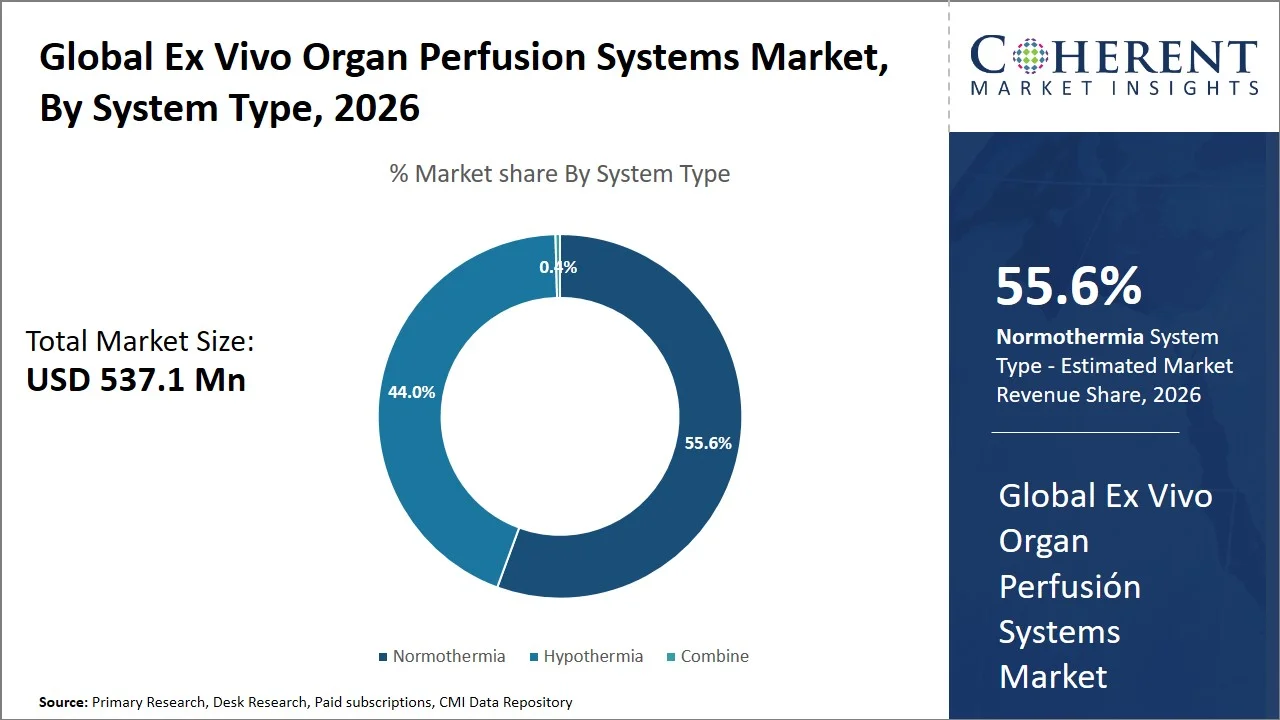
Why Does Normothermia Dominate the Global Ex Vivo Organ Perfusion Systems Market?
Normothermia is projected to hold a market share of 55.6% in 2026, owing to its ability to keep the donor organs in the conditions as similar to that of human physiology allowing continuous metabolism, simultaneous assessment of organ viability and preservation of organs over a significantly longer duration of time when contrasted with traditional cold preservation techniques. Normothermia system assists in the preservation of donor organs that were rejected with traditional cold preservation and also assist in preservation of donation after circulatory death (DCD) and marginal organs for transplantation to ensure better outcomes for the graft. For instance, in April 2022, NHS Blood and Transplant (NHSBT) commenced the Perfused Liver Utilization Study (PLUS), recruiting around 799 extended criteria donor livers to assess whether the addition of normothermic machine perfusion (NMP) of donated livers would enhance liver utilization whilst not adversely affecting 12-month patient and graft survival, while also assessing its cost-effectiveness for NHS adoption.
Why Does Kidney Represent the Largest Organ Type Segment in the Ex Vivo Organ Perfusion Systems Market?
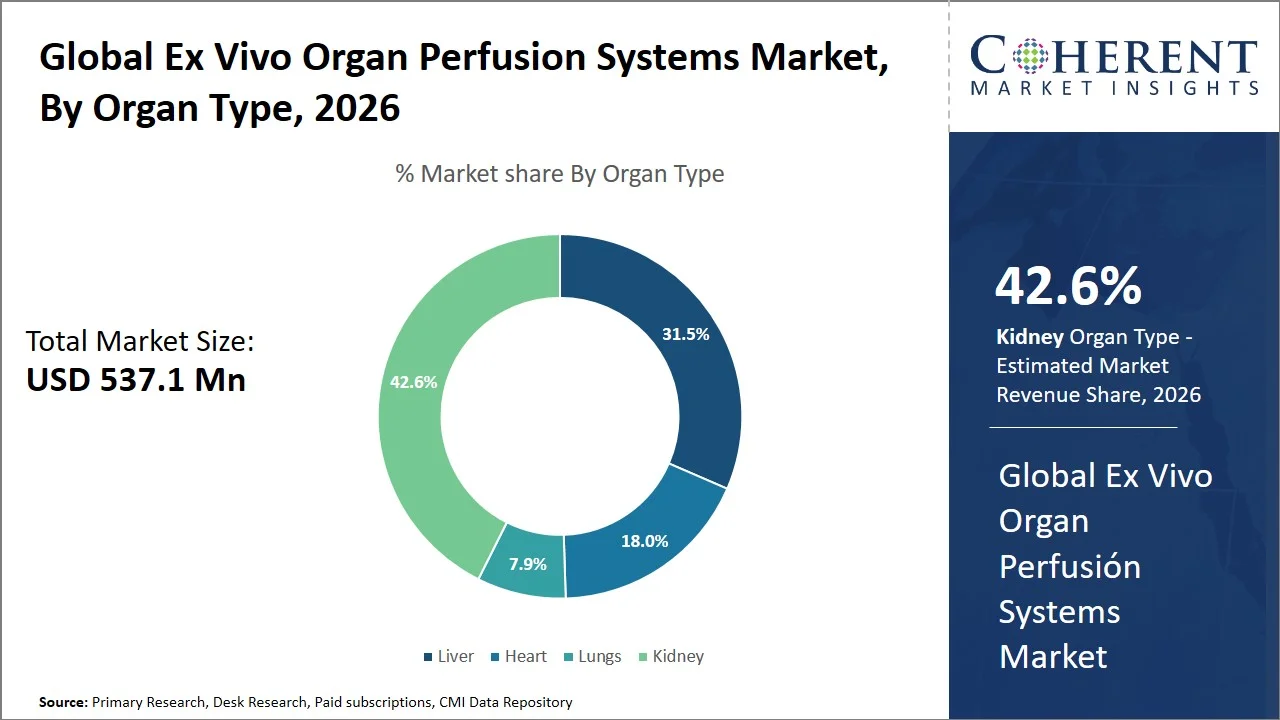
Kidney is projected to hold a market share of 42.6% in 2026, owing to the high prevalence of chronic kidney diseases (CKD) and a vast number of kidney transplantations occurring globally. Ex vivo kidney perfusion systems ensure better maintenance of the preserved organ, decrease the effect of ischemia-reperfusion injury, and allow the use of marginal and Donation after Circulatory Death (DCD) donor kidneys, thereby maximizing graft survival and better outcomes in patients receiving kidney transplants. For instance, in July 2024, a systematic review published by The Cochrane Collaboration, reviewed 21 clinical studies (4007 participants) and stated that hypothermic machine perfusion significantly decreased delayed graft function and improved the survival of transplanted kidneys in comparison to static cold storage, thus promoting clinical adoption in deceased donor kidney transplantation.
Hospitals and Clinics Segment Dominates the Global Ex Vivo Organ Perfusion Systems Market
The hospitals and clinics segment is projected to hold a market share of 55.7% in 2026, owing to the high rate of transplantation occurring in these facilities and availability of state-of-the-art facilities to handle the transplants including skilled multi-disciplinary transplant team, specialized transplant equipment, and preservation equipment. The integration of ex vivo organ perfusion technology helps in maintaining viability of the organ in real-time, and provides time for preservation, utilization of donor organs in a better way. For instance, in March 2024, Duke University Health System had clinically implemented ex vivo normothermic machine perfusion (NMP) in liver transplantation as result of a large multi-site clinical trial which evaluated the procedure for nearly 400 liver transplant procedures across 15 transplant centers in the U.S., signaling an increased adoption of sophisticated perfusion devices by top-tiered in-hospital transplant programs.
Currents Events and their Impact
Current Events | Description and its Impact |
EU4Health Launches USD 2.28 million (€2 Million) Tender to Strengthen National Organ Transplant Practices (November 2025) |
|
Organ Procurement and Transplantation Network (OPTN) Proposes Comprehensive Multi-Organ Allocation Policy to Standardize Organ Distribution (United States, September 2025) |
|
Ex Vivo Organ Perfusion Systems Market Dynamics
Market Drivers
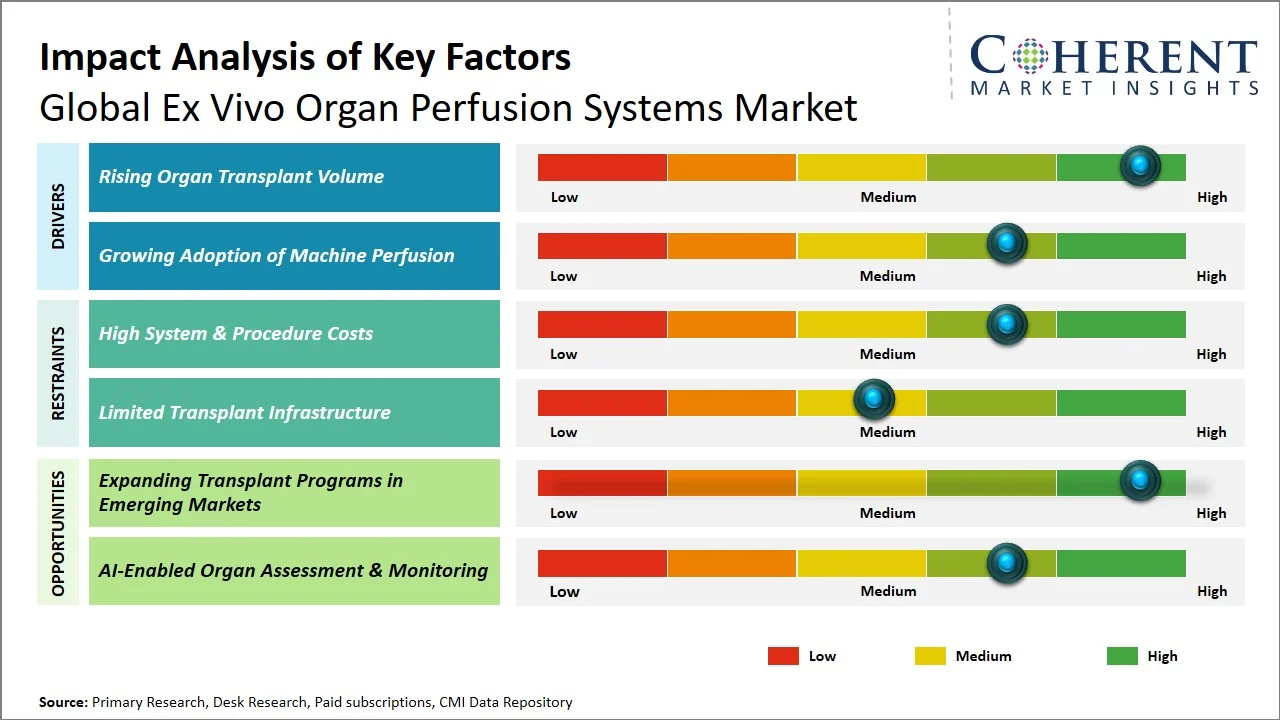
- Rising Organ Transplant Volume: The rising volume of organ transplant procedures globally continues to drive demand for ex vivo organ perfusion systems by improving organ preservation, extending preservation time, and enabling real-time viability assessment. Rising incidences of end-stage organ failure and expanding transplant programs are further accelerating adoption across major transplant centers. For instance, according to the 2025 Annual Report of the National Organ and Tissue Transplant Organization (NOTTO), India performed over 18,900 organ transplants in 2024, making it the third-highest country globally in total organ transplants and the leading country in living donor organ transplantation. This sustained growth in transplant activity is expected to strengthen the demand for advanced organ preservation technologies, including ex vivo organ perfusion systems.
- Growing Adoption of Machine Perfusion: The widespread adoption of machine perfusion is emerging as a key driver of the global ex vivo organ perfusion systems market, owing to its ability to extend organ preservation time, reduce ischemia-reperfusion injury, and enable real-time assessment of donor organ viability. Compared with conventional static cold storage, machine perfusion improves graft quality and increases the utilization of marginal and donation after circulatory death (DCD) donor organs. For instance, in January 2025, the International Society for Heart and Lung Transplantation (ISHLT) updated its clinical practice guidance to recognize ex vivo heart perfusion as an effective preservation strategy for selected donor hearts, reflecting the growing clinical acceptance of machine perfusion technologies in transplantation.
- Growing Utilization of Marginal & DCD (Donation after Brain Death) Donor Organs: The growing utilization of marginal and Donation after Circulatory Death (DCD) donor organs is a major driver of the global ex vivo organ perfusion systems market, as these organs often require advanced preservation and viability assessment before transplantation. Ex vivo organ perfusion systems help reduce ischemic injury, enable functional evaluation, and improve the utilization of organs that would otherwise be discarded. For instance, in January 2025, the UK National Health Service Blood and Transplant (NHSBT) reported that Donation after Circulatory Death (DCD) donors accounted for over 40% of deceased organ donors in the U.K., reflecting the increasing reliance on DCD transplantation and the growing need for advanced organ perfusion technologies to optimize graft outcomes.
- Favorable Government Support for Organ Donation & Transplantation: Favorable government policies promoting organ donation and strengthening transplantation infrastructure are driving the adoption of ex vivo organ perfusion systems by increasing donor availability and transplant activity. Reforms such as deemed consent legislation, improved organ allocation frameworks, and investments in national transplant programs are creating a supportive environment for advanced organ preservation technologies. For instance, in June 2025, Ireland implemented the organ donation provisions of the Human Tissue Act 2024, introducing a soft opt-out (deemed consent) system for deceased organ donation to expand the donor pool and enhance the country's transplantation framework.
- Increasing Investments in Transplant Research & Innovation: Increasing investments in transplant research and innovation are accelerating the development of next-generation organ preservation technologies, including ex vivo organ perfusion systems. Funding from government agencies and research institutions is supporting advancements in organ preservation, immune tolerance, and transplant outcomes. For instance, in January 2025, the U.S. National Institutes of Health (NIH) awarded a multi-million-dollar grant to the Terasaki Institute for Biomedical Innovation to develop advanced platforms for organ transplantation research, aimed at improving transplant success and accelerating innovation in organ preservation technologies.
Market Restraints
- High System & Procedure Costs: The high capital investment and operational costs associated with ex vivo organ perfusion systems remain a significant restraint to market growth, particularly in low- and middle-income countries. In addition to the cost of perfusion devices, expenses related to consumables, preservation solutions, and specialized clinical personnel increase the overall cost of transplantation, limiting adoption beyond high-volume transplant centers. For instance, in January 2025, a study published by Journal of Hepatology reported that while normothermic machine perfusion improves clinical outcomes, its widespread implementation is constrained by the substantial costs of equipment, disposable perfusion circuits, and specialized infrastructure, highlighting the need for robust cost-effectiveness evidence before broader adoption.
- Limited Transplant Infrastructure: Inadequate transplant infrastructure is a factor limiting the global ex vivo organ perfusion systems market, especially in low- and middle-income countries, which lack appropriate infrastructure, such as specialized transplant facilities, well-trained manpower for transplantation, and organ procurement organizations. The implementation of ex vivo organ perfusion systems require advanced infrastructure and coordinated transplant logistics, limiting adoption primarily to established transplant centers. For instance, the World Health Organization (WHO) highlighted that many low- and middle-income countries continue to face substantial gaps in transplantation infrastructure, including limited transplant centers, inadequate organ donation systems, and shortages of trained healthcare professionals, restricting equitable access to organ transplantation services.
- Stringent Regulatory Approval Requirements: As manufacturers must generate robust clinical evidence to demonstrate the safety, efficacy, and performance of organ perfusion systems before commercialization. These extensive regulatory requirements increase development costs and prolong product approval timelines. For instance, in January 2025, the U.S. Food and Drug Administration (FDA) finalized its guidance on predetermined change control plans (PCCPs) for AI-enabled medical devices, reinforcing stricter expectations for device validation and lifecycle management, reflecting the increasingly rigorous regulatory landscape for innovative medical technologies.
- Limited Organ Donation Rates in Developing Countries: Limited organ donation rates in developing countries continue to restrain the growth of the global Ex vivo organ perfusion systems market by reducing the availability of donor organs for transplantation. Low public awareness, inadequate organ donation infrastructure, and cultural and legal barriers restrict transplant activity, thereby limiting the demand for advanced organ preservation technologies. For instance, the World Health Organization (WHO) reaffirmed that fewer than 10% of the global demand for organ transplantation is currently met, with the shortage being most pronounced in low- and middle-income countries due to limited organ donation systems and transplant infrastructure.
Top 5 Emerging Trends in Global Ex Vivo Organ Perfusion Systems Market
- Rising Adoption of Normothermic Machine Perfusion (NMP): Normothermic machine perfusion is gaining widespread adoption due to its ability to maintain donor organs under near-physiological conditions, enabling real-time viability assessment and reducing ischemic injury. The technology is increasingly replacing conventional static cold storage in heart, liver, and lung transplantation.
- Growing Utilization of Marginal and DCD Donor Organs: Transplant centers are increasingly utilizing Donation after Circulatory Death (DCD) and extended-criteria donor organs to address organ shortages. Ex vivo perfusion technologies are facilitating the assessment and rehabilitation of these organs, significantly expanding the donor pool.
- Expansion of Portable Organ Perfusion Systems: Manufacturers are focusing on portable ex vivo perfusion platforms that enable continuous organ preservation during transportation. These systems improve transplant logistics, extend organ transport distances, and support broader geographic sharing of donor organs.
- Increasing Clinical Research on Organ Repair and Regeneration: Research is expanding beyond organ preservation toward ex vivo organ repair, regenerative therapies, and targeted therapeutic delivery during perfusion. These advancements are expected to improve graft quality and increase the utilization of previously unsuitable donor organs.
- Expansion of Organ Perfusion Beyond Kidney and Liver Transplantation: The adoption of ex vivo perfusion technologies is expanding from liver and kidney transplantation to heart, lung, and multi-organ preservation. Ongoing clinical evidence and regulatory approvals are broadening the application of perfusion systems across multiple organ types, creating new growth opportunities for market participants.
Regional Insights
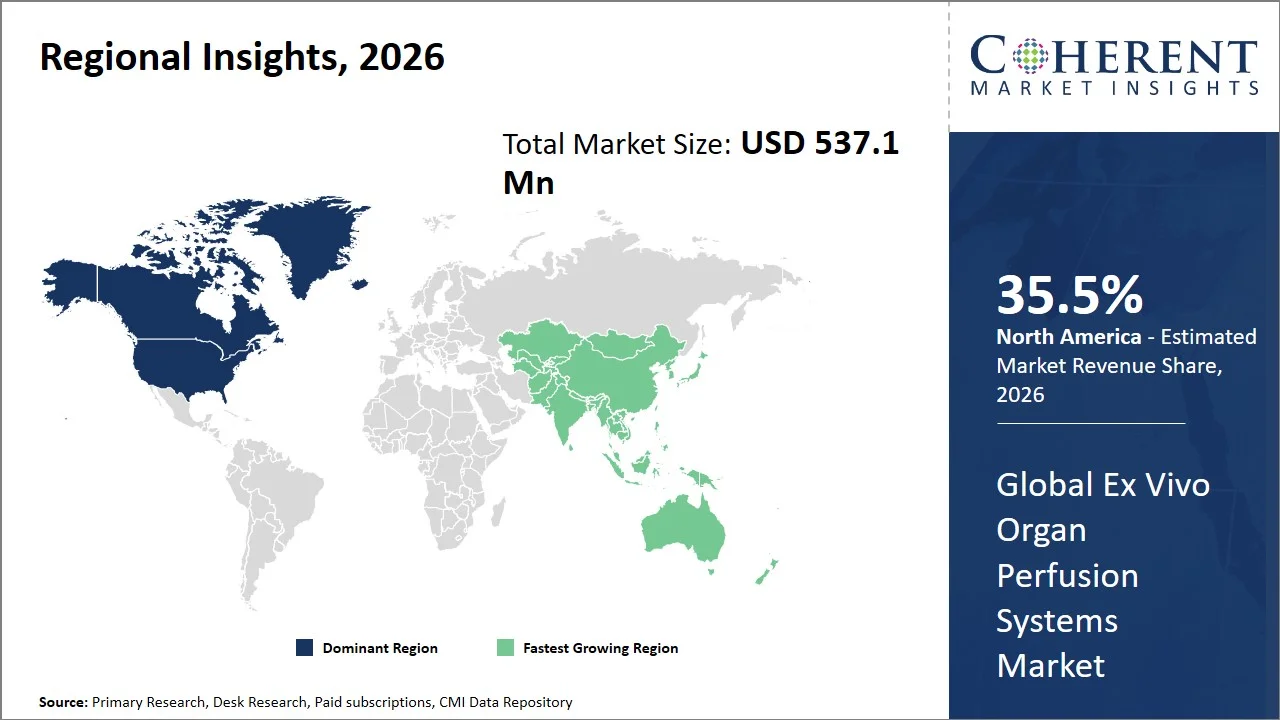
Why is North America a Strong Market for Ex Vivo Organ Perfusion Systems?
North America leads the global ex vivo organ perfusion systems market, accounting for an estimated 35.5% share in 2026, attributed to the advanced transplant infrastructure, strong adoption of machine perfusion systems and extensive network of specialized transplant centers. Additionally, the region has a strong governmental framework with specific regulatory procedures, organ donation initiatives at the national level and investment in transplantation research that promotes development in the organ preservation market. For instance, the U.S. Department of Health and Human Services (HHS) introduced the Organ Donation Breakthrough Collaborative to spur the growth of organ donation and transplant by enhancing partnerships between Organ Procurement Organizations (OPOs) and transplant hospitals to bolster the ecosystem.
Why Does the Asia Pacific Ex Vivo Organ Perfusion Systems Market Exhibit High Growth?
The Asia Pacific ex vivo organ perfusion systems market is expected to exhibit the fastest growth with an estimated contribution of 21.1% share to the global market in 2026, attributed to increased focus of expanding organ transplantation infrastructure, rising investment in the healthcare industry, and expanding awareness of organ donation procedures across the Asia Pacific nations. Additionally, increased government initiatives aimed at supporting the organ donation system and organ transplantation programs, modernize transplantation policies, and promote medical devices would fuel the adoption of ex vivo organ perfusion systems within the region.
For instance, in March 2023, the government of India through the Ministry of Health & Family Welfare (MoHFW) and National Organ and Tissue Transplant Organisation (NOTTO) revised guidelines on organ transplantation, removing the age limit of 65 years for registration of recipients to receive deceased donor organs, and removal of domicile status for registration as recipients. These changes are being made to enhance equity in access to organ transplantation and build up the national organ donation framework.
Global Ex Vivo Organ Perfusion Systems Market Outlook for Key Countries
Why is the U.S. Leading Innovation and Adoption in the Ex Vivo Organ Perfusion Systems Market?
The U.S. is expected to account for an estimated 31.8% share of the global ex vivo organ perfusion systems market in 2026, due to the broad clinical applications of normothermic perfusion during heart, liver, lung, and kidney transplantation, and a rise in donation after circulatory death (DCD) donor organs. The large organ procurement network in the U.S, combined with a high number of transplant procedures and early uptake of portable multi-organ perfusion systems are fueling the demand for innovative technologies for ex vivo preservation of organs.
Is the U.K. a Favorable Market for Ex Vivo Organ Perfusion Systems Market?
The U.K. is expected to account for an estimated 8.6% of the global ex vivo organ perfusion systems market in 2026, due its extensive use of donation after circulatory death (DCD) donor organs, where innovative solutions for their perfusion, assessment of viability and reconditioning technologies are critical for enabling transplantation. The U.K. has also established itself as a pioneer for the implementation of machine normothermic liver, heart and lung transplant procedures and, with NHS Blood and Transplant (NHSBT)-supported clinical programs and national protocols, this will remain a solid and enduring market.
Is Spain Emerging as a Key Growth Hub for the Ex Vivo Organ Perfusion Systems Market?
Spain is expected to account for an estimated 6.5% of the global ex vivo organ perfusion systems market in 2026, attributed to its well-recognized deceased donor transplantation framework that has long embraced the use of extended-criteria and donation after circulatory death (DCD) donor organs. Driven by initiatives aimed at leveraging all viable donor organs, Spain’s increased adoption of advanced organ evaluation machine perfusion devices for the preservation of organs has resulted in the continuous rise in the demand for ex vivo organ perfusion systems in liver, kidney and lung transplants.
Why Does Germany Top the European Ex Vivo Organ Perfusion Systems Market?
Germany is expected to account for an estimated 7.4% of the global ex vivo organ perfusion systems market in 2026, attributed to the vast network of transplant hospitals (such as University Hospital Heidelberg, Charité – Universitätsmedizin Berlin, University Hospital Essen, and Hannover Medical School), considerable volume of transplantation procedures (3,700 organs transplanted in 2024), and the substantial use of advanced organ preservation technologies in liver, kidney, heart, and lung transplantation. Increasing trend towards increasing use of marginal donor organs and increased adoption of machine perfusion into routine transplant workflows also support the growth of ex vivo organ perfusion systems market.
Is Ex Vivo Organ Perfusion Systems Market Developing in Japan?
Japan is expected to account for an estimated 5.3% of the global ex vivo organ perfusion systems market in 2026, driven by progressive implementation of deceased organ transplantation and increase in adoption of superior technologies at major transplant centers across Japan (such as The University of Tokyo Hospital, Kyoto University Hospital, Osaka University Hospital, and Kyushu University Hospital). Further, the nation’s focus on optimizing usage of marginal donor organs and the increased use of machine perfusion in liver and kidney transplantations have paved for introduction of machine perfusion systems.
Evolution of Organ Preservation Technologies in the Global Ex Vivo Organ Perfusion Systems Market
Technology | Current Clinical Use | Impact on Market |
Static Cold Storage (SCS) | Conventional preservation method for donor organs using cold preservation solutions | Remains the baseline standard but faces limitations in organ assessment and preservation duration |
Hypothermic Machine Perfusion (HMP) | Primarily used for kidney and liver preservation under low-temperature, oxygenated conditions | Improves graft preservation, reduces ischemic injury, and increases utilization of marginal donor organs |
Normothermic Machine Perfusion (NMP) | Maintains organs at physiological temperature, enabling continuous perfusion and functional assessment | Fastest-growing technology due to extended preservation time, real-time viability assessment, and improved transplant outcomes |
Oxygenated Machine Perfusion (OMP) | Supplies oxygen during hypothermic or normothermic preservation to minimize cellular injury | Enhances organ quality, supports use of extended-criteria and DCD donor organs, and improves post-transplant graft function |
How are the expanding transplant programs in emerging markets creating new growth opportunities in the ex vivo organ perfusion systems market?
The heightened focus on organ transplantations in emerging economies will aid global ex vivo organ perfusion systems market growth. Emerging economies such as India, China, Brazil, and Southeast Asian countries are experiencing increased healthcare spending and significant advancements in transplant infrastructure, driving the rapid expansion of organ transplantation programs. Supportive government schemes for organ donation and enhanced organ transplant network are encouraging the usage of better and advance technologies for preserving organs. For instance, the Government of India started the National Organ Transplant Programme (NOTP) in 2019 as a Central Sector Scheme to boost organ donation and transplantation activities through enhanced support for infrastructure of transplant, strengthening of State Organ and Tissue Transplant Organizations (SOTTOs), training for transplant coordinators and infrastructure for organ retrieval.
Market Players, Key Development, and Competitive Intelligence
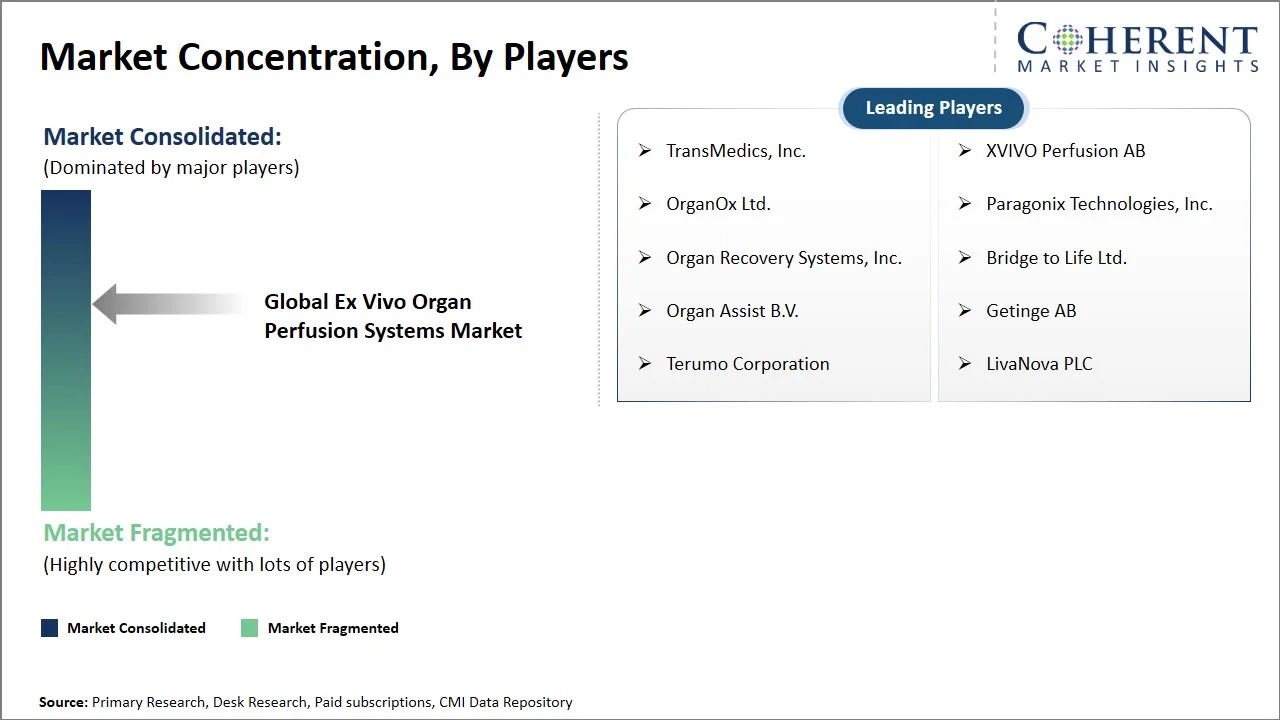
Key Developments
- Regulatory Approval/Certification
- In June 2026, United Therapeutics Corporation received U.S. FDA approval for its LungFX Device, designed for centralized ex vivo lung perfusion. The device enables assessment, preservation, and rehabilitation of donor lungs before transplantation, helping expand the pool of transplantable organs. The approval strengthens innovation and commercialization within the ex vivo organ perfusion systems market.
- Partnership
- In November 2025, Paragonix Technologies partnered with Gravitas Surgical to improve donor lung viability and expand organ availability across the U.S. West Coast. The collaboration focuses on enhancing access to advanced organ preservation and transportation technologies, helping transplant centers optimize donor lung utilization and improve transplant outcomes.
- Merger & Acquisition (M&A)
- In August 2025, Terumo Corporation announced the acquisition of OrganOx Limited for approximately USD 1.5 billion. The acquisition expands Terumo's presence in the organ transplantation market by adding OrganOx's normothermic organ perfusion technologies to its portfolio. The strategic move is expected to accelerate innovation and global adoption of advanced organ preservation systems.
- In August 2023, TransMedics Group, Inc. acquired the EVOSS warm perfusion and LifeCradle cold perfusion technologies from Bridge to Life Ltd. The acquisition expands TransMedics' organ preservation and transport capabilities while strengthening its portfolio of ex vivo organ perfusion solutions. The deal reinforces the company's position in the evolving organ transplantation market.
Competitive Landscape
Company | Headquarters | Key Brands | Primary Market Segment |
TransMedics, Inc. | Massachusetts, U.S. | Organ Care System (OCS) Heart, OCS Lung, OCS Liver | Normothermic Multi-Organ Perfusion Systems |
XVIVO Perfusion AB | Gothenburg, Sweden | XVIVO Heart Assist Transport, XPS, STEEN Solution, Kidney Assist Transport | Lung, Heart & Kidney Perfusion Systems |
OrganOx Ltd. | Oxford, U.K. | metra | Normothermic Liver Perfusion Systems |
Paragonix Technologies, Inc. | Massachusetts, U.S. | SherpaPak, LUNGguard, BAROguard, KidneyVault | Advanced Organ Preservation & Transport Systems |
Organ Recovery Systems, Inc. | Illinois, U.S. | LifePort Kidney Transporter, LifePort Liver Transporter | Hypothermic Kidney & Liver Perfusion Systems |
Bridge to Life Ltd. | London, U.K. | Belzer UW, Belzer MPS, VitaSmart | Organ Preservation Solutions & Kidney Perfusion Systems |
Organ Assist B.V. | Groningen, The Netherlands | Kidney Assist, Liver Assist, Lung Assist, Heart Assist | Ex Vivo Multi-Organ Perfusion Systems |
Getinge AB | Gothenburg, Sweden | Cardiohelp, Rotaflow II, HL 40 | Extracorporeal Life Support (ECLS) & Organ Perfusion Technologies |
Terumo Corporation | Tokyo, Japan | Capiox, Terumo Advanced Perfusion System | Cardiopulmonary Bypass & Organ Perfusion Systems |
LivaNova PLC | London, U.K. | Essenz Perfusion System, S5 Heart-Lung Machine | Cardiac Perfusion & Cardiopulmonary Support Systems |
Market Report Scope
Ex Vivo Organ Perfusion Systems Market Report Coverage
| Report Coverage | Details | ||
|---|---|---|---|
| Base Year: | 2025 | Market Size in 2026: | USD 537.1 Mn |
| Historical Data for: | 2020 To 2024 | Forecast Period: | 2026 To 2033 |
| Forecast Period 2026 to 2033 CAGR: | 6.8% | 2033 Value Projection: | USD 850.9 Mn |
| Geographies covered: |
| ||
| Segments covered: |
| ||
| Companies covered: | TransMedics, Inc., XVIVO Perfusion AB, OrganOx Ltd., Paragonix Technologies, Inc., Organ Recovery Systems, Inc., Bridge to Life Ltd., Organ Assist B.V., Getinge AB, Terumo Corporation, LivaNova PLC | ||
| Growth Drivers: |
| ||
| Restraints & Challenges: |
| ||
Analyst Opinion (Expert Opinion)
- In the coming years, the ex vivo organ perfusion systems market is anticipated to transition from a niche preservation technology to a standard of care in organ transplantation. Growing adoption of normothermic machine perfusion, increasing utilization of Donation after Circulatory Death (DCD) and extended-criteria donor organs, and advancements in organ assessment and repair technologies are expected to improve transplant outcomes while expanding the donor organ pool. Integration of AI-driven monitoring and regenerative therapies during perfusion is likely to further accelerate market growth.
- The maximum opportunities are foreseen within Normothermic Organ Perfusion Systems for Kidney Transplantation in the United States. The U.S. performs one of the highest volumes of kidney transplant procedures globally while continuing to face a significant shortage of donor kidneys. Increasing adoption of donation after circulatory death (DCD) and extended-criteria donor kidneys, combined with strong clinical evidence supporting normothermic perfusion for improving organ viability and post-transplant outcomes, is expected to drive demand.
- In order to gain a competitive advantage market players should prioritize the development of portable, multi-organ perfusion platforms that reduce operational complexity and improve transport flexibility. Generating robust clinical evidence demonstrating superior graft survival and cost-effectiveness, expanding partnerships with transplant centers and organ procurement organizations, and securing favorable reimbursement and regulatory approvals will be critical to strengthening market position. Investments in AI-enabled organ monitoring and ex vivo therapeutic interventions can further differentiate product offerings.
Speak to the analyst
Want personalized insights?
Take the findings above to one of our principal consultants, or have the report rebuilt around the segments, geographies and competitors you actually track.
Market Segmentation
- System Type Insights (Revenue, USD Mn, 2021 - 2033)
- Normothermia
- Hypothermia
- Combine (Normothermia + Hypothermia)
- Organ Type Insights (Revenue, USD Mn, 2021 - 2033)
- Liver
- Heart
- Lungs
- Kidney
- End User Insights (Revenue, USD Mn, 2021 - 2033)
- Hospitals and Clinics
- Specialty Centers
- Others
- Regional Insights (Revenue, USD Mn, 2021 - 2033)
- North America
- U.S.
- Canada
- Latin America
- Brazil
- Argentina
- Mexico
- Rest of Latin America
- Europe
- Germany
- U.K.
- Spain
- France
- Italy
- Russia
- Rest of Europe
- Asia Pacific
- China
- India
- Japan
- Australia
- South Korea
- ASEAN
- Rest of Asia Pacific
- Middle East
- GCC Countries
- Israel
- Rest of Middle East
- Africa
- South Africa
- North Africa
- Central Africa
- North America
- Key Players Insights
- TransMedics, Inc.
- XVIVO Perfusion AB
- OrganOx Ltd.
- Paragonix Technologies, Inc.
- Organ Recovery Systems, Inc.
- Bridge to Life Ltd.
- Organ Assist B.V.
- Getinge AB
- Terumo Corporation
- LivaNova PLC
Sources
Primary Research Interviews
- Product managers and business development executives from ex vivo organ perfusion system manufacturers
- Transplant surgeons specializing in kidney, liver, heart, and lung transplantation
- Organ procurement organization (OPO) executives and transplant coordinators
- Biomedical engineers specializing in organ preservation technologies
- Clinical perfusionists and transplant anesthesiologists
- Medical device regulatory and quality assurance professionals
Stakeholders
- Ex vivo organ perfusion system manufacturers
- Organ preservation solution providers
- Organ procurement organizations (OPOs)
- Hospitals and transplant centers
- Contract manufacturing organizations (CMOs) for medical devices
- Healthcare distributors and procurement organizations
- End-use Sectors
- Hospitals and healthcare providers
- Multi-organ transplant centers
- Academic and research institutes
- Organ procurement organizations (OPOs)
- Regulatory & Health Bodies
- U.S. Food and Drug Administration (FDA)
- European Commission
- European Medicines Agency (EMA)
- Medicines and Healthcare products Regulatory Agency (MHRA), U.K.
- Health Resources and Services Administration (HRSA), U.S.
- Organ Procurement and Transplantation Network (OPTN)
- National Health Service Blood and Transplant (NHSBT), U.K.
- Pharmaceuticals and Medical Devices Agency (PMDA), Japan
- National Medical Products Administration (NMPA), China
- Therapeutic Goods Administration (TGA), Australia
- Health Canada
Databases
- FDA Medical Device Databases
- FDA MAUDE (Manufacturer and User Facility Device Experience)
- Organ Procurement and Transplantation Network (OPTN) Database
- United Network for Organ Sharing (UNOS) Data
- Global Observatory on Donation and Transplantation (GODT)
- ClinicalTrials.gov
- European Commission EUDAMED
- WHO Global Health Observatory
Magazines
- MedTech Dive
- Medical Design & Outsourcing
- MedTech Intelligence
- Medical Product Outsourcing (MPO)
Journals
- American Journal of Transplantation
- Journal of Heart and Lung Transplantation
- Nature Reviews Nephrology
- Nature Biomedical Engineering
Newspapers
- Financial Times – Healthcare & Life Sciences
- The Wall Street Journal – Healthcare
Associations
- The Transplantation Society (TTS)
- American Society of Transplant Surgeons (ASTS)
- American Society of Transplantation (AST)
- European Society for Organ Transplantation (ESOT)
- International Society for Heart and Lung Transplantation (ISHLT)
- Advanced Medical Technology Association (AdvaMed)
- MedTech Europe
Public Domain Sources
- World Health Organization (WHO)
- U.S. Food and Drug Administration (FDA)
- Health Resources and Services Administration (HRSA)
- Organ Procurement and Transplantation Network (OPTN)
- United Network for Organ Sharing (UNOS)
- Global Observatory on Donation and Transplantation (WHO-ONT)
- European Commission
- European Medicines Agency (EMA)
- National Health Service Blood and Transplant (NHSBT)
- Health Canada
- Pharmaceuticals and Medical Devices Agency (PMDA), Japan
- National Medical Products Administration (NMPA), China
Proprietary Elements
- CMI Data Analytics Tool, Proprietary CMI Existing Repository of information for last 10 years.
Get access to 250+ pages report
Every segment, forecast, competitor profile and data table behind the analysis above — available for instant download.
- ESOMAR Member
- ISO 9001:2015 Certified
- D-U-N-S Registered
- GDPR & CCPA Compliant
Missing comfort of reading report in your local language? Find your preferred language:
Transform your Strategy with Exclusive Trending Reports
Frequently Asked Questions
The global ex vivo organ perfusion systems market is estimated to be valued at USD 537.1 Mn in 2026 and is expected to reach USD 850.9 Mn by 2033.
Normothermia dominates due to its ability to preserve donor organs under near-physiological conditions, enabling continuous oxygen and nutrient supply, real-time functional assessment, and therapeutic intervention prior to transplantation.
The CAGR of the global ex vivo organ perfusion systems market is projected to be 6.8% from 2026 to 2033.
TransMedics, Inc., XVIVO Perfusion AB, OrganOx Ltd., Paragonix Technologies, Inc., and Bridge to Life Ltd. are the top five players in the global ex vivo organ perfusion systems market
Normothermic machine perfusion enables continuous organ assessment, reduces ischemic injury, and extends preservation time.
It improves organ viability by maintaining oxygen delivery and reducing preservation-related tissue damage.
They enable the evaluation and utilization of marginal and Donation after Circulatory Death (DCD) donor organs.