

Organ Transplant Market Size and Forecast – 2026 to 2033
The Organ Transplant Market is anticipated to grow at a CAGR of 7.8% with USD 9.1 Bn share in 2026 and is expected to reach USD 17.7 Bn in 2033. The Organ Transplant Market include increasing organ failure and chronic disease rates, greater awareness of organ donation, advances in transplant surgery and immunosuppressive therapies, and innovations in tissue matching and post-transplant care. Approximately 750,000 patients in the United States and 2 million worldwide are affected by kidney failure each year.
Key Takeaways
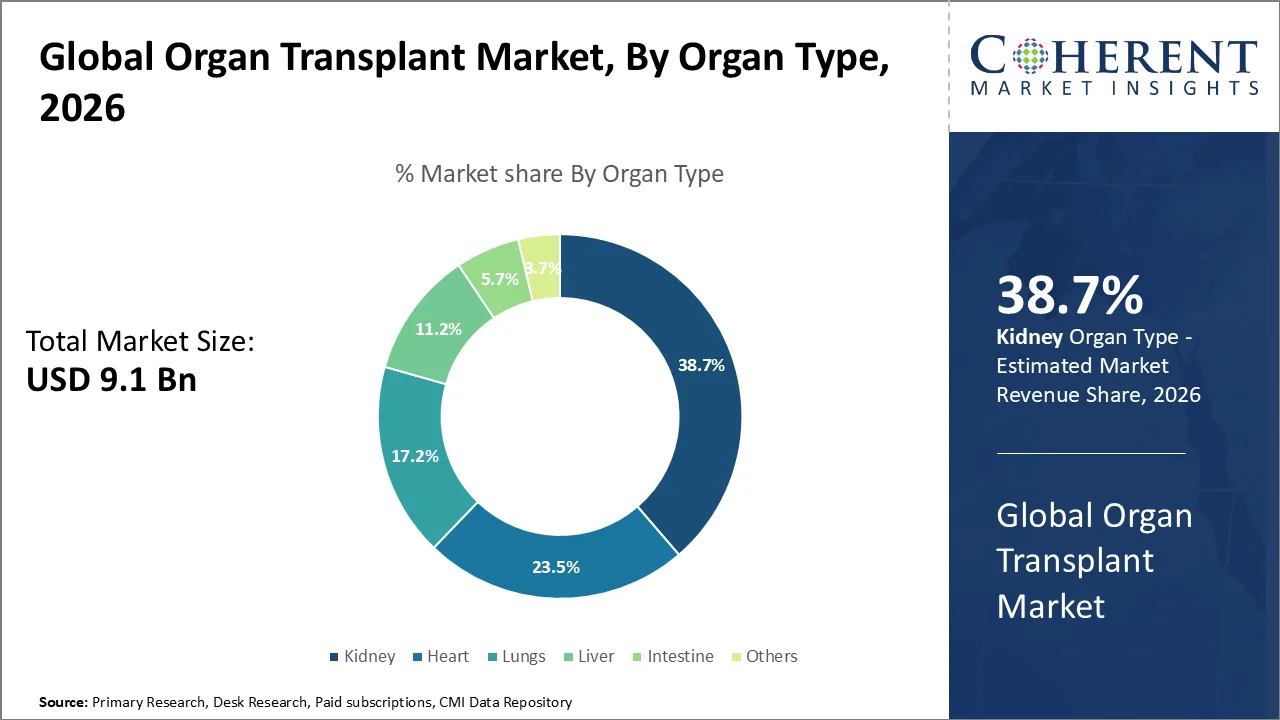
- Kidney holds the largest market share of 38.7% in 2026 owing to the rising prevalence of CKD and ESRD. By 2030, the number of chronic kidney disease (CKD) cases is projected to reach approximately 25.1 million, according to the National Library of Medicine.
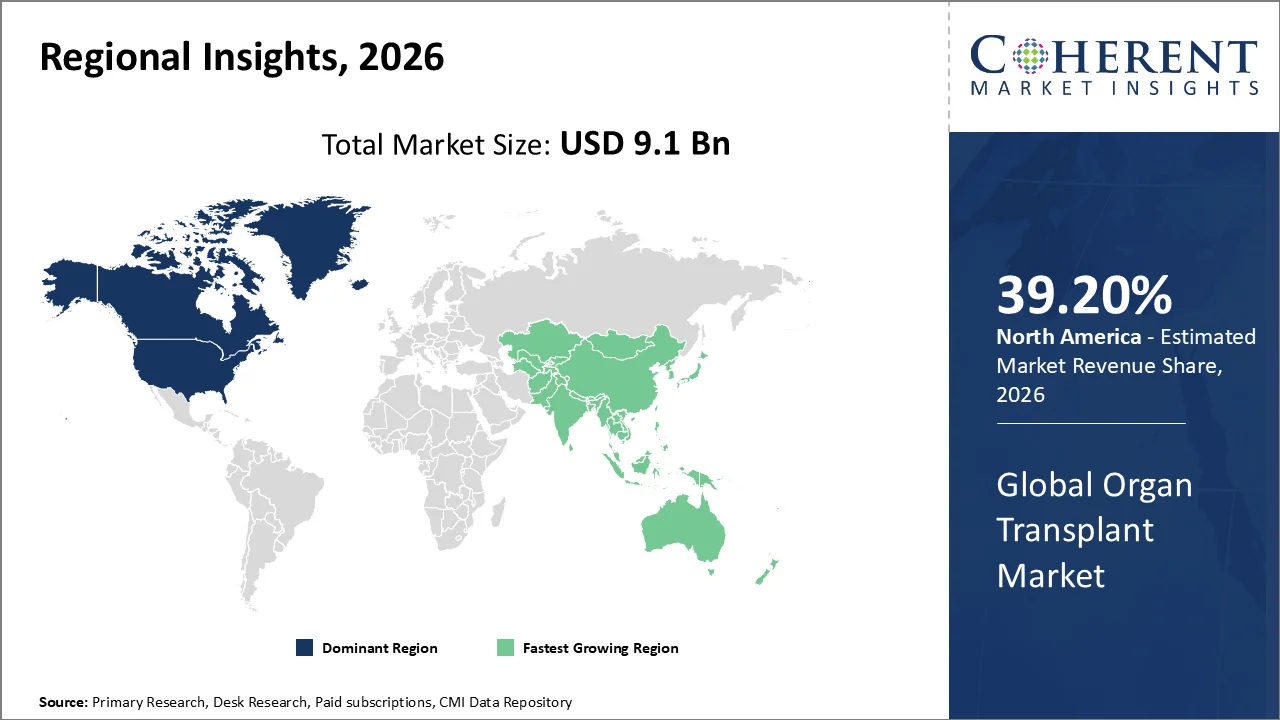
- North America is expected to acquire the dominant share of 39.2% in 2026 owing to its high prevalence of chronic and end-stage diseases. Approximately 129 million people in the United States have at least one major chronic disease.
Current Events and Their Impact on the Organ Transplant Market
Current Event | Description and its Impact |
CMS Proposed Strengthening of Organ Procurement Organization (OPO) Oversight — January 2026 |
|
CMS Increasing Organ Transplant Access (IOTA) Model — 2026 |
|
Segmental Insights
- Current Industry Events of 2026
- Market Size Estimation
- Regional Breakdown
- Competitive Landscape
- Customer Intelligence
- Segmental Analysis
- Pricing Analysis
- Key Market Drivers, Challenges & Future Trends
- Customized Insights Section
Why is Kidney Acquiring the Largest Market Share?
Kidney holds the largest market share of 38.7% in 2026. The kidney segment of the organ transplant market is growing as the rising prevalence of chronic kidney disease, end-stage renal disease, diabetes, and hypertension increases the demand for kidney transplantation. Growing transplant waiting lists and limited donor availability further drive market demand. Healthcare providers are adopting advanced organ preservation and machine perfusion technologies, minimally invasive surgical techniques, improved immunosuppressive therapies, and enhanced donor-recipient matching to improve transplant outcomes. In addition, expanding living-donor programs, increasing awareness of organ donation, and strengthening transplant infrastructure continue to support market growth. For instance, in August 2026, Medcare Hospitals & Medical Centres launched its Organ Transplant Centre after successfully performing its first kidney transplant at Medcare Hospital Sharjah, marking a major expansion of its transplant services for patients in the UAE and beyond.
Organ Transplant Market Trends
- Rising adoption of advanced organ-preservation technologies, including hypothermic and normothermic machine perfusion, is expanding the ability of transplant centers to preserve and assess donor organs before transplantation. This is particularly relevant as conventional preservation windows remain limited: kidneys are generally transplanted within 36 hours, while livers, pancreases, and intestines are typically transplanted within 12 hours, and hearts and lungs usually within 6 hours. These constraints support continued development and adoption of technologies designed to maintain organs outside the body.
- Growing transplant volumes and persistent organ shortages continue to shape the market. In the United States, more than 49,000 organ transplants were performed in 2025, including over 27,000 kidney transplants, while more than 90,000 people remained on the kidney waiting list.
- Growing use of living-donor transplantation and kidney-paired exchange programs is expanding transplantation opportunities, particularly for kidney patients with willing but incompatible donors. In the U.S., 6,419 living-donor kidney transplants were performed in 2024, and 23.4% of living-donor kidney transplants involved donor exchanges. The OPTN operates a national kidney-paired donation system that allows incompatible donor-recipient pairs to exchange donors.
Regional Insights
North America dominates owing to improving transplant outcomes and immunosuppressive therapies
North America is expected to acquire the dominant share of 39.20% in 2026. North America’s organ transplant market is expanding as chronic diseases and organ failure increase the need for transplantation. Growing waiting lists, higher organ donation and transplant volumes, and expanding living- and deceased-donor programs continue to drive demand. Healthcare providers are adopting advanced organ preservation, machine perfusion, donor-recipient matching, and surgical techniques to improve organ utilization and patient outcomes. In addition, well-developed healthcare infrastructure, specialized transplant centers, government initiatives, and modernization of the U.S. transplant system are improving access and supporting regional market growth. For instance, in July 2026, OneLegacy launched the Western U.S.’s first in-house EVLP program at an organ procurement organization through a partnership with XVIVO and Perfusion Solution.
Asia Pacific Organ Transplant Market Trends
Rising chronic disease rates, growing cases of organ failure, and an aging population drive the Asia Pacific organ transplant market. Healthcare providers and governments are increasing healthcare spending and investing in transplant infrastructure, which expands access to specialized procedures. Governments also promote organ donation through national transplant registries and public awareness campaigns, strengthening regional donation systems. Furthermore, advances in surgical techniques, organ preservation technologies, immunosuppressive therapies, and transplant diagnostics improve patient outcomes and encourage the expansion of transplantation services across Asia Pacific. For instance, India recorded a record 20,138 organ transplants in 2025, while the government launched new initiatives to strengthen organ donation, improve transparency, and expand transplant access.
United States Organ Transplant Market Trends
The United States organ transplant market is driven by the increasing prevalence of chronic diseases and organ failure, a growing aging population, and a substantial number of patients awaiting transplants. Healthcare providers are performing more transplant procedures, particularly kidney transplants, which strengthens market demand. Technological advances in organ preservation, donor-recipient matching, surgical techniques, and artificial-organ research are improving outcomes. Favorable reimbursement policies, advanced healthcare infrastructure, specialized transplant centers, and ongoing innovations in immunosuppressive therapies further support the market’s growth. For instance, in May 2026, Donor Alliance and LifeSource partnered to strengthen organ donation and transplantation by creating Vital Impact Health Group, a new system organization.
Japan Organ Transplant Market Trends
Japan’s organ transplant market is driven by an aging population, rising chronic disease burden, and advances in transplant surgery and immunosuppressive therapies. Greater public awareness of organ donation, improved donor registration, and government efforts to strengthen transplant infrastructure further support market growth. Japan’s regulatory framework and advanced healthcare facilities also enable transplantation. For instance, in 2025, Japan recorded a record 134 organ donations from brain-dead donors as of November 30, according to the Japan Organ Transplant Network (JOT).
Who are the Major Companies in Organ Transplant Industry
Some of the major key players in Organ Transplant are Organogenesis Incorporated, Terumo Co., OrganOX, Transplant Biomedical, Preservation solution, TransMedic, WorldHeart Co., Waters Medical systems, and Jarvik Heart Incorporated.
Key News
- In August 2026, IGIMS unveiled liver transplant services as it strengthens organ and cornea retrieval efforts across Bihar.
- In August 2026, Libya launched a national liver transplant initiative in collaboration with Turkish specialists, announced at the Libyan-Turkish Liver Transplant Forum in Tripoli under the theme “Towards Building a Sustainable National Liver Transplant Programme.”
Market Report Scope
Organ Transplant Market Report Coverage
| Report Coverage | Details | ||
|---|---|---|---|
| Base Year: | 2025 | Market Size in 2026: | USD 9.1 Bn |
| Historical Data for: | 2020 To 2024 | Forecast Period: | 2026 To 2033 |
| Forecast Period 2026 to 2033 CAGR: | 7.8% | 2033 Value Projection: | USD 17.7 Bn |
| Geographies covered: |
| ||
| Segments covered: |
| ||
| Companies covered: | Organogenesis Incorporated, Terumo Co., OrganOX, Transplant Biomedical, Preservation solution, TransMedic, WorldHeart Co., Waters Medical systems, and Jarvik Heart Incorporated. | ||
Analyst Opinion
- Organ transplantation is constrained more by donor availability than by clinical demand. More than 150,000 solid-organ transplants are performed globally each year, yet this meets only a fraction of the need. In Japan, for example, more than 16,000 patients were registered for organ transplantation in 2024, while deceased-donor availability remained limited. In my view, this structural donor shortage—not demand—is the market’s defining growth bottleneck.
- Kidney transplantation will remain the volume anchor, but the real opportunity lies in expanding deceased-donor supply. Kidneys account for the majority of solid-organ transplants worldwide, while thousands of patients continue to depend on dialysis while waiting for a suitable organ. Japan illustrates the imbalance clearly: the country has historically relied heavily on living-donor kidney transplantation because deceased-donor procurement remains comparatively low. This makes donor recruitment, organ-preservation technologies, and allocation efficiency commercially more important than simply increasing transplant capacity.
- Technology is shifting the market from “organ scarcity” toward “organ usability.” Normothermic machine perfusion and other advanced preservation technologies can assess and maintain organs outside the body, potentially allowing marginal or previously unsuitable organs to reach transplantation. For example, clinical studies of normothermic liver perfusion have demonstrated the ability to increase the number of organs successfully transplanted while reducing unnecessary discard. I believe these technologies represent one of the strongest long-term catalysts because improving the usable-organ pool directly addresses the market’s biggest constraint.
Speak to the analyst
Want personalized insights?
Take the findings above to one of our principal consultants, or have the report rebuilt around the segments, geographies and competitors you actually track.
Market Segmentation
- By Organ Type (Revenue, USD Bn, 2021-2033)
- Kidney
- Heart
- Lungs
- Liver
- Intestine
- Others
- By Region (Revenue, USD Bn, 2021-2033)
- North America
- U.S.
- Canada
- Latin America
- Brazil
- Mexico
- Argentina
- Rest of Latin America
- Europe
- Germany
- U.K.
- France
- Italy
- Spain
- Russia
- Rest of Europe
- Asia Pacific
- China
- India
- Japan
- Australia
- South Korea
- ASEAN
- Rest of Asia Pacific
- Middle East
- GCC
- Israel
- Rest of Middle East
- Africa
- South Africa
- Central Africa
- North Africa
- North America
Sources
Primary Research Interviews
- Transplant surgeons and physicians specializing in kidney, liver, heart, lung, pancreas, and other solid-organ transplantation
- Organ procurement and donation specialists
- Transplant coordinators and clinical transplant program managers
- Nephrologists, hepatologists, cardiologists, pulmonologists, and other specialists involved in transplant patient management
- Hospital administrators and transplant center executives
- Organ procurement organization (OPO) representatives
- Organ donation coordinators and deceased-donor program specialists
- Representatives from national and regional organ-transplant authorities
- Healthcare policymakers and government officials involved in transplantation programs
- Immunologists, histocompatibility specialists, and transplant laboratory professionals
- Researchers and academic experts specializing in transplantation, organ preservation, and regenerative medicine
- Representatives from transplant hospitals and specialized transplant centers
- Patient advocacy and organ-donation program representatives
Databases
- WHO Global Observatory on Donation and Transplantation (GODT)
- WHO transplantation databases and statistics
- United States Organ Procurement and Transplantation Network (OPTN) data
- Scientific Registry of Transplant Recipients (SRTR)
- United Network for Organ Sharing (UNOS) transplant statistics and historical data
- European Registry of Organ Transplantation / European transplant activity datasets
- National transplant registries and government-maintained transplantation databases
- National health ministry and public-health databases
- Eurostat
- OECD Health Statistics
- World Bank health and demographic databases
- United Nations population and demographic databases
- National hospital and healthcare utilization databases
- PubMed/MEDLINE
- Scopus
- Web of Science
- ClinicalTrials.gov
- WHO Global Health Observatory
Magazines
- Transplantation-related medical and healthcare publications
- Hospital and healthcare industry magazines
- Medical technology and biotechnology publications
- Pharmaceutical and life-sciences publications
- Healthcare policy and healthcare management magazines
- Organ-donation and transplantation awareness publications
- Institutional newsletters and publications from transplant centers and health systems
Journals
- Transplantation
- American Journal of Transplantation
- Transplantation Proceedings
- Clinical Transplantation
- Transplant International
- Journal of Heart and Lung Transplantation
- Liver Transplantation
- Kidney International
- Kidney International Reports
- American Journal of Kidney Diseases
- Journal of Hepatology
- Hepatology
- Annals of Surgery
- JAMA
- The Lancet
- New England Journal of Medicine
- Nature Medicine
- Frontiers in Transplantation
- Peer-reviewed publications indexed in PubMed/MEDLINE, Scopus, and Web of Science
Newspapers
- The New York Times
- The Guardian
- The Washington Post
- Reuters
- Associated Press
- BBC
- Financial Times
- The Times of India
- The Hindu
- Hindustan Times
- Major national and regional newspapers covering healthcare, organ donation, transplantation, and government policy
- Government press releases and official public announcements
Associations
- The Transplantation Society (TTS)
- International Society for Heart and Lung Transplantation (ISHLT)
- American Society of Transplantation and Cellular Therapy (ASTCT)
- American Society of Transplantation (AST)
- European Society of Organ Transplantation (ESOT)
- European Society for Blood and Marrow Transplantation (EBMT)
- International Liver Transplantation Society (ILTS)
- International Pancreas and Islet Transplant Association (IPITA)
- International Pediatric Transplant Association (IPTA)
- American Society of Nephrology (ASN)
- European Renal Association (ERA)
- International Society of Nephrology (ISN)
- National and regional transplant societies
- National organ donation and transplantation organizations
- Professional medical and surgical associations relevant to transplantation
Public Domain Sources
- World Health Organization (WHO)
- WHO Global Observatory on Donation and Transplantation
- National health ministries and departments
- U.S. Department of Health and Human Services (HHS)
- Centers for Medicare & Medicaid Services (CMS)
- National Institutes of Health (NIH)
- National Center for Biotechnology Information (NCBI)
- Centers for Disease Control and Prevention (CDC)
- U.S. Food and Drug Administration (FDA)
- European Commission
- European Medicines Agency (EMA)
- Eurostat
- World Bank
- United Nations
- OECD
- National statistical offices
- Government transplant registries
- National organ donation registries
- Public hospital and healthcare-system reports
- Government legislation, regulations, policy documents, and parliamentary publications
- Publicly available clinical-trial registries
- Publicly available transplant-center annual reports
- Publicly available annual reports and statistical reports from organ donation organizations
Proprietary Elements
- CMI Data Analytics Tool
- Proprietary CMI Existing Repository of information for last 10 years
Get access to 250+ pages report
Every segment, forecast, competitor profile and data table behind the analysis above — available for instant download.
- ESOMAR Member
- ISO 9001:2015 Certified
- D-U-N-S Registered
- GDPR & CCPA Compliant
Missing comfort of reading report in your local language? Find your preferred language:
Transform your Strategy with Exclusive Trending Reports
Frequently Asked Questions
The Organ Transplant Market is anticipated to grow at a CAGR of 7.8% with USD 9.1 Bn share in 2026 and is expected to reach USD 17.7 Bn in 2033.
The market is primarily driven by the rising number of patients with end-stage organ failure, increasing transplant demand, and innovations in organ preservation and allocation.
Kidney transplantation represents the largest share of solid-organ transplant procedures globally, supported by the high prevalence of chronic kidney disease and kidney failure.
The shortage of suitable donor organs remains the most significant constraint.
Technologies such as machine perfusion, improved preservation systems, tissue matching, and advanced organ-allocation platforms are helping extend organ viability, and potentially increase the number of usable donor organs.
Better preservation can extend the time available to transport and assess organs, while technologies such as normothermic machine perfusion can help clinicians evaluate organ function before transplantation.