

Hepatitis Vaccine Market Size and Share Analysis - 2026 To 2033
The hepatitis vaccine market is anticipated to grow at a CAGR of 3.63% with USD 3.51 Bn in 2026 and is expected to reach USD 4.50 Bn in 2033. Hepatitis is one of the most prevalent infectious disease across the globe, it attracted attention from health bodies such as World Health Organization (WHO) due to its severity. Increasing incidence of hepatitis (300 million people) worldwide is estimated to drive growth of the hepatitis vaccine market.
Key Takeaways
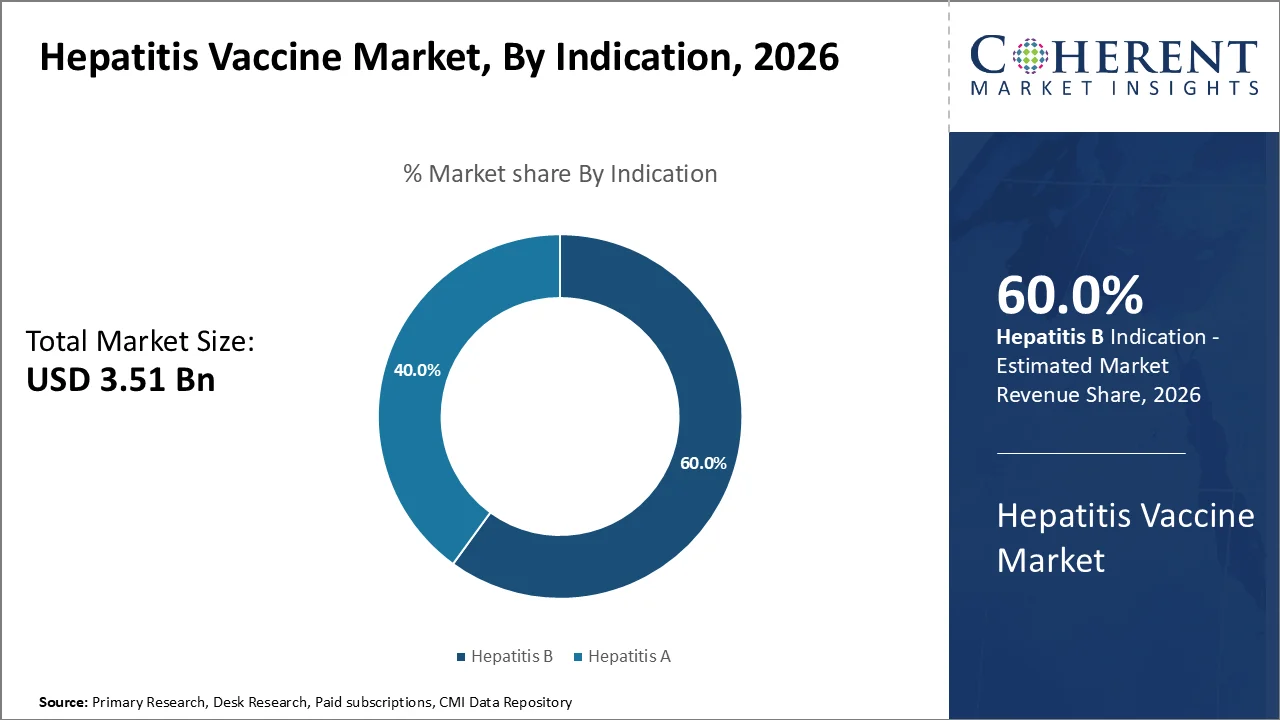
- Hepatitis B segment is expected to account the largest share of 60.0% in 2026, higher disease burden globally, routine infant immunization programs, and stronger government vaccination initiatives drive demand. Hepatitis B also has a major role in preventing chronic infections, cirrhosis, and liver cancer. In 2024, about 1.8 million people were newly infected with the hepatitis B virus.
- Recombinant vaccine segment will dominate with 70.0% in 2026, recombinant hepatitis B vaccines are widely preferred due to improved safety profile, high effectiveness, and large-scale production capability. Most modern Hepatitis B vaccines are recombinant-based. India is one of the ten countries that together account for nearly 69% of deaths caused by hepatitis B and 58% of deaths caused by hepatitis C worldwide.
- Hospital pharmacies segment will dominate with 40.0% in 2026, vaccines are frequently administered through hospitals, government immunization centers, and healthcare facilities, especially for newborn vaccination and high-risk populations. In 2023, approximately 84% of infants worldwide received the third dose of the hepatitis B vaccine (HepB3)
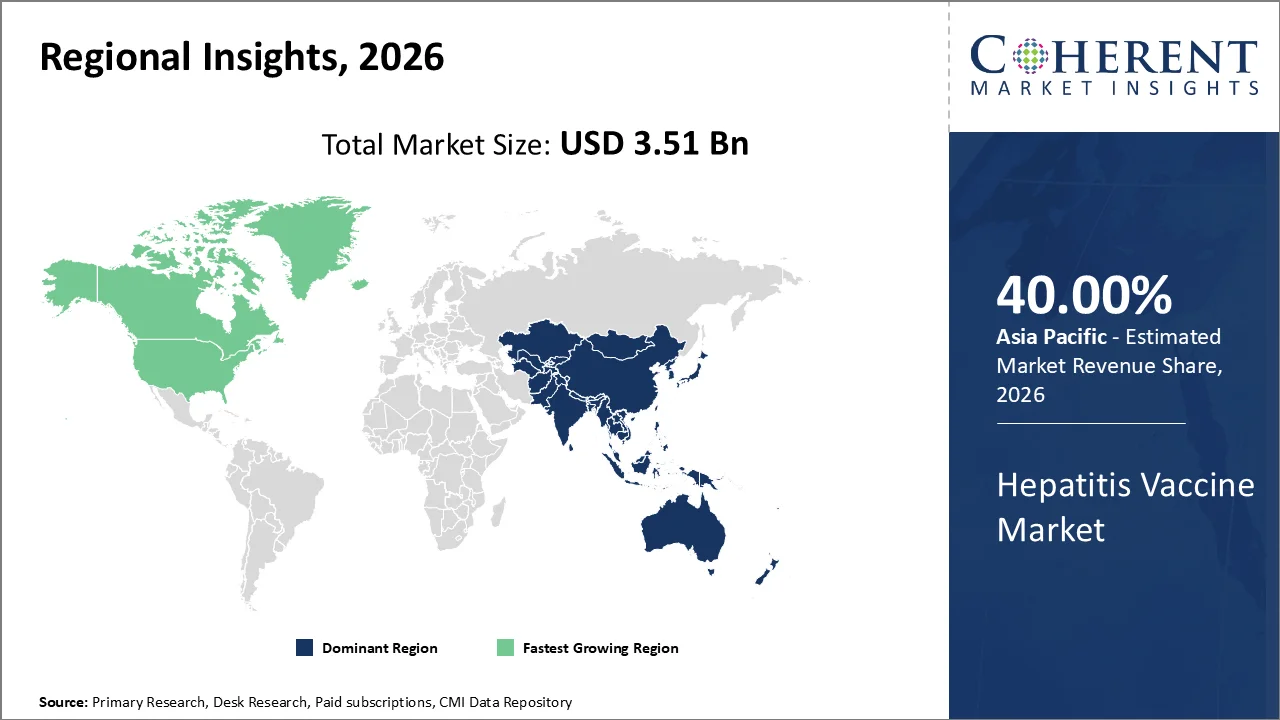
- Asia Pacific is expected to acquire the dominant share of 40.00% in 2026, many APAC countries have historically had a high prevalence of hepatitis B infections. In 2023, the Asia-Pacific region had the highest number of chronic hepatitis B (CHB) cases, accounting for 63.1% of the global cases (178 million people). The region’s CHB prevalence rate was 3.7%, which was higher than the global average.
Segmental Insights
Why is Hepatitis B Segment Acquiring the Largest Market Share?
Hepatitis B segment is projected to account for the largest share of indication in 2026, representing approximately 60.0% of the total volume. Owing to its significantly higher global disease burden, deeply entrenched universal immunization mandates, and the critical role it plays in preventing life-threatening long-term complications such as liver cirrhosis and hepatocellular carcinoma. Hepatocellular carcinoma (HCC) is the most common type of liver cancer. It makes up about 80% of all primary liver cancer cases.
According to WHO, about 240 million people were living with chronic hepatitis B infection in 2024, and around 900,000 new infections occur every year.
This staggering epidemiological burden has compelled governments as well as international health bodies to prioritize Hepatitis B vaccination as a foundational pillar of national immunization programs across virtually every country in the world.
- Current Industry Events of 2026
- Market Size Estimation
- Regional Breakdown
- Competitive Landscape
- Customer Intelligence
- Segmental Analysis
- Pricing Analysis
- Key Market Drivers, Challenges & Future Trends
- Customized Insights Section
Recombinant Vaccine Segment holds the Largest Market Share
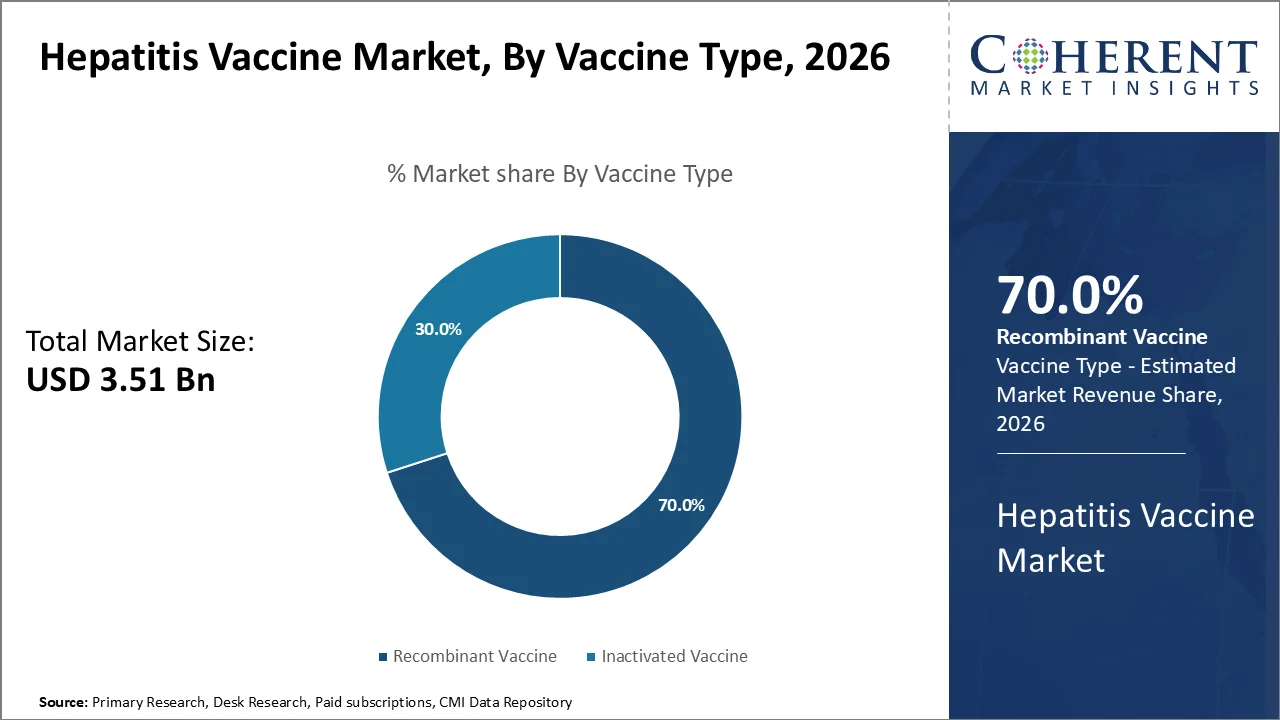
Based on vaccine type, recombinant vaccine segments dominates the market, accounting for a significant 70.0% share in 2026. These vaccines are made using recombinant DNA technology, wherein the hepatitis B surface antigen (HBsAg) is expressed in yeast or mammalian cell systems, discard the need for handling live or inactivated virus during manufacturing. In August 2025, India approved the recombinant HEV 239 vaccine for adults between 18 and 65 years of age.
This technological foundation has not only enhanced the scalability of production but has also ensured consistent immunogenicity as well as a highly favorable safety profile, which are major factors driving large-scale public health adoption.
One of the major significant contributors to the dominance of recombinant vaccines is their integration into national immunization programs across virtually every country globally. The World Health Organization (WHO) has strongly recommended the inclusion of the Hepatitis B recombinant vaccine in routine childhood immunization schedules since the early 1990s.
Hospital Pharmacies Segment holds the Largest Market Share
Based on distribution channel, Hospital Pharmacies segments dominates the market, accounting for a significant 40.0% share in 2026. Due to their integrated role in vaccine administration, clinical oversight, as well as coordinated immunization programs that are fundamentally in line with national and international public health mandates.
The structural advantage that hospital pharmacies hold is their ability to serve as a centralized point for vaccine procurement, cold chain management, as well as patient follow-up, all of which are critical requirements for hepatitis vaccine delivery.
Hospital pharmacies work within a controled clinical environment where trained healthcare professionals can directly administer vaccines, manage adverse event reporting, as well as handle compliance with national immunization schedules.
Market Drivers
Recombinant DNA (rDNA) Technology is transforming the Hepatitis Vaccine Industry
Recombinant DNA (rDNA) technology is the main technology used today to develop hepatitis B vaccines. This method creates vaccines by inserting the hepatitis B surface antigen (HBsAg) gene into host cells, mainly yeast cells such as Saccharomyces cerevisiae, to make large amounts of vaccine antigen without using live or killed hepatitis B virus. The produced antigen forms virus-like particles (VLPs), which are purified as well as combined with adjuvants to make an effective vaccine. Major companies using this technology include Merck & Co. with Recombivax HB, GSK with Engerix-B, Serum Institute of India with Shanvac-B, Bharat Biotech with Revac-B+, and LG Chem with Hepavax-Gene. GSK’s Engerix-B has become one of the broadly used hepatitis B vaccines, being distributed in more than 180 countries.
The adoption of rDNA technology has changed the hepatitis B vaccine market by improving safety, reducing costs, as well as enabling large-scale vaccination programs. Earlier plasma-derived vaccines had risks of contamination, but recombinant vaccines eliminated these concerns.
Production costs have decreased significantly, from around USD 100 per dose for plasma-derived vaccines to less than USD0.50 per dose for generic recombinant vaccines. This technology has supported global immunization efforts, with childhood hepatitis B vaccine coverage reaching more than 84% worldwide by 2022 through programs such as the WHO Expanded Programme on Immunization (EPI). Countries that introduced universal hepatitis B vaccination, such as Taiwan, reported major health benefits, including a more than 70% reduction in childhood liver cancer (hepatocellular carcinoma) cases.
Current Events and Their Impact on the Hepatitis Vaccine Market
Current Event | Description and its Impact |
WHO Global Hepatitis Elimination Strategy and expanded vaccination efforts (2025–2026) |
|
Expansion of universal childhood hepatitis B vaccination programs (2025–2026) |
|
Hepatitis Vaccine Market Trends
- The global hepatitis vaccine market represents one of the most critical segments within the broader immunology and infectious disease prevention landscape. With viral hepatitis particularly Hepatitis A, B, C, D, and E continuing to impose a substantial disease burden on populations worldwide, the demand for effective prophylactic vaccines has remained robust and continues to grow at a steady pace. Viral hepatitis affects about 300 million people worldwide. Around 1.3 million people die every year from hepatitis B and hepatitis C.
- One of the most defining trends reshaping the hepatitis vaccine market is the accelerating development as well as commercial adoption of combination vaccines. Products that integrate Hepatitis A+B antigens such as Twinrix (GSK) or multi-disease combination vaccines that include hepatitis B alongside diphtheria, tetanus, pertussis, Hib, and polio antigens are gaining tremendous traction, especially within national immunization programs (NIPs).
- Technological innovation is highly changing the market toward recombinant DNA-based and adjuvanted hepatitis B vaccines. Products such as HEPLISAV-B (Dynavax Technologies) which utilizes a cytosine phosphoguanine (CpG 1018) adjuvant system offer superior seroprotection rates with a two-dose regimen compared to traditional three-dose schedules.
- The global expansion of birth dose hepatitis B (HepB-BD) vaccination programs represents a structural, long-term demand driver. UNICEF and WHO data indicate that while global HepB-BD coverage has improved to approximately 45–48%, major gaps remain particularly across Sub-Saharan Africa and South Asia.
- Beyond pediatric programs, demand for hepatitis vaccines particularly Hepatitis A and the combined Hepatitis A+B vaccine within adult immunization and travel medicine segments is experiencing meaningful growth. Increasing global travel volumes, growing awareness of occupational exposure risks (healthcare workers, military personnel, food handlers), and expanding adult vaccination campaigns across North America and Europe are creating a significant and commercially attractive adult immunization sub-market.
Regional Insights
Asia Pacific dominates owing to its massive population base
Asia Pacific account 40.00% market share in 2026, owing to its massive population base, high endemicity of hepatitis B and hepatitis A infections, and robust government-led immunization programs that have been systematically institutionalized over decades. The Asia-Pacific region has 59% of all chronic hepatitis B (CHB) cases and 79% of deaths caused by hepatitis B virus (HBV) worldwide.
The region hosts a disproportionately large share of the hepatitis burden world, with the World Health Organization (WHO) reporting that the Western Pacific Region alone accounts for approximately 116 million people living with chronic hepatitis B infection, making it one of the most affected zones globally.
Countries such as China, India, Japan, South Korea, Australia, etc., have embedded hepatitis B vaccination into their Expanded Program on Immunization (EPI), ensuring high birth-dose coverage across urban as well as rural populations alike.
The national immunization program China, administered by the National Disease Control and Prevention Administration, has achieved hepatitis B birth-dose coverage exceeding 95% in recent years, creating a sustained demand pipeline for vaccine manufacturers.
North America Hepatitis Vaccine Market Trends
The North America region is poised to be the fastest-growing region through 2026-2033, expanding at a CAGR of approximately 6.8%. Driven primarily by recent policy expansions, increasing adult immunization initiatives, as well as the growing recognition of hepatitis-related disease burden among previously underserved and high-risk adult populations. The United States has an estimated 1.7 million people living with hepatitis B virus (HBV) infection. This means about 0.5% of the population has HBV infection.
A landmark development is fueling this growth trajectory was the CDC's ACIP unanimous vote in 2022 recommending universal Hepatitis B vaccination for all adults aged 19 through 59 years, and vaccination of adults aged 60 years and older based on individual clinical decision-making.
This landmark policy change substantially expanded the eligible adult vaccination population in the United States, triggering increased procurement demands from healthcare providers, pharmacies, as well as occupational health programs.
Massive immunization infrastructure is Accelerating the Hepatitis Vaccine Market Demand in China
China contributes the highest share in the hepatitis vaccine market in Asia Pacific owing to its massive immunization infrastructure, government-mandated vaccination policies, and the historically high burden of hepatitis B virus (HBV) infection across its population.
China has long been recognized as one of the countries with the highest prevalence of chronic hepatitis B, which directly drives sustained demand for hepatitis vaccines across all age groups. The National Immunization Program (NIP) of China, administered by the National Disease Control and Prevention Administration (NDCPA), mandates hepatitis B vaccination for all newborns within 24 hours of birth, majorly expanding the vaccine uptake base.
In March 2026, GSK announced that China’s National Medical Products Administration (NMPA) has started reviewing its application for bepirovirsen, a new investigational medicine to treat chronic hepatitis B (CHB) in adults.
For example, according to the World Health Organization (WHO), China has achieved hepatitis B surface antigen (HBsAg) occurrence below 1% in children under five years of age, a remarkable achievement directly attributed to its robust national vaccination campaigns.
U.S. Hepatitis Vaccine Market Trends
The U.S. contributes the highest share in the market in North America owing to its deeply entrenched public health infrastructure, federally mandated vaccination programs, and an exceptionally robust pharmaceutical manufacturing ecosystem that collectively positions it as the undisputed leader in hepatitis vaccine adoption and distribution across the entire region.
The United States has maintained a consistent trajectory of high hepatitis vaccine uptake, particularly for Hepatitis A and Hepatitis B vaccines, which are embedded within the Advisory Committee on Immunization Practices (ACIP) recommended childhood immunization schedule published by the Centers for Disease Control and Prevention (CDC).
According to the CDC, Hepatitis B vaccination is recommended for all newborns before hospital discharge, and the three-dose series is universally recommended for children, adolescents, and adults up to age 59, which has directly translated into sustained and consistently high demand volumes across both public and private healthcare channels.
In July 2026, leaders of the Congressional Hepatitis Caucus, introduced a resolution to recognize July 28, 2026, as World Hepatitis Day. The resolution aims to raise awareness about hepatitis B and C and shows Congress’s commitment to preventing and ending these diseases.
Who are the Major Companies in Hepatitis Vaccine Industry
Some of the major key players in Hepatitis Vaccine market include, Merck and Company, GlaxoSmithKline, Sanofi Pasture, CSL Behring GmbH, Novartis AG and Pfizer Inc. Few leading brands in hepatitis vaccine market are Engerix-B, Havrix (Glaxosmithkline), Recombivax, Vaqta (Merck and Company), Euvax – Avaxim (Sanofi Pasteur), and Shanvac B (Shantha Biotech).
Key News
- In May 2026, GSK announced positive results from major clinical trials of bepirovirsen, a new investigational medicine for treating chronic hepatitis B (CHB). Results from two Phase III studies, B-Well 1 and B-Well 2, were published in the New England Journal of Medicine and presented at the EASL congress.
- In April 2026, Ionis Pharmaceuticals’ partner GSK announced that the U.S. FDA has accepted its application for priority review of bepirovirsen, an investigational medicine for adults with chronic hepatitis B (CHB). The FDA has given bepirovirsen a Breakthrough Therapy designation and plans to make a decision by October 26, 2026.
Market Report Scope
Hepatitis Vaccine Market Report Coverage
| Report Coverage | Details | ||
|---|---|---|---|
| Base Year: | 2025 | Market Size in 2026: | USD 3.51 Bn |
| Historical Data for: | 2020 To 2024 | Forecast Period: | 2026 To 2033 |
| Forecast Period 2026 to 2033 CAGR: | 3.63% | 2033 Value Projection: | USD 4.50 Bn |
| Geographies covered: |
| ||
| Segments covered: |
| ||
| Companies covered: | Merck and Company, GlaxoSmithKline, Sanofi Pasture, CSL Behring GmbH, Novartis AG and Pfizer Inc. Few leading brands in hepatitis vaccine market are Engerix-B, Havrix (Glaxosmithkline), Recombivax, Vaqta (Merck and Company), Euvax – Avaxim (Sanofi Pasteur), and Shanvac B (Shantha Biotech) | ||
| Growth Drivers: |
| ||
| Restraints & Challenges: |
| ||
Analyst Opinion
- The hepatitis vaccine market continues to demonstrate compelling growth dynamics, driven by increasing global awareness regarding the prevention of hepatitis A and B infections.
- Rising government initiatives and national immunization programs across both developed and developing economies remain primary catalysts accelerating vaccine adoption worldwide. Hepatitis C (HCV) infections decreased by 34% from 2015 to 2024. This reduction was mainly due to national programs to eliminate hepatitis C, including a large campaign in Egypt.
- The World Health Organization's strategic push toward eliminating viral hepatitis as a public health threat by 2030 has significantly reinforced policy-driven demand across multiple geographies.
- Additionally, growing pediatric vaccination mandates and expanding adult immunization recommendations are broadening the target population considerably.
- Substantial opportunities exist in emerging markets across Asia-Pacific and Africa, where hepatitis infection burden remains disproportionately high and healthcare infrastructure is progressively improving.
Speak to the analyst
Want personalized insights?
Take the findings above to one of our principal consultants, or have the report rebuilt around the segments, geographies and competitors you actually track.
Market Segmentation
- By Indication (Revenue, USD Bn, 2021-2033)
- Hepatitis A
- Hepatitis B
- By Vaccine Type (Revenue, USD Bn, 2021-2033)
- Recombinant Vaccine
- Inactivated Vaccine
- By Distribution Channel (Revenue, USD Bn, 2021-2033)
- Hospitals
- Retail Pharmacy
- Online Pharmacy
- By Region (Revenue, USD Bn, 2021-2033)
- North America
- U.S.
- Canada
- Latin America
- Brazil
- Mexico
- Argentina
- Rest of Latin America
- Europe
- Germany
- U.K.
- France
- Italy
- Spain
- Russia
- Rest of Europe
- Asia Pacific
- China
- India
- Japan
- Australia
- South Korea
- ASEAN
- Rest of Asia Pacific
- Middle East
- GCC
- Israel
- Rest of Middle East
- Africa
- South Africa
- Central Africa
- North Africa
- North America
Sources
Primary Research Interviews
- Hepatitis Vaccine Manufacturers & Suppliers
- Healthcare Professionals & Infectious Disease Specialists
- Hospital Procurement & Pharmacy Managers
- Public Health Officials & Immunization Program Directors
- Others
Databases
- World Health Organization (WHO) Global Health Observatory Database
- Centers for Disease Control and Prevention (CDC) Vaccine Database
- IQVIA Healthcare Database
- Global Burden of Disease (GBD) Database
- Others
Magazines
- Vaccine Business Weekly
- Pharmaceutical Technology Magazine
- BioPharma Reporter
- Infectious Disease Special Edition Magazine
- Others
Journals
- Journal of Hepatology
- Vaccine – Elsevier Journal
- Journal of Infectious Diseases
- Others
Newspapers
- The Lancet News
- FiercePharma
- Reuters Health News
- Financial Times (Pharma & Healthcare Section)
- Others
Associations
- World Hepatitis Alliance (WHA)
- International Federation of Pharmaceutical Manufacturers & Associations (IFPMA)
- Centers for Disease Control and Prevention (CDC) Advisory Committee on Immunization Practices (ACIP)
- Global Alliance for Vaccines and Immunization (GAVI)
- Others
Public Domain Sources
- World Health Organization (WHO) – Hepatitis Vaccine Reports & Guidelines
- Centers for Disease Control and Prevention (CDC) – Immunization Schedules & Data
- U.S. Food and Drug Administration (FDA) – Vaccine Approvals & Regulatory Data
- European Medicines Agency (EMA) – Hepatitis Vaccine Approvals
- Others
Proprietary Elements
- CMI Data Analytics Tool
- Proprietary CMI Existing Repository of information for last 10 years
Get access to 250+ pages report
Every segment, forecast, competitor profile and data table behind the analysis above — available for instant download.
- ESOMAR Member
- ISO 9001:2015 Certified
- D-U-N-S Registered
- GDPR & CCPA Compliant
Missing comfort of reading report in your local language? Find your preferred language:
Transform your Strategy with Exclusive Trending Reports
Frequently Asked Questions
The hepatitis vaccine market is expected to reach USD 4.50 Bn in 2033.
Major players operating in the global hepatitis vaccine market include Merck and Company, GlaxoSmithKline, Sanofi Pasture, CSL Behring GmbH, Novartis AG and Pfizer Inc. Few leading brands in hepatitis vaccine market are Engerix-B, Havrix (Glaxosmithkline), Recombivax, Vaqta (Merck and Company), Euvax – Avaxim (Sanofi Pasteur), and Shanvac B (Shantha Biotech)
Stringent regulatory approval processes and complex manufacturing challenges are the major factors that is expected to hamper growth of the market over the forecast period.
Rising healthcare expenditure and funding from global health organizations (WHO, UNICEF, Gavi) is driving growth of the global Hepatitis Vaccine market.
The Hepatitis Vaccine market is anticipated to grow at a CAGR of 3.63% between 2026 and 2033.
Among regions, Asia Pacific is expected to account for a largest market share in the global Hepatitis Vaccine market over the forecast period.
There are specific vaccines to prevent Hepatitis A and Hepatitis B, as well as a combination shot called Twinrix that protects against both. There is currently no vaccine available for Hepatitis C.