

Organ Preservation Solutions Market Size and Share Analysis - Growth Trends and Forecast (2026 - 2033)
The global organ preservation solutions market is estimated to be valued at USD 450 Mn in 2026 and is projected to grow at a CAGR of 12% during the forecast period (2026-2033), reaching USD 996 Mn by 2033. This growth is attributable to increasing number of organ transplantation procedures worldwide, rising prevalence of end-stage organ failure, and advancements in organ preservation technologies like hypothermic and normothermic machine perfusion systems. Global organ transplantation has reached a record level, with 173,727 solid organ transplant procedures performed in recent years.
Key Takeaways from the Organ Preservation Solutions Market Report
- Viaspan is projected to dominate the market with a share of more than 36% in 2026 due to strong clinical adoption and long-standing validation in liver and kidney transplantation. It is widely recognized as the “gold standard” for abdominal organ preservation. Studies show it extended safe liver preservation from ~6–8 hours to around 12–24+ hours in clinical practice.
- Static cold storage is slated to account for the largest market share of 45% in 2026 because of its low cost and universal clinical adoption. A major peer-reviewed review states that “Static cold storage remains the most widely used organ preservation method,” highlighting its widespread use due to simplicity, accessibility, and cost-effectiveness.
- North America is projected to dominate the global organ preservation solutions industry with a share of 42% in 2026, owing to high transplant volume and rising adoption of advanced perfusion technologies. For instance, organ transplants in the U.S. exceeded 48,000 in 2024, indicating increased utilization of organ preservation solutions.
- Asia Pacific, holding a share of 25% in 2026, is anticipated to emerge as the fastest-growing market for organ preservation solutions during the forecast period, thanks to increasing incidence of organ failure, rising transplant procedures, and rapid adoption of advanced preservation and perfusion technologies. For instance, showing a large and growing number of patients needing organ transplants, increasing demand for organ preservation solutions.
Organ Preservation Solutions Market Overview
The global organ preservation solutions market is poised to exhibit strong growth during the forecast period. This is primarily due to incidence of chronic diseases such as kidney, liver, and heart disorders, rising number of organ transplant procedures, and increasing prevalence of end-stage organ failure. In addition, improvements in preservation technologies, expansion of transplant infrastructure, and increasing awareness about organ donation are also supporting market expansion.
Organs are highly vulnerable outside the human body due to lack of blood supply and oxygen. Therefore, they are stored in organ preservation solutions that help slow cellular damage as well as maintain viability. These solutions are carefully formulated with electrolytes, buffers, and protective agents to maintain osmotic balance, regulate pH, and reduce tissue injury during storage and transport.
Expansion of organ donation programs is set to boost growth of organ preservation solutions market during the forthcoming period. Countries such as China, India, and Brazil are strengthening national donor registries, organ procurement systems, and hospital transplant networks. This is improving organ availability as well as increasing the use of preservation solutions per organ procurement event.
For example, in November 2025, Paragonix Technologies launched a first-of-its-kind supply chain initiative called the Paragonix Distribution Fleet to improve access to organ transplants. The program helps ensure that hospitals, transplant centers, and organ procurement organizations (OPOs) can get timely and reliable access to Paragonix’s organ preservation technologies as well as clinical support.
Advancements in organ preservation technologies are also supporting market expansion. Emerging innovations, including machine perfusion systems (hypothermic and normothermic), improved cold storage solutions, and real-time organ viability assessment technologies, are increasingly being integrated into clinical practice. These advancements enhance organ viability, reduce ischemia-reperfusion injury, and extend preservation time windows, thereby driving the adoption of advanced organ preservation solutions.
Segmental Insights
Which Solution Type Dominates the Organ Preservation Solutions Market?
Viaspan Dominates the Market with Over One-Third Share in 2026
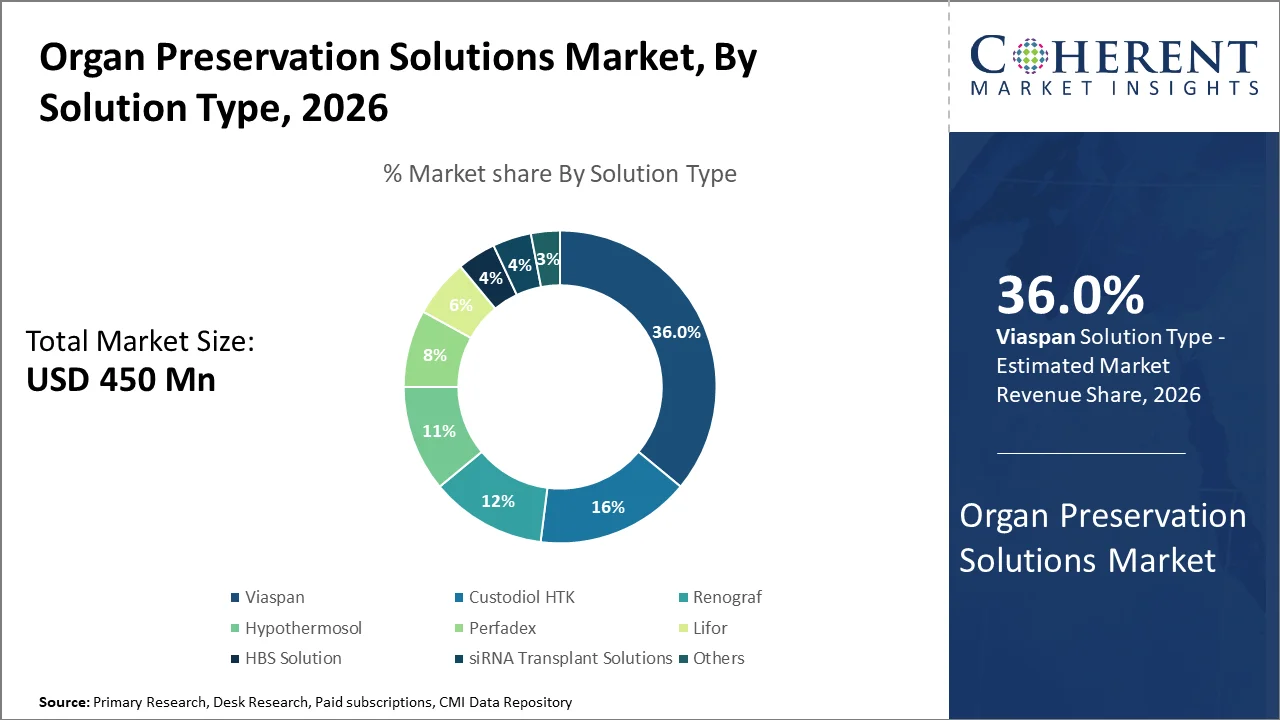
According to Coherent Market Insights’ latest organ preservation solutions market analysis, Viaspan segment is set to lead the market with a share of over 36% in 2026. This dominance can be attributed to its long-established clinical efficacy in multi-organ preservation, particularly for kidney, liver, and pancreas transplants.
Viaspan has become the gold standard in organ preservation due to its superior ability to reduce cellular swelling, minimize ischemia-reperfusion injury, and extend safe cold storage time compared to earlier-generation preservation fluids. Its widespread adoption across transplant centers is also supported by strong physician familiarity, extensive clinical validation, and consistent outcomes in both cadaveric and living donor organ transplantation.
- Current Industry Events of 2026
- Market Size Estimation
- Regional Breakdown
- Competitive Landscape
- Customer Intelligence
- Segmental Analysis
- Pricing Analysis
- Key Market Drivers, Challenges & Future Trends
- Customized Insights Section
Which is the Mostly Widely Used Organ Preservation Technique Type?
Static Cold Storage Continues to Dominate Due to Its Simplicity and Cost-Effectiveness
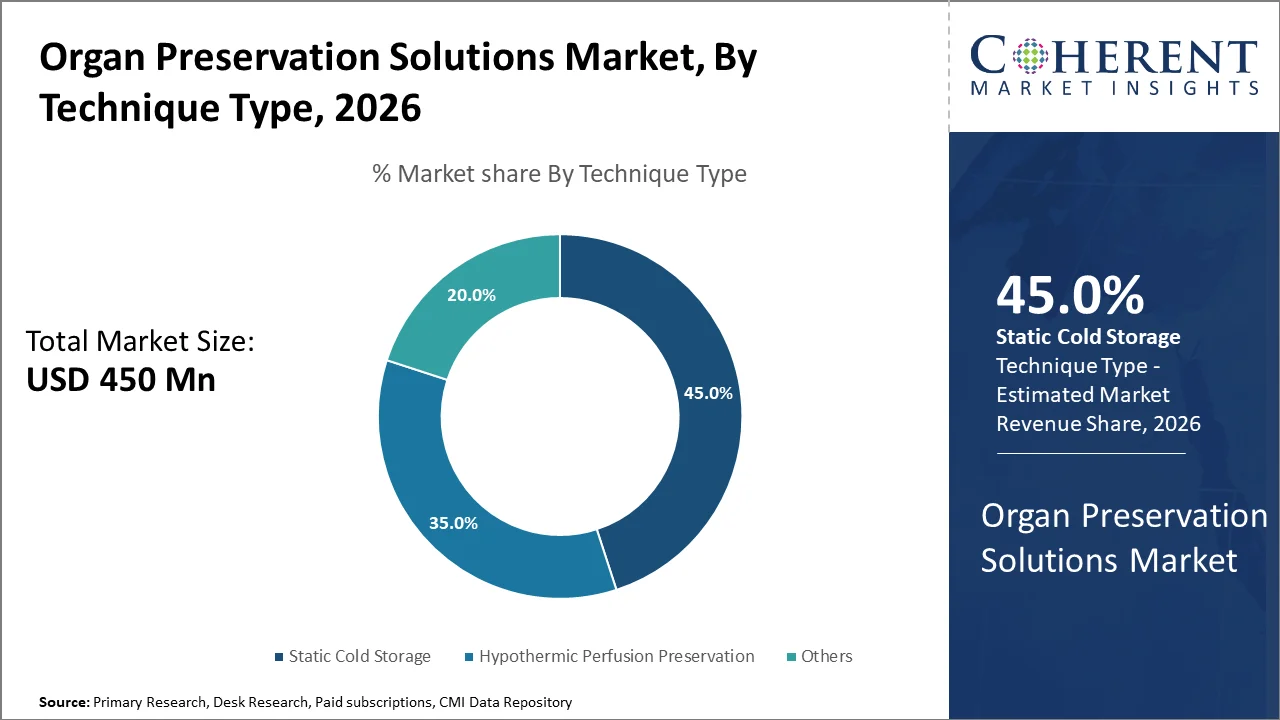
By technique type, static cold storage is projected to account for around 45% of the global organ preservation solutions market share in 2026. This is mostly due to its simplicity, cost-effectiveness, widespread clinical adoption, ease of use in routine transplant workflows, and its proven reliability for short-term preservation across a wide range of organs such as kidneys, liver, and heart.
Static cold storage also continues to dominate because it requires minimal specialized equipment or technical training compared to more advanced methods like machine perfusion. Most transplant centers worldwide already have established protocols and infrastructure for static cold storage, making it the default choice in developed as well as developing healthcare systems.
Market Dynamics
Organ Preservation Solutions Market Growth Drivers
Rising Organ Transplant Procedures Worldwide
Increasing number of organ transplant procedures globally is providing a strong impetus for the growth of organ preservation solutions market. There is a spike in the prevalence of end-stage organ failure, including kidney, liver, heart, and lung conditions globally. This, in turn, is creating demand for organ transplantation, thereby boosting the utilization of preservation solutions used during organ procurement, storage, and transportation.
According to the Global Observatory on Donation and Transplantation (GODT) 2024 report, a record 173,727 solid organ transplants were performed worldwide in 2024. This surge in transplant procedures is creating a favorable environment for the expansion of the organ preservation solutions market.
Organ Preservation Solutions Market Opportunities
Increasing Burden of Chronic Diseases
Chronic conditions like diabetes, cardiovascular diseases, liver disorders, and chronic kidney disease are increasing organ failure rates, expanding the patient pool requiring transplantation. As a result, lucrative growth opportunities are emerging for manufacturers of organ preservation solutions.
For example, The Lancet reports that chronic kidney disease (CKD) affects approximately 9%–14% of adults worldwide. The rising number of CKD cases and their progression to end-stage renal disease (ESRD) are expected to increase demand for kidney transplantation, which in turn creates growth opportunities for the organ preservation solutions market.
Organ Preservation Solutions Market Trends
Shift from Static Cold Storage to Machine Perfusion
Increasing adoption of machine perfusion technologies is a key growth-driving trend in the organ preservation solutions market. The industry is transitioning from traditional static cold storage toward advanced methods such as hypothermic machine perfusion (HMP) and normothermic machine perfusion (NMP), as these techniques improve organ viability and reduce organ discard rates.
Current Events and Their Impact
Current Event | Description and its Impact |
FDA clearance expands use of machine perfusion systems |
|
Expanding use of organ perfusion during transport improves transplant reach |
|
Regional Insights
North America Remains at the Epicenter of Organ Preservation Solutions Market Growth
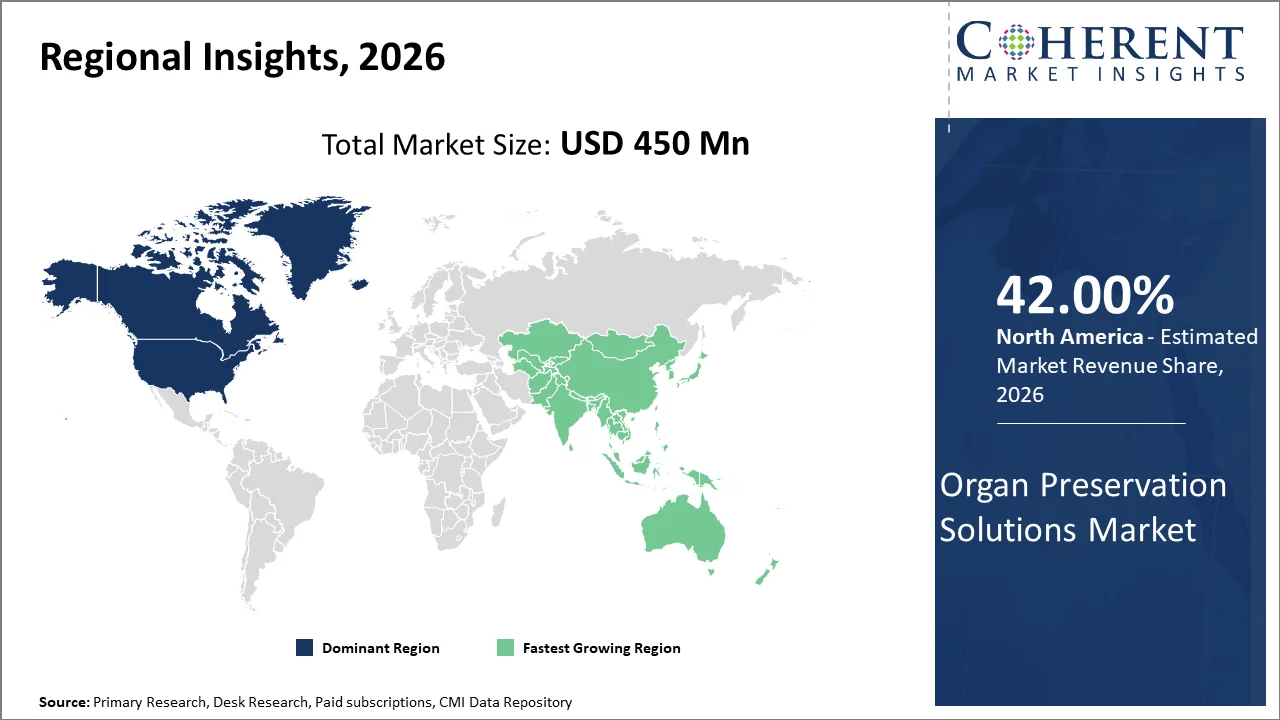
North America is expected to dominate the global organ preservation solutions market with a 42% share in 2026. This can be attributed to strong transplant infrastructure, high prevalence of chronic diseases, and presence of leading organ preservation solution manufacturing companies. The region also benefits from advanced hospitals, high organ donation rates, and rising cases of kidney and liver failure that require transplantation support.
Rising burden of end-stage organ failure, especially kidney disease, is boosting growth of North America organ preservation solutions market. According to the National Institute of Diabetes and Digestive and Kidney Diseases (NIDDK), an estimated 35.5 million adults in the United States are affected by chronic kidney disease (CKD), with many progressing to advanced stages requiring renal replacement therapy. This expanding patient pool is increasing demand for organ preservation solutions across the region.
Asia Pacific Becoming a Hotbed for Organ Preservation Solution Companies
Asia Pacific is projected to emerge as a central hub for manufacturers of organ preservation solutions during the forecast period, holding a global market share of 25% in 2026. This is mostly due to expanding patient pool with organ failure, improving healthcare access, and rising transplant awareness. Nations like China and India are expanding transplant programs, while better diagnostic rates are helping identify more patients in need of organ replacement.
The large untreated burden of organ failure diseases is playing a key role in driving growth of Asia Pacific organ preservation solutions market. According to the World Health Organization, chronic kidney disease affects an estimated 674 million people worldwide, with the majority of patients residing in low- and middle-income countries. This substantial underserved patient population is increasing the demand for organ transplantation and, in turn, driving the need for organ preservation solutions across the region.
Organ Preservation Solutions Market Outlook – Country-wise
U.S. Organ Preservation Solutions Market Trends
The United States remains a leading market for organ preservation solutions. This is mainly due to advanced transplant infrastructure, high healthcare spending, and strong access to critical care and prescription therapies. Global healthcare spending has reached record levels, led by the United States with per-capita expenditure exceeding USD 15,474, representing about 18% of GDP, compared with an OECD average of roughly USD 6,000 per person. In India, public health expenditure remains around 1.9% of GDP, while out-of-pocket spending accounts for nearly 47% of total healthcare costs. Growing use of organ preservation solutions in kidney, liver, and heart transplant procedures, along with rising cases of chronic conditions that lead to organ failure, is also boosting market growth in the U.S.
China Organ Preservation Solutions Market Forecast
The Organ Preservation Solutions Market in China is expected to grow rapidly during the assessment period. This can be attributed to improving healthcare infrastructure, rising awareness of organ failure-related diseases, and broader access to essential medical treatments. The country is also strengthening its transplant ecosystem through better hospital capacity and increasing investment in critical care services, which is supporting overall market growth.
Who are the Major Companies in the Organ Preservation Solutions Market?
Some of the major players in Organ Preservation Solutions Market are Teva Pharmaceutical Industries Ltd., Dr. Franz Köhler Chemie GmbH, BioLife Solutions, XVIVO Perfusion AB, Bristol-Myers Squibb, Inc., ToleroTech, Inc., Lifeline Scientific, Preservation Solutions Inc., Claris Injectables Limited, 21st Century Medicine, Paragonix Technologies Inc., BioTime, Inc., and CryoLife, Inc.
Key Strategies Adopted by Industry Players
Leading companies in the organ preservation solutions market are adopting various organic and inorganic strategies to boost their revenue as well as gain a competitive edge in the industry. These include new product launches and approvals, partnerships, mergers and acquisitions, and distribution agreements. Manufacturers are also investing in research and development to improve solution efficacy, extend organ viability time, and reduce ischemia-reperfusion injury during transplantation.
- In August 2025, Terumo Corporation announced an agreement to acquire OrganOx Limited. This deal marks Terumo’s entry into the organ transplantation and organ preservation technology sector.
- In January 2025, Paragonix Technologies reported the world’s first-in-human use of its KidneyVault Renal Perfusion System. The system is a portable hypothermic perfusion technology used to preserve and transport donor kidneys from donor to recipient.
- In November 2024, OrganOx Limited and eGenesis announced an exclusive clinical co-development agreement to develop a treatment for acute liver failure. The collaboration combines OrganOx’s normothermic machine perfusion (NMP) technology with eGenesis’ genetically engineered pig livers.
Market Report Scope
Organ Preservation Solutions Market Report Coverage
| Report Coverage | Details | ||
|---|---|---|---|
| Base Year: | 2025 | Market Size in 2026: | USD 450 Mn |
| Historical Data for: | 2020 To 2024 | Forecast Period: | 2026 To 2033 |
| Forecast Period 2026 to 2033 CAGR: | 12% | 2033 Value Projection: | USD 996 Mn |
| Geographies covered: |
| ||
| Segments covered: |
| ||
| Companies covered: | Teva Pharmaceutical Industries Ltd., Dr. Franz Köhler Chemie GmbH, BioLife Solutions, XVIVO Perfusion AB, Bristol-Myers Squibb, Inc., ToleroTech, Inc., Lifeline Scientific, Preservation Solutions Inc., Claris Injectables Limited, 21st Century Medicine, Paragonix Technologies Inc., BioTime, Inc., and CryoLife, Inc. | ||
| Growth Drivers: |
| ||
| Restraints & Challenges: |
| ||
Analyst Opinion (Expert Opinion)
- The global demand for organ transplants continues to rise due to end-stage organ failure cases increasing worldwide, especially kidney and liver diseases. This directly increases the need for preservation solutions, as every transplant procedure depends on them to keep organs viable during transport.
- The shortage of donor organs remains a major structural driver. According to the World Health Organization (WHO), only about 10% of global organ transplant needs are met each year, leaving a large unmet gap that supports continuous demand for preservation solutions used in every available transplant.
- Organ preservation solutions are increasingly important because they reduce organ damage during transport and improve transplant success rates. Better preservation leads to higher organ utilization, meaning fewer donated organs are wasted and more patients can receive transplants, improving overall system efficiency.
- New technologies such as machine perfusion and improved cold storage methods are helping keep organs usable for longer outside the body. This allows organs to be transported over greater distances and matched with patients in wider areas, helping the market grow.
Speak to the analyst
Want personalized insights?
Take the findings above to one of our principal consultants, or have the report rebuilt around the segments, geographies and competitors you actually track.
Market Segmentation
- By Solution Type Insights ( Revenue, USD Mn, 2021 - 2033)
- Viaspan
- Custodiol HTK
- Renograf
- Hypothermosol
- Perfadex
- Lifor
- HBS Solution
- siRNA Transplant Solutions
- Others
- By Techniques Type Insights ( Revenue, USD Mn, 2021 - 2033)
- Hypothermic Perfusion Preservation
- Static Cold Storage
- Others
- By Region Insights ( Revenue, USD Mn, 2021 - 2033)
- North America
- U.S.
- Canada
- Latin America
- Brazil
- Argentina
- Mexico
- Rest of Latin America
- Europe
- Germany
- U.K.
- Spain
- France
- Italy
- Russia
- Rest of Europe
- Asia Pacific
- China
- India
- Japan
- Australia
- South Korea
- ASEAN
- Rest of Asia Pacific
- Middle East
- GCC Countries
- Israel
- Rest of Middle East
- Africa
- South Africa
- North Africa
- Central Africa
- North America
- Key Players in the Organ Preservation Solutions Market
- Teva Pharmaceutical Industries Ltd.
- Franz Köhler Chemie GmbH
- BioLife Solutions
- XVIVO Perfusion AB
- Bristol-Myers Squibb, Inc.
- ToleroTech, Inc.
- Lifeline Scientific
- Preservation Solutions Inc.
- Claris Injectables Limited
- 21st Century Medicine
- Paragonix Technologies Inc.
- BioTime, Inc.
- CryoLife, Inc.
Sources
Primary Research interviews
- Interviews conducted with transplant surgeons, organ preservation specialists, procurement coordinators, hospital transplant unit heads, biomedical engineers, and critical care physicians across key healthcare institutions and transplant centers
Databases
- PubMed Central
- World Health Organization (WHO) Global Health Observatory
- UN Comtrade Database
- World Bank Data
- National Health databases
- Clinical trial registries
- Hospital procurement databases
- Medical device regulatory databases (FDA, EMA, CDSCO)
Magazines
- Medical Device & Diagnostic Industry (MD+DI)
- The Lancet Digital Health insights section
- Biotechnology Focus
- Hospital Management Asia
- Healthcare Technology Magazine
Journals’
- American Journal of Transplantation
- Transplantation Proceedings
- Journal of Heart and Lung Transplantation
- Cryobiology Journal
- Artificial Organs Journal
- International Journal of Organ Transplantation Medicine
Newspapers
- The Hindu
- The Times of India
- The Economic Times (Healthcare section)
- The Guardian (Health section)
- The New York Times (Science & Health)
- Other leading national and international newspapers covering healthcare and medical innovations
Associations
- World Health Organization (WHO) – Transplantation Division
- The Transplantation Society (TTS)
- United Network for Organ Sharing (UNOS)
- European Society for Organ Transplantation (ESOT)
- National Organ & Tissue Transplant Organizations
- Regional health ministries
Public Domain sources
- Government health ministry reports
- Open-access hospital statistics
- WHO reports
- NIH publications
- CDC datasets
- Regulatory filings
- Clinical trial registries
- Publicly available academic research papers
Proprietary Elements
- CMI Data Analytics Tool
- Proprietary CMI Existing Repository of information for last 8 years
Get access to 250+ pages report
Every segment, forecast, competitor profile and data table behind the analysis above — available for instant download.
- ESOMAR Member
- ISO 9001:2015 Certified
- D-U-N-S Registered
- GDPR & CCPA Compliant
Missing comfort of reading report in your local language? Find your preferred language:
Transform your Strategy with Exclusive Trending Reports
Frequently Asked Questions
The global market is estimated to be valued at US$ 450 Mn in 2026.
The global Organ Preservation Solutions Market value is expected to reach US$ 996 Mn by 2033.
The global market is poised to exhibit a CAGR of 12% from 2026 to 2033.
Major growth factors include increasing prevalence of chronic diseases and rising demand for organ transplants.
Viaspan is projected to dominate the market with a share of more than 36% in 2026.
Some major companies in the Organ Preservation Solutions Market include Teva Pharmaceutical Industries Ltd., Dr. Franz Köhler Chemie GmbH, BioLife Solutions, XVIVO Perfusion AB, Bristol-Myers Squibb, Inc., ToleroTech, Inc., Lifeline Scientific, Preservation Solutions Inc., Claris Injectables Limited, 21st Century Medicine, Paragonix Technologies Inc., BioTime, Inc., and CryoLife, Inc.
North America, with a 42% share in 2026, is set to lead the market during the forecast period.