

Global Fault Current Limiter Market Size and Forecast – 2026 to 2033
According to Coherent Market Insights, the global fault current limiter market is estimated to be valued at USD 5.67 Bn in 2026 and is expected to reach USD 8.41 Bn by 2033, expanding at a compound annual growth rate (CAGR) of 5.8% from 2026 to 2033.
Key Takeaways of the Fault Current Limiter Market
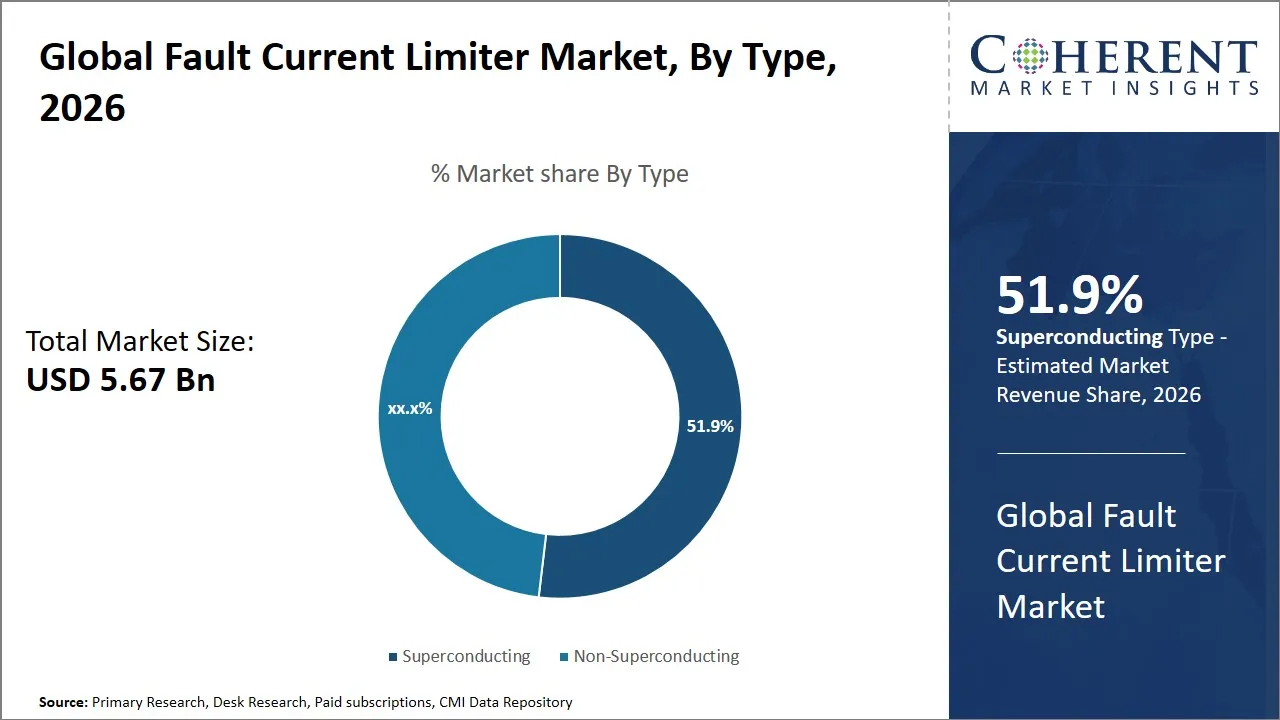
- The superconducting segment is projected to account for 51.9% of the global fault current limiter market share in 2026.
- The high segment is expected to capture 45.9% of the fault current limiter market share in 2026.
- The power stations segment is projected to represent 34.2% of the market share in 2026.
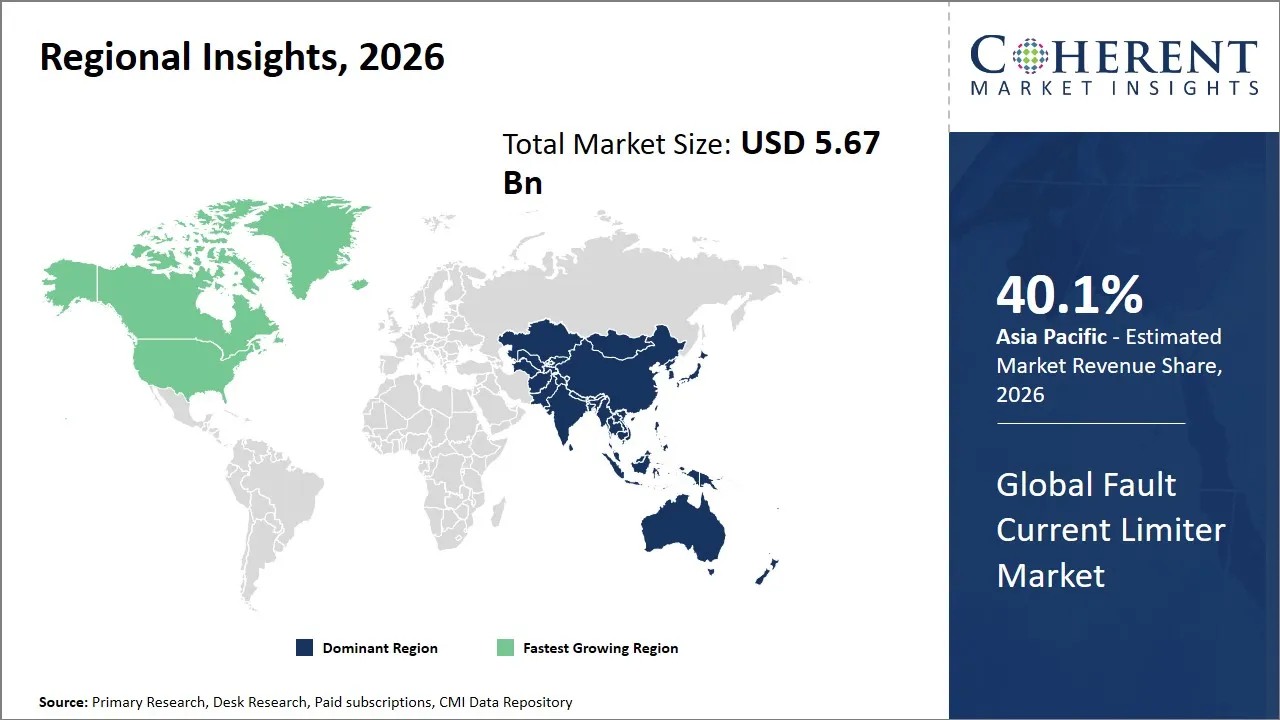
- The Asia Pacific region is expected to lead the market with a 40. 1% share in 2026.
- North America is anticipated to experience the fastest market growth, contributing 23. 3% share in 2026.
Market Overview
- Market trends indicate a growing adoption of advanced fault current limiter technologies driven by enhancements in smart energy grid applications and green energy
- The focus on minimizing power outages and protecting sensitive equipment supports increased deployment in both industrial and utility sectors.
- Additionally, innovations such as superconducting fault current limiters and digital monitoring features are gaining traction, improving market competitiveness and driving demand over the forecast period.
Currents Events and Its Impacts
Current Events | Description and its Impacts |
Surge in Global Grid Modernization & Renewable Integration Investments |
|
Rapid EV Infrastructure Expansion and High‑Load Demand Pressures |
|
Segmental Insights
- Current Industry Events of 2026
- Market Size Estimation
- Regional Breakdown
- Competitive Landscape
- Customer Intelligence
- Segmental Analysis
- Pricing Analysis
- Key Market Drivers, Challenges & Future Trends
- Customized Insights Section
Why Does the Superconducting Dominate the Fault Current Limiter Market?
Superconducting segment is expected to hold 51.9% of the market share in 2026, driven by their unparalleled technological advantages and efficiency in managing power system faults. Superconducting FCLs take advantage of superconductors, which have two distinct characteristics: superconductors are zero-resistance conductors at critical temperatures. This feature enables them to work with low energy losses within the ordinary circumstances, and they would be very efficient elements in power grids.
For example, a significant implementation of superconducting FCLs took place in the European Union, where they were integrated into the transmission grids of Germany to prevent cascading faults during peak demand periods. The installation has significantly reduced fault-related downtime and infrastructure damage, supporting the trend of adopting superconducting FCLs in critical power systems.
Why are High Voltage Fault Current Limiters Critical for Grid Resilience and Infrastructure Expansion?
High segment is projected to hold 45.9% of the global fault current limiter market share in 2026, reflecting their significance in managing power transmission networks and ensuring grid resilience. The usage of high-voltage fault current limiter is mainly in transmission lines and substations where there is a high risk of fault currents being exhibited by the large network and energy flow. They play a critical role in avoiding disastrous losses to costly electrical tools and reducing the number of cases of power interruptions that may impact large groups of people or important industrial processes.
The long-term growth of the power transmission system across the globe, especially in the new economy that is able to invest heavily on their grid modernizations and interconnections between countries, increases the need to have a dependable high-voltage FCLs. These limiters allow utilities to expand transmission capacity without making far-reaching changes to existing network protection programs, a cost-effective substitute to traditional grid reinforcement practices.
Power Stations Dominate the Global Fault Current Limiter Market
Power stations segment is set to account for the 34.2% of the global fault current limiter market share in 2026, underscoring their critical need for robust fault management solutions. Electrical networks Electricity-generating stations such as thermal, nuclear, hydroelectric and more and more renewable facilities are key nodes in power systems, fault events at which may have far-reaching operational and safety consequences. These environments require fault current limiters that will insulate turbines, generators, transformers, and other costly components against the devastating impact of short circuits or unusual surges of current.
The increasing complexity of power plants, driven by the introduction of variable renewable energy sources as well as the demand to achieve increased efficiency and reduced emissions, further increases the need to use the latest fault current limitation technologies. A significant problem that power stations are constantly confronted with is the changing conditions of the loads and the dynamism of the conditions of the network, and advanced FCLs are simply needed to balance the supply and demand without disrupting the integrity of the system. Their performance saves downtime, maintenance and probability of long power outages, which is the assurance to reliable power generation and delivery.
Regional Insights
Asia Pacific Fault Current Limiter Market Analysis and Trends
The Asia Pacific region is projected to lead the market with a 40.1% share in 2026. The fast pace of industrialization, urbanization, and the growth of the infrastructure development significantly raise the use of electricity and require effective solutions to power supplies. Governments of such countries as China, India, Japan, or South Korea have already come up with favorable policies to modernize power grids and add renewable sources of energy, which has given a boost to the use of FCL technologies.
The increased number of both local and multinational corporations such as Toshiba Corporation, Hitachi Ltd. and KEPCO spurs regional-based innovation. Moreover, Asia Pacific is enjoying some cost-effective manufacturing factors and rising investments in the smart grid projects that are projecting a favorable market ecosystem. The market growth is also enhanced by trade dynamics that favor technology movement across the borders and foreign investments.
North America Fault Current Limiter Market Analysis and Trends
The North America region is expected to exhibit the fastest growth in the market contributing 23.3% share in 2026, due to its advanced electrical infrastructure, robust industrial ecosystem, and strong regulatory environment. The availability of developed power grid and emphasis on grid modernization programs stimulate the need of fault current limiting solutions to improve the grid reliability and safety.
Policy initiatives by the government in encouraging smart grid and integration of renewable are additions to market growth. Siemens Energy, ABB Ltd. and General Electric (GE) are the major participants in this region and have laid down major operations in this region making large investments in R&D and implementing new FCL technologies. Also, the strategic partnerships of utilities and technology companies contribute to product innovation and entry into the market. Market dominance is also determined by the North American dynamics of trade which are well-developed supply chains and the high demand of electrical equipment.
Global Fault Current Limiter Market Outlook for Key Countries
Why is the U.S. Fault Current Limiter Market Growing?
The U.S. market for fault current limiter can be defined as a well-developed power infrastructure and strong focus of the government on the resilience of the grid and cyber-physical security. General Electric and Siemens Energy are some of the big players in the design and installation of the latest FCL solutions to serve a wide portfolio of utility and industrial clients. The opportunities to reduce fault risks through fault current limiters present a chance in energy transition policies and huge investment in the integration of renewable energy. Cooperation between utilities, technology suppliers, and research institutions facilitates innovation, and the U.S. could be a strategic location of innovation in FCL technology.
China Fault Current Limiter Market Trends
China’s fault current limiter market is driven by rapid urbanization and massive expansion of its electrical grid to meet growing energy demand. Key players such as State Grid Corporation of China along with international firms like Toshiba and ABB contribute to large-scale deployment of high-capacity FCL devices. Government initiatives aimed at grid modernization and carbon neutrality target improved power system reliability and efficiency, directly benefiting the market. Local manufacturing capabilities and government-backed infrastructure investments sustain a dynamic ecosystem conducive to the swift adoption of fault current limiting technologies.
Germany Fault Current Limiter Market Trends
Germany is still a market leader in fault current limiters in Europe, and it is taking advantage of its highly developed industrial sector as well as its investment in renewable energy within the Energiewende policy. There are companies, such as Siemens AG or Schneider Electric, which actively provide innovative solutions that will increase grid stability through faster integration of distributed energy sources. The country’s supportive regulatory framework for grid modernization and stringent safety standards encourage utilities to upgrade existing systems with effective FCL technology. Germany’s strong export orientation also allows local players to influence the broader European market.
What Are the Key Trends Driving the India Fault Current Limiter Market?
The market for fault current limiter in India is expanding fast as it is backed by the wide rural electrification schemes and modernization of the old transmission and distribution systems. The domestic firms and international players such as ABB and Tata Power are working on enhancing grid reliability using cost effective fault current limiting solutions. The Smart Grid Mission, as well as the campaigns to promote the expansion of renewable capacity, are government initiatives which make more sophisticated protection devices needed. The changing regulatory climate and increasing investments in power infrastructure in the countries have left the countries promising to FCL technologies.
Japan Fault Current Limiter Market Trends
The Japanese fault current limiter market is technologically developed with the emphasis on reliability and the disaster-proof nature inspired by the experience of the natural disasters. An example of companies that have been at the forefront of introducing FCL technologies to deal with power system upsets and promote fault management is a corporation such as Hitachi and Toshiba. The strategic focus of the country on converting renewables and modernizing old grid equipment guarantees the ongoing need in new fault current limiting equipment. The joint industry and research activities also make Japan one of the hubs of the state of art development of fault current limiter.
FCL Payback Period by Voltage Level
Voltage Level | Payback Period (Years) | Key Considerations |
Low Voltage (LV) | 3–5 years | Common in residential and small commercial grids |
Medium Voltage (MV) | 4–7 years | Used in industrial plants, medium-sized grids |
High Voltage (HV) | 6–10 years | Applied in national grid systems, large cities |
Inverter-Based Resources Change Fault Dynamics
Aspect | Conventional Generators | Inverter-Based Resources (IBRs) |
Fault Current Contribution | Contribute significant fault current due to synchronous operation. | Limited fault current contribution due to inverter protection and control. |
Voltage Support | Can provide reactive power and voltage regulation during faults. | May not provide sufficient reactive power under fault conditions, reducing voltage support. |
Grid Synchronization | Stay naturally synchronized with grid frequency during disturbances. | May face synchronization challenges during faults, especially if multiple IBRs are involved. |
Market Players, Key Development, and Competitive Intelligence
Key Developments
- In July 2024, Nexperia announced the latest additions to its power device portfolio: NPS3102A and NPS3102B electronic fuses (eFuses).
- In June 2024, Nexans and SNCF Réseau announced a strategic alliance to deploy the world’s first superconducting fault current limiter for the rail sector.
- In February 2024, COSEL Co., Ltd. launched a PDA series of AC or DC power supply, which includes inrush current limiting and further enhances reliability for industrial applications.
Top Strategies Followed by Global Fault Current Limiter Market Players
Player Type | Strategic Focus | Example |
Established Market Leaders | Heavy investment in R&D and innovation | For example, Siemens that is one of the leading companies in the market. They have invested into high-temperature superconducting (HTS) fault current limiters that are able to respond very quickly and reduce chances of damage to grid equipment should a fault occur. |
Mid-Level Players | Cost-effective solutions with balanced quality | Schneider Electric has launched solutions of FCL that are affordable and scalable to the small and medium sized utility operators. Their PowerPac T series, which is the best product, has reliable protection and low cost because their designs are standardized and they do not lose key features. |
Small-Scale Players | Niche specialization & innovative variants | For instance, gridON which provides advanced fault current limiting technology based on superconducting materials. They have developed their Superconducting Fault Current Limiter (SFCL) that is intended to be used in high precision application, offering very fast response time and greater ease of integration with the existing grid infrastructures. |
Market Report Scope
Fault Current Limiter Market Report Coverage
| Report Coverage | Details | ||
|---|---|---|---|
| Base Year: | 2025 | Market Size in 2026: | USD 5.67 Bn |
| Historical Data for: | 2020 To 2024 | Forecast Period: | 2026 To 2033 |
| Forecast Period 2026 to 2033 CAGR: | 5.8% | 2033 Value Projection: | USD 8.41 Bn |
| Geographies covered: |
| ||
| Segments covered: |
| ||
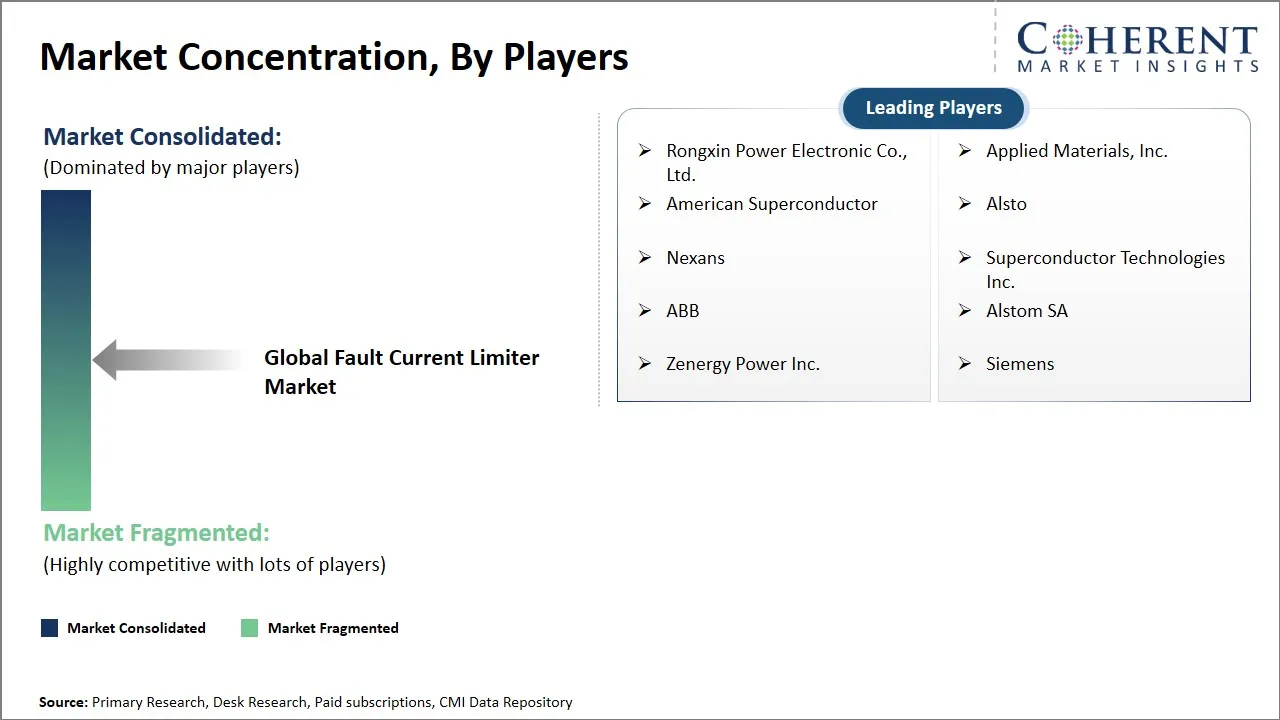
| Companies covered: | Rongxin Power Electronic Co., Ltd., Applied Materials, Inc., American Superconductor, Alsto, Nexans, Superconductor Technologies Inc., ABB, Alstom SA, Zenergy Power Inc., and Siemens | ||
| Growth Drivers: |
| ||
| Restraints & Challenges: |
| ||
Fault Current Limiter Market Dynamics
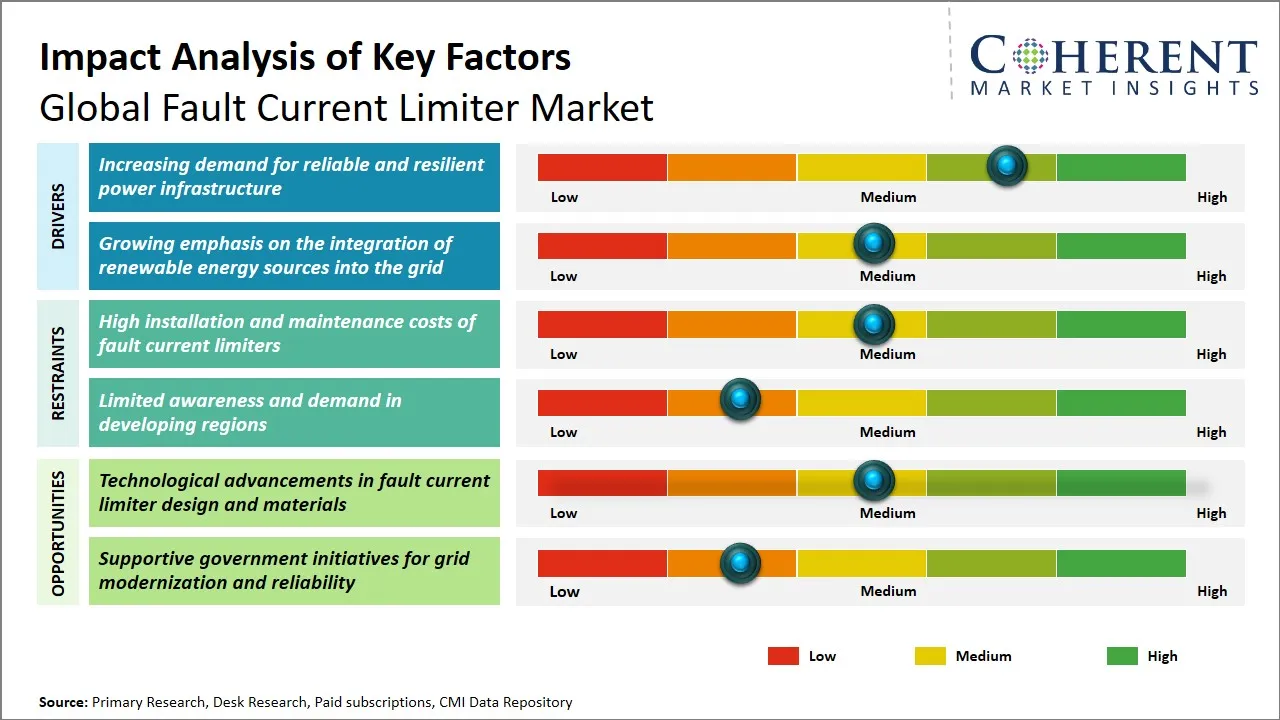
Fault Current Limiter Market Driver - Increasing Demand for Reliable and Resilient Power Infrastructure
The growing demand to have reliable and sturdy power infrastructure is another major force that is driving the use of fault current limiters in the world. As the modern society grows more and more dependent on continuous power supply in both domestic and industrial setups, power grid system are anticipated to be able to manage increasing complexities and loads without negatively affecting safety and performance. Fault current limiters also become central to the improvement of grid resilience by eliminating the excessive currents in case of short circuiting or faults and protecting transformers, circuit breakers, and other important elements of the grid.
For example, power sector in some countries like India, where a massive transformation of power sector is undertaken through programs such as Saubhagya Scheme and Smart Grid Mission, the use of fault current limiters in cities and industry grids is essential. These systems are essential in avoiding grid breakdowns, particularly in areas that are densely populated where any form of power interruption is far-reaching.
Fault Current Limiter Market Opportunity - Technological Advancements in Fault Current Limiter Design and Materials
The current technological developments in the design and the material of the global fault current limiter have a lot of potential in the global fault current limiter market since they will enhance the current state of the market. Improved efficiency and reliability of FCLs Superconducting materials, including those of high temperature superconductors (HTS), are transforming the speed and capacity of FCLs, allowing them to respond quickly and carry larger currents and be small and lightweight in size. Also, the development of advanced power electronics and intelligent sensors contributes to real-time or adaptive fault management and improvement of grid stability and downtime.
As one example, the U.S. in 2021 had a pilot project in the Grid Modernization Program involving the use of SFCLs to provide fault protection in smart grids. These systems provide an accelerated reaction to the faults and improve the general functioning of the power grid.
Analyst Opinion (Expert Opinion)
- The fault current limiter market is highly expected to grow and this is evidenced by the growing need to have a more reliable grid and the need to incorporate renewable energy sources. The reflections of the International Conference on Smart Grid Technology (2023) and the Global Power Systems Conference (2022) identified the key developments, and such companies as Siemens and General Electric are the leaders in the creation of innovative FCL technologies to reduce fault currents.
- The prototype of a superconducting fault current limiter developed in the recent past by Siemens is an example of advanced technology that aims at safeguarding electrical infrastructure with minimal discontinuity. The importance of these conferences highlighted the fact that FCLs are essential to modernize aging electrical grids and avoid damage of equipment, especially as increasing loads and renewable energy integration place an increasing burden on utilities.
- The obstacles as high costs of implementation and regulatory standards were often mentioned. Companies with strategic ties with utilities and those companies that invest in research and development to make FCL technology more cost-effective would most likely seize vast markets. Finally, the future expansion of the fault current limiter market will rely on its innovative capacity in a successive way and in relation to the emergent energy environment with the urgent issues of grid resilience and stability.
Speak to the analyst
Want personalized insights?
Take the findings above to one of our principal consultants, or have the report rebuilt around the segments, geographies and competitors you actually track.
Market Segmentation
- Type Insights (Revenue, USD Bn, 2021 - 2033)
- Superconducting
- Non-Superconducting
- Voltage Range Insights (Revenue, USD Bn, 2021 - 2033)
- High
- Medium
- Low
- End Use Application Insights (Revenue, USD Bn, 2021 - 2033)
- Power Stations
- Oil & Gas
- Automotive
- Paper Mills
- Chemicals
- Others
- Regional Insights (Revenue, USD Bn, 2021 - 2033)
- North America
- U.S.
- Canada
- Latin America
- Brazil
- Argentina
- Mexico
- Rest of Latin America
- Europe
- Germany
- U.K.
- Spain
- France
- Italy
- Russia
- Rest of Europe
- Asia Pacific
- China
- India
- Japan
- Australia
- South Korea
- ASEAN
- Rest of Asia Pacific
- Middle East
- GCC Countries
- Israel
- Rest of Middle East
- Africa
- South Africa
- North Africa
- Central Africa
- North America
- Key Players Insights
- Rongxin Power Electronic Co., Ltd.
- Applied Materials, Inc.
- American Superconductor
- Alsto
- Nexans
- Superconductor Technologies Inc.
- ABB
- Alstom SA
- Zenergy Power Inc.
- Siemens
Sources
Primary Research Interviews
- CEO – Leading Fault Current Limiter Manufacturer (e.g., ABB or Siemens equivalent)
- Supply Chain Director – Major Power Grid Equipment Distributor
- Production Lead – Superconducting FCL Producer (e.g., American Superconductor)
- Sustainability Officer – Smart Grid Certification Authority
Stakeholders
- Manufacturers
- End-use Sectors
- Utilities (Transmission & Distribution Grids)
- Renewable Energy (Solar, Wind Integration)
- Industrial (Data Centers, Oil & Gas)
- Regulatory & Certification Bodies (e.g., IEEE for FCL standards, IEC compliance)
- E-commerce Platforms and Retailers (Alibaba Industrial, ThomasNet, DirectIndustry)
- Technology Integration Players: HVDC and smart grid developers using FCLs
Databases
- UN Comtrade Database (HS codes for electrical apparatus)
- India Import Export (EXIM) Database (power equipment imports)
- USGS Mineral Commodity Summaries (related materials if applicable)
- Eurostat Trade Statistics for Electrical Equipment
- Market Research Databases (Grand View Research, Research and Markets)
Magazines
- Power Engineering International – FCL trends in grid protection
- Electrical Review – Fault current limiters innovations
- IEEE Power & Energy Magazine – Smart grid FCL applications
- Transmission & Distribution World – Market dynamics for FCLs
- Renewable Energy World – FCL in renewables integration
Journals
- IEEE Transactions on Power Delivery – FCL design and performance
- International Journal of Electrical Power & Energy Systems – FCL surveys
- Electric Power Systems Research – Optimal FCL allocation
- Superconductor Science and Technology – Superconducting FCLs
- Journal of Engineering – Advances in FCL technologies
Newspapers
- The Wall Street Journal – Global power grid investments
- Reuters – Energy sector tech volatility
- Business Standard (India) – Smart grid market growth
- Energy Connects – FCL supply chain news
- Power Technology – FCL deployment updates
Associations
- IEEE Power & Energy Society (PES) – FCL working groups
- CIGRE – Study Committee on power system protection
- International Electrotechnical Commission (IEC) – Standards bodies
- Smart Electric Power Alliance (SEPA)
- European Network of Transmission System Operators for Electricity (ENTSO-E)
Public Domain Sources
- DOE Office of Electricity – FCL testing guidelines
- IEEE Standards Association – FCL specifications
- European Commission – Grid resilience directives
- NERC – Reliability standards for fault protection
- IEA – Reports on grid modernization and FCLs
Proprietary Elements:
- CMI Data Analytics Tool
- Proprietary CMI Existing Repository of information for last 8 years.
Get access to 250+ pages report
Every segment, forecast, competitor profile and data table behind the analysis above — available for instant download.
- ESOMAR Member
- ISO 9001:2015 Certified
- D-U-N-S Registered
- GDPR & CCPA Compliant
Missing comfort of reading report in your local language? Find your preferred language:
Transform your Strategy with Exclusive Trending Reports
Frequently Asked Questions
The global fault current limiter market is estimated to be valued at USD 5.67 Bn in 2026 and is expected to reach USD 8.41 Bn by 2033.
The CAGR of global fault current limiter market is projected to be 5.8% from 2026 to 2033.
Increasing demand for reliable and resilient power infrastructure and growing emphasis on the integration of renewable energy sources into the grid are the major factors driving the growth of the global fault current limiter market.
High installation and maintenance costs of fault current limiters and limited awareness and demand in developing regions are the major factors hampering the growth of the global fault current limiter market.
In terms of type, superconducting is estimated to dominate the market revenue share in 2026.
Installed at high fault current points such as substations and renewable energy integration sites.
Asia Pacific is expected to lead the global fault current limiter market in 2026.