

Global Flying Car Market Size and Forecast – 2026-2033
The global flying car market is expected to grow from USD 1.30 Bn in 2026 to USD 19 Bn by 2033, registering a compound annual growth rate (CAGR) of 18% from 2026 to 2033. The global flying car market is driven by rapid advancements in battery technology and autonomous flight systems. On December 2, 2025, Eve Air Mobility selected BETA Technologies to supply electric pusher motors for its conforming prototypes and production aircraft. With a current backlog of 2,800 eVTOLs, Eve Air Mobility is strengthening its supply chain through this collaboration.
Key Takeaways of the Global Flying Car Market
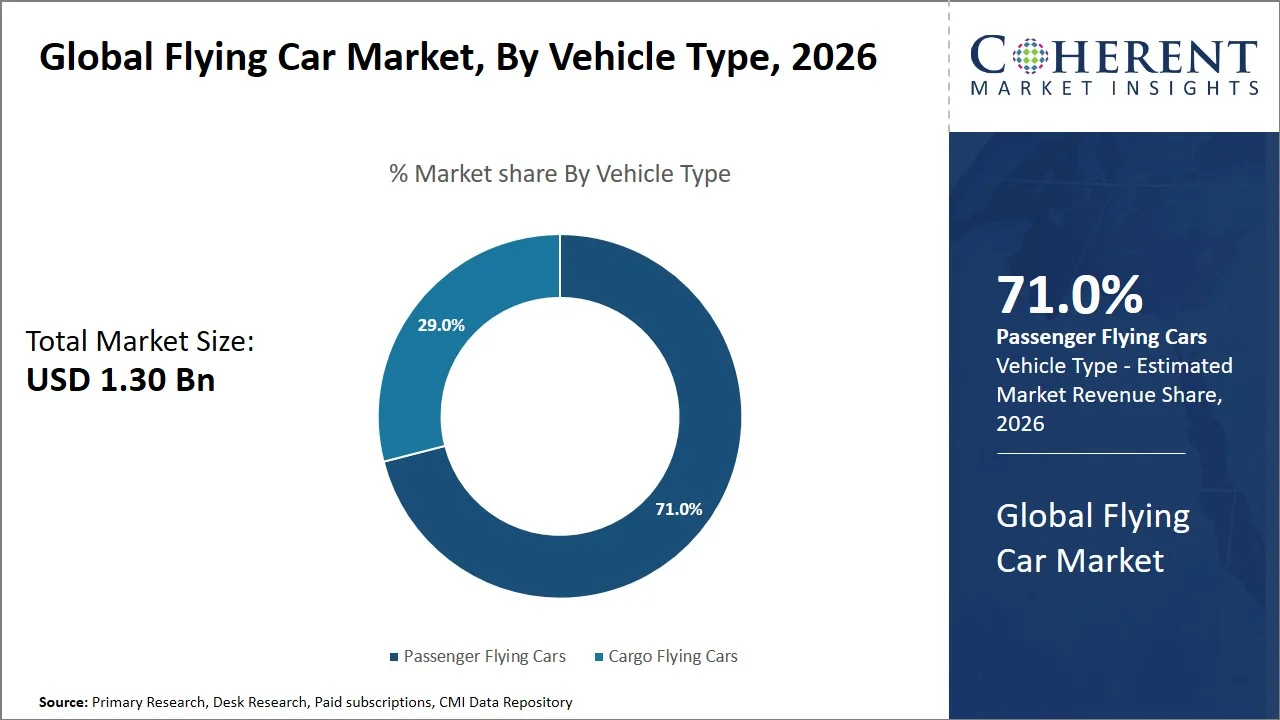
- The passenger flying cars segment is expected to account for 71.0% of the global flying car market share in 2026. Increasing government support for urban air mobility pilot programs is driving the growth of the segment. On December 17, 2025, Joby Aviation, Inc. announced its support for the U.S. Department of Transportation’s (DOT) Advanced Air Mobility (AAM) National Strategy, as well as its intent to immediately engage on key recommendations.
- The battery electric segment is estimated to capture 57.0%of the market share in 2026. Strategic collaborations between aerospace and automotive companies is majorly driving the growth of the segment. On June 30, 2026, Joby Aviation, Inc. and Toyota Motor Corporation announced the initial phase of their strategic manufacturing alliance by establishing the Joint Venture to develop air mobility.
- The piloted segment is estimated to capture 46.0% of the market share in 2026. Expansion of smart city infrastructure enabling aerial transportation is driving the growth of the segment. On September 22, 2025, Skyports Infrastructure was appointed by the Jeju Provincial Government as the lead developer and operator of South Korea's first commercial vertiport network.
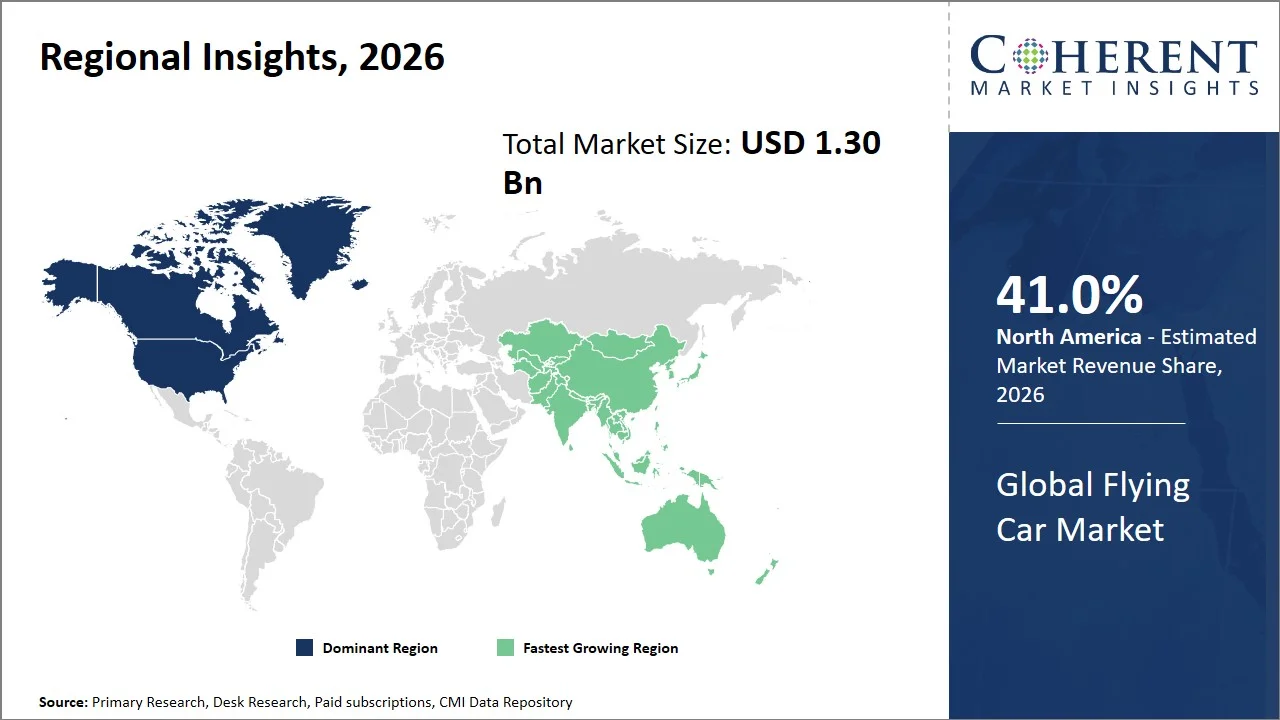
- North America is expected to dominate the flying car market in 2026 with a market share of 41.0%. Expansion of defense and surveillance operations in North America is driving the growth of the regional market. On July 20, 2026, Anduril and Archer Aviation unveiled their jointly-developed autonomous VTOL aircraft platform, built to serve both defense and commercial applications. Anduril showcased the defense variant, Thunder, a Group 5 autonomous attack rotorcraft specifically designed to multiply the combat power of current and next-generation crewed attack and assault aircraft.
- Asia Pacific is expected to account for 32.0% of the market share in 2026 and is projected to record the fastest growth over the forecast period. Infrastructure development for urban air mobility ecosystems across Asia Pacific is driving the growth of the regional market. In February 2026, SkyDrive partnered with Skyports Infrastructure to demonstrate a fully operational temporary vertiport during public eVTOL flight demonstrations in Japan.
Segmental Insights
Why Do Passenger Flying Cars Dominate the Global Flying Car Market?
The passenger flying cars segment is expected to account for 71.0% of the global flying car market share in 2026. Passenger flying cars make for the largest proportion of market demand because urban air mobility projects are largely aimed to transport people rather than freight. Governments, aviation authorities, and manufacturers are prioritizing passenger-focused electric vertical takeoff and landing (eVTOL) aircraft for air taxi services, airport shuttles, and short-distance urban commuting, supported by extensive investments in certification, vertiport infrastructure, and commercial pilot programs. This significant emphasis on reducing urban congestion and enabling speedier point-to-point transportation has propelled the commercialization and deployment of passenger flying cars ahead of cargo-focused platforms, making this segment the dominant contributor to market growth. On April 27, 2026, Joby Aviation, Inc. announced the successful completion of the first point-to-point electric vertical takeoff and landing (eVTOL) air taxi demonstration flights in the history of New York City and the beginning of a weeklong public campaign across the city’s current heliport network.
- Current Industry Events of 2026
- Market Size Estimation
- Regional Breakdown
- Competitive Landscape
- Customer Intelligence
- Segmental Analysis
- Pricing Analysis
- Key Market Drivers, Challenges & Future Trends
- Customized Insights Section
Why is Battery Electric the Most Preferred Propulsion Type?
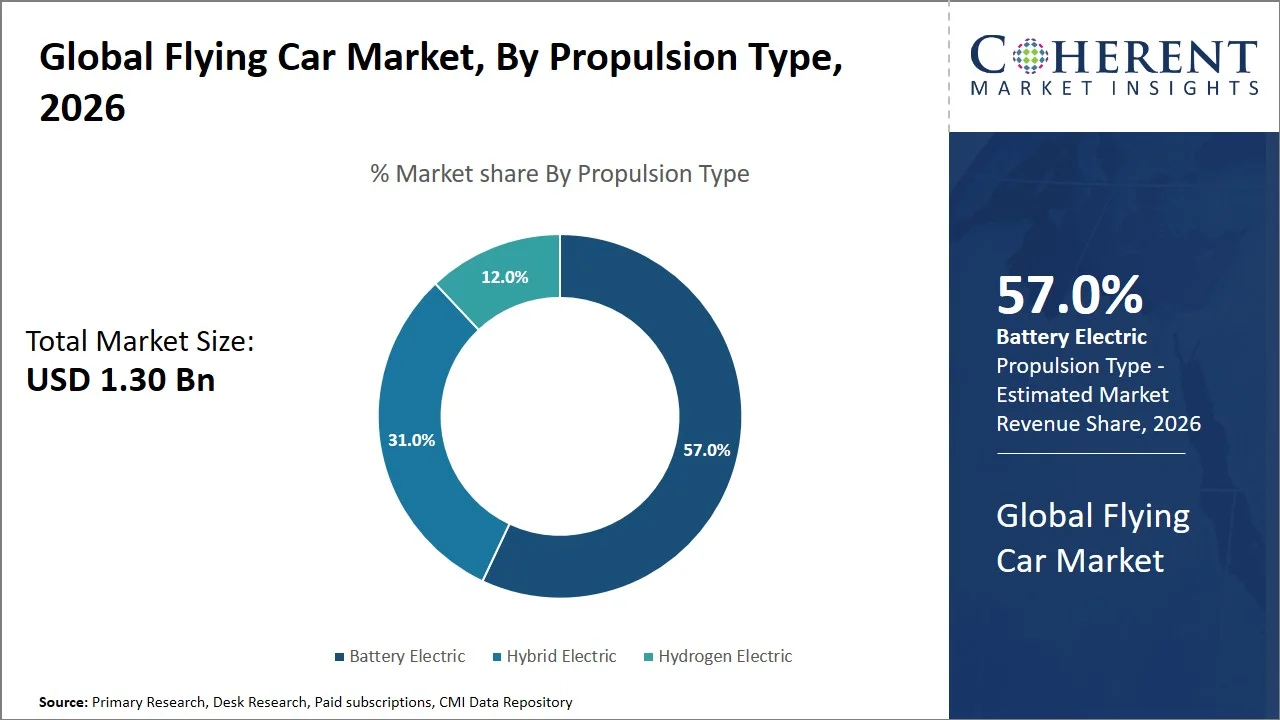
The battery electric segment is expected to account for 57.0% of the global flying car market share in 2026. Battery electric propulsion is the most favored propulsion type as it is most consistent with global aviation decarbonization goals and the growing electric vertical takeoff and landing (eVTOL) aircraft designs. Battery electric systems have been the preferred alternative for urban air transportation applications due to the development of high energy density lithium-based batteries, electric motors and power management systems which has resulted to quieter operation, reduced maintenance requirements and zero direct emissions during flight. Regulatory support for sustainable aviation and increased investment in electric aircraft infrastructure are also accelerating the adoption of battery electric propulsion throughout commercial flying car development programs. In July 2026, Vertical Aerospace took its battery-electric VX4 eVTOL to the Farnborough International Airshow to highlight ongoing advances in electric propulsion and to announce a hybrid-electric version to complement the type for longer-range missions. The company reiterated that its flagship commercial aircraft is still entirely battery electric.
Piloted Segment Dominates the Global Flying Car Market
The piloted segment is expected to account for 46.0% of the global flying car market share in 2026. The major share of the industry belongs to piloted flying cars because existing aviation certification frameworks and safety rules are built for human-operated aircraft. Piloted platforms will get to market the fastest since regulators want to see a lot of validation of autonomous flying systems before they are allowed to be used commercially. Most commercial flying vehicle firms are therefore targeting piloted, electric vertical takeoff and landing (eVTOL) aircraft for early passenger transport services, enabling earlier certification, operational approval and public acceptance as autonomous capabilities advance. On March 13, 2026, Joby Aviation, Inc. announced the completion of a series of demonstration flights across the San Francisco Bay Area. With one of the world’s most recognizable skylines as a backdrop, the company showcased its operational readiness in a region defined by traffic congestion.
Current Events and their Impact
Current Events | Description and its Impact |
European Union - European Union Aviation Safety Agency AI Roadmap 2.0 |
|
United States - FAA Special Federal Aviation Regulation for Powered-Lift Pilot Certification |
|
Global Flying Car Market Dynamics
Market Drivers
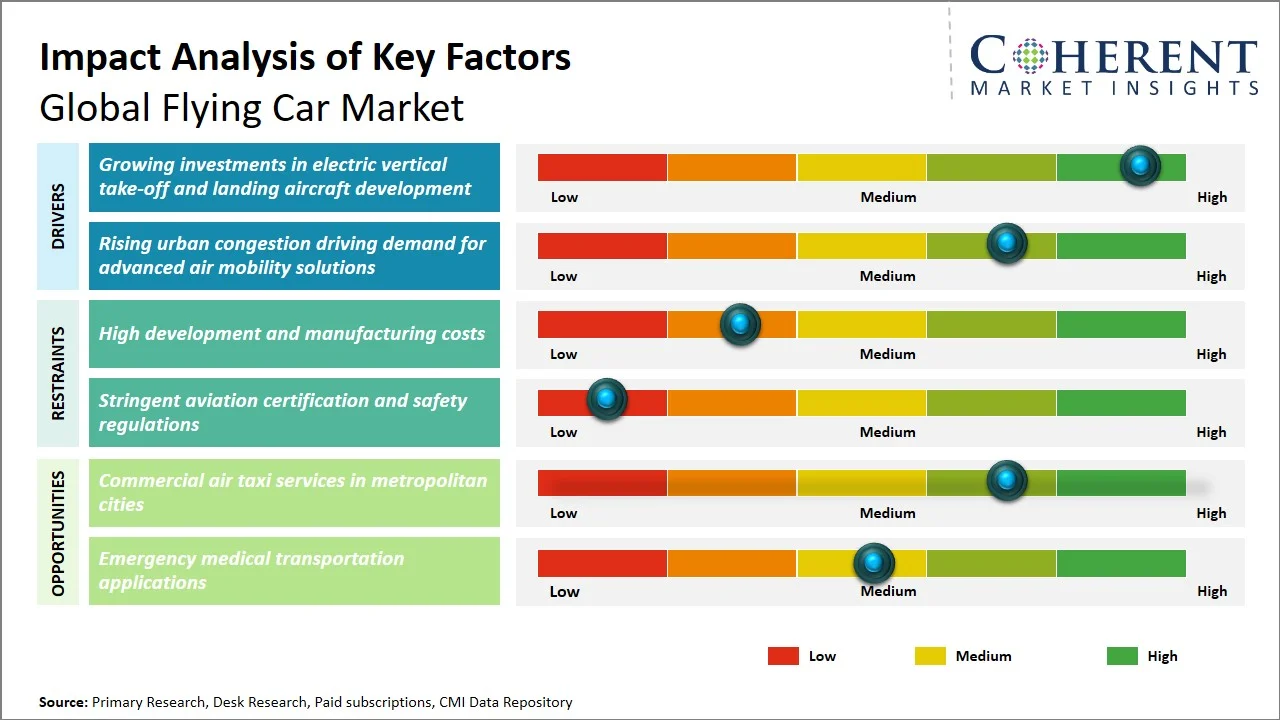
Growing investments in electric vertical take-off and landing aircraft development
The electric vertical take-off and landing (eVTOL) aircraft development is witnessing a surge in investment as aerospace manufacturers, automotive companies, venture capital firms, and government-backed innovation programs ramp up commercialization efforts. Companies including Joby Aviation, Archer Aviation, Vertical Aerospace, Beta Technologies and Eve Air Mobility are ramping up aircraft testing, manufacturing facilities, battery technology development and certification efforts to get commercial passenger services to market. These investments are also accelerating development of lightweight materials, electric propulsion, autonomous flight technology and scalable production capabilities, further bolstering the global flying car ecosystem. On January 7, 2026, Joby Aviation, Inc. stated that it has entered into an agreement to acquire a manufacturing facility of more than 700,000 square feet located in the Dayton, Ohio area. The facility is ready for use now and will first support Joby’s plans to treble production to four aircraft per month in 2027 and also provide room for major future growth.
Rising urban congestion driving demand for advanced air mobility solutions
Increasing traffic congestion in major metropolitan areas is driving demand for advanced air mobility solutions that can enable faster point-to-point transit while reducing dependence on congested road networks. Governments and city planners are backing pilot projects of urban air mobility by building vertiports, integrating digital air traffic management systems and providing regulatory frameworks for commercial eVTOL operations. Hence, flying cars are being promoted as a viable transportation solution for airport transfers, business trips, emergency services and short distance urban travel, driving the market penetration rate in congested cities. On July 2, 2025, Archer Aviation announced the successful completion of an initial flight of its Midnight aircraft at Al Bateen Executive Airport in Abu Dhabi, marking a key milestone for its planned commercial deployment in the U.A.E and the expansion of its operations in the Middle East region.
Emerging Trends
Rapid commercialization of electric vertical takeoff and landing aircraft
Manufacturers are transitioning from prototype development to certification and commercial deployment of electric vertical takeoff and landing (eVTOL) aircraft, with pilot programs expanding in urban air mobility corridors, airport shuttle services, and regional passenger transportation.
Expansion of vertiport infrastructure and digital air traffic management
Governments, airports and infrastructure developers are investing in dedicated vertiports, charging facilities and digital unmanned traffic management systems to help safely integrate flying cars into existing airspace and urban transportation networks.
Growing adoption of artificial intelligence and autonomous flight technologies
Flying car developers are increasingly leveraging artificial intelligence for flight control, obstacle detection, predictive maintenance and navigation assistance, and gradually progressing towards higher levels of autonomous operation as certification frameworks mature.
Increasing partnerships between aerospace manufacturers, automotive companies, and technology firms
Strategic collaborations are accelerating the development of aircraft by combining aviation know-how, electric vehicle technologies, battery innovation, software platforms and advanced manufacturing capabilities to speed up commercialization timelines and improve operational efficiencies.
Regional Insights
Why is North America a Strong Market for Flying Cars?
North America is expected to account for a market share of 41.0% in 2026. North America is still the global center of innovation in flying cars, with a high concentration of certified eVTOL developers, advanced aerospace suppliers, and supportive legislative activities. In the US, companies like as Joby Aviation, Archer Aviation, Beta Technologies, Wisk Aero and Pivotal are among the leaders in the field, and are performing significant flight testing and certification work with the Federal Aviation Administration (FAA).
Archer Aviation has completed construction of its high-volume manufacturing facility in Georgia with an initial planned production capacity of up to 650 aircraft per year, while Joby Aviation has expanded piloted transition flights and entered into a partnership with Delta Air Lines to develop airport shuttle services in New York and Los Angeles. Beta Technologies has built ALIA aircraft for military and commercial evaluation and set up a statewide charging network for electric aircraft. Canada bolsters the regional supply chain with Horizon Aircraft’s hybrid eVTOL research and strong aerospace manufacturing presence in Quebec and Ontario.
Why Does the Asia Pacific Flying Car Market Exhibit High Growth?
Asia Pacific is projected to account for 32.0% of the global flying car market in 2026 and is expected to register the fastest growth. Asia Pacific is emerging as one of the fastest growing regions with strong government support, extensive urban air mobility demonstration programs and local aircraft manufacturing capabilities. China, Japan, South Korea, Singapore and Australia all have active programs to establish low-altitude aviation ecosystems with specialized rules and infrastructure investments. China’s drive for a low altitude economy has sped up the commercial roll-out of autonomous passenger aircraft. Japan is advancing preparations for advanced air mobility services for urban travel through public-private partnerships. South Korea’s K-UAM Grand Challenge has conducted many flight demonstrations using integrated air traffic management systems, and Singapore has remained active testing urban air mobility through the Civil Aviation Authority of Singapore and infrastructure planning surrounding Changi Airport. Regional battery producers such as CATL, Panasonic Energy and LG Energy Solution are also supporting the development of eVTOL with sophisticated lithium battery technologies.
Global Flying Car Market Outlook for Key Countries
Why is the U.S. Emerging as a Major Hub in the Flying Car Market?
The U.S. has taken the lead in global commercial flying car development, due to regulatory improvements, manufacturing growth and considerable investment. The Federal Aviation Administration has developed a new powered-lift pilot certification system that is a direct benefit to commercial eVTOL operations. Joby Aviation has performed dozens of piloted transition flights between vertical and forward flight as it moves through the FAA type certification process. Archer Aviation is getting ready to deploy its Midnight aircraft for commercial air taxi operations through collaborations with United Airlines and wants to begin service in key urban regions to start. Wisk Aero, backed by Boeing, is still working on its sixth-generation completely autonomous aircraft, while Beta Technologies has gathered thousands of miles of demonstration flights and built electric charging infrastructure in various states. NASA also continues to assist enhanced air mobility research and development through its airspace integration and flight operations initiatives.
Is China the Next Growth Engine for the Flying Car Market?
China is one of the most active flying car markets in the world due to strong legislative backing for the low-altitude economy and rapid commercialization of autonomous eVTOL aircraft. EHang has been the first firm in China to get a type certificate, a production certificate and a standard airworthiness certificate for its autonomous passenger aircraft EH216-S, allowing it to operate commercially subject to regulatory approval. A number of province governments, like as Guangdong and Anhui, have announced specific investment projects for the development of low-altitude aviation infrastructure and urban air mobility. Car makers like Xpeng AeroHT are creating modular flying cars that are electric road vehicles with detachable flight modules. Vertaxi and AutoFlight are still doing their cross-city demonstration flights. Several Chinese towns are also building vertiports and low altitude aircraft corridors to facilitate future passenger services.
Germany Flying Car Market Analysis and Trends
Owing to its aerospace engineering knowledge and strong industrial ecosystem, Germany is Europe’s hub for flying car development. Munich-based Lilium has developed its all-electric Lilium Jet with multiple ducted electric motors for regional passenger transport while Bruchsal-based Volocopter has accomplished a number of public demonstration flights in locations including Singapore, Paris, Rome and Osaka. German aerospace vendors like Bosch, Siemens and regional operations of Honeywell are providing avionics, electric propulsion components, automation systems and digital engineering solutions for eVTOL programs. The country also benefits from research by the German Aerospace Center (DLR), supporting electric propulsion, autonomous flight technologies and integration of urban air mobility through several collaborative research efforts.
Japan Flying Car Market Analysis and Trends
Japan is aiming to become a leading market for commercial flying cars, with synchronized policies from the government and cooperation from industry. SkyDrive has already undertaken public demonstration flights and is in the process of preparing for commercial operations with its three-seat SD-05 aircraft. The Japanese government has integrated advanced air mobility into its national transportation strategy and the Ministry of Land, Infrastructure, Transport and Tourism has set certification procedures and operational standards for eVTOL aircraft. Osaka has become a leading testing ground, with operations for flying cars planned around the Expo 2025 site and the city’s urban regions. Major companies such as Suzuki, Toyota, Japan Airlines, ANA Holdings, and Mitsubishi Electric have invested in the development of aircraft, manufacturing, mobility services, and supporting technology, establishing one of the world’s most comprehensive ecosystems for advanced air mobility.
U.K. Flying Car Market Analysis and Trends
The U.K. is developing its flying car industry through legislative innovation, aeronautical expertise and advanced flight testing programs. Vertical Aerospace is developing the VX4 eVTOL aircraft and has done a lot of piloted flight testing while working towards certification with the UK Civil Aviation Authority and the European Aviation Safety Agency. The Future Flight Challenge, which has sponsored many advanced air mobility initiatives involving airports, air navigation service providers, universities and aircraft companies, is backed by Innovate UK. Airports like Heathrow and Bristol and others are looking into introducing vertiports into future passenger operations, while businesses such as Skyports Infrastructure are readying dedicated landing facilities and digital operational systems. The U.K. also has a strong aerospace supply chain with companies such as Rolls-Royce, GKN Aerospace and BAE Systems, which can provide sophisticated propulsion technologies, lightweight structures and aircraft systems that support next generation flying vehicles.
Global Flying Car Market - Number of Operational and Planned Vertiports by Country (2025)
Country | Operational Vertiports (2025) |
China | 6 |
U.S. | 5 |
U.A.E | 2 |
Japan | 2 |
South Korea | 1 |
U.K. | 1 |
France | 1 |
Germany | 1 |
How are Commercial Air Taxi Services in Metropolitan Cities Creating New Growth Opportunities in the global flying car market?
Commercial air taxi services in metropolitan cities are creating significant growth opportunities by establishing the first revenue-generating business model for flying car manufacturers and operators. Metropolitan commercial air taxi services are offering a strong growth opportunity by developing the first revenue producing business model for flying car makers and operators. At the same time, companies such as Joby Aviation and Archer Aviation are working to build airport shuttle networks between major aviation hubs and downtowns of Los Angeles and New York in cooperation with Delta Air Lines and United Airlines, with an aim to cut the travel time to less than 20 minutes on routes that usually take more than an hour by road during rush hours. Joby Aviation has inked arrangements to operate commercial air taxi services in Dubai, with Skyports Infrastructure building specialized vertiports in the U.A.E to support the service.
On the other side, Volocopter has teamed up with Jet Systems Hélicoptères Services and Groupe ADP to provide urban air transportation services in Paris. In Japan, SkyDrive is getting ready for commercial passenger operations in Osaka with the help of Osaka Metro and local government, and in China, EHang has begun to grow its commercial low-altitude sightseeing and urban passenger transport services with its approved EH216-S aircraft. These city-specific deployments are expediting aircraft certification, vertiport investments, fleet procurement, digital air traffic management and mobility-as-a-service platforms, providing new long-term income prospects across the global flying car sector.
On June 30, 2025, Joby Aviation and Dubai’s Roads and Transport Authority announced they are working to expedite preparations for Dubai Air Taxi with commercial operations expected in 2026. The project will comprise dedicated vertiports connecting Dubai International Airport, Palm Jumeirah, Dubai Marina and Downtown Dubai to create one of the world’s first electric air taxi networks throughout an entire city.
Market Players, Key Development, and Competitive Intelligence
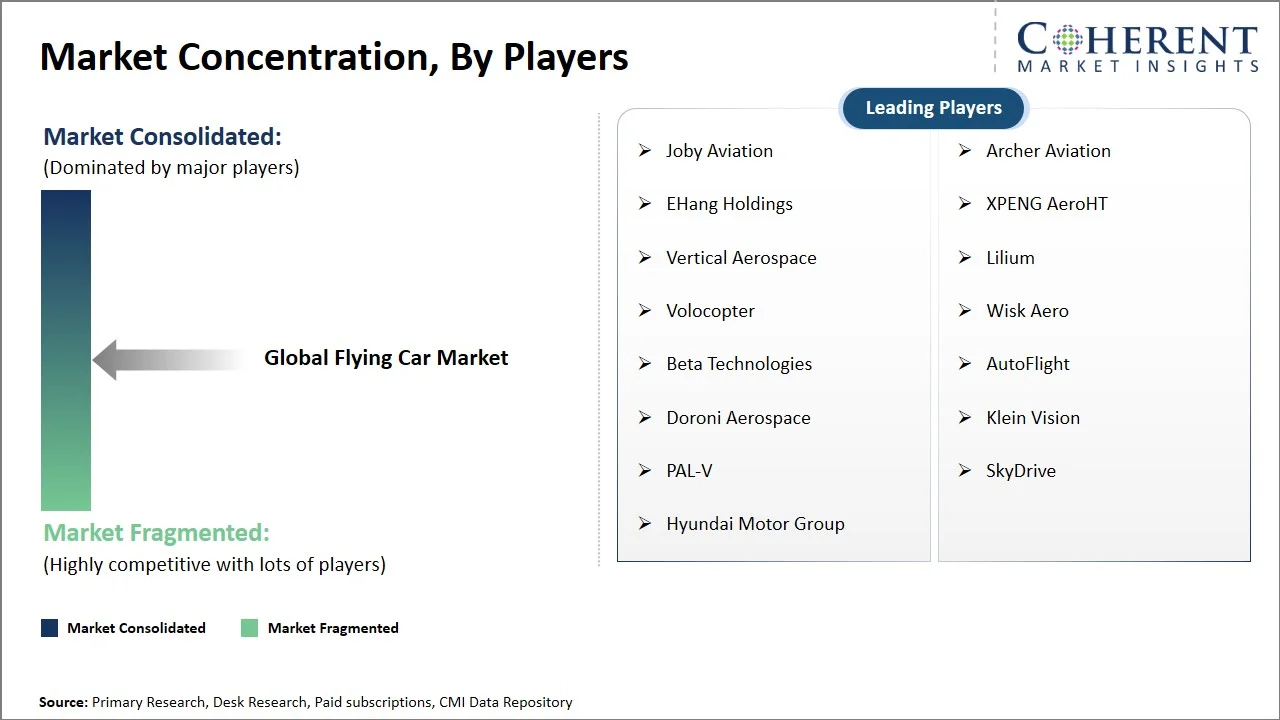
Key Developments
- On March 11, 2026, Joby Aviation, Inc., a company developing electric air taxis for commercial passenger service, announced that it has begun flight testing its first FAA-conforming aircraft for Type Inspection Authorization (TIA), a major step on the path to type certification.
- On August 18, 2025, Archer Aviation announced that its Midnight aircraft successfully completed its longest piloted flight to date, flying approximately 55 miles in 31 minutes at speeds exceeding 126 mph. The flight took place at Archer’s flight test facility in Salinas, California, in front of United Airlines’ Chief Financial Officer, Mike Leskinen, who led United Airlines’ early investment in Archer.
Competitive Landscape
The competitive landscape is led by Joby Aviation, Archer Aviation, EHang, Lilium, Volocopter, Beta Technologies, Wisk Aero, and SkyDrive, with competition centered on aircraft certification, manufacturing scale-up, airline partnerships, and vertiport ecosystem development rather than prototype creation. Joby Aviation is focusing on FAA type certification while leveraging its partnership with Delta Air Lines to establish airport shuttle services in the U.S. Archer Aviation is also rapidly progressing toward commercialization with its large-scale manufacturing plant in Georgia and partnerships with United Airlines, Stellantis and Abu Dhabi Aviation to enable fleet deployment and production.
EHang has received China’s type certificate, manufacturing certificate and standard airworthiness certificate for the EH216-S, enabling it to commercialize autonomous passenger flights ahead of most of its competitors. While Wisk Aero is continuing to invest in completely autonomous sixth-generation aircraft supported by Boeing, Beta Technologies is differentiating itself by developing passenger aircraft and a national electric aircraft charging network. SkyDrive is looking at early commercial operations in Japan with partners Suzuki and Osaka Metro, while Volocopter and Lilium are concentrating on European certification, urban air mobility networks and relationships with airport operators and infrastructure developers.
Market Report Scope
Flying Car Market Report Coverage
| Report Coverage | Details | ||
|---|---|---|---|
| Base Year: | 2025 | Market Size in 2026: | USD 1.30 Bn |
| Historical Data for: | 2020 To 2024 | Forecast Period: | 2026 To 2033 |
| Forecast Period 2026 to 2033 CAGR: | 18% | 2033 Value Projection: | USD 19 Bn |
| Geographies covered: |
| ||
| Segments covered: |
| ||
| Companies covered: | Joby Aviation, Archer Aviation, EHang Holdings, XPENG AeroHT, Vertical Aerospace, Lilium, Volocopter, Wisk Aero, Beta Technologies, AutoFlight, Doroni Aerospace, Klein Vision, PAL-V, SkyDrive, and Hyundai Motor Group | ||
| Growth Drivers: |
| ||
| Restraints & Challenges: |
| ||
Analyst Opinion (Expert Opinion)
- The future of the industry is expected to be determined by certification success and commercial route deployment rather than aircraft performance alone. Companies capable of achieving regulatory approval and establishing operational passenger services before 2030 are likely to secure long-term contracts with airlines, airports, municipalities, and mobility operators, creating strong barriers for late entrants.
- The largest opportunity is anticipated to be in battery electric passenger flying cars for commercial air taxi operations in the U.S., China, the U.A.E and Japan, where governments are actively developing vertiports, low altitude airspace management systems and certification frameworks. The first large-scale commercial uses are expected to be airport-city shuttle routes and premium urban commuter services, because of their predictable flight pathways and considerable demand for shortened trip time.
- Emphasis should be on regulatory certification, scalable production and strategic ecosystem collaborations, not just on aircraft development. Competitive advantage will come from partnerships with airlines, airport operators, battery manufacturers, charging infrastructure providers and digital air traffic management companies, and investments in battery energy density, autonomous flight software and lifecycle operating cost reduction will be the key differentiators during commercial expansion.
Speak to the analyst
Want personalized insights?
Take the findings above to one of our principal consultants, or have the report rebuilt around the segments, geographies and competitors you actually track.
Market Segmentation
- Vehicle Type Insights (Revenue, USD Billion, 2021 - 2033)
- Passenger Flying Cars
- Cargo Flying Cars
- Propulsion Type Insights (Revenue, USD Billion, 2021 - 2033)
- Battery Electric
- Hybrid Electric
- Hydrogen Electric
- Mode Of Operation Insights (Revenue, USD Billion, 2021 - 2033)
- Piloted
- Autonomous
- Semi Autonomous
- Take Off Type Insights (Revenue, USD Billion, 2021 - 2033)
- eVTOL
- STOL
- CTOL
- Seating Capacity Insights (Revenue, USD Billion, 2021 - 2033)
- One Person
- Two Person
- Four Person
- More Than Four Person
- End User Insights (Revenue, USD Billion, 2021 - 2033)
- Commercial
- Personal
- Government and Defense
- Emergency Medical Services
- Regional Insights (Revenue, USD Billion, 2021 - 2033)
- North America
- U.S.
- Canada
- Latin America
- Brazil
- Argentina
- Mexico
- Rest of Latin America
- Europe
- Germany
- U.K.
- Spain
- France
- Italy
- Russia
- Rest of Europe
- Asia Pacific
- China
- India
- Japan
- Australia
- South Korea
- ASEAN
- Rest of Asia Pacific
- Middle East
- GCC Countries
- Israel
- Rest of Middle East
- Africa
- South Africa
- North Africa
- Central Africa
- North America
Sources
Primary Research Interviews
- Heads of Flight Test Engineering
- Aerospace Systems Engineers
- Battery Technology Specialists for electric aircraft
- Vertiport Infrastructure Developers
Magazines
- Aerospace America
- Aviation Week & Space Technology
- Flight International
- Airline Business
Journals
- AIAA Journal of Aircraft
- AIAA Journal of Air Transportation
- AIAA Journal of Aerospace Information Systems
- Journal of Air Transport Management
Associations
- Aerospace Industries Association (AIA)
- American Institute of Aeronautics and Astronautics (AIAA)
- International Air Transport Association (IATA)
- General Aviation Manufacturers Association (GAMA)
- Vertical Flight Society (VFS)
Public Domain Sources
- Federal Aviation Administration (FAA)
- European Union Aviation Safety Agency (EASA)
- International Civil Aviation Organization (ICAO)
- U.S. Department of Transportation (USDOT)
- National Aeronautics and Space Administration (NASA)
Proprietary Elements
- CMI Data Analytics Tool
- Proprietary CMI Existing Repository of Information for the Last 10 Years
Get access to 250+ pages report
Every segment, forecast, competitor profile and data table behind the analysis above — available for instant download.
- ESOMAR Member
- ISO 9001:2015 Certified
- D-U-N-S Registered
- GDPR & CCPA Compliant
Missing comfort of reading report in your local language? Find your preferred language:
Transform your Strategy with Exclusive Trending Reports
Frequently Asked Questions
The global flying car market is expected to stand at USD 1.30 Bn in 2026 and is expected to reach USD 19 Bn by 2033.
The CAGR of the global flying car market is projected to be 18% from 2026 to 2033.
Growing investments in electric vertical take-off and landing aircraft development and rising urban congestion driving demand for advanced air mobility solutions are the major factors driving the growth of the global flying car market.
High development and manufacturing costs and stringent aviation certification and safety regulations are the major factors hampering the growth of the global flying car market.
In terms of vehicle type, the passenger flying cars segment is estimated to dominate the market revenue share in 2026.
Governments are introducing certification frameworks, low-altitude airspace regulations, and infrastructure development programs.
They reduce direct emissions and noise pollution by using electric propulsion technologies.