

Food Dehydrator Market Size and Forecast – 2026 To 2033
The Global Food Dehydrator Market is projected to grow from USD 2.36 Bn in 2026 to USD 3.52 Bn by 2033, reflecting a compound annual growth rate (CAGR) of 5.9% over the forecast period. The global food dehydrator market is gaining steady traction as food manufacturers, retailers, foodservice operators, and consumers increasingly prefer shelf stable, lightweight, and easy-to-store food products. Dehydrated food includes fruits, vegetables, meat, seafood, dairy powders, herbs, spices, soups, ready meals, instant mixes, and snack ingredients produced through air drying, spray drying, freeze drying, vacuum drying, drum drying, and osmotic dehydration.
Food waste reduction is also supporting the demand for preservation technologies. The U.S. Department of Agriculture (USDA) estimates that food waste in the U.S. accounts for 30–40% of the food supply, while Food and Agriculture Organization (FAO) reported in 2025 that fruits and vegetables have the highest global food loss rate at 25.4%. This creates demand for equipment that can convert surplus produce into shelf-stable dried products. (Source: U.S. Food and Drug Administration)
Key Takeaways of the Global Food Dehydrator Market
- Shelf or cabinet food dehydrators are expected to be the top food dehydrator product type in 2026, capturing 38.4 % of the market share in 2026. The advantage of these models is that they have higher drying capacity, better airflow distribution, operate using a tray, and are suitable for premium users at home, for jerky makers, small food processors and commercial kitchen requirements.
- Residential is expected to be the largest end user segment of the food dehydrator market, accounting for 51.4 % share in 2026. Factors driving this segment include home food preservation, healthy snacking, homemade jerky, dried fruit, garden products preservation, and making pet treats.
- Higher penetration of home food preserving appliances, high consumption of jerky products, internet access, and availability of brands like Excalibur, NESCO, COSORI, Presto, Hamilton Beach, LEM Products, and Brod & Taylor, drive the North America food dehydrator market, which is expected to account for approximately 34.8 % of the market share in 2026.
- Asia Pacific is expected to be the fastest-growing region in the global food dehydrator market, accounting for a market share of 22.8 % in 2026. This growth can be attributed to the high production of fruits and vegetables in the region, the increasing awareness about the escalating post-harvest losses, and the increased adoption of small-scale food processing. Dehydrators for producing dried fruits, vegetable flakes, spice powders, herbs, snacks and farm level value addition are seeing strong demand in countries such as India, China, Indonesia, Vietnam, and Thailand. Government assistance for food processing, growth in packaged healthy snack foods and more entrepreneurship in rural areas is anticipated to result in more dehydrators being used throughout the region.
- Food Waste Reduction Alignment: Dehydrators can be used for seasonal foods, meat, herbs and snacks to extend shelf life, and for the world to reduce food waste and promote sustainable consumption.
Segmental Insights
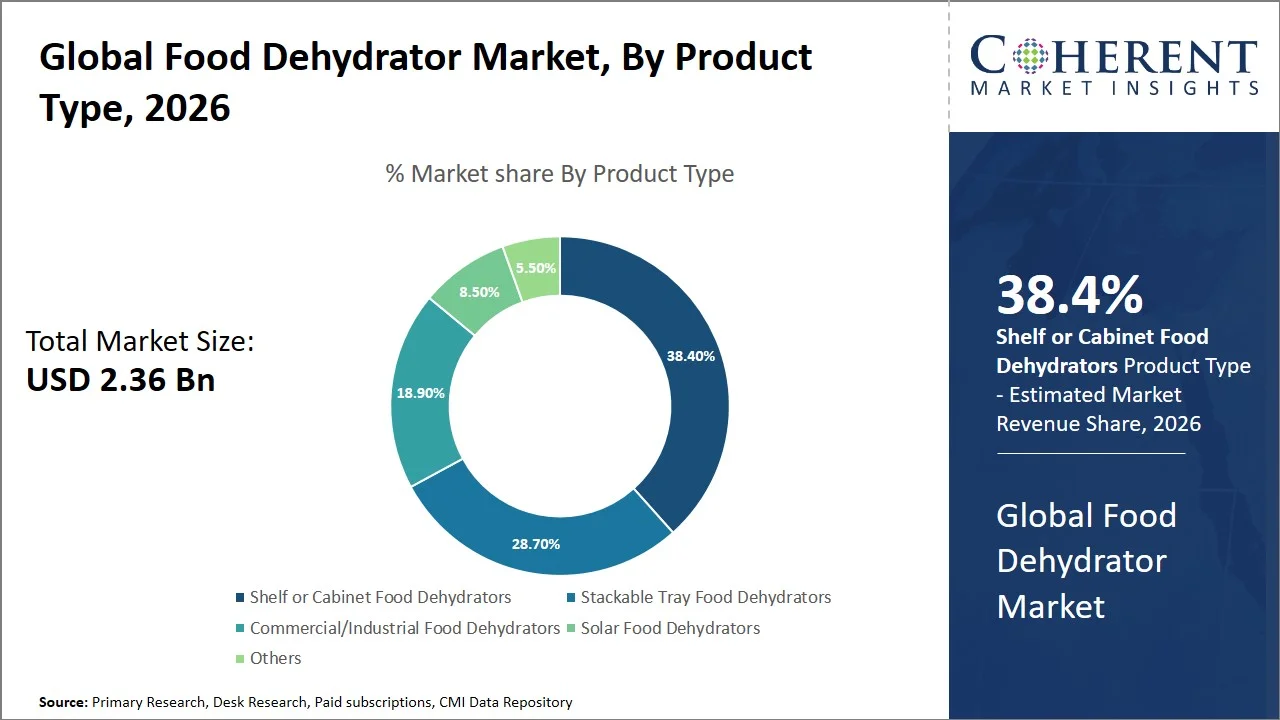
Why are Shelf or Cabinet Food Dehydrators the Most Preferred Product Type?
The food dehydrator market is expected to be dominated by the self or cabinet dehydrators segment based on product type in 2026, with a market share of 38.4% respectively, because they offer larger drying area, uniform airflow and can be used for batch processing.
For instance, Excalibur’s 10-tray stainless-steel dehydrator provides 16 sq. ft. of drying space, while Brod & Taylor’s Sahara Folding Dehydrator provides more than 11 sq. ft. of drying area, dual heaters, filtered air intake, dual time/temperature controls, and glass doors. (Source: Excalibur)
- Current Industry Events of 2026
- Market Size Estimation
- Regional Breakdown
- Competitive Landscape
- Customer Intelligence
- Segmental Analysis
- Pricing Analysis
- Key Market Drivers, Challenges & Future Trends
- Customized Insights Section
Which End User Segment Dominates the Food Dehydrator Market?
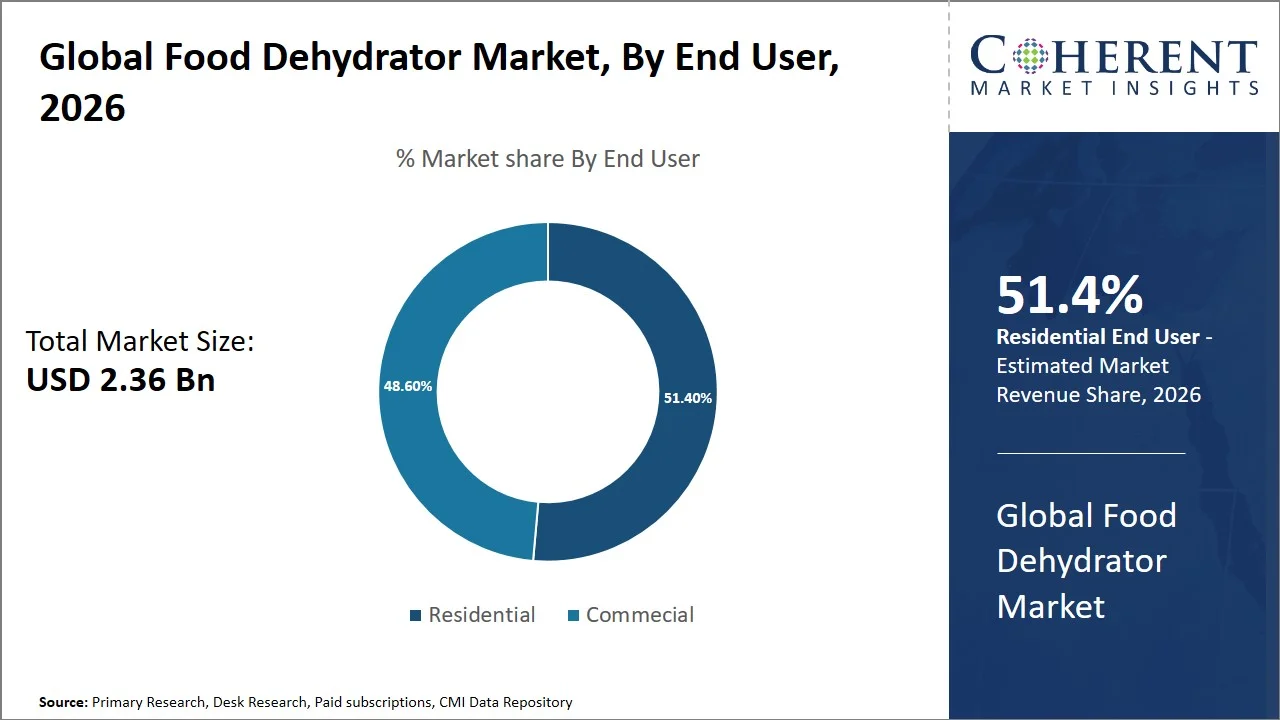
The residential segment’s dominance with an expected market share of 51.4% in 2026 can be attributed to the increasing household consumption of dehydrated snacks (no sugar added), dried fruits, dried vegetables, fruit rolls, homemade jerky, garden produce preservation and pet treats. Dried foods are light, compact, and do not need refrigeration, so dehydrators can be beneficial in the home, for backpacking, or camping.
Product-level evidence also supports residential demand. Presto’s Dehydro electric food dehydrator is positioned for homemade jerky, fruits, vegetables, and pet treats, while COSORI’s 6-tray stainless-steel dehydrator offers a 48-hour timer and adjustable thermostat from 95°F to 165°F. (Source: COSORI’s)
Current Events and their Impact
Current Events | Description and its Impact |
Food Safety Standards for Dried Products |
|
Product Innovation in High-Capacity Digital Dehydrators |
|
Electrical Safety Scrutiny in Dehydrators |
|
Global Food Dehydrator Market Dynamics
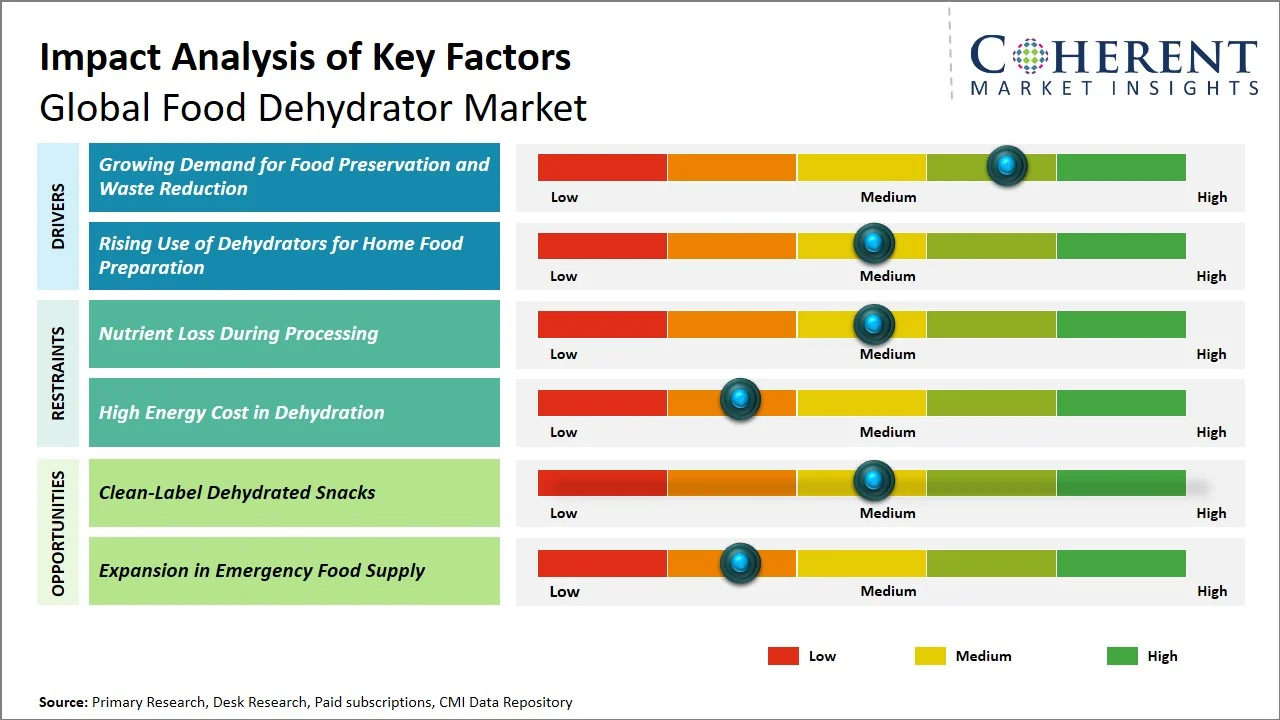
Market Drivers
- Growing Demand for Food Preservation and Waste Reduction: Post-harvest losses and waste concerns are increasing due to growing food waste and are boosting the demand for food preservation equipment. Food dehydrators are an effective way to make watery foods like fruits, vegetables, herbs, meat and excess produce into dry foods like dehydrated snacks, powders, and shelf-stable ingredients, which extend the food shelf life. The Food and Agriculture Organization (FAO) states that 13.2% of food is lost after harvest and before retail, while USDA estimates that 30–40% of the U.S. food supply is wasted, supporting the need for preservation-led waste reduction. (Source: FAO)
- Rising Use of Dehydrators for Home Food Preparation: Consumers are using dehydrators more often for dried fruits, vegetable chips, fruit leathers, pumpkin seeds, beef jerky, herbs and for lightweight food storage. According to the National Center for Home Food Preservation, the modern dehydrator will enable year-round drying of fruit leathers, banana chips, pumpkin seeds and beef jerky, and dried foods are light, space-saving and do not need refrigeration. In addition, FDA points out that the removal of moisture will limit microbial proliferation, which is the reason for the demand for dehydrators featuring controlled temperature, airflow and timer features. (Source: National Center for Home Food Preservation)
Emerging Trends
- Shift Toward Smart and Programmable Dehydrators: Digital dehydrators are gaining traction among residential and semi-commercial users as consumers increasingly prefer appliances with adjustable thermostats, long-duration timers, digital displays, and automatic shut-off functions. These features improve process control, reduce manual monitoring, and support consistent drying for fruits, vegetables, herbs, meat, and pet treats.
- Growing Demand for Large-Capacity Multi-Tray Systems: High-capacity tray-based dehydrators are becoming popular among gardeners, homesteaders, hunters, families, jerky makers, and small food processors. The trend is being driven by the need to process larger batches efficiently, especially for seasonal produce preservation, meat drying, and small-scale commercial snack production.
- Rising Adoption of Space-Saving Premium Designs: Foldable and compact premium dehydrators are emerging as an attractive category for urban households and premium home users. These models combine larger drying surfaces with space-saving storage, filtered airflow, dual heating, and automated time-temperature control, making them suitable for users seeking high performance without occupying permanent kitchen space.
Regional Insights
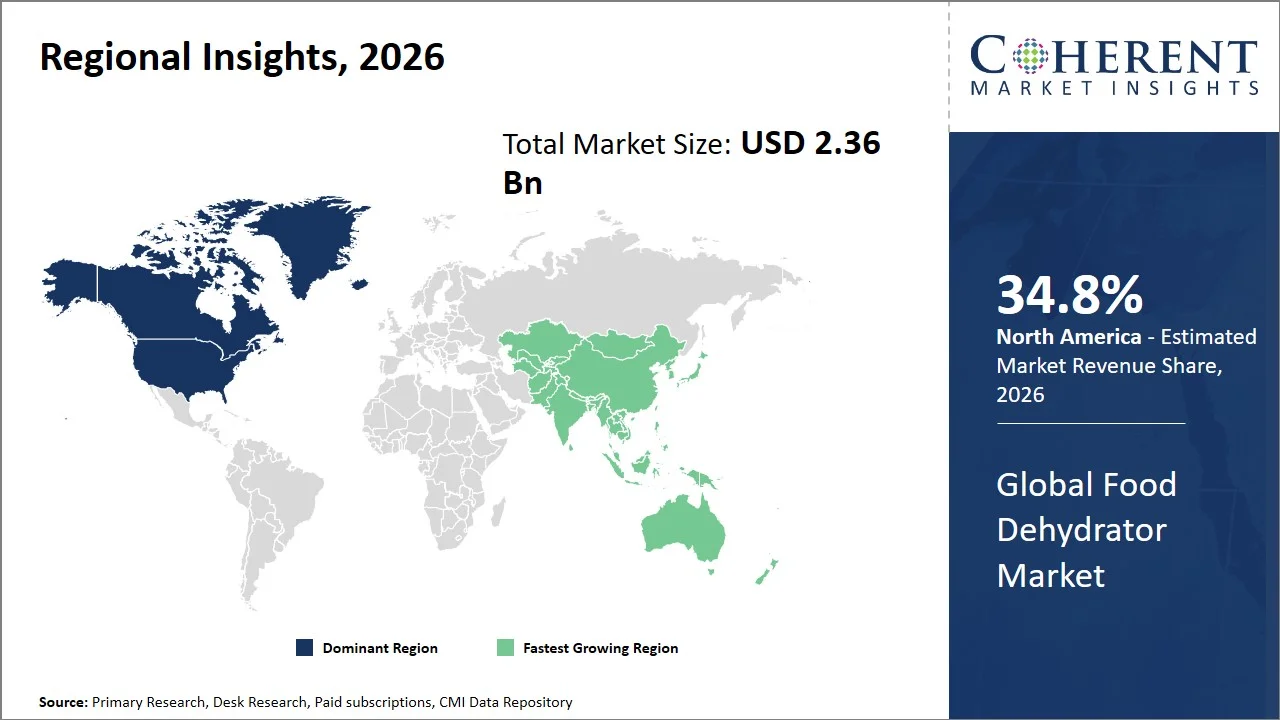
Why is North America a Strong Market for Food Dehydrators?
Driven by strong practices of home food preservation among the households, high adoption rate of homemade dried snacks and a high preference for jerky preparation in the region, North America is expected to lead the food dehydrator market with an estimated share of 34.8% in 2026. The food waste in the U.S., ranging from 30–40% of the food supply, represents a need for preservation equipment that can help preserve fruits, vegetables, herbs and meat products for a longer time. (Source: USDA)
Also, outdoors recreation adds to the food dehydrator market in North America, where dry foods are frequently used to prepare meals for outdoor use, including camping. In 2024, the outdoor recreation economy had a value of US$ 696.7 billion, representing 2.4% of the U.S. GDP, and was enjoyed by U.S. consumers, which makes it highly likely that consumers have a demand for portable and shelf-stable food preparation. (Source: Bureau of Economic Analysis)
For instance, LEM Products’ BigBite 10-Tray Stainless Steel Dehydrator is marketed for making beef jerky, snacks, fruits, and vegetables at home. The product features 10 sq. ft. of drying space, 10 stainless-steel trays, an 800-watt heating element, rear-mounted fan, and horizontal airflow vents for even drying. This supports North America’s demand for higher-capacity dehydrators used in home kitchens, hunting households, jerky preparation, and small-batch snack processing. (Source: LEM Products)
Why Does the Asia Pacific Food Dehydrator Market Exhibit High Growth?
Asia Pacific is expected to exhibit the fastest growth in the food dehydrator market, with an estimated 22.8% share in 2026. Growth is supported by high fruit and vegetable production, post-harvest loss concerns, rising small-scale food processing, and increasing adoption of value-added food products such as dried fruits, vegetable flakes, spice powders, herbs, and healthy snacks. (Source: FAO)
India is a key growth contributor as horticulture production reached 367.72 million tons in 2024–25, including 114.51 million tons of fruits and 219.67 million tons of vegetables. This creates a large raw material base for dried fruit, vegetable chips, flakes, powders, and small-scale processing units.
Government support is also improving the processing ecosystem. India’s Pradhan Mantri Krishi Sinchayee Yojana (PMKSY) supports creation and expansion of food processing and preservation capacities to improve shelf life and reduce wastage of agri-produce, while the Pradhan Mantri Formalization of Micro Food Processing Enterprises (PMFME) scheme supports micro food processing enterprises through subsidy and branding/marketing assistance.
Global Food Dehydrator Market Outlook for Key Countries
Why is the U.S. Leading Adoption in the Food Dehydrator Market?
There is a long history of house-hold food preservation in the U.S., as well as maturing awareness of food waste, outdoor recreation and high jerky consumption, which contributes to market maturity of the food dehydrator market. In the U.S., according to the Outdoor Industry Association report, in 2023, outdoor participation reached a record 175.8 million participants, representing 57.3% of Americans aged six and older, supporting demand for portable dehydrated foods used in hiking, camping, fishing, and travel. (Source: Outdoor Industry Association)
Is Canada a Favorable Market for Food Dehydrators?
Canada’s strong consumer awareness of food waste reduction, coupled with the country’s cold climate favorable for extended food storage and a population with high engagement in outdoor recreational activities, creates a compelling market opportunity. These factors collectively enhance demand for food preservation solutions, positioning the food dehydrator market as strategically attractive for growth and innovation. Food loss and waste reduction, including surplus food recovery and conversion to other food products, is a national priority recognized by the Government of Canada. This facilitates use of de-hydrators in households, farms and small-scale food treatment.
Is China Emerging as a Key Growth Hub for Food Dehydrators?
The national policy on food waste and high domestic fruit and vegetable production combined with the rising income of the Chinese people makes China a promising country for food dehydrator industry. In 2021, the Anti-Food Waste Law was passed to tackle food waste by means of responsibilities, incentives, and penalties in the Chinese context. The increasing income of urbanites also drives the demand for high-end kitchen products and healthy snack foods.
Why is Germany Important in the European Food Dehydrator Market?
Germany is a key market in Europe, with consumers having a high awareness of the need to reduce food waste, sustainable consumption and of premium kitchen appliances. The National Strategy for Food Waste Reduction in Germany includes the entire food chain (from production to processing, retail, restaurants, and households) and is part of the broader efforts to raise awareness for preservation-led food waste reduction. (Source: Federal Ministry of Agriculture)
Is India Developing as a High-Growth Food Dehydrator Market?
India is emerging as a high-growth food dehydrator market, with many horticulture crops being produced, a growing number of food processing entrepreneurs, and government support for micro food processing businesses. Considering India’s fruit and vegetable production reached 334.18 million tons in 2024–25 — including 114.51 million tons of fruits and 219.67 million tons of vegetables, food dehydrators are becoming increasingly relevant for mango, banana, onion, herbs, spices, vegetable flakes, fruit chips and powder production. (Source: E Three Hvac System And Solution)
Macro & Micro Economic Factors Impacting the Global Food Dehydrator Market
Market Factors | Impact on the Dehydrated Food Market |
Increasing Urbanization and Disposable Income | Increases demand for convenient, ready-to-eat, and shelf-stable food products. |
Inflation and Raw Food Price Volatility | It increases the cost of production and packaging, which impacts pricing and profit margins. |
Food Safety Standards and Trade Regulations | Influences exports, imports, labeling, quality compliance, and market entry. |
Changing Consumer Preferences | Increasing inclination towards healthy, organic, clean-label and nutrient-rich dehydrated foods is supporting the demand. |
Raw Material Availability | Seasonal supply fluctuations of fruits, vegetables, meat, and dairy affect production continuity. |
Competitive Prices & Distribution Network | Strong retail, ecommerce and distributor networks allow companies to boost sales and market penetration. |
Market Players, Key Development, and Competitive Intelligence
Key Developments
- In February 2025, NESCO introduced the 16-Tray Dual Zone Digital Dehydrator. The product includes 1,200 watts of power, stainless-steel housing, sixteen trays, two drip trays, two mesh sheets, internal lighting, glass front doors, and almost 10 sq. ft. of drying space.
- Brod & Taylor offers compact premium dehydration through its Sahara Folding Dehydrator. The product folds to one-third of its size and includes more than 11 sq. ft. drying area, dual heaters, filtered air intake, and automated time/temperature controls.
- Presto positions its Dehydro electric food dehydrator for household jerky, fruits, vegetables, and pet treats. The model includes a top-mounted fan and heating element for constant airflow, with expandable tray capacity.
Competitive Landscape
The Global Food Dehydrator Market is competitive across residential, commercial, and industrial equipment categories. In the residential segment, brands compete through compact countertop designs, stackable or multi-tray systems, digital timers, adjustable temperature controls, quiet operation, and easy-clean trays. For example, Excalibur focuses on precision drying with digital time and temperature controls and multi-tray formats, while COSORI and NESCO offer consumer dehydrators with adjustable thermostats, built-in timers, and tray-based drying systems for fruits, vegetables, herbs, and jerky.
Players are pitted against each other in the commercial segment by means of bigger trays, stainless steel build, more powerful heating systems, rear mounted fans, horizontal air flow and consistent drying system. Industrial equipment manufacturers specialize in customizable systems of conveyors, cabinets, tunnels, vacuum and freeze-drying equipment for bulk processing of fruit, vegetable, meat, seafood, snack and ready-to-eat food ingredients.
Meanwhile, niche brands are gradually taking market share with high-value preservation options like home freeze dryers and small smart dehydrators for health-conscious shoppers, small food businesses, homesteaders and emergency food storage enthusiasts. Competition is defined overall by the degree of efficiency of drying, the energy consumption, the capacity of the trays, the accuracy of the temperature, the food safety, the ease of cleaning and the design of equipment for the specific applications.
Market Report Scope
Food Dehydrator Market Report Coverage
| Report Coverage | Details | ||
|---|---|---|---|
| Base Year: | 2025 | Market Size in 2026: | USD 2.36 Bn |
| Historical Data for: | 2020 To 2024 | Forecast Period: | 2026 To 2033 |
| Forecast Period 2026 to 2033 CAGR: | 5.9% | 2033 Value Projection: | USD 3.52 Bn |
| Geographies covered: |
| ||
| Segments covered: |
| ||
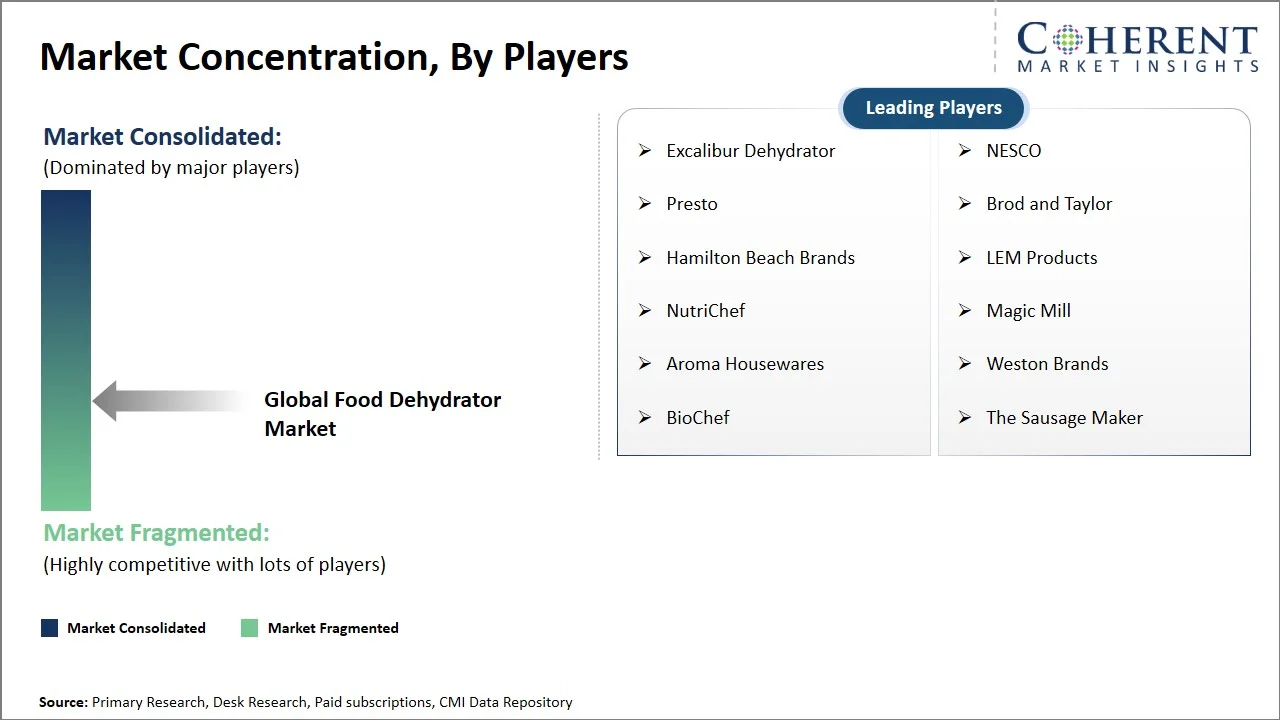
| Companies covered: | Excalibur Dehydrator, NESCO, Presto, Brod and Taylor, Hamilton Beach Brands, LEM Products, NutriChef, Magic Mill, Aroma Housewares, Weston Brands, BioChef, and The Sausage Maker | ||
| Growth Drivers: |
| ||
| Restraints & Challenges: |
| ||
Analyst Opinion (Expert Opinion)
- The food dehydrator market is shifting from a basic home-preservation appliance category to a broader healthy snacking, food safety, and small-scale processing equipment market. Demand will remain linked to food waste reduction, household preservation, clean-label snacks, homemade jerky, pet treats, and farm-level value addition.
- Maximum opportunity is expected in premium residential dehydrators, stainless-steel cabinet models, large-capacity digital dehydrators, and commercial tray systems. North America and Europe are expected to remain strong for premium home appliances, while Asia Pacific and Latin America may create opportunities through fruit, vegetable, herb, spice, and farm-level drying applications.
Speak to the analyst
Want personalized insights?
Take the findings above to one of our principal consultants, or have the report rebuilt around the segments, geographies and competitors you actually track.
Market Segmentation
- Product Type Insights (Revenue, USD Bn, 2021 - 2033)
- Shelf or Cabinet Food Dehydrators
- Stackable Food Dehydrators
- Commercial or Industrial Food Dehydrators
- Others
- Application Insights (Revenue, USD Bn, 2021 - 2033)
- Fruits and Vegetables
- Meat and Seafood
- Herbs and Spices
- Pet Food and Treats
- Others
- End User Insights (Revenue, USD Bn, 2021 - 2033)
- Residential
- Commercial or Foodservice
- Food Processing Companies
- Others
- Distribution Channel Insights (Revenue, USD Bn, 2021 - 2033)
- Online Channels
- Offline Channels
- Regional Insights (Revenue, USD Bn, 2021 - 2033)
- North America
- U.S.
- Canada
- Latin America
- Brazil
- Argentina
- Mexico
- Rest of Latin America
- Europe
- Germany
- U.K.
- Spain
- France
- Italy
- Russia
- Rest of Europe
- Asia Pacific
- China
- India
- Japan
- Australia
- South Korea
- ASEAN
- Rest of Asia Pacific
- Middle East
- GCC Countries
- Israel
- Rest of Middle East
- Africa
- South Africa
- North Africa
- Central Africa
- North America
- Key Players Insights
- Excalibur Dehydrator
- NESCO
- Presto
- Brod and Taylor
- Hamilton Beach Brands
- LEM Products
- NutriChef
- Magic Mill
- Aroma Housewares
- Weston Brands
- BioChef
- The Sausage Maker
Sources
Primary Research Interviews
- Food dehydrator manufacturers specializing in residential food dehydrators, commercial dehydrators, tray dehydrators, stackable dehydrators, freeze dryers, and industrial drying systems
- Food processing equipment manufacturers offering hot air drying, freeze drying, vacuum drying, infrared drying, and hybrid drying technologies
- Dehydrated fruit, vegetable, meat, seafood, herb, spice, snack, and pet food manufacturers using dehydrator equipment
- Retailers, e-commerce distributors, kitchen appliance dealers, commercial kitchen equipment suppliers, and HoReCa equipment distributors
- Food technologists, quality assurance managers, R&D specialists, and process engineers involved in food drying and shelf-life extension
Stakeholders
- Food dehydrator manufacturers, commercial drying equipment suppliers, kitchen appliance brands, food processing machinery providers, and component suppliers
- End-use Sectors
- Households and residential consumers
- Food processing companies
- Dehydrated fruit and vegetable manufacturers
- Meat, seafood, and jerky processors
- Snacks, bakery, pet food, and nutraceutical manufacturers
- Hotels, restaurants, cafés, and commercial kitchens
- Farms, farmer producer organizations, and small-scale food entrepreneurs
- Regulatory & Food Safety Bodies: U.S. Food and Drug Administration (FDA), U.S. Department of Agriculture (USDA), European Food Safety Authority (EFSA), Food Safety and Standards Authority of India (FSSAI), Codex Alimentarius Commission, Health Canada, and Japan Ministry of Health, Labour and Welfare
Databases
- FAOSTAT – fruit, vegetable, meat, and agricultural production data
- FAO Food Loss and Waste Database – food loss trends and preservation relevance
- UN Comtrade Database – trade data for food processing equipment, dried foods, fruits, vegetables, and related appliances
- ITC Trade Map – import-export analysis for food drying equipment and dehydrated food categories
- World Bank Database – food processing, household income, and consumer expenditure indicators
- OECD Statistics – food consumption, retail, and household expenditure indicators
- Eurostat – food processing, household appliance, and manufacturing indicators in Europe
- USDA Economic Research Service (ERS) – food consumption, processing, and retail trends
Magazines
- Food Engineering Magazine – food processing equipment and drying technology trends
- Food Processing Magazine – food manufacturing and process automation insights
- Food Technology Magazine – food science, preservation, and product innovation updates
- Food Manufacture – food processing and manufacturing industry developments
- Processing Magazine – industrial drying and processing equipment coverage
- Appliance Design – residential kitchen appliance design and technology trends
- The Spoon – smart kitchen, home appliance, and food technology innovation
Journals
- Journal of Food Engineering
- Drying Technology
- Journal of Food Process Engineering
- Food and Bioproducts Processing
- LWT – Food Science and Technology
- Innovative Food Science & Emerging Technologies
- Food Control
- Foods
- International Journal of Food Science & Technology
Newspapers
- Financial Times – consumer appliance, food processing, and global trade developments
- The Wall Street Journal – appliance industry, retail, and consumer spending trends
- The New York Times – food preservation, home cooking, and consumer lifestyle trends
- The Economic Times – food processing, appliance, and India market developments
- Business Standard – manufacturing, food processing, and consumer appliance industry updates
Associations
- Institute of Food Technologists (IFT)
- International Union of Food Science and Technology (IUFoST)
- Association for Packaging and Processing Technologies (PMMI)
- Food Processing Suppliers Association (FPSA)
- Association of Home Appliance Manufacturers (AHAM)
- North American Association of Food Equipment Manufacturers (NAFEM)
- European Hygienic Engineering & Design Group (EHEDG)
- International Association for Food Protection (IAFP)
Public Domain Sources
- Food and Agriculture Organization (FAO) – food loss, agricultural output, and preservation relevance
- Codex Alimentarius – hygienic practices and standards for dried and dehydrated foods
- U.S. FDA – food safety, water activity, labeling, and food processing regulations
- USDA National Center for Home Food Preservation – home drying and food preservation guidelines
- USDA Economic Research Service – food consumption and retail food trends
- European Commission – food safety, machinery, and food contact material regulations
- FSSAI – food safety standards for processed and dried food products in India
- U.S. Census Bureau and Eurostat – manufacturing, trade, and household appliance indicators
Proprietary Elements
- CMI Data Analytics Tool, Proprietary CMI Existing Repository of information for last 10 years.
Get access to 250+ pages report
Every segment, forecast, competitor profile and data table behind the analysis above — available for instant download.
- ESOMAR Member
- ISO 9001:2015 Certified
- D-U-N-S Registered
- GDPR & CCPA Compliant
Missing comfort of reading report in your local language? Find your preferred language:
Transform your Strategy with Exclusive Trending Reports
Frequently Asked Questions
The global food dehydrator market is projected to grow from USD 2.36 Bn in 2026 to USD 3.52 Bn by 2033, reflecting a compound annual growth rate (CAGR) of 5.9% over the forecast period.
Leading options include Magic Mill 7-Tray Pro, COSORI Stainless Steel, Excalibur 10-Tray, Samson Silent, and NESCO Digital 5-Tray models.
India’s dehydrated fruits and vegetables market was estimated at ~USD 2.15 Bn in 2026 and is projected to reach USD 3.18 Bn by 2033.
A food dehydration business can generally earn 20–40% gross margin, depending on raw material cost, product type, packaging, and sales channel.
Yes, bacteria can survive if meat is not heated properly, so USDA FSIS recommends heating meat to 160°F and poultry to 165°F before dehydration.
China is a major food dehydrator manufacturing hub, supported by large industrial dryer producers and supplier clusters.
Growing demand for food preservation and waste reduction and rising use of dehydrators for home food preparation are the major factors driving the growth of the food dehydrator market.