

Pearl Milk Tea Market Size and Forecast — 2026 - 2033
Global Pearl Milk Tea Market Size and Forecast – 2026 – 2033
The Global Pearl Milk Tea Market size is projected to be valued at USD 3.5 billion in 2026 and is anticipated to reach USD 6.1 billion by 2033, growing at a compound annual growth rate (CAGR) of 8.4% during the forecast period from 2026 to 2033.
Overview
The Pearl Milk Tea Market is driven by several key factors. Rising consumer preference for flavored beverages and premium tea products is fueling demand, particularly among younger demographics and urban populations who value customization and experiential consumption. The expansion of café chains, bubble tea outlets, and online delivery platforms has enhanced accessibility and convenience, further boosting adoption. Additionally, social media trends and influencer promotions are creating awareness and aspirational appeal, while innovative product offerings like fruit-infused pearls, low-sugar variants, and plant-based milk alternatives cater to health-conscious consumers. This combination of convenience, customization, and trend-driven consumption underpins market growth.
Key Takeaways
The Classic Pearl Milk Tea segment dominates the market share due to its established consumer base and continuous product innovation for enhanced taste.
Ready-to-Drink Bottles packaging holds a significant share, driven by convenience and high sales in urbanized areas.
Café and bubble tea shops lead distribution, benefiting from experiential consumer preferences and in-store customization options.
Asia Pacific is the market leader regionally, accounting for over 45% of the industry share, supported by strong manufacturing ecosystems and cultural affinity for pearl milk tea.
North America records the highest CAGR, fueled by growing consumer curiosity and thriving urban food culture in cities like New York and Los Angeles.
Europe, especially the UK and Germany, shows steady growth due to café expansions and health-focused product launches catering to local tastes.
Global Pearl Milk Tea Market Segmentation Analysis
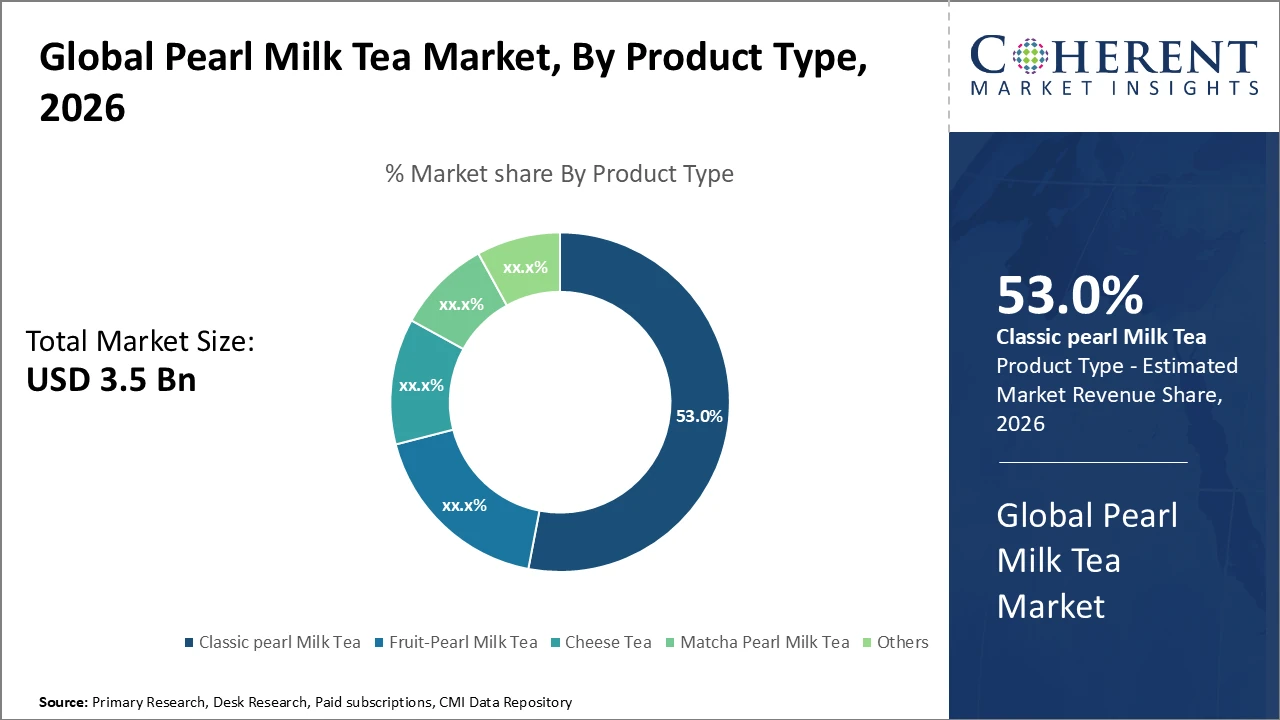
Global Pearl Milk Tea Market Insights, By Product Type
Classic Pearl Milk Tea dominates the market with a 53% share, driven by its widespread popularity across demographics, consistent flavor innovations, and strong brand recognition. The fastest-growing subsegment is Cheese Tea, attracting consumers with its creamy texture and premium positioning, often achieving double-digit growth in metropolitan areas. Fruit-flavored Pearl Milk Tea appeals to younger audiences seeking variety and refreshing tastes, while Matcha Pearl Milk Tea targets health-conscious consumers interested in antioxidant-rich beverages.
Global Pearl Milk Tea Market Insights, By Packaging Type
Ready-to-Drink Bottles lead the market with a 55% share, driven by convenience, portability, and strong presence in retail chains catering to urban consumers. The fastest-growing segment is Sachets, fueled by rising demand for at-home DIY pearl milk tea preparation, especially following increased home consumption trends in post-pandemic years. Cups remain a staple in cafés and bubble tea shops, providing a customizable in-store experience. The Others category includes innovative packaging solutions such as eco-friendly sachets and biodegradable bottles, which are gradually gaining traction among environmentally conscious consumers. Overall, packaging trends reflect a balance between convenience, sustainability, and experiential consumption.
Global Pearl Milk Tea Market Insights, By Distribution Channel
Cafés and bubble tea shops dominate the market with a 62% share, driven by experiential purchasing and in-store customization that caters to socially oriented beverage consumption. The fastest-growing distribution channel is online retail, supported by expanded delivery platforms and targeted digital marketing, allowing brands to reach wider demographics and meet consumer demand for convenience and time savings. Supermarkets and hypermarkets primarily focus on ready-to-drink packaged pearl milk tea, offering accessibility in everyday shopping. The Others category includes vending machines and specialty retailers, which serve niche markets and provide innovative ways to access pearl milk tea, reflecting evolving consumer preferences and retail strategies.
Global Pearl Milk Tea Market Trends
The market is driven by growing demand for ready-to-drink pearl milk tea, catering to urban, fast-paced lifestyles.
Increased adoption of sustainable packaging solutions appeals to environmentally conscious millennials and Gen Z consumers.
Product innovation through ingredient diversification is expanding acceptance beyond traditional markets, such as the rising popularity of cheese tea and brown sugar pearl milk tea in Western countries.
Traditional cafés are integrating AI-based ordering systems to enhance customer experience and enable personalized beverage customization.
These trends are intensifying competitive dynamics, particularly in metropolitan areas where consumer expectations for convenience, innovation, and customization are highest.
Global Pearl Milk Tea Market Insights, By Geography
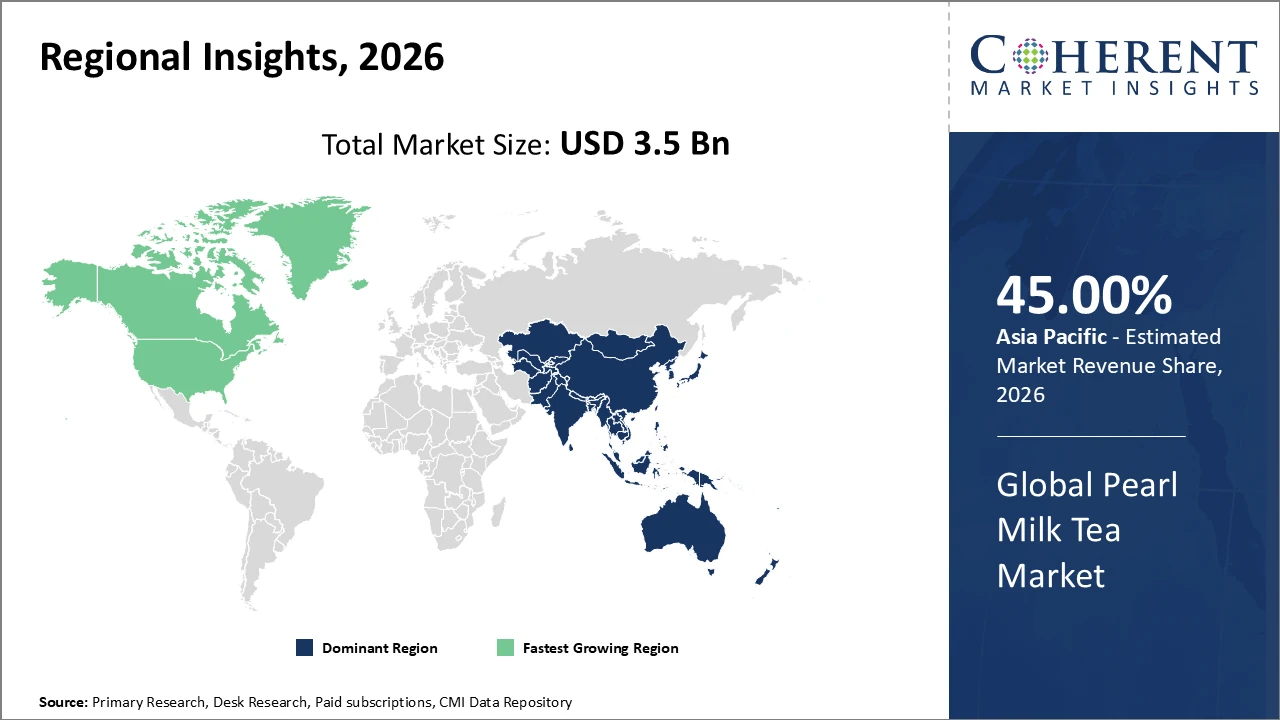
Asia Pacific Global Pearl Milk Tea Market Analysis and Trends
Asia Pacific holds the largest share of the pearl milk tea market at around 45%, driven by early adoption and strong cultural affinity for the beverage in countries like China, Taiwan, and Japan. The region benefits from a robust tapioca production infrastructure, ensuring a steady supply for manufacturers and retailers. Expanding café chains and growing e-commerce platforms further boost market revenue by increasing accessibility and convenience for consumers. Additionally, supportive government policies in countries such as China promote food and beverage innovations, encouraging product development and market expansion. These factors collectively reinforce Asia Pacific’s leadership in the global pearl milk tea market.
North America Global Pearl Milk Tea Market Analysis and Trends
North America is projected to exhibit the fastest CAGR in the pearl milk tea market, estimated at over 9% through 2033. Growth is driven by a diverse, multicultural consumer base increasingly embracing Asian lifestyles and flavors, as well as rising health-conscious segments seeking low-sugar and organic options. The United States plays a central role, with metropolitan areas fueling demand through innovative store concepts, in-store experiences, and expanding online delivery services. Strategic investments by leading market players in brand development, local ingredient sourcing, and marketing initiatives further accelerate market penetration. These factors position North America as a rapidly growing region for pearl milk tea.
Global Pearl Milk Tea Market Outlook for Key Countries
USA Global Pearl Milk Tea Market Analysis and Trends
The USA pearl milk tea market is experiencing rapid growth, fueled by increasing consumer familiarity with bubble tea culture and the expansion of specialty beverage outlets. Major urban centers such as Los Angeles, New York, and San Francisco lead the trend, with over 1,200 new bubble tea stores opening between 2024 and 2026, boosting market revenue and overall industry size. Key players are investing in menu innovation, offering sugar-free, non-dairy, and health-oriented options to cater to American preferences. The rising popularity of ready-to-drink pearl milk tea, supported by both online and retail distribution channels, further strengthens market growth and competitive positioning.
Germany Global Pearl Milk Tea Market Analysis and Trends
The pearl milk tea market in Germany is experiencing steady growth, driven by rising consumer interest in Asian beverages and the expanding café culture. Key trends include the increasing popularity of customizable drinks, offering options for sugar levels, milk types, and toppings such as tapioca pearls, popping boba, and jelly. Ready-to-drink bottled and canned pearl milk teas are gaining traction among busy urban consumers. Health-conscious options, including plant-based milk and natural sweeteners, are also influencing product offerings. Additionally, social media-driven marketing and seasonal flavor launches are boosting brand visibility, making Germany an emerging and dynamic market for pearl milk tea.
Analyst Opinion
The surge in customization options is driving market growth, with over 45% of global consumers in 2025 preferring personalized pearl milk tea. This trend has encouraged manufacturers to introduce richer textures, novel flavors, and plant-based milk alternatives, which have grown by 30% since 2024, boosting product innovation and revenue.
Supply-side capacities, particularly tapioca pearl production, are key to market share. In 2026, Southeast Asia produced 1.2 million metric tons of tapioca, meeting over 70% of global demand. Expanded plantations in Thailand and Vietnam increased export volumes by 25%, ensuring raw material availability and steady growth.
Import trends in emerging markets indicate rising adoption outside traditional regions. North America, for example, saw a 22% increase in imports of tea concentrates and tapioca pearls in 2025, reflecting growing consumer interest in Asian food culture and untapped market potential.
Pricing flexibility remains critical, with premium strategies allowing companies to maintain margins despite raw material cost inflation in 2024. Average retail prices rose by 6%, and consumers in developed markets are willing to pay up to 15% more for artisanal or organic variants, driving revenue expansion.
- Current Industry Events of 2026
- Market Size Estimation
- Regional Breakdown
- Competitive Landscape
- Customer Intelligence
- Segmental Analysis
- Pricing Analysis
- Key Market Drivers, Challenges & Future Trends
- Customized Insights Section
Market Scope
| Report Coverage | Details | ||
|---|---|---|---|
| Base Year: | 2025 | Market Size in 2026: | USD 3.5 billion |
| Historical Data for: | 2020 To 2024 | Forecast Period: | 2026 To 2033 |
| Forecast Period 2026 to 2033 CAGR: | 8.4% | 2033 Value Projection: | USD 6.1 billion |
| Geographies covered: |
| ||
| Segments covered: |
| ||
| Companies covered: | ChaTime, Koi The, Gong Cha, Boba Guys, Kool KaCha, The Alley, Daboba, Happy Lemon, HEYTEA, Royaltree | ||
| Growth Drivers: |
| ||
Global Pearl Milk Tea Market Growth Factors
The global bubble tea market is experiencing a transformative surge driven by convenience and innovation. By 2025, over 60% of urban consumers shifted toward ready-to-drink formats to accommodate fast-paced lifestyles. Simultaneously, a health-conscious pivot toward organic and low-sugar variants has fueled a 20% annual growth rate in that segment since 2024. The proliferation of physical café chains across North America and Europe has further cultivated community-centric consumption hubs. Finally, a digital revolution, bolstered by app-based delivery, has streamlined accessibility—culminating in a remarkable 28% increase in online sales throughout 2026, securing the industry’s robust global expansion.
Global Pearl Milk Tea Market Development
In February 2026, Foodsta Kitchens launched Zen Chai, a new-age bubble tea brand combining Taiwanese bubble tea with India’s tea culture. Its first outlet opened in Whitefield, Bengaluru, marking the company’s fourth brand after Nasi and Mee, Wok Shop, and Kokoro.
Key Players
Leading Companies of the Market
ChaTime
Koi The
Gong Cha
Boba Guys
Kool KaCha
The Alley
Daboba
Happy Lemon
HEYTEA
Royaltree
The competitive landscape of the bubble tea industry is currently defined by strategic expansion and product diversification. Industry giants Chatime and Gong cha have spearheaded this movement, collectively establishing hundreds of new outlets across the Asia-Pacific and North American regions between 2024 and 2026. Gong cha, specifically, has accelerated its Western presence through its Gong cha 2.0 initiative, aiming for a significant milestone of 500 stores in the Americas by the end of this year.
Global Pearl Milk Tea Market Future Outlook
The future outlook for the global pearl milk tea market is highly promising, driven by rising consumer demand for innovative and customizable beverages. Growth is expected from the expansion of ready-to-drink products, international brand presence, and increasing café culture in urban areas worldwide. Health-conscious trends will push the adoption of plant-based milk, low-sugar options, and natural ingredients. Technological advancements in supply chain and packaging, alongside social media marketing and limited-edition flavors, will further boost market penetration. Overall, the market is set to expand steadily, with innovation, convenience, and personalization serving as key drivers for sustained growth and consumer engagement.
Global Pearl Milk Tea Market Historical Analysis
The historical analysis of the global pearl milk tea market shows a gradual evolution from a niche Asian beverage to a widely popular global trend. Originating in Taiwan in the 1980s, the market initially relied on small tea shops offering traditional milk tea with tapioca pearls. Over the years, international expansion, franchise models, and product innovation—such as fruit flavors, specialty teas, and diverse toppings—have driven market growth. The rise of café culture, social media influence, and demand for customizable drinks further accelerated adoption. Early ready-to-drink formats and innovative packaging laid the foundation for today’s dynamic and expanding global market.
Sources
Primary Research Interviews:
Café owners, franchise managers, and retail operators directly selling pearl milk tea products.
Supply chain managers, product development heads, and procurement specialists responsible for sourcing tea leaves, tapioca pearls, and flavoring ingredients.
Market analysts, brand managers, and regulatory experts from companies developing innovative beverages, ready-to-drink products, and health-oriented tea variants.
Magazines:
Tea & Coffee Trade Journal – Updates on beverage innovations, market trends, and consumer preferences.
Beverage Industry – Insights into product launches, retail expansion, and flavor trends.
Drinks International – Coverage of global tea and specialty beverage markets, including bubble tea developments.
Journals:
International Journal of Food Science & Technology – Studies on beverage formulation, ingredient innovations, and consumer acceptance.
Food Research International – Research on functional beverages, flavor innovations, and market trends.
Journal of Culinary Science & Technology – Studies on beverage preparation, texture innovations, and sensory evaluation.
Newspapers:
Financial Times – Global food and beverage investments, market growth, and corporate developments.
Reuters – Product launches, international brand expansion, and market dynamics in the beverage sector.
Bloomberg – Strategic initiatives, mergers, acquisitions, and R&D trends in global beverage companies.
Associations:
World Tea Association – Guidelines, research updates, and market insights for tea-based beverages.
Specialty Tea Institute – Conferences, innovation updates, and consumer trends for specialty teas.
International Beverage Association – Global industry data, regulatory guidance, and market analysis for drinks and tea products.
Get access to 250+ pages report
Every segment, forecast, competitor profile and data table behind the analysis above — available for instant download.
- ESOMAR Member
- ISO 9001:2015 Certified
- D-U-N-S Registered
- GDPR & CCPA Compliant
Missing comfort of reading report in your local language? Find your preferred language:
Transform your Strategy with Exclusive Trending Reports
Frequently Asked Questions
The market is led by ChaTime, Gong Cha, CoCo Fresh Tea & Juice, and Koi Thé, which collectively command substantial market share through extensive global expansion and innovative product portfolios.
The market size is poised to reach USD 6.1 billion by 2033, advancing at a CAGR of 8.4% driven by increased product adoption and diversification internationally.
Ready-to-drink Bottles segment dominates the market.
Sustainability initiatives, digital ordering platforms, and health-oriented product variants will shape market trends, enabling rapid shift toward premiumization and consumer engagement innovation.
Competition is intense with emphasis on expansion, product differentiation, and supply chain optimization. Challenges include raw material price volatility and regulatory compliance in emerging markets.
Key strategies include geographic expansion, product portfolio diversification with health-conscious variants, digital marketing, and omnichannel retailing to capture broader consumer segments.