

Global Frac Sand Market Size and Forecast – 2026 To 2033
The Global Frac Sand Market is estimated to be valued at USD 10,318.7 Mn in 2026 and is expected to reach USD 15,825.5 Mn by 2033, exhibiting a compound annual growth rate (CAGR) of 6.3% from 2026 to 2033. This growth reflects increasing demand for hydraulic fracturing in oil and gas production, the increasing demand for energy, high intensity completion of wells, and continued development of shale and tight reservoirs.
Strong production activity in various major unconventional basins and a continuous demand for proppant supply for well productivity are the additional factors contributing to the growth of the global frac sand market. For instance, in April 2026, ConocoPhillips reported Lower 48 production of 1,453 MBOED in Q1 2026, including output from the Delaware Basin, Midland Basin, Eagle Ford, and Bakken, highlighting the scale of shale operations that continue to support frac sand consumption. (Source: ConocoPhillips)
Key Takeaways of the Global Frac Sand Market
- 40 by 70 Mesh is expected to hold 34.6 % of the market share in 2026, reflecting its strong use in slickwater and high-intensity hydraulic fracturing where finer sand supports deeper proppant placement, better fracture-network coverage, and lower screen-out risk. In 2025, Atlas Energy Solutions disclosed that its Kermit and Lamesa mines primarily process 40/70-mesh and 70/200-mesh frac sand products, supporting strong in-basin demand.
- Shale oil is expected to account for 44.8 % of the market share in 2026, supported by high-intensity completions in oil-rich basins where sand volume, flowback performance, and logistics precision directly influence well economics. In July 2025, Chevron announced that its triple-frac technique would be used on nearly half of its Permian wells in 2025, reducing completion time and cost. (Source: Chevron Corporation)
- Northern white sand is expected to capture 42.7 % of the market share in 2026, as its high silica quality, grain strength, and established rail-linked supply chains keep it relevant for demanding shale completions. In May 2025, Smart Sand reported approximately 1.1 million tons sold in Q1 2025 and highlighted its integrated Northern White sand and logistics model.
- North America is expected to account for 58.5 % of the market share in 2026, anchored by mature unconventional oil and gas basins, large-scale pressure pumping capacity, and deep proppant logistics infrastructure. In March 2026, EIA reported that Permian shale and tight formations produced 6.0 million b/d of crude oil and 22.2 Bcf/d dry gas in December 2025. (Source: U.S. Energy Information Administration)
- Asia Pacific is expected to hold 19.2 % share in 2026 and emerge as the fastest-growing region, supported by China’s expanding shale oil and shale gas resource development and improving unconventional drilling capability. In May 2026, Sinopec announced approval for 235.687 billion cubic meters of proven reserves at the ultra-deep Ziyang Dongfeng shale gas field.
- In-Basin Sand Logistics Optimization: Operators are increasingly prioritizing lower landed proppant cost, fewer handling points, faster truck turns, and flexible inventory positioning near active basins. This trend strengthens vertically integrated sand suppliers, favors local and regional deposits where performance requirements allow, and pushes producers to compete on delivery reliability rather than only mine-gate pricing.
- Automation-Led Completion Intensity: Advanced completion workflows are making frac sand supply more time-sensitive and specification-driven. As service companies automate stage execution and improve pad-level coordination, sand producers must deliver consistent mesh quality, predictable volumes, and tighter scheduling support. This shifts supplier differentiation toward operational dependability, digital logistics coordination, and basin-specific service responsiveness.
Segmental Insights
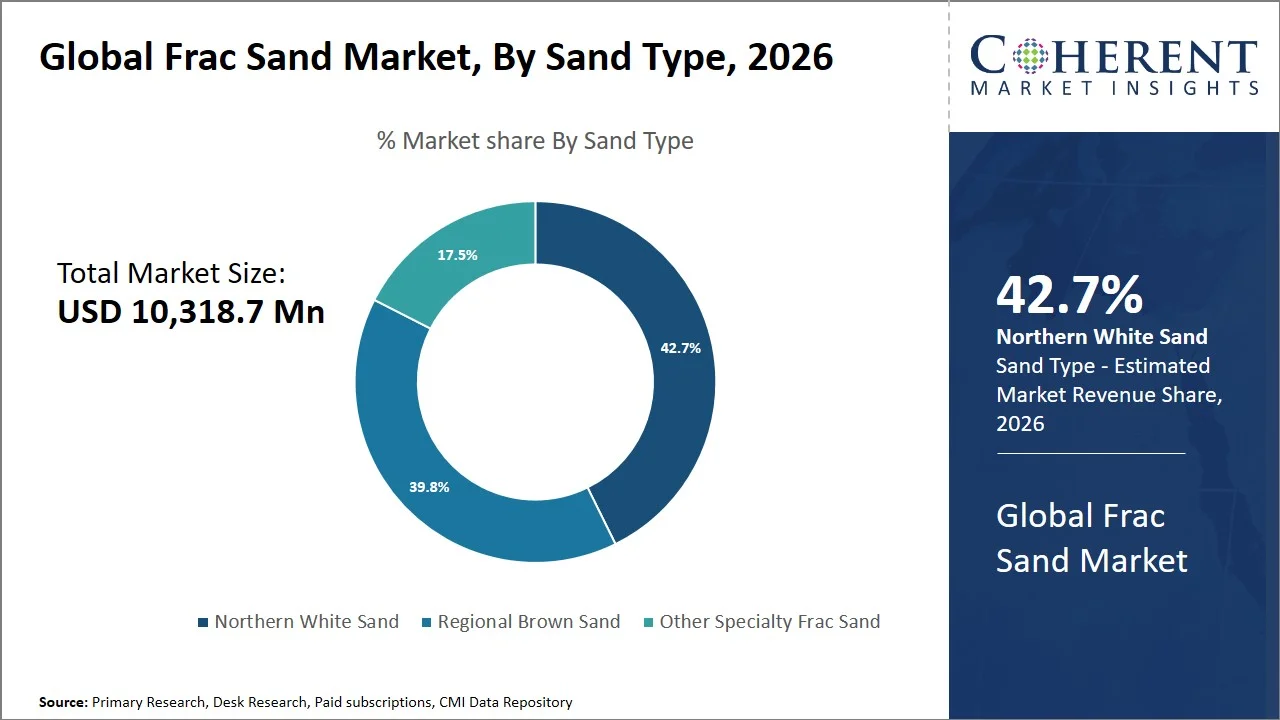
Why Does Northern White Sand Dominate the Global Frac Sand Market?
Northern white sand is expected to account for 42.7% share in 2026, supported by its strong fit for performance-sensitive hydraulic fracturing programs. The segment dominates because operators use it where fracture conductivity, low fines generation, consistent grain shape, and reliable downhole performance matter more than only freight savings. Demand remains strong in deeper and higher-value unconventional wells, particularly where operators need predictable proppant behavior across long laterals. On the supply side, established Wisconsin mine assets, rail access, and terminal networks improve deliverability into Appalachia, Bakken, DJ, and Canadian plays. It is strongly adopted in shale and tight formations where premium sand quality helps sustain hydrocarbon flow. In August 2025, Iron Oak Energy acquired HC Minerals’ Northern White assets, including Wyeville, Wisconsin capacity and Marcellus/Utica terminals, strengthening shale-basin supply access.
- Current Industry Events of 2026
- Market Size Estimation
- Regional Breakdown
- Competitive Landscape
- Customer Intelligence
- Segmental Analysis
- Pricing Analysis
- Key Market Drivers, Challenges & Future Trends
- Customized Insights Section
Why Does 40 by 70 Mesh Represent the Largest Mesh Size Segment in the Global Frac Sand Market?
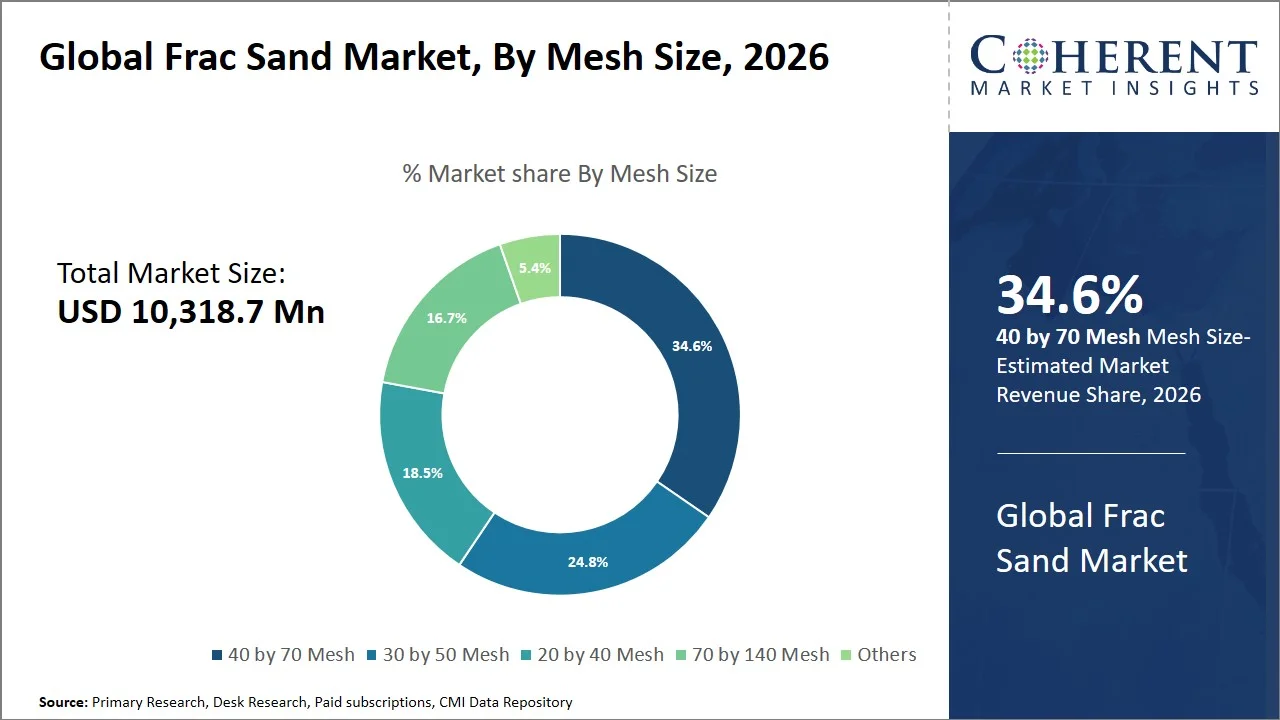
40 by 70 Mesh is expected to hold 34.6% share in 2026, as it offers a practical balance between proppant transport and fracture conductivity. The segment dominates because it is fine enough to move efficiently through complex fracture networks, yet coarse enough to maintain flow channels under moderate closure stress. Demand is supported by slickwater and high-rate pumping designs, where operators require stable placement without excessive screen-out risk. From the supply side, mines can efficiently dry, screen, silo, and dispatch 40/70 sand alongside other grades, improving production flexibility and inventory planning. It is widely adopted in shale oil and gas completions where mesh blending supports broader fracture coverage. In March 2025, Mammoth Energy’s Form 10-K stated that its Wisconsin frac sand facilities produce predominantly 20/40, 30/50, and 40/70 mesh sand.
Why Does Shale Oil Dominate the Global Frac Sand Market?
Shale oil is expected to capture 44.8% of the market share in 2026, as oil-weighted unconventional wells typically justify higher completion intensity due to stronger payback potential versus many dry-gas projects. The segment dominates because Permian, Bakken, Eagle Ford, and Delaware Basin operators rely on sand-heavy fracturing to unlock low-permeability crude reservoirs and improve early production performance. Demand is reinforced by multi-well pad development, longer laterals, and infill drilling programs that require continuous sand availability to avoid completion downtime. Supply chains have adapted around oil-focused basins through mobile storage, conveyor systems, wet-sand handling, and integrated procurement models. End-use relevance is strongest where frac sand keeps induced fractures open and supports sustained crude flow. In May 2025, Diamondback reported 123 gross operated wells completed in Q1 2025 across the Midland and Delaware Basins, with 11,978-foot average laterals. (Source: Diamondback Energy, Inc)
Global Frac Sand Market Dynamics
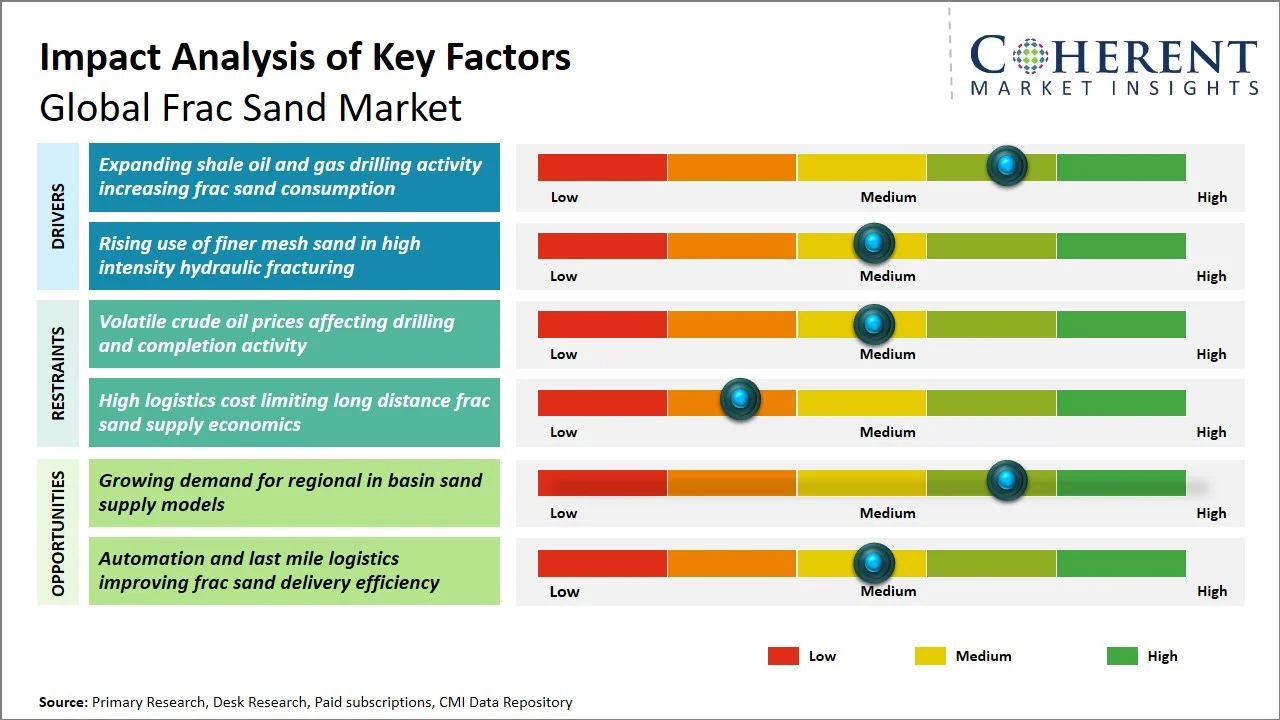
Key Market Drivers
- Expanding Shale Oil and Gas Drilling Activity Increasing Frac Sand Consumption: Expanding shale oil and gas drilling activity is a major growth driver for the global frac sand market, as every new horizontal well requires large volumes of proppant to keep induced fractures open and sustain hydrocarbon flow. Operators are increasingly focused on multi-well pad drilling, longer laterals, and repeatable completion designs, which translate into steady sand demand across shale oil, shale gas, and tight gas formations. This benefits sand suppliers with reliable basin access, screening capacity, and last-mile delivery capabilities. In May 2025, Ovintiv reported that it planned to invest approximately USD 1.2–1.3 billion in the Permian and bring 130–140 net wells online in 2025, directly supporting completion-led frac sand consumption. (Source: Ovintiv Inc)
- Rising Use of Finer Mesh Sand in High-Intensity Hydraulic Fracturing: The rising use of finer mesh sand is strengthening frac sand consumption because modern high-intensity fracturing designs require proppants that can travel deeper into complex fracture networks. Finer grades such as 40/70 and 100 mesh improve placement efficiency in secondary fractures, reduce bridging risk, and support wider stimulated reservoir volume. Demand is especially strong in shale oil and liquids-rich gas basins where operators prioritize early production response and controlled completion costs. Suppliers capable of producing consistent finer mesh grades gain an advantage because customers need predictable particle size, crush resistance, and continuous wellsite availability. In January 2025, Atlas Energy Solutions announced first commercial delivery from Dune Express and highlighted its 100 mesh and 40/70 mesh proppant offering for well completions. (Source: Atlas Energy Solutions Inc)
Emerging Market Trends
- Shift Toward In-Basin and Regional Sand Sourcing: The frac sand market is increasingly moving toward in-basin and regional sand sourcing as operators focus on reducing landed cost, truck miles, delivery risk, and completion downtime. This trend is reshaping procurement strategy from purely quality-led sourcing toward a cost-performance balance. While premium Northern White sand remains important for demanding wells, regional brown sand is gaining relevance where local deposits can meet operator specifications. The shift also changes competitive dynamics, as suppliers closer to active shale basins can offer faster replenishment, lower freight exposure, and more flexible contract structures. For exploration and production companies, local sourcing improves working capital efficiency and reduces disruption risk during high-pressure completion schedules. For sand producers, regional mine positioning and integrated logistics are becoming as important as reserve quality.
- Greater Focus on Wet Sand Handling and Direct-to-Wellsite Delivery: Wet sand handling is emerging as a practical trend in frac sand logistics because it reduces drying requirements, lowers energy use, and improves throughput at high-volume completion sites. The model supports faster movement from mine to wellsite, especially in basins where operators prioritize completion efficiency and shorter cycle times. Direct-to-wellsite delivery systems, mobile storage, conveyor-based transfer, and automated inventory tracking are becoming more relevant as frac crews require uninterrupted proppant flow. This trend benefits suppliers that can combine production, transportation, storage, and real-time coordination into a single service offering. It also supports cost discipline by reducing intermediate handling, demurrage exposure, and operational bottlenecks. Over the forecast period, logistics capability will increasingly determine supplier competitiveness, not only sand quality.
Current Events and their Impact
Current Events | Description and its Impact |
January 2026 – BLM Proposed Updates to Oil and Gas Commingling Rules |
|
March–May 2025 – EPA Removal of Waste Emissions Charge Regulation |
|
April 2026 – EPA Revisions to Oil and Natural Gas OOOOb/c Rules |
|
Regional Insights
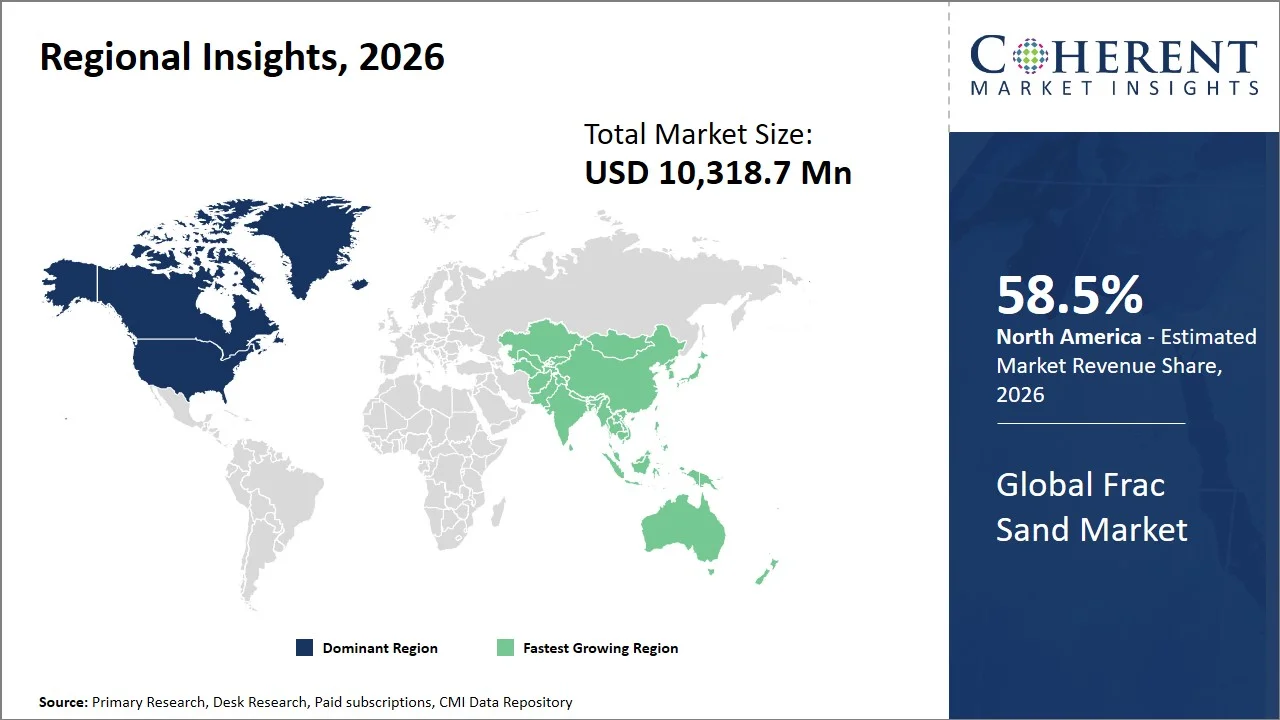
Why Does North America Dominate the Global Frac Sand Market?
North America is expected to dominate the global frac sand market with 58.5% share in 2026, supported by its large unconventional oil and gas base, mature hydraulic fracturing ecosystem, and dense network of sand mines, rail terminals, transloading hubs, and pressure pumping fleets. The U.S. and Canada have strong shale and tight resource development across oil- and gas-focused basins, creating recurring demand for multiple sand grades and reliable last-mile delivery.
The region also benefits from advanced completion practices, high service-provider concentration, and established procurement models that link sand suppliers directly with operators and fracturing contractors. In June 2026, Baker Hughes published its North America Rig Count report, reinforcing the continued visibility of active drilling activity across the region.
Why is Asia Pacific Emerging as the Fastest-Growing Region in the Frac Sand Market?
Asia Pacific is expected to hold 19.2% share in 2026 and emerge as the fastest-growing region in the frac sand market, supported by rising unconventional gas development, energy security priorities, and growing use of hydraulic stimulation in complex reservoirs. China and Australia are central to regional growth, while India’s long-term exploration needs create additional demand potential. The region is still less mature than North America, but that creates room for rapid adoption of frac sand logistics, mesh-specific supply, and basin-level service models. Growth is also supported by LNG-linked gas development and domestic production targets. In June 2026, the Northern Territory Government stated that first gas from Australia’s Beetaloo Sub-basin is expected in the second half of 2026, supported by modern drilling and hydraulic stimulation technologies. (Source: Northern Territory Government)
Global Frac Sand Market Outlook for Key Countries
Why is the U.S. a Key Market for Frac Sand?
The U.S. is the most important country-level market for frac sand because it has the deepest commercial base for shale oil, shale gas, and tight oil development. Major basins such as the Permian, Eagle Ford, Bakken, Haynesville, Marcellus, and Utica require continuous sand supply for horizontal well completions. The country also has a mature oilfield service ecosystem, a large pressure pumping fleet, extensive proppant logistics infrastructure, and established in-basin sand production. Demand is supported by long lateral wells, multi-stage fracturing, pad drilling, and operator focus on completion efficiency. The U.S. also shapes global frac sand specifications, procurement benchmarks, and logistics models. Its role is not only demand-driven but also technology-led, as completion design innovation often spreads from U.S. shale basins to other unconventional markets.
Why is Canada Important in the Global Frac Sand Market?
Canada is important in the global frac sand market due to its large unconventional gas and liquids-rich resource base, particularly across Western Canada. The Montney, Duvernay, and other tight formations require high-quality proppant supply for multi-stage hydraulic fracturing, making Canada a structurally relevant demand center. The market benefits from cross-border sand flows, rail-linked logistics, and proximity to Northern White sand supply routes, while domestic and regional sand sources support cost efficiency in western basins. Canada’s demand profile is strongly tied to natural gas, condensate, and LNG-linked upstream development, which requires reliable completion inputs. The country also has strict environmental and operational standards, encouraging suppliers to focus on quality control, dust management, transportation reliability, and contract-based supply assurance. This makes Canada a strategic market for premium and logistics-integrated frac sand suppliers.
Why is India Important in the Global Frac Sand Market?
India is an emerging long-term market for frac sand as the country works to strengthen domestic oil and gas production and reduce import dependence. Although large-scale shale development remains at an early stage, India has potential across shale gas, tight reservoirs, and coalbed methane, all of which can support future hydraulic fracturing demand. The country’s importance lies in its energy demand growth, expanding exploration activity, and policy interest in domestic hydrocarbon development. India also has industrial silica sand resources, creating potential for local processing and proppant-grade sand development if quality and logistics gaps are addressed. Demand may initially remain selective and project-based, but the long-term opportunity is meaningful where unconventional gas, deep basin exploration, and improved well stimulation practices gain commercial traction. Suppliers with cost-effective grades and technical support will be better positioned.
Why Does China Support Growth in the Frac Sand Market?
China supports growth in the frac sand market through its large unconventional gas ambitions, extensive shale resources, and strong focus on domestic energy security. The country’s key shale activity is concentrated in technically complex basins, where deep formations, challenging geology, and high-pressure conditions require advanced drilling, fracturing, and proppant placement practices. China’s demand is shaped by shale gas, shale oil, tight gas, and coalbed methane development, creating a broad opportunity for mesh-specific sand and higher-performance proppant solutions. The country also has strong industrial capacity, which can support domestic sand processing, equipment manufacturing, and localized supply chain development. Unlike North America, China’s growth is more state-directed and resource-security led, making long-term upstream planning an important demand driver. Suppliers that can support technical performance, cost control, and large-scale field development can benefit from this market.
Why is Australia a Strategic Country in the Frac Sand Market?
Australia is a strategic country in the frac sand market because of its unconventional gas potential, LNG-linked energy infrastructure, and growing focus on domestic gas security. Key basins require hydraulic stimulation to unlock tight and shale gas resources, creating demand for proppant supply, wellsite logistics, and technical sand handling capabilities. The market in Australia is different from North America because activity is more project-specific, remote, and infrastructure-dependent, which increases the importance of reliable transport, storage, water management, and regulatory compliance. Demand is closely connected to gas supply for domestic industry, power generation, and LNG export positioning. The country also has strict environmental scrutiny around hydraulic fracturing, making quality assurance and responsible operating practices important for supplier acceptance. As unconventional projects progress, Australia can become a meaningful Asia Pacific growth node for frac sand demand.
Technology Adoption Landscape in the Global Frac Sand Market
Technology | Adoption Level | Key Application Area | Business Impact | |
Wet sand logistics systems | High | Direct mine-to-wellsite delivery | Reduces drying cost, improves delivery speed, and supports high-volume completion schedules. | |
Automated proppant storage and conveyor systems | High | Wellsite sand handling | Minimizes truck wait time, reduces manual handling, and improves frac crew productivity. | |
Mesh screening and precision classification systems | High | Sand processing plants | Ensures consistent 20/40, 30/50, 40/70, and 100 mesh quality for operator specifications. | |
Real-time inventory and dispatch platforms | Medium | Last-mile logistics coordination | Improves fleet visibility, prevents stockouts, and supports multi-well pad execution. | |
Dust-control and silica exposure mitigation systems | Medium | Mine, transload, and wellsite operations | Supports worker safety compliance and reduces operational disruption from environmental controls. | |
Resin-coated and specialty proppant enhancement | Low to Medium | High-stress or performance-sensitive wells | Enables product differentiation where standard sand cannot meet closure stress or conductivity needs. | |
How are Integrated Sand Logistics and Basin-Specific Proppant Solutions Creating New Growth Opportunities in the Global Frac Sand Market?
Integrated sand logistics and basin-specific proppant solutions are creating meaningful growth opportunities by shifting the market from a commodity supply model toward a performance-and-service model. Operators no longer evaluate frac sand only by mine-gate price; they increasingly assess total delivered cost, mesh consistency, truck availability, transload reliability, wellsite storage, and completion schedule risk. This creates room for suppliers to capture higher value through bundled mine-to-wellsite solutions, wet sand delivery, automated storage, and digital dispatch. Basin-specific products also support differentiation because sand requirements vary by reservoir depth, closure stress, fluid system, and completion design. Suppliers that align mesh mix, logistics assets, and contract structures with shale basin needs can improve customer retention and margin stability. The opportunity is commercially important because frac sand demand is closely tied to operational continuity; any delay in proppant availability can disrupt pressure pumping activity and increase completion costs.
Market Players, Key Development, and Competitive Intelligence
Key Developments
- In January 2026, the U.S. Bureau of Land Management proposed updates to modernize oil and gas commingling regulations on federal and Indian lands. The policy change may improve upstream operating efficiency and drilling economics, indirectly supporting frac sand consumption across U.S. shale basins.
- In January 2025, Halliburton and Coterra launched the first fully-automated hydraulic fracturing program using Octiv Auto Frac. This supports the frac sand market by improving completion precision, enabling more consistent proppant placement, and strengthening demand for reliable mesh-size sand in high-intensity shale well operations.
- In August 2025, Iron Oak Energy Solutions acquired Northern White sand assets from HC Minerals, including the Wyeville, Wisconsin plant and terminal assets serving operators in the Marcellus and Utica shale regions. This strengthens premium frac sand supply access and improves distribution efficiency for Appalachian shale operators.
Competitive Landscape
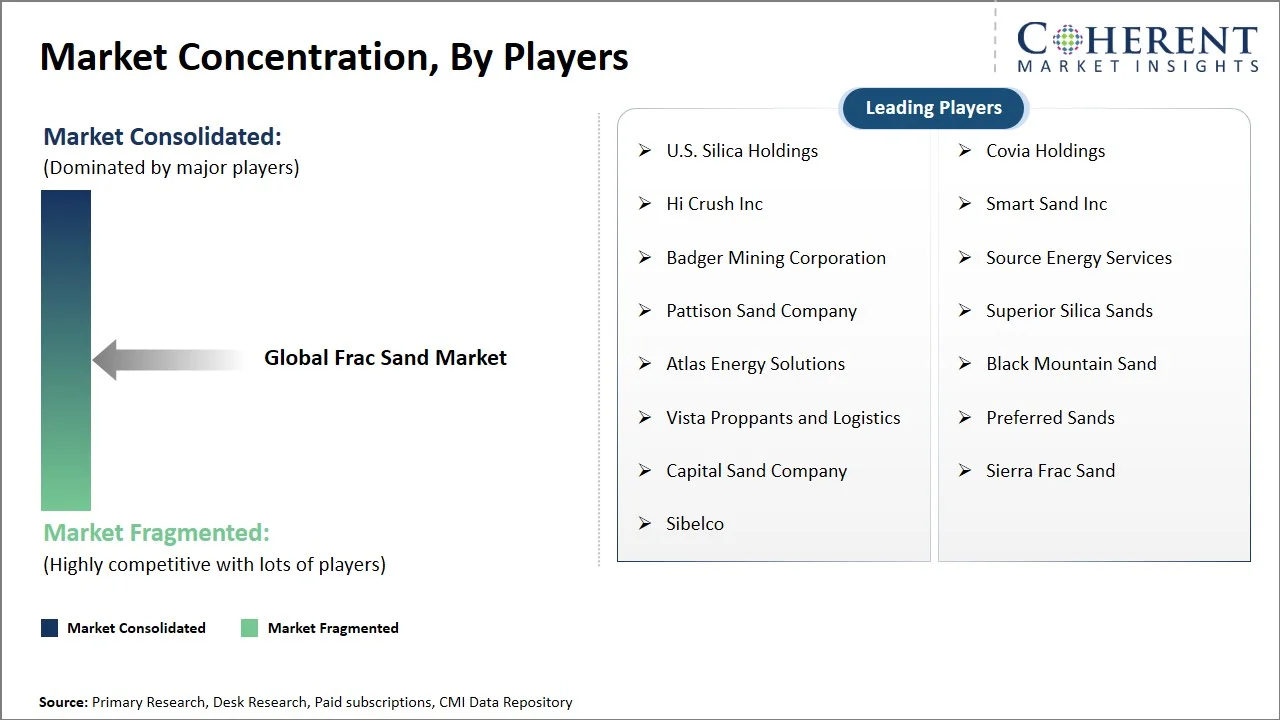
The global frac sand market is moderately fragmented but increasingly shaped by logistics-integrated suppliers, regional mine operators, and oilfield service-linked procurement networks. Competition is the strongest in North America, where basin proximity, supply dependability, product consistency, and transportation economics define commercial advantage.
Key focus areas include
- Companies compete on mesh-size consistency, crush strength, sphericity, turbidity, and API-aligned quality control.
- In-basin sand suppliers compete aggressively on delivered cost, shorter lead times, and reduced truck-mile economics.
- Northern white sand producers maintain relevance through premium quality, rail connectivity, and suitability for demanding wells.
- Logistics integration, including storage, trucking, conveyor systems, and dispatch platforms, is becoming a core differentiator.
- Pricing competition remains intense due to regional oversupply risks and operator pressure to reduce completion cost per lateral foot.
- Suppliers are strengthening customer stickiness through multi-year agreements, basin-specific supply contracts, and dedicated wellsite services.
- Compliance with silica dust, mine safety, environmental permitting, and transportation standards remains essential for long-term operating credibility.
- Specialty and finer mesh product positioning is gaining importance as completion designs become more technical and reservoir-specific.
Market Report Scope
Frac Sand Market Report Coverage
| Report Coverage | Details | ||
|---|---|---|---|
| Base Year: | 2025 | Market Size in 2026: | USD 10,318.7 Mn |
| Historical Data for: | 2020 To 2024 | Forecast Period: | 2026 To 2033 |
| Forecast Period 2026 to 2033 CAGR: | 6.3% | 2033 Value Projection: | USD 15,825.5 Mn |
| Geographies covered: |
| ||
| Segments covered: |
| ||
| Companies covered: | U.S. Silica Holdings, Covia Holdings, Hi Crush Inc, Smart Sand Inc, Badger Mining Corporation, Source Energy Services, Pattison Sand Company, Superior Silica Sands, Atlas Energy Solutions, Black Mountain Sand, Vista Proppants and Logistics, Preferred Sands, Capital Sand Company, Sierra Frac Sand, and Sibelco | ||
| Growth Drivers: |
| ||
| Restraints & Challenges: |
| ||
Analyst Opinion (Expert Opinion)
- The global frac sand market is expected to maintain steady growth as operators continue to optimize well productivity through longer laterals, higher proppant loading, and more efficient completion designs. Future growth will be shaped by the industry’s shift from volume-led sand supply toward integrated proppant solutions, where mine proximity, mesh consistency, wellsite storage, and last-mile logistics become key value drivers.
- Growth prospects are the strongest for suppliers that can support basin-specific sand requirements, especially finer mesh grades used in high-intensity shale completions. Increasing adoption of wet sand handling, automated proppant delivery, and direct-to-wellsite logistics is expected to improve cost efficiency and create differentiation beyond basic sand production. Asia Pacific also presents long-term opportunity as unconventional oil and gas programs expand and regional operators seek reliable, scalable proppant supply chains.
- Key risks include crude oil price volatility, pressure pumping slowdown, regional sand oversupply, transportation constraints, environmental scrutiny, and silica dust compliance costs. Market players should focus on integrated logistics, consistent finer mesh output, long-term customer agreements, wet sand capabilities, and basin-specific product positioning to protect margins and improve competitive resilience.
Speak to the analyst
Want personalized insights?
Take the findings above to one of our principal consultants, or have the report rebuilt around the segments, geographies and competitors you actually track.
Market Segmentation
- Sand Type Insights (Revenue, USD Mn, 2021 - 2033)
- Northern White Sand
- Regional Brown Sand
- Other Specialty Frac Sand
- Mesh Size Insights (Revenue, USD Mn, 2021 - 2033)
- 40 by 70 Mesh
- 30 by 50 Mesh
- 20 by 40 Mesh
- 70 by 140 Mesh
- Others
- Application Insights (Revenue, USD Mn, 2021 - 2033)
- Shale Oil
- Shale Gas
- Tight Gas
- Coalbed Methane
- Others
- End User Insights (Revenue, USD Mn, 2021 - 2033)
- Hydraulic Fracturing Service Providers
- Oil and Gas Exploration Companies
- Integrated Oilfield Service Companies
- Others
- Regional Insights (Revenue, USD Mn, 2021 - 2033)
- North America
- U.S.
- Canada
- Latin America
- Brazil
- Argentina
- Mexico
- Rest of Latin America
- Europe
- Germany
- U.K.
- Spain
- France
- Italy
- Russia
- Rest of Europe
- Asia Pacific
- China
- India
- Japan
- Australia
- South Korea
- ASEAN
- Rest of Asia Pacific
- Middle East
- GCC Countries
- Israel
- Rest of Middle East
- Africa
- South Africa
- North Africa
- Central Africa
- North America
- Key Players Insights
- U.S. Silica Holdings
- Covia Holdings
- Hi Crush Inc
- Smart Sand Inc
- Badger Mining Corporation
- Source Energy Services
- Pattison Sand Company
- Superior Silica Sands
- Atlas Energy Solutions
- Black Mountain Sand
- Vista Proppants and Logistics
- Preferred Sands
- Capital Sand Company
- Sierra Frac Sand
- Sibelco
Sources
Primary Research Interviews
- Frac sand mining companies and proppant producers
- Northern White Sand and regional brown sand suppliers
- Hydraulic fracturing service providers
- Oil and gas exploration and production companies
- Integrated oilfield service companies
- Frac sand logistics, trucking, transloading, and last-mile delivery providers
- Sand processing, screening, drying, and storage equipment suppliers
- Procurement and completion planning teams from shale oil and shale gas operators
Stakeholders
- Frac sand manufacturers and mine operators
- Proppant suppliers and specialty sand producers
- Hydraulic fracturing service providers
- Oil and gas exploration companies
- Integrated oilfield service companies
- Sand terminal, transloading, and rail logistics operators
- Trucking and last-mile frac sand delivery companies
- Oilfield equipment and wellsite storage solution providers
- Regulatory, environmental, and mine safety authorities
End-use Sectors
- Shale oil
- Shale gas
- Tight gas
- Coalbed methane
- Unconventional oil and gas exploration
- Hydraulic fracturing services
- Oilfield completion operations
- Integrated oilfield services
Regulatory & Government Sources Used
- U.S. Energy Information Administration (EIA) – shale oil, tight oil, and natural gas production data
- U.S. Bureau of Land Management (BLM) – oil and gas rule updates and federal land development policies
- U.S. Environmental Protection Agency (EPA) – oil and gas methane, emissions, and compliance-related updates
- Northern Territory Government, Australia – Beetaloo Sub-basin unconventional gas development updates
Industry / Trade / Technical Sources
- Baker Hughes Rig Count – North America drilling activity indicators
- U.S. Securities and Exchange Commission (SEC) filings – company-level frac sand production, mesh size, and operational disclosures
- Oilfield service and upstream operator technical updates related to hydraulic fracturing, completion efficiency, and shale basin activity
Company Sources Used
- Atlas Energy Solutions
- Halliburton
- Coterra Energy
- Iron Oak Energy Solutions
- Smart Sand, Inc.
- Mammoth Energy Services
- Diamondback Energy
- Ovintiv
- Chevron
- ConocoPhillips
- Permian Resources
- Sinopec
- Aurora Innovation
- Detmar Logistics
- Total Sand Solution
- Wallstreet Sand
Associations / Industry Reference:
- Baker Hughes Rig Count
- SEC company filings and investor disclosures
- Government energy and environmental agencies
Proprietary Elements
- CMI Data Analytics Tool, Proprietary CMI Existing Repository of information for last 10 years.
Get access to 250+ pages report
Every segment, forecast, competitor profile and data table behind the analysis above — available for instant download.
- ESOMAR Member
- ISO 9001:2015 Certified
- D-U-N-S Registered
- GDPR & CCPA Compliant
Missing comfort of reading report in your local language? Find your preferred language:
Transform your Strategy with Exclusive Trending Reports
Frequently Asked Questions
The CAGR of the global frac sand market is projected to be 6.3% from 2026 to 2033.
The global frac sand market is estimated to be valued at USD 10,318.7 million in 2026 and is expected to reach USD 15,825.5 million by 2033.
In terms of mesh size, 40 by 70 mesh dominates the global frac sand market with an expected share of 34.6% in 2026.
In terms of product type, rigid boxes are estimated to lead the global frac sand market, accounting for an expected 43.6% share in 2026.
Volatile crude oil prices affecting drilling and completion activity and high logistics cost limiting long distance frac sand supply economics are the major factors hampering the growth of the global frac sand market.
In terms of sand type, Northern white sand is estimated to dominate the market revenue share in 2026.
Expanding shale oil and gas drilling activity increasing frac sand consumption and rising use of finer mesh sand in high intensity hydraulic fracturing are the major factors driving the growth of the global frac sand market.