

Global Fully Autonomous Irrigation Systems Market Size and Forecast – 2026-2033
The global fully autonomous irrigation systems market is estimated to be valued at USD 3.86 Bn in 2026 and is expected to reach USD 6.84 Bn by 2033, exhibiting a compound annual growth rate (CAGR) of 8.5% from 2026 to 2033.
Key Takeaways of the Fully Autonomous Irrigation Systems Market
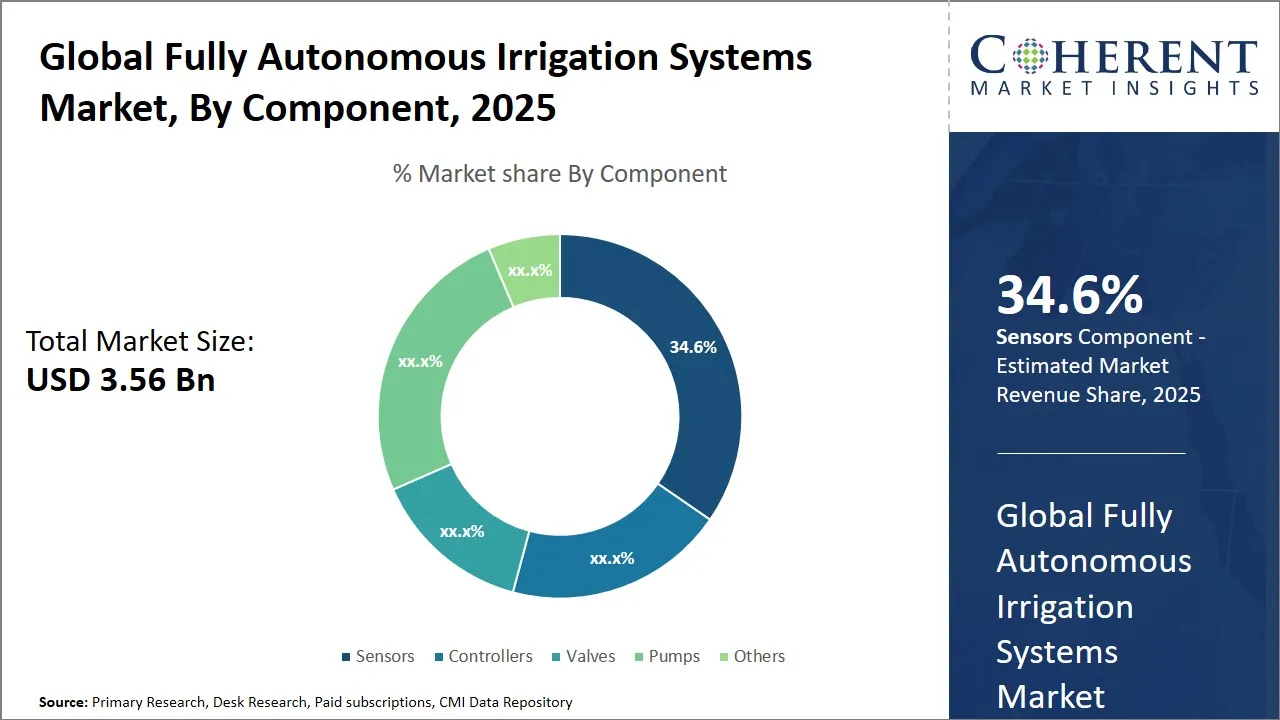
- The sensors segment is expected to hold 35.6 % of the market share in 2026.
- The drip irrigation segment is projected to account for 28.6 % of the fully autonomous irrigation systems market share in 2026.
- The agriculture segment is expected to capture 27.4 % of the market share in 2026.
- Asia Pacific is projected to lead the global fully autonomous irrigation systems market in 2026 with a 37.5 % share. North America, with a share of 28.5% in 2026, is projected to be the fastest-growing region.
Market Overview
A significant market trend is the integration of AI and Internet of Things (IoT) technologies within autonomous irrigation systems, enabling real-time data monitoring and remote control. Furthermore, the shift towards sustainable farming practices and government incentives for smart agriculture adoption are accelerating the deployment of fully autonomous irrigation solutions globally. These innovations are expected to enhance irrigation efficiency and optimize resource management, fueling the market expansion over the forecast period.
Currents Events and their Impact
Current Events | Description and its Impact |
Advancements in AI and Sensor Technology |
|
Shift Towards Precision Agriculture |
|
Segmental Insights
- Current Industry Events of 2026
- Market Size Estimation
- Regional Breakdown
- Competitive Landscape
- Customer Intelligence
- Segmental Analysis
- Pricing Analysis
- Key Market Drivers, Challenges & Future Trends
- Customized Insights Section
Fully Autonomous Irrigation Systems Market Insights, By Component – Sensors Segment Dominates the Market due to its Increasing Demand for Precision Farming
The sensors segment is expected to capture 35.6% of the market share in 2026, owing to their critical role in enabling precision and efficiency in fully autonomous irrigation systems. These systems rely on sensors, which in turn constantly track the real-time data of the environment (soil moisture, temperature, humidity, presence of nutrients, etc.). This powerful data collection makes irrigation systems capable of making accurate data-driven decisions that maximize the use of water in response to real crop or soil needs, as opposed to following fixed schedules. The increased precision saves on water wastage, avoids excessive irrigation, resulting in soil erosion and destruction of crops.
Furthermore, sensor technology has made tremendous progress that has made these components very reliable and affordable thus they are more affordable to a larger customer base including the small and medium farms. Wireless connected sensors with IoT are crucial in the development of an automated network that is easy to use through turning raw data into meaningful actions. The resulting connectivity can be used to perform remote monitoring and control to allow farmers to react to the irrigation requirements in real-time and minimize labor expenses.
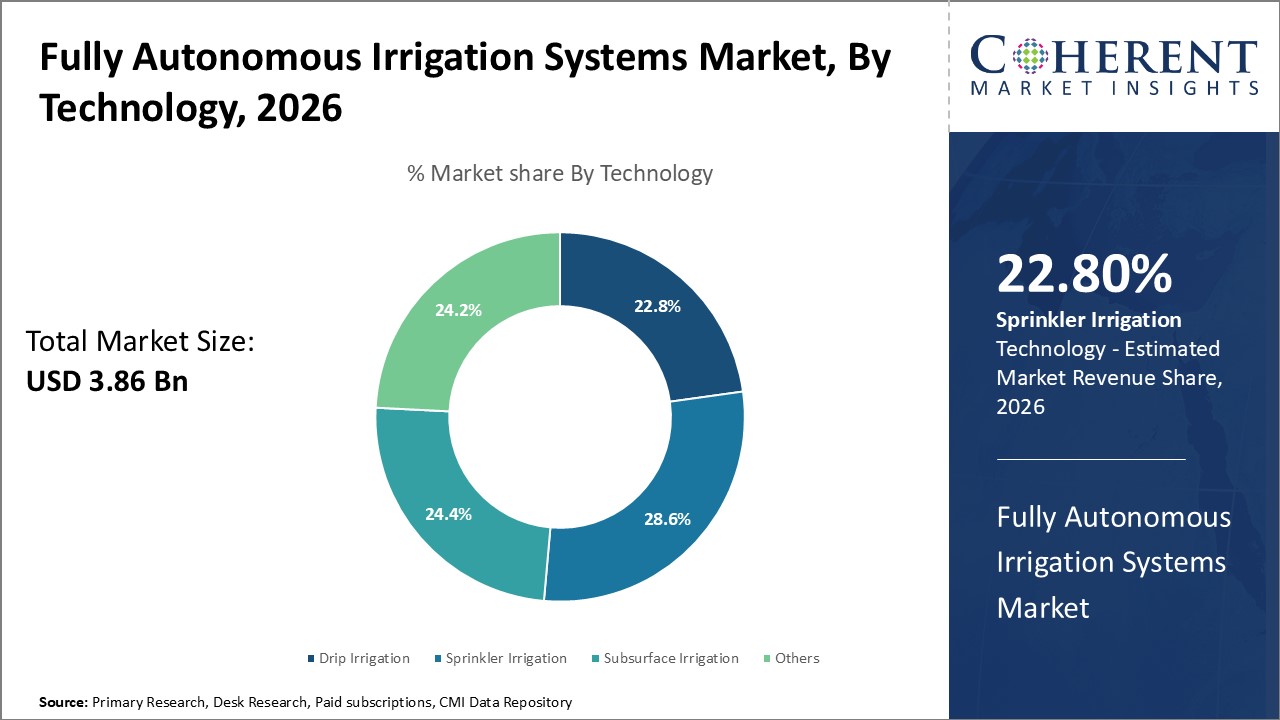
Fully Autonomous Irrigation Systems Market Insights, By Technology - Drip Irrigation Segment Dominates the Market due to its Adaptability to Different Crops
The drip irrigation segment is projected to hold 28.6% share in 2026, due to its inherent water efficiency and suitability for precision irrigation applications. The drip irrigation technology involves the application of water to the root of the plants through a system of tubes and emitters which reduces evaporation and run off which are more prevalent in other forms of irrigation. Such a specific strategy guarantees the most efficient use of water, which is essential in the regions where the amount of water resources is limited or conservation is the priority of the regulator.
Combination of drip irrigation with completely autonomous solutions can only enhance the advantages further since it automates the provision of water according to sensor based real time signals. This synchronization can provide the fine tuning of water flow, adjusting irrigation timetables and the quantity of water used to the requirements of the plants and soil moisture changes. Drip irrigation is very versatile and flexible to most types of crops and irrigation landscapes such as row crops in agriculture to high value horticultural systems due to its modular and scalable nature.
Fully Autonomous Irrigation Systems Market Insights, By Application – Agriculture Segment Dominates the Market due to its Water Scarcity and Conservation
The agriculture segment is expected to capture 27.4% of the fully autonomous irrigation systems market share in 2026, driven by the increasing need for sustainable water management and improved crop productivity across diverse farming landscapes. The greatest user segment is agriculture since it has large areas of land that demand water management resources. Autonomous irrigation solution is an option in solving the problem of agriculture, which enables the farmers to curb the problem of labor shortages, unpredictable weather, and water availability fluctuations.
The fully autonomous irrigation systems are especially useful in the agricultural field since they can best distribute water and minimize over irrigation which is a huge consideration in improving the yielding and quality of crops. The application of automated irrigation promotes precision farming that is designed to optimize the use of inputs and minimize environmental effects.
Regional Insights
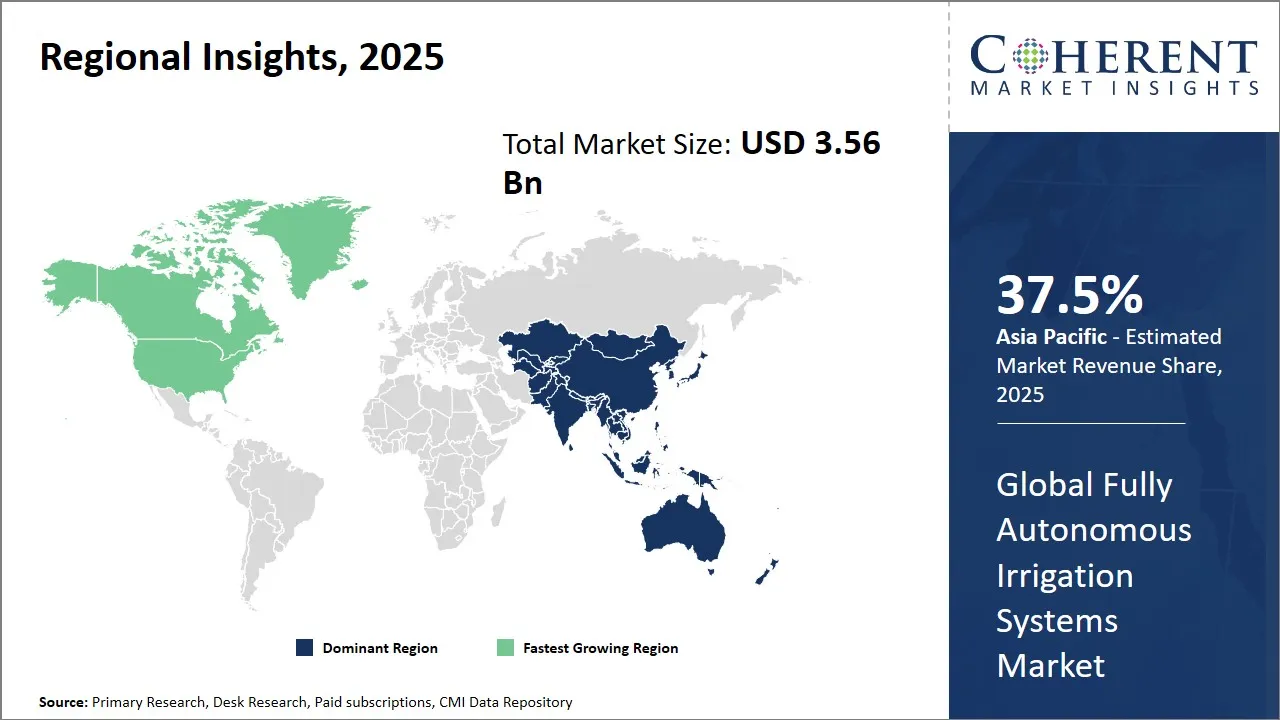
Asia Pacific Fully Autonomous Irrigation Systems Market Analysis and Trends
The Asia Pacific region is projected to lead the market with a 37.5% share in 2026, driven by increasing demand for enhanced water-use efficiency amid growing water scarcity concerns. Market growth is driven by swift modernization of agriculture in such countries as India, China, and Australia as well as by the government policies that encourage smart farming and environmental friendliness. Further adoption is encouraged by the investments in digital infrastructure and increasing awareness of small and medium-scale farmers about the usefulness of technology.
The presence of regional industries is further supported by the presence of companies like Netafim India Pvt Ltd, Lindsay Corporation and Jain Irrigation Systems which actively invent and tailor solutions to varied agricultural landscapes. Imports of advanced components are also supported by the trade dynamic, which enhances market growth.
North America Fully Autonomous Irrigation Systems Market Analysis and Trends
The North America region is expected to exhibit the fastest growth in the market, contributing 28.5% share in 2026. The area enjoys a heavy investment in agricultural research and development and infrastructure that favors IoT and AI adoption. The use of autonomous irrigation systems is increased with the help of government programs, including subsidies and grants that encourage the use of sustainable farming technologies.
The industry is run by major industry players such as Deere & Company, CropX and The Toro Company, which supports the innovation and competitive development. Furthermore, extensive supply networks and trade relationships make it easier to incorporate the most recent irrigation technologies across the United States and Canada and solidify the dominant role of North America.
Fully Autonomous Irrigation Systems Market Outlook for Key Countries
U.S. Fully Autonomous Irrigation Systems Market Analysis and Trends
The market of the autonomous irrigation systems in the U.S. is considered to be highly penetrated by the autonomous irrigation systems that are primarily used in the large-scale farming operations focused on the maximum yield and water saving. The key players, such as Deere & Company and The Toro Company, are leading companies that have provided integrated solutions that include AI, IoT sensors, and drone technology. Technology acceptance is developed by government programs that promote sustainable agriculture. The U.S. is a technological innovation center, and a pioneer in technology with well-established agri-tech partnerships and an excellent digital infrastructure that supports the ecosystem.
India Fully Autonomous Irrigation Systems Market Analysis and Trends
The fully autonomous irrigation systems market in India is developing very fast since there are mounting government policies to modernize agriculture and better the water management in the face of frequent droughts. The smart agriculture, coupled with subsidies of drip and micro-irrigation systems, sets a good environment of autonomous irrigation implementation. Firms such as the Jain Irrigation Systems and Netafim India Pvt Ltd have customized their products to suit the small to medium scale farms, and such products are affordable and easy to use.
China Fully Autonomous Irrigation Systems Market Analysis and Trends
China continues to lead as a major adopter of fully autonomous irrigation technologies, driven by its vast agricultural footprint and strong emphasis on sustainable farming practices. The government’s push toward smart agriculture involves integrating AI and automation to enhance productivity while conserving resources. Key players such as Lindsay Corporation and local Chinese firms are expanding their presence, offering advanced solutions adapted to the country’s varied climatic conditions.
Australia Fully Autonomous Irrigation Systems Market Analysis and Trends
Australia fully autonomous irrigation systems market benefits from acute water scarcity and a strong need for efficient irrigation solutions in its predominantly arid and semi-arid agricultural zones. The government promotes technologies that ensure sustainable water usage and drought resilience in farming communities. Companies like Netafim and Manna Irrigation leverage local expertise to design autonomous systems tailored to Australia’s unique environmental challenges. Collaboration between private sector innovators and public research institutions fosters advancements in sensor technology and remote management platforms, enhancing the market penetration.
Macro and Micro Economic Factors Impacting the Fully Autonomous Irrigation Systems Market Growth
Macro-Economic Factors
- Water Scarcity and Climate Change: Water shortages, erratic rain, and depleting water resources are becoming more common in the world leading to the need to pursue intelligent resource-saving irrigation technologies, and therefore full autonomy of systems is on the agenda of sustainable agriculture.
- Population Growth and Urbanization: Population increase and reduction in available arable land implies that agriculture would need to generate more using less independent irrigation systems would serve to maximize the yields per drop of water and per acre.
- Government Policy and Subsidies: Most areas are offering subsidies, tax exemptions and incentives to farmers to use water saving technologies, which is driving the adoption of modern irrigation systems.
Micro Economic Factors
- Cost Reduction through Operation: Autonomous systems sharply decrease labor expenses, cut water, energy costs, and decrease human error, and increase the profitability of farms.
- Barrier to High initial Investment: Although it has the operational benefits, high cost of installation of the system is still a challenge, particularly to smallholder farmers in the developing economies.
Market Players, Key Development, and Competitive Intelligence
Key Development
- In July 2025, GreenBot marked a major advancement in sustainable agriculture with the launch of its autonomous weeding system for woody crop cultivation. The system has a high precision self-navigating vehicle which is designed to control and manage weeds in crops like almonds, citrus, and olives with high efficiency, and minimize the use of chemicals to boost productivity.
Top Strategies Followed by Global Fully Autonomous Irrigation Systems Market Players
- Established players, in many cases multinational companies with strong financial bases, invest extensively in research and development as a way of continuing the innovation. They are interested in designing high-performance technologically sophisticated irrigation systems with precise, efficient, and sustainable solutions. Moreover, the internationalization is a very important point of their development.
- For example, Netafim is the first to develop drip irrigation systems that combine IoT-enabled sensors and cloud-based analytics to use water optimally and avoid wastage. Its systems are also common in various climatic conditions and agricultural settings all around the world, including large scale farming in the U.S. as well as in the Middle East where there is water scarcity.
- The middle ground participants in the fully autonomous irrigation systems market are following a very different strategy by focusing on the provision of affordable solutions that consider the qualities of the products and their prices. Being aware of the large need among price-sensitive consumer especially smallholder farmers and mid-sized agricultural businesses these companies come up with designs that guarantee good performance but without the high price that is attached to the high-quality technology.
- For example, CropX provides soil sensing technologies that enable farmers use water optimally at low costs.
- Small-scale players in the global market of fully autonomous irrigation systems concentrate on specific features or innovative products aimed at satisfying specific agricultural requirements. Agility and innovation are the keys that these players focus on as they adopt cutting-edge technologies including IoT-powered sensors, artificial intelligence-based irrigation scheduling, or solar-powered systems to stand out amidst bigger players.
- For example, Aquaspy created a soil moisture sensor system to be used on high-price crops (grapes and almonds), with the benefit of having a data-sensitive irrigation strategy that lessens water use.
Market Report Scope
Fully Autonomous Irrigation Systems Market Report Coverage
| Report Coverage | Details | ||
|---|---|---|---|
| Base Year: | 2025 | Market Size in 2026: | USD 3.86 Bn |
| Historical Data for: | 2020 To 2024 | Forecast Period: | 2026 To 2033 |
| Forecast Period 2026 to 2033 CAGR: | 8.5% | 2033 Value Projection: | USD 6.84 Bn |
| Geographies covered: |
| ||
| Segments covered: |
| ||
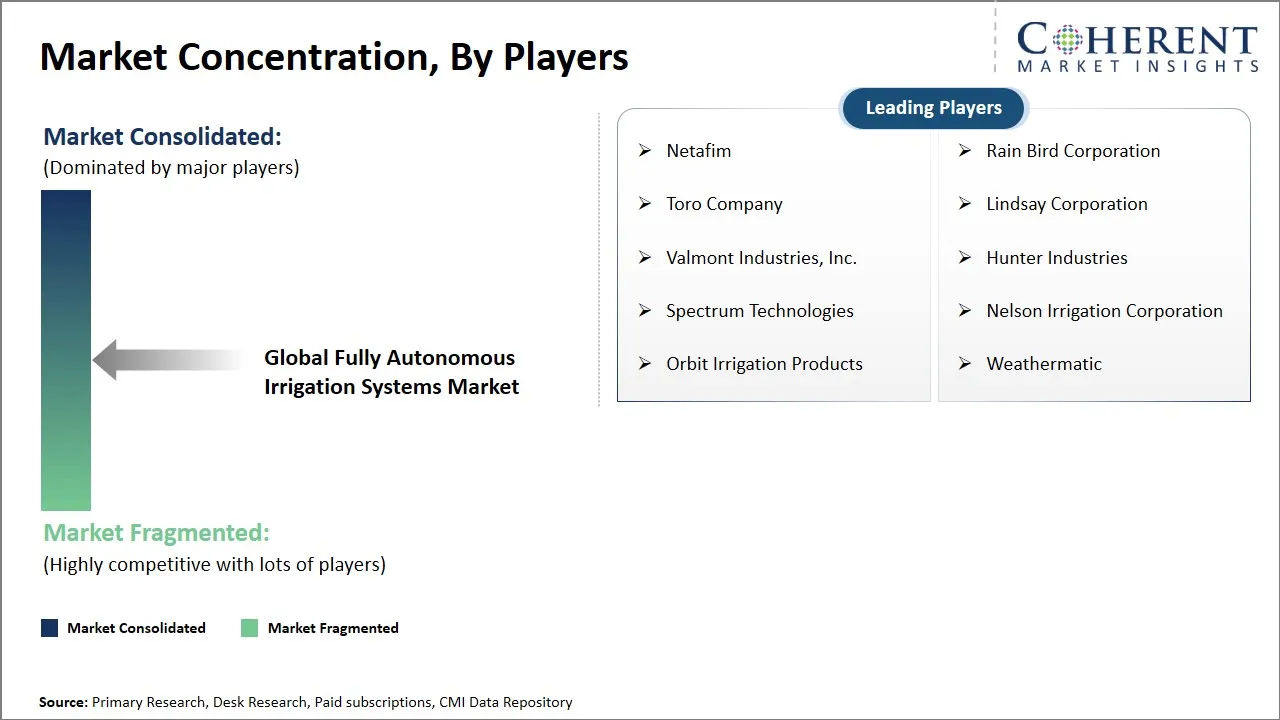
| Companies covered: | Netafim, Rain Bird Corporation, Toro Company, Lindsay Corporation, Valmont Industries, Inc., Hunter Industries, Spectrum Technologies, Nelson Irrigation Corporation, Orbit Irrigation Products, and Weathermatic | ||
| Growth Drivers: |
| ||
| Restraints & Challenges: |
| ||
Fully Autonomous Irrigation Systems Market Dynamics
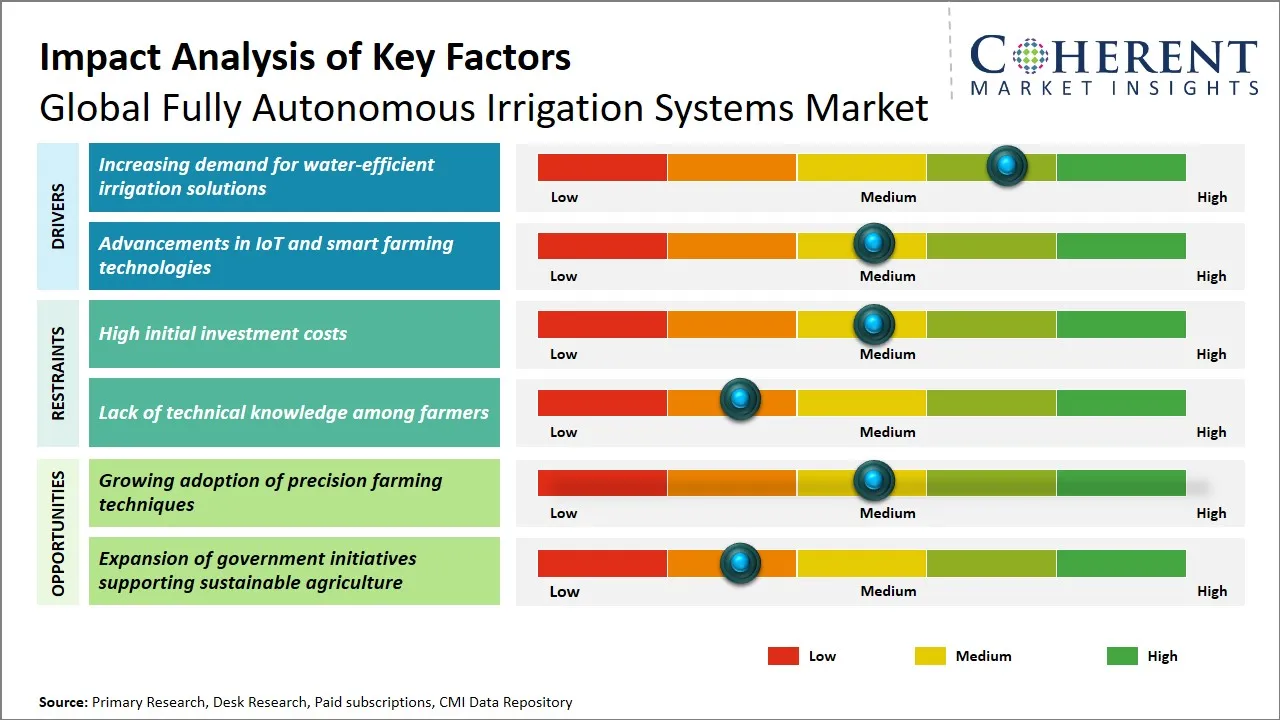
Fully Autonomous Irrigation Systems Market Driver - Increasing Demand for Water-Efficient Irrigation Solutions
The rising interest in sustainable agriculture and the necessity to maximize on water resources have fueled the rising need to maximize on water-efficient irrigation technology, which has led to the uptake of the fully autonomous irrigation systems on a global scale. Conventional approaches to irrigation usually lead to large amounts of water being wasted because of overwatering or distribution imbalance, and it is now a priority to switch to smarter irrigation technologies that allow managing water more accurately. Completely autonomous irrigation systems with advanced sensors and AI-based analytics will be able to measure soil moisture, weather conditions, and crop needs in real time, enabling the application of water only at its need and only where it is required.
To illustrate, water management can be conducted precisely by the use of real-time soil moisture sensors, as well as weather predicting systems on the fully autonomous irrigation systems. The firms such as Rachio and Netafim have come up with smart irrigation systems that regulate the timing of watering according to the environment to maximize water use and reduce water wastage.
Fully Autonomous Irrigation Systems Market Opportunity - Growing Adoption of Precision Farming Techniques
The global fully autonomous irrigation systems market stands to benefit significantly from the accelerating adoption of precision farming techniques worldwide. The application of sophisticated technologies like GPS, IoT sensor and drones and data analytics in precision farming necessitates highly efficient and intelligent irrigation to ensure the most of crops are grown and the scarcity of resources is minimized. Perfectly compatible with such needs are fully autonomous irrigation systems that allow real-time monitoring and automated water delivery depending on the needs of particular crops and the state of soil.
An example of this is the use of the latest technologies in precision farming that has been integrated into the equipment of John Deere, a world agricultural machinery giant, and has provided a farmer with an integrated approach to field management. These systems will assist farmers to know when and where water is needed by using GPS tracking and real-time data analytics. This combination of autonomous irrigation and precision farming enables water to be applied according to the soil moisture, weather conditions and crop requirements hence increasing efficiency.
Analyst Opinion (Expert Opinion)
- The market of fully autonomous irrigation systems in the world will experience impressive growth, as the lack of water conservation and the emergence of precision agriculture become a burning issue. The International Irrigation Show (2023) and Smart Irrigation Conference (2022) have provided an insight into major innovations, with such companies as Netafim and Hunter Industries being the most active in the field of automation and smart technologies integration.
- A new solar-powered autonomous irrigation system introduced by Netafims, can be viewed as an example of a progressive solution that does not only take into account the issue of sustainability but also that of efficiency. The high initial investment costs and the necessity of educating farmers on the benefits of the systems were discussed at these conferences. Furthermore, the trend towards the further integration of IoT and AI technologies in the agricultural sector was a common thing, which presupposes a transition to data-based decision-making in irrigation activities.
- Firms that can prove high ROI in terms of improved crop yields and water savings will most likely win the market share. The competitiveness can be further improved by strategic collaboration with technological companies in agriculture to come up with integrated solutions. Finally, the success of its innovation, training and actual benefits to the farmers in a dynamic agricultural environment will determine the expansion of the global market of fully autonomous irrigation systems.
Speak to the analyst
Want personalized insights?
Take the findings above to one of our principal consultants, or have the report rebuilt around the segments, geographies and competitors you actually track.
Market Segmentation
- Component Insights (Revenue, USD Bn, 2021 - 2033)
- Sensors
- Controllers
- Valves
- Pumps
- Others
- Technology Insights (Revenue, USD Bn, 2021 - 2033)
- Drip Irrigation
- Sprinkler Irrigation
- Subsurface Irrigation
- Others
- Application Insights (Revenue, USD Bn, 2021 - 2033)
- Agriculture
- Horticulture
- Landscape
- Greenhouses
- Others
- Regional Insights (Revenue, USD Bn, 2021 - 2033)
- North America
- U.S.
- Canada
- Latin America
- Brazil
- Argentina
- Mexico
- Rest of Latin America
- Europe
- Germany
- U.K.
- Spain
- France
- Italy
- Russia
- Rest of Europe
- Asia Pacific
- China
- India
- Japan
- Australia
- South Korea
- ASEAN
- Rest of Asia Pacific
- Middle East
- GCC Countries
- Israel
- Rest of Middle East
- Africa
- South Africa
- North Africa
- Central Africa
- North America
- Key Players Insights
- Netafim
- Rain Bird Corporation
- Toro Company
- Lindsay Corporation
- Valmont Industries, Inc.
- Hunter Industries
- Spectrum Technologies
- Nelson Irrigation Corporation
- Orbit Irrigation Products
- Weathermatic
Sources
Primary Research Interviews
- R&D Director – Leading Agricultural Technology Manufacturer
- Operations Manager – Major Irrigation Equipment Provider
- Product Development Head – Autonomous Irrigation System Brand
Stakeholders
- Manufacturers of Autonomous Irrigation Systems
- End-use Sectors
- Agriculture (Large-scale farming, specialty crops)
- Landscape Management and Golf Courses
- Greenhouse and Controlled Environment Agriculture
- Regulatory & Certification Bodies for Water and Agricultural Equipment
- Technology Integration Providers: AI and IoT solution providers for irrigation automation
- Service Providers: Installation and Maintenance Companies
- E-commerce Platforms and Distributors
Databases
- UN Comtrade Database
- India Import Export (EXIM) Database
- Global Agricultural Equipment Market Databases (John Deere, Trimble, etc.)
Magazines
- Irrigation Today – Trends and innovations in irrigation technology
- Precision Ag Magazine – Advances in agricultural precision systems
- Smart Water Magazine – Water management technology and efficiency
- AgriBusiness Global – Market updates in agri-tech and automation
Journals
- Agricultural Water Management Journal – Research on water use efficiency and irrigation systems
- Journal of Irrigation and Drainage Engineering – Advances in irrigation technology
- Sensors and Actuators: A Physical – IoT sensors in irrigation automation
- Computers and Electronics in Agriculture – AI and robotics applications in irrigation
Newspapers
- The Financial Times – Market growth and investments in agri-tech innovations
- The Guardian – Environmental impacts and sustainability in agriculture
- Asia Agriculture News – Trends in agricultural automation in Asia-Pacific
Associations
- Irrigation Association (IA)
- International Commission on Irrigation and Drainage (ICID)
- US National Institute of Food and Agriculture (NIFA)
- American Society of Agricultural and Biological Engineers (ASABE)
- Water Environment Federation (WEF)
Public Domain Sources
- Food and Agriculture Organization (FAO) – Guidelines and reports on irrigation and water management
- United States Department of Agriculture (USDA) – Agricultural technology and water use research
- Environmental Protection Agency (EPA) – Water quality standards and agricultural runoff mitigation
- OECD – Agricultural water use and technology assessments
- European Commission – Regulations related to irrigation technologies and water conservation
Proprietary Elements
- CMI Data Analytics Tool, Proprietary CMI Existing Repository of information for last 8 years.
Get access to 250+ pages report
Every segment, forecast, competitor profile and data table behind the analysis above — available for instant download.
- ESOMAR Member
- ISO 9001:2015 Certified
- D-U-N-S Registered
- GDPR & CCPA Compliant
Missing comfort of reading report in your local language? Find your preferred language:
Transform your Strategy with Exclusive Trending Reports
Frequently Asked Questions
The global fully autonomous irrigation systems market is estimated to be valued at USD 3.86 Bn in 2026 and is expected to reach USD 6.84 Bn by 2033.
The CAGR of the global fully autonomous irrigation systems market is projected to be 8.5% from 2026 to 2033.
Increasing demand for water-efficient irrigation solutions and advancements in IoT and smart farming technologies are the major factors driving the growth of the global fully autonomous irrigation systems market.
High initial investment costs and lack of technical knowledge among farmers are the major factors hampering the growth of the global fully autonomous irrigation systems market.
In terms of component, sensors are estimated to dominate the market revenue share in 2026.
Netafim, Rain Bird Corporation, Toro Company, Lindsay Corporation, Valmont Industries, Inc., Hunter Industries, Spectrum Technologies, Nelson Irrigation Corporation, Orbit Irrigation Products, and Weathermatic are the major players.
Asia Pacific is expected to lead the global fully autonomous irrigation systems market in 2026.