

Global Hovercraft Market Size and Forecast — 2026-2033
Global hovercraft market is estimated to be valued at USD 298.4 Mn in 2026 and is expected to reach USD 437.0 Mn by 2033, growing at a compound annual growth rate (CAGR) of 5.6% from 2026 to 2033.
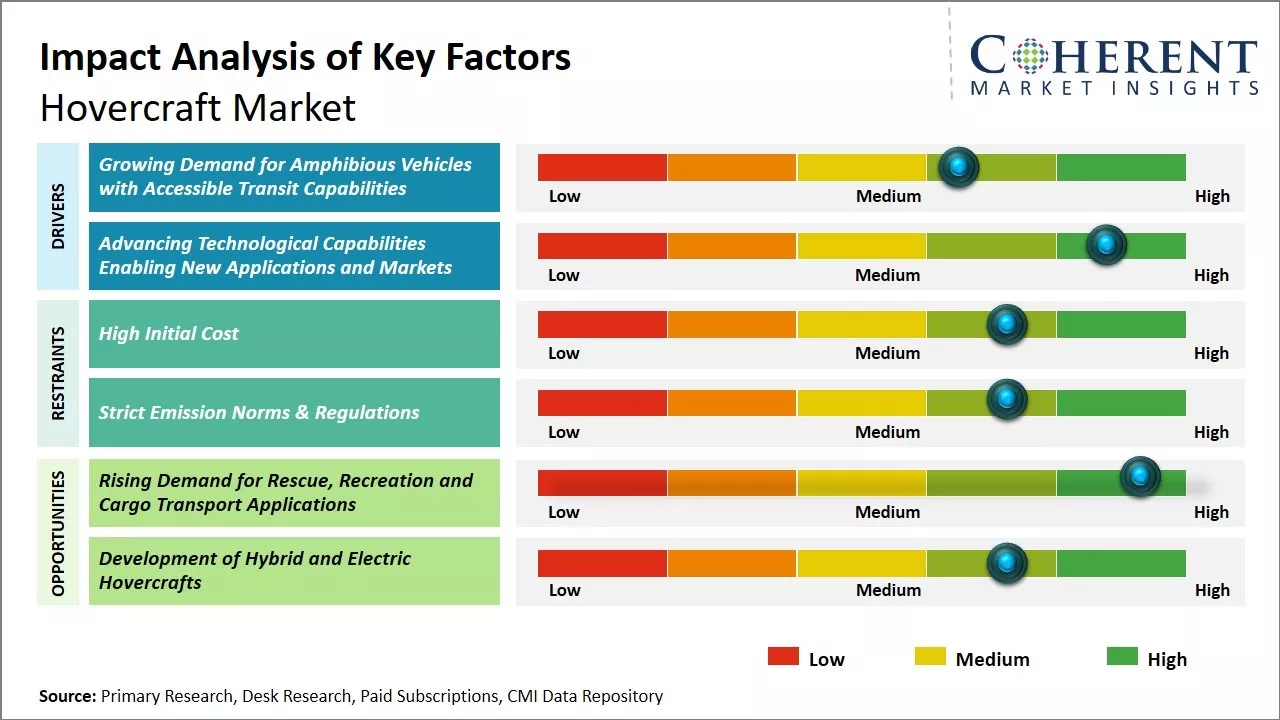 Global hovercraft market is expected to witness positive growth over the forecast period. Increasing demand for high speed water transportation and the adoption of hovercrafts for military applications are expected to drive the market growth. The advancements in hovercraft design to improve performance and efficiency can aid growth of the market. However, the high operational costs associated with hovercrafts may hamper market growth to some extent over the forecast period. Overall, increased R&D investments by leading players to develop new technologies is likely to create new opportunities for the expansion of the hovercraft market.
Growing Demand for Amphibious Vehicles with Accessible Transit Capabilities
As the global population rises and urbanization continues at an accelerated pace, efficient transportation solutions that can overcome geographic barriers will have huge demand. Hovercraft technology allows seamless transit across land and water, filling an important mode of transport suited for diverse terrain. With their ability to travel over marshes, swampland, and coastal regions inaccessible to other vehicles, hovercraft offer a flexible option for transport, emergency response, and recreational activities.
Traditional modes of transit struggle to provide accessibility in areas divided by water or wetland regions. Hovercraft have the unique ability to connect communities separated by natural barriers like rivers, lakes, or coastal areas more efficiently. As urban populations grow and the demand for transportation between cities and towns increases, hovercraft can help to meet these connectivity needs. Their amphibious qualities make hovercraft an appealing choice for routes serving port cities, coastal suburbs, or areas with seasonal water level fluctuations. Where traditional ferry systems may not be economically viable, hovercraft can fill the gaps with an affordable alternative.
Beyond mobility needs, hovercraft also allow expedited access for emergency responders. Being able to rapidly deploy hovercraft for medical evacuations, search and rescue operations, or disaster response gives these vehicles strategic value. Their amphibious driving capabilities let hovercraft traverse otherwise impassable terrain to reach remote or isolated areas. As weather events become more unpredictable with climate change, the need for emergency access across diverse geographies is rising.
For instance, Griffon Hoverwork offers Hovercrafts - 2000TD Hovercraft, 2450TD Hovercraft, and 8100TD Hovercraft that are used in amphibious operations.
Insights, by Propulsion
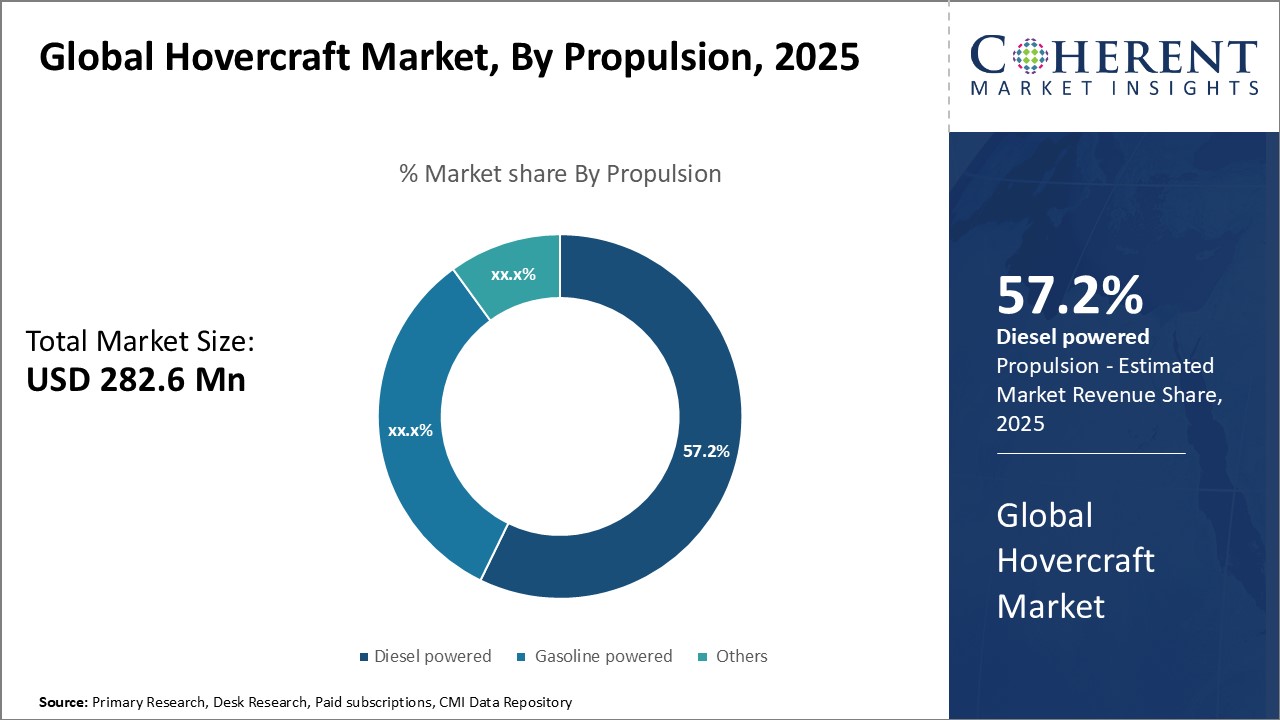 Insights, by Propulsion: The Rise of Diesel Powered Hovercraft
Diesel powered segment is estimated to contribute the highest share of 58.2% in 2026 in the market ownig to its operational and economic advantages.
The diesel powered hovercraft segment has been witnessing significant growth owing to various benefits offered by diesel engines. Diesel engines are heavier and more durable than gasoline engines, allowing hovercrafts to carry heavier payload and operate for longer durations. These require less maintenance and have a longer lifespan. This directly helps to reduce the total cost of ownership for operators.
Moreover, diesel fuel contains more energy than an equivalent amount of gasoline, resulting in better fuel efficiency. Diesel engines convert a higher percentage of fuel into work output. This enables hovercrafts with diesel propulsion to cover longer distances before refueling and brings down fuel costs significantly. Lower consumption of fuel translates to improved sustainability and environmental performance as well.
Diesel engines are also easier to start and operate, especially in colder conditions as these does not lose efficiency as much as gasoline engines. This provides hovercraft operators with greater flexibility to undertake operations throughout the year without any downtime. Their self-ignition feature eliminates the need for spark plugs, further simplifying the engine design.
Owing to such compelling functional as well as economic advantages, most commercial operators prefer diesel powered hovercrafts for cargo transportation and passenger transport activities. Even militaries across countries are opting for diesel engines to power their combat and patrol hovercrafts in view of the enhanced dependability, endurance, and lowered life-cycle costs. This growing demand from major application industries will continue propelling the rise of diesel propulsion in the hovercraft market.
Insights, By Application
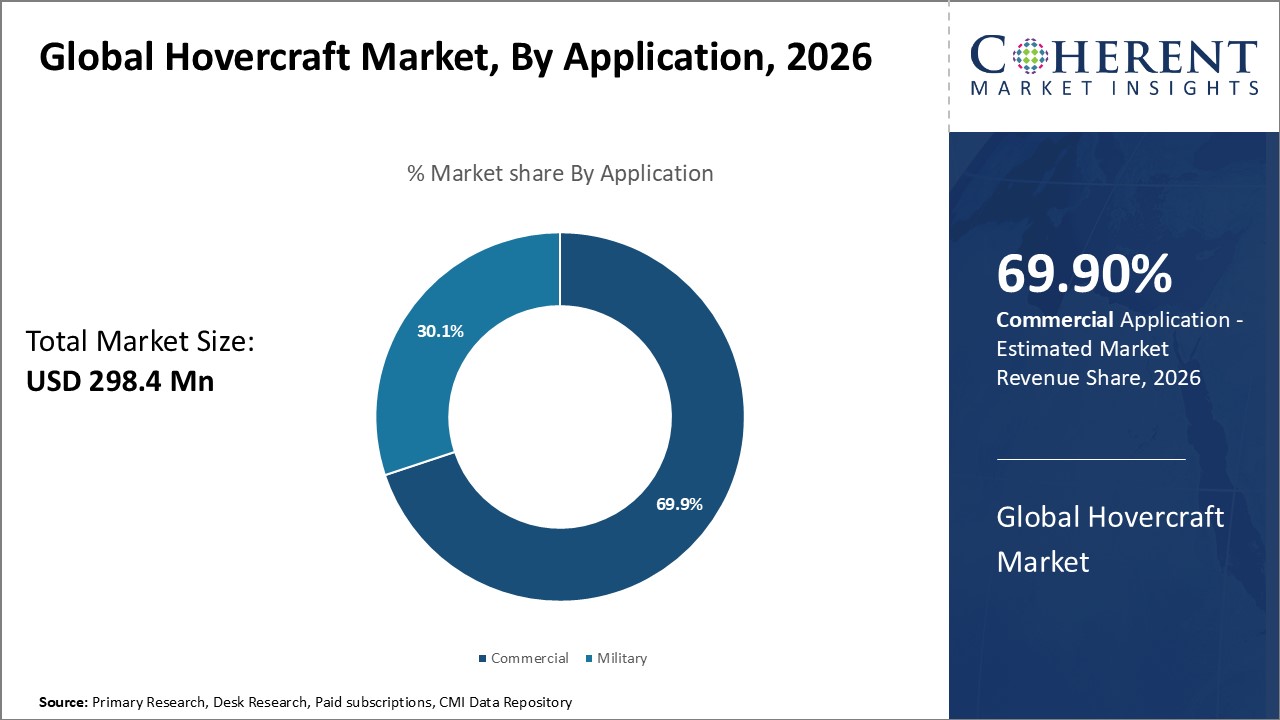
Insights, by Application - Growth of Commercial Applications
Commercial is estimated to contribute the highest share of 69.9% in 2026 in the market due to expanded use in transport services.
The commercial applications segment has emerged as a major driver of hovercraft market growth. Hovercrafts are increasingly being used by operators for reliable transport of passengers and cargo across areas not served by roads or rail infrastructure. These offer a faster mode of transportation over water, marshland, and uneven terrains where construction of dedicated infrastructure proves challenging.
A number of commercial passenger ferry services running short-haul routes connecting islands and mainland regions have incorporated hovercrafts in their fleets. This enables convenient, fast and comfortable travel for daily commuters. Similarly, cargo transportation companies have added hovercrafts to deliver freight rapidly to remote areas. Their loading and unloading does not depend on tide conditions or need for ports, simplifying logistics.
With expanding offshore resource development and coastal infrastructure projects, hovercrafts are seeing rising work deployments to transport equipment and personnel. Their amphibiousness allows easy mobilization to work sites, irrespective of terrain conditions. In disaster relief and emergency medical assistance as well, hovercrafts are gaining strategic importance for swift deployment.
The ability of hovercrafts to operate from any location with minimum surface preparation further enhances their appeal. This, along with reducing acquisition and operational costs, is supporting wider commercialization. As transport needs within the expanding marine and maritime economies continue to emerge, the commercial applications segment promises strong growth prospects for hovercrafts.
For instance, Griffon Hoverwork Ltd. offers hovercrafts for commercial applications such as logistical support, mobile medical clinics, oil spill response, passenger operation, search and rescue, and survey work.
Regional Insights
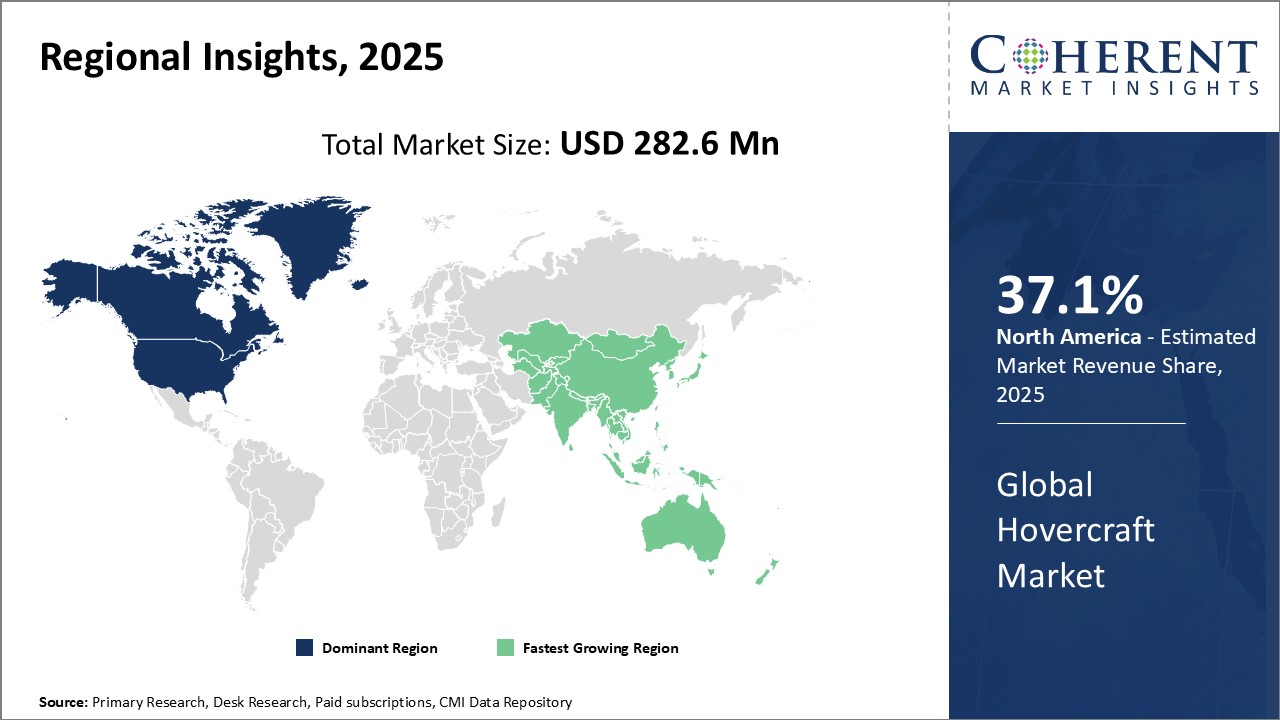
North America has established itself as the dominant region in the global hovercraft market, with a revenue share of 37.1% in 2026. The presence of key industry players such as Aerohod and Textron systems catering to both defense and commercial requirements has enabled North America to enjoy strong market consolidation over the years.
Moreover, North America is home to vast inland water bodies and coastal territories spread across the U.S. and Canada, facilitating extensive usage of hovercraft for transportation, rescue operations, and recreational activities. Several state-level authorities have incorporated hovercraft as a reliable mode for emergency medical services (EMS) and quick transport of supplies and personnel during natural disasters striking islands and isolated coastal communities. The existing defense contracts and established domestic commercial demand have empowered North American manufacturers to achieve economies of scale and offer competitive pricing for hovercraft and their components.
Asia Pacific region has emerged as the fastest growing market for hovercraft globally. Countries like China, Japan, and Australia have increased their procurement of hovercraft for military modernization programs, with a focus on maritime security near disputed territories. Public and private sector investments in developing hovercraft ferry services for linking remote islands and places with inadequate port infrastructure have picked up momentum across several Southeast Asian nations as well.
Countries in the region have also started encouraging the assembly and export of hovercraft to cater to global demand, by leveraging lower labor and manufacturing costs. For instance, Chinese companies have signed partnerships with foreign OEMs for local production of hovercraft models. India also announced plans to indigenously build hovercraft for border protection force and civil applications. The growing overseas sale and import of hovercraft components by Asia Pacific nations is expected to strengthen the regional supply chain ecosystem over the coming years.
Market Players, Key Development, and Competitive Intelligence
 Advancing Technological Capabilities Enabling New Applications and Markets
Historically limited to military, cargo, and passenger transport uses, hovercraft technology continues to evolve, thus, creating new potential commercial applications. Advancements in design, propulsion and navigation have made modern hovercraft smaller, more efficient, durable and autonomous. Lighter composite materials allow the construction of more specialized hovercraft tailored for specific industrial, recreational or research tasks. Improved engine power provides greater payload capacity and range. Advances in sensor technology enable autonomous operations as well as all-weather, night-time navigation.
New applications are emerging from these technological capabilities. Autonomous hovercraft loaded with sensors allow efficient mapping and monitoring of environments like wetlands, coastlines or infrastructure. Their ability to operate continuously in remote locations expands surveillance and ranger patrol capabilities.
Key Developments
- In February 2022, the U.S. Navy tested a next-generation hovercraft capable of carrying an Abrams tank. The next-generation landing craft of the U.S. Navy completed well deck interoperability testing, demonstrating its preparedness for fleet integration.
- In August 2022, Hammacher Schlemmer, an U.S.-based company, launched a new hovercraft named ‘The Flying Hovercraft’.
- In September 2022, Hoverlink Ontario Inc. announced a hovercraft service from Niagara region to Toronto. The service is expected to make up to 48 lake crossings per day with the aid of two vessels, such as BHT-130 and BHT-150 model hovercrafts. In addition, hovercraft models will be able to carry up to 180 passengers on each journey.
- On June 11, 2022, a Swedish navy military hovercraft traveled across the Stockholm archipelago during the Baltic Operations NATO military drills (Baltops 22). With more than 45 ships, 75 planes, and 7,500 soldiers, 14 NATO allies and two NATO partner nations, Finland and Sweden, took part in the exercise.
*Definition: The hovercraft market consists of the manufacturing and sales of hovercraft vehicles. Hovercrafts are capable of traveling over land and water through the use of air cushions to create a cushion of air below the vehicle. This allows hovercrafts to move smoothly across various surfaces without touching the ground or water. The hovercraft market caters to commercial, military, rescue, and recreational applications. Major players in this market manufactures and sells hovercrafts of varying sizes and capacities to cater to the diverse needs of customers across industries.
- Current Industry Events of 2026
- Market Size Estimation
- Regional Breakdown
- Competitive Landscape
- Customer Intelligence
- Segmental Analysis
- Pricing Analysis
- Key Market Drivers, Challenges & Future Trends
- Customized Insights Section
Market Report Scope
Global Hovercraft Market Report Coverage
| Report Coverage | Details | ||
|---|---|---|---|
| Base Year: | 2025 | Market Size in 2026: | USD 298.4 Mn |
| Historical Data for: | 2020 To 2024 | Forecast Period: | 2026 To 2033 |
| Forecast Period 2026 to 2033 CAGR: | 5.6% | 2033 Value Projection: | USD 437.0 Mn |
| Geographies covered: |
| ||
| Segments covered: |
| ||
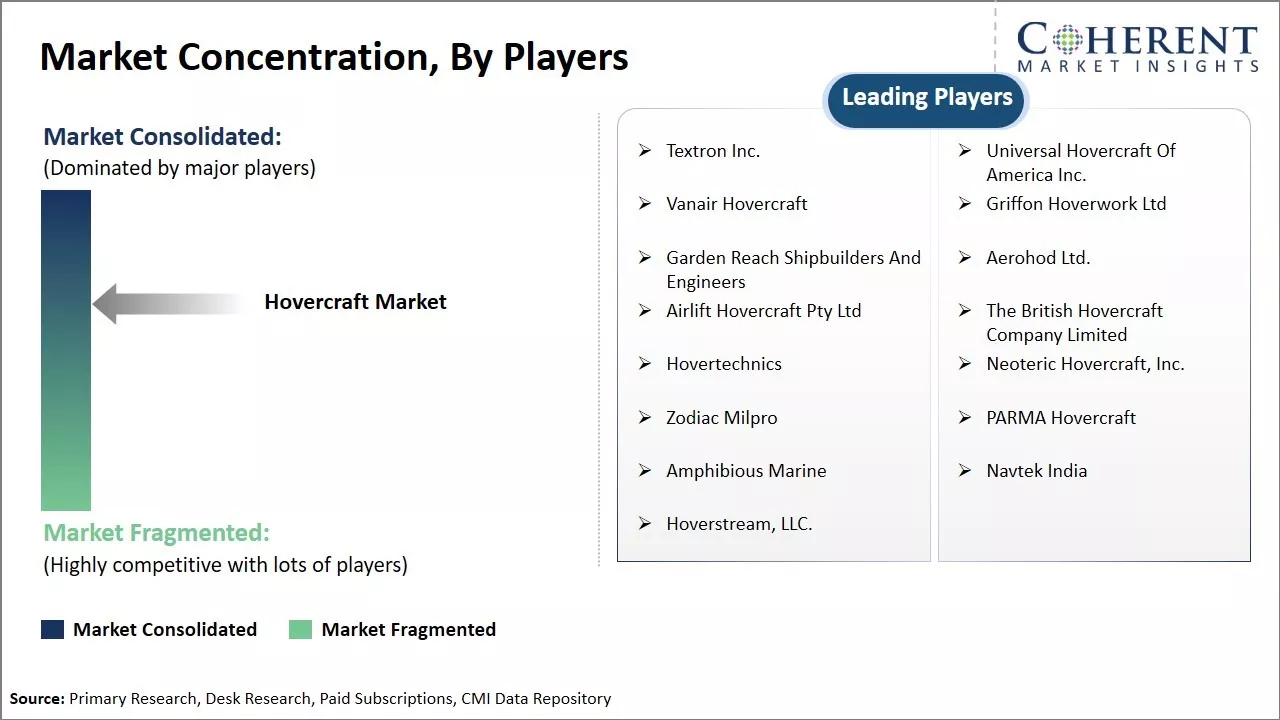
| Companies covered: | Textron Inc., Universal Hovercraft Of America Inc., Vanair Hovercraft, Griffon Hoverwork Ltd, Garden Reach Shipbuilders And Engineers, Aerohod Ltd., Airlift Hovercraft Pty Ltd, The British Hovercraft Company Limited, Hovertechnics, Neoteric Hovercraft, Inc., Zodiac Milpro , PARMA Hovercraft, Amphibious Marine, Navtek India, Hoverstream, LLC. | ||
| Growth Drivers: |
| ||
| Restraints & Challenges: |
| ||
Analyst Opinion (Expert Opinion)
 Market Challenges: High Initial Cost
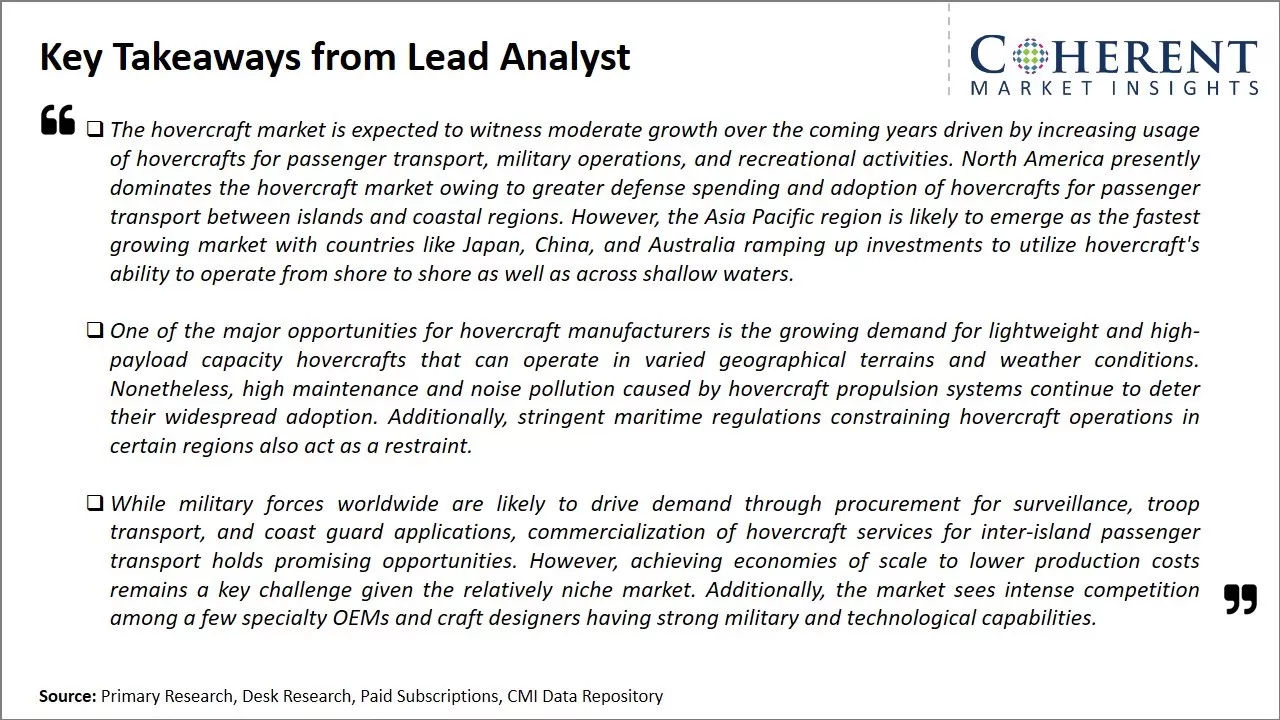
The hovercraft market faces several challenges. As the technology is still developing, initial costs are high, maintain, and insure hovercrafts. Harsh environmental conditions can limit their functionality. Creating sufficient lift over varied surfaces requires advanced engineering. Strict noise and emissions controls present design and manufacturing challenges. Further innovation is needed to address technical issues and expand usable terrain before the market can significantly grow.
Market Opportunities: Rising Demand for Rescue, Recreation and Cargo Transport Applications
As the technology matures, costs are expected to decrease through mass production and design improvements. Their ability to traverse land and water opens new applications for rescue, recreation and cargo transport. Demand could increase for uses like coast guard patrols, movement of building materials, and tourism. Successful military and commercial applications can demonstrate capabilities to gain broader acceptance.
Speak to the analyst
Want personalized insights?
Take the findings above to one of our principal consultants, or have the report rebuilt around the segments, geographies and competitors you actually track.
Market Segmentation
- Propulsion Insights (Revenue, USD Million, 2021 - 2033)
- Diesel powered
- Gasoline powered
- Others
- Application Insights (Revenue, USD Million, 2021 - 2033)
- Military
- Commercial
- Regional Insights (Revenue, USD Million, 2021 - 2033)
- North America
- U.S.
- Canada
- Europe
- Germany
- U.K.
- France
- Italy
- Russia
- Spain
- Rest of Europe
- Asia Pacific
- China
- India
- Japan
- Australia
- South Korea
- ASEAN
- Rest of Asia Pacific
- Latin America
- Brazil
- Argentina
- Mexico
- Rest of Latin America
- Middle East & Africa
- GCC Countries
- Israel
- South Africa
- Rest of Middle East
- North America
- Key Players Insights
- Textron Inc.
- Universal Hovercraft Of America Inc.
- Vanair Hovercraft
- Griffon Hoverwork Ltd
- Garden Reach Shipbuilders And Engineers
- Aerohod Ltd.
- Airlift Hovercraft Pty Ltd
- The British Hovercraft Company Limited
- Hovertechnics
- Neoteric Hovercraft, Inc.
- Zodiac Milpro
- PARMA Hovercraft
- Amphibious Marine
- Navtek India
- Hoverstream, LLC.
Get access to 250+ pages report
Every segment, forecast, competitor profile and data table behind the analysis above — available for instant download.
- ESOMAR Member
- ISO 9001:2015 Certified
- D-U-N-S Registered
- GDPR & CCPA Compliant
Missing comfort of reading report in your local language? Find your preferred language:
Transform your Strategy with Exclusive Trending Reports
Frequently Asked Questions
The Global Hovercraft Market is estimated to be valued at USD 298.4 Mn in 2026, and is expected to reach USD 437.0 Mn by 2033.
The CAGR of the Global Hovercraft Market is projected to be 5.6% from 2026 to 2033.
Growing Demand for Amphibious Vehicles with Accessible Transit Capabilities and Advancing Technological Capabilities Enabling New Applications and Markets are the major factor driving the growth of Hovercraft Market.
High Initial Cost and Strict Emission Norms & Regulations are the major factor hampering the growth of Hovercraft Market.
In terms of Propulsion, Diesel powered, estimated to dominate the market revenue share 2026.
Textron Inc., Universal Hovercraft Of America Inc., Vanair Hovercraft, Griffon Hoverwork Ltd, Garden Reach Shipbuilders And Engineers, Aerohod Ltd., Airlift Hovercraft Pty Ltd, The British Hovercraft Company Limited, Hovertechnics, Neoteric Hovercraft, Inc., Zodiac Milpro , PARMA Hovercraft, Amphibious Marine, Navtek India, Hoverstream, LLC. are the major players.
North America is expected to lead the Hovercraft Market.