

Global Manual Resuscitators Market Analysis & Forecast: 2026-2033
Global manual resuscitators market was valued at USD 573.8 Mn in 2026 and is expected to reach USD 862.7 Mn by 2033, exhibiting a compound annual growth rate (CAGR) of 6.0% from 2026 to 2033.
Key Takeaways
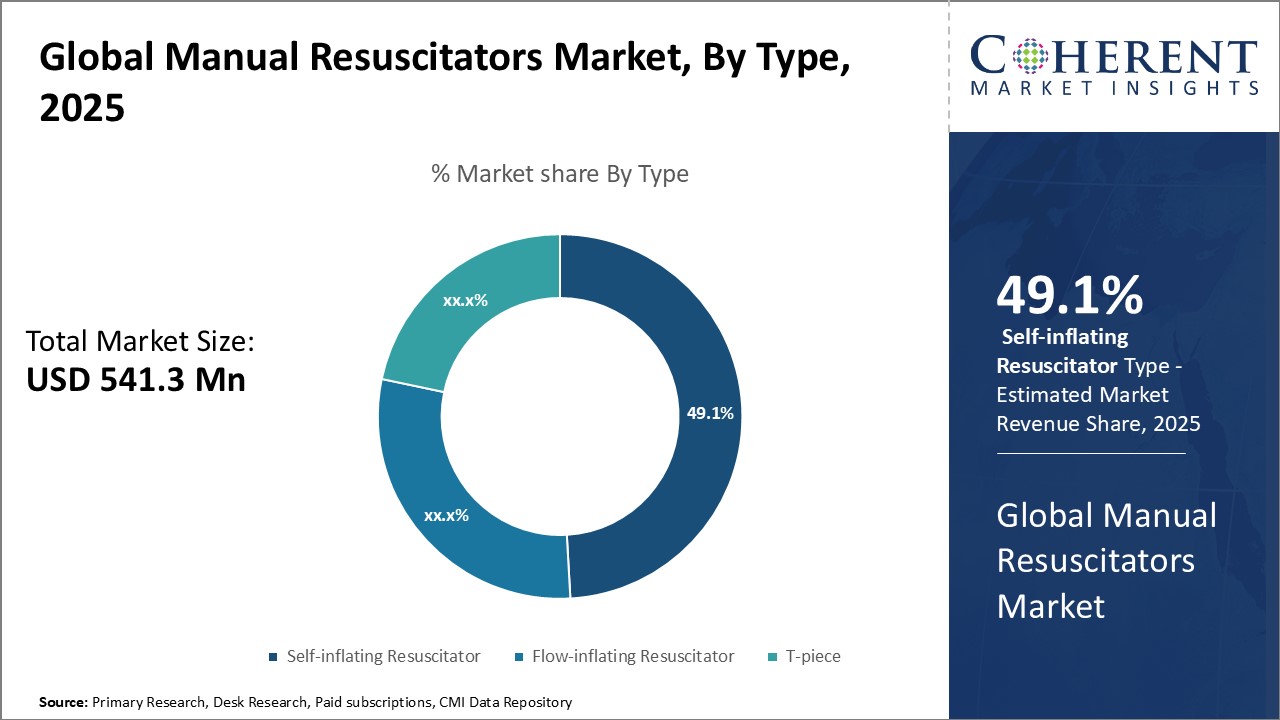
- By Type, the Self-Inflating Resuscitators segment is projected to account for the largest share of 50.1% in the global manual resuscitators market in 2026, driven by their ease of use, portability, and suitability for emergency medical scenarios without requiring an external gas source.
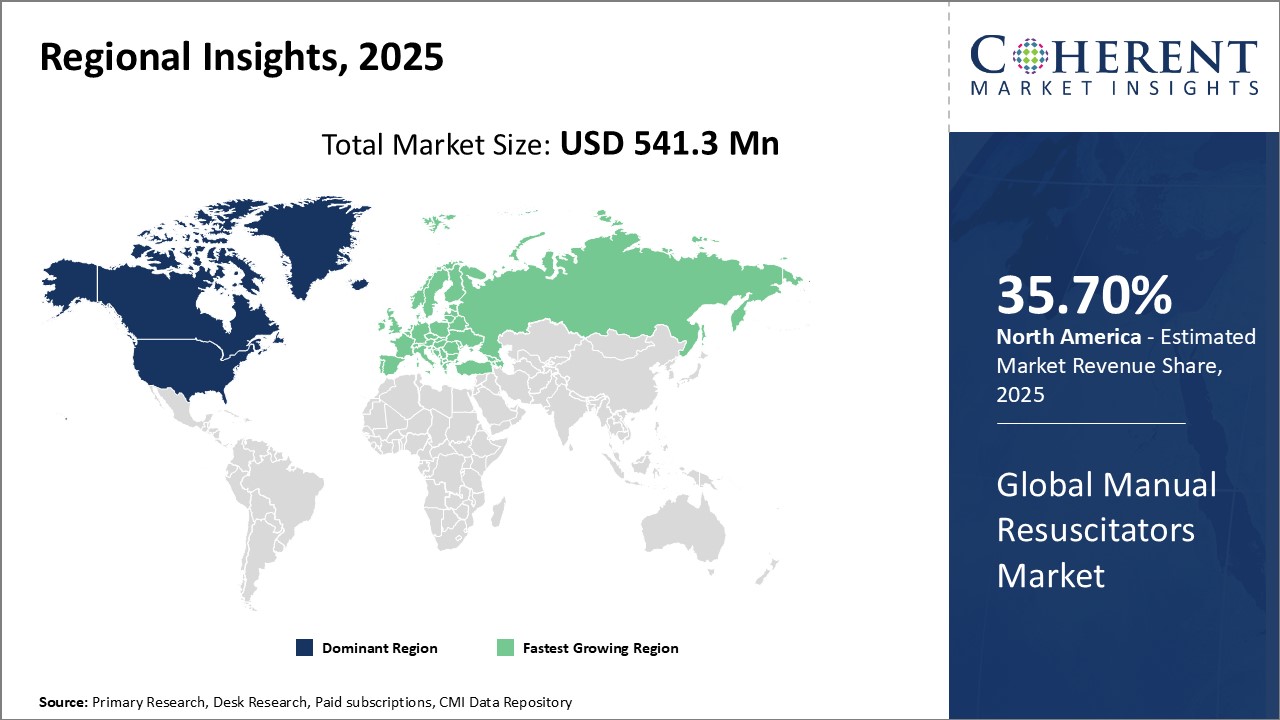
- By Region, North America is anticipated to dominate the market with a projected share of 35.70% in 2026, supported by a well-established emergency care infrastructure, high healthcare spending, and strong adoption of advanced respiratory support devices.
- Asia Pacific is expected to emerge as the second-largest market, capturing over 25.2% of the global share in 2026, fueled by growing healthcare access, rising awareness of emergency medical interventions, and expanding hospital networks in countries such as China and India.
- Europe is forecasted to be the fastest-growing region in 2026, with a projected market share of 19.0%, driven by increasing investments in pre-hospital care, neonatal resuscitation programs, and advancements in manual ventilation technology.
Market Overview
Global Manual Resuscitators Market has been witnessing noteworthy growth over the forecast period. Manual resuscitators which are also known as manual ventilation bags or self-inflating bags are medical devices that are used to provide ventilation to patients who are not breathing or are not breathing adequately. They enable healthcare professionals to inflate a patient's lungs with room air or oxygen through intubation or non-invasive ventilation like a face mask.
In many rural and digital healthcare settings worldwide, manual resuscitators are crucial due to limited access to advanced mechanical ventilators. For example, emergency medical teams in remote areas of Australia and parts of Africa frequently use manual resuscitators during patient transport and in field clinics to provide life-saving ventilation. These devices’ portability, ease of use, and reliability in diverse environments underscore their growing adoption and contribute significantly to the steady growth of the global manual resuscitators market.
Current Events and Its Impact on the Global Manual Resuscitators Market
Event | Description and Impact |
Geopolitical Conflicts Disrupting Medical Supply Chains |
|
Regulatory Shifts Reshaping Market Access |
|
Public Health Trends Accelerating Demand |
|
Pipeline Analysis – Global Manual Resuscitators Market
- The manual resuscitators are constructed with their engineering design features prioritized over other considerations like clinical trial pathways. One prominent example is the NIH-sponsored Haemorrhagic Shock Resuscitator, which is currently in phased clinical trials, and seeks to improve oxygenation as well as haemorrhage control during trauma management.
- Firms like Ambu A/S, Medtronic, and Teleflex are participating in developing advanced valve designs, new sustainable materials, and monitoring technologies. Even though their particular strategies are not accessible to the public, R&D investment aims at increasing ease of device utilization and responsiveness during emergencies.
- Some other essential drivers include AstraZeneca's biologics for asthma and COPD in the diagnosis associated with emergency vents, which are in phase three with hopes of lessening the need for emergency ventilators and Autolus Therapeutics’ Obe-cel in phase one which has potential in emergency neurosurgical procedures.
- Current Industry Events of 2026
- Market Size Estimation
- Regional Breakdown
- Competitive Landscape
- Customer Intelligence
- Segmental Analysis
- Pricing Analysis
- Key Market Drivers, Challenges & Future Trends
- Customized Insights Section
Reimbursement Scenario
- In Emergency Medicine and the Care level for the critically ill, manual resuscitators are seamlessly integrated pieces of technology, though reimbursement differs greatly between healthcare systems. It is to be noted that in America, as well as with Medicare and Medicaid, coverage with regards to a manual resuscitator is only provided when using certain Current Procedural Terminology (CPT) codes). Reimbursable codes of importance are 92950 (cardiopulmonary resuscitation, including manual resuscitator use), 99291/99292 (critical care evaluation), and 94760 (pulse oximetry during resuscitation under restrained conditions).
- Coverage requires the proving of medical necessity and compliance with the adequate document requirements. Services providing critical care evernt subsidized by the US are manually billed to the other insurers, demonstrating the level of medicare spending on such activities, which is esteemad to be high. However, very limited in-depth data specific to the reimbursement for certain devices is available. Typically, private payers go after each other’s Medicare policies, though some impose more restrictions like requiring prior authorization.
- Throughout the globe, reimbursement mechanisms illustrate stark contrast. In the European Union, the cost of a Manual resuscitator is Included in the bundle payment used to reimburse inpatient activities in the critical care or surgical period as Diagnosis-Related Groups (DRG). While the UK’s NHS incorporates the cost for resuscitation devices in DRGs, other countries like Germany allow them to be billed independently for the devices. In many low income countries, in the absence of a system, or limited and sporadic reimbursement policies make wider adoption of such devices in public healthcare systems difficult.
- Burying problems accompanying reimbursement from one to another of the annoyingly strict outline enveloping global surgical periods include composed documentation for the devices, only widen the scope of stress. Given the tense fragmentation of the globe, it is recommended by stakeholders to try and tackle the issue country-specific coding and payable policies in detail.
Patent Landscape
- Between 2020 and 2025, over 40 new patents were filed in the market, highlighting key innovations in emergency medical device technologies. Notable areas of focus include one-handed operation systems designed to improve ease of use, feedback-controlled valve mechanisms that enhance device precision and safety, and the development of recyclable or sustainable bag materials aimed at reducing environmental impact.
- Leading the patent filings are prominent industry players such as Laerdal Medical, Ambu A/S, and Teleflex Incorporated, underscoring their commitment to advancing product functionality and sustainability. These patent activities indicate a strong emphasis on user-centric design and eco-friendly solutions, shaping future trends in the medical device landscape.
Prescribers’ Preference
- Manual resuscitators (bag-valve-mask devices) remain indispensable in emergency respiratory care, with prescriber preferences shaped by clinical guidelines, patient needs, and device features. Emergency physicians and anesthesiologists favor self-inflating bags for their simplicity and reliability, especially during high-pressure situations like CPR.
- Pediatricians prioritize devices designed for smaller patients, favoring resuscitators with pressure-limiting valves and appropriately sized masks to prevent lung injury and barotrauma in neonates and children. Respiratory therapists emphasize resuscitators equipped with integrated monitoring tools—such as transparent manometer ports or smart sensors—to provide real-time feedback on ventilation rates and volumes, helping reduce user errors.
- In infection-prone environments like ICUs and patient transport settings, disposable, single-use resuscitators are preferred to minimize cross-contamination risks despite higher costs.
- Devices with features such as oxygen reservoirs and PEEP valves are favored in critical care, while models offering synchronized ventilation and rate-assist metronomes improve compliance with CPR protocols. Overall, prescribers are increasingly selecting manual resuscitators that combine ease of use with safety-enhancing technologies aligned with updated resuscitation guidelines.
Segmental Analysis
Manual Resuscitators Market Insights, By Type
In terms of type, self-inflating resuscitators are expected to hold the largest share of the global manual resuscitators market in 2026, accounting for 50.1%. This dominance is primarily due to their ease of use, reliability, and effectiveness in emergency situations without the need for external gas sources. These devices are widely used in hospital settings, ambulances, and field emergencies, offering immediate ventilation support to patients in critical condition.
Their portability and ability to function independently make them a preferred choice in both developed and developing regions. Additionally, growing awareness about emergency preparedness and training in basic life support (BLS) is further driving their adoption. Leading manufacturers are focusing on enhancing features such as pressure-limiting valves and ergonomic designs to improve safety and user comfort. The segment's strong position reflects its continued relevance in diverse clinical and pre-hospital care environments.
Global Manual Resuscitators Market- Regional Insights
North America Manual Resuscitators Market Analysis and Trends
North America is projected to lead the global manual resuscitators market, accounting for over 35.7% of the market share in 2026. This leadership is driven by the rising prevalence of lifestyle-related diseases such as asthma, COPD, and cardiac arrest, which necessitate the availability of effective emergency respiratory support.
Asia Pacific Manual Resuscitators Market Analysis and Trends
Asia Pacific is expected to be the second-largest market, capturing over 25.2% of the global share in 2026. Key growth drivers include rising birth rates, expanding neonatal care services, and increasing investments in healthcare infrastructure, especially in emerging economies such as India and China. The integration of advanced medical technologies and rising healthcare access in both urban and rural areas are further accelerating regional market growth.
Dominating Countries in the Manual Resuscitators Market
United States Manual Resuscitators Market Analysis and Trends
The U.S. is the leading country in the North American manual resuscitators market, backed by a highly developed healthcare ecosystem and significant investments in emergency medical services. Government programs that promote CPR training and the strategic placement of emergency resuscitation devices in public areas are increasing usage. Continuous innovation by U.S.-based medical device manufacturers further enhances the availability and quality of manual resuscitators.
China Manual Resuscitators Market Analysis and Trends
China is emerging as a major contributor within Asia Pacific, driven by its large population base and growing focus on improving healthcare delivery. Increased birth rates and rising demand for neonatal care devices are key market drivers. Government initiatives to upgrade public hospitals and train healthcare professionals in emergency response are expected to support strong market growth.
Market Report Scope
Manual Resuscitators Market Report Coverage
| Report Coverage | Details | ||
|---|---|---|---|
| Base Year: | 2025 | Market Size in 2026: | USD 573.8 Mn |
| Historical Data for: | 2020 To 2024 | Forecast Period: | 2026 To 2033 |
| Forecast Period 2026 to 2033 CAGR: | 6.0%2033 Value Projection: | USD 862.7 Mn | |
| Geographies covered: |
| ||
| Segments covered: |
| ||
| Companies covered: | WEINMANN Emergency Medical Technology GmbH + Co. KG, Laerdal Medical, Ambu A/S, Medline Industries, LP, Hopkins Medical Products, ResMed, Inc., HUM Gesellschaft für Homecare und Medizintechnik mbH, PERSYS MEDICAL, and CareFusion. | ||
| Growth Drivers: |
| ||
| Restraints & Challenges: |
| ||
Global Manual Resuscitators - Drivers
- Increasing numbers of emergency cases:
The number of emergency medical cases requiring resuscitation services has witnessed a steady rise globally during forecast years. Various reports from organizations like the World Health Organization (WHO) and studies published in -reviewed medical journals show that the incidence of condition like cardiac arrests, respiratory failures, and choking accidents outside of hospital settings have increased substantially.
- Rising incidence of chronic diseases:
Rising incidence of chronic diseases across the globe is proving to be a major factor driving the growth of the global manual resuscitators market. Chronic conditions like cardiovascular diseases, cancer, respiratory diseases and diabetes are among the leading causes of mortality worldwide.
The high prevalence of such lifestyle-related non-communicable diseases has increased the need for critical care equipment and devices like manual resuscitators. instance, in South nations, the anticipated pooled prevalence of chronic obstructive pulmonary disease (in 2021 was 11.1%, according to a National Center of Biotechnology () report released in March 2022. The survey also said that Bangladesh (13.5%) and North India (19.4%) have the highest rates of COPD prevalence.
- Technological advancements in resuscitation devices:
Technological advancements in medical devices are playing a crucial role in driving the growth of global manual resuscitators market. Resuscitation is a critical procedure to revive cardiac arrests or respiratory failures and manual resuscitators remain the first line of treatment in such life-threatening conditions. The devices are witnessing continuous innovations to make resuscitation more effective and improve clinical outcomes.
For, many manufacturers are developing bag valve masks with improved ventilation performance that are tailored to deliver appropriate peak inspiratory pressures, especially for pediatric patients. Some brands have incorporated safety features like pressure release valves and manometers to avoid risks of over-inflation.
Global Manual Resuscitators Market- Opportunities
- Introduction of portable and disposable resuscitation devices:
Introduction of portable and disposable resuscitation devices can unlock new opportunities in the global manual resuscitators market. Portable resuscitators are lightweight, compact, and easy to carry medical devices that can be used cardiopulmonary resuscitation is required. Their disposable nature means no requirement is needed for cleaning or sterilization between the uses, thus reducing the risk of cross-contamination. This makes them highly useful for emergency medical services, ambulance crews, and in healthcare settings.
- Increasing healthcare expenditure:
Increasing healthcare expenditure is indeed a promising opportunity for growth in the global manual resuscitators market. As economies around the world continue to develop, citizens are demanding higher quality and more comprehensive medical services. Governments are responding by dedicating more funds towards improving healthcare infrastructure and access to care.
This rise in overall healthcare expenditure often starts with equipping medical facilities with basic but critical life-saving equipment. Manual resuscitators represent a cost-effective solution for reviving patients experiencing respiratory issues in even basic clinical settings. As primary care access widens in developing nations, the need for manual resuscitators will multiply at the community level.
Global Manual Resuscitators Market- Trends
- Miniaturization of resuscitation devices:
The trend of miniaturizing medical devices has significantly impacted the manual resuscitators market during forecast period. As devices get smaller and more compact, they are becoming easier for healthcare professionals to transport and use in diverse settings outside the traditional hospitals. This has increased the demand for small and portable manual resuscitators that can be easily carried and utilized in ambulances, emergency response vehicles, and other locations where space may be limited.
- Growing demand for emergency medical equipment:
The demand for emergency medical equipment has significantly risen in forecast period owing to numerous factors such as aging population, increasing prevalence of chronic diseases, and life-threatening medical conditions, and growing incidence of road accidents and injuries. This rising demand is directly influencing the global manual resuscitators market.
Manual resuscitators are especially crucial for administering artificial respiration in emergency situations. With more people requiring urgent medical care and emergency airway management, the need for reliable and portable manual resuscitators has surged across healthcare facilities as well as pre-hospital emergency medical services.
Analyst View
- The global manual resuscitators market is expected to grow steadily, driven by the rising incidence of chronic respiratory diseases, a growing elderly population, and increasing demand for emergency medical services.
- North America leads the market due to its advanced healthcare infrastructure, early adoption of medical technologies, and supportive reimbursement frameworks.
- Asia-Pacific is anticipated to register the fastest growth, with countries like China and India investing in healthcare infrastructure and raising awareness about emergency care.
- However, market growth may be restrained by the increasing availability of automated resuscitators and a shortage of trained healthcare professionals in low- and middle-income regions.
- Opportunities lie in developing cost-effective, portable, and easy-to-use manual resuscitators tailored for resource-constrained settings.
- Integration of advanced features such as pressure monitoring and adjustable ventilation settings is expected to boost product value and safety.
- To capitalize on emerging trends, manufacturers should focus on innovation, affordability, and user training to expand access and improve patient outcomes globally.
- As the market evolves, collaboration between healthcare providers and device manufacturers will be essential for ensuring widespread adoption and effective utilization of manual resuscitators.
Manual Resuscitators Market Key Developments
- On April 22, 2025, Ambu A/S unveiled a next-generation self-inflating manual resuscitator equipped with dual pressure-relief valves and a built-in oxygen monitoring window, aimed at enhancing patient safety during critical care interventions.
- In February 2025, Laerdal Medical launched a compact, single-use manual resuscitator specifically designed for use in ambulances and emergency transport settings, offering lightweight handling and reduced risk of cross-contamination.
- In November 2024, Medline Industries introduced a sustainable manual resuscitator series manufactured using partially biodegradable materials, targeting hospitals aiming to reduce their medical waste footprint.
- In September 2024, Teleflex Incorporated partnered with a digital health startup to co-develop a sensor-enabled manual resuscitator capable of providing real-time ventilation feedback, supporting improved clinical outcomes in both adult and pediatric resuscitation.
Market Segmentation:
- Global Manual Resuscitators Market, By Type
- Self-inflating Resuscitator
- Flow-inflating Resuscitator
- T-piece
- Global Manual Resuscitators Market, By Modality
- Disposable
- Reusable
- Global Manual Resuscitators Market, By Material
- Silicon
- PVC
- Rubber
- Global Manual Resuscitators Market, By Application
- Chronic Obstructive Pulmonary Disease
- Cardiopulmonary Arrest
- Others
- Global Manual Resuscitators Market, By End User
- Hospitals
- Out of Hospital
- Ambulance Services
- Others
Regional Insights (Revenue, USD Mn, 2021 - 2033)
- North America
- U.S.
- Canada
- Latin America
- Brazil
- Argentina
- Mexico
- Rest of Latin America
- Europe
- Germany
- U.K.
- Spain
- France
- Italy
- Russia
- Rest of Europe
- Asia Pacific
- China
- India
- Japan
- Australia
- South Korea
- ASEAN
- Rest of Asia Pacific
- Middle East
- GCC Countries
- Israel
- Rest of Middle East
- Africa
- South Africa
- North Africa
- Central Africa
- North America
- Top Companies in Global Manual Resuscitators Market
- WEINMANN Emergency Medical Technology GmbH + Co. KG
- Laerdal Medical
- Ambu A/S
- Medline Industries, LP
- Hopkins Medical Products
- ResMed, Inc.
- HUM Gesellschaft für Homecare und Medizintechnik mbH
- PERSYS MEDICAL
- CareFusion
Sources:
Primary Research interviews:
- Product Managers and Technical Experts from Emergency Medical Device Providers
- Clinicians and Respiratory Therapists from Hospitals and Clinics
- Analysts from Healthcare Research Firms
- Others
Databases:
- CMI Industry Database
- Others
Magazines:
- Healthcare Business Review (Respiratory Care Edition)
- Medical Product Outsourcing
- Emergency Medical Services (EMS) Today
- Others
Journals:
- National Centre for Biotechnology Information (NCBI) Publications
- American Heart Association (AHA) Resuscitation Journal
- Journal of Critical Care Medicine
- Others
Newspapers:
- The Wall Street Journal (Healthcare Sector)
- Bloomberg Medical Devices Digest
- Reuters Health News
- Others
Associations:
- American Heart Association (AHA)
- American Respiratory Care Foundation (ARCF)
- Global Initiative for Chronic Obstructive Lung Disease (GOLD)
- Others
Public Domain sources:
- National Institutes of Health (NIH) Public Reports
- World Health Organization (WHO) Respiratory Health Statistics
Centers for Disease Control and Prevention (CDC) Emergency Care Data
Others - Proprietary Elements:
CMI Data Analytics Tool
Proprietary CMI Existing Repository of information for last 8 years
Definition: Manual resuscitators which are also commonly known as bag-valve masks (BVMs) are medical devices that provide ventilation to individuals who are either not breathing or breathing inadequately. They are manual, portable units that are designed to deliver breaths to a patient with minimal delay. These devices are essential for various medical emergencies, particularly when immediate respiratory assistance is needed.
Get access to 250+ pages report
Every segment, forecast, competitor profile and data table behind the analysis above — available for instant download.
- ESOMAR Member
- ISO 9001:2015 Certified
- D-U-N-S Registered
- GDPR & CCPA Compliant
Missing comfort of reading report in your local language? Find your preferred language:
Transform your Strategy with Exclusive Trending Reports
Frequently Asked Questions
The Global Manual Resuscitators Market size is estimated to be valued at USD 573.8 Mn in 2026, and is expected to reach USD 862.7 Mn by 2033.
Lack of training on manual resuscitators and low awareness level about emergency care are the key factors hampering growth of the global market.
Increasing number of emergency cases, rising incidence of chronic diseases, and technological advancements in resuscitation devices are the major factors driving the global market.
Self-inflating resuscitator segment is the leading type segment in the global market.
The major players operating in the global manual resuscitators industry are WEINMANN Emergency Medical Technology GmbH + Co. KG, Laerdal Medical, Ambu A/S, Medline Industries, LP, Hopkins Medical Products, ResMed, Inc., HUM Gesellschaft für Homecare und Medizintechnik mbH, PERSYS MEDICAL, and CareFusion.
North America leads the global manual resuscitators industry.
The CAGR of the Global Manual Resuscitators industry is projected to be 6.0% from 2026 to 2033.