

The global optical genome mapping market size is expected to reach USD 803.0 Mn by 2033, from USD 206.6 Mn in 2026, exhibiting a compound annual growth rate (CAGR) of 21.4% during the forecast period.
Key Takeaways
- By Product, The Instruments Segment is projected to dominate the global Optical Genome Mapping Market, securing approximately 42.1% of the total market revenue share in 2026.
- By Region, North America is anticipated to retain its leading position in the global Optical Genome Mapping Market, accounting for an estimated 35.70% of the total market share in 2026.
Market Overview
The global Optical Genome Mapping Market is experiencing robust growth, driven by the increasing need for high-resolution structural variation analysis in genomics research, clinical diagnostics, and personalized medicine. Key growth factors include the rising incidence of genetic disorders and cancer, growing investments in precision medicine, and advancements in genome mapping technologies.
Current Events and its Impact on the Optical genome mapping market
Current Event | Description and its impact |
Regulatory Support for Rare Disease and Cancer Diagnostics |
|
Strategic Collaborations and Industry-Academia Partnerships |
|
Increased Genomic Funding in Asia-Pacific |
|
Market Dynamics
Optical genome mapping market Trends
- Advancements in sequencing technologies
Advancements in sequencing technologies have greatly influenced the global optical genome mapping market in recent years. Next generation sequencing technologies have significantly brought down the cost of decoding the entire genome. While whole genome sequencing provides nucleotide-level resolution, it does not reliably capture large structural variants which plays an important role in genetic disorders and complex diseases.
Optical genome mapping helps address this limitation as it can rapidly analyze entire genomes to detect large structural changes like insertions, deletions, inversions, and translocations at a relatively lower resolution compared to sequencing.
In May 2025, Bionano Genomics reported a 9% increase in its installed base of OGM systems, reaching 379 units by the end of Q1 2025. This growth reflects the expanding adoption of OGM technology in clinical and research settings. Additionally, an international consortium published expert recommendations for integrating OGM as a standard-of-care cytogenetic assay in diagnostic workflows for blood cancers. These advancements underscore the increasing recognition of OGM's potential in genomic diagnostics.
- Adoption of cloud-based analysis solutions
The adoption of cloud-based analysis solutions is having a significant impact on the global optical genome mapping market. As researchers and healthcare organizations now have the ability to easily access advanced genome mapping and analysis technologies via the cloud without having to make large upfront investments in infrastructure and hardware.
This has increased the accessibility of optical genome mapping solutions and driven more organizations, especially smaller labs and research facilities, to utilize these technologies for their work. Cloud-based platforms are allowing for faster, more collaborative analysis of large genomic datasets through their powerful computing capabilities and ability to handle large storage needs.
In July 2023, the Centre for Cellular & Molecular Biology (CCMB) in Hyderabad, India, launched an innovative next-generation genetic testing tool, Optical Genome Mapping (OGM), capable of identifying genomic anomalies linked to various hereditary diseases in humans. This advancement underscores the growing adoption of OGM technology in clinical diagnostics and genomic research
Opportunities in the Optical genome mapping market
- Genome mapping for cancer research
Genome mapping for cancer research presents a major opportunity in the global optical genome mapping as genome mapping allows a comprehensive analysis of the entire genome in one go, it is emerging as a powerful tool for cancer research. For instance, in August 2021, according to a study published in ScienceDirect journal, optical genome mapping resulted in a more complete assessment than any previous single test and most likely reported the most accurate underlying genomic architecture (e.g., for complex translocations, chromoanagenesis, and marker chromosomes).
- Advent of targeted therapeutics
The advent of targeted therapeutics can unlock immense opportunities in the global optical genome mapping market. Targeted therapeutics allows for the precise targeting of diseases at the genetic level. With optical genome mapping, one can gain a comprehensive understanding of a person's entire genome and epigenome at an unprecedented scale and resolution. This detailed genomic information paves the way for the development of innovative targeted therapeutics that can address diseases with much higher specificity and efficacy.
- Current Industry Events of 2026
- Market Size Estimation
- Regional Breakdown
- Competitive Landscape
- Customer Intelligence
- Segmental Analysis
- Pricing Analysis
- Key Market Drivers, Challenges & Future Trends
- Customized Insights Section
Segmental Insights
Optical Genome Mapping Market Insights, By Product
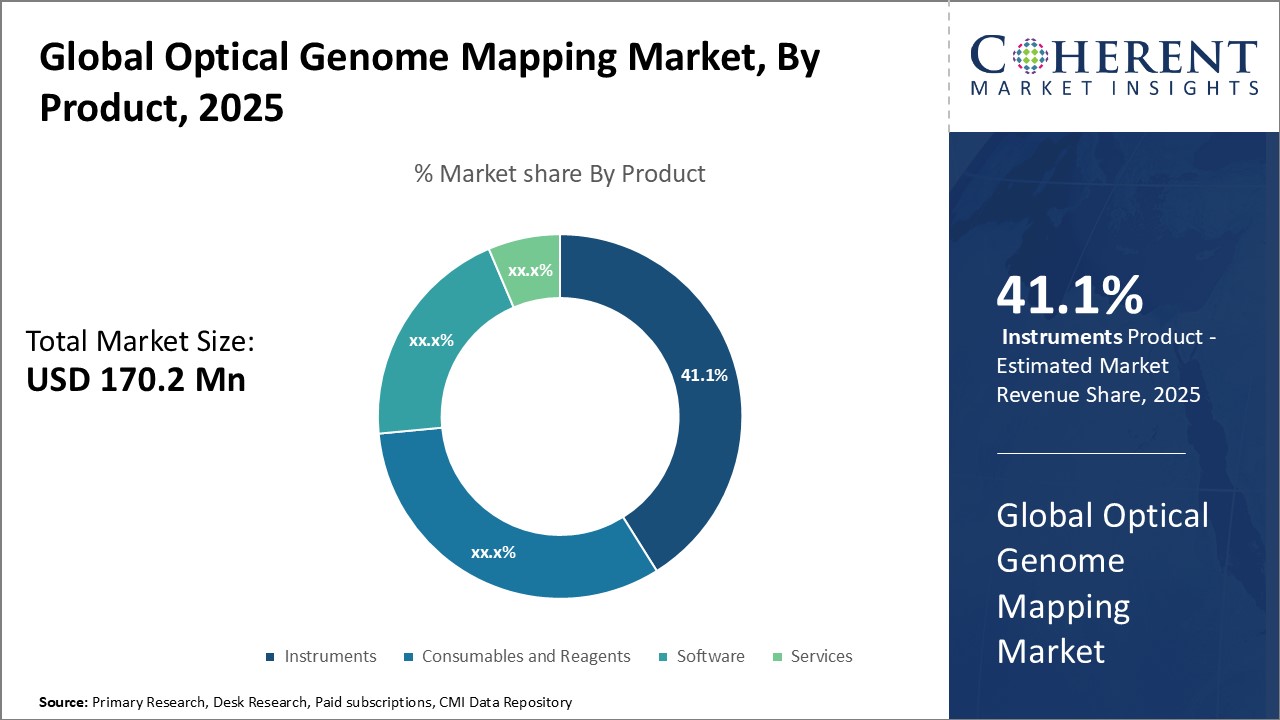
The Instruments segment is projected to dominate the global Optical Genome Mapping Market, securing approximately 42.1% of the total market revenue share in 2026. This leading position is primarily attributed to the rising adoption of advanced genome mapping instruments in clinical diagnostics and genetic research.
These instruments offer high-resolution structural variation detection, making them essential tools in areas such as rare disease identification, oncology research, and gene therapy development. In addition, technological innovations that enhance throughput, reduce turnaround times, and simplify user interfaces are accelerating instrument deployment across academic, hospital, and biotech laboratories.
Growing investments in personalized medicine, coupled with expanding collaborations between research institutions and biotechnology firms, are further driving demand, solidifying the instruments segment’s dominance.
Optical Genome Mapping Market Insights, By Application
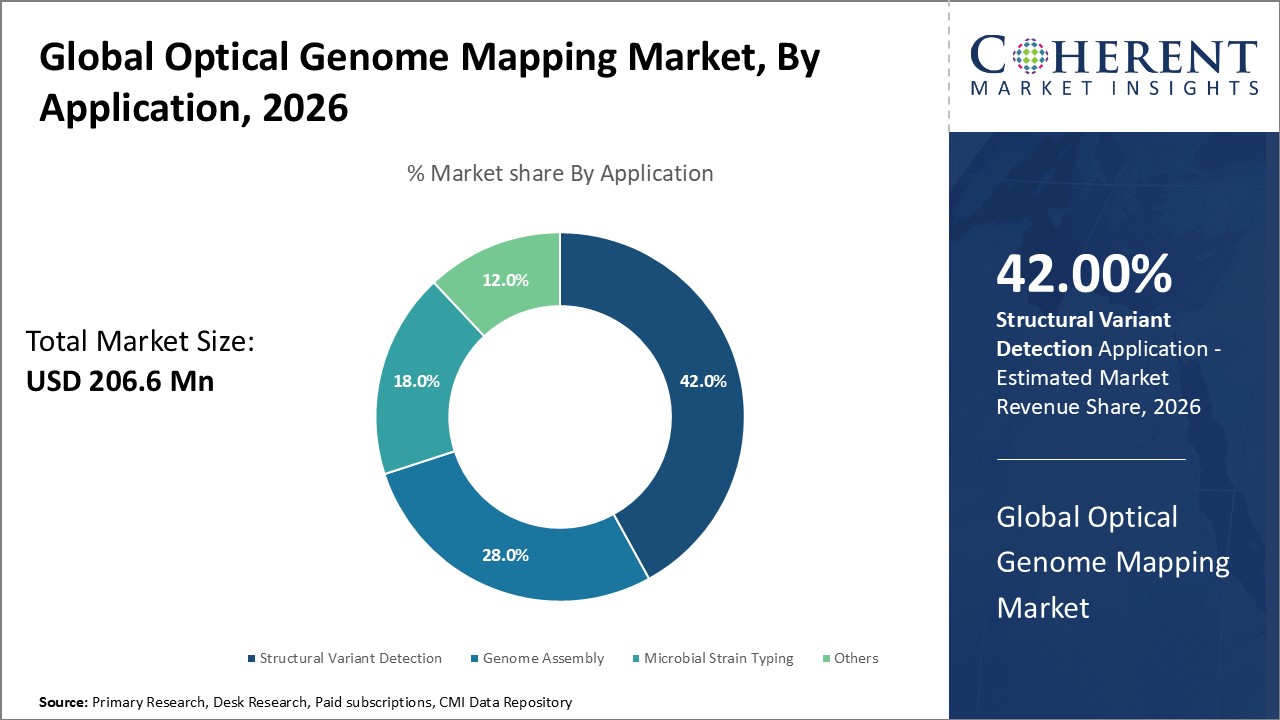
The Clinical Diagnostics segment is expected to account for a substantial share of the Optical Genome Mapping Market in 2026, driven by increasing implementation in genetic testing, oncology screening, and rare disease diagnosis. The technology’s ability to detect large-scale structural variations and complex genomic rearrangements more accurately than traditional sequencing methods positions it as a critical tool for comprehensive genomic analysis.
As healthcare systems shift toward precision medicine, there is growing emphasis on using OGM technologies to enable early and accurate diagnosis, particularly for hereditary disorders and hematological malignancies.
Regional Insights
Optical Genome Mapping Market: Regional Insight
North America Optical Genome Mapping Market Trends and Analysis
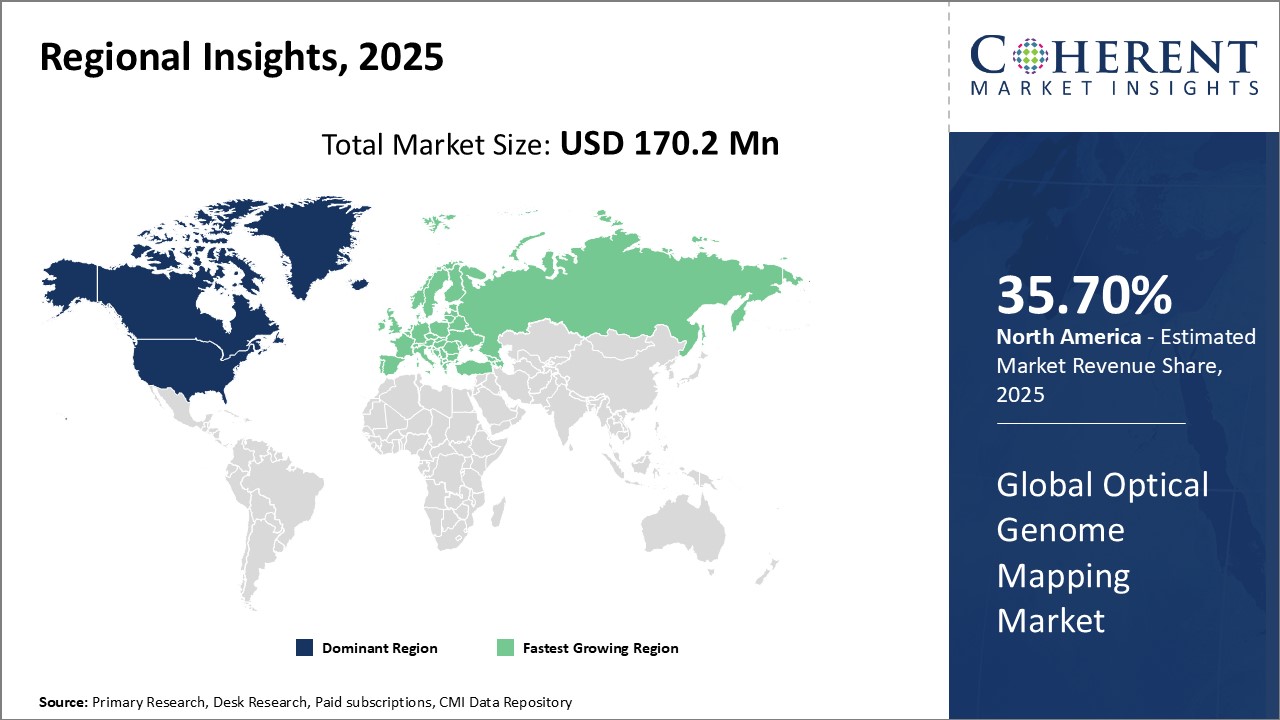
North America is anticipated to retain its leading position in the global Optical Genome Mapping Market, accounting for an estimated 35.70% of the total market share in 2026. This regional dominance is supported by a robust healthcare infrastructure, a strong concentration of genomic research institutions, and early adoption of next-generation sequencing and genome mapping technologies.
The United States remains the key contributor, bolstered by substantial funding from government agencies such as the National Institutes of Health (NIH) and the growing integration of optical genome mapping tools in precision medicine and clinical diagnostics.
Europe Optical Genome Mapping Market Trends and Analysis
Europe is expected to secure a significant share in the Optical Genome Mapping Market through 2026, fueled by advancements in genomics research, expanding biotech ecosystems, and supportive regulatory frameworks for personalized medicine. Countries like Germany, the UK, and France are witnessing increased deployment of genome mapping in rare disease diagnostics and translational research initiatives.
EU-funded genomic research programs and partnerships between public health agencies and academic institutions are enhancing access to cutting-edge genome analysis tools.
Asia Pacific Optical Genome Mapping Market Trends and Analysis
Asia Pacific is emerging as the fastest-growing region in the Optical Genome Mapping Market, driven by rapidly advancing healthcare systems, increasing investments in biotechnology infrastructure, and growing awareness of genetic disorders. Key countries such as China, Japan, South Korea, and India are expanding their genomics capabilities through national initiatives and international partnerships.
Governments and private players are actively funding genome mapping research for applications in oncology, infectious diseases, and reproductive health.
Optical Genome Mapping Market Dominating Countries
United States and Canada Optical Genome Mapping Market Analysis and Trends
The United States and Canada are at the forefront of the North American Optical Genome Mapping Market, which is expected to command a dominant 35.70% market share in 2026. The U.S. leads the global market with its advanced genomic research infrastructure, widespread adoption of precision medicine, and strong federal support through organizations like the NIH. Leading biotech firms and academic research centres are heavily investing in high-resolution genome mapping for oncology, rare diseases, and gene therapy development.
Canada complements regional growth with rising investments in healthcare innovation, public health genomics, and partnerships between universities and research institutes focused on personalized medicine. The country is also expanding access to genome mapping tools across clinical settings.
Market Report Scope
Optical Genome Mapping Market Report Coverage
| Report Coverage | Details | ||
|---|---|---|---|
| Base Year: | 2025 | Market Size in 2026: | USD 206.6 Mn |
| Historical Data for: | 2020 To 2024 | Forecast Period: | 2026 To 2033 |
| Forecast Period 2026 to 2033 CAGR: | 21.4% | 2033 Value Projection: | USD 803.0 Mn |
| Geographies covered: |
| ||
| Segments covered: |
| ||
| Companies covered: | Bionano Genomics, Nucleome Informatics Private Limited, Praxis Genomics, LLC, SourceBio International Limited (Source BioScience), MedGenome, INRAE (French Plant Genomic Resources Center (CNRGV)), PerkinElmer (PerkinElmer Genomics), Genohub Inc., Hofkens Lab, and Cerba | ||
| Growth Drivers: |
| ||
| Restraints & Challenges: |
| ||
Analyst Viewpoint Optical Genome Mapping Market
- The global Optical Genome Mapping (OGM) market is on a strong growth trajectory, driven by increasing demand for high-resolution genome analysis in clinical diagnostics and biomedical research. Enhanced automation and ease of use are further accelerating adoption in both research and clinical laboratories.
- While the market shows promising growth, analysts note unmet needs such as cost-effective solutions for emerging markets, expanded regulatory approvals, and improved bioinformatics integration. As industry players address these gaps and scale innovation, the OGM market is expected to play a pivotal role in transforming genomic diagnostics and personalized healthcare.
Optical Genome Mapping Market: Key Development
- In March 2025, Bionano Genomics unveiled its latest Optical Genome Mapping platform, offering improved resolution and faster analysis times for structural variation detection. This advancement targets enhanced clinical diagnostics, particularly in oncology and rare genetic disorders, driving wider adoption in medical research.
- In April 2025, a strategic partnership was announced between Oxford Nanopore Technologies and a leading pharmaceutical company to integrate optical genome mapping with long-read sequencing technologies. This collaboration aims to accelerate drug discovery and personalized medicine applications by combining complementary genomic data.
- In February 2025, Resolve Biosciences launched a new bioinformatics software suite designed to streamline data interpretation from optical genome mapping instruments. The software enhances accuracy in detecting complex structural variants, addressing a key unmet need in genomic data analysis.
- In January 2025, Bionano Genomics expanded its manufacturing capabilities with a new facility in the United States to meet growing global demand for optical genome mapping instruments, particularly in clinical and academic research sectors. This expansion supports faster product delivery and innovation pipeline acceleration.
Market Segmentation
- By Product (Revenue, USD Mn, 2021 - 2033)
- Instruments
- Consumables and Reagents
- Software
- Services
- By Application (Revenue, USD Mn, 2021 - 2033)
- Structural Variant Detection
- Genome Assembly
- Microbial Strain Typing
- Others
- By End User (Revenue, USD Mn, 2021 - 2033)
- Biotechnology and Pharmaceutical Companies
- Clinical Laboratories
- Academic research institutes
- Others
- By Region (Revenue, USD Mn, 2021 - 2033)
- North America
- U.S.
- Canada
- Latin America
- Brazil
- Argentina
- Mexico
- Rest of Latin America
- Europe
- Germany
- U.K.
- Spain
- France
- Italy
- Russia
- Rest of Europe
- Asia Pacific
- China
- India
- Japan
- Australia
- South Korea
- ASEAN
- Rest of Asia Pacific
- Middle East
- GCC Countries
- Israel
- Rest of Middle East
- Africa
- South Africa
- North Africa
- Central Africa
- Key Players Insights
- Bionano Genomics
- Nucleome Informatics Private Limited
- Praxis Genomics, LLC
- SourceBio International Limited (Source BioScience)
- MedGenome
- INRAE (French Plant Genomic Resources Center (CNRGV))
- PerkinElmer (PerkinElmer Genomics)
- Genohub Inc.
- Hofkens Lab
- Cerba
Sources
The Stakeholders Consulted
- Geneticists, molecular biologists, and clinical researchers
- Manufacturers and suppliers of optical genome mapping instruments and consumables
- Healthcare IT specialists and diagnostic lab managers
- Precision medicine and rare disease specialists
- Regulatory bodies and compliance advisors in genomics and diagnostics
- Academic and research institutions focused on genome mapping and structural variation
- End-users across sectors such as clinical diagnostics, biotechnology, pharmaceuticals, and research laboratories
Databases Opened
- National Center for Biotechnology Information (NCBI) – Genomics and Sequence Databases
- ClinicalTrials.gov – Optical Genome Mapping Related Trials
- FDA Medical Devices Database – Genome Mapping Equipment Approvals
- European Medicines Agency (EMA) – Advanced Diagnostics and Technologies
- World Health Organization (WHO) – Global Health and Genomics Trends
Magazines & Trade Publications
- Genetic Engineering & Biotechnology News
- GenomeWeb – Clinical and Research Genomics News
- BioTechniques Magazine
- Nature Reviews Genetics – Industry Insight Section
- Clinical Lab Products Magazine
Scientific and Industry Journals
- Nature Genetics
- Genome Research
- Journal of Molecular Diagnostics
- Human Genetics
- Trends in Genetics
Newspapers & Media Outlets
- The Wall Street Journal – Biotechnology & Health Innovation
- Bloomberg – Healthcare & Life Sciences News
- Reuters – Global Biotech Developments
- The Economic Times – Healthcare & Genomics Section
- Business Standard – Biotech & Diagnostics Coverage
Associations and Regulatory Bodies
- American Society of Human Genetics (ASHG)
- International Society for Genetic and Genomic Medicine (ISGGM)
- U.S. Food and Drug Administration (FDA)
- European Medicines Agency (EMA)
- Indian Council of Medical Research (ICMR)
Public Domain Sources
- U.S. National Institutes of Health (NIH) – Genomic Research Reports
- European Commission – Genomics & Health Innovation Programs
- World Bank – Global Healthcare & Technology Reports
- OECD – Health Statistics and Biotechnology Insights
- UNESCO – Science and Genomic Research Funding Data
Proprietary Research Elements
- CMI Data Analytics Tool
- Proprietary CMI Repository of Market Data (covering past 8 years)
- CMI Expert Interviews and Transcripts (focused on genome mapping trends, clinical adoption, and regulatory frameworks)
Get access to 250+ pages report
Every segment, forecast, competitor profile and data table behind the analysis above — available for instant download.
- ESOMAR Member
- ISO 9001:2015 Certified
- D-U-N-S Registered
- GDPR & CCPA Compliant
Missing comfort of reading report in your local language? Find your preferred language:
Transform your Strategy with Exclusive Trending Reports
Frequently Asked Questions
The Global Optical Genome Mapping Market size is estimated to be valued at USD 206.6 Mn in 2026, and is expected to reach USD 803.0 Mn by 2033.
High cost of instruments and regulatory and ethical barriers are the key factors hampering the growth of the global market.
Genome mapping applications, next-generation sequencing, and genetic disorders diagnosis are the major factors driving the global market.
Among product type, the instruments segment is the leading product type segment in the global optical genome mapping industry.
The major players operating in the global optical genome mapping industry are Bionano Genomics, Nucleome Informatics Private Limited, Praxis Genomics, LLC, SourceBio International Limited (Source BioScience), MedGenome, INRAE (French Plant Genomic Resources Center (CNRGV)), PerkinElmer (PerkinElmer Genomics), Genohub Inc., Hofkens Lab, and Cerba.
North America leads the global market.
The CAGR of the Global Optical Genome Mapping Industry is projected to be 21.4% from 2026 to 2033.