

Plant Stem Cell Market Size and Trends- (2026-2033)
The Plant Stem Cell Market is estimated to be valued at USD 1.2 Bn in 2026 and is expected to reach USD 2.5 Bn by 2033, growing at a compound annual growth rate (CAGR) of 8.5% from 2026 to 2033.
Key Takeaways
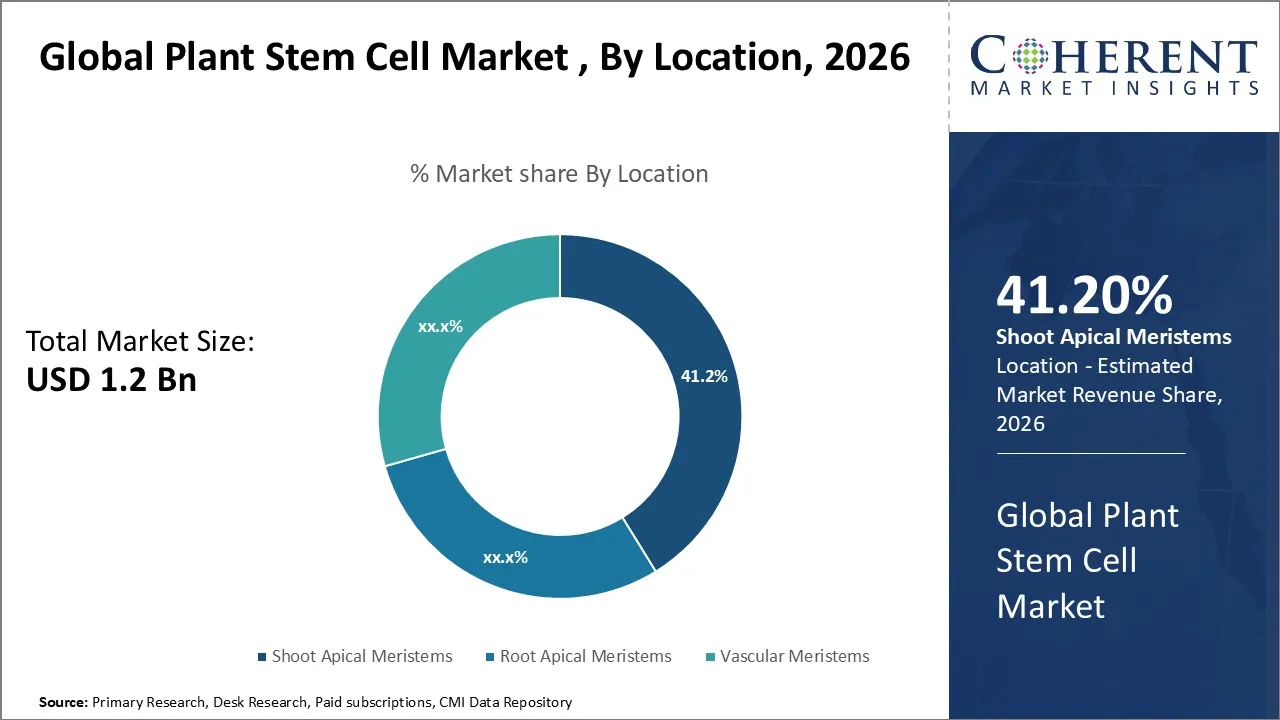
- Based on Location, the Shoot Apical Meristems segment is expected to lead the market with 41.20 % share in 2026, due to its dominant use in extraction and regenerative potential.
- Based on Application, the Cosmetics segment is expected to hold 48.75 % share of the market in 2026, driven by rising demand for plant-based anti-aging and sustainable beauty products.
- Based on Region, North America is set to lead the market with 34.60 % share in 2026. While, Asia Pacific is anticipated to be the fastest growing region.
Market Overview
The Plant Stem Cell Market provides advanced cellular extraction systems and biotechnological cultivation methods primarily for the cosmetics, pharmaceutical, and nutraceutical industries. The market includes bioreactor-based cultivation, in vitro propagation, and specialized extraction techniques, along with associated culture media, high-purity reagents, and lab-scaling services.
Global demand for plant-based bioactives is increasing each year, thus creating a greater need for sustainable stem cell production among skincare brands and healthcare manufacturers. Premium cosmetic companies and biopharmaceutical operators recognize the importance of these undifferentiated cells for their superior antioxidant, anti-aging, and tissue regenerative properties. Regulatory bodies and consumer standards now encourage the use of laboratory-grown botanical ingredients to ensure purity and protect biodiversity, making plant stem cell technology a standard requirement in high-end natural product development.
Current Events and Its Impacts on the Plant Stem Cell Market
Current Event | Description and the Impact |
Technological Innovations and Research Breakthroughs |
|
Industry Collaborations and Market Consolidation
|
|
Regional Consumer Behavior and Cultural Trends
|
|
Segmental Insights
- Current Industry Events of 2026
- Market Size Estimation
- Regional Breakdown
- Competitive Landscape
- Customer Intelligence
- Segmental Analysis
- Pricing Analysis
- Key Market Drivers, Challenges & Future Trends
- Customized Insights Section
Plant Stem Cell Market Insights, By Location - Shoot Apical Meristems Leads with Broad Use in Extraction and Regenerative Potential
In terms of location, the shoot apical meristems segment contributes the highest share of 41.20% in 2026 of the market owing to their ability to provide superior regenerative potential. Manufacturers prefer this location since it provides easy access to pluripotent cells found at the growing tips of plant stems. These cells drive the continuous development of new organs and maintain high concentrations of essential nutrients. Biotechnology companies are using SAM as a source of stable and effective antioxidants. The ability of these tissues to produce high amounts of biologically active compounds is helping drive the demand for the segment.
Plant Stem Cell Market Insights, By Application - Cosmetics Leads with Rising Demand for Plant-Based Anti-Aging and Sustainable Beauty Products
In terms of application, the cosmetics segment contributes the highest share of 48.75% in 2026 of the market as there has been increased demand for natural compounds for anti-aging applications. The cosmetic industry uses plant stem cells as active constituents for anti-aging creams and lotions that shield human skin against environmental hazards. The plant stem cells possess the ability to counter free radicals and prolong the life span of skin cells. The cosmetic industry has opted for alternatives from plants instead of chemicals, as it meets the clean beauty requirement. Consequently, the cosmetic sector generates the highest revenue by transforming plant biotechnology into high-value consumer products.
For instance, in October 2025, Cocky has introduced Formula H, India's first neuro-cosmetic serum designed specifically for men. Kannabia Sense, a cutting-edge active ingredient created with plant stem cell biotechnology, is essential to Formula H. Kannabia Sense, which is derived from Cannabis sativa stem cells, stimulates the skin's microbiota and causes the release of cutaneous oxytocin, also known as the "happiness hormone."
Regional Insights
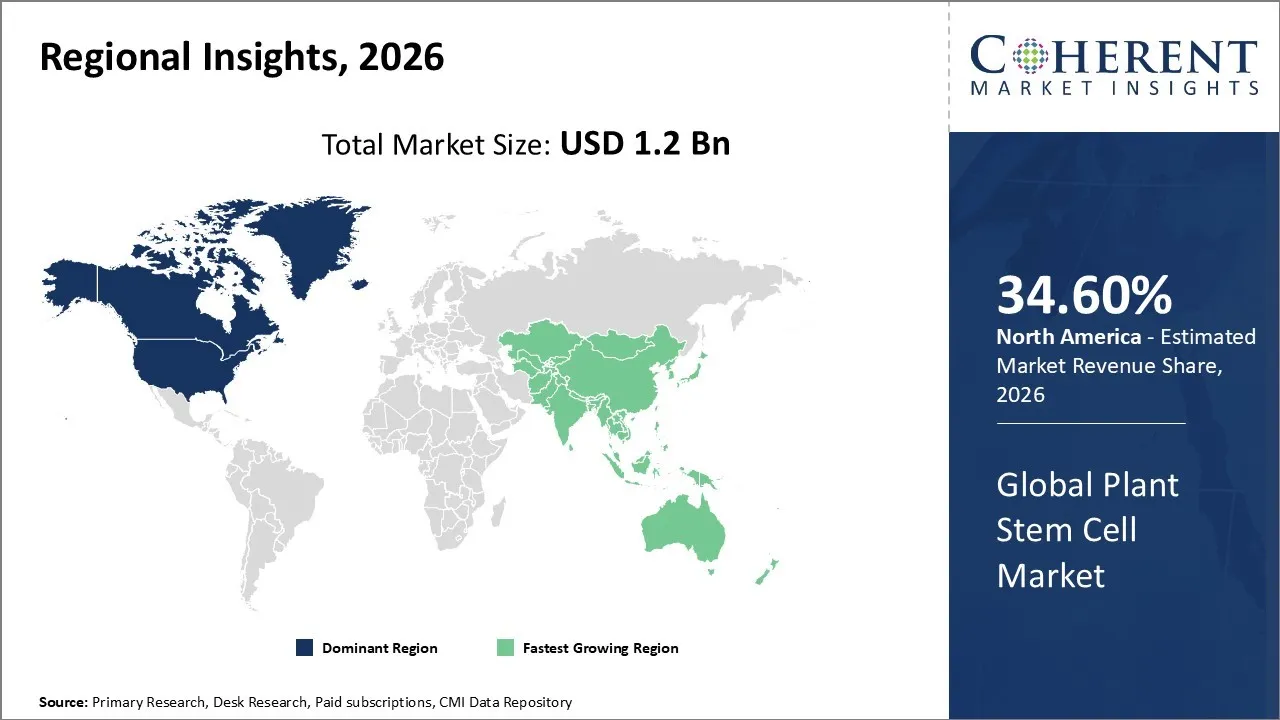
North America Plant Stem Cell Market Analysis & Trends
North America has remained the dominant region with 34.60% in 2026 of the global Plant Stem Cell Market over the past decade. The growth is owing to its advanced biotechnology infrastructure and a shift toward sustainable bio-based ingredients. Consumers in the countries of the US and Canada are prioritizing clean beauty and ethical sourcing, which has sped up the use of plant stem cell culture technology. This method allows for the production of high-potency extracts similar to those from Swiss Apple and Goji berry without any environmental impact of traditional large-scale farming.
The market growth can also be attributed to the increase in research on regenerative medicine as well as noninvasive anti-aging treatments. The strategic collaborations between pharmaceutical companies and specialized biotech firms have expanded applications beyond cosmetics into nutraceuticals and wound healing. The robust regulatory frameworks in the region provide a transparent pathway for product launches and help in fostering high consumer confidence in the safety and efficacy of stem cell-derived formulations.
For instance, in May 2023, DERMA E, a top natural and clean beauty skincare brand unveiled its new product named Advanced Peptides & Flora Collagen™ Cryo-Gel Mask. This new mask contains Flora-Collagen™, Arginine®, and Matrixyl Synthe 6®, as well as Edelweiss Extract and Plant Stem Cells. It aids in the healing of the skin and prepares it for either a daytime or nighttime routine.
Asia Pacific Plant Stem Cell Market Analysis & Trends
Asia Pacific is rapidly expanding as a major hub for the plant stem cell market owing to its vast biodiversity and heavy spending in biotechnology. The countries of Japan, South Korea, and China are the leading contributors to this growth. This is due to their integration of traditional botanical knowledge with cutting-edge cell culture technologies. There is an increasing demand for sustainable and natural ingredients in the regional cosmetic sector, where consumers prioritize anti-aging and skin rejuvenation products.
The strategic government initiatives and funding for regenerative medicine have sped up the development of plant-based bioactive compounds for pharmaceutical and nutraceutical applications. Manufacturers in this region are using diverse local sources such as ginseng, rice, and ginger to produce high-potency extracts that cater to both domestic and international treatments. The presence of cost-effective manufacturing facilities and a robust research network ensures that Asia Pacific remains a competitive leader in the production and innovation of plant stem cell therapies.
For instance, in May 2025, Alvio Pharmaceuticals has marked its entry into India’s thriving beauty and skincare market with the introduction of its new brand,Uncap. Built on the principles of simplicity, science, and nature, Uncap aims to redefine daily skincare by providing transparent, high-performing products that are effective, affordable, and accessible. The collection includes cutting edge ingredients like NMN (Nicotinamide Mononucleotide), ceramides, plant stem cell extracts, Lactobacillus, and hyaluronic acid, along with potent natural components like Neo Fer, Brazilian Green Propolis, and Gosulin Agave.
Plant Stem Cell Market Outlook Country-Wise
The U.S. Plant Stem Cell Market Trends
The U.S. market features a high-quality infrastructure for biotechnological research and maintains a strong pipeline of botanical innovations. Driven by a shift toward clean beauty and sustainable medicine, the country employs advanced cell culture technologies that allow researchers to extract potent bioactive compounds from plants without harming the environment. This controlled cultivation environment has boosted the use of modern phyto stem cells, including extracts from rare Swiss apples and alpine roses, which are integrated into high-end anti-aging and tissue repair formulas.
Currently the market is moving toward personalized regenerative care, with new clinical interest in using plant-derived exosomes to stimulate human cell renewal and repair damaged tissues in the skin and musculoskeletal system. Substantial investments in biotechnology and favorable regulatory frameworks for sustainable ingredients continue to attract major chemical and cosmetic conglomerates looking to commercialize standardized plant-based actives. These factors make the US a global leader in high-efficacy botanical solutions, shifting the industry focus from simple plant extracts to complex lab-grown regenerative cures.
For instance, in July 2023, Ayana Bio, a company that makes plant cell technology, announced that it has opened a new, cutting-edge lab in Boston's Seaport District. Ayana Bio's main goal is to improve plant cell-cultivated production systems so that they can make a wide range of high-quality, affordable health, wellness, and nutrition ingredients. The lab will be the center of this work.
China Plant Stem Cell Market Trends
The market for plant stem cells in China is characterized by a huge potential market and an ever-changing government policy to become a pioneer in ecofriendly biotechnology. With an increased popular demand for natural and pure biologically active compounds, there has been an increased focus on large-scale research on meristematic cell structure to make a shift from conventional labor and resource-intensive plant cell harvests. Although plant-based biologically active compounds are already a commonplace trend in premium cosmeceuticals, such products are still not an easy commodity in the home market. China is soon to become a hotspot worldwide for phytochemistry studies, having already gained international acclamation for innovations in bioreactors to produce pure antioxidants from rare TCM plants.
Market Report Scope
Plant Stem Cell Market Report Coverage
| Report Coverage | Details | ||
|---|---|---|---|
| Base Year: | 2025 | Market Size in 2026: | USD 1.2 Bn |
| Historical Data for: | 2020 To 2024 | Forecast Period: | 2026 To 2033 |
| Forecast Period 2026 to 2033 CAGR: | 8.5% | 2033 Value Projection: | USD 2.5 Bn |
| Geographies covered: |
| ||
| Segments covered: |
| ||
| Companies covered: | Oriflame Holding AG, MyChelle Dermaceuticals, LLC, Natura Therapeutics Inc, Aidan Products LLC, Mibelle Biochemistry, Phyto Science SDN BHD, and Renature Skin Care Inc. | ||
| Growth Drivers: |
| ||
| Restraints & Challenges: |
| ||
Plant Stem Cell Market Drivers
Rising consumer demand for natural, sustainable cosmetics
The global market is experiencing growth as buyers prioritize natural and eco-friendly alternatives to man-made beauty products. This shift of preference is driven by a heightened awareness of environmental issues and a preference for clean beauty recipes that are free from harsh chemicals and responsibly sourced. Plant stem cell technology is uniquely positioned to meet this demand because it allows for the production of powerful active ingredients like skin protectors and proteins in controlled laboratory settings. This innovative approach minimizes the environmental impact of cosmetic making by minimizing land use and water consumption while eliminating the need for traditional large-scale farming.
Moreover, the rising demand for science-backed youth preserving solutions has propelled the market forward, as plant stem cells offer proven healing benefits for the skin. The stem cell technology offer a highly concentrated and steady supply of active parts that promote skin cell growth and protect against environmental damage. The market is expected to grow with established beauty brands and small eco-friendly labels including these sustainable ingredients in their product lines. The link between environmental duty and high-performance skin care ensures that plant stem cells remain a main part of the modern sustainable cosmetic industry.
Analyst Opinion (Expert Opinion)
- The plant stem cell market is demonstrating sustained momentum, supported by expanding adoption across cosmetics, personal care, pharmaceuticals, nutraceuticals, and agricultural biotechnology. Industry assessments consistently indicate strong year-on-year volume growth, driven by increasing demand for natural, bio-active, and sustainably sourced ingredients. Within application analysis, cosmetics and personal care account for the largest consumption share, with plant stem cell–based actives increasingly incorporated into anti-aging creams, serums, and skin repair formulations. Industry data shows that products positioned with regenerative or cellular renewal claims record higher average selling prices and stronger repeat purchase rates compared to conventional botanical extracts.
- Regionally, North America and Europe remain key innovation hubs due to advanced research infrastructure and early adoption of biotechnology-driven ingredients. Asia Pacific is emerging as a high-growth region, supported by rising disposable incomes, rapid expansion of premium skincare brands, and growing consumer awareness of plant-based formulations. From a technology perspective, advances in in-vitro cultivation, encapsulation, and stabilization techniques are improving extract potency, consistency, and shelf life, thereby enhancing commercial scalability.
- Statistical insights from consumer and formulation studies indicate a measurable shift toward clean-label and sustainable ingredients, with a significant proportion of end users showing preference for plant-derived actives over synthetic alternatives. Collectively, these data-driven trends position plant stem cells as a strategic growth area within the broader biotechnology and specialty ingredient ecosystem.
Speak to the analyst
Want personalized insights?
Take the findings above to one of our principal consultants, or have the report rebuilt around the segments, geographies and competitors you actually track.
Plant Stem Cell Industry News
- In December 2025, SDAI planned to introduce its exclusive plant stem cell skincare line in China and Singapore as a part of its strategic shift into biotechnology. This launch highlights the Group's dedication to long-term growth and marks an important turning point in its transformational journey. By focusing on cellular renewal, the Biotech B-III skincare line seeks to capitalize on nature's regenerative qualities.
- In July 2025, Sacha Bostoni has introduced Firn in collaboration with Clémence de Stabenrath, who previously worked at L'Oréal and Typology, and Raphaële Four, the founder of the lingerie brand Girls in Paris. The trio has enlisted the expertise of Dr. Fred Zülli, a specialist recognized for his research on plant stem cells and his work with luxury cosmetics brands from Switzerland. Firn's products are built on a patented innovation known as STM30 Complex, which merges Alpine plant stem cells with a glacial microorganism, aimed at regenerating skin.
- In April 2025, Vytrus Biotech has introduced its new product named CLARIVINE, which uses state-of-the-art plant biotechnology. This fully natural active optimizes skin health and resilience from within by simulating the natural fasting state of Vitis vinifera flower stem cells. This in turn triggers vital cellular processes like autophagy, telomere protection, and oxidative stress defense.
Market Segmentation
- Location Insights (Revenue, USD Bn, 2026 - 2033)
- Root Apical Meristems
- Shoot Apical Meristems
- Vascular Meristems
- Application Insights (Revenue, USD Bn, 2026 - 2033)
- Nutrition
- Pharmaceutical
- Cosmetics
- Regional Insights (Revenue, USD Bn, 2026 - 2033)
- North America
- U.S.
- Canada
- Latin America
- Brazil
- Argentina
- Mexico
- Rest of Latin America
- Europe
- U.K.
- Germany
- Italy
- France
- Russia
- Spain
- Rest of Europe
- Asia Pacific
- China
- India
- Japan
- ASEAN
- Australia
- South Korea
- Rest of Asia Pacific
- Middle East
- GCC
- Israel
- Rest of Middle East
- Africa
- North Africa
- Central Africa
- South Africa
- North America
- Key Players Insights
- Oriflame Holding AG
- MyChelle Dermaceuticals, LLC
- Natura Therapeutics Inc
- Aidan Products LLC
- Mibelle Biochemistry
- Phyto Science SDN BHD
- Renature Skin Care Inc.
Sources
Primary Research Interviews
- Plant Stem Cell Extract Manufacturers
- Agricultural Biotechnology Companies
- Cosmetic & Personal Care Ingredient Suppliers
- Botanical Research Institutes & Tissue Culture Labs
- Regenerative Agriculture & Crop Science Experts
- Others
Databases
- Bloomberg Terminal
- Thomson Reuters Eikon
- Factiva
- Euromonitor International
- S&P Global Market Intelligence
- Others
Magazines
- Nature Biotechnology Magazine
- Cosmetics & Toiletries Magazine
- Genetic Engineering & Biotechnology News (GEN)
- AgBioWorld
- Chemical & Engineering News
- Others
Journals
- Plant Cell, Tissue and Organ Culture
- Journal of Plant Biotechnology
- Frontiers in Plant Science
- Plant Biotechnology Journal
- In Vitro Cellular & Developmental Biology – Plant
- Others
Newspapers
- Financial Times
- The Wall Street Journal
- Reuters
- Bloomberg News
- The Guardian – Science & Environment
- Others
Associations
- International Society for Plant Cell & Molecular Biology (ISPMCB)
- Biotechnology Innovation Organization (BIO)
- International Association for Plant Biotechnology (IAPB)
- Crop Science Society of America (CSSA)
- European Federation of Biotechnology (EFB)
- Others
Public Domain Sources
- Food and Agriculture Organization of the United Nations (FAO)
- U.S. Department of Agriculture (USDA)
- European Commission – Directorate-General for Research & Innovation
- World Intellectual Property Organization (WIPO)
- National Center for Biotechnology Information (NCBI)
- Others
Proprietary Elements
- CMI Data Analytics Tool
- Proprietary CMI Existing Repository of Information for the Last 8 Years
Definition: The Plant Stem Cell Market encompasses cutting-edge nanotechnology, specifically focusing on the rejuvenating potential of undifferentiated plant cells. These applications occur in the cosmetic, pharmaceutical, and nutritional industries, where the need for high purity of botanical extracts is critical for modern products. Plant stem cell technology supports the mitigation of aging signs and environmental impact associated with oxidative stress and ultraviolet degradation by isolating and concentrating biologically active compounds extracted from plants before converting them into their end products. Plant stem cell solutions are in high demand among manufacturers of cosmetic products, pharmaceuticals, and functional foods, as well as academic institutions driven by the latest consumer demand for sustainable, lab-made, and very effective botanicals.
Get access to 250+ pages report
Every segment, forecast, competitor profile and data table behind the analysis above — available for instant download.
- ESOMAR Member
- ISO 9001:2015 Certified
- D-U-N-S Registered
- GDPR & CCPA Compliant
Missing comfort of reading report in your local language? Find your preferred language:
Transform your Strategy with Exclusive Trending Reports
Frequently Asked Questions
The Plant Stem Cell Market is estimated to be valued at USD 1.2 Bn in 2026, and is expected to reach USD 2.5 Bn by 2033.
The CAGR of the Plant Stem Cell Market is projected to be 8.5% from 2026 to 2033.
The rising consumer demand for natural, sustainable cosmetics and increased R&D by cosmetic companies are the major factors driving the growth of the Plant Stem Cell Market.
The high manufacturing costs and a lack of standardized regulations and quality control are the major factors hampering the growth of the Plant Stem Cell Market.
In terms of application, the cosmetics segment is estimated to dominate the market revenue share in 2026.
Oriflame Holding AG, MyChelle Dermaceuticals, LLC, Natura Therapeutics Inc, Aidan Products LLC, Mibelle Biochemistry, Phyto Science SDN BHD, and Renature Skin Care Inc. are the major players.
North America is expected to lead the Plant Stem Cell Market in 2026.