

Dengue Vaccines Market Size and Forecast: 2026-2033
The Dengue Vaccines Market is estimated to be valued at USD 434.8 Mn in 2026 and is expected to reach USD 1,689.7 Mn by 2033, exhibiting a compound annual growth rate (CAGR) of 14.3% from 2026 to 2033.
Key Takeaways
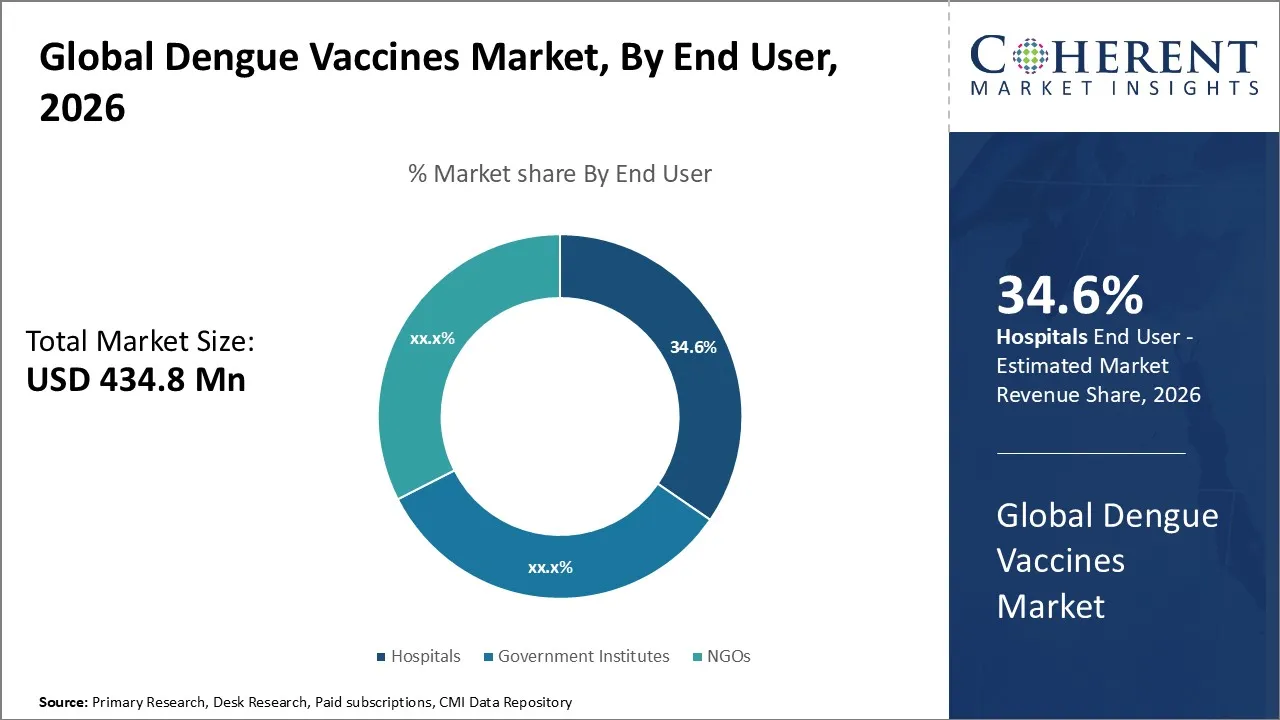
- By End User, Hospitals hold the largest market share of 34.6% in 2026 owing to its primary centers for vaccine administration.
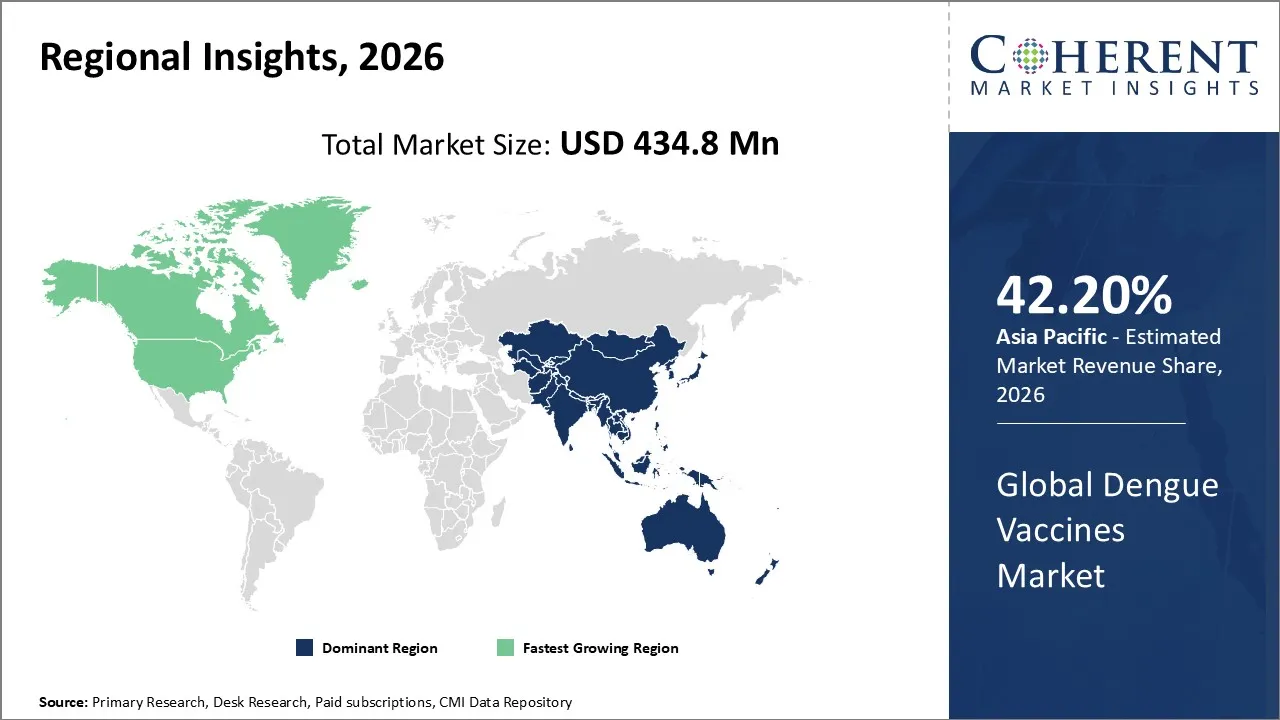
- By Region, Asia Pacific expected to hold largest market share of 42.2% in 2026 owing to the favorable climate for mosquito transmission.
Market Overview
The dengue vaccines market continues to expand as the global burden of Dengue Fever rises, particularly in tropical and subtropical regions. Governments and healthcare organizations are increasing awareness of preventive care and actively promoting immunization programs, which drives demand. Researchers and pharmaceutical companies are advancing vaccine development and securing regulatory approvals, improving accessibility and public confidence. Hospitals and public health agencies distribute vaccines efficiently, while pharmaceutical firms and international organizations invest in production and supply, ensuring greater availability for high-risk populations
Current Events and their Impact on the Dengue Vaccines Market
Current Events | Description and its impact |
Regulatory Approvals and Policy Shifts |
|
Technological Advancements in Vaccine Development |
|
Epidemiological Trends and Climate Change Effects |
|
Segmental Insights
- Current Industry Events of 2026
- Market Size Estimation
- Regional Breakdown
- Competitive Landscape
- Customer Intelligence
- Segmental Analysis
- Pricing Analysis
- Key Market Drivers, Challenges & Future Trends
- Customized Insights Section
Dengue Vaccines Market Insights, By End User - Hospitals contribute the highest share of the market owing to its integrated diagnostic & monitoring facilities
Hospitals hold the largest market share of 34.6% in 2026. Hospitals actively drive the dengue vaccines market by functioning as key centers for diagnosing, treating, and immunizing patients against Dengue Fever. They maintain controlled storage systems, employ skilled professionals, and ensure timely access for eligible patients, which supports safe vaccine administration. By combining testing with vaccination, they improve patient management and boost uptake. Patients place strong trust in hospital care, increasing adoption. Moreover, hospitals work closely with public health authorities and pharmaceutical providers to ensure efficient distribution and support large-scale vaccination during outbreaks.
Regional Insights
Asia Pacific Dengue Vaccines Market Trends
Asia Pacific expected to hold largest market share of 42.20% in 2026. The Asia Pacific dengue vaccines market is advancing as healthcare systems prioritize preventive care and promote early immunization against Dengue Fever. Governments are actively expanding vaccination programs and strengthening public health campaigns to control outbreaks. Pharmaceutical companies are building regional partnerships to enhance production and improve access. Rapid urbanization and climate factors are increasing disease spread, which drives vaccine demand. At the same time, researchers and regulators are supporting the development and introduction of safer, more effective vaccines for diverse populations. For instance, India unveiled a potential breakthrough dengue vaccine as cases surge worldwide. An indigenous vaccine candidate has reached the final stage of clinical testing, raising hopes for one of the world’s first single-dose dengue vaccines.
North America Dengue Vaccines Market Trends
Health authorities in North America are strengthening preparedness for emerging cases of Dengue Fever driven by travel and climate changes, which is shaping the dengue vaccines market. Regulatory bodies are actively evaluating new vaccine candidates to ensure safety and appropriate use. Public health agencies are improving surveillance and promoting awareness in at-risk areas. Pharmaceutical companies are advancing research and conducting clinical trials, while healthcare providers are implementing selective immunization strategies, supporting a careful yet forward-looking approach to dengue prevention.
India Dengue Vaccines Market Trends
Public health authorities in India are intensifying efforts to control Dengue Fever outbreaks, especially in urban and densely populated areas, actively expanding the dengue vaccines market. Governments are promoting preventive vaccination through immunization programs and awareness campaigns. Pharmaceutical companies are boosting local production and distribution to enhance accessibility. Hospitals and clinics are delivering vaccines alongside routine healthcare services, while researchers and regulators are supporting the rollout of newer, safer vaccines, collectively increasing adoption among high-risk populations across the country. For instance, in June 2025, Merck, known as MSD outside the US and Canada, began the MOBILIZE-1 Phase 3 trial to test the safety, immune response, and effectiveness of a single dose of V181, a quadrivalent dengue vaccine protecting against all four virus serotypes, regardless of prior infection.
United States Dengue Vaccines Market Trends
Healthcare authorities in the United States are actively responding to sporadic Dengue Fever cases caused by travel and climate-related risks, driving the dengue vaccines market. Federal and state agencies are raising awareness and running preparedness programs to educate at-risk populations. Pharmaceutical companies are conducting clinical research and developing vaccines tailored for U.S. populations. Healthcare providers are applying selective immunization strategies and integrating vaccination into preventive care, while regulators, researchers, and public health organizations collaborate to establish a cautious yet proactive approach to dengue prevention nationwide.
Dengue Vaccines Market Trend
Growing Emphasis on Preventive Healthcare
Healthcare systems worldwide are increasingly prioritizing preventive measures to curb dengue outbreaks, shifting focus from treatment to immunization. Governments and hospitals are actively promoting awareness campaigns, encouraging routine vaccination, and educating high-risk populations. Patients and caregivers are responding positively to preventive healthcare approaches. This trend drives demand for safer, multi-serotype vaccines and motivates ongoing research to develop innovative solutions, improving access, patient adherence, and long-term protection in endemic regions.
Expansion in Emerging and Endemic Regions
High dengue prevalence in regions like Asia Pacific and Latin America is fueling market expansion. Urbanization, climate change, and mosquito breeding conditions increase exposure risk, creating urgency for vaccination. Governments are implementing mass immunization programs and public health initiatives, while pharmaceutical companies expand distribution networks to reach both urban and rural populations. Enhanced awareness and accessibility in these regions are accelerating vaccine adoption, strengthening preventive healthcare infrastructure, and fostering partnerships for sustained market growth.
Dengue Vaccines Market Opportunity
Development of Next-Generation Vaccines
The demand for safer, multi-serotype dengue vaccines presents opportunities for innovation. Companies can develop formulations with simplified dosing, longer-lasting immunity, and broader age coverage. Research into combination vaccines or needle-free delivery systems can improve adherence and patient convenience. Regulatory support for innovative vaccines accelerates market entry, offering manufacturers the chance to lead with advanced solutions, address unmet medical needs, and build trust among healthcare providers and patients in endemic and non-endemic regions alike.
Market Report Scope
Dengue Vaccines Market Report Coverage
| Report Coverage | Details | ||
|---|---|---|---|
| Base Year: | 2025 | Market Size in 2026: | USD 434.8 Mn |
| Historical Data for: | 2020 To 2024 | Forecast Period: | 2026 To 2033 |
| Forecast Period 2026 to 2033 CAGR: | 14.3% | 2033 Value Projection: | USD 1,689.7 Mn |
| Geographies covered: |
| ||
| Segments covered: |
| ||
| Companies covered: | Sanofi, Takeda Pharmaceutical Company Limited, GlaxoSmithKline, and Merck & Co | ||
| Growth Drivers: |
| ||
| Restraints & Challenges: |
| ||
Dengue Vaccines Market News
- In April 2026, Paraguay launched its first dengue vaccination campaign, inviting children aged six to eight years in 16 municipalities across the Asunción, Central, Paraguarí, and Itapúa departments. The Ministry of Public Health received 70,200 vaccine doses for the initiative.
Analyst Opinion (Expert Opinion)
- The dengue vaccines market is positioned at a critical juncture where scientific progress is colliding with real-world implementation challenges. Recent systematic analyses identify those newer candidates, such as TAK‑003 (Qdenga), demonstrate robust efficacy against symptomatic and hospitalized dengue, reducing risk substantially in clinical settings, but variability across serotypes and age groups remains a complex barrier to universal adoption. Long‑term safety concerns, especially regarding antibody‑dependent enhancement, continue to shape regulatory and clinician confidence, underscoring that incremental gains in vaccine performance must be balanced with cautious deployment strategies.
- Despite decades of research and the introduction of licensed vaccines like Dengvaxia and Qdenga, market growth is constrained by heterogeneous efficacy profiles and restrictive usage guidelines tied to serostatus and prior exposure. Acceptance studies report high general willingness to receive dengue vaccines, but inconsistent confidence tied to safety and socioeconomic factors threatens uptake heterogeneity across endemic populations.
- Manufacturers are required to navigate a landscape where scientific complexity, regulatory rigor, and market education must align to translate clinical promise into public‑health impact. Compelling real‑world examples, such as the phase III evidence guiding long‑term vaccine evaluation by Takeda, demonstrate that sustained investment in post‑licensure evidence and targeted policymaker engagement are essential to convert emerging efficacy data into broader preventive strategies.
Speak to the analyst
Want personalized insights?
Take the findings above to one of our principal consultants, or have the report rebuilt around the segments, geographies and competitors you actually track.
Market Segmentation
- By End User
- Hospitals
- Government Institutes
- NGOs
- By Regional Insights
- North America
- U.S.
- Canada
- Latin America
- Brazil
- Argentina
- Mexico
- Rest of Latin America
- Europe
- Germany
- U.K.
- Spain
- France
- Italy
- Russia
- Rest of Europe
- Asia Pacific
- China
- India
- Japan
- Australia
- South Korea
- ASEAN
- Rest of Asia Pacific
- Middle East
- GCC Countries
- Israel
- Rest of Middle East
- Africa
- South Africa
- North Africa
- Central Africa
- North America
- Key Players Insights
- Sanofi
- Takeda Pharmaceutical Company Limited
- GlaxoSmithKline
- Merck & Co
Sources
Primary Research interviews
- Interviews with healthcare professionals (virologists, immunologists, vaccine program managers)
- Interviews with public health officials and dengue control program leads
- Interviews with vaccine developers and clinical trial investigators
Databases
- World Health Organization (WHO) databases
- Centers for Disease Control and Prevention (CDC) data portals
- National immunization and disease surveillance databases (e.g., India’s NVBDCP data portal)
- ClinicalTrials.gov database for dengue vaccine trials
Magazines
- Vaccines & Immunotherapy Magazine
- Global Health Magazine
- Infection Control Today
Journals
- The Lancet Infectious Diseases
- Vaccine
- Journal of Virology
- Clinical Infectious Diseases
- Human Vaccines & Immunotherapeutics
Newspapers
- The Times of India
- The Hindu
- The Guardian (Health section)
- The New York Times (Health section)
Associations
- World Health Organization (WHO)
- Pan American Health Organization (PAHO)
- Indian Association of Preventive and Social Medicine (IAPSM)
- International Society for Vaccines (ISV)
Public Domain sources
- WHO dengue fact sheets and vaccination guidelines
- Government health ministry websites (e.g., MoHFW India)
- National disease surveillance reports
- Patent databases (e.g., WIPO, USPTO dengue vaccine patents)
Proprietary Elements
- CMI Data Analytics Tool
- Proprietary CMI Existing Repository of information for last 8 years
Get access to 250+ pages report
Every segment, forecast, competitor profile and data table behind the analysis above — available for instant download.
- ESOMAR Member
- ISO 9001:2015 Certified
- D-U-N-S Registered
- GDPR & CCPA Compliant
Missing comfort of reading report in your local language? Find your preferred language:
Transform your Strategy with Exclusive Trending Reports
Frequently Asked Questions
The Dengue Vaccines Market is estimated to be valued at USD 434.8 Mn in 2026 and is expected to reach USD 1,689.7 Mn by 2033, exhibiting a compound annual growth rate (CAGR) of 14.3% from 2026 to 2033.
Hospitals, clinics, and public health centers serve as the main administration channels.
Key challenges include safety concerns such as antibody-dependent enhancement, variability in efficacy across serotypes, multi-dose regimen adherence, and limited cold chain infrastructure in remote regions.
The Asia Pacific region dominates market adoption due to high disease prevalence, government immunization initiatives, and rising awareness.
Research focuses on next-generation vaccines with simplified dosing schedules, broader serotype coverage, and improved safety profiles.
Governments are integrating dengue vaccines into national immunization schedules, offering subsidies, and running awareness campaigns.