

Global Ground Beef Market Size and Forecast – 2026 To 2033
The Global Ground Beef Market is estimated to be valued at USD 90.79 Bn in 2026 and is expected to reach USD 126.05 Bn by 2033, growing at a compound annual growth rate (CAGR) of 4.8% from 2026 to 2033. Growth is supported by the continuing role of ground beef as an accessible and versatile protein across household meals, burgers, foodservice menus, and ready-to-cook applications.
Urban lifestyles, convenient meal preparation, expanding modern retail, and diversified Fat Content and packaging options are strengthening consumption opportunities. In June 2026, the U.S. Department of Agriculture’s Economic Research Service projected U.S. per-capita beef availability at 60.0 pounds for 2026, slightly above 2025 levels, indicating resilient beef availability and consumption despite elevated market prices.
Key Takeaways of the Global Ground Beef Market
- Fresh and Chilled Ground Beef is forecast to register an estimated CAGR of 5.0 % during 2026–2033 and account for 71.8% of the global ground beef market in 2026. Its lead reflects frequent replenishment, meat-case visibility, flexible meal use, and retailer preference for refrigerated formats supporting immediate consumption. In February 2026, the Beef Checkoff/NCBA marketplace update identified ground beef as the leading retail growth engine and a core at-home staple.
- Regular Ground Beef is expected to expand at an estimated CAGR of 4.5 % during 2026–2033 and capture 44.6% of the market in 2026. The segment benefits from its balance of flavor, juiciness, cooking performance, and accessible pricing across burgers, meatballs, tacos, and foodservice menus. In July 2026, Natural Grocers featured Thousand Hills 80/20 grass-fed ground beef in its summer savings promotion across participating stores, reinforcing mainstream retail relevance.
- Tray packed Ground Beef should advance at an estimated CAGR of 4.6 % during 2026–2033 and represent 42.7% of the market in 2026. Tray formats remain commercially favored because they provide clear product presentation, standardized portions, efficient shelf merchandising, and compatibility with high-throughput case-ready operations. In September 2024, Amcor showcased its Revolution sortable-barrier APET thermoformed trays for protein packaging, combining familiar tray presentation with improved recyclability.
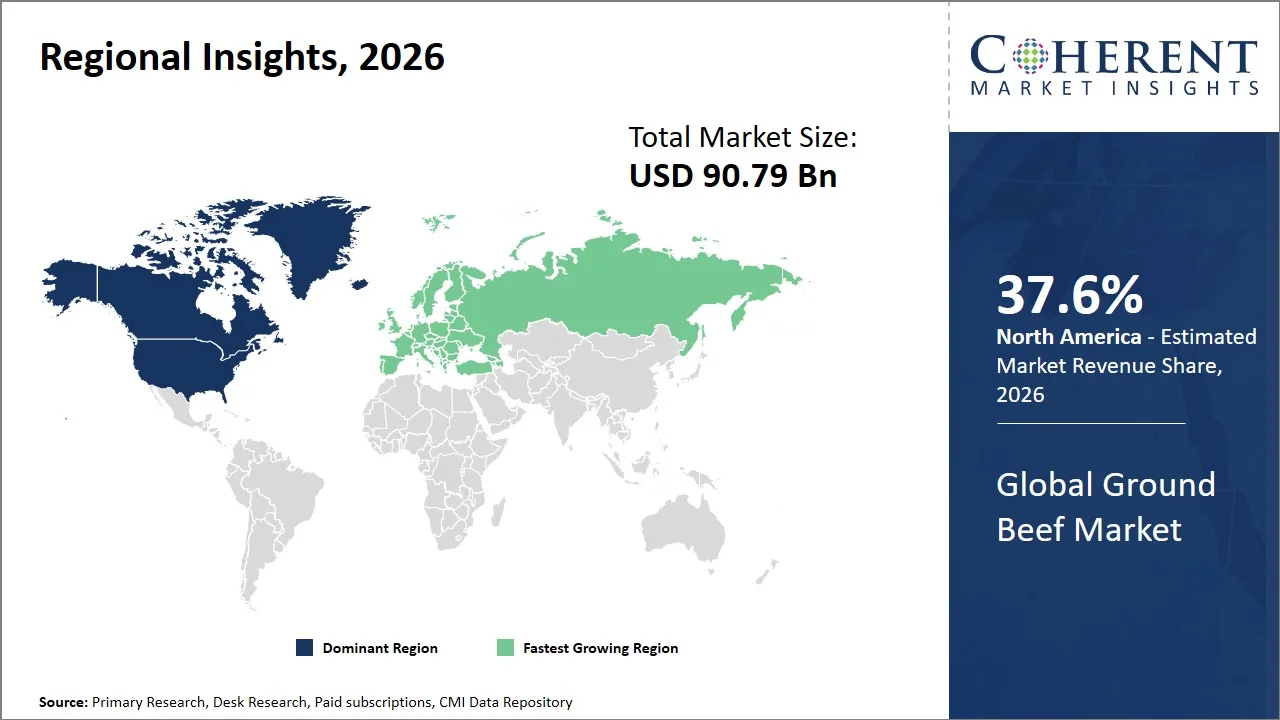
- North America is projected to post an estimated CAGR of 3% during 2026–2033 and contribute 37.6% of the global market in 2026. The region combines established burger consumption, large-scale beef processing, dense supermarket networks, advanced refrigerated logistics, and broad foodservice penetration. In June 2025, Walmart opened its first company-owned case-ready beef facility in Kansas to package fresh beef for Midwest stores, strengthening regional supply-chain control and retail availability.
- Europe is anticipated to deliver an estimated CAGR of 4.3 % during 2026–2033 and hold 23.8% of the global market in 2026. Expansion is supported by established minced-beef consumption, premium private-label offerings, sophisticated chilled distribution, and tighter cattle availability that can sustain higher market values and import requirements. In July 2026, the European Commission projected declining EU beef production through 2027, indicating continued supply tightness and firm pricing conditions.
Segmental Insights
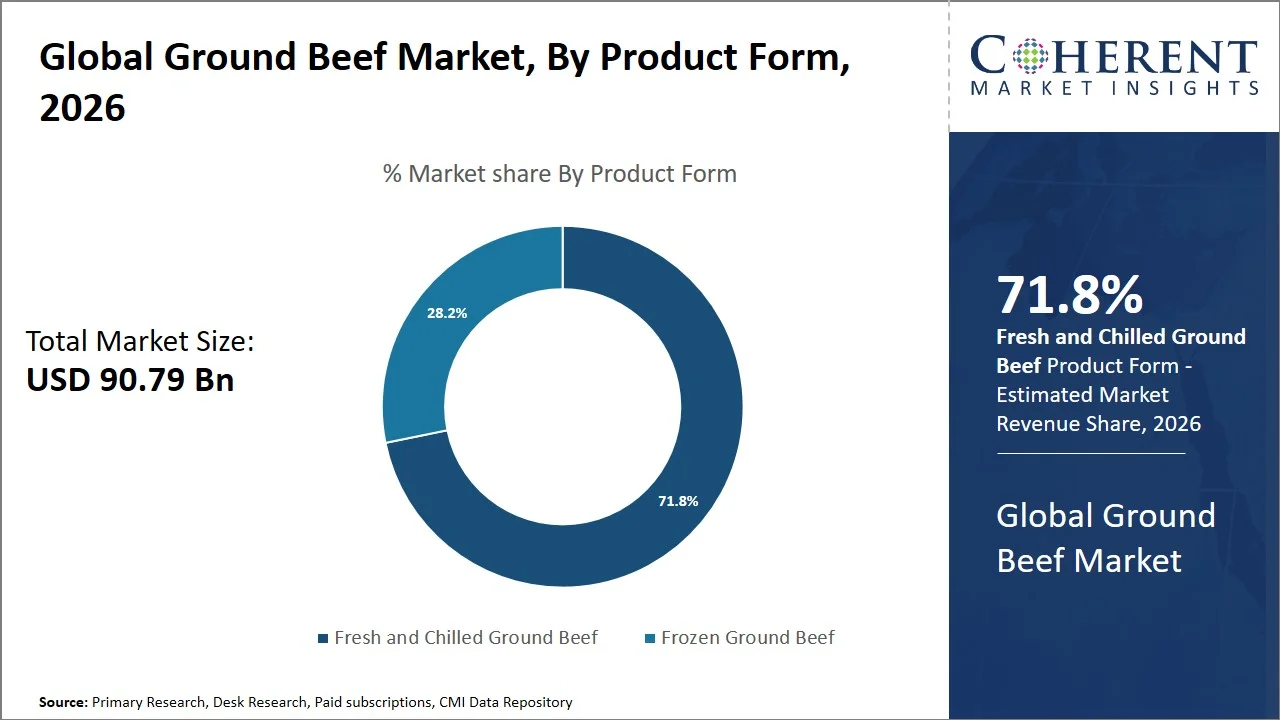
Why Does Fresh and Chilled Ground Beef Dominate the Global Ground Beef Market?
Fresh and Chilled Ground Beef is expected to lead with market share 71.8% in 2026 because refrigerated merchandising aligns with frequent household purchase cycles and lets shoppers evaluate color, texture, pack size, and use-by information immediately before purchase. For processors and retailers, chilled supply also supports rapid inventory rotation, centralized case-ready production, and broad assortment across loose grinds, patties, and family packs without requiring consumers to plan for thawing. The format is especially relevant to supermarkets, butcher counters, and same-day meal preparation, where immediate usability can outweigh the longer storage advantage of frozen products. Commercially, suppliers that can coordinate short production runs, cold-chain replenishment, and seasonal promotions gain stronger access to high-traffic meat cases. In May 2024, Kroger included its ground beef chuck hamburger patties in a Memorial Day grilling bundle and supported purchases through stores, pickup, and delivery, illustrating the retail importance of ready-to-cook ground beef merchandising.
- Current Industry Events of 2026
- Market Size Estimation
- Regional Breakdown
- Competitive Landscape
- Customer Intelligence
- Segmental Analysis
- Pricing Analysis
- Key Market Drivers, Challenges & Future Trends
- Customized Insights Section
Why Does Regular Ground Beef Represent the Largest Fat Content Segment in the Global Ground Beef Market?
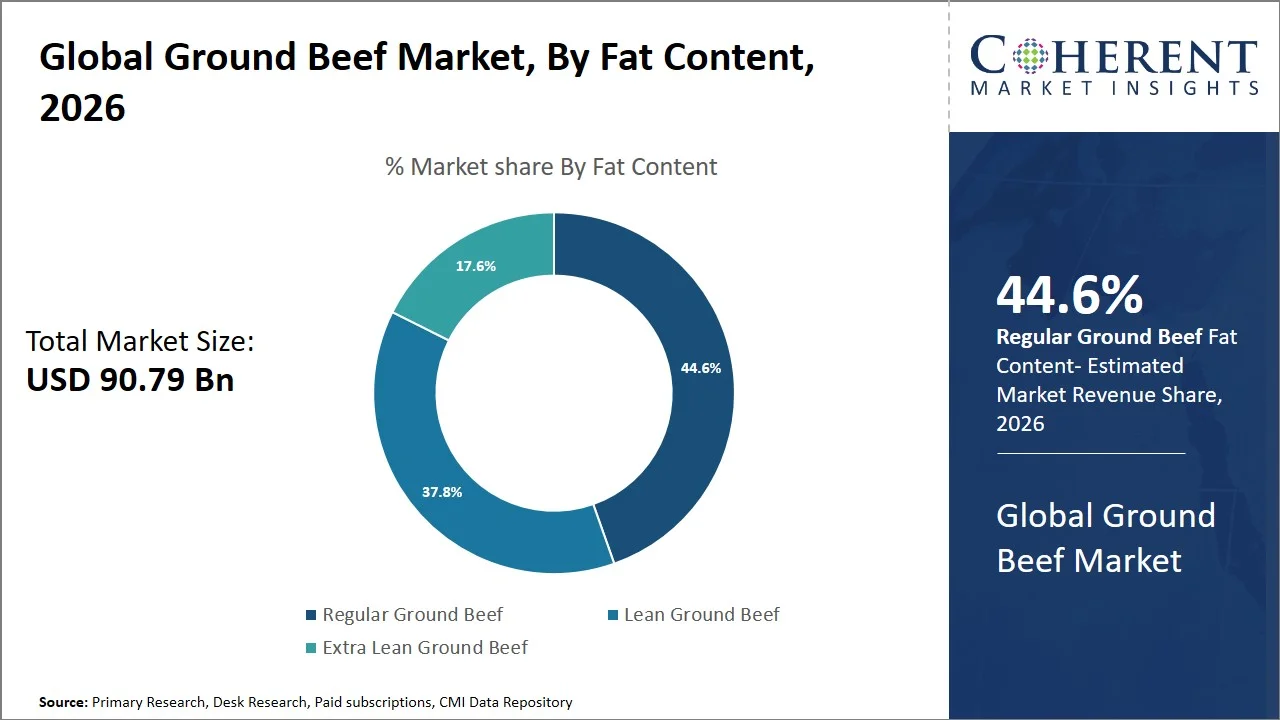
Regular Ground Beef leads the Fat Content category with an expected 44.6% market share in 2026, as its balanced fat level supports flavor, juiciness, browning, and affordability across everyday meals. It is widely suited to burgers, meatballs, tacos, meatloaf, and skillet recipes, while processors can formulate regular blends efficiently from available beef trim. This versatility supports strong uptake among households, supermarket private labels, and foodservice buyers seeking dependable cooking performance without the higher cost associated with leaner specifications. Flexible pack sizes also strengthen its appeal across value and family-oriented purchases. In June 2025, Meijer promoted two pounds of 80/20 bulk ground beef as the centerpiece of an under-USD 35 Fourth of July cookout package for eight people, highlighting the format’s strong value positioning and mainstream meal relevance.
Why Does Tray packed Ground Beef Dominate the Packaging Type Segment of the Global Ground Beef Market?
Tray packed Ground Beef remains the leading packaging format with market share 42.7% in 2026 because rigid trays fit established supermarket meat-case handling, labeling, stacking, display, and automated overwrap or lidding workflows. The format gives retailers a familiar horizontal presentation that makes product appearance and portion size easy to assess, while processors can integrate absorbency, barrier films, modified atmospheres, and standardized footprints into case-ready lines. Tray systems are particularly relevant to high-volume grocery distribution where shelf presentation, leak control, scan-ready labeling, and rapid restocking matter alongside product protection. For packaging suppliers, the opportunity is shifting toward lighter, recyclable, and recycled-content structures that preserve existing filling and sealing infrastructure. In February 2025, Klöckner Pentaplast partnered with Tesco and Hilton Foods to pilot Tesco Finest minced beef in trays made from 100% recycled PET tray material, showing that tray architecture can evolve toward circularity without abandoning the format.
Current Events and their Impact
Current Event | Description and Its Impact |
March 2024 – USDA FSIS finalizes new U.S.-origin meat-labeling requirements |
|
July 2025 – USDA halts livestock trade through southern U.S. ports following New World Screwworm spread |
|
January 2024 – Great Britain implements revised origin terminology for beef and minced beef |
|
Global Ground Beef Market Dynamics
Key Market Drivers
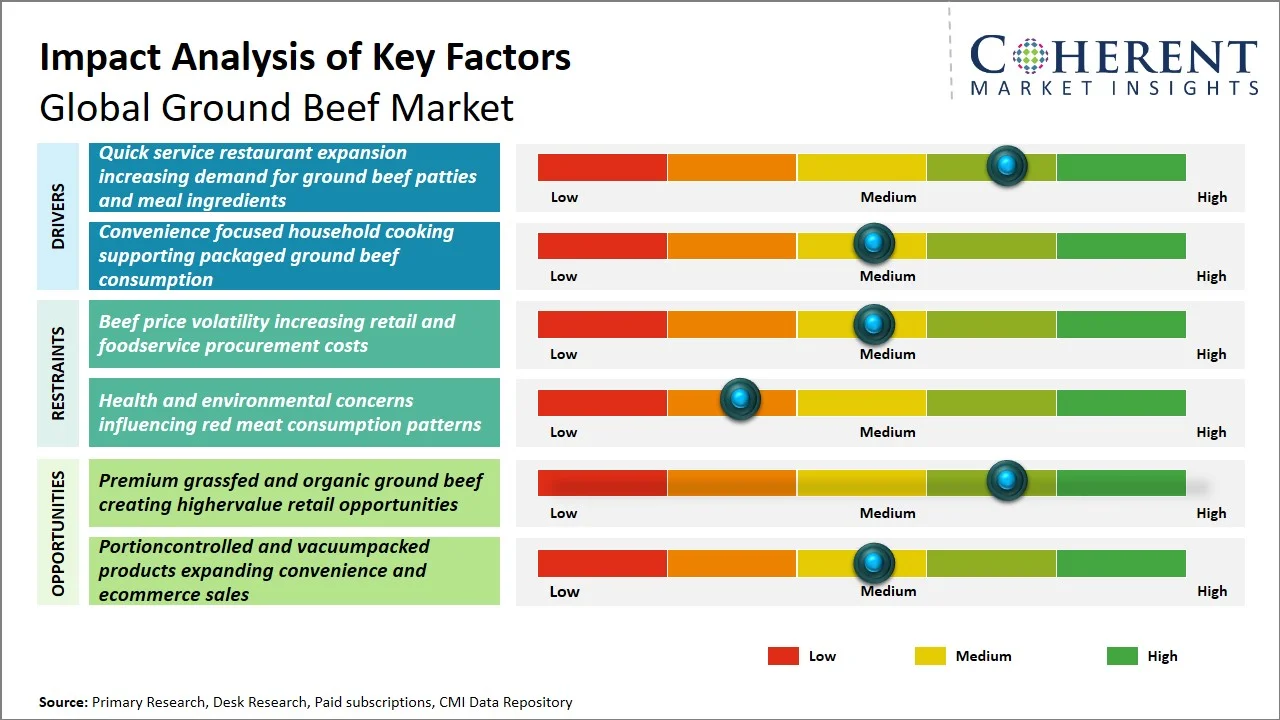
- Quick service restaurant expansion increasing demand for ground beef patties and meal ingredients: Quick service restaurant expansion increasing demand for ground beef patties and meal ingredients is strengthening recurring, specification-led demand for burger grinds, formed patties, and foodservice beef blends. Each new burger-focused outlet creates repeat procurement for standardized fat ratios, patty weights, food-safety controls, and dependable refrigerated or frozen supply, benefiting integrated beef processors, patty manufacturers, distributors, and contract suppliers. The commercial advantage is less about one-time volume and more about predictable replenishment across expanding restaurant networks, which supports production planning and long-term customer contracts. In November 2025, Restaurant Brands International and CPE announced a joint venture backed by USD 350 million of primary capital to expand Burger King China from roughly 1,250 restaurants to more than 4,000 by 2035, directly enlarging the addressable procurement base for flame-grilled beef burgers and related inputs.
- Convenience focused household cooking supporting packaged ground beef consumption: Convenience focused household cooking supporting packaged ground beef consumption is reinforcing the category’s role as a flexible protein for quick meals that require limited preparation, portioning, or culinary skill. Ground beef fits tacos, pasta sauces, meatballs, casseroles, and burgers, allowing retailers to merchandise multiple lean points and pack sizes around everyday meal missions. Processors, supermarket meat departments, private-label suppliers, and branded beef programs benefit because repeat household use supports frequent purchase cycles and broad assortment depth. In October 2025, Certified Angus Beef reported that more retail partners were offering premium grinds, with collective ground beef sales increasing, while its value-added portfolio continued to gain traction among time-constrained consumers. The combination indicates that convenience and quality can coexist, giving packaged ground beef room to defend household relevance even when beef prices are elevated.
Emerging Market Trends
- Affordability Engineering Through Pack Architecture and Fat Content Laddering: Retailers and processors are increasingly using smaller pack sizes, value formats, Fat Content options, and private-label positioning to maintain affordability without relying entirely on price discounts. This approach broadens consumer choice while protecting margins. Suppliers with flexible grinding, packing, and assortment capabilities are best positioned to serve entry-price, family-size, and premium ground beef formats.
- Provenance-Led Premiumization of Ground Beef: Ground beef is increasingly being differentiated by cattle breed, origin, feeding practices, production methods, and verified sourcing claims. This allows processors and retailers to move selected products beyond commodity positioning and support premium pricing. Suppliers with strong traceability, segregation, documentation, and branded sourcing capabilities are likely to benefit as buyers increasingly favor credible, clearly communicated quality and origin attributes.
Regional Insights
Why Does North America Dominate the Global Ground Beef Market?
North America is expected to retain leadership with 37.6% share in 2026 because the region combines specification-driven processor–retailer relationships with a mature system for converting beef trimmings into standardized retail and foodservice grinds. Large processors can balance lean and fatty inputs across multiple plants, while strict pathogen-control programs, centralized case-ready operations, and high-volume procurement improve consistency for major buyers. The U.S.–Canada–Mexico beef trade also broadens access to cattle, trim, and finished beef inputs, helping manufacturers manage formulation needs when domestic supply conditions change. These capabilities favor dependable supply of multiple lean points, patty formats, and private-label specifications rather than one undifferentiated ground beef product. In February 2024, Cargill acquired two U.S. case-ready meat plants from Ahold Delhaize USA affiliates to expand production and distribution of packaged ground beef and other meats, demonstrating continued investment in integrated retail supply.
Why Is Europe Emerging as the Fastest-Growing Region in the Global Ground Beef Market?
Europe is positioned as the fastest-growing region with expected market share 23.8% in 2026 because ground and minced beef can capture consumption occasions that become more important when households seek adaptable, portion able protein rather than higher-cost whole-muscle cuts. Retailers can vary pack weights, fat levels, recipe positioning, and promotional formats, while burger and ready-to-cook demand gives processors additional channels beyond traditional fresh meat counters. Growth is also supported by provenance, animal-welfare, origin, and sustainability requirements that encourage value-added differentiation and reward suppliers able to document sourcing. This creates room for market value to expand even when overall beef availability is constrained. In March 2025, AHDB reported that Great Britain’s beef mince volumes increased 2.5% year on year in the 12 weeks ending February 23, while burgers and grills increased 2.9%, indicating resilience in ground-beef-related formats despite broader meat-price pressure.
Global Ground Beef Market Outlook for Key Countries
Why Is the U.S. a Key Market for the Global Ground Beef Market?
The U.S. is a key market because ground beef occupies both household and restaurant meal occasions, giving suppliers unusually broad exposure across grocery, quick-service, casual dining, institutional, and direct-to-consumer channels. Commercial demand spans value-oriented family packs, leaner retail grinds, premium branded beef, frozen patties, and highly standardized foodservice specifications. The country also has substantial grinding, patty-forming, cold-storage, and food-safety infrastructure, allowing processors to serve national accounts at scale while regional operators compete through local sourcing and specialty claims. Import demand for lean beef additionally supports blending economics when domestic cow-beef availability tightens. In November 2025, the National Restaurant Association’s 2026 What’s Hot Culinary Forecast highlighted smashed burgers among prominent menu trends, reinforcing the continuing ability of ground beef to generate restaurant innovation around value, customization, texture, and familiar comfort-food positioning.
Why Is China Important in the Global Ground Beef Market?
China supports growth in the global ground beef market through the scale of its urban foodservice system, expanding cold-chain retail, and substantial reliance on imported beef alongside domestic production. Ground and minced beef can serve burger chains, western-style restaurants, convenience foods, hot-pot ingredient processors, and e-commerce meat platforms, while imported boneless beef provides processors with flexible raw material for value-oriented and foodservice formulations. The country’s large buyer base makes supplier access, registered processing plants, tariff exposure, and origin diversification commercially important. However, policy intervention is becoming a larger part of procurement planning. In June 2026, China’s Ministry of Commerce reported that Australian beef imports had reached 100% of their annual country-specific safeguard quantity by June 18, triggering an additional tariff from June 20, illustrating both the depth of import demand and the need for diversified sourcing.
Why Is India Important in the Global Ground Beef Market?
India is strategically relevant to the global ground beef market primarily from the supply side rather than as a conventional domestic beef-consumption market. The country’s large buffalo population supports a sizeable bovine-meat processing and export industry, with frozen boneless buffalo meat serving price-sensitive buyers across Southeast Asia, the Middle East, and other halal-oriented markets. This creates potential feedstock and processed-meat opportunities for importers and manufacturers using bovine meat in minced, ground, or further-processed applications, although species labeling, religious sensitivities, and destination-country regulations remain critical. India’s cost competitiveness also supports participation where buyers prioritize affordable protein over premium cattle-beef positioning. In October 2025, APEDA’s bovine-meat dashboard projected India’s bovine meat production to increase 2%, supported by a stable animal base, breeding programs, and domestic and export demand.
Why Is Brazil an Important Growth Market for the Global Ground Beef Market?
Brazil is an important growth market because it combines one of the world’s deepest cattle and beef-processing bases with a large domestic consumer market and extensive export channels. Abundant slaughter supply gives processors access to trimmings and boneless beef suitable for grinding, burgers, processed foods, and value-oriented retail formats, while industrial scale supports competitive conversion costs. Domestic foodservice and modern grocery channels provide local outlets, whereas broad international market access allows processors to redirect beef according to pricing and demand conditions. This flexibility is strategically important for companies balancing fresh, frozen, and further-processed portfolios. In September 2025, Brazil’s Ministry of Agriculture reported that fresh beef exports reached 268,000 tonnes in August, increasing 23.5% year on year, demonstrating the country’s capacity to expand beef availability and serve international demand at substantial scale.
Why Is Australia a Strategic Country in the Global Ground Beef Market?
Australia is strategically important because its grassfed cattle system produces large volumes of lean beef that are valuable for blending with higher-fat trim in hamburger and other ground-beef formulations. Export-oriented processing, rigorous market-access systems, and established cold-chain logistics allow Australian suppliers to serve North American and Asian customers requiring consistent lean inputs. The country also benefits from diversified export destinations, reducing reliance on one consumption market and supporting processor utilization. For ground beef manufacturers abroad, Australian lean beef can therefore function as a formulation input as well as a consumer-facing origin proposition. In March 2026, Meat & Livestock Australia projected record national beef production and record exports for 2026, while specifically noting firm U.S. demand for lean, grassfed beef amid reduced domestic supply, reinforcing Australia’s strategic role in global ground-beef blending supply chains.
Technology Adoption Landscape in the Global Ground Beef Market
Technology | Adoption Level | Key Application Area | Business Impact |
Automated Grinding, Blending and Patty-Forming Lines | High | Industrial ground beef and foodservice patty production | Improves throughput, portion consistency, lean-point control, and labor productivity across high-volume operations. |
In-line Lean/Fat Analysis Systems | Medium | Ground beef blend formulation | Enables processors to adjust lean-to-fat ratios during production, reducing giveaway and improving specification compliance. |
Modified Atmosphere Packaging | High | Chilled retail ground beef | Helps retain desirable appearance and extends merchandising life while supporting centralized case-ready distribution. |
High-Barrier Vacuum and Chub Packaging | High | Bulk ground beef, foodservice and frozen distribution | Reduces oxygen exposure, supports longer storage periods, and improves transport efficiency for larger-format packs. |
Antimicrobial Trim Intervention Systems | High | Beef trim preparation before grinding | Strengthens pathogen-control programs through validated interventions and reduces food-safety exposure in raw ground beef. |
X-ray, Metal Detection and Automated Checkweighing | High | Final packed ground beef inspection | Improves foreign-material detection, weight accuracy, process control, and retailer specification compliance before shipment. |
How Are Export-Ready Frozen and Portion-Controlled Ground Beef Programs Creating New Growth Opportunities in the Global Ground Beef Market?
Export-ready frozen ground beef remains an attractive underdeveloped opportunity because it can extend selling distance beyond chilled distribution limits while giving foodservice operators, institutional kitchens, distributors, and modern retailers a more predictable inventory format. Suppliers can capture this opportunity by developing portion-controlled patties, calibrated lean-point blends, bulk chubs, and smaller retail packs designed around destination-market cooking habits and channel economics. Commercial success will depend on freezing performance, moisture control, pathogen management, packaging integrity, halal or other destination-specific certification where required, and documentation that supports cross-border meat trade. Producers also need importer relationships, cold-storage capacity, and demand forecasting that prevents overstocking. The model can favor vertically integrated processors with export approvals and specialist frozen-meat suppliers that understand local distribution. New entrants can participate through contract processing, but scale without route-to-market access would create inventory risk. Differentiation should therefore combine format, specification, certification, and distributor support rather than compete on frozen beef price alone.
Market Players, Key Development, and Competitive Landscape
Key Developments
- In August 2026, Tyson Foods announced a restructuring of its U.S. beef network around facilities in Dakota City, Holcomb, and Amarillo while reallocating capacity from other locations to create a more efficient processing footprint. This is important for the global ground beef market because slaughter-network configuration directly influences beef-trim availability, processing economics, and the ability of downstream grinding operations to secure consistent raw material.
- In February 2026, JBS USA broke ground on a USD 150 million expansion of its Cactus, Texas, beef production facility, including a new fabrication floor and an expanded ground beef room. This is important for the global ground beef market because the project enhances dedicated grinding capability, operating efficiency, and future production flexibility at a major beef-processing site, supporting large-scale retail and foodservice supply.
- In August 2024, Greater Omaha Packing launched WinterFrost American Wagyu, offering the premium beef program across subprimals, portion-controlled steaks, and ground beef. This is important for the global ground beef market because it demonstrates how processors can move ground beef beyond commodity positioning through breed-specific sourcing, controlled quality grading, premium eating attributes, and differentiated offerings for chefs, retailers, and higher-value consumer occasions.
Competitive Landscape
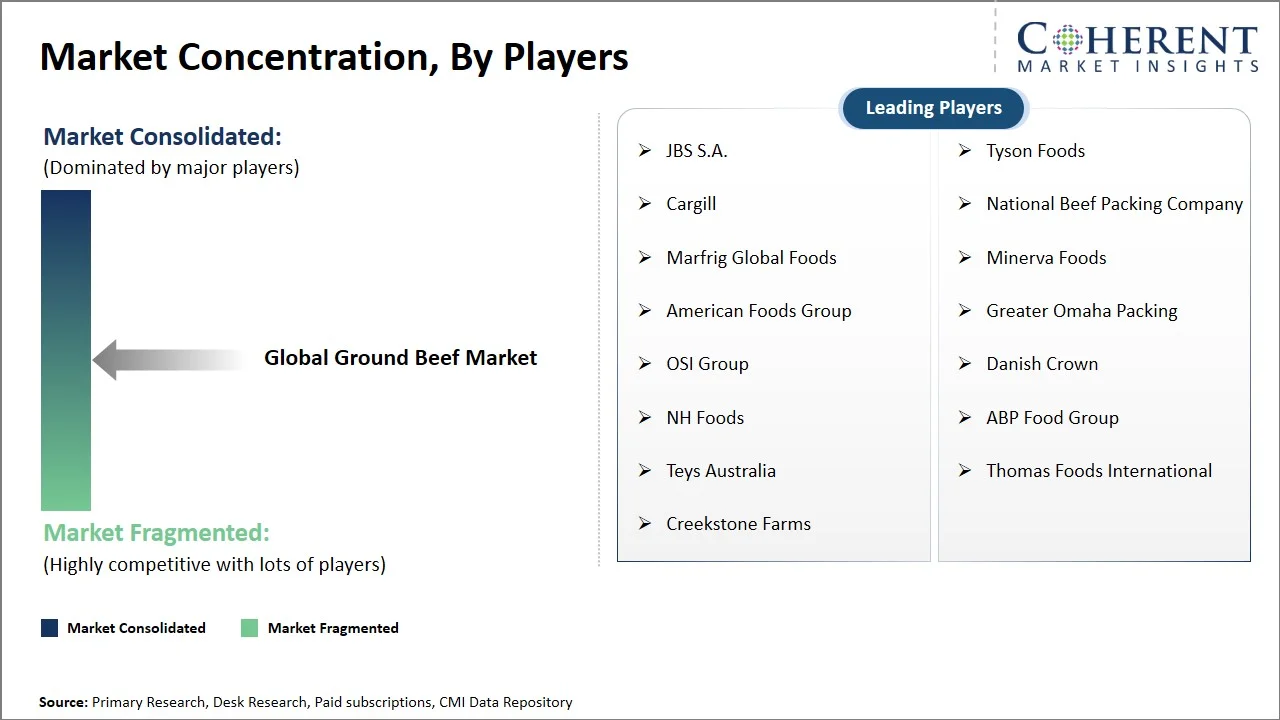
The global ground beef market is moderately fragmented at the finished-product level, despite stronger concentration within primary cattle processing in several major producing countries. Competition spans vertically integrated beef processors, dedicated grinding and patty manufacturers, retailer private-label suppliers, foodservice specialists, premium branded-beef companies, regional processors, and independent meat operators. Winning contracts depends less on brand visibility alone than on controlling blend economics, microbiological safety, specification consistency, processing yield, customer-specific pack formats, cold-chain execution, and dependable supply. Regional processors remain relevant where retailer relationships, local cattle access, shorter lead times, or customized production offset the scale advantages of multinational suppliers.
Key focus areas include
- Trim procurement economics: Access to suitable lean and fatty inputs directly influences formulation cost and margin protection.
- Lean-point precision: Consistent fat specifications are critical for retail labeling, cooking performance, and foodservice contracts.
- Food-safety assurance: Validated pathogen interventions and rigorous plant controls are fundamental supplier-qualification criteria.
- Yield optimization: Efficient trimming, grinding, blending, and portion control help processors protect margins from raw-material volatility.
- Customer-specific production: Private-label packs, proprietary burger specifications, and customized grind formats strengthen account retention.
- Cold-chain execution: Reliable chilled and frozen distribution affects shelf life, geographic reach, and order fulfillment.
- Regulatory documentation: Traceability, origin records, labeling controls, and export documentation increasingly influence market access.
- Contract reliability: Large retailers and foodservice buyers favor suppliers capable of maintaining volume, specification, and delivery consistency.
Market Report Scope
Ground Beef Market Report Coverage
| Report Coverage | Details | ||
|---|---|---|---|
| Base Year: | 2025 | Market Size in 2026: | USD 90.79 Bn |
| Historical Data for: | 2020 To 2024 | Forecast Period: | 2026 To 2033 |
| Forecast Period 2026 to 2033 CAGR: | 4.8% | 2033 Value Projection: | USD 126.05 Bn |
| Geographies covered: |
| ||
| Segments covered: |
| ||
| Companies covered: | JBS S.A., Tyson Foods, Cargill, National Beef Packing Company, Marfrig Global Foods, Minerva Foods, American Foods Group, Greater Omaha Packing, OSI Group, Danish Crown, NH Foods, ABP Food Group, Teys Australia, Thomas Foods International, Creekstone Farms | ||
| Growth Drivers: |
| ||
| Restraints & Challenges: |
| ||
Analyst Opinion (Expert Opinion)
- The global ground beef market leadership is likely to move from standardized ground beef toward customer-specific protein programs. Processors that combine sourcing, formulation, packaging, and replenishment flexibility will be better positioned to serve changing retail and foodservice requirements while protecting margins.
- Distributed grinding and packing closer to major consumption centers could reshape processing economics. This model can improve responsiveness, reduce finished-product inventory exposure, and support local specifications, while increasing the importance of formulation control, sanitation, procurement coordination, and multi-site quality management.
- Suppliers should prioritize yield optimization, food safety, flexible formulations, diversified sourcing, and profitable long-term retail and foodservice accounts. Margin protection should rely on specification management and procurement flexibility, while companies should avoid excessive capacity expansion or premium offerings without secured demand and reliable cattle supply.
Speak to the analyst
Want personalized insights?
Take the findings above to one of our principal consultants, or have the report rebuilt around the segments, geographies and competitors you actually track.
Market Segmentation
- Product Form Insights (Revenue, USD Bn, 2021 - 2033)
- Fresh and Chilled Ground Beef
- Frozen Ground Beef
- Fat Content Insights (Revenue, USD Bn, 2021 - 2033)
- Regular Ground Beef
- Lean Ground Beef
- Extra Lean Ground Beef
- Packaging Type Insights (Revenue, USD Bn, 2021 - 2033)
- Tray packed
- Vacuum packed
- Chub Packaging
- Modified Atmosphere Packaging
- Others
- Distribution Channel Insights (Revenue, USD Bn, 2021 - 2033)
- Supermarkets and Hypermarkets
- Foodservice
- Butcher and Specialty Meat Stores
- Online Retail
- Convenience Stores
- Others
- Regional Insights (Revenue, USD Bn, 2021 - 2033)
- North America
- U.S.
- Canada
- Latin America
- Brazil
- Argentina
- Mexico
- Rest of Latin America
- Europe
- Germany
- U.K.
- Spain
- France
- Italy
- Russia
- Rest of Europe
- Asia Pacific
- China
- India
- Japan
- Australia
- South Korea
- ASEAN
- Rest of Asia Pacific
- Middle East
- GCC Countries
- Israel
- Rest of Middle East
- Africa
- South Africa
- North Africa
- Central Africa
- North America
- Key Players Insights
- JBS S.A.
- Tyson Foods
- Cargill
- National Beef Packing Company
- Marfrig Global Foods
- Minerva Foods
- American Foods Group
- Greater Omaha Packing
- OSI Group
- Danish Crown
- NH Foods
- ABP Food Group
- Teys Australia
- Thomas Foods International
- Creekstone Farms
Sources
Primary Research Interviews
- Beef processors, ground beef manufacturers, slaughterhouses, meat packers, and patty producers
- Supermarkets, hypermarkets, butcher shops, foodservice distributors, QSR chains, and institutional buyers
- Procurement, production, food safety, quality, packaging, supply chain, sales, and category management executives
Stakeholders
- Cattle producers, feedlots, beef processors, grinding and patty manufacturers
- Fresh, chilled, and frozen ground beef suppliers
- Packaging manufacturers, cold-chain logistics providers, wholesalers, distributors, and retailers
- Restaurants, QSR chains, catering companies, institutional kitchens, and e-commerce meat platforms
End-use Sectors
- Household retail consumption
- Quick-service and full-service restaurants
- Hotels, catering, and institutional foodservice
- Ready-to-cook and processed meat products
- Supermarkets, butcher stores, convenience stores, and online meat retail
Regulatory and Government Bodies
- U.S. Department of Agriculture (USDA)
- USDA Food Safety and Inspection Service (FSIS)
- U.S. Food and Drug Administration (FDA)
- European Commission and European Food Safety Authority (EFSA)
- UK Food Standards Agency
- Canadian Food Inspection Agency
- China General Administration of Customs and State Administration for Market Regulation
- Food Safety and Standards Authority of India (FSSAI)
- Food Standards Australia New Zealand
- Brazil Ministry of Agriculture and Livestock
Databases
- USDA Economic Research Service
- USDA Agricultural Marketing Service
- USDA Foreign Agricultural Service
- FAOSTAT
- UN Comtrade
- ITC Trade Map
- Eurostat
- OECD-FAO Agricultural Outlook databases
- National livestock production, slaughter, meat trade, and retail-price databases
- Company annual reports, product portfolios, processing-capacity disclosures, and retail catalogues
Magazines and Journals
- Meat Science
- Journal of Food Protection
- Food Control
- Journal of Animal Science
- Meat and Muscle Biology
- Foods
- International Journal of Food Microbiology
Associations
- National Cattlemen’s Beef Association
- Meat Institute
- International Meat Secretariat
- Meat & Livestock Australia
- Agriculture and Horticulture Development Board
- Canadian Meat Council
- Brazilian Association of Meat Exporting Industries
- Global Roundtable for Sustainable Beef
Public Domain Sources
- Ground beef production, slaughter, cattle inventory, and beef-trim availability
- Fresh, chilled, and frozen ground beef specifications and Fat Content classifications
- Retail pricing, pack sizes, product formats, promotional activity, and distribution channels
- Foodservice burger and ground beef procurement trends
- Beef imports, exports, tariffs, quotas, and country-of-origin requirements
- Ground beef food-safety recalls, pathogen-control requirements, labeling, and traceability rules
- Grinding, blending, patty forming, modified-atmosphere packaging, vacuum packaging, and case-ready processing technologies
- Company capacity expansions, processing investments, product launches, partnerships, and market entries
Key Standards and Regulations
- USDA FSIS regulations for raw ground beef production, inspection, sanitation, and labeling
- 9 CFR Part 317 – Labeling, Marking Devices, and Containers
- 9 CFR Part 320 – Records, Registration, and Reports
- USDA requirements for ground beef traceability and grinding records
- FDA Food Safety Modernization Act, where applicable across food handling and distribution
- EU Regulation (EC) No 178/2002 – General Food Law and Traceability
- EU Regulation (EC) No 852/2004 – Hygiene of Foodstuffs
- EU Regulation (EC) No 853/2004 – Specific Hygiene Rules for Food of Animal Origin
- EU Regulation (EU) No 1169/2011 – Food Information to Consumers
- Codex General Principles of Food Hygiene – CXC 1-1969
- Codex Code of Hygienic Practice for Meat – CXC 58-2005
- HACCP principles for meat processing facilities
- ISO 22000 – Food Safety Management Systems Bottom of Form
Proprietary Elements
- CMI Data Analytics Tool, Proprietary CMI Existing Repository of information for last 10 years.
Get access to 250+ pages report
Every segment, forecast, competitor profile and data table behind the analysis above — available for instant download.
- ESOMAR Member
- ISO 9001:2015 Certified
- D-U-N-S Registered
- GDPR & CCPA Compliant
Missing comfort of reading report in your local language? Find your preferred language:
Transform your Strategy with Exclusive Trending Reports
Frequently Asked Questions
The CAGR of global ground beef market is projected to be 4.8% from 2026 to 2033.
The global ground beef market is estimated to be valued at USD 90.79 billion in 2026 and is expected to reach USD 126.05 billion by 2033
Ground beef is widely used in burgers, meatballs, meatloaf, tacos, pasta sauces, casseroles, ready-to-cook meals, and several foodservice preparations due to its versatility and ease of preparation.
The market primarily includes regular ground beef, lean ground beef, and extra lean ground beef, with products also offered in fresh and chilled as well as frozen forms.
Ground beef is mainly distributed through supermarkets and hypermarkets, foodservice channels, butcher and specialty meat stores, online retail platforms, convenience stores, and other food distribution outlets.
Quick service restaurant expansion increasing demand for ground beef patties and meal ingredients and Convenience focused household cooking supporting packaged ground beef consumption are the major factor driving the growth of global ground beef market.
Beef price volatility increasing retail and foodservice procurement costs and Health and environmental concerns influencing red meat consumption patterns are the major factor hampering the growth of global ground beef market.