

Global Halal Packaging Market Size and Forecast – 2026 To 2033
The Global Halal Packaging Market is estimated to be valued at USD 48.92 Bn in 2026 and is expected to reach USD 79.07 Bn by 2033, growing at a compound annual growth rate (CAGR) of 7.1% from 2026 to 2033. This growth reflects increasing requirements for halal-certified packaging solutions across food, beverages packaging, pharmaceuticals, and personal care industries, as manufacturers focus on material traceability, certification compliance, and consumer trust.
The market is further supported by strengthening halal assurance infrastructure worldwide. In September 2025, Majlis Ugama Islam Singapore (MUIS) introduced an enhanced recognition framework for foreign halal certification bodies and digital halal certificates to improve transparency and governance across halal supply chains, supporting greater confidence in certified halal products and related packaging requirements.
Key Takeaways of the Global Halal Packaging Market
- Plastic Packaging is estimated to register a CAGR of 7.0 % and account for 42.6% of the global halal packaging market in 2026, supported by its extensive use in food, beverage, pharmaceutical, and personal care packaging requiring durability and material control. The segment benefits from scalable manufacturing and compatibility with halal compliance requirements. February 2025, JAKIM Malaysia updated halal certification guidance emphasizing documentation requirements for packaging materials.
- Flexible Packaging is projected to achieve a CAGR of 7.4 % and represent 38.7% of the global halal packaging market in 2026, owing to its suitability for lightweight, export-oriented, and shelf-stable halal products. Flexible formats enable efficient logistics and customization for food manufacturers. March 2025, Constantia Flexibles highlighted sustainable flexible packaging solutions supporting evolving food packaging requirements.
- Food and Beverages are expected to expand at a CAGR of 7.3 % and capture 56.8% of the global halal packaging market in 2026, driven by strong demand for certified packaging across processed foods, beverages, dairy, and convenience products. Packaging suppliers increasingly support traceability and compliance needs. October 2024, Indonesia began enforcing mandatory halal certification requirements for relevant food products.
- Asia Pacific is anticipated to grow at a CAGR of 7.6 % and hold 45.7% of the global halal packaging market in 2026, supported by large consumer populations, halal export networks, packaging manufacturing capacity, and government-backed certification systems. The region remains central for food and consumer goods production. In November 2024, Indonesia’s BPJPH strengthened implementation of halal certification requirements across relevant product categories.
- Europe is forecast to register a CAGR of 8.0 % and account for 18.6% of the global halal packaging market in 2026, supported by sustainable packaging innovation, increasing halal product availability, and stronger transparency expectations among brands and retailers. The region’s advanced packaging ecosystem supports premium compliant solutions. In June 2025, CEN continued initiatives related to standardization activities supporting greater alignment of quality frameworks.
Segmental Insights
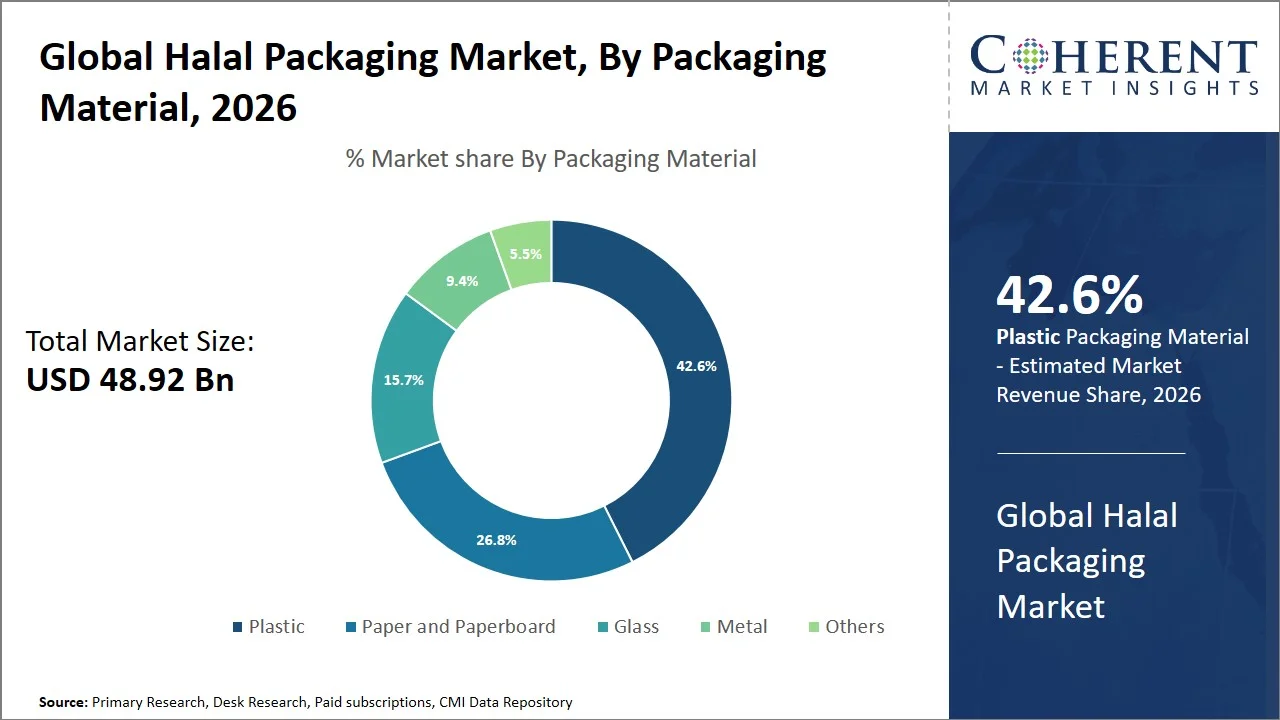
Why Does Plastic Dominate the Packaging Material Category in the Global Halal Packaging Market?
Plastic packaging maintains its prominent place with an expected market share of 42.6% in the global halal packaging market as its ability to be easily adapted to a wide range of applications including food, beverage, pharmaceuticals, and personal care, which are all demanding durability, light weight, and contamination control. Plastic formats, including pouches, containers, films and closures, are preferred by manufacturers as they allow for an efficient mass production and transportation cost reduction as well as extended product protection. Converters are also making efforts to develop halal-compliant polymers, additives, inks and barrier layers for certified supply chains which are also helping to support demand. Food processors and consumer brands are able to leverage flexible design options and scalable packaging solutions. In February 2025, JAKIM (Department of Islamic Development Malaysia) issued updated guidance emphasizing documentation requirements for packaging materials, including plastics, reinforcing supplier compliance expectations.
- Current Industry Events of 2026
- Market Size Estimation
- Regional Breakdown
- Competitive Landscape
- Customer Intelligence
- Segmental Analysis
- Pricing Analysis
- Key Market Drivers, Challenges & Future Trends
- Customized Insights Section
Why Does Flexible Packaging Represent the Largest Packaging Type Category in the Global Halal Packaging Market?
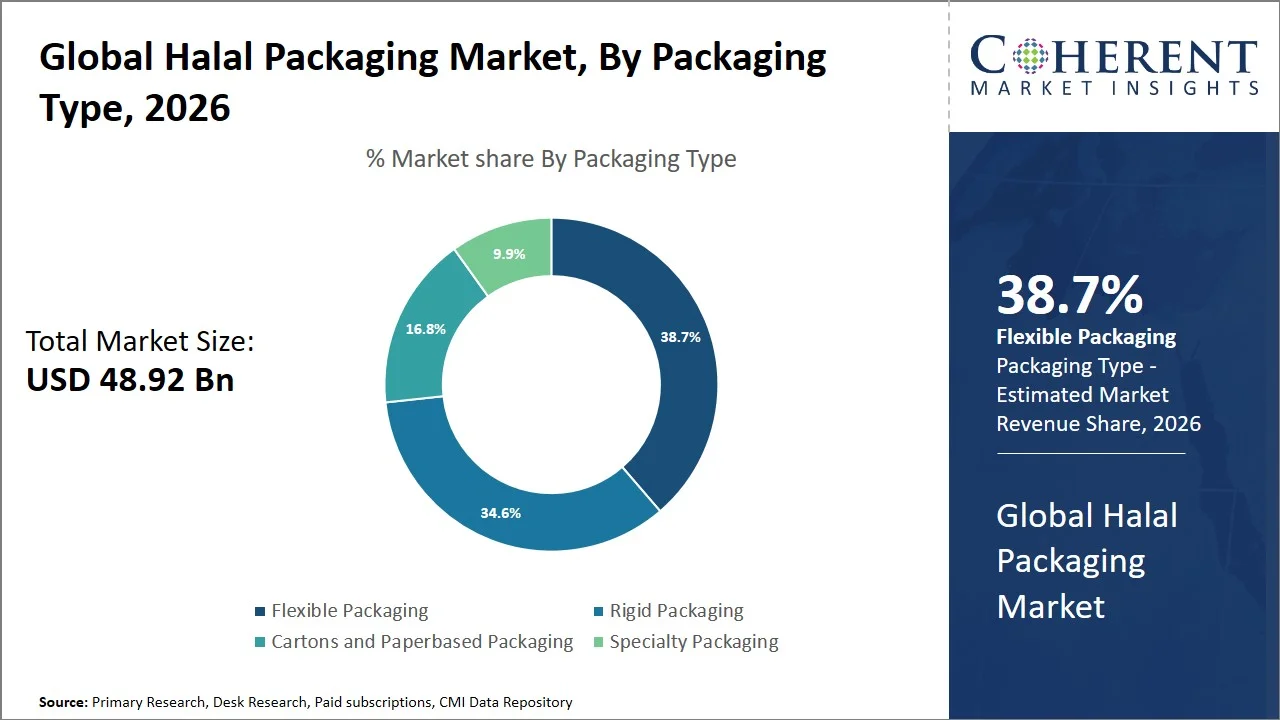
Flexible Packaging leads the packaging type segment with an expected share of 38.7% in the global halal packaging market because it provides strong compatibility with halal food exports, convenience products, and processed food categories requiring efficient storage and distribution. Films, pouches, sachets, and laminated structures allow the manufacturer to provide product protection without using too much material and increase transportation efficiency. With the requirements of certification for some international markets, packaging converters are now paying attention to the use of halal-compliant adhesives, coatings, and printing technologies. This format is especially significant for applications such as snacks, ready to use products, sauces, drinks, and pharmaceuticals, where shelf life is an important requirement. In March 2025, Constantia Flexibles highlighted its expanded sustainable flexible packaging solutions portfolio, supporting brands seeking advanced packaging formats with improved compliance and environmental performance.
Why Do Food and Beverages Dominate the Application Category of the Global Halal Packaging Market?
Food and Beverages account for the largest application, at 56.8% share in 2026, due to the extensive use of halal-certified packaging across processed foods, beverages, dairy products, meat products, and convenience foods. The food manufacturers need packaging systems which can maintain product integrity and make sure the materials used, processing aids and handling procedure comply with the halal standards. The segment is supported by growing global demand for halal products, the availability of retail outlets and the heightened product assurance standards by consumers and regulators. Packaging suppliers for this segment are oriented towards traceability, hygienic production environment and supporting certification for improving customer relationship. In October 2024, Product registration Indonesia began enforcing mandatory halal labeling compliance for food products, increasing pressure on manufacturers and packaging suppliers to ensure complete halal supply-chain alignment.
Current Events and their Impact
Current Event | Description and Its Impact |
September 2025 – MUIS Singapore introduces enhanced halal recognition framework and digital halal certificates |
|
November 2025 – Indonesia proposes halal requirements for storage, packaging, and distribution services |
|
October 2024 – Indonesia begins enforcement of mandatory halal labeling requirements |
|
Global Halal Packaging Market Dynamics
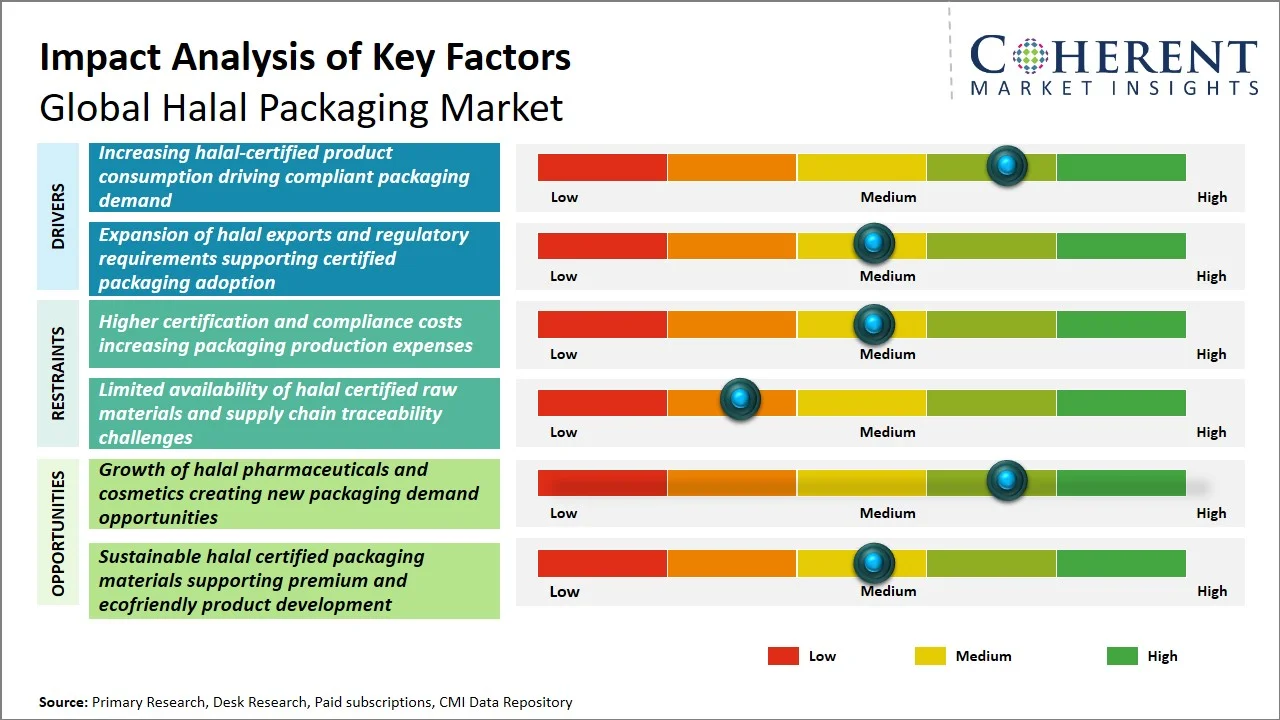
Key Market Drivers
- Increasing halal-certified product consumption driving compliant packaging demand: Demand for packaging that remains compliant during manufacture, storage and distribution, is increasing as more people consume certified products, ranging from food through to pharmaceuticals and personal care. Packaging manufacturers can have confidence in the materials they use, the compliant inks and adhesives, and the processes they have that are certified, and brands can have a higher level of consumer confidence. The change has motivated suppliers to make compliance with the standards for halal meat a full packaging-system requirement, as opposed to a product attribute. In July 2025, LPH LPPOM and the Indonesian Packaging Federation conducted an industry seminar highlighting the importance of halal certification for packaging components beyond raw materials.
- Expansion of halal exports and regulatory requirements supporting certified packaging adoption: The rise in international trade in halal products is driving up the demand for compliance from packaging suppliers for export-oriented manufacturers. Companies that provide packaging for food, pharmaceutical, and cosmetic products must prove that they can be traced, the products are suitable for use, and the packaging is segregated during the production process, to be able to access regulated halal markets. The trend's positive effect on certified packaging converters and testing organizations is the fact that it generates demand for documentation, audits, and special manufacturing methods. In October 2024, according to the International Trade Administration, Indonesia began enforcing halal labeling compliance inspections under its mandatory halal certification framework, increasing pressure on domestic and international suppliers to align packaging and product certification processes.
Emerging Market Trends
- Integration of traceability systems into halal packaging value chains: It is beginning to shift from a certification-based product category to a transparency-based value chain solution. Traceability, supplier documentation, production controls and verification capabilities are being looked at more and more by manufacturers when assessing packaging materials. Such digital identification technologies, QR code authentication, or data-driven tracking systems are likely to become more significant as brands look to build trust and streamline compliance for their customers. Those packaging suppliers who have the expertise of the package materials along with verification capabilities may find that this can give them a better position, whilst traditional suppliers with less documentation may see increased challenges when working with multinational halal product manufacturers.
- Shift toward sustainable halal packaging materials with compliance compatibility: Halal packaging is being developed to meet both religious requirements and sustainability considerations. The packaging of the future will focus on using recycled, renewable and responsibly sourced materials, while at the same time processing aids, coatings, adhesives and additives will be suitable for halal standards. This transfer will allow the material innovators and converters the opportunity to develop solutions that will be environmentally responsible and meet certification standards. As more and more global brands increasingly put sustainability as a priority for their ethical sourcing and responsible packaging, companies that do not have sustainability at the heart of their business risk to be affected.
Regional Insights
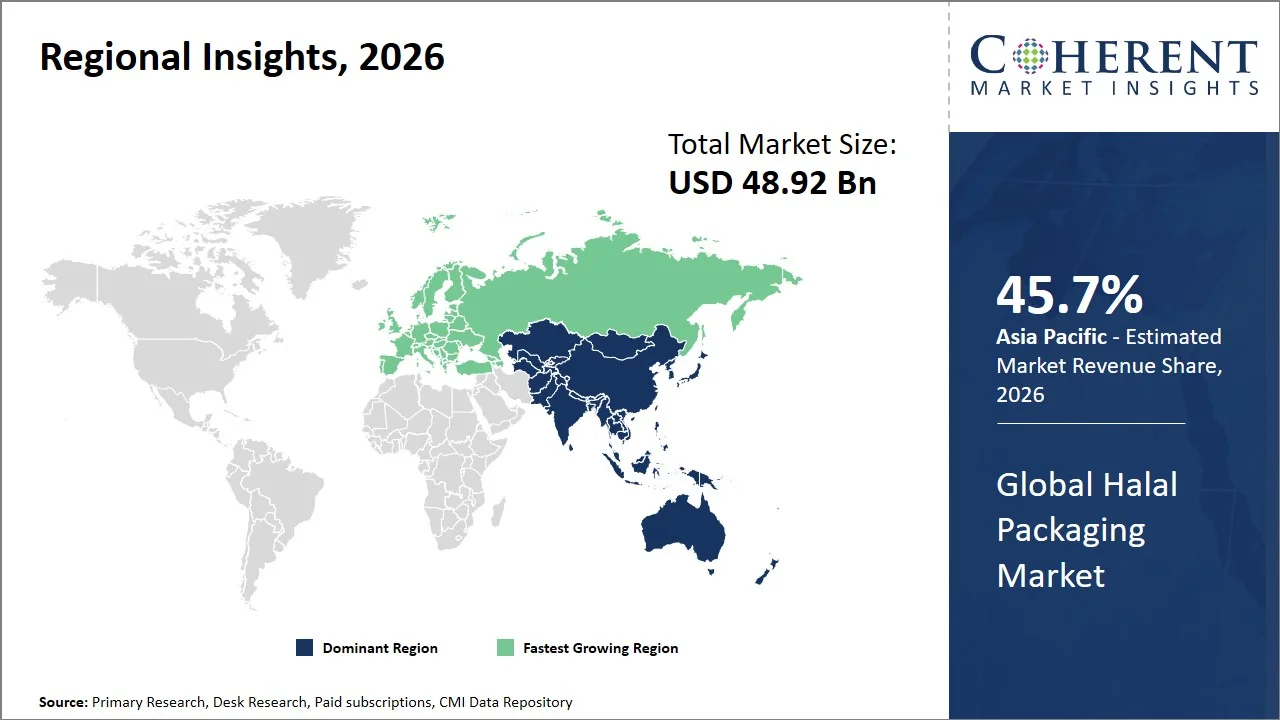
Why Does Asia Pacific Dominate the Global Halal Packaging Market?
Asia Pacific leads the global halal packaging market with an expected market share of 45.7% in 2026 due to its large halal consumer base, strong food processing ecosystem, expanding halal exports, and established certification infrastructure. Countries such as Indonesia, Malaysia, and India are strengthening halal compliance frameworks across food, beverages, pharmaceuticals, and consumer goods, creating demand for certified packaging materials, production controls, and traceable supply chains. The region also benefits from extensive packaging manufacturing capacity, cost-efficient production networks, and increasing adoption of flexible and sustainable packaging formats. Export-oriented manufacturers require packaging solutions that support compliance with international halal standards while maintaining product quality during transportation. In November 2024, according to the Halal Product Assurance Organizing Agency, Indonesia’s BPJPH expanded mandatory halal certification implementation requirements for food products, increasing compliance focus among manufacturers and packaging suppliers.
Why Is Europe Emerging as the Fastest-Growing Region in the Global Halal Packaging Market?
Europe is emerging as the fastest-growing region with an expected share of 18.6% in the global halal packaging market as manufacturers increasingly respond to halal product demand, sustainability expectations, and stricter transparency requirements across food and consumer goods sectors. The region’s advanced packaging industry provides strong capabilities in recyclable materials, barrier technologies, and customized packaging formats suitable for halal-certified applications. Growing Muslim populations, expanding halal food imports, and increasing availability of certified products are encouraging retailers and brands to strengthen packaging compliance. European packaging suppliers are also integrating sustainability and traceability features to meet evolving customer requirements. In June 2025, the European Committee for Standardization (CEN) continued discussions around halal-related standardization initiatives, supporting greater alignment of quality and certification practices across European markets.
Global Halal Packaging Market Outlook for Key Countries
Why Is Indonesia a Key Market for the Global Halal Packaging Market?
Indonesia represents a strategic market for halal packaging due to its position as one of the world’s largest Muslim consumer markets and its rapidly expanding halal-certified food and beverage ecosystem. The country’s mandatory halal certification roadmap is increasing requirements for manufacturers to ensure packaging materials, processing environments, and supply-chain activities align with halal principles. Domestic food producers, exporters, and packaging converters are investing in certification readiness to maintain market access and consumer trust. Indonesia’s growing processed food industry, retail expansion, and government-backed halal ecosystem development create strong opportunities for certified packaging suppliers. In October 2024, Indonesia began enforcing mandatory halal certification requirements for relevant products, accelerating compliance adoption among businesses involved in food and packaging value chains.
Why Is Malaysia Important in the Global Halal Packaging Market?
Malaysia plays an important role in the global halal packaging market through its mature halal certification ecosystem, export-oriented food industry, and internationally recognized halal standards. The country has developed strong capabilities in halal assurance systems, enabling packaging manufacturers to support food, pharmaceutical, and personal care brands requiring certified supply chains. Malaysia’s strategic position as a halal hub in Southeast Asia encourages investment in compliant packaging production, testing services, and certification support. Local manufacturers benefit from government initiatives promoting halal industry development and international market expansion. In February 2025, Malaysia’s Department of Islamic Development Malaysia (JAKIM) continued strengthening halal certification governance through updated industry guidance, reinforcing compliance expectations for companies operating across halal product categories.
Why Does Saudi Arabia Support Growth in the Global Halal Packaging Market?
Saudi Arabia supports halal packaging market growth through its large consumer market, religious significance, and increasing focus on food quality assurance and imported product compliance. The country relies heavily on packaged food imports and requires manufacturers supplying halal products to meet strict conformity expectations. This creates opportunities for packaging suppliers offering certified materials, traceability systems, and reliable supply-chain solutions. The expansion of retail, food processing, pharmaceuticals, and premium consumer products further increases demand for packaging formats that support safety, authenticity, and brand trust. Saudi Arabia’s Vision 2030 initiatives are also encouraging localization of food and manufacturing capabilities, supporting domestic packaging opportunities. In January 2025, the Saudi Food and Drug Authority continued enhancing food safety oversight requirements, strengthening compliance expectations across packaged food supply chains.
Why Is UAE a Strategic Country in the Global Halal Packaging Market?
The UAE holds strategic importance in the global halal packaging market due to its role as a regional trade hub connecting Middle Eastern, Asian, and African halal product markets. The country’s advanced logistics infrastructure, strong food import activity, and expanding premium food and beverage sector create demand for reliable halal-compliant packaging solutions. Manufacturers and distributors increasingly require packaging partners capable of supporting international certification requirements, product protection, and efficient cross-border movement. The UAE’s focus on becoming a global halal economy center further strengthens opportunities for certified packaging suppliers and service providers. In November 2024, the UAE Ministry of Industry and Advanced Technology highlighted continued development of national quality and conformity systems, supporting stronger product assurance frameworks.
Why Is India an Important Growth Market for the Global Halal Packaging Market?
India contributes to halal packaging market development through its expanding processed food industry, large consumer base, export-oriented halal food production, and growing demand for compliant packaging solutions. The country’s manufacturers supplying Middle Eastern and Southeast Asian markets require packaging systems that support product authenticity, hygiene standards, and export documentation. Growth in packaged foods, beverages, pharmaceuticals, and personal care products is encouraging packaging suppliers to develop solutions aligned with halal requirements. India’s established packaging manufacturing base and competitive production capabilities provide opportunities for domestic and international suppliers. In July 2025, the Agricultural and Processed Food Products Export Development Authority (APEDA) continued promoting food export compliance initiatives, supporting exporters seeking access to regulated international markets.
Technology Adoption Landscape in the Global Halal Packaging Market
Technology | Adoption Level | Key Application Area | Business Impact |
Halal-compliant material screening systems | High | Verification of packaging materials, inks, adhesives, and coatings | Improves compliance assurance by reducing contamination risks and supporting certification approval. |
Digital halal certification platforms | Medium | Certification tracking, supplier documentation, and compliance management | Enables faster audits, improves transparency, and simplifies cross-border halal verification processes. |
QR-based packaging authentication systems | Medium | Consumer verification and product traceability | Enhances consumer confidence by allowing buyers to validate halal status and product information. |
Sustainable recyclable packaging technologies | Medium | Food, beverage, and personal care packaging applications | Supports brands seeking environmentally responsible packaging while maintaining halal compliance requirements. |
Advanced barrier coating technologies | Medium | Flexible packaging and food preservation applications | Improves shelf life, product protection, and packaging performance for halal-certified products. |
Automated quality inspection systems | Low | Packaging production monitoring and defect detection | Helps manufacturers maintain consistent quality standards and reduce compliance-related production errors. |
How Are Traceability and Sustainable Packaging Solutions Creating New Growth Opportunities in the Global Halal Packaging Market?
The integration of traceability solutions with sustainable packaging development represents a high-potential opportunity for halal packaging manufacturers. Brands are increasingly seeking packaging partners that can provide documented material origins, compliance verification, and environmentally responsible solutions within a single offering. This opportunity extends across food, beverages, pharmaceuticals, cosmetics, and nutraceutical categories were trust and transparency influence purchasing decisions. Packaging converters can capture this opportunity by investing in certified material sourcing, digital tracking capabilities, recyclable structures, and specialized compliance expertise. Established packaging companies may benefit from existing manufacturing scale, while specialist suppliers can differentiate through halal-focused technical capabilities. Companies entering this space will need strong supplier networks, certification knowledge, and regional compliance capabilities to serve diverse halal markets effectively.
Market Players, Key Development, and Competitive Landscape
Key Developments
- In September 2025, SIG continued strengthening its halal-certified aseptic carton capabilities to support customers requiring compliant packaging solutions for dairy and beverage applications. This development highlights the increasing role of packaging suppliers in helping brands address halal certification requirements across international markets.
- In September 2025, MUIS Singapore introduced digital halal certificates and an enhanced recognition framework for foreign halal certification bodies. This development supports stronger verification systems and increases expectations for packaging suppliers to maintain transparent compliance records across halal supply chains.
- In July 2025, LPH LPPOM and Indonesian Packaging Federation organized an industry seminar focused on halal packaging implementation, emphasizing that halal compliance extends beyond product ingredients to packaging components and production processes. This initiative improves awareness among packaging manufacturers regarding certification requirements and halal packaging market access opportunities.
Competitive Landscape
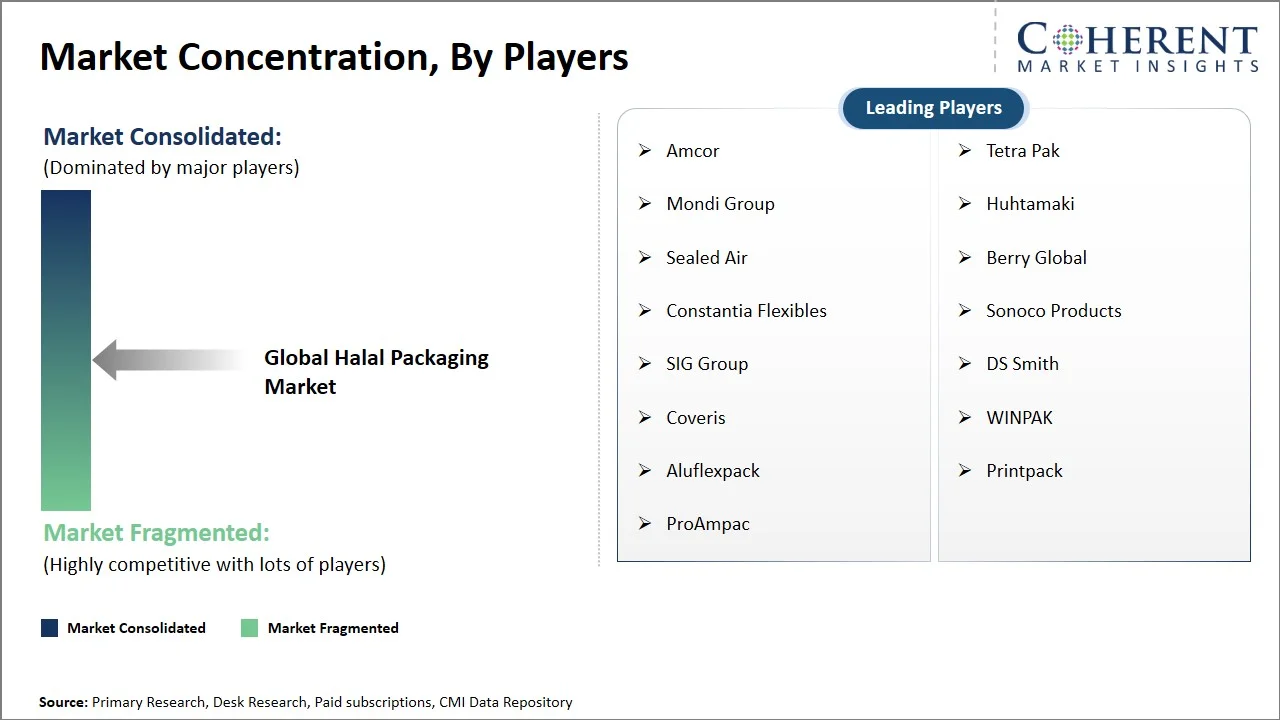
The global halal packaging market is moderately fragmented, with competition involving multinational packaging manufacturers, regional converters, certification-focused suppliers, and specialty packaging providers. Companies compete through halal certification capabilities, material innovation, production reliability, customization, sustainability positioning, and regional market access. While large packaging companies leverage manufacturing scale and global distribution networks, specialized suppliers compete through compliance expertise and customer-specific solutions. Key focus areas include:
- Halal certification capabilities and compliance documentation
- Material traceability and supplier qualification systems
- Sustainable packaging material development
- Flexible and barrier packaging innovation
- Regional manufacturing presence in halal-focused markets
- Customization capabilities for food, pharmaceutical, and cosmetic applications
- Distribution partnerships and local customer support
- Quality assurance and contamination-control processes
Market Report Scope
Halal Packaging Market Report Coverage
| Report Coverage | Details | ||
|---|---|---|---|
| Base Year: | 2025 | Market Size in 2026: | USD 48.92 Bn |
| Historical Data for: | 2020 To 2024 | Forecast Period: | 2026 To 2033 |
| Forecast Period 2026 to 2033 CAGR: | 7.1% | 2033 Value Projection: | USD 79.07 Bn |
| Geographies covered: |
| ||
| Segments covered: |
| ||
| Companies covered: | Amcor, Tetra Pak, Mondi Group, Huhtamaki, Sealed Air, Berry Global, Constantia Flexibles, Sonoco Products, SIG Group, DS Smith, Coveris, WINPAK, Aluflexpack, Printpack, ProAmpac | ||
| Growth Drivers: |
| ||
| Restraints & Challenges: |
| ||
Analyst Opinion (Expert Opinion)
- The global halal packaging market is likely to move from a certification-led purchasing model toward a solution-oriented ecosystem where suppliers provide integrated compliance, traceability, and sustainability capabilities. Future competitive advantage will depend less on packaging format availability and more on the ability to support customers through complex halal supply-chain requirements.
- A major transformation will emerge from the combination of digital verification and packaging transparency. Companies that integrate authentication technologies, supplier data management, and compliance monitoring may redefine customer expectations, while traditional packaging suppliers with limited traceability capabilities could face increasing pressure.
- Market participants should prioritize halal certification expertise, sustainable material innovation, and regional compliance capabilities. Companies should avoid treating halal packaging as only a material specification and instead develop broader service capabilities covering documentation, technical support, and customer-specific regulatory requirements.
Speak to the analyst
Want personalized insights?
Take the findings above to one of our principal consultants, or have the report rebuilt around the segments, geographies and competitors you actually track.
Market Segmentation
- Packaging Material Insights (Revenue, USD Bn, 2021 - 2033)
- Plastic
- Paper and Paperboard
- Glass
- Metal
- Others
- Packaging Type Insights (Revenue, USD Bn, 2021 - 2033)
- Flexible Packaging
- Rigid Packaging
- Cartons and Paper-based Packaging
- Specialty Packaging
- Application Insights (Revenue, USD Bn, 2021 - 2033)
- Food and Beverages
- Pharmaceuticals
- Cosmetics and Personal Care
- Nutraceuticals
- Others
- Certification Type Insights (Revenue, USD Bn, 2021 - 2033)
- Halal Certified Packaging
- Halal Compliant Packaging
- Distribution Channel Insights (Revenue, USD Bn, 2021 - 2033)
- Direct Sales
- Indirect Sales
- Regional Insights (Revenue, USD Bn, 2021 - 2033)
- North America
- U.S.
- Canada
- Latin America
- Brazil
- Argentina
- Mexico
- Rest of Latin America
- Europe
- Germany
- U.K.
- Spain
- France
- Italy
- Russia
- Rest of Europe
- Asia Pacific
- China
- India
- Japan
- Australia
- South Korea
- ASEAN
- Rest of Asia Pacific
- Middle East
- GCC Countries
- Israel
- Rest of Middle East
- Africa
- South Africa
- North Africa
- Central Africa
- North America
- Key Players Insights
- Amcor
- Tetra Pak
- Mondi Group
- Huhtamaki
- Sealed Air
- Berry Global
- Constantia Flexibles
- Sonoco Products
- SIG Group
- DS Smith
- Coveris
- WINPAK
- Aluflexpack
- Printpack
- ProAmpac
Sources
Primary Research Interviews
- Halal packaging manufacturers, packaging converters, food & beverage companies, pharmaceutical companies, cosmetic brands, and certification service providers
- Halal certification bodies, packaging material suppliers, adhesive and coating manufacturers, procurement managers, packaging specialists, and industry consultants
Stakeholders
- Packaging manufacturers, flexible packaging producers, paperboard suppliers, plastic packaging companies, glass and metal packaging providers
- Halal certification organizations, food processors, pharmaceutical manufacturers, retailers, distributors, and supply-chain solution providers
End-use Sectors
- Food and beverages
- Pharmaceuticals and healthcare products
- Cosmetics and personal care products
- Nutraceuticals and dietary supplements
- Specialty halal-certified consumer products
Regulatory and Government Bodies
- Halal certification authorities and Islamic regulatory organizations
- Government halal assurance agencies (BPJPH Indonesia, JAKIM Malaysia, MUIS Singapore)
- Food safety and packaging regulatory authorities
- International trade and standards organizations
Databases
- UN Comtrade and ITC Trade Map – Packaging material and packaging product trade analysis
- Government halal certification databases and regulatory publications
- FAOSTAT, Eurostat, national trade databases, and customs records
- Company annual reports, product catalogues, technical documents, and shipment intelligence
Magazines and Journals
- Packaging World
- Packaging Europe
- Journal of Islamic Marketing
- Food Packaging and Shelf Life
- International Journal of Halal Research
Associations
- International Halal Accreditation Forum (IHAF)
- World Halal Council
- Halal Food Standards Alliance of America (HFSAA)
- Malaysian Halal Development Corporation (HDC)
- Packaging industry associations and halal certification organizations
Public Domain Sources
- Halal certification frameworks, packaging compliance guidelines, and material standards
- Sustainable packaging developments, recycling initiatives, and packaging technology advancements
- Regulatory announcements, technical papers, patents, and industry publications
- Import-export data for halal food, packaging materials, and related products
Key Standards and Regulations
- Halal assurance system requirements and certification guidelines
- JAKIM Malaysia halal certification standards
- BPJPH Indonesia halal product assurance regulations
- MUIS Singapore halal certification requirements
- ISO quality management, food safety, packaging safety, and traceability standards
Proprietary Elements
- CMI Data Analytics Tool, Proprietary CMI Existing Repository of information for the last 10 years
Get access to 250+ pages report
Every segment, forecast, competitor profile and data table behind the analysis above — available for instant download.
- ESOMAR Member
- ISO 9001:2015 Certified
- D-U-N-S Registered
- GDPR & CCPA Compliant
Missing comfort of reading report in your local language? Find your preferred language:
Transform your Strategy with Exclusive Trending Reports
Frequently Asked Questions
The global halal packaging market is estimated to be valued at USD 48.92 billion in 2026 and is expected to reach USD 79.07 billion by 2033
The CAGR of global halal packaging market is projected to be 7.1% from 2026 to 2033.
The global halal packaging market report covers detailed segmentation analysis by packaging material, packaging type, application, certification type, distribution channel, and region. The report evaluates segment performance, market positioning, demand trends, and growth opportunities across major categories.
The competitive landscape section provides insights into major market participants, company positioning, product offerings, certification capabilities, manufacturing strategies, sustainability initiatives, distribution networks, and competitive factors influencing the halal packaging industry.
The major applications analyzed in the global halal packaging market include food and beverages, pharmaceuticals, cosmetics and personal care, nutraceuticals, and other specialty applications. The report evaluates how halal compliance requirements influence packaging selection across these industries.
Increasing halal-certified product consumption driving compliant packaging demand and expansion of halal exports and regulatory requirements supporting certified packaging adoption are the major factors driving the growth of global halal packaging market.
Higher certification and compliance costs increasing packaging production expenses and limited availability of halal certified raw materials and supply chain traceability challenges are the major factors hampering the growth of global halal packaging market.