

Aerosol Cans Market Size and Forecast — 2026 - 2033
The Global Aerosol Cans Market size is estimated to be valued at USD 23.7 billion in 2026 and is expected to reach USD 37.2 billion by 2033, exhibiting a compound annual growth rate (CAGR) of 6.5% from 2026 to 2033.
Overview
The growth of the aerosol cans market is driven by rising demand for convenient and portable packaging solutions across personal care, household, healthcare, automotive, and food products. Increasing consumption of deodorants, hair sprays, air fresheners, and spray paints is significantly boosting market demand. Growing urbanization, changing consumer lifestyles, and higher spending on grooming and hygiene products further support industry expansion. Technological advancements in lightweight and recyclable aluminum and steel aerosol cans are encouraging sustainable packaging adoption. In addition, the expansion of e-commerce and retail distribution channels, along with increasing demand for controlled dispensing and longer product shelf life, continues to drive growth in the global aerosol cans market.
Key Takeaways
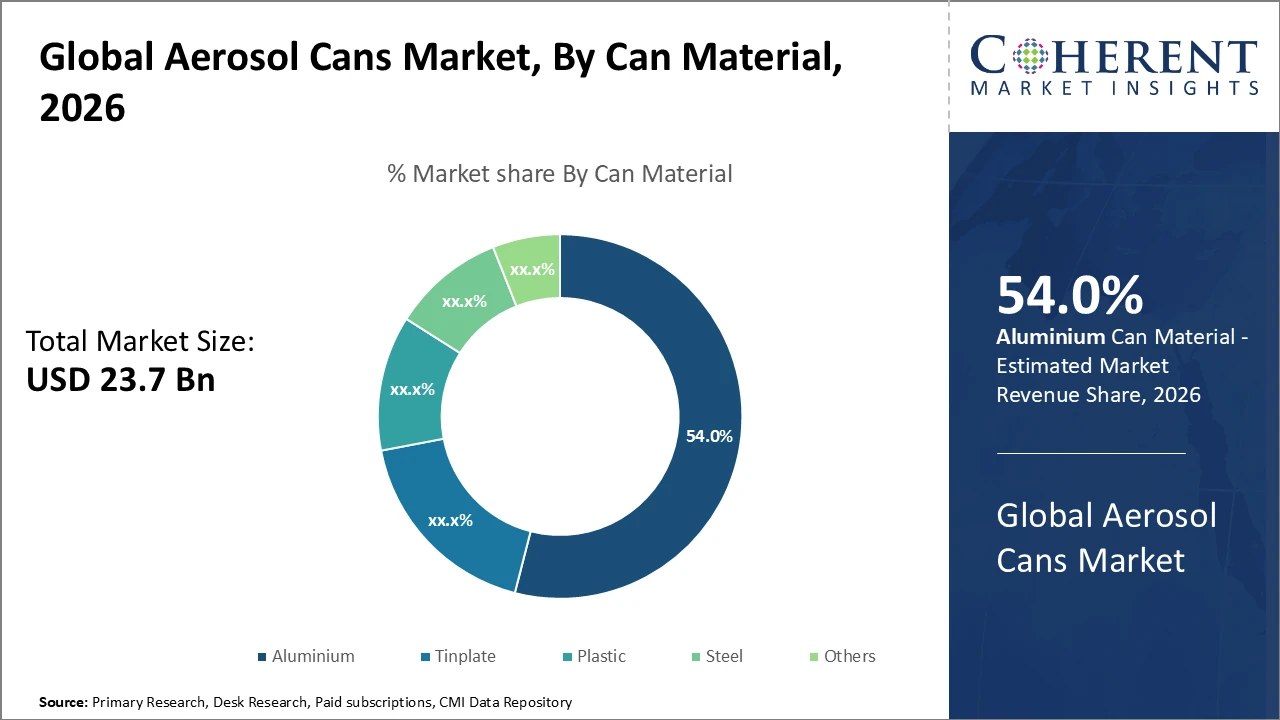
The aluminum subsegment under the can material category dominates with a 54% market share, driven by sustainability and recyclability advantages.
Personal care is the leading application segment, contributing approximately 38% of market revenue, fueled by rising consumer spending on cosmetics and grooming products.
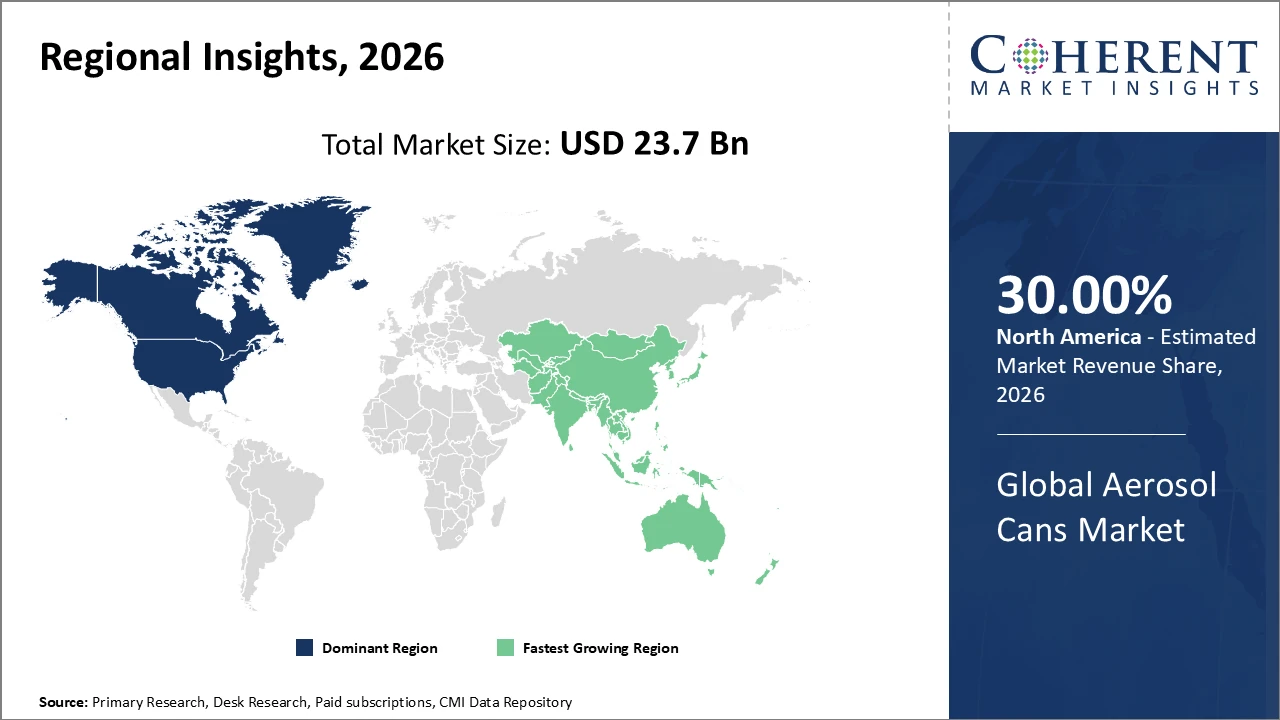
North America holds the largest regional market share, supported by established manufacturing capacities and strict environmental regulations that encourage eco-friendly packaging adoption.
Asia Pacific is the fastest-growing region, with a projected CAGR above 7%, driven by urban population growth, increasing disposable incomes, and government initiatives promoting circular economy models and recycling infrastructure.
Aerosol Cans Market Segmentation Analysis
Aerosol Cans Market Insights, By Can Material
Aluminum dominates the aerosol cans market with a 54% share, prized for its lightweight, corrosion-resistant, and recyclable properties, making it a preferred choice across personal care, food, and industrial applications. Regulatory incentives for sustainable packaging further support its widespread adoption. The fastest-growing subsegment is Plastic, driven by innovations enhancing flexibility and compatibility, especially in niche cosmetic products. Tinplate maintains relevance due to cost-efficiency and durability in food and industrial aerosols. Steel retains steady demand in automotive applications requiring robustness, while specialty alloys and hybrid materials address bespoke industrial needs, contributing to product diversification and market expansion.
Aerosol Cans Market Insights, By Application
Personal care leads the aerosol cans market with a 38% share, driven by growing consumer preference for convenience, portability, and enhanced product performance in cosmetics and grooming. The fastest-growing segment is household care, fueled by eco-conscious consumers embracing aerosol cleaning products with environmentally friendly propellants. Automotive aerosols sustain steady demand, supported by widespread use in lubricants, paints, and coatings. Food and beverage applications are gradually expanding, particularly in sprayable preservation and packaging solutions. Industrial aerosols remain niche, catering to specialized maintenance, protective, and lubrication needs. Together, these segments reflect diversified applications and evolving consumer and industrial demands.
Aerosol Cans Market Insights, By End User
The cosmetics segment dominates the aerosol cans market, driven by widespread use of deodorants, hair sprays, and grooming products that leverage aerosols for convenience and improved user experience. This segment also leads in implementing innovative can materials and advanced valve mechanisms to preserve product quality. The pharmaceutical segment is the fastest growing, fueled by rising adoption of metered-dose inhalers and topical aerosol applications, emphasizing patient-friendly packaging. The food industry utilizes convenience aerosols like cooking sprays, while the automotive sector relies on aerosols for lubricants, cleaners, and coatings. Industrial applications grow steadily, focusing on specialized maintenance and protective formulations.
Aerosol Cans Market Trends
Aluminum aerosol cans are experiencing strong growth, driven by environmental regulations and increasing consumer preference for sustainable packaging.
Digital printing adoption is rising, enabling personalized and visually appealing packaging; in 2026, it contributed to a 15% increase in global product customization orders.
Smart valve technologies are being integrated to enhance usability, control, and product delivery, particularly in personal care aerosols.
These trends reflect the market’s adaptation to sophisticated consumer demands, emphasizing convenience, sustainability, and customization.
Overall, technological innovation and eco-friendly practices are key drivers shaping the aerosol cans market.
Aerosol Cans Market Insights, By Geography
North America Aerosol Cans Market Analysis and Trends
In North America, the aerosol cans market is dominated by well-established industrial infrastructure, advanced manufacturing capabilities, and strong recycling systems, particularly favoring aluminum cans due to environmental regulations. The region accounted for over 30% of global market share in 2025, bolstered by strict sustainability mandates and growing consumer demand for eco-friendly packaging. Leading companies, such as Ball Corporation and Crown Holdings, have capitalized on this environment by incorporating high percentages of recycled materials and investing in innovation-driven solutions like digital printing and smart valves. These efforts reinforce market leadership while addressing regulatory compliance and sustainability goals, sustaining steady growth.
Asia Pacific Aerosol Cans Market Analysis and Trends
The Asia Pacific region demonstrates the fastest growth in the aerosol cans market, with a CAGR exceeding 7%, driven by rapid urbanization, rising disposable incomes, and expanding demand across end-use segments such as personal care and household products. Government policies promoting circular economy practices and recycling infrastructure have further strengthened market adoption. Key countries, including China and India, have attracted significant investments from multinational manufacturers seeking to capitalize on growing consumer demand. Additionally, the presence of agile local companies and strategic partnerships has accelerated product availability and innovation, positioning the region as a pivotal growth hub for aerosol cans.
Aerosol Cans Market Outlook for Key Countries
USA Aerosol Cans Market Analysis and Trends
The USA leads the North American aerosol cans market, driven by strong demand across personal care, industrial, and automotive applications. In 2025, the country contributed roughly 60% of the region’s market revenue, supported by established consumer preferences and stringent environmental regulations emphasizing recyclable packaging. Key players, including Crown Holdings and Ball Corporation, expanded domestic production capacities, with Crown Holdings increasing output by 10% in 2026 to meet rising aluminum aerosol can demand. Furthermore, government incentives promoting sustainable packaging and innovation have encouraged product diversification, reinforcing the U.S.’s competitive edge and positioning it as a pivotal market within the global aerosol cans industry.
Germany Aerosol Cans Market Analysis and Trends
Germany’s aerosol cans market is characterized by strong industrial and consumer adoption, supported by stringent environmental regulations and advanced recycling infrastructure. The personal care segment dominates, driven by high consumption of deodorants, hair sprays, and grooming products packaged in aluminum cans. The pharmaceutical and household care segments are emerging rapidly due to innovations in metered-dose inhalers and eco-friendly cleaning aerosols. Market growth is also propelled by technological advancements, including digital printing for product customization and smart valve systems for improved usability. Government initiatives promoting sustainability and circular economy practices further reinforce demand, positioning Germany as a key player in the European aerosol cans market.
Analyst Opinion
The surge in demand for eco-friendly and lightweight packaging has driven significant market growth. In 2025, over 45% of revenue came from aluminum aerosol cans due to their recyclability and corrosion resistance. This trend is expected to strengthen as global sustainability regulations tighten, encouraging production shifts from tinplate to aluminum.
Demand-side growth is evident in personal care applications, which accounted for approximately 38% of total market revenue in 2026. Rising consumer preference for convenience and effectiveness has led companies like Procter & Gamble to expand aerosol product lines, boosting revenue streams.
Micro-indicators highlight stable pricing overall, though aluminum price spikes in 2024 caused a 5% increase in manufacturing costs, slightly moderating market growth. Strategic sourcing and bulk procurement have become key to maintaining competitive pricing.
Nano-level trends include technological innovations such as smart nozzles and improved valve systems, demonstrated by leading firms in 2024, resulting in a 12% increase in dispensing efficiency and reshaping market share dynamics.
- Current Industry Events of 2026
- Market Size Estimation
- Regional Breakdown
- Competitive Landscape
- Customer Intelligence
- Segmental Analysis
- Pricing Analysis
- Key Market Drivers, Challenges & Future Trends
- Customized Insights Section
Market Scope
| Report Coverage | Details | ||
|---|---|---|---|
| Base Year: | 2025 | Market Size in 2026: | USD 23.7 billion |
| Historical Data for: | 2020 To 2024 | Forecast Period: | 2026 To 2033 |
| Forecast Period 2026 to 2033 CAGR: | 6.5% | 2033 Value Projection: | USD 37.2 billion |
| Geographies covered: |
| ||
| Segments covered: |
| ||
| Companies covered: | Ball Corporation, SRI Pack, Rexam Plc, CCL Industries, Sonoco, Can-Pack S.A., Alcoa Corporation, Mukesh Containers Pvt Ltd., Crown Holdings Inc., Silgan Holdings Inc. | ||
| Growth Drivers: |
| ||
Aerosol Cans Market Growth Factors
The aerosol cans market is driven by rising consumer preference for convenient and eco-friendly packaging, with aluminum cans leading due to their recyclability and sustainability. Rapid growth in end-use sectors, including personal care, household cleaning, and food products, has further bolstered market expansion. Regulatory initiatives targeting plastic waste reduction have accelerated the shift toward metal aerosol cans. Advancements in production technologies have improved efficiency, reduced costs, and expanded product availability. For instance, in 2024, Asia Pacific experienced surging demand for aerosol packaging fueled by urbanization and a growing middle-class population, reinforcing the region’s contribution to global market growth.
Aerosol Cans Market Development
In November 2025, Alcoa Corporation partnered with Ball Corporation and Unilever PLC to introduce aluminum produced using Elysis carbon-free smelting technology for consumer personal and home care packaging applications.
Key Players
Leading Companies of the Market
Ball Corporation
SRI Pack
Crown Holdings Inc.
Rexam Plc
CCL Industries
Sonoco
Can-Pack S.A.
Alcoa Corporation
Mukesh Containers Pvt. Ltd.
Silgan Holdings Inc.
Leading companies in the aerosol cans market have pursued aggressive growth strategies, including capacity expansions and strategic mergers, to strengthen their market positions. For example, Ball Corporation’s 2025 investment in sustainable packaging technology reduced carbon emissions by 18%, enhancing its competitive edge and aligning with global sustainability trends. Similarly, Crown Holdings inaugurated a new manufacturing facility in the Asia Pacific region in 2026, enabling deeper market penetration and capturing growing regional demand, which translated into a 22% revenue increase. These strategic initiatives underscore how leading players leverage innovation and geographic expansion to consolidate market share.
Aerosol Cans Market Future Outlook
The Aerosol Cans market is poised for significant growth over the coming years, driven by rising consumer demand for convenience, precision dispensing, and sustainable packaging solutions. Advancements in eco-friendly propellants, lightweight materials, and refillable systems are expected to reshape product offerings while complying with stringent environmental regulations. Personal care, household cleaning, and industrial sectors will continue to dominate demand, with emerging applications in medical and food-grade aerosols gaining traction. Geographic expansion, particularly in Asia Pacific and Latin America, will be fueled by urbanization, rising disposable incomes, and increased awareness of hygiene and personal care, ensuring robust market growth through 2033.
Aerosol Cans Market Historical Analysis
The Aerosol Cans market has experienced steady growth over the past decade, driven by rising demand across personal care, household, and industrial sectors. Historically, traditional propellants such as chlorofluorocarbons (CFCs) were phased out due to environmental regulations, prompting the adoption of hydrofluoroolefins (HFOs) and compressed gases. Innovations in packaging design, including lightweight aluminum cans and precision nozzles, improved usability and safety. North America and Europe led early market adoption, supported by well-established manufacturing infrastructure and regulatory frameworks. Increasing awareness of hygiene, convenience, and sustainability trends gradually influenced product development, setting the stage for the current focus on eco-friendly and technologically advanced aerosol solutions.
Sources
Primary Research Interviews:
Engineers, R&D managers, and project leaders from companies manufacturing aerosol cans and pressurized packaging systems.
Technical specialists from firms providing aerosol filling, propellant handling, and safety testing services.
Industry experts from companies supplying eco-friendly propellants, lightweight materials, and smart dispensing technologies.
Magazines:
Packaging World – Innovations in aerosol can design, sustainable materials, and industry trends.
Aerosol & Dispensing Today – Market updates, new formulations, and technological developments.
Consumer Goods Technology – Insights on packaging, marketing, and product performance.
Journals:
Journal of Coatings Technology and Research – Studies on coatings, corrosion resistance, and aerosol durability.
Packaging Technology and Science – Research on aerosol materials, design efficiency, and environmental impact.
International Journal of Chemical Engineering – Insights into propellant chemistry, safety standards, and industrial applications.
Newspapers:
The Wall Street Journal – Company strategies, mergers, and investments in aerosol manufacturing.
Financial Times – Market developments, regulatory updates, and global aerosol demand.
Reuters – News on technological advancements and safety compliance.
Bloomberg – Corporate financial performance and global market insights in aerosol cans.
Associations:
European Aerosol Federation (FEA) – Industry standards, safety guidelines, and sustainability initiatives.
Aerosol & Dispensing Forum – Best practices, training, and innovation trends.
U.S. Environmental Protection Agency (EPA) – Regulations, environmental compliance, and propellant safety guidelines.
Get access to 250+ pages report
Every segment, forecast, competitor profile and data table behind the analysis above — available for instant download.
- ESOMAR Member
- ISO 9001:2015 Certified
- D-U-N-S Registered
- GDPR & CCPA Compliant
Missing comfort of reading report in your local language? Find your preferred language:
Transform your Strategy with Exclusive Trending Reports
Frequently Asked Questions
The dominant players include Ball Corporation, Crown Holdings, Silgan Holdings, which collectively lead innovation, production, and global distribution within the market.
The Aerosol Cans market is projected to grow from USD 23.7 billion in 2026 to USD 37.2 billion by 2033, registering a CAGR of 6.5% during this period.
The personal care segment offers the largest growth opportunity, fueled by increasing demand for convenient, hygienic, and visually appealing packaging solutions.
Market trends will be shaped by sustainability initiatives, eco-friendly materials, smart dispensing technologies, and digital printing for personalized packaging.
The landscape is competitive, driven by innovation and consolidation, while challenges include fluctuating raw material costs, regulatory compliance, and environmental sustainability pressures.
Companies pursue capacity expansions, strategic partnerships, mergers and acquisitions, and adoption of advanced technologies to strengthen regional penetration and product differentiation.